Specs are compiled from manufacturer listings and verified buyer reviews and can change over time — please confirm the key details on the product page before buying.
If your living room is already full, the answer is not a bigger box — it is a shallow one you can slide under the couch. A small subwoofer earns its place by moving air from a cabinet that disappears into your room. The picks below range from a 7-inch-tall model that hides under a sofa to a sealed dual-driver unit that punches like a much larger cabinet.
This guide is built by comparing the manufacturers’ published specifications and the patterns across verified customer reviews, so you get each pick’s real strengths and trade-offs instead of marketing spin.
You do not need a giant cabinet to get real low end; you need the right driver size and enough honest amplifier power for the room you actually have. Here is what genuinely separates a compact sub that fills a room from one that just rattles a shelf: smallest subwoofer for home.
Top Picks


How To Choose The Best Smallest Subwoofer for Home
The whole point of going small is to keep the bass without giving up the floor. That single goal decides everything else: how big the driver can be, how much power the cabinet can take, and where the thing will physically live in your room.
Driver size versus cabinet size
A driver is the round speaker cone that actually pushes air, measured across its diameter. A bigger driver moves more air at lower frequencies, but an 8-inch driver can still sit in a cabinet that tucks behind a couch. Do not assume a short cabinet means weak bass — a down-firing 8-inch driver in a slim box can use the floor itself to reinforce output.
Peak watts versus RMS watts
Peak power is a short burst the amplifier can hit for an instant; RMS is the continuous power it holds. A sub rated at 800 watt RMS is doing far more sustained work than one rated at 300 watt peak. When a listing gives you both, trust the continuous figure for real listening.
Sealed or ported cabinet
A sealed cabinet has no air hole, so the cone stops and starts faster — that reads as tight, accurate bass. A ported cabinet uses a tuned opening to boost low output, which suits movie explosions but can smear fast musical notes. Your music-to-movies ratio should decide this.
Connections and placement
RCA inputs are the standard line-level connection from a receiver or powered speaker; LFE is a dedicated single-channel bass input. If your sub has no RCA option you will need speaker-level wiring. Check the footprint against the gap behind your sofa or under your desk before anything else.
Side-by-Side Comparison
| Model | Best For | Driver Size | Power Rating | Frequency Response | Amazon |
|---|---|---|---|---|---|
| Sonos Sub 4★ Best Overall | Sonos soundbar owners | 5 inches (dual) | — | — | Amazon |
| Rockville Rock Shaker 6.5″Best Value | First-time buyers on a budget | 6.5 inches | 200W peak / 100W RMS | — | Amazon |
| Edifier T5sBest for Desks | Desktop and bookshelf systems | 8 inches | 70W RMS | 35 Hz | Amazon |
| Dayton Audio CS800 | Music-first listeners | 8 inches | 150W (Class-D) | 35 Hz | Amazon |
| Klipsch Reference R-8SW | Small living rooms | 8 inches | 150W peak | — | Amazon |
| Audioengine S6 | Desktop and dorm setups | 6 inches | 210W | — | Amazon |
| Earthquake CP-8 Couch Potato | Under-sofa placement | 8 inches | 300W peak / 150W continuous | 20Hz–180Hz | Amazon |
| Kanto SUB8 | Small apartments | 8 inches | 300W peak | 35 Hz – 175 Hz | Amazon |
| Definitive Technology DN8 | Movie nights | 8 inches plus two 8-inch radiators | 500W peak | — | Amazon |
| Bowers & Wilkins ASW608 | Music detail | 8 inches | 200W Class-D | — | Amazon |
| SVS 3000 Micro | Maximum output per inch | 8 inches (dual opposing) | 800W RMS / 2,500+W peak | — | Amazon |
Detailed Reviews
1. Sonos Sub 4 – Wireless Subwoofer – Black
Our pick — 4.5+★ from 550+ verified ratings; the strongest balance of quality and price.
A dual 5-inch force-canceling sub that lies flat under a sofa and still pressurizes a small room.
The Sonos Sub 4 is a two-driver design, and that is the whole trick. Two 5-inch drivers (the round cones that push the air) sit face to face in a force-canceling layout, so they shove against each other instead of against your cabinet. The maker says that arrangement is what all but eliminates distortion, buzz, and rattle — the three sounds that give away a cheap sub in a shared apartment.
That 5-inch figure is genuinely small. Measured against the Klipsch Reference R-8SW’s 8-inch driver, the Sonos runs a full 3 inches narrower on driver diameter. It makes up for that with a sealed, ported enclosure built to reinforce low output rather than just move a lot of air. In real terms, this is bass you feel through the floor without a washing-machine wobble.
The catch is the walled garden. This sub connects over Wi-Fi only, through the Sonos app, and it is built to pair with a Sonos Arc Ultra, Arc, or Beam. If you own a different brand of receiver or soundbar, there is no RCA input waiting for you here. Set against that, the setup is a single power cable and a few taps, and the sculptural finish means you can stand it upright in a corner without hiding it.
Where it earns its keep
- Force-canceling dual 5-inch drivers cut the buzz and rattle that spoil quiet-room listening.
- Stands upright or lies on its side to slide under a sofa.
- Plug-and-play pairing with the Sonos app — one power cable, no wiring puzzle.
- Ported enclosure tuned to squeeze deep bass from a small sealed box.
What to weigh first
- Wi-Fi and the Sonos app are the only routes in — no RCA, no speaker-level wire.
- You need a Sonos soundbar or speaker to make it sing.
- The price lands in premium territory for a 5-inch driver.
Buy it if: you already run a Sonos Arc Ultra, Arc, or Beam and want low end that never announces itself with a rattle.
Think twice if: your system is a receiver with RCA sub-out — this sub has no wired door for you.
2. Rockville Rock Shaker 6.5″ Subwoofer
A 6.5-inch, 200W-peak budget sub that delivers real rumble per dollar in a small room.
For an entry-level sub, the Rock Shaker puts real numbers on the table: 200W peak and 100W RMS from a Class-D amplifier behind a 6.5-inch woofer. RMS is the continuous power figure, so that 100W is the part that actually holds a bass line steady through a whole film. The detachable grill and MDF wood cabinet (a dense board that resists flexing) keep it feeling sturdier than the tier suggests.
What wins people over here is the bass-to-dollar ratio — it is the aspect owners praise most, by a wide margin over any other. The 11 by 11.8 by 12.6 inch cabinet slides into a corner without eating your room. And the adjustable crossover (the dial that sets where bass hands off to your main speakers) and phase controls (the setting that keeps the sub in step with your speakers) let you dial it in against your main speakers instead of letting it boom over them.
There is a trade-off hiding in the volume knob, though. Crank it and the low end carries through walls, which is great in a house and less great in a thin-walled apartment. A few listeners also pick up a faint hum at idle, so give it a clean outlet and a proper ground. For someone building a first home theater on a tight budget, the compromise is easy to live with.
Value read: 200W peak from a 6.5-inch driver in a cabinet this manageable is a lot of output for the tier, and the RCA plus speaker-level inputs mean it slots into almost any receiver.
One caution: the walls will know about it — plan your volume around your neighbours, not just your movie.
Reach for this if: you want the most rumble per dollar and you have a receiver with an RCA sub-out.
Look elsewhere if: you need whisper-quiet idle operation in a shared building.
3. Edifier T5s Powered Subwoofer
A wood-grain 8-inch sub rated to 35Hz that fits beside a desk or bookshelf system.
The number to hold onto is 35Hz — that is how low this sub reaches, and it is the bottom note of a lot of bass lines and film scores. An 8-inch long-throw woofer (a cone built to travel further in and out) does the work, fed by a 70W RMS Class-D amplifier. RMS means sustained, so this is a sub that holds a low note rather than just flicking at it.
Because it is a powered sub — amplifier built in — you do not need a separate receiver. If your speakers have a sub-out, one RCA cable handles it. If they do not, you run the T5s in series between your source and your main speakers. That second path only works if your main speaker has a line-in, and Bluetooth, USB, and optical connections are not supported through it. Worth checking your speaker’s back panel before you order.
The 18mm MDF cabinet (a thick, dense board that damps resonance) with a front-firing driver and right-firing acoustic port keeps the bass from turning muddy. Auto-standby kicks in after 15 minutes of quiet, so it is not sipping power all day. The one honest snag is compatibility: it plays nicely with some Edifier models and not others, so match the model list before you commit.
Sound where it counts: the quality read on this one is unusually high for the tier — owners call it an 11/10 sort of product, and 35Hz from a compact MDF box is the reason.
Check first: confirm your speakers or amp have a sub-out or line-in, because the series wiring route is fussier than it sounds.
Best matched with: desktop and bookshelf speakers that list a sub-out, especially Edifier models named on the compatibility list.
Not for: a soundbar or TV with optical-only output and no line-level path.
4. Dayton Audio Classic CS800 Subwoofer
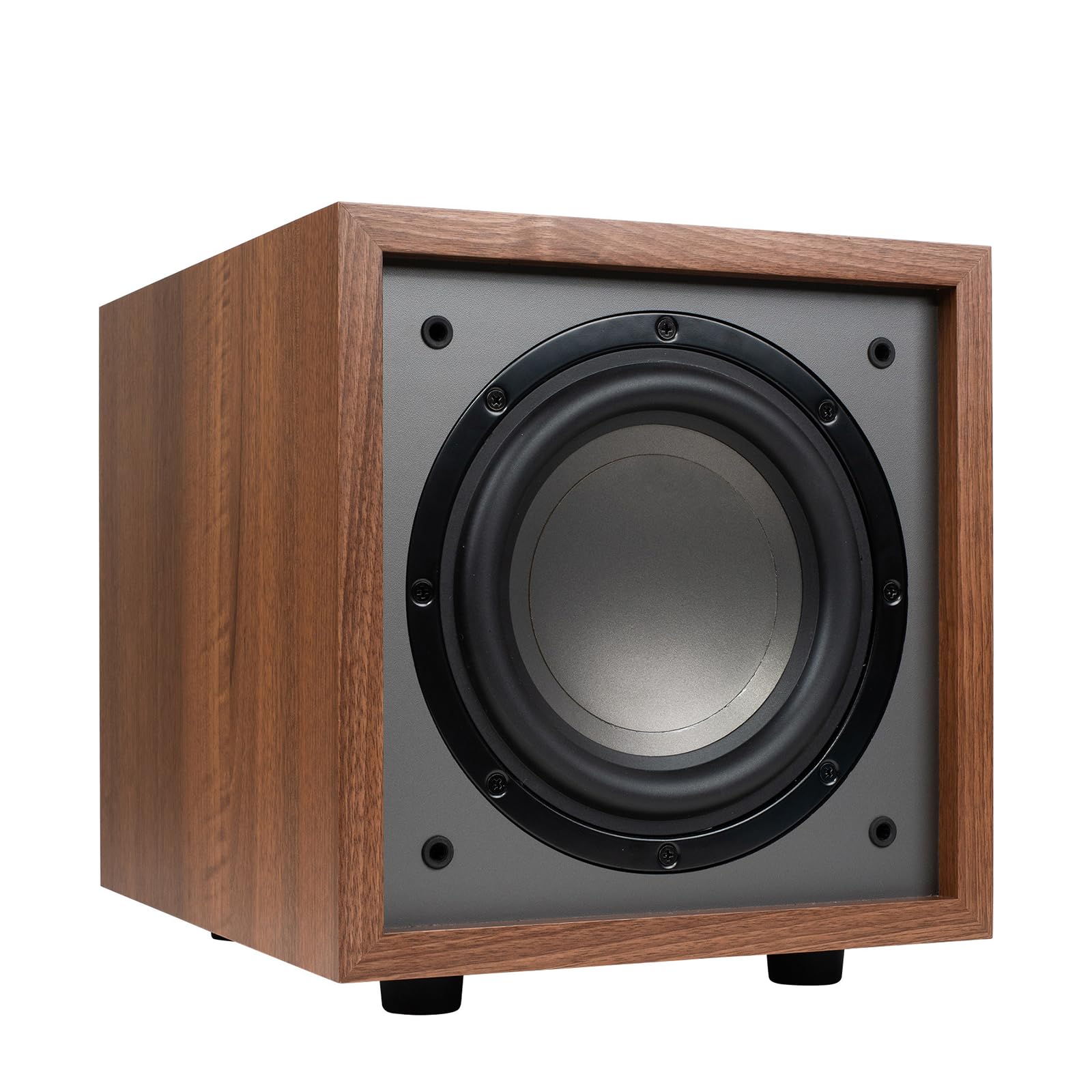
A sealed-leaning 8-inch music sub with tight, unboomy bass and a 5-year warranty.
Most compact subs chase volume; this one chases control. A 150W Class-D amplifier drives an 8-inch driver inside a rigid, braced cabinet, and the design brief is clean low end without boominess. Down at 35Hz it still reaches the deepest notes, but it does so with the kind of stop-and-start discipline that keeps a double bass sounding like a double bass.
The connectivity is the quietly useful part. Stereo RCA, LFE, and speaker-level inputs all live on the back panel, so it will graft onto a modern receiver or an older stereo without adapter shopping. Auto-on means no reaching behind the cabinet, and the grille swaps out — a gray one ships in the box, with black sold separately — so it can match your furniture instead of fighting it.
Designed in the USA and backed by a 5-year warranty, it is built to be a long-term resident rather than a starter sub. What wins people over is how musical it sounds: bass that stays tight and accurate even when pushed. The honest quibble is that it is a music sub at heart, so the very lowest movie rumble will not hit as hard as a big ported cabinet. In a small room, you will not miss it.
The musical argument: clean, tight bass plus a braced cabinet and 35Hz reach — this is the pick for someone who listens to records more than blockbusters.
Fair caveat: braced and sealed-leaning designs trade a little raw rumble for accuracy, so action-movie purists may want more air movement.
Pick this for: a stereo-first room where bass accuracy matters more than wall-shaking output.
Skip if: you want maximum explosion rumble from the smallest possible box — ported designs do that better.
5. Klipsch Reference R-8SW Subwoofer

An 8-inch down-firing sub that uses the floor to reinforce output in a small living room.
Klipsch points this driver at the floor instead of at you, and that is a deliberate choice. A down-firing 8-inch driver with a spun copper woofer uses the floor as a natural amplifier, which is why a cabinet this compact can move real air. Peak power lands at 150W through an all-digital amplifier, and the brushed black vinyl finish keeps it visually quiet in a living room.
Living rooms are exactly where it belongs. Owners with smaller spaces describe it as the right fit, and it pairs naturally with Klipsch R-15PM speakers if you already run that set. RCA and LFE inputs cover the standard receiver connection, and a remote control handles the tuning from the sofa.
Here is the one thing to know: at high volume, the port can add its own voice — a puffing sound that sits under the bass. Some listeners also find it rattles loose objects on the shelves above. Drop the gain a notch and both issues largely disappear, so this is a sub to run at sensible levels in a room that is not huge. That is a fair trade for the footprint.
What it gets right
- Down-firing 8-inch driver squeezes more output from a small box.
- Suited to living rooms and compact setups by design.
- RCA and LFE inputs plus a remote make tuning easy from the couch.
- 150W peak through an all-digital amplifier.
Where it asks patience
- Pushed hard, the port adds audible puffing under heavy bass.
- At high gain it can rattle nearby objects on shelves.
Fits best in: a modest living room where the sub sits near a wall and plays at normal listening levels.
Look past it if: you plan to run it near its limit for loud movie nights.
6. Audioengine S6 Mini Subwoofer

A 6-inch, 210W front-firing sub built for desks and dorms that keeps the mids clean.
Sit this next to the Dayton and the power gap is the story: 210W here against that model’s 150W, a difference of 60W. Audioengine fits that output behind a 6-inch front-firing driver in a cabinet sized for a desktop, a dorm room, or an apartment shelf. Front-firing means the bass comes at you directly rather than bouncing off a wall, so placement is forgiving.
The connection set is unusually generous for the size: both a 3.5mm mini-jack cable and an RCA cable ship in the box, plus a microfiber cloth bag for each. That means it plugs into a computer, a turntable preamp, or Audioengine’s own A2+ and A5 powered speakers without a trip to the store. If you want to cut the cable, it is compatible with the Audioengine W3 wireless adapter.
What everyone notices is that the bass stays whole — it does not smear into the mids, so vocals and instruments keep their edges even when the low end is working. The build quality is the second thing people bring up. The honest limit is the 6-inch driver: this is a sub for a desk or a small lounge, and a large living room will swallow it.
Desktop logic: 210W, a 6-inch front-firing driver, and both cable types included — it is engineered for a chair-and-monitor setup rather than a full theater.
Know the ceiling: a 6-inch cone has less air-moving surface than an 8-inch, so big rooms will feel its limits before small ones do.
Go for it when: your listening happens at a desk or in a dorm and you want clean bass that keeps the mids intact.
Hold off if: the sub has to fill an open-plan living area.
7. Earthquake Sound CP-8 Subwoofer

A 7-inch-tall down-firing sub designed to slide under a sofa or bed.
Seven inches. That is the whole reason this sub exists — it slides under most sofas and beds, or stands on its side in the gap behind the couch. An 8-inch down-firing driver with a 2-inch high-temperature voice coil (the wire winding that takes the heat when the cone works hard) and a long-excursion Santoprene surround pushes bass into the floor and lets the room amplify it. A 3-inch bass-reflex port shoots the low end out from under the furniture.
The amplifier does 150W continuous with a 300W peak, and the frequency range runs 20Hz to 180Hz with a 40Hz–120Hz variable crossover. Continuous power is the honest number, and 150W behind a down-firer that close to the listener is why the tactile side of bass — the thump you feel rather than hear — lands hard. Deep notes reach around 30Hz in-room, and it performs above what the price suggests.
Two things to plan for. First, the proximity is the point: bass sounds faster when it is near your feet, but it also means any popping or hum is right under you. Second, big volume demands are not its strong suit — some owners want more output than a slim cabinet can give. Treat it as a hidden helper for a modest room and it delivers.
Placement play: 7 inches of height plus a down-firing 8-inch driver means the couch becomes part of the speaker system — you feel the low end through the cushions.
Set expectations: a slim sealed-feeling box cannot out-shout a large ported cabinet at reference volume; keep the gain reasonable and it stays clean.
Made for: rooms where floor space is gone and the only free real estate is under the sofa.
Rethink it if: you listen very loud very often and want output over concealment.
8. Kanto SUB8VMB Subwoofer
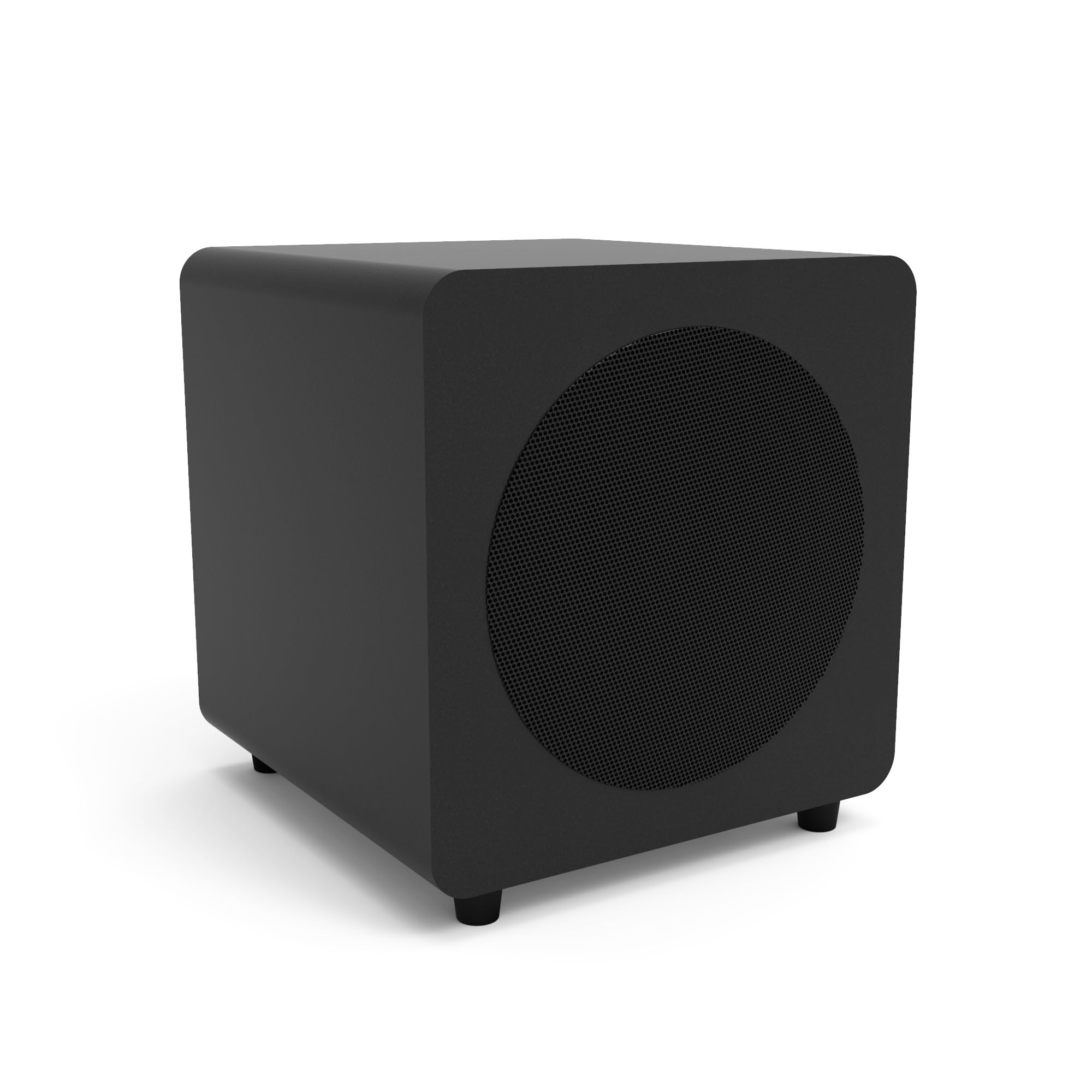
A sealed 8-inch, 300W-peak sub that keeps apartment bass tight instead of boomy.
Sealed means no air hole, and no air hole means the cone responds to changes in the music faster. That is why this sub gets called musical rather than boomy — the notes start and stop when they should, and the cabinet adds little of its own voice. Behind it sits an 8-inch paper cone driver, 300W peak of amplification, and a stated 35Hz to 175Hz range with 88dB sensitivity (a measure of how efficiently it turns power into sound).
At roughly 11 inches in each direction, it fits under a desk or in the smallest apartment where a conventional theater sub would dominate the room. The high-pass filter and phase switch let you integrate it with whatever speakers you already own, so the sub hands off cleanly at the crossover point instead of doubling up on the low mids. Vinyl-wrapped finish and a universal 100V–240V power supply round out the practical side.
There is one thing to brace for: “roughly 11 inches” is smaller than some buyers picture when it arrives. Measure your gap before ordering. Otherwise the sealed design does exactly what it promises — tight, undistorted bass that suits a small space without notable the room’s resonance.
Why the sealed box wins here
- Sealed enclosure produces tight, accurate notes with little distortion.
- Roughly 11 inches per side fits under desks and in small apartments.
- High-pass filter and phase switch blend it into existing speakers.
- 300W peak and an 8-inch driver give it headroom for a compact cabinet.
The one to measure for
- Some buyers find it bigger in person than the “roughly 11 inches” suggests.
- Sealed designs trade some raw rumble for accuracy.
Choose it for: an apartment or study where you want clean, musical bass without disturbing the whole building.
Pass on it if: you want maximum low-end rumble rather than accuracy.
9. Definitive Technology Descend DN8 Subwoofer

Three times the bass surface of a ported box, crammed into an 8-inch cabinet.
The trick here is the 3XR architecture: one active 8-inch driver plus two pressure-coupled 8-inch Ultra Low Bass Radiators. Radiators are passive cones that move with the air pressure inside the cabinet, adding output without a port. The maker claims that triples the bass-producing surface of a traditional ported sub, which is how a cabinet this size is said to perform like a 10-inch. A 500W peak Class-D amplifier backs it up.
No ports means no port noise — the chuffing sound a ported box makes when pushed. The DN8 keeps the low end underneath the dialogue instead of intruding on it. Studio owners say the deep bass is a genuine step up from whatever it replaced, and the review pages back that up.
Controls sit on the back panel: variable volume, a low-pass filter, a phase toggle at 0 or 180 degrees, and an auto on/off power switch. RCA and LFE inputs are there, though the cables are not included, so budget for a set. Adding a second matching sub is an option the maker supports for smoother peaks across a bigger room. For a small-room movie setup, the DN8 is the one that behaves like a larger sub.
Home theater read: three bass-producing surfaces and 500W peak in an 8-inch footprint give this the loudest, most film-friendly character of the port-free options.
Small print: cables are not in the box, and the bass-reflex-free design still needs careful placement to hit its stated potential.
Best for: a compact movie room where dialogue clarity and explosive low end have to coexist.
Not ideal if: your main goal is delicate acoustic music — the radiators are tuned for impact.
10. Bowers & Wilkins ASW608 Compact Powered Subwoofer – Black

Warm, detailed low end from an 8-inch driver that stays fast under pressure.
An 8-inch driver (the cone that actually moves the air) and a 200W Class-D amplifier (a small, efficient amp chip that drives it) handle the work here. Bowers & Wilkins built the whole thing around speed and depth rather than sheer volume. The brand describes it as big sound in small places, and the spec sheet backs the claim: the cabinet is tidy enough for a bookshelf or corner, and the driver is claimed to deliver fast, tight, deep bass rather than one long wobble.
Music listeners tend to notice the tone first — a warm character that lets an upright bass sound like a wooden instrument, with the finger work still audible. The sub carries the low end without smearing the mids, so acoustic and jazz recordings keep their texture. It integrates cleanly with an existing system through its RCA input suite, and it ships with the mains cable and accessory pack so nothing is missing on day one.
This is a sub for someone who cares more about how a note is shaped than how much furniture it moves. That focus is also the honest limit: for pure action-movie rumble, a bigger ported box will out-shove it. If detail is your measure, the ASW608 is the refined pick.
Detail-first: 200W and an 8-inch driver tuned for warmth and speed — the sub disappears into the music instead of announcing itself.
Best paired with: stereo listening over film soundtracks, where accuracy beats brute output.
The right call for: vinyl listeners and stereo setups where bass has to stay musical, not just loud.
Wrong tool for: anyone shopping on output alone.
11. SVS 3000 Micro Subwoofer

Two 8-inch drivers firing in opposite directions inside a 10-inch cabinet.
The headline is 800W RMS with a peak over 2,500W, from the Sledge STA-800D2 amplifier. RMS is the sustained number, so that 800W is the power this sub genuinely holds, not a burst. Two active 8-inch drivers are mounted in opposition — one pushes out while the other pulls in — which cancels the cabinet’s own movement so it stays still even at peak levels. That dual-driver setup is the reason all this output comes out of a compact 10-inch cabinet.
Behind the drivers sits a 50 MHz Analog Devices DSP (a digital processor that shapes the signal). It open up the SVS app, which lets you adjust volume, crossover, a three-band parametric EQ, polarity, and room gain from your seat. You can also save custom tuning presets for music, movies, or gaming, so you are not re-dialing the knobs every time you switch sources. The sealed cabinet, thick MDF side baffles, and internal bracing keep it acoustically quiet on the outside.
Is it the smallest? No — the Couch Potato is half its height. Is it the most output per inch? Almost certainly. The catch is the one every high-output sub carries: the app does the heavy lifting, so you need your phone and a little patience to set it up properly. Once dialed in, this is the sub that makes a small room feel like it has a much bigger one hiding in the walls.
Where the power shows
- 800W RMS sustained, with peak output over 2,500W.
- Dual opposing 8-inch drivers cancel vibration for a still cabinet.
- App control adds parametric EQ and saved movie, music, and gaming profiles.
- Sealed cabinet with extra-thick MDF baffles stays resonance-free.
Plan around these
- App-based tuning is capable but demands patience to dial in.
- Its 10-inch cabinet is bulkier than the truly slim under-sofa options.
Top of the pile if: you want near full-size theater output from a compact sealed box and do not mind app setup.
Look elsewhere if: you need something thin enough to slide under a low sofa.
Know the Specs
RMS vs Peak Wattage
RMS is the power an amplifier can sustain hour after hour; peak is a brief burst. A sub rated at 800W RMS is doing far more real work than one rated at 300W peak, which is why the RMS figure matters most when you compare across brands. If a listing only gives peak, read it as a ceiling, not a guarantee.
Driver Size and Air Movement
A driver is the diameter of the cone that pushes air, measured in inches. A bigger cone moves more air at low frequencies, but a dual-driver design or a down-firing layout can make a small driver feel bigger. Two 8-inch drivers in opposition can out-push one 8-inch driver, which is why cabinet size and driver count both belong on your checklist.
Frequency Response and Crossover
Frequency response tells you how low the sub reaches — 35Hz is a common floor for a compact cabinet, while 20Hz is genuinely deep. The crossover is the cutoff where the sub stops and your main speakers take over. Matching that handoff to your speakers is what keeps bass from booming over dialogue.
Sealed vs Ported Enclosure
Sealed cabinets react faster and sound tighter; ported cabinets use a tuned opening to boost low output at the cost of some precision. Neither is better — sealed suits music, ported suits effects-heavy film. A ported design can also produce audible chuffing at high volume, so placement near a wall matters.
Common Questions
Will a small subwoofer actually produce deep bass or just mid-bass thump?
How do I connect a compact subwoofer to a receiver without a dedicated sub-out?
Is a sealed or ported subwoofer better for apartment listening?
Can I put a subwoofer undermy sofa or bed?
Will a subwoofer this small work in a large open-plan living room?
Do I need a separate amplifier to run a small home subwoofer?
How do I stop a compact subwoofer from sounding boomy or muddy?
Is a down-firing subwoofer worse for upstairs neighbours than a front-firing one?
Can I add a second compact subwoofer later for more even bass?
Does a wireless subwoofer need a Wi-Fi network to work?
What size subwoofer driver is best for a small room?
The Bottom Line
For most people shopping for the smallest subwoofer for home, the winner is the Sonos Sub 4. Its force-canceling dual-driver design (two drivers facing each other so the cabinet barely shakes) gives you deep, clean bass from a cabinet you can stand upright in a corner or lay flat under a sofa, and it stays quiet where it matters. If your priority is maximum output per inch of cabinet, the SVS 3000 Micro brings 800W RMS (a continuous power rating) and dual opposing 8-inch drivers to a 10-inch box. And when floor space is genuinely gone, the Earthquake CP-8 Couch Potato at 7 inches tall turns the space under your sofa into a bass source.
The one nudge worth making: if you already own a Sonos soundbar, the Sub 4 is the pick that blends into your system with a single cable and a few app taps — the 4.5+ star crowd favorite among owners who paired it with an Arc Ultra. Everything else on this list earns its spot for a different reason, from the budget rumble of the Rock Shaker to the sealed musicality of the Kanto SUB8.
How we choose
We do not accept paid placement. Every pick is matched to a real buyer and a real use-case; we do not hands-on test units.
Sources
Specifications: manufacturer listings and product documentation. Review insights: verified customer reviews, as of November 2026. Pricing: not shown on this page (it changes often); check the current price via the retailer link.
As an Amazon Associate, Tactical Gear Guy earns from qualifying purchases. This does not affect which products we feature.