Specs are compiled from manufacturer listings and verified buyer reviews and can change over time — please confirm the key details on the product page before buying.
If your car sits so low that a normal jack won’t slide under the pinch weld, you need one that starts at 3.4 inches rather than the usual 5 or more. That single number — the saddle’s starting height — decides whether you can even begin to lift a lowered sedan, a sports coupe, or a car with a body kit. This guide separates the jacks that genuinely squeeze under low cars from the ones that only claim to, and it tells you which one matches your car and your garage.
This guide is built by comparing the manufacturers’ published specifications and the patterns across verified customer reviews, so you get each pick’s real strengths and trade-offs instead of marketing spin.
You’ll see the actual lift ranges, saddle heights, and weight figures for every pick, plus the honest limit on each — so you buy the right one the first time. Here are the nine worth considering as the smallest floor jack for your garage.
Top Picks


How To Choose The Best Smallest Floor Jack
Start with your car, not the jack. Measure the gap between the ground and the lifting point on your vehicle, then insist on a jack whose minimum saddle height (the lowest the lifting pad sits) leaves you room to slide it in. A jack rated for massive weight is useless if it can’t fit under the car in the first place.
Match the minimum height to your clearance
A lowered sedan or sports car typically needs a jack that starts around 3.4 inches or lower. A standard-height car gives you more room to work with, so a 5-inch starting height is fine. Check the spec sheet for the minimum height before anything else — it is the make-or-break number.
Check the lift range covers your job
Lift range is the gap between the lowest and highest the jack reaches. A jack that runs from a 3.4-inch start up to 14 or 15 inches handles both a lowered sedan and a taller SUV. A narrow range can leave you unable to get a tire fully off the ground, which is exactly the problem a few buyers hit.
Weigh the ton rating against your vehicle
The ton rating (how much the jack is built to lift) should clear your vehicle’s weight with room to spare. A 1.5-ton jack suits small cars; a 2-ton or 2.5-ton jack gives you more margin and covers heavier vehicles. Never lift more than the jack’s rated capacity.
Decide how portable it needs to be
If the jack lives in a fixed garage spot, a 27- to 33-pound steel build is fine. If you need to carry it to a track day or store it on a shelf, a 16- to 22-pound jack or one with a blow-mold case makes the difference. Weight figures here run from 16.1 to 33.6 pounds, so pick based on how you’ll actually move it.
Side-by-Side Comparison
| Model | Best For | Load Capacity | Min Height | Max Lift Height | Amazon |
|---|---|---|---|---|---|
| AV Steel Low Profile 2.5 Ton★ Best Overall | Low cars and sedans | 5000 lbs | 3.4″ | 14.6″ | Amazon |
| Maxority 2-Ton Trolley JackBudget Starter | Budget garage starter | 4000 lbs | 4.9″ | 11.8″ | Amazon |
| Pro-LifT F-757G 2 TonCompact Mover | Light, portable use | 2 tons | 3.74″ | 13.38″ | Amazon |
| DNA MOTORING Low Profile 1.5 Ton | Light-duty lifting | 1.5 Ton | 5.3″ | 12″ | Amazon |
| BIG RED 2.5 Ton Low Profile | Low cars and SUVs | 5000 lbs | 3-1/3″ | 15″ | Amazon |
| Big RED 1.5 Ton Trolley Jack | Compact carry-around | 3000 lbs | 5-3/5″ | 13″ | Amazon |
| Torin TORT825051 Low Profile | Cars, trucks and SUVs | 2.5 tons | 3-1/3″ | 14.94″ | Amazon |
| Torin TAM815016L Racing Jack | Racecar and track duty | 1.5 tons | 3-1/2″ | 14.13″ | Amazon |
Detailed Reviews
1. AV Steel Low Profile Floor Jack 2.5 Ton (5000 lbs)
Our pick — 4.5+★ from 500+ verified ratings; the strongest balance of quality and price.
Slides under a lowered car at 3.4 inches, then heaves 5,000 pounds up to 14.6.
This is the one to beat if your car sits low and you want a single jack that does it all. Its 3.4-inch minimum saddle height (the lowest the lifting pad sits) means it slides under sports cars, lowered sedans, and anything with a tight gap where a taller jack simply won’t go.
The lift range runs from 3.4 inches all the way up to 14.6 inches, which is the widest top-end here, so you can raise a tire clear off the ground and still have room. Steel construction handles the load, and two rear rotating wheels let you roll it into position without wrestling it. Where it wins people over is build quality — it’s the trait praised most across the review pages, and it feels sturdy the moment you set it under the car. A single-piston quick-lift pump means fewer strokes to reach height.
Here’s the honest side: the jack is built for cars, not trucks or lifted vehicles, and you should check you don’t need more than 14.6 inches of lift before you buy. The handle is on the short side, which is worth knowing if you like a long lever for easier pumping. Compare it to the Maxority below and the numbers are stark: this one starts 1.5 inches lower and reaches 2.8 inches higher, so it covers low entry and full lift in one tool.
What earns its keep
- Widest lift range here at 3.4″ to 14.6″
- 5000 lb capacity with a 360° rotating saddle for stability
- Built-in overload valve protects you on a heavy load
- Two rear wheels roll it into place easily
The honest catches
- Made for cars — not rated for trucks or lifted vehicles
- Handle runs short, so pumping takes more effort
Reach for this if: your car sits low and you want one jack that handles both tight entry and a full lift.
Look elsewhere if: you’re lifting a heavy SUV or truck that needs more than 14.6 inches of height.
2. Maxority 2-Ton Hydraulic Trolley Floor Jack
A 4,000-pound trolley jack that packs down into its own carrying case for the shelf.
If you want a low-cost jack that stays tidy between jobs, this one ships with a blow-mold carrying case that keeps it protected and easy to store. The 4000-pound capacity covers most sedans and light pickups, and the steel body is built to take frequent use. Heavy-duty swivel casters let you roll it into position in a tight workshop corner.
The catch is at the height end. The minimum sits at 4.9 inches, which is high enough to miss very low cars — a big jump from the AV Steel’s 3.4 inches, so if clearance is your problem this isn’t the one. The top end stops at 11.8 inches, the lowest max here, which is why buyers report it “barely lifts the front end and can only gain 1/4″ of lift” on some vehicles. Read that as a fit warning: it’s a starter jack for standard-height cars, not a heavy lifter.
On the plus side, the safety valve guards against overloading and the lift saddle gives stable support. This is a sensible budget pick for someone working on a normal sedan who wants a case to stow it away. Just confirm your clearance first — the 4.9-inch start is the deal-decider.
Posture under load: the swivel casters and secure saddle keep it stable while the safety valve prevents overloading, so routine oil changes and tire swaps go smoothly.
Suits: a standard-height sedan and a garage where you want the jack cased up neatly.
Think twice: your car sits below about 4.9 inches — it won’t slide under.
3. Pro-LifT F-757G 2 Ton Floor Jack
At 22 pounds, this one is light enough to carry between jobs and stow in a corner.
Weight is the reason to pick this jack. At 22 pounds it is 8 pounds lighter than the AV Steel at 30 pounds, so lifting it off a shelf or hauling it to a friend’s driveway doesn’t wreck your back. The steel body still handles a 2-ton load, and it starts at 3.74 inches, which clears most cars and even a good number of lowered ones.
The lift range tops out at 13.38 inches. On paper that is a fair bit lower than the AV Steel’s 14.6 inches, and it explains why some buyers find it “doesn’t lift high enough” for taller vehicles. If you drive a lifted rig or a tall SUV, measure before you commit — 13.38 inches may not clear the tire.
Functionality is the trait owners rate highest, and the built-in by-pass device guards the hydraulic system from over-pumping damage. The large swivel saddles and 360-degree casters make positioning easy in a home garage. One caution worth knowing: treat the hydraulics gently, since there’s a report of the hydraulic tank failing early. Keep it for basic lift jobs and it earns its spot as the portable pick.
Worth grabbing if: portability is your priority and your car doesn’t need more than 13.38 inches of lift.
Better off skipping if: you’re working on a tall SUV or lifted truck that needs the extra height.
4. DNA MOTORING Low Profile Hydraulic Floor Jack 1.5 Ton
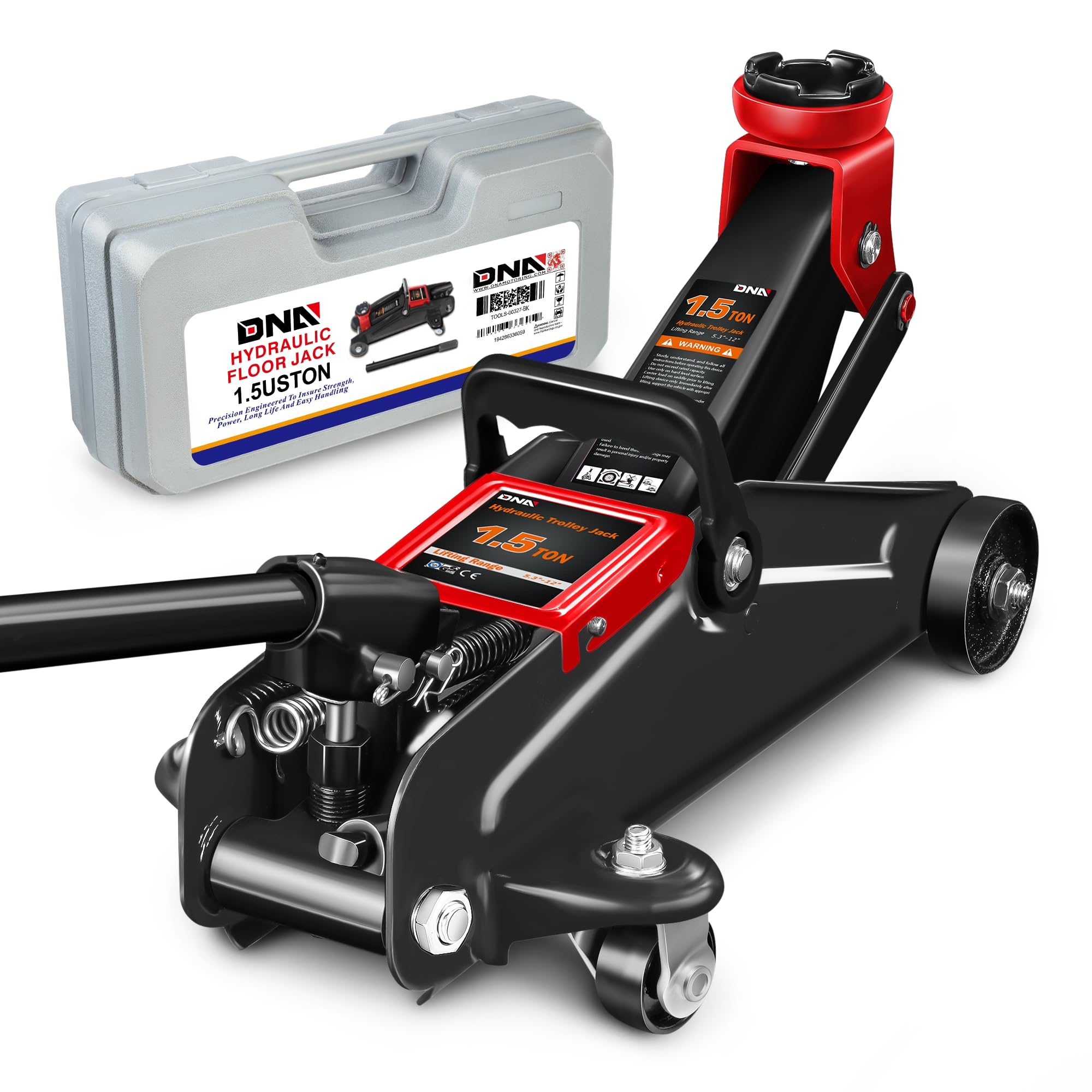
A 3,000-pound garage jack for light cars that want a simple, steady lift.
This DNA MOTORING jack is built for small vehicles. Its 1.5-ton (3,000-pound) capacity suits compact cars and coupes, and the safety release valve trips in an overload to protect you. Steel construction gives it rigidity, and the swivel casters roll it into position without a fight.
The catch here is clearance. Its minimum height is 5.3 inches — by far the highest starting point on this list, and 1.9 inches above the AV Steel. That makes it the wrong tool for a truly low car. The 12-inch max height also trails the leaders, so it’s a light-duty lifter, not a heavy hauler.
Keep it as a compact starter for a light car and it does the job — just don’t ask it to lift a full-size SUV.
Know the real job: it is a lifting tool only and cannot hold a load for a prolonged period; a jack stand is required for support. Treat it as a helper for quick lifts on a light car.
Keep on your shortlist: you drive a light coupe or compact and want a simple steel jack for quick jobs.
Pass it by: your car sits low, since the 5.3-inch start won’t slip under.
5. BIG RED 2.5 Ton (5,000 lb) Low Profile Hydraulic Floor Jack

Starts at 3-1/3 inches and climbs to a 15-inch ceiling — the tallest top-end here.
If you need the most lift headroom, this is your pick. It starts low at 3-1/3 inches to slip under a low car, then reaches 15 inches, the highest max on this list. That wide band means it covers low-profile racing cars right up through normal cars and SUVs. The 5,000-pound capacity gives serious margin, and it’s built from rust-resistant heavy-duty steel.
Performance is solid — owners note it “lifts both vans and small cars without issues.” The safety valve prevents overloading, and the large casters make it easy to maneuver. At 27.7 pounds it’s mid-weight, heavier than the 19.1-pound Big RED but lighter than the AV Steel.
Here’s the honest caveat: stability gets mixed readings, with some owners finding it less planted under a heavy load or on a full-size truck. That points to using it within its comfort zone — cars, vans, and light SUVs — rather than maxing it out. Used that way, the 15-inch reach is a genuine advantage over the AV Steel’s 14.6 inches.
Where it pulls ahead
- Tallest max lift here at 15 inches
- 3-1/3″ entry handles low cars
- 5000 lb capacity with overload protection
- Rust-resistant heavy-duty steel
Worth weighing first
- Stability reads mixed under very heavy loads
- 27.7 lb is mid-weight, not the lightest to carry
Go for this when: you want the most height headroom and a wide 3-1/3″ to 15″ band for cars and light SUVs.
Look past it if: you’re lifting a full-size truck that pushes its stability limit.
6. Big RED 1.5 Ton Hydraulic Trolley Floor Jack with Case
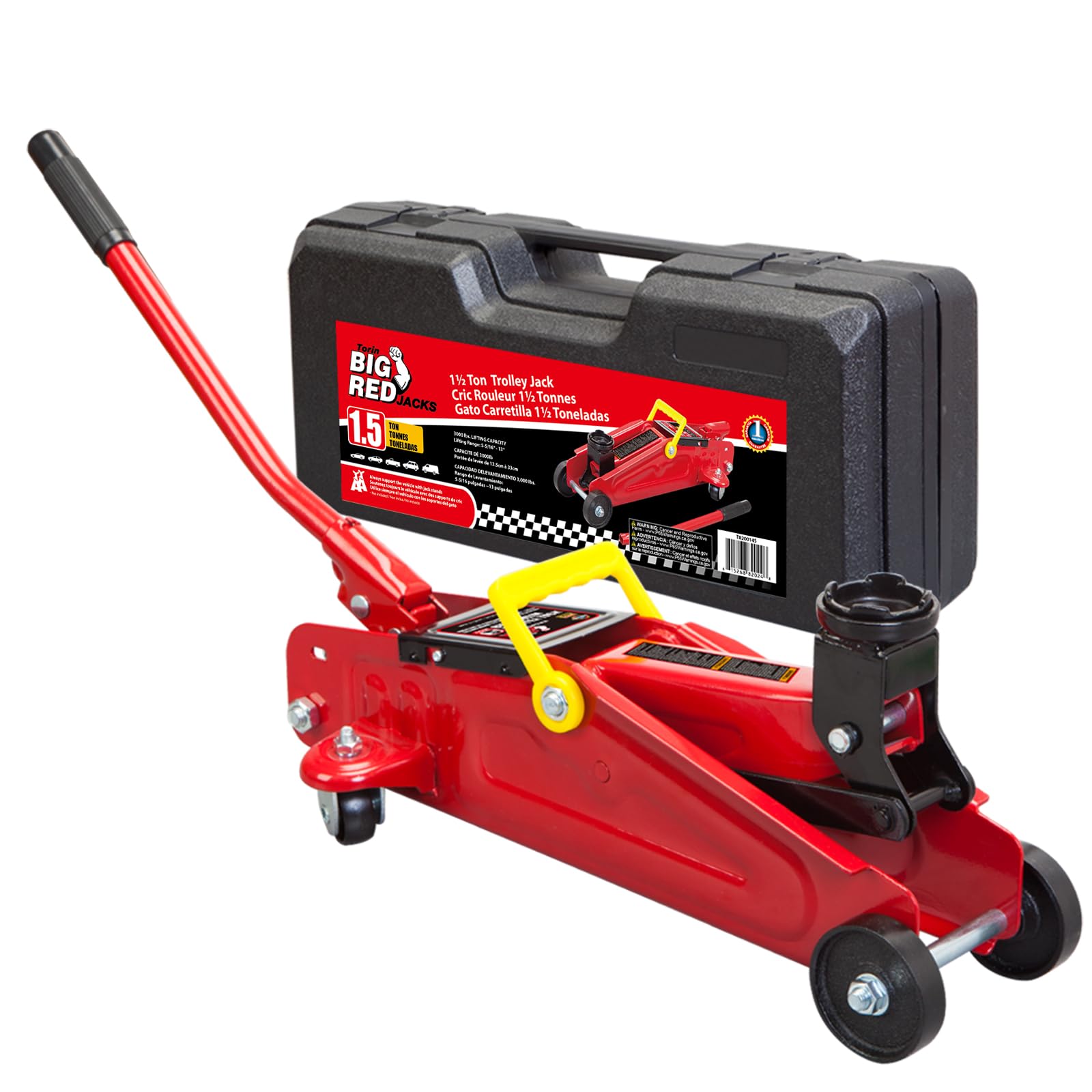
The lightest jack here at 16.1 pounds, yet it still ships in a hard carrying case.
Carrying weight is where this one shines. At 16.1 pounds it is the lightest jack on the list, making it easy to lift onto a shelf or toss into a trunk for a roadside tire change. It comes with a plastic blow-mold case and a carrying handle, so moving it around is a one-hand job. Size is what wins people over — it is praised most for being compact and easy to handle.
The 1.5-ton (3,000-pound) capacity suits most cars and light trucks, and the safety bypass system prevents overloading. It starts at 5-3/5 inches and reaches 13 inches, a band that fits standard cars. One buyer found it perfect for a specific older pickup, which shows it handles more than just sedans.
The trade-off is durability, which draws a mixed read — treat it as a light-duty companion jack rather than your everyday heavy lifter. For a compact, genuinely light jack you can carry anywhere, it earns its place.
Carry-anywhere appeal: at 16.1 pounds with a hard case and handle, this is the jack you keep in the trunk for emergencies or haul to a friend’s driveway. It’s built for convenience first.
Choose it: you want the lightest, most carry-friendly jack for a standard car or light truck.
Look elsewhere: you need heavy-use durability or entry for a very low car.
7. Torin TORT825051 Low Profile Trolley Floor Jack 2.5 Ton

Built to straddle the gap between low cars and taller trucks in one 2.5-ton jack.
This Torin is pitched at the widest range of vehicles — cars, trucks, and SUVs all appear in its spec sheet. It starts low at 3-1/3 inches to reach under a low car, then runs up to 14.94 inches, so it covers small and tall vehicles in one tool. The 2.5-ton (5,000-pound) capacity gives it plenty of margin.
A single-piston quick-lift pump raises the car with fewer strokes, and the safety bypass system guards against overloading. Two large steel casters plus two 360-degree swivel casters move it smoothly around a car. A built-in carrying handle lets you lift the 27.2-pound jack quickly.
Cut against the AV Steel, this one reaches 14.94 inches versus the AV Steel’s 14.6 inches — a hair more top-end — though the AV Steel starts slightly lower at 3.4 versus 3-1/3 inches. Both are close; pick this if you want broader truck-and-SUV coverage, pick the AV Steel if the lowest entry is your priority. It’s a workhorse jack for a mixed garage.
Best suited to: a garage with both low cars and a truck or SUV that wants one jack to cover them all.
Less ideal if: you need the absolute lowest entry point — the AV Steel edges it there.
8. Torin TAM815016L Racing Floor Jack 1.5 Ton

A dual-pump racing jack that hits full height in five strokes for track-day swaps.
This is the enthusiast’s jack. A dual-piston pump reaches maximum height in just 5 strokes, so you’re not working the handle forever at the track. It’s built from a mix of high-strength steel and aluminum, which makes it lighter than an all-steel jack of the same size, and a side handle lets you carry it easily. The 1.5-ton (3,000-pound) capacity suits racecars, family cars, and light trucks.
The lift band starts at 3-1/2 inches and reaches 14-1/8 inches, covering low cars and taller vehicles alike. A 37.2-inch two-stage handle detaches for storage, and rubber pads plus foam bumpers protect the car’s finish. Two universal casters and a front roller let you roll it anywhere you want to go.
Quality is the strongest positive — it’s well-built and reads as good value, and it’s a favorite for racecar use on track days. The caution is lifting power and durability in the long run, so keep it within its 1.5-ton rating. For a fast, portable jack that lives for quick tire changes, this one is hard to argue with.
Built for speed: 5 strokes to full height and a detachable handle make it the pick for quick swaps and track paddocks; it trades raw tonnage for fast, light duty.
Made for you: you want fast lifts and portability for a racecar or a light car, with a jack you can carry to the track.
Not for you: you need to lift a heavy vehicle that pushes past 1.5 tons.
Know the Specs
Minimum Saddle Height
This is the lowest the lifting pad sits when fully down. On a lowered car, it’s the number that decides whether the jack fits under the car at all. A jack starting at 3.4 inches slides under sports cars and lowered sedans; one starting at 5.3 inches often won’t. Measure the gap under your car before you pick.
Maximum Lift Height
This is the highest point the jack reaches, and you need enough of it to get the tire mostly off the ground. A wider gap between the min and max heights means the jack fits more vehicles. A 3.4″ to 14.6″ band handles both a low car and a full lift, so you can raise a sedan and still clear a taller vehicle. A narrower band may fall short on tall vehicles.
Load Capacity
This is how much weight the jack is rated to lift, listed in tons or pounds. Always leave margin below the rating for safety. A 1.5-ton jack suits light cars; a 2.5-ton jack gives more headroom for heavier vehicles. Never exceed the rated capacity.
Construction and Weight
Steel jacks run 27 to 33.6 pounds and take abuse; aluminum-and-steel builds like the Torin racing jack are lighter to carry. Weight figures here range from 16.1 pounds up to 33.6 pounds, so pick based on whether the jack stays put in the garage or travels with you.
Common Questions
What minimum height do I need for a lowered car?
Can a 1.5 ton jack lift my car safely?
Will a compact jack fit under a car with a body kit?
How high does a floor jack need to lift to change a tire?
Can I use a floor jack to hold the car up while I work?
Is a steel or aluminum floor jack better for a small garage?
What does low profile mean on a floor jack?
Why does my jack barely lift the car off the ground?
Do I need a carrying case for a floor jack?
The Bottom Line
For most people, the smallest floor jack winner is the AV Steel Low Profile 2.5 Ton. It slides under a low car at 3.4 inches and still reaches 14.6 inches with 5,000 pounds of capacity — the widest band here, backed by the strongest build-quality praise. If you want the most height headroom, grab the BIG RED 2.5 Ton Low Profile and its 15-inch ceiling. And for track days and quick swaps, the Torin TAM815016L Racing Jack hits full height in five strokes. Any of these three earns its spot — the AV Steel just covers the most ground for the typical low-car owner.
How we choose
We do not accept paid placement. Every pick is matched to a real buyer and a real use-case; we do not hands-on test units.
Sources
Specifications: manufacturer listings and product documentation. Review insights: verified customer reviews, as of November 2026. Pricing: not shown on this page (it changes often); check the current price via the retailer link.
As an Amazon Associate, Tactical Gear Guy earns from qualifying purchases. This does not affect which products we feature.