Specs are compiled from manufacturer listings and verified buyer reviews and can change over time — please confirm the key details on the product page before buying.
You want a panel that folds into a bag, clips straight onto a 12V battery, and charges unattended until you return. That is exactly what a small solar kit does — and the one thing that separates a good kit from a frustrating one is honest wattage plus a controller that protects your battery instead of cooking it. Below are seven kits that actually deliver, sorted by what they are genuinely good at, so you can match one to your camper van, boat, trailer, gate opener or off-grid shed in a single pass.
This guide is built by comparing the manufacturers’ published specifications and the patterns across verified customer reviews, so you get each pick’s real strengths and trade-offs instead of marketing spin.
Wattage numbers on a box rarely match what reaches your battery, so the picks below weigh controller type, cell efficiency and real carrying weight against each other. Here is how to read a small solar kit before you spend, and which one suits your setup best.
Top Picks
How To Choose The Best Small Solar Kit
You will pick the right small solar kit faster by answering three questions than by chasing the biggest wattage number. What are you charging? Where will the panel sit? And do you want to fold it up and carry it, or bolt it down and leave it? Answer those three and the wattage, controller and mount choices follow.
Match the panel to what you are charging
A 50W kit is a maintainer — it keeps a battery topped off between trips, which suits a stored motorcycle, a lawn mower or a camper van that sits idle for weeks. A 100W panel gives you real charging headroom for daily use on a boat or RV. A 200W kit is for people running lights, a fridge or a power station and who want the battery back up quickly instead of slowly.
MPPT or PWM — which controller do you actually need
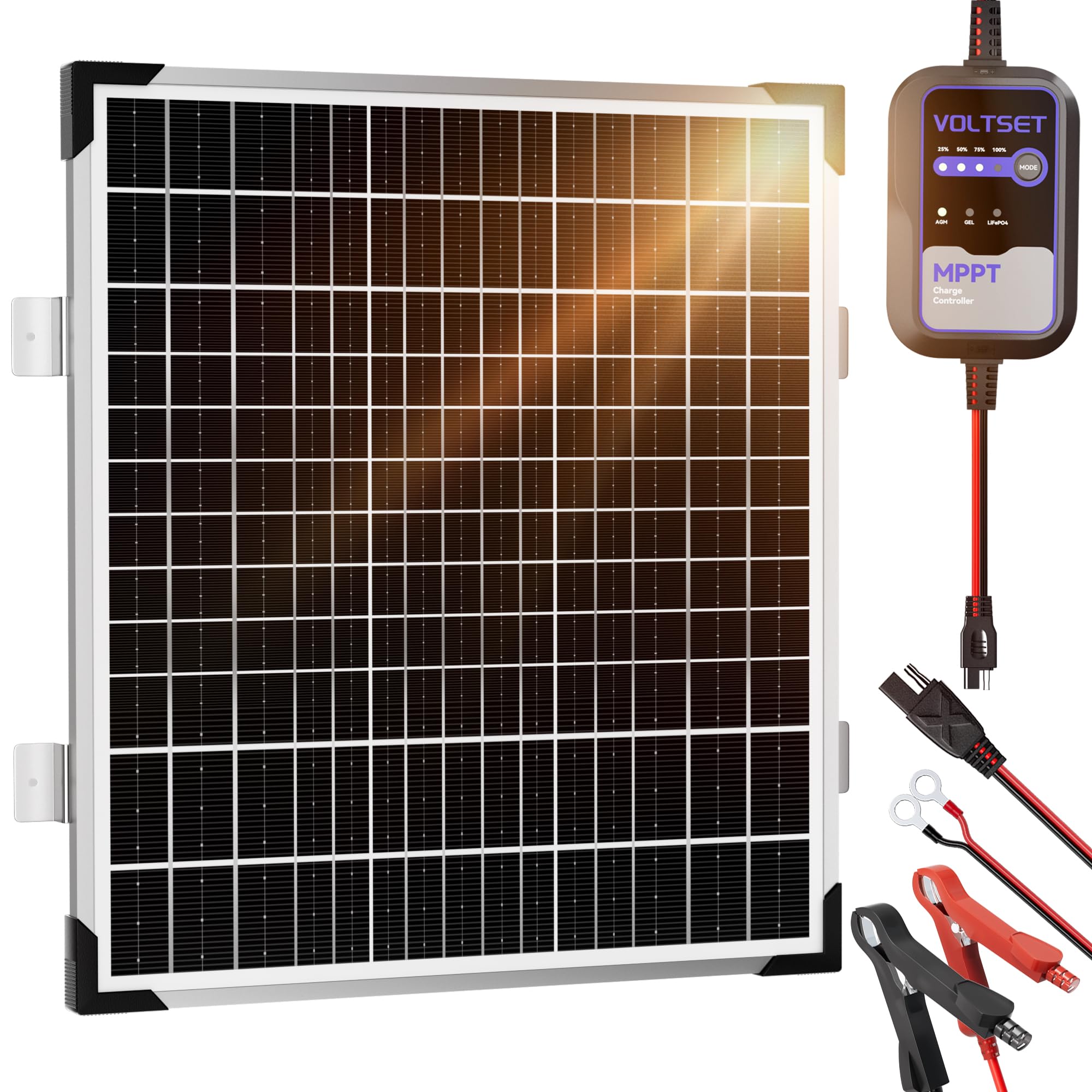
For a small setup, a PWM controller (pulse-width modulation, the simpler and cheaper type) is fine — it throttles the panel down to battery voltage. An MPPT controller (maximum power point tracking) squeezes more out of the same panel by tracking its best operating point as light changes, so more of the harvest reaches the battery. The Voltset kit lists up to 99% tracking efficiency and 98% peak conversion efficiency for its MPPT design, according to the maker. Once your panel is larger than about 100W, MPPT earns its keep.
Waterproofing and frame build
An IP rating tells you how well a panel survives dust and water — the first digit covers solids, the second covers liquid. So IP68 is the tougher of the two, and IP67 is still fully dust-tight with protection against immersion. A tempered glass surface resists scratches better than the thin plastic film on cheaper panels, so your panel keeps its output after a season of packing and unpacking. A corrosion-resistant aluminum frame is what stops a panel from flexing itself apart on a windy rooftop.
Suitcase or rigid panel
A foldable suitcase panel folds in half and carries by a handle or bag, which makes it right for camping and for chasing the sun around a campsite. A rigid panel is heavier and bulkier but mounts permanently, so it suits a rooftop or a shed where the kit stays put. Weigh your carrying plan honestly — a foldable that weighs 20 pounds is not something you want to haul far.
Side-by-Side Comparison
| Model | Best For | Max Power | Max Voltage | Weight | Amazon |
|---|---|---|---|---|---|
| Voltset 50W 12V Solar Kit★ Best Overall | Keeping stored batteries topped off | 50 watts | 12 volts | — | Amazon |
| DOKIO 100W SuitcaseBest Value | Camping and RV battery charging | 100 watts | 18 volts | 10.1 pounds | Amazon |
| ZOUPW 100W Foldable | Boondocking with a power station | 100 watts | 23.1 volts | 9.36 pounds | Amazon |
| Rvpozwer 200W N-Type | Rooftop and camper builds | 200 watts | — | 20.4 pounds | Amazon |
| DOKIO 200W Foldable | High-output portable charging | 200 watts | 22.5 volts | 19.4 pounds | Amazon |
| ZOUPW 220W Dual-Panel Kit | Class B vans and marine installs | 220 watts | 21.14 volts | 26.9 pounds | Amazon |
| Renogy 200W RV Kit | Full RV install with Bluetooth | 200 watts | — | — | Amazon |
Detailed Reviews
1. Voltset 50W Solar Panel Kit
Our pick — 4.5+★ from 2,000+ verified ratings; the strongest balance of quality and price.
The quiet workhorse that keeps a stored battery alive without you touching it
This is a 50W panel married to an MPPT controller — the smart charging type that hunts the panel’s best power point as clouds roll through. That combination is unusual on a kit this small, and it is exactly why this one earns the top spot. The MPPT design lists up to 99% tracking efficiency and 98% peak conversion efficiency, and Voltset says it lifts solar utilization by roughly 20%–30% against traditional charge control. In plain terms, dreary winter light still puts something back into the battery. Owners confirm the thing keeps working when the sky is grey, and one recurring theme is a camper van battery sitting near topped off between trips. What wins people over most is the charging behavior — panel quality and easy setup both draw steady praise, and the crowd favorite sits at 4.5+ stars across 2,400+ ratings.
Set-up is genuinely plug-and-play: run the panel, clip or wire it to the battery, and walk away. The 3-stage charging algorithm (bulk, float, then trickle) fills the battery up and then holds it with a low current, so a long-term parked vehicle does not get overcharged. The digital display carries 4 battery-level indicators, so one glance tells you the charge state and the current mode. A 12V output and 50 watts suit a motorcycle, lawn mower, gate opener, trailer or camper van that sits idle for weeks. If you are expecting to run a fridge off this, you have the wrong tool — 50W is a maintainer, not a generator. That maintainer role makes it the safest pick for anyone tired of coming back to a dead battery.
The build is the other half of the story. IP67 protection (dust-tight, and rated to survive short immersion) pairs with a corrosion-resistant aluminum frame, and Voltset rates it for wind loads of 2,400 Pa and snow loads of 5,400 Pa. Bend-resistant and dust-resistant construction means it handles a fence post or shed roof year after year. The 8-fold protection suite covers overcharge, overvoltage, overcurrent, short-circuit, reverse-polarity and overtemperature, plus low standby draw and reverse-current protection so it will not drain your battery overnight. It supports LiFePO4, lithium-ion, AGM, gel, flooded lead-acid, SLA and VRLA batteries — a wide net for one small panel.
The honest limit: this is a trickle maintainer, and its 12V, 50-watt ceiling means it will take a long time to bring a deeply drained battery back from empty. It is the wrong buy if you need daily amp-hours for a fridge or inverter. But for keeping something healthy while it waits, nothing here does the job more cleanly.
Where this kit wins
- MPPT controller on a 50W panel — rare at this size, and it squeezes more from weak light
- IP67 rating with 2,400 Pa wind and 5,400 Pa snow load figures, so it lives outdoors
- Automatic 3-stage charging with 4-level display needs zero babysitting
- Works with LiFePO4, AGM, gel, flooded lead-acid, SLA and VRLA batteries
What the panel will not do
- 50W is maintainer duty only — it will not fast-charge a drained bank
- You get one panel; mounting hardware for a roof is your own job
- No USB output, so phones need a separate adapter
Reach for this if: you own something with a 12V battery that sits idle — a trailer, boat, mower, gate opener or camper van — and you want it ready when you return.
Look elsewhere if: you need daily amp-hours for a fridge or power station rather than a battery top-off.
2. DOKIO 100W Portable Solar Panel Suitcase
Unfold it, clip it to the battery, and it starts charging in sunlight
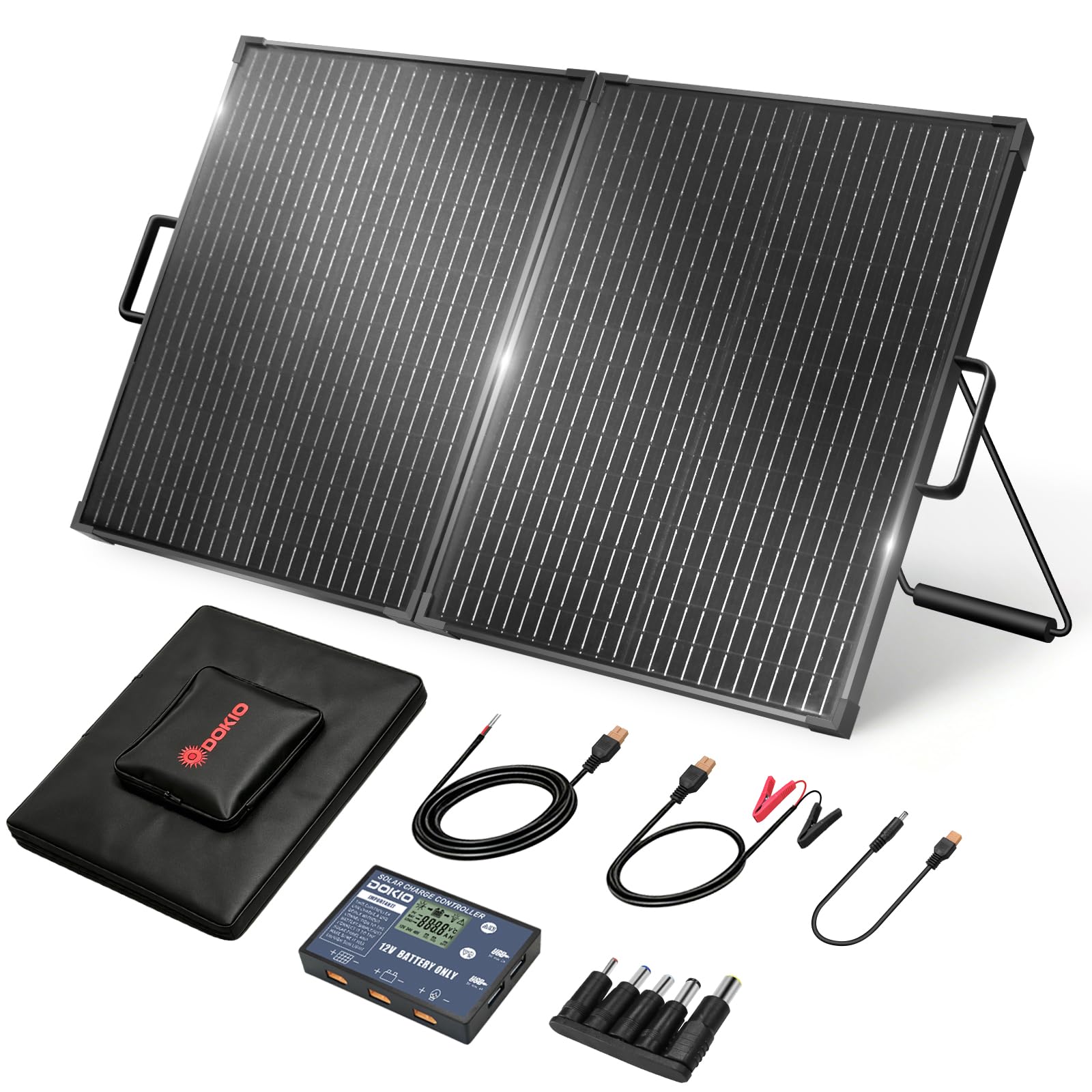
You get charging almost the moment you unfold it: hook the alligator clips to your battery and it starts. A 100W rating and 18V maximum output feed a 5.56 A current, which is more amperage than the ZOUPW 100W foldable manages at 5.23 A — small on paper, but it means a touch more push on bright days. Buyers report the panel charges partially drained batteries within 6 hours, and the recurring theme across reviews is that it simply works as soon as it hits sunlight. Build quality draws the most praise, with functionality close behind — 65 and 62 mentions respectively — so the feel of the panel and its ability to keep working both land well.
It is a suitcase build, so it folds for transport and carries by a rubber handle through hiking, camping, caravan, RV and boat trips. The 9.8ft cable lets you move the panel toward the sun without dragging your power station along. An adjustable bracket lets you angle the panel freely, and the panel is at its best charging efficiency at a 90-degree angle to the sunlight. A built-in smart PWM controller guards against reverse polarity, overcharging, short-circuit and reverse current. Two integrated 5V 2A USB ports let you charge a phone or small gadget straight off the panel, no extra kit needed.
Know the trade-offs before you buy. Sturdiness and power output both draw a mixed response in the review pages — the frame and the fold-out stand feel less solid than the rest of the build, so treat the bracket gently and do not use the stand as a handle. And at 10.1 pounds, this is carryable but not featherweight. Realistically, this is the panel for the camper who wants easy charging without fuss, and the storage bag that ships with it makes packing it up painless. If you plan to hike miles with it on your back, the lighter ZOUPW is the better fit.
The honest read: a 100W panel with a real controller, dual USB and a bag, priced as an easy first kit — quality and ease of use carry it, and the frame is the piece to handle with care.
Best fit: weekend campers and RV owners who want a 100W panel that is ready in seconds and can top up a phone on the side.
Consider a step up if: the folding frame needs to survive being thrown around — a sturdier build costs more.
3. ZOUPW 100W Portable Solar Panel

Tempered glass and a 9.36-pound frame that folds into the camper with room to spare
This panel shrugs off scratches and knocks that would mark a plastic one, because it uses 1.6mm tempered glass where most folding panels use a plastic film surface — the same idea as a phone screen protector but far thicker. It is rated IP68, the stronger of the waterproof ratings on this list, and folds down to 27 x 17.9 x 1.77 inches at 9.36 pounds. That weight matters: it is the one you will actually carry on a hike without resenting it. Efficiency is listed at 23.5%, and the panel pushes a 5.23 A current at up to 23.1 volts.
The accessory set is where this kit pulls ahead of the DOKIO 100W above. You get a 5-in-1 solar cable with XT-60, Anderson, DC5521, DC7909 and DC8020 adapters, which covers most power stations on the market without hunting for a converter. There is also a 20A PWM controller with overcharge, reverse-charging, short-circuit, reverse-polarity and over-temperature protection, plus an SAE-alligator clip cable so you can go straight to a 12V battery. Owners mention a Group 27 battery fully charged in under 3 hours, and the recurring note is that this panel is perfect for keeping an RV juiced up while boondocking. Quality is what gets praised most — 20 mentions — with functionality behind it at 11.
Two kickstands prop the panel at roughly 90 degrees to the sun for peak output, and the whole thing folds back into a storage bag. One caution the maker calls out directly: the PWM controller is not waterproof, so do not leave it out in prolonged rain even though the panel itself is. Also check between the folded panels on arrival — the controller and clip cable ship tucked in the middle layer, and it would be easy to toss them out with the packaging. A 5-year warranty covers the panel.
Why it leads on portability: tempered glass plus IP68 in a 9.36-pound fold is a hard combination to find, and the 5-in-1 adapter set means it plugs into almost anything you already own.
Keep in mind: the controller is a dry-weather component — the panel is the waterproof part.
Pick this when: you are hauling the panel around by hand or packing it tight, and you want it to work with a power station from the start.
Lean toward the DOKIO 100W instead if: you mainly charge a 12V battery and want the extra amperage.
4. Rvpozwer 200 Watt N-Type Solar Panel Kit, 25% Efficiency

One 200W board instead of two 100W panels, wired to lose less in the joining
You avoid the small losses that come from wiring two smaller panels together, because this kit builds the 200W into a single N-type board at a 25% conversion rate. The maker says that removes inter-board connection loss and yields 12% more power than dual 100W kits, with 35% higher efficiency on cloudy days. Those are manufacturer figures, and the daily generation claim of 1,000Wh+ assumes 5–6 hours of sunshine. What you can count on physically: 60 cells, a 30A charge controller, 10AWG solar cable and tray cable, and black Z brackets for a boat or camper mount. Build quality earns the most respect in the review pages, with value-for-money also landing positive.
This is a rigid panel, so it is not a folding carry case — it is a rooftop or camper fixture. The whole unit weighs 20.4 pounds and needs a flat spot with decent airflow. It ships with the controller and cabling, so you are not hunting a separate charge controller. N-type cells are the reason behind the efficiency figure, and they are worth having if your mount gets hot, since that cell type is less bothered by heat build-up.
Be clear-eyed on power output. This is the one pick where performance and power output both draw a mixed verdict from owners — some get exactly the output they expected, while others measure well short of it and report figures around 110 watts. That is not a defect so much as the reality of panel angle, shading and temperature on a fixed board. If your mount sits half-shaded or at a poor angle, expect less. Set it clean and square to the sun, wipe leaves and bird droppings every couple of weeks as the maker advises, and it earns its keep. Also respect the wiring limit: no more than three panels in parallel or three in series.
The case for one big board
- Single 200W N-type panel at 25% conversion, no inter-panel joining loss
- 30A charge controller plus 10AWG cable and Z brackets included
- Build quality is the strongest praise it draws
- N-type cells hold output better in heat than standard cells
Where it can fall short
- Output is mixed in practice — shading and angle cost you real watts
- Rigid 20.4-pound panel, not a fold-and-carry kit
- Cap your array at three panels in series or parallel
Suits you if: you have a permanent camper or boat mount and want maximum watts from one board with the controller already in the box.
Think twice if: your mount has any shade through the day — a portable panel you can move will serve you better.
5. DOKIO 200W 18V Portable Foldable Solar Panel Suitcase Kit

200 watts versus a 100W suitcase, still folding into its own case
Running a fridge or a power station off-grid is where a folding 200W panel hits the balance. This one folds to 1.6 inches thick and carries by a metal grip. It delivers 11.36 A at 22.5V, a serious step up from the 5.56 A the DOKIO 100W suitcase manages — a meaningful jump in how fast a big battery fills. Smart PWM charging handles reverse polarity, overcharge, short circuit and reverse current, and a 5V 2A USB port lets you top off a phone directly. Owners note it charges RV batteries well and still produces on cloudy days, and that it packs down neatly into its own case.
The bracket adjusts through 30 degrees to help you find the sun, and a 9.8ft cable lets you follow the light without hauling the whole setup around. It uses N-type cells in a corrosion-resistant aluminum frame with reinforced corner guards, and the maker rates it from -40°F to 185°F with 5,400 Pa snow load and 2,400 Pa wind load figures. That temperature range is what makes it a real off-grid panel rather than a fair-weather one. A detachable LCD charge controller is included, along with a 1-meter extension cable, a short connector, 5 DC adapter plugs and mounting hardware — so it is ready straight from the box.
Know the limits up front. It is 19.4 pounds, so it is a car boot panel, not a backpack panel. And build quality is the one place reviews turn negative — the folding structure leaves some buyers wanting more rigidity, so adjust the bracket gently and avoid pulling the cables as the maker warns. A 10-year power output warranty softens that frame concern.
The long and short: 200W folding output with N-type cells and a bundled LCD controller is a lot of portable kit in one case — just treat the folding frame as the delicate part.
Choose it for: RV and van trips where you want 200W of charging without bolting anything to the roof.
Skip the fold if: weight and frame rigidity matter more than portability — a rigid 200W board saves you the folding mechanism.
6. ZOUPW 220 Watt Solar Panel Kit

Two 110W N-type panels, a 30A controller, and every cable you need in the box
This is a full install kit, not a portable panel. You get two 110W N-type panels at a listed 25% efficiency, a 30A PWM controller that auto-senses 12V or 24V systems, Y connectors, Z brackets, an 11AWG O-ring cable and an 11AWG PV cable. The maker cites about 1.1kWh of daily generation on 5 hours of full sun. Quality is the standout in the review pages, with performance close behind, and customers note charging a 12V 12Ah battery in a couple of hours — brisk for a kit in this class.
The 16BB N-type cells are the interesting bit. The 16-busbar structure is the cell’s internal wiring grid, and the maker says it eliminates light-induced degradation and keeps output stable in low light and cloudy conditions. It also stands up to road vibration, which is why this kit points at RVs, trailers and marine installs. The controller does 3-stage charging with an LCD monitor, dual USB ports and protections against reverse polarity and overcharge. IP68 waterproofing and a corrosion-resistant aluminum frame let it handle wind and snow. It is expandable too — the PWM controller accepts up to 400W of input, so you can add panels in series or parallel with the included connectors.
At 26.9 pounds and with a rigid aluminum frame, this is roof or rack territory; plan your mount before it arrives. Power output draws a mixed response — some buyers see high output, others find it short of the label. That is the nature of a fixed two-panel array where one panel can shade the other. Aim both panels at clean sunlight and the kit behaves. The 10-year panel and 2-year controller warranties cover early faults.
What makes it a good install kit
- Two 110W N-type panels with a 30A controller and all cabling included
- Controller auto-senses 12V or 24V and accepts up to 400W input
- IP68 rated frame built for road vibration and weather
- LCD controller with dual USB and 3-stage charging
The trade-offs to plan for
- Power output is mixed in practice — shading hits a two-panel array hard
- 26.9 pounds and rigid, so it needs a proper mount
- PWM rather than MPPT, so it leaves some harvest on the table vs an MPPT kit
Built for: Class B camper vans, boats and rooftop installs where you want a complete two-panel array with the controller and connectors already matched.
Look elsewhere if: you want to chase the sun by hand or you have a shaded roof.
7. Renogy 200W 12V N-Type RV Solar Panel Kit

A complete roof kit with a flush-mount controller and a Bluetooth module in the box
One order covers your whole install here, because this is the most complete package on the list. You get two 100W monocrystalline panels, an Adventurer-Li 30A PWM charge controller designed to flush-mount on an RV wall, a 30ft 10AWG adaptor kit, a 16ft 10AWG tray cable, a pair of branch connectors, a BT-1 Bluetooth module and a cable entry housing. Quality and functionality both land strongly with owners, and the panels keep batteries charged through the day. The maker cites 800Wh of daily output based on 4 hours of sunlight and a 22% cell efficiency figure.
You can read your system without climbing up to look at the controller, thanks to the Bluetooth module — the feature nobody else here has. It pairs with an app, though connectivity is the one place the feedback splits, with roughly as many finding it useful as finding it unreliable. Treat it as a handy extra rather than a reason to buy. The controller itself protects against overcharging, overload, short-circuit and reverse polarity, and it mounts flush for a clean wall look. Rated IP67 with a -40°F to +194°F range, the panels handle high winds at 2,400 Pa and snow loads at 5,400 Pa.
Installation is the part owners praise most — the wiring and mounts all match, which takes the guesswork out of a first RV install. Value splits opinion, since you are paying for a brand-name kit with the Bluetooth module and full cable set bundled in. A 5-year warranty covers the hardware, and the panels carry a 25-year power output warranty — worth checking each manufacturer’s terms before you commit to a permanent roof install.
Why it is the complete pick: two 100W panels, a flush-mount 30A controller, cables and a Bluetooth module in one box means one order finishes the job — and installation is its most-praised quality.
Worth knowing: Bluetooth satisfaction is split, so judge it on the panels and controller instead.
Right for: RV and camper owners who want a matched roof kit where every cable and mount is already accounted for.
Not for: you if you plan to move the panel around or want the simplest possible portable setup.
Know the Specs
Maximum power and what it really means
The wattage on the box is the panel’s peak output under ideal sun, usually at a 90-degree angle to clear light. In the real world cloud, shade, heat and a bad angle all chip away at it, so a 200W panel often sends noticeably less than 200W to the battery. The kit’s controller then converts that into a voltage your battery accepts. Treat the watt figure as a ceiling, then size your expectations around your mount and typical weather.
MPPT vs PWM controllers
A PWM controller is the simpler, cheaper design that throttles the panel down to battery voltage. An MPPT controller tracks the panel’s best operating point as light shifts, so more of the harvest lands in the battery — the Voltset kit lists 99% tracking efficiency and 98% peak conversion efficiency for its MPPT design. For small maintainer kits PWM is fine; for larger arrays MPPT gives you more of the watts you paid for.
Cell type and efficiency percentage
The efficiency number tells you how much of the sunlight hitting the panel becomes electricity. Monocrystalline cells, and the newer N-type variant, generally sit higher on that scale than older cell types, which is why a compact N-type panel can match a bigger older one. N-type cells also keep output steadier in heat and low light, which matters on a hot roof or a cloudy afternoon.
Weight and folded size
Folding panels trade surface area for portability, so weight and folded thickness are the two numbers that decide whether you actually carry it. A 9.36-pound fold goes on a hike; a 19.4-pound fold belongs in the car boot. Check a panel’s folded dimensions against your storage space before you buy — a panel that does not fit the van is a panel that stays home.
Common Questions
Will a 100W panel keep my camper van battery topped up?
Can I connect a solar panel directly to my battery without a controller?
What does IP67 or IP68 actually protect against?
Will a folding solar panel work on a cloudy day?
What is the difference between a folding suitcase panel and a rigid kit?
Can I charge a phone or power station off one of these kits?
Will a 12V lithium or AGM battery work with these panels?
How much sunlight does a small solar kit need to charge a battery?
Do I need to maintain a solar panel?
Can I add more panels later to a kit I already bought?
The Bottom Line
For most people, the small solar kit worth starting with is the Voltset 50W Kit — its MPPT controller squeezes real charging out of weak light, and it keeps a stored 12V battery alive with zero fuss. If you need to charge on the move, grab the ZOUPW 100W Foldable for its tempered glass, IP68 panel and 5-in-1 adapter set. And if your setup lives on a roof, the Renogy 200W Kit bundles the panels, controller, cables and a Bluetooth module into one complete install — check that flush-mount controller against your wall before you drill.
How we choose
We do not accept paid placement. Every pick is matched to a real buyer and a real use-case; we do not hands-on test units.
Sources
Specifications: manufacturer listings and product documentation. Review insights: verified customer reviews, as of July 2026. Pricing: not shown on this page (it changes often); check the current price via the retailer link.
As an Amazon Associate, Tactical Gear Guy earns from qualifying purchases. This does not affect which products we feature.