Specs are compiled from manufacturer listings and verified buyer reviews and can change over time — please confirm the key details on the product page before buying.
You buy a small scuba tank that looks compact and tough, then find nobody nearby will fill it, or the valve won’t match your regulator. The Catalina Pony Bottle in 13 cubic feet solves most of those headaches for most buyers. It pairs an aluminum body with a convertible Pro Valve that takes both yoke and DIN regulator fittings. Below you’ll find nine compact cylinders compared on what matters underwater: fill pressure, breath count, valve type, and how you get them refilled.
This guide is built by comparing the manufacturers’ published specifications and the patterns across verified customer reviews, so you get each pick’s real strengths and trade-offs instead of marketing spin.
Compact cylinders come in two families: true pony bottles rated for high-pressure reserve use, and handheld mini tanks built for shallow work. That choice decides everything else about your setup. The right small scuba tank depends on your depth, your fill source, and if you need a redundant air supply.
Top Picks


How To Choose The Best Small Scuba Tank
Your first question is not “how big” but “who fills it.” A compact cylinder only helps if you can put air back in it. Your fill source narrows the field fast.
Pony Bottle or Handheld Mini Tank
A pony bottle is a reserve cylinder you carry alongside your main tank. It uses a standard scuba valve and holds enough air to get you safely to the surface. A handheld mini tank is a smaller, self-contained unit built for shallow work — boat cleaning, pool inspection, snorkeling. The Catalina here is the pony-bottle type at 13 cubic feet. The SMACO S300 is the handheld type at 0.5 liters.
Pick the pony bottle if you dive with a regulator you already own. Pick the handheld if you want a grab-and-go cylinder for shallow water and short bottom times.
Working Pressure and Breath Count
Most compact cylinders in this category are built around 200 bar, which is roughly 3000 psi. The breath count you see quoted — 35 breaths for the S300, 115 for the CHIKADIV C700 — is measured at a specific depth under controlled conditions. Your own count will differ with your breathing rate and how deep you go. Treat the number as a comparison tool between tanks, not a promise.
The Fill Question
There are usually three or four ways to refill these tanks, and they are not equal in effort. A dive shop fill is the easiest. A refill adapter connected to a larger scuba tank is the fastest. An electric compressor is the most self-sufficient. A high-pressure hand pump is the hardest work and often the slowest. Check which of these you can actually access before you buy.
Valve Compatibility
Your regulator has to attach to the tank. Yoke and DIN are the two fitting standards. A convertible Pro Valve accepts both, which saves you an adapter and a headache. If a tank ships with only one fitting type, confirm your regulator matches it first.
Side-by-Side Comparison
| Model | Best For | Capacity | Working Pressure | Weight | Amazon |
|---|---|---|---|---|---|
| Catalina Pony Bottle★ Best Overall | Divers with their own regulator | 13 cu. ft. | — | 8 lb | Amazon |
| SEBiger 0.5L Pony BottleTravel-Ready Pick | Travel and boat backup | 0.5 L | 3000 PSI / 200 bar / 20 MPa | 8 lb | Amazon |
| GOYOJO Mini Scuba TankBest for Snorkelers | Snorkel-to-dive transitions | 0.5 L | 3000 PSI / 200 bar / 20 MPa | 5 lb | Amazon |
| SEBiger Twin 0.5L Kit | Two-person pool sessions | 2 × 0.5 L | 200 bar / 5000 psi relief | — | Amazon |
| CHIKADIV C700 | Longest shallow bottom time | 1.9 L | 3000 PSI / 200 bar / 20 MPa | 4.5 kg empty | Amazon |
| SMACO S700 Plus | Hands-free extended sessions | 1.9 L | 200 bar | 5.51 kg | Amazon |
| SEBiger 1.0L Mini Tank | Longer shallow sessions | 1.0 L | 200 bar | 2.86 kg | Amazon |
| SMACO S300 | Budget entry and travel | 0.5 L | 200 bar | 1.54 kg | Amazon |
| CHIKADIV 0.5L Lung Tank | Learners and casual snorkelers | 0.5 L | 3000 PSI / 200 bar / 20 MPa | — | Amazon |
Detailed Reviews
1. Catalina Pony Bottle Tanks, Yellow with Pro Valve
Our pick — 4.5+★ from 70+ verified ratings; the strongest balance of quality and price.
The one that speaks regulator, not gimmick — and takes both fittings.
This is the pick for the diver who already owns a regulator and wants a real reserve cylinder behind it. The Catalina holds 13 cubic feet of air — the largest capacity on this list by a wide margin. Its aluminum body is built for buoyancy, so it sits and moves predictably underwater instead of dragging your trim off.
What wins people over is the valve. The convertible Pro Valve accepts yoke and DIN setups, so you are not hunting for an adapter or hoping your regulator matches. Every other tank here is a handheld unit with its own mouthpiece, while this one slots into a standard scuba configuration.
It is also Nitrox ready up to 40% oxygen, so enriched-air fills are an option. At 8 pounds it is heavier than the 5-pound GOYOJO, but it is a real cylinder rather than a handheld lung tank. Catalina covers it with a manufacturer lifetime limited warranty.
What earns it top billing
- 13 cubic feet — the biggest reserve on the list
- Convertible Pro Valve fits yoke and DIN regulators
- Nitrox compatible up to 40% oxygen
- Aluminum build tuned for buoyancy control
- Manufacturer lifetime limited warranty
Before you commit
- 8 pounds is the heaviest tank here
- No mouthpiece or handheld setup included
- You need a regulator and a fill source to use it
Reach for this one if: you dive with your own regulator and want a redundant air source that matches standard scuba gear.
Think twice if: you want a grab-and-go cylinder with a mouthpiece already attached for shallow work.
2. SEBiger 0.5L Pony Bottle with DOT Certification
Small enough for a carry-on, serious enough to stay on the boat.
For boat owners and travelers who want a compact backup cylinder they can stow and forget, this SEBiger hits the practical notes. The tank body and cylinder separate, so you can pack it for air travel — a real advantage for anyone who wants to dive somewhere other than home.
It holds 0.5 liters and supports 200 bar / 37 breaths. That is a short supply, but it is a backup, not a primary. Construction is 6061 aerospace-grade aluminum with a triple-layer design that resists seawater corrosion. A 5K pressure relief valve kicks in at 5000 psi, venting gas through an internal bursting disc — you replace the disc before diving again. The mouthpiece is food-grade silicone.
Portability is what owners praise most here — it lives on the boat without taking up space. The fill routes are the same three-way system you see across this category: dive shop, adapter in about 4 seconds, compressor in about 11 minutes, with the manual pump as a backup at 30 minutes. That last option is the one to avoid leaning on.
Where it shines: the detachable body and DOT certification make this the tank that travels with you, whether by plane or by boat. Fill options cover shop, adapter, compressor, and hand pump.
Suited to: travelers and boat owners who want a stowable 0.5 L backup with real safety valving.
Less ideal: if you want long bottom time, 37 breaths at 0.5 L will run dry fast.
3. GOYOJO Mini Scuba Tank with Full-Face Mask
A mask and tank that switch from surface to underwater mid-swim.
The snorkeler’s answer to the small tank problem — this is the only kit here that pairs the cylinder with a full-face mask. The mask connects to the 0.5 L tank through a mask connector, so you snorkel on the surface and drop into the tank when you want to look closer at something.
The mask carries a 180° wide field of view, so your peripheral vision stays open while you swim. Anti-fog treatment keeps the glass clear through the dive. Above water you breathe through a dry snorkel that seals automatically when you go under, then hands off to the tank air supply.
The cylinder is 6061 aviation aluminum with a luminous pressure gauge and relief valves. It charges by high-pressure pump, refill adapter, or electric inflator, at a maximum pressure of 3000 PSI / 200 BAR / 20 MPa. The included kit runs from manual and O-ring set to the mask and tank. At 5 pounds it is 3 pounds lighter than the Catalina’s 8, which makes it easier to swim with. The trade-off is genuine: some owners find filling takes about 30 minutes with an electric compressor.
Pick this if: you want one kit that handles snorkeling and shallow diving without swapping gear.
The catch: that 0.5 L cylinder and the fill time mean this is a short-use, plan-ahead setup, not an on-demand tank.
4. SEBiger 0.5L Mini Scuba System, Twin Kit
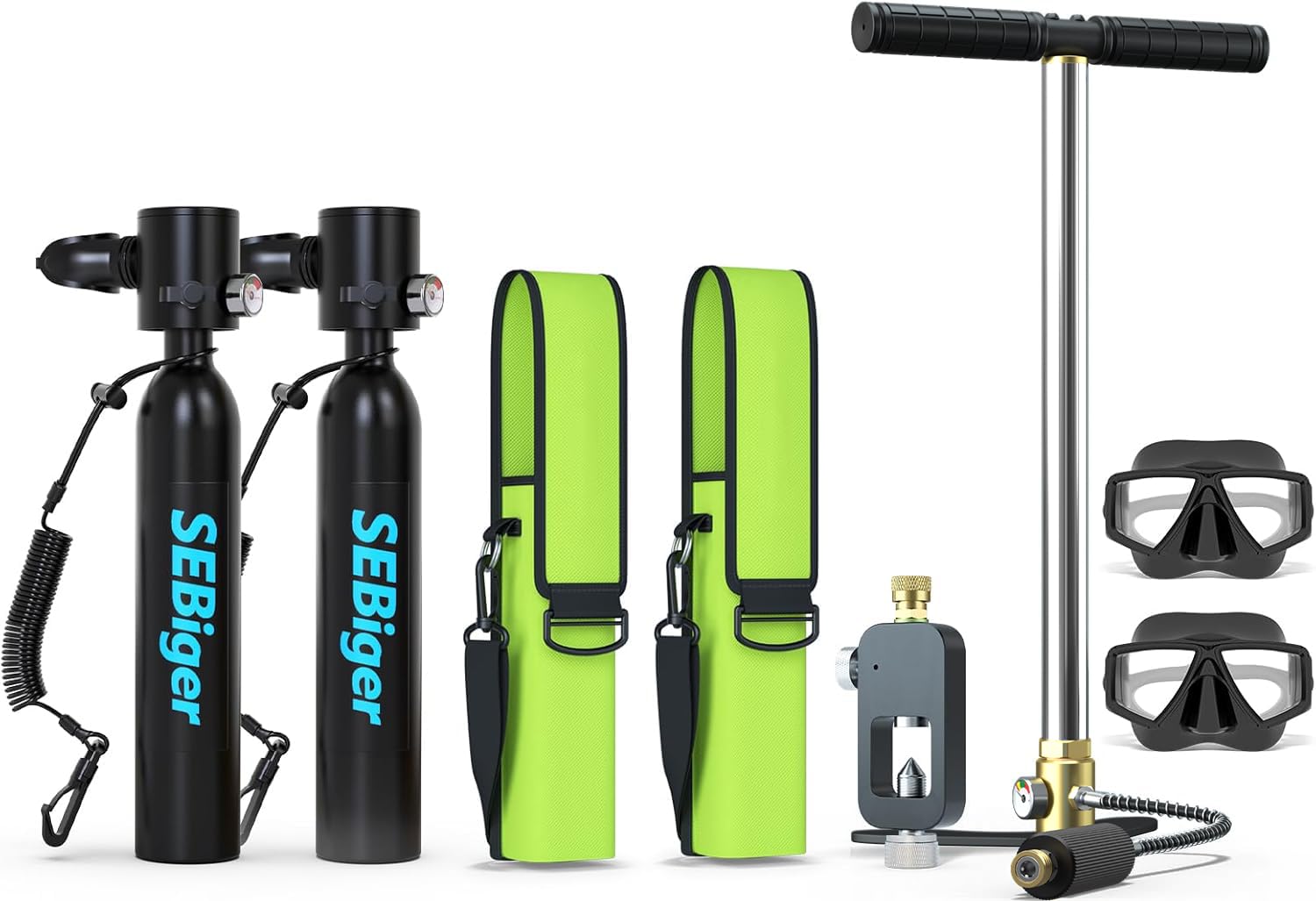
Two tanks, two masks, two bags — one box for a shared dive day.
If you dive with a partner, this is the only kit here built for two at once. Two 0.5-liter cylinders each give 200 bar / 37 breaths. Two masks, two cylinder bags, two anti-loss cords, and a mini hand pump fill out the package.
The cylinders have food-grade silicone mouthpieces and a 5K explosion-proof valve that vents at 5000 psi through an internal copper disc, protecting against overfill. A professional-grade dust cap shields each nozzle. The body and valve head separate for airline carry-on.
The honest note is the pump. The kit includes a mini hand pump, and owners are split on how easy it is to use — some find it straightforward, others run into trouble working it. Plan on a shop fill or compressor as your primary route and treat the hand pump as emergency backup. For two people sharing short pool or shallow sessions, it delivers a lot of gear in one purchase.
Why a paired diver will like it
- Two cylinders plus two masks in one set
- 200 bar / 37 breaths per cylinder
- 5K explosion-proof valve on each tank
- Bags, cords, and pump included
- Detachable bodies for air travel
The trade-off to know
- Hand pump reputation is mixed — don’t rely on it
- 0.5 L tanks still run short on air
- Bulkier package than a single-tank setup
Best match: a dive buddy or couple who wants two complete shallow-water setups in one buy.
Look elsewhere if: you dive alone, or you expect the included hand pump to be your main fill method.
5. CHIKADIV C700 1.9L Mini Scuba Tank
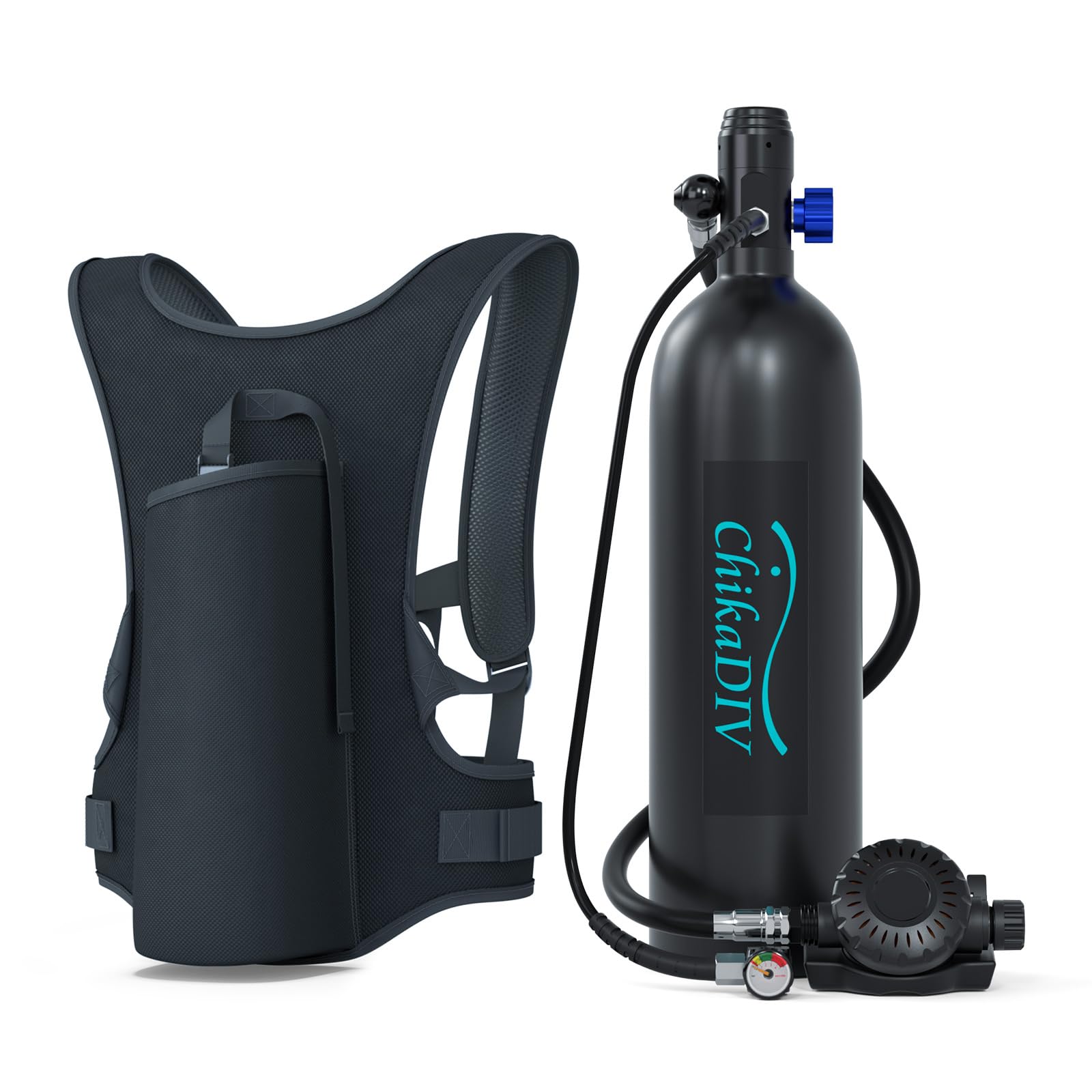
A 1.9 litre lung tank that buys you a longer stay down there.
The C700 holds 1.9 liters and delivers roughly 115 breaths at 200 bar, tested at 16 feet. Against the 0.5 L SMACO S300’s 35 breaths, that is a much larger air reserve for the same working pressure — the number that makes this the tank for longer shallow sessions.
What makes it easier to use underwater is the pressure gauge on an extension tube, so you can read your remaining air without squinting at the bottle. A 360° swivel fitting on the secondary valve keeps the regulator moving with you. The C700 regulator adds a decompression chamber and air switch. The whole tank sits in a vest that fixes it on your back and frees your hands.
Deep and cold use is where you should be careful. The manufacturer lists a maximum applicable depth of 10 meters and warns against deep or below-50°F use except as a reserve air source. Reliability is the mixed point in owner accounts, which is worth respecting — this is shallow-water gear, not a deep-dive primary. At 4.5kg empty it travels once disassembled.
The real draw: 115 breaths from a 1.9 L tank at 200 bar, with a gauge you can actually read and a vest that keeps your hands free.
Go with this: for shallow recreational diving, boat work, or underwater photography where you want the most air on this list.
Not for: deep dives or cold water — the maker caps it at 10 meters and reserve use only below 50°F.
6. SMACO S700 Plus 1.9L Mini Scuba Tank

The hands-free 1.9 litre kit with a gauge you can read mid-dive.
This is the premium end of the handheld category, and the extra spend buys you a longer readable gauge, a vest, and a mesh travel bag. The 1.9 L cylinder delivers approximately 115 breaths at 200 bar, tested at 33 feet — deeper than the C700’s 16-foot test, so the same breath count reflects a harder working depth.
It is built for hands-free shallow work. The vest holds the tank on your back and the mesh bag carries the whole kit. SMACO lists it for recreational diving, treasure hunting, lobstering, boat inspection, and rapid entry rescue. Refill routes are shop fill, an 8mm adapter that tops it off in about 16 seconds, or the SMACO air compressor in about 46 minutes. A high-pressure hand pump will not fill this tank at all.
The point to weigh honestly: suitability for scuba use is mixed in owner accounts, and the maker is clear this is shallow-water gear and a redundant air source. If you plan to rely on it as a primary supply for deep dives, this is the wrong tool. For pool work, boat maintenance, and shallow exploration, the capacity and hands-free setup do their job.
Ideal for: divers who want maximum shallow-water air with hands-free carry and a travel bag.
Know before buying: a hand pump can’t fill it, and it is designed as shallow reserve gear rather than a deep-dive primary.
7. SEBiger 1.0L Mini Scuba Tank Kit
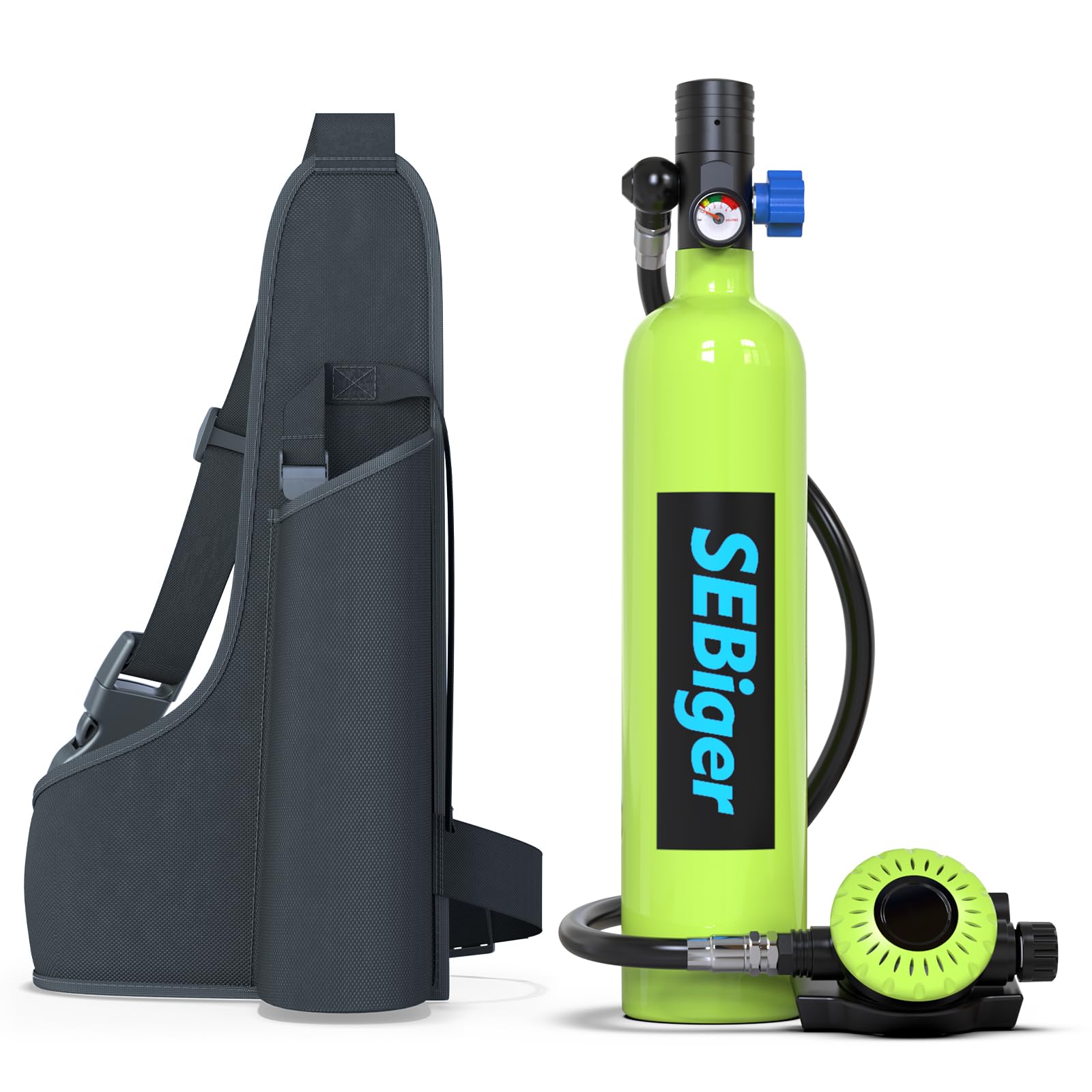
Double the air of a 0.5 L tank, in a body you can still strap on.
SEBiger’s 1.0 L sits in the middle of the handheld size range. Its 200 bar fill delivers up to 20 minutes of underwater breathing under standard conditions — twice the 0.5 L capacity of the SMACO S300 in a mid-size body. The body is 6061 aerospace-grade aluminum with CE/DOT dual certification.
The breathing valve is a constant-pressure design for smooth airflow, paired with an adjustable control valve. A dedicated harness straps the tank to your body and frees both hands, which makes free-diving mode and underwater photography far less clumsy. The 8mm interface allows dive-shop refills, an adapter tops it off in about 8 seconds, the SEBiger compressor takes 26 minutes, and a manual pump runs 50 minutes.
The manufacturer’s own caution matters: recommended depth is 17 feet, and deep or below-50°F water means reserve use only. This is a shallow-water companion. The package includes the cylinder, the dedicated mounting strap, and a manual. If you want more air than a 0.5 L but not the bulk of a 1.9 L, this is the sensible middle.
Why it fits the middle: 1.0 L at 200 bar with a CE/DOT dual certification, a hands-free harness, and a fast adapter refill.
The right buyer: snorkelers and shallow divers who want hands-free gear with more air than a handheld mini tank.
Skip if: you plan to go past 17 feet — that is the maker’s recommended depth limit.
8. SMACO S300 Mini Scuba Tank, 0.5L
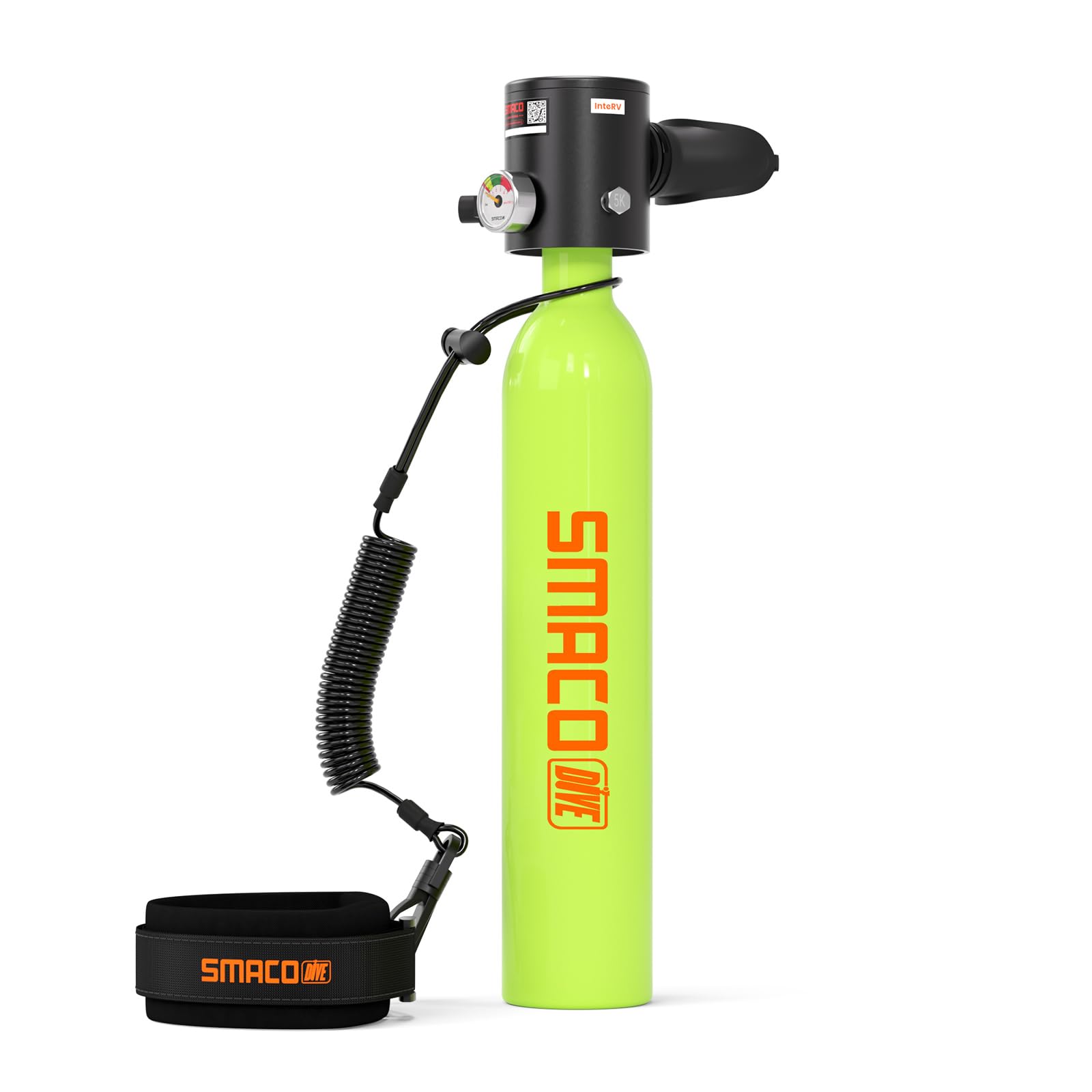
The budget doorway into a compact diving cylinder — with a caveat.
The S300 is the entry point into this whole category. It holds 0.5 L and delivers approximately 35 breaths at 200 bar, tested at 16 feet. The latest S300 upgrade adds an external explosion-proof device and an upgraded breathing valve core for smoother airflow. At 1.54kg, it is the lightest tank here by a wide margin — easy to toss in a bag.
What makes it travel-friendly is that the small tank disassembles for the plane. Maximum depth is 16 feet, and it works as a backup air source for deep diving within 100 feet. A three-layer filtration system blocks dust and impurities. Construction is aerospace-grade 6061 aluminum alloy. You can fill it at a local dive shop, through the 8mm adapter in about 4 seconds, an air compressor in about 11 minutes, or a hand pump in about 30 minutes.
The caveat is the pump. Owners are clear that operating it is a workout, and air supply gets mixed reviews — some breathe easily underwater, others report air escaping. This is the budget entrant, so treat it as a short-shot backup for shallow work rather than a serious dive tool. The quality and functionality are what owners tend to praise most.
What the budget gets you
- 1.54 kg — the lightest tank on the list
- 35 breaths at 200 bar for a short backup
- Upgraded breathing valve core and explosion-proof device
- Disassembles for air travel
Where it asks patience
- Hand pump is hard work to operate
- Air supply gets mixed reports
- 16-foot max depth limits real-world use
A sensible start: if you want a lightweight 0.5 L backup and can fill it at a shop or with a compressor.
Hold off if: you expect a hand pump to be easy or you need to go deeper than 16 feet.
9. CHIKADIV 0.5L Lung Tank for Snorkeling

An entry lung tank with a gauge that glows so you can read your air.
This CHIKADIV is the simplest 0.5 L option, and it is built with the new diver in mind. The manufacturer markets it as learner-friendly, and its DOT certification covers it for dive-shop fills. The body is 6061 aviation aluminum with 4mm wall thickness, painted for extra protection against corrosion and heat.
The fluorescent pressure gauge is the detail that helps most — you can judge remaining air at a glance, even in low light. The mouthpiece is food-grade silicone, and a 5K explosion-proof valve releases pressure automatically if the tank is overfilled. Working pressure is 3000 PSI / 200 bar / 20 MPa with an 8mm inflation interface.
Fill options are a refill adapter from a larger cylinder at a dive shop, an electric compressor that fills the 0.5 L in about 10 minutes, or a hand pump. CHIKADIV recommends the hand pump only as a backup device, which is honest. Dive time varies with breathing rate and depth. Use it for snorkeling, boat cleaning, or a first diving tool.
Who it clicks with: a first-time user who wants a DOT-certified 0.5 L tank, an easy-to-read glowing gauge, and simple fill options.
Worth it for: casual snorkelers and beginners who want a certified, low-effort entry tank.
Not the pick for: anyone chasing long bottom time — the 0.5 L tank is a short-use tool, and the hand pump is backup only.
Know the Specs
Working pressure (bar and psi)
Working pressure is how much air the cylinder holds, measured in bar or psi. Most compact tanks here run at 200 bar, which is about 3000 psi. Higher pressure means more air in the same space, but it also means the fill equipment has to be rated for it. A tank rated at 3000 PSI / 200 bar / 20 MPa can be filled at any dive shop that handles standard scuba cylinders.
Breath count
A breath count tells you roughly how many breaths a full tank gives at a specific depth, under controlled test conditions. It is a comparison tool, not a guarantee. Your own count changes with how fast you breathe and how deep you go. A tank quoted at 115 breaths at 16 feet will not last as long at a deeper depth.
Valve type: Pro Valve, yoke, and DIN
Your regulator connects to the tank through the valve. Yoke and DIN are the two fittings. A convertible Pro Valve, like the one on the Catalina, accepts both, so you skip an adapter. Handheld mini tanks use their own mouthpiece instead of a regulator fitting, so valve compatibility does not apply to those.
Relief and explosion-proof valves
These are safety features. When internal pressure rises past a set point, a relief valve vents gas so the cylinder does not over-pressurize. Many tanks here use a 5K design that vents at 5000 psi through a bursting disc or copper disc. On some, you must replace the disc before diving again. Read the manual — this is not the place to guess.
Common Questions
Can I get a small scuba tank filled at a regular dive shop?
What is the difference between a pony bottle and a mini scuba tank?
How deep can I safely take these small tanks?
Can I take a small scuba tank on a plane?
How many breaths will I actually get from a 0.5L tank?
Do I need a compressor or can I use a hand pump?
What does a convertible Pro Valve do for me?
Are these small tanks Nitrox compatible?
What does the 5K explosion-proof valve actually do?
The Bottom Line
For most divers, the small scuba tank winner is the Catalina Pony Bottle, because its convertible Pro Valve fits yoke and DIN regulators and its 13 cubic feet of air dwarfs every handheld tank here. If you want maximum shallow-water air with a readable gauge and a vest that frees your hands, grab the CHIKADIV C700 at 1.9 L and roughly 115 breaths. And for travel, the SEBiger 0.5 L is the one to reach for — it separates for the plane and lives on the boat without a fuss. One honest nudge: the Catalina is the only true pony bottle on this list, so if you already own a regulator, it is the pick that fits your existing gear with no adapter to buy.
How we choose
We do not accept paid placement. Every pick is matched to a real buyer and a real use-case; we do not hands-on test units.
Sources
Specifications: manufacturer listings and product documentation. Review insights: verified customer reviews, as of November 2026. Pricing: not shown on this page (it changes often); check the current price via the retailer link.
As an Amazon Associate, Tactical Gear Guy earns from qualifying purchases. This does not affect which products we feature.