Specs are compiled from manufacturer listings and verified buyer reviews and can change over time — please confirm the key details on the product page before buying.
You want one small pot that heats milk without scorching, melts butter without a double boiler, and pours gravy without a trail down the outside of the pan. That is the whole job of a small saucepan. One honesty note before you scroll: this list matches small capacity loosely — roughly 1 to 2 quarts, accepting up to 2.5 quarts — so not every pick is the exact number you typed into the search bar. The nearest same-type size does the same job, and every capacity below is stated exactly as the maker lists it.
This guide is built by comparing the manufacturers’ published specifications and the patterns across verified customer reviews, so you get each pick’s real strengths and trade-offs instead of marketing spin.
Heat control is the real test of a small pot, not the shine on the box. Below you’ll find nine pans built to sit on one burner and behave, and the fastest route to the right one is our lineup of the small sauce pan picks worth your counter space.
Top Picks
How To Choose The Best Small Sauce Pan
A small sauce pan earns its drawer space by holding heat steady at low settings. The wrong one spikes on one spot, scorches the bottom of your béchamel, and gets shoved to the back of the cabinet. These are the four things that separate a keeper from a regret.
Capacity: match the pan to the job, not the shelf
One quart covers a single serve of oatmeal, a couple of boiled eggs, or a small batch of sauce for two. One and a half quarts is the flexible middle ground for warming milk and reducing a pan sauce. Two quarts is where you start reheating soup for a family and boiling a partial box of pasta. A pan filled more than two-thirds loses its headroom for stirring.
Build: full tri-ply versus a triple-layer base
Tri-ply bonded construction sandwiches an aluminum core between stainless layers, so heat spreads sideways through the whole wall instead of climbing one spot. A triple-bottom pan puts that aluminum core only in the base. Both work on a burner, but a full-clad wall tends to be gentler on sauces that sit low in the pan. Aluminum pans, by contrast, conduct heat fast and heat up quickly, but they are hand-wash only and typically need a lid bought separately.
Cooktop compatibility and oven limits
Induction burners only respond to magnetic metal. An 18/0 or 430 stainless outer layer is what makes a pot induction compatible, and every tri-ply pick here lists all-stovetop use including induction, gas, electric and ceramic. Oven ratings matter if you finish a dish under the broiler — stainless bodies commonly go far higher than their glass lids, so check the lid separately before you slide the whole thing in.
Handles, rims, and the pour
A riveted stay-cool handle is what keeps your wrist safe when the pot is full. A hollow or tubular handle diffuses heat better than a solid one. Look hard at the rim: a flared edge or a dedicated pour spout is the difference between a clean stream into a bowl and a drip running down the outside wall. Strainer holes built into a lid save you grabbing a colander for a single portion of noodles.
Side-by-Side Comparison
| Model | Best For | Capacity | Build | Weight | Amazon |
|---|---|---|---|---|---|
| Made In 2 Quart Stainless Clad Saucepan★ Best Overall | Sauces and stews for two | 2 quarts | 5-ply stainless clad | 2 pounds | Amazon |
| Winco 2 1/2 qt Tapered Aluminum Sauce PanBudget Workhorse | High-volume stirring on a budget | 2.5 qt | 3mm 3003 aluminum | 16 ounces | Amazon |
| P&P CHEF 1 Quart Tri-Ply SaucepanBest for One | One person, one portion | 1 quart | Full 3-ply, 18/10 interior | 1.03 kg | Amazon |
| Ohtomber 1.5 Qt Tri-Ply Saucepan | Steaming vegetables and dumplings | 1.5 quarts | Tri-ply with steamer basket | 1.32 kg | Amazon |
| MICHELANGELO 1.5 QT Saucepan | Drip-free pouring into bowls | 1.5 quarts | 18/10 with tri-ply bottom | — | Amazon |
| Update International SSP-2 | Straight-sided braising and induction | 2-Quart | Stainless steel | 7.04 ounces | Amazon |
| Quienkitch 1.5 Quart with Pour Spout | Tea, milk, and straining pasta | 1.5 QT | Tri-ply bonded base, 18/10 | 2.1 pounds | Amazon |
| Tramontina Signature 1.5-Quart | Small sauces and reheating soup | 1.5 quarts | Tri-ply clad, aluminum core | 2.1 pounds | Amazon |
| Tramontina Signature 2-Quart | Soup and pasta for two | 2 quarts | Tri-ply clad, aluminum core | 2.6 pounds | Amazon |
Detailed Reviews
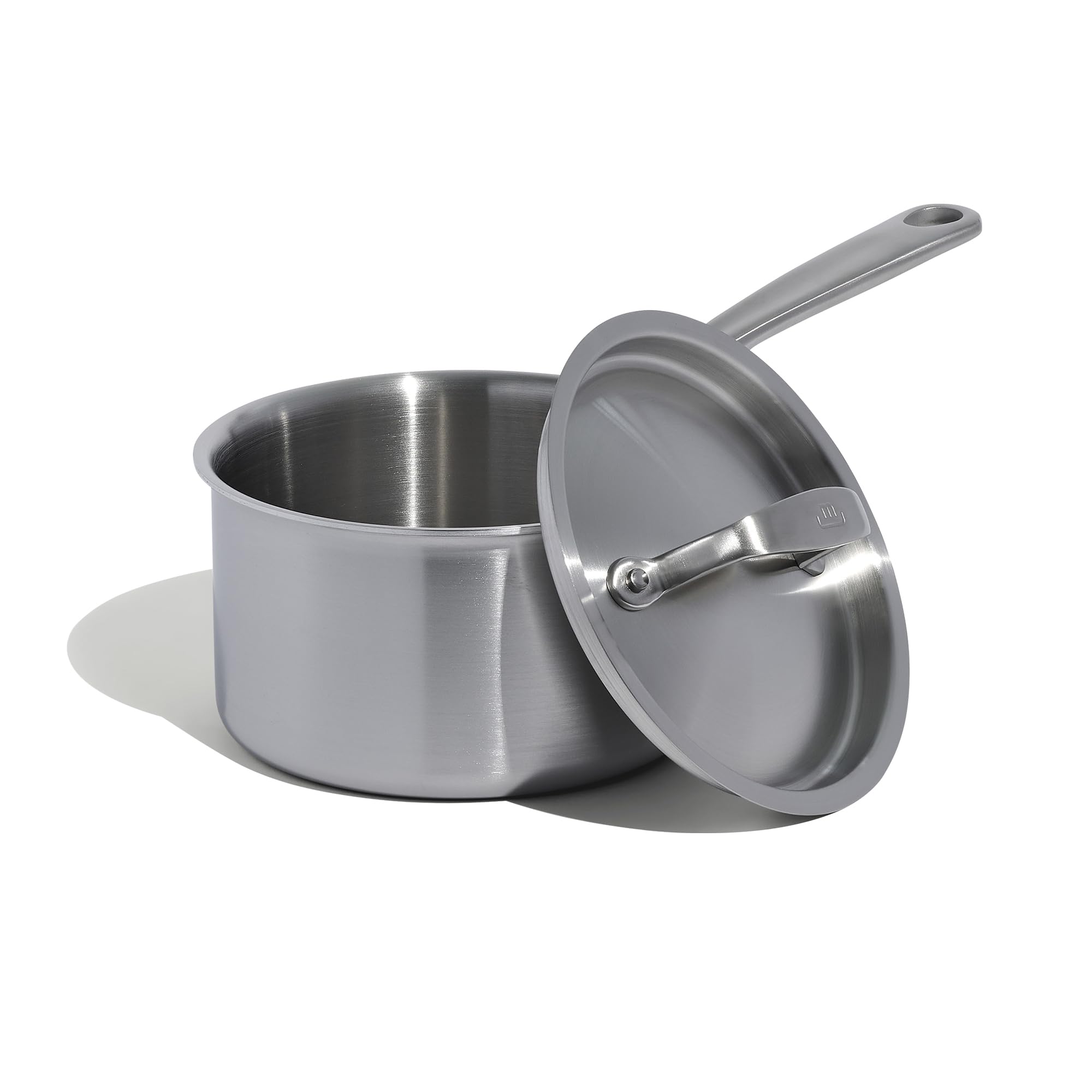
1. Made In Cookware 2 Quart Stainless Steel Saucepan
Our pick — 4.5+★ from 600+ verified ratings; the strongest balance of quality and price.
Five layers of metal and a snug lid, built to hold a simmer for twenty minutes without babysitting.
This 2 quart pan is the one to reach for when you are making a sauce you actually care about. Five layers of stainless cladding spread heat across the whole wall rather than one hot circle, and the 3.85-inch depth gives a reduction room to bubble without climbing the sides. Total diameter is 7 inches with a 6-inch cooking surface, so it still tucks onto a single burner while fitting a real batch of stew.
What wins buyers over is the sheer build — the quality of the metalwork draws by far the most praise, and durability runs second. Owners describe a commercial-feeling pan that heats fast and moves from stovetop to oven without complaint. Induction is covered by that top layer of 430 stainless steel, so it responds on magnetic burners as readily as gas. The lid seats tightly enough that moisture stays in the pot, which is exactly what a long braise wants.
Here is the catch, and it is the only recurring one: the premium cost is the most split opinion on the page. Plenty of cooks call it money well spent on a pan that will outlast them; a fair number question the premium. Weigh that against a 2 pound weight — noticeably heavier than the Winco’s listed 16 ounces — and this is a pan you lift with a purpose, not one you flip one-handed while pouring. If you want maximum heat control in a two-quart pan, nothing here beats it. If you want a knock-around pot for boiled eggs, you are overpaying for talent you will not use.
Where it earns the top spot
- 5-ply clad walls hold even heat for delicate sauces and soups
- 430 stainless steel top layer makes it induction compatible
- 2 quart capacity with a 6-inch cooking surface for real batches
- Tight-seating lid traps steam for braises and stews
What to weigh first
- Premium pricing splits opinion more than any other spec here
- 2 pounds in hand feels heavier than the aluminum alternatives
Reach for this if: you cook sauces and stews for two and want a pan that responds the instant you drop the flame.
Look elsewhere if: the premium price is a stretch for a pot that will mostly boil eggs.
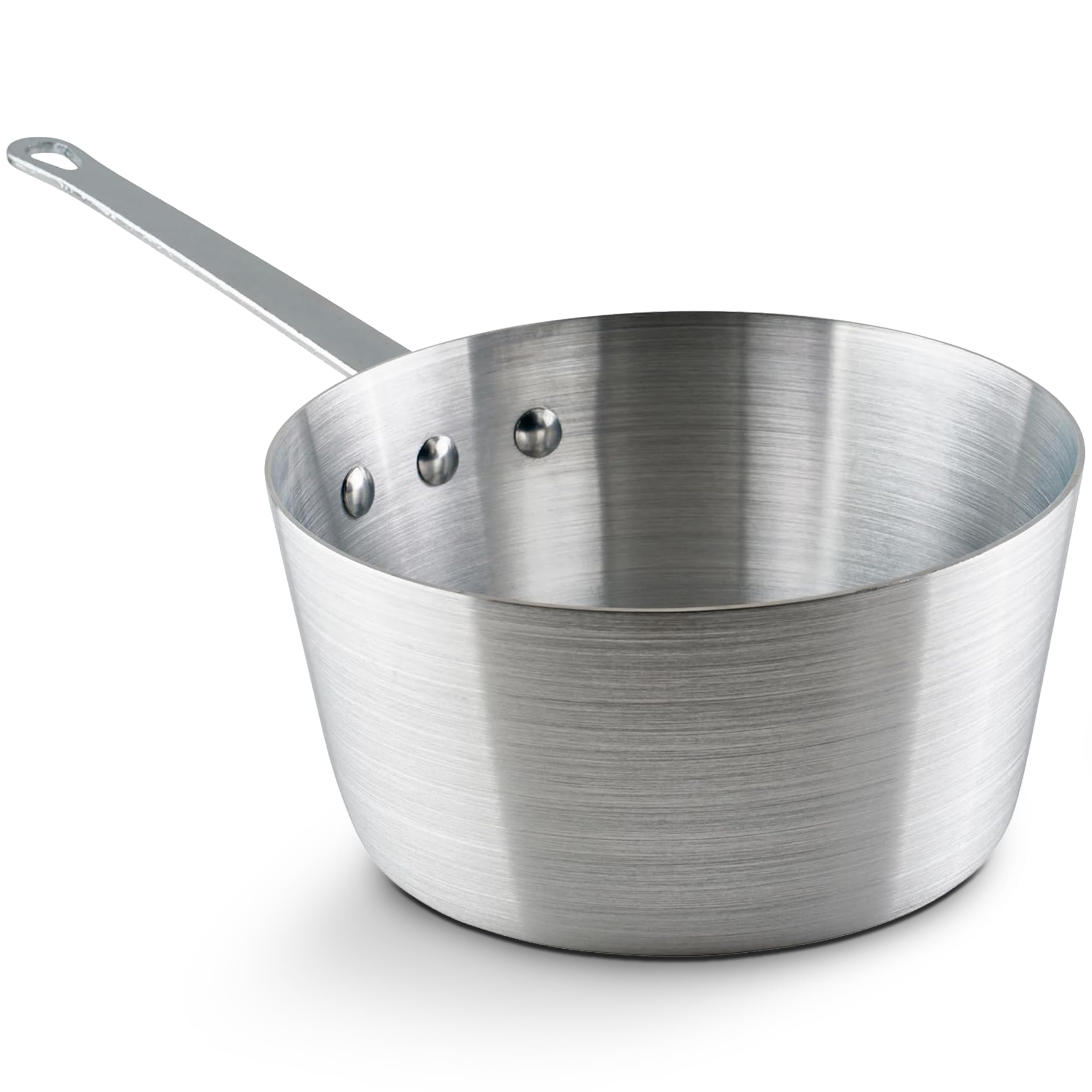
2. Winco 2 1/2 qt Heavy-Duty Tapered Aluminum Sauce Pan
The restaurant-supply pot that weighs next to nothing and takes a beating at high heat.
Tapered sides are the design story here — the walls angle gently outward so a spoon or whisk travels the bottom and up the side without catching in a corner. That shape is why this 2.5 quart pan suits churning a roux or stirring a big batch of oatmeal. It measures 8.06 inches across, which is more than double the 3.85-inch depth of the Made In’s cooking surface, so you are working with a wide, shallow pool rather than a tall column. Total height is 5.63 inches, taller than the P&P CHEF’s 3.54 inches.
The metal is 3mm thick 3003 grade aluminum, a commercial-grade sheet chosen for even heating and long service. At 16 ounces it is the lightest pan on this list by a wide margin, which matters when you are pouring off hot liquid one-handed. The handle is riveted for a secure grip and carries a built-in hanging hole, so it stores on a hook instead of eating cabinet space. NSF listing tells you the build meets commercial kitchen material standards.
Two honest limits live in this pan. First, it is hand wash only — aluminum does not belong in a dishwasher. Second, the lid is sold separately, so this is a pan you buy for open-top work. The size labeling draws mixed reactions, and a few find it larger than they pictured for a small pot. Heat is the bigger talking point: aluminum moves heat fast, and a couple of owners found food scorches if the burner stays high, plus the handle warms up on longer cooks. Keep the flame moderate and this becomes the cheapest way to stir a big batch comfortably.
Best value in the lineup: commercial-grade 3mm aluminum, a riveted hanging handle, and a tapered bowl that stirs clean — the everyday pot for someone who cooks in volume and washes by hand.
Temper the flame: aluminum responds quickly to heat, so low-to-medium settings are where this pan behaves best.
Who it beats: any clad pot at this price if you stir often and want a feather-light pan.
Who should pass: anyone who wants a lid in the box or plans to load the dishwasher.
3. P&P CHEF 1 Quart Tri-Ply Saucepan with Visible Lid
A single-serve pot small enough for a dorm shelf, sturdy enough to feel like real cookware.
One quart is the point of this pan, and it commits fully. That is half the capacity of the Made In’s 2 quarts, so this is the pot for boiling a couple of eggs, warming milk for one, or simmering a sauce sized for two people. The full 3-ply body sandwiches an aluminum core between an 18/10 stainless interior and an 18/0 stainless exterior. The 18/10 interior will not react with food and change its taste, and the 18/0 outer layer is what makes it induction compatible.
The glass lid earns its keep in daily use. It is tempered with a steel edge, and the steam hole vents excess pressure so a boil does not climb over the rim. You can watch a sauce thicken without lifting the lid and losing the heat you built up. The pan itself is oven safe to 500°F, though the glass lid must stay out of the oven. Both pan and lid are dishwasher safe, and the brushed interior helps reduce sticking while the mirror outside keeps its shine.
Weight runs 1.03 kg, the lightest of the tri-ply group and noticeably lighter than the Ohtomber’s 1.32 kg. Handles are riveted and long enough to feel controlled, with a hanging hole at the end. The one defect worth knowing about: a small number have found the inner base pitting right away, so check the cooking surface when it arrives. For a one-person kitchen or a starter setup, a 1-quart tri-ply pan at this price is hard to argue with.
Why the single cook picks it: a genuine 1 quart tri-ply pot with a vented glass lid, oven safe to 500°F, induction ready, and light enough to handle with one hand at 1.03 kg.
Check on arrival: give the inner base a look for pitting before the return window closes.
The straight answer: buy this if you cook for one and want a real tri-ply pan rather than a flimsy starter pot.
Keep looking if: you regularly feed two or more — one quart fills fast.
4. Ohtomber 1.5 Qt Stainless Steel Saucepan

Two pans in one body — a saucepan for sauce, a steamer for broccoli, and one lid doing both jobs.
Most small sauce pans do one thing. This one drops a steamer basket inside a 1.5 quart tri-ply pot, so the same vessel that simmers oatmeal steams dumplings twenty minutes later. The basket lifts out, the pot goes back to ordinary saucepan duty, and the tight transparent lid works for both. Owners repeatedly frame it as a two-for-one, and the versatility is a real draw rather than a marketing line.
Construction is a food-grade 18/8 stainless interior over an aluminum core, with a magnetic stainless exterior that works on gas, electric, ceramic, halogen and induction. The handles are riveted stainless and built to stay cool, and the steam hole in the lid lets you vent pressure before a boil overflows. It measures 13.9 inches long by 6.9 inches wide by 4.1 inches high, and at 1.32 kg it sits 28% heavier than the P&P CHEF’s 1.03 kg — that extra mass is the basket and the wider body. Length runs 13.9 inches versus the P&P CHEF’s 13.07 inches.
Quality draws the loudest praise, with size close behind — families use it daily for toddler vegetables, and the single serve crowd finds it sized right for one or two. A few find it smaller than they pictured; the honest read is that 1.5 quarts is a side-dish pan, not a meal-for-four pot. The exterior is mirror polished and dishwasher safe, though hand washing with a non-abrasive pad keeps that finish longer. If you steam vegetables more often than you simmer sauce, start here.
The case for the basket
- Built-in steamer basket turns one pot into two
- Transparent lid with a steam hole vents while you watch
- 18/8 interior works across gas, electric, ceramic, halogen and induction
- Stay-cool riveted handles and a hanging hole for storage
The sizing truth
- 1.5 quarts suits side dishes and one or two servings, not family portions
- 1.32 kg feels heavier in hand than the plain 1 quart clad pots
Buy it for: daily vegetable steaming, dumplings, and baby food in the same pan you simmer sauce in.
Think twice if: you need a main-course pot for a family — go up in capacity.
5. MICHELANGELO 1.5 QT Saucepan
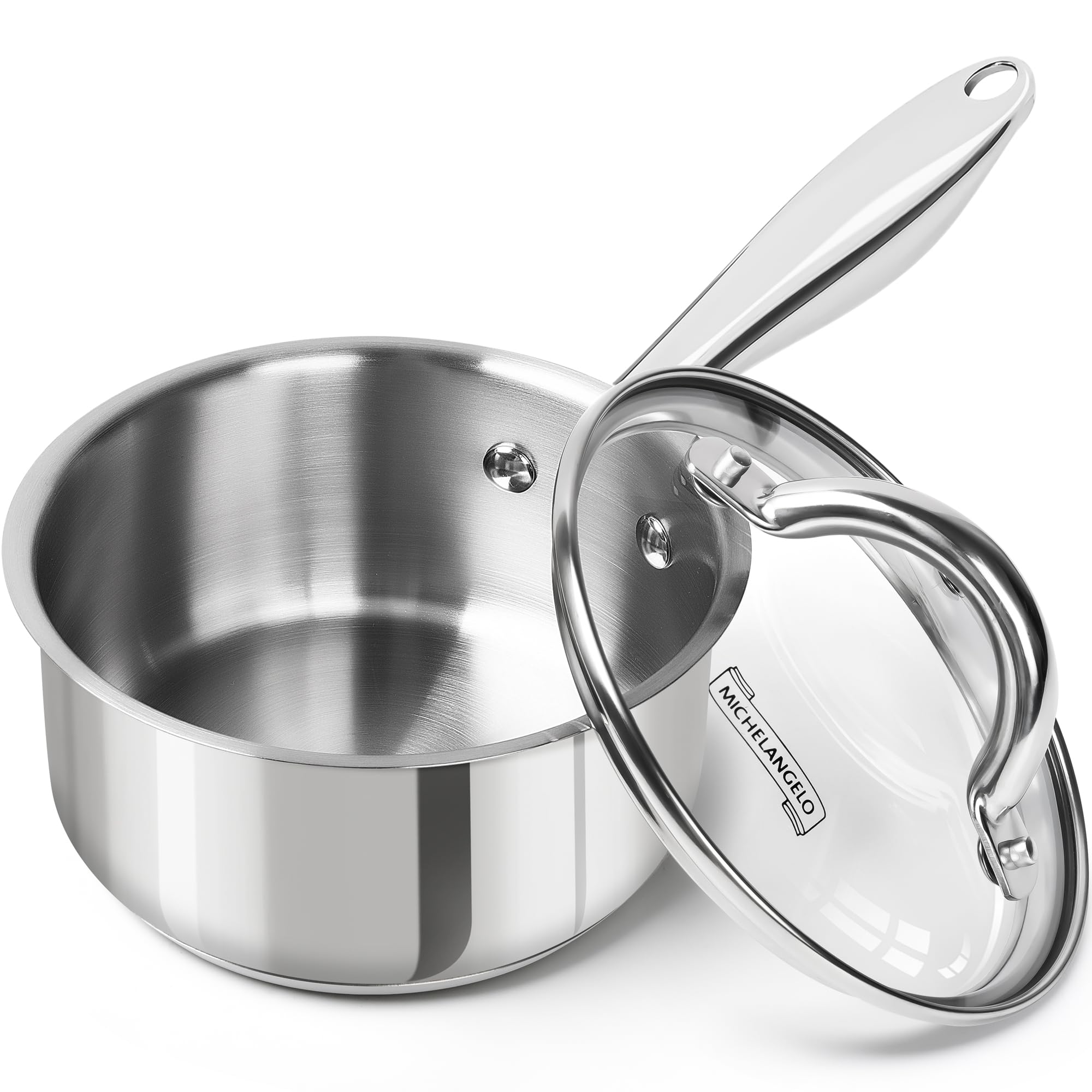
The flared lip is the whole pitch: liquid leaves the pan in a clean stream, not down the side.
If you have ever poured milk from a straight-sided pot and watched it run under the rim, this pan was designed for you. The flared edge breaks the stream cleanly, letting you move liquids pan-to-plate without the drip trail. That flared lip changes daily pouring more than any spec sheet number. The body is food-grade 18/10 stainless over a triple-layer bottom, which puts the aluminum core where the burner hits.
Heat tolerance is unusually wide here. The pan is oven safe to 600°F, with the lid rated to 350°F — far beyond what most pots this size will list. Double-riveted hollow handles diffuse heat for a cool touch, and the tempered glass lid lets you watch a simmer without releasing the moisture. It works on every stovetop including induction, and the flared rim means you can take it straight from burner to oven to table without a second vessel.
The compact 1.5 quart size is built around morning milk for coffee and small batches of gravy, and the quantity of quality praise it draws is far ahead of any other spec on the page. Durability and easy cleanup follow close behind, and owners note the handle stays comfortably cool through longer cooks. One small gripe shows up around the handle seam, which reads a little less refined than the rest of the finish. For anyone who pours milk or gravy daily, this is the practical pick.
The pour is the feature: a flared rim plus a 600°F oven rating and hollow stay-cool handles at a modest capacity — built around the moments you actually move hot liquid.
Minor finish note: the handle seam looks less polished than the rest of the pot.
Made for you if: your day starts with heated milk and ends with a poured pan sauce.
Skip past if: you need more than 1.5 quarts of working room.
6. Update International SSP-2 Sauce Pan

Tall, straight walls where a braise stays put and a sauce does not slop over the edge.
Where the Winco tapers outward, this pot goes vertical. High, straight sides are the defining shape, and they make sauce-based dishes easier and less messy because there is no wide flare for liquid to run over. It holds a 2 quart capacity as a 1.89 liter body, and it ships with a cover included — a small thing that nudges it ahead of pans that make you buy the lid separately. Both pan and cover are induction ready, and the pan itself is NSF listed.
The handles are hollow and carry hang holes, designed to diffuse heat and give a grip you can hold. Both form and function were clearly considered, not just the bowl. Straight walls also mean the footprint stays compact for the volume — a 6-inch diameter across the base against a 6.2-inch width. If you are cooking a pastry cream or a braise that needs a deep pool rather than a shallow one, this is the shape that keeps things contained.
Durability is the reason buyers keep it around for years, and that thickness is what keeps it sitting flat on a glass-top stove. The recurring caution is heat control: it cooks evenly, but the burner has to come down or the base will scorch. Consider this a straight-sided workhorse for sauce and braising tasks where you want the cover in the same box.
Why it earns a spot: straight sides plus a cover in the box, NSF listed, induction ready, and built to sit flat and steady for years.
Worth knowing: the base scorches if the burner stays high, so ride the dial down.
Good fit for: braises, pastry cream, and sauce-based dishes that want a deep, contained pool.
Not the pick for: anyone who wants an easy-watch glass lid — the cover is stainless.
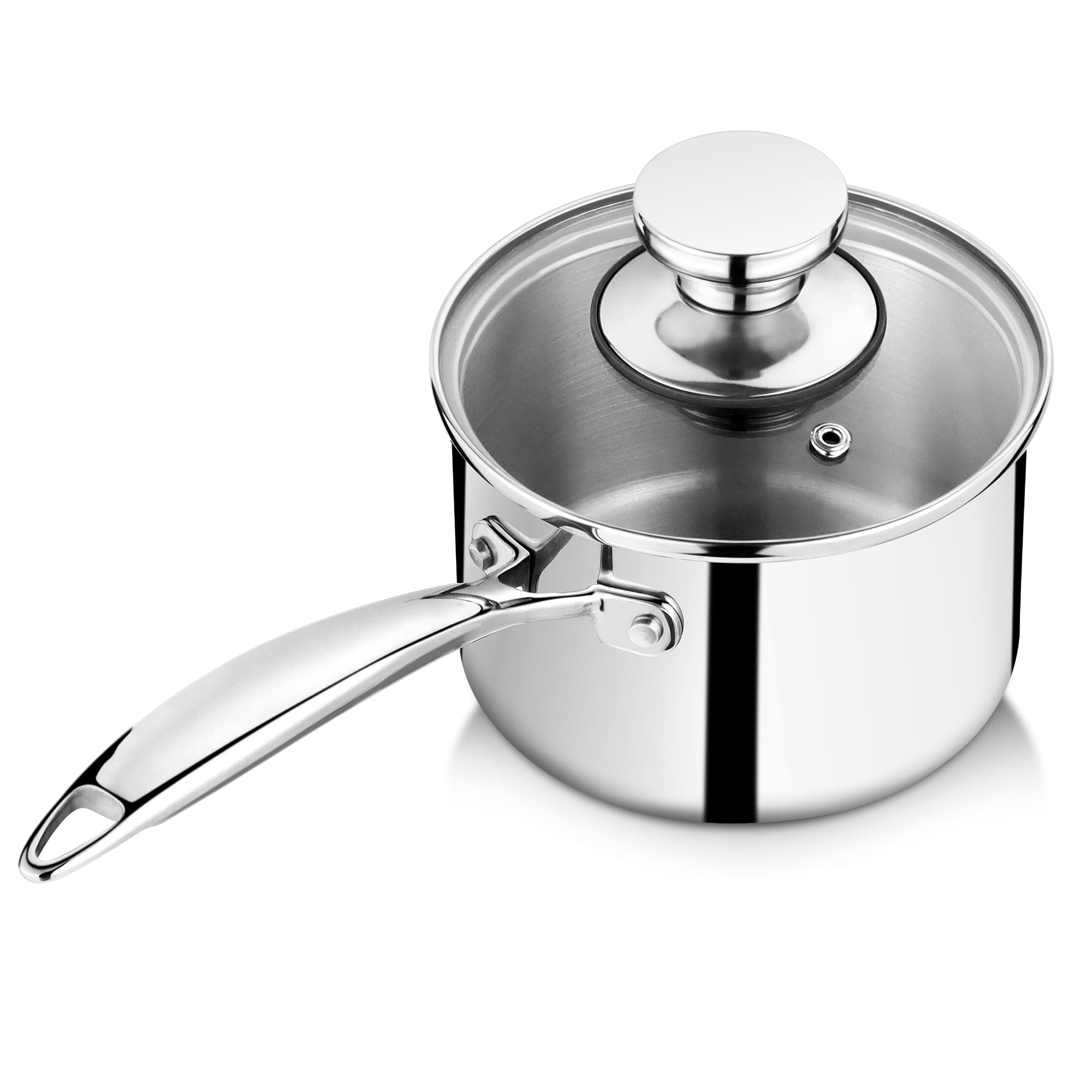
7. Quienkitch 1.5 Quart Stainless Steel Saucepan

Strainer holes in the lid mean you drain pasta without ever reaching for a colander.
The lid is the reason to buy this. It is a shatterproof glass cover with straining holes on both sides, so you can pour off the water from a single portion of noodles or vegetables straight from the pot. The pan adds a dedicated pour spout for the direct pour, and together they eliminate a colander for small jobs. The body is 18/10 food-grade stainless with a tri-ply bonded base, using an aluminum core between stainless layers for fast, even heat across gas, electric ceramic and induction.
Inside, measurement marks are easy to read and the interior carries a matte finish meant to resist scratches over time, while the outside is mirror polished. The 18/10 handle is ergonomic and designed to stay cool. At 1.5 quarts it is built around warming foods, melting butter, making breakfast cereal, and soups or sauces large enough for one. Owners lean on it for tea, bone broth, and noodles — the size suits four to six medium eggs in one go.
Heat distribution is what people notice first, and the handle genuinely does not get hot even though it looks like it should. The one fair objection is pricing relative to size — the compactness is the whole point, and you pay for the straining lid and pour spout combo. If you boil small or medium portions and drain them regularly, that is a job no plain pot does.
What the lid brings
- Straining holes in the glass lid let you drain pasta and vegetables in place
- Pour spout channels liquids into a clean stream
- Tri-ply bonded base heats fast for milk and soup
- Stay-cool ergonomic handle and easy-to-read measurement marks
The honest objection
- You pay a premium for 1.5 quarts of cooking space
- The shatterproof lid does not resolve the size limit for family portions
The pick for: small-batch pasta, noodles, and tea where you drain or pour at the end.
The trade-off: it is a compact pot at a price that expects you to want the straining lid.
8. Tramontina Signature 1.5-Quart Sauce Pan
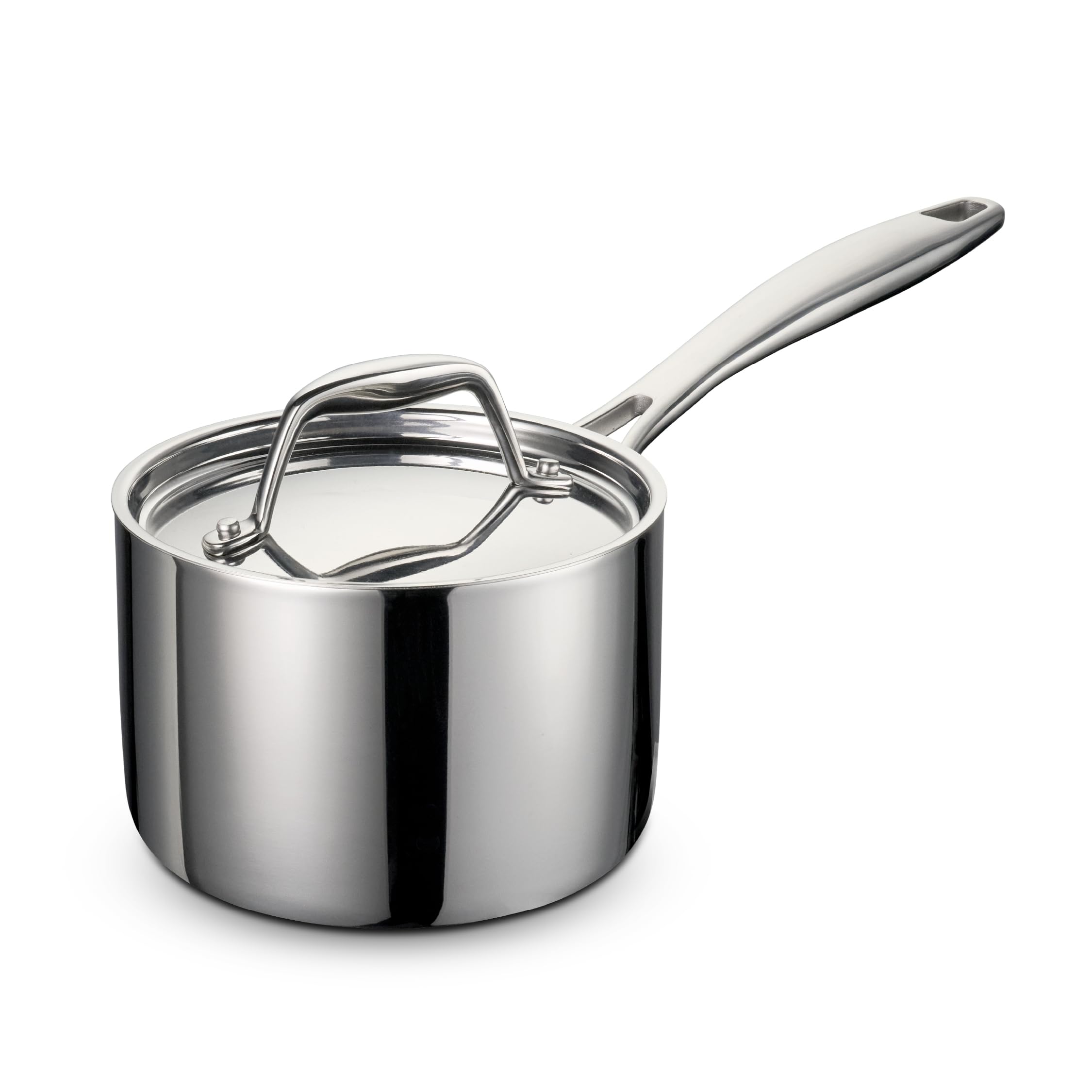
Clad cookware with an aluminum core and a lifetime warranty — for sauce work you want to last.
Tri-ply clad construction means the aluminum core runs through the wall, not just the base, so heat spreads evenly and controls precisely when you dial the burner down. The body is oven safe to 500°F, so a pan sauce can move straight under the broiler without a second vessel. It works on induction, gas, electric and ceramic glass alike. The stainless steel lid seals in moisture, and the riveted handles give a secure grip on a full pan.
At 1.5 quarts you are looking at a pan for sauces, gravies, and reheating soup rather than a batch of pasta for four. It measures 5.75 inches across the diameter inside a 2.1 pound body — a weight that feels solid in hand without crossing into two-handed territory. The mirror-polished exterior is dishwasher safe, the pan is NSF certified, and it comes with a lifetime warranty. For someone outfitting a kitchen that should last, that warranty is half the value.
Heat control is this model’s strongest suit — it climbs quickly on gas and holds steady when you drop the flame, and the handle stays cool through the process. Owners find it worth what they paid for the finish and solidity. One recurring friction point: the rim does not pour neatly on its own, so you are back to a spoon or ladle for transferring liquid. That is a design trade-off, not a defect, and it is worth knowing before you buy.
Where it pays off: tri-ply clad with a 500°F oven rating, a snug stainless lid, and a lifetime warranty for sauce and soup duty.
One honest gap: the pour is the weak spot — the rim spills if you tip it without help.
The right buy for: a sauce-focused cook who wants clad construction and a warranty behind it.
Better served elsewhere: if pouring straight from the pot is a daily move.
9. Tramontina Signature 2-Quart Sauce Pan

The bigger sibling: two quarts of clad steel without the weight of a stock pot.
This is the same tri-ply clad construction as the 1.5-quart model above, expanded to a 2 quart body with a 6.58-inch diameter. The extra volume is what makes it viable for soup, gravy, and reheating leftovers for two rather than just a sauce. It moves from stovetop to oven up to 500°F, the stainless lid seals in moisture, and the riveted handles stay secure when the pan is full. It works on induction, gas, electric, and ceramic glass, is dishwasher safe, NSF certified, and carries a lifetime warranty.
Weight runs 2.6 pounds — heavier than the 1.5-quart version’s 2.1 pounds, which is the price of the extra volume. The 2-quart body is also matched against the Made In’s 2 quarts: both hit the same capacity, though the Made In advertises 5-ply construction against this pan’s tri-ply. In real use, that translates to two pans that reach the same destination by different paths. Both have a lidded stainless body, both go in the oven, both work on induction.
The most-divided point in the reviews is durability — some owners have watched the finish discolor after a single use, while others find it built to last across months of steady use. That is a fair caveat to hold, not a reason to write off the pan. The body stays sturdy and washes up easily, and the riveted handles feel solid. If you want two quarts of clad cookware for both sauce and small-batch soup, this is the pick.
The draw: 2 quarts of tri-ply clad at 6.58 inches across, oven safe to 500°F, dishwasher safe, with a lifetime warranty.
The variable: finish discoloration is the one thing owners disagree on — check it early and treat the surface gently.
Buy this if: you want one pan for soup, sauce, and reheat duty with clad construction behind it.
Hold off if: you can only afford one piece and want the tightest sauce control — the 1.5-quart sibling focuses better.
Know the Specs
What tri-ply actually means
Tri-ply bonds three metal layers into one sheet: an aluminum core between two stainless layers. Aluminum moves heat sideways quickly, so it spreads the burner’s heat across the whole pan base and wall rather than one hot spot. That is why a clad pan simmers a delicate sauce without scorching the center. A “triple-bottom” pan puts that same core only in the base, so the walls are single-layer steel. Both cook fine; full-clad tends to be gentler on sauce.
Stainless grades: 18/10 versus 18/8 versus 18/0
The numbers describe the chromium and nickel content in the steel. An 18/10 interior resists reacting with acidic food like tomato or lemon, so flavors stay true. The outer layer is different — a magnetic 18/0 or 430 stainless exterior is what makes induction work, because induction burners only respond to magnetic metal. When a smoker claims “induction compatible,” an outer magnetic layer is exactly what they are talking about.
Why capacity and weight fight each other
A larger pan holds more but weighs more, and that trade-off shows up every time you lift it. A 1-quart clad pot typically weighs about a kilogram in hand; a 2-quart version of the same build is heavier and takes two hands to pour confidently. If you mostly boil eggs or warm milk, smaller is easier. If you cook sauce for two or reheat soup, capacity wins and the extra weight is worth it.
Oven ratings and lid rules
Stainless bodies commonly list a much higher oven limit than their glass lids. The pan may go to 500°F or higher while the lid tops out substantially lower — or in some cases must stay out of the oven entirely. Check both numbers before sliding the whole pan in. If the dish needs a covered oven finish, a stainless lid handles the heat; a glass one wants you to read its own limit first.
Common Questions
Is a 1-quart or 1.5-quart sauce pan better for a single person?
Will these small sauce pans work on an induction cooktop?
Can I put the whole pan with its glass lid in the oven?
What is the difference between tri-ply clad and a triple-bottom pan?
Can I put a stainless sauce pan in the dishwasher?
Why does my sauce scorch in a small pan?
Do I need a lid on a small sauce pan?
What size sauce pan do I need for boiling two eggs?
Does a heavier sauce pan heat more evenly?
Will stainless steel sauce pans react with tomato sauces?
The Bottom Line
For the tightest heat control in the lineup, pick the Made In 2 Quart Stainless Clad Saucepan, our small sauce pan winner. Its 5-ply clad walls (five bonded metal layers that spread heat evenly) plus a 6-inch cooking surface keep a delicate sauce from scorching — the pan you want when sauce matters. If you stir big batches and want to stay light on your feet, grab the Winco 2 1/2 qt Tapered Aluminum Sauce Pan at 16 ounces. And for draining noodles straight from the pot, reach for the Quienkitch 1.5 Quart with Pour Spout and its straining lid. Whatever you pick, buy the size that matches your most common portion — the right small pan is the one you can lift and pour from with one hand.
How we choose
We do not accept paid placement. Every pick is matched to a real buyer and a real use-case; we do not hands-on test units.
Sources
Specifications: manufacturer listings and product documentation. Review insights: verified customer reviews, as of November 2026. Pricing: not shown on this page (it changes often); check the current price via the retailer link.
As an Amazon Associate, Tactical Gear Guy earns from qualifying purchases. This does not affect which products we feature.