Specs are compiled from manufacturer listings and verified buyer reviews and can change over time — please confirm the key details on the product page before buying.
Small pools are the hardest ones to keep clean, because a full-size robot is too big to turn around in them. The right machine for a compact pool is light enough to lift with one hand, compact enough to turn between the wall and the first step, and simple enough that you actually drop it in every week. This guide sorts the small-pool robots worth owning by how they clean, how long they run, and how easy they are to pull back out.
This guide is built by comparing the manufacturers’ published specifications and the patterns across verified customer reviews, so you get each pick’s real strengths and trade-offs instead of marketing spin.
A small-pool robot lives or dies on three numbers: how much water it pulls per hour, how many minutes it runs on a charge, and how many liters of debris it holds before you have to fish it out. Below you will find the models that get those three right for a compact pool, ranked by what they actually do well. Every pick here fits a tight pool and a tight storage shelf.
Top Picks

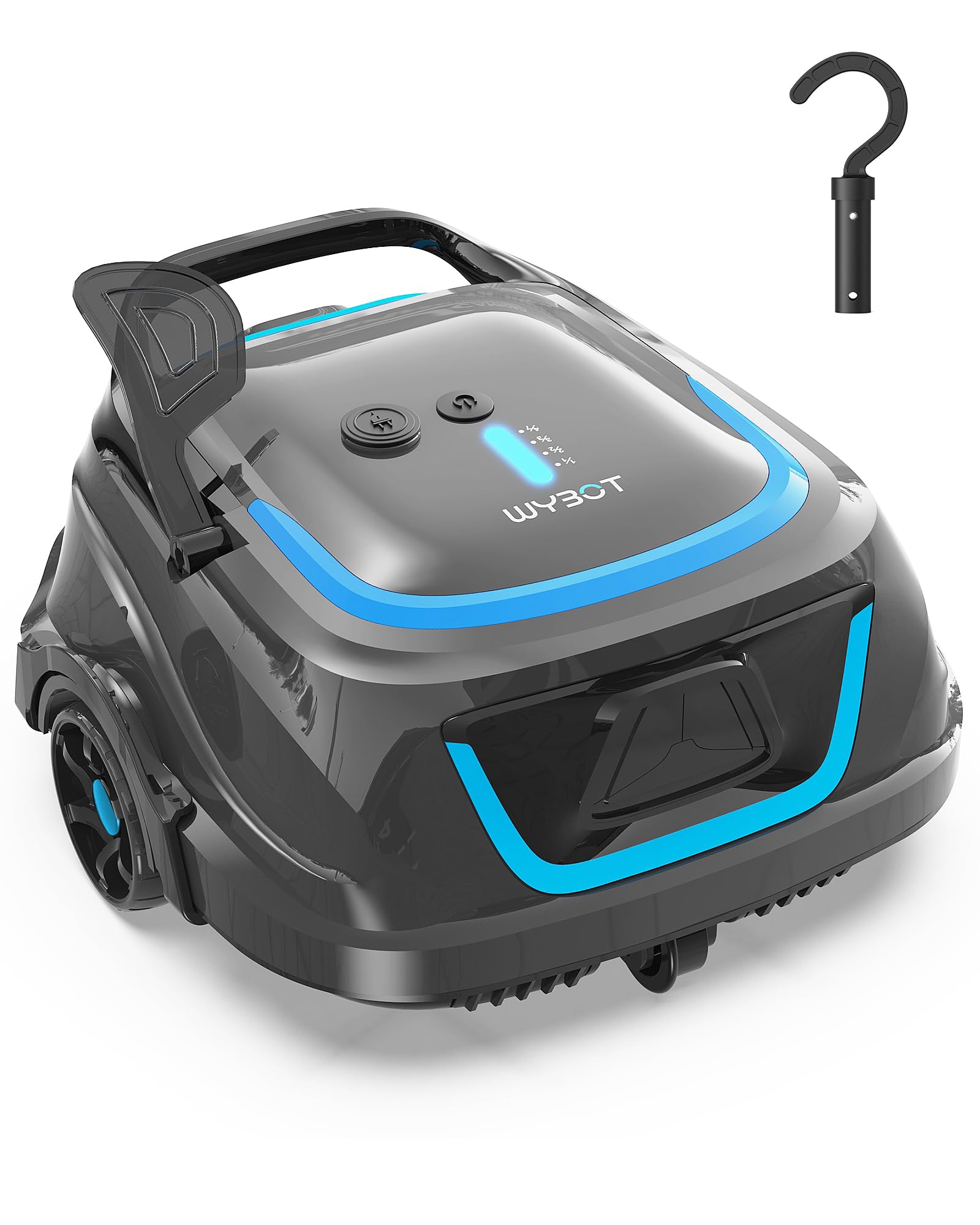

How To Choose The Best Small Pool Vacuum Robot
A compact pool punishes the wrong robot fast. Buy something built for a 40-foot in-ground pool and it will spend half its cycle bumping the same wall. Buy something that only cleans the floor and you will still be scrubbing the waterline by hand. The picks below all fit the small-pool brief, so the real decision is which set of numbers matches your pool.
Match the coverage rating to your actual water surface
Every robot lists a square-foot coverage figure, and that number is the honest ceiling for one charge. A robot rated for 1,100 sq. ft. is built for a modest above-ground pool, while one rated for 2,500 sq. ft. is doing extra laps in a small pool. Pick a coverage figure close to your pool’s real surface area so you are not paying for capacity you never use.
Suction in GPH tells you how fast debris disappears
GPH stands for gallons per hour — the volume of water the robot pushes through its filter in sixty minutes. A higher figure clears leaves and sand faster, which matters most when your pool sits under trees. The trade-off is that big suction usually means a bigger battery, and a bigger battery means more weight to haul out.
Runtime and charge time set your weekly rhythm
Runtime is how many minutes the robot cleans on a single charge; charge time is the wait before the next run. A machine that runs 200 minutes but takes hours to recharge suits a once-a-week deep clean. A shorter-running robot that tops up quickly suits a pool you refresh every few days.
Filter mesh in microns decides whether silt stays out
A micron is one thousandth of a millimeter, so a lower number catches finer particles. A 180-micron basket grabs leaves and sand; a 3-micron layer traps the cloudy dust that turns water hazy. If your pool clouds up quickly, the finer filter layer is worth more than extra suction.
Weight and retrieval matter more than any spec sheet admits
You will lift this robot out of the water every single time it runs, so its weight in pounds is a daily-use number, not a footnote. Machines in the mid-teens of pounds come out with one hand. Heavier units are fine if the robot parks itself at the waterline for easy grabbing. Look for that parking feature before you look at anything else.
Side-by-Side Comparison
| Model | Best For | Runtime | Debris Capacity | Weight | Amazon |
|---|---|---|---|---|---|
| WYBOT B1 Six-Roller★ Best Overall | Small above-ground pools | 125 minutes | 1.5 liters | 19 pounds | Amazon |
| WYBOT A1Best Filtration | Fine-silt filtration | 130 minutes | 3 liters | — | Amazon |
| Hinice Cordless RobotLightest Pick | Lightweight handling | 150 minutes | — | 10.6 pounds | Amazon |
| Zebary C1 | Large debris loads | 200 minutes | 2.7 liters | — | Amazon |
| Nepturox Sonar Robot | Wall and waterline climbing | 150 minutes | — | 14.5 pounds | Amazon |
| WYBOT B1 Inground | Big debris basket | 120 minutes | 6 liters | 14.3 pounds | Amazon |
| iGarden KN40 | Long runtime coverage | 4 hours | 3.2 liters | 17.9 pounds | Amazon |
| Beatbot Sora 10 | Shallow sun shelves | 300 minutes | 5 liters | 18.7 pounds | Amazon |
| Dolphin Nautilus AG | Above-ground simplicity | 1.5 hours | — | 6.6 kg | Amazon |
| BOTLIFE PC200 | Four-zone cleaning | 2.5 hours | — | — | Amazon |
| AIPER Scuba V3 | AI-guided debris hunting | 240 minutes | — | 18.1 pounds | Amazon |
Detailed Reviews
1. WYBOT B1 Cordless Robotic Pool Vacuum Six-Roller Brush
Our pick — 4.5+★ from 150+ verified ratings; the strongest balance of quality and price.
Six brushes working the edges of a small pool, where ordinary robots leave a dirt ring.
The trick that makes this robot worth its spot at the top is the brush count. Most compact robots run one or two rollers under the chassis, which leaves the corners and the seam where the wall meets the floor untouched. This one runs six — dual main rollers plus side brushes and bottom brushes — so it scrubs along walls and into corners that a single-roller machine skips. For a small pool, where the perimeter is a big share of the total surface, that edge cleaning is the whole ballgame.
It runs up to 125 minutes on a charge and covers pools up to 1,220 sq. ft., which is sized right for a modest above-ground pool rather than a sprawling in-ground one. Against the A1 below it carries less battery energy — 35.97 watt-hours versus 85 watt-hours — and holds less debris, 1.5 liters versus 3 liters. What you get in exchange is the brush system and a 1-hour Quick Clean Mode for a fast refresh before guests arrive. Charge time is 3 hours.
The rest of the package is app-driven: you pick from Floor, Wall, Waterline, and Combo modes in the WYBOT App, schedule runs, and let over-the-air firmware updates improve the navigation over time. At 19 pounds it is not the lightest robot here, so plan on two hands at the pool edge. It arrives as a 15-minute assembly job, and the 40-foot hose gives you slack for placement at the water’s edge.
What earns it the top slot
- Six-roller brush setup scrubs walls, corners, and seams where single-roller robots leave dirt
- Four cleaning modes plus Combo let you target floor, wall, or waterline instead of one generic pass
- 1-hour Quick Clean Mode gets a small pool presentable before company shows up
- OTA firmware updates keep improving navigation after you own it
Where it asks for patience
- 1.5-liter basket fills fast if your pool sits under heavy leaf fall
- 19 pounds is a two-hand lift at the pool edge
- 3-hour recharge is a longer wait than the quick-clean mode implies
Reach for this if: your compact pool has walls, corners, and a waterline you are tired of scrubbing by hand.
Look elsewhere if: you want a big debris basket for a leaf-heavy yard — the 6-liter WYBOT B1 below holds four times as much.
2. WYBOT A1 Cordless Pool Vacuum Robot
The filtration play: a two-layer basket that traps the cloudy dust most robots leave behind.
If your above-ground pool turns hazy a day after you clean it, the problem is fine particles, not leaves. The A1 attacks that directly with a dual-layer filter — a 180μm precision layer (μm means microns, each one a thousandth of a millimeter) backed by a textured foam layer. The two stages together capture both the fine dust and the larger debris in one pass. Suction is 2280 GPH, meaning it pushes 2,280 gallons of water through that filter every hour, which is plenty for a modest pool.
The battery story is the standout. At 85 watt-hours it carries more than twice the energy of the six-roller B1 above at 35.97 watt-hours, and it turns that into up to 130 minutes of runtime across pools up to 1,100 sq. ft. Its 3-liter basket is double the B1’s 1.5 liters, so you empty it half as often. Recharge takes 2.5 hours.
Two behaviors make ownership easy. Drop it in and it starts cleaning on its own; when the battery runs low it parks near the pool wall so you can reach it without wading in. It also pauses at the edges to concentrate cleaning there before carrying on. Control runs through the app, and the whole thing is a no-installation drop-in.
The filtration advantage: a 180μm layer plus foam is the thing that separates this from a suction-only robot, and it is why hazy water clears instead of lingering.
One thing to plan around: the 1,100 sq. ft. coverage ceiling suits a compact above-ground pool. If your water surface runs larger, the 2,500 sq. ft. Zebary C1 below has more headroom.
Steer here for: a small above-ground pool that clouds up with fine silt.
Think twice if: you need wall climbing — this one is built around floor cleaning and edge pauses.
3. Hinice Cordless Robotic Pool Cleaner
At 10.6 pounds, this is the robot you can pull out with one hand and never dread.
Weight is the spec nobody puts on the box, and it is the one that decides whether you actually run the robot every week. This Hinice unit weighs 10.6 pounds, which is roughly half the 19 pounds of the six-roller B1 above. Dropping it into a small pool and lifting it back out stops being a chore. The compact body is 16.7 by 11 by 9 inches, so it stows on a shelf without eating the whole garage.
The cleaning numbers are respectable for the class: a 9000mAh battery rated at 100Wh (watt-hours, a measure of stored energy) drives 150 minutes of runtime across pools up to 2,153 sq. ft. A 40W motor spins dual brushes to lift sand, leaves, and fine particles, and a dual-layer precision filter improves filtration efficiency. The body carries an IPX8 rating, which is the top tier of water resistance — it is built to sit fully submerged and keep running, not just survive a splash.
Charging takes 3.5 hours and the robot accepts global voltage at 11.1V. The shell is high-strength ABS, a hard plastic that resists corrosion in chlorinated water. Where this robot has drawn mixed notes is fine debris pickup: medium and large debris come up cleanly, while very fine silt is the harder test. Pair it with a finer filter habit if your pool is dusty.
Why it earns a place: the 10.6-pound body lifts out with one hand, so weekly cleaning is a quick drop-in instead of a workout.
The honest catch: fine silt is the weakest link in its pickup, so a pool that clouds easily wants the A1’s dual-layer filter instead.
Pick this one when: lifting is the part of pool care you resent most.
Pass it over for: a pool loaded with microscopic dust — finer filtration serves you better.
4. Zebary C1 Robotic Pool Cleaner
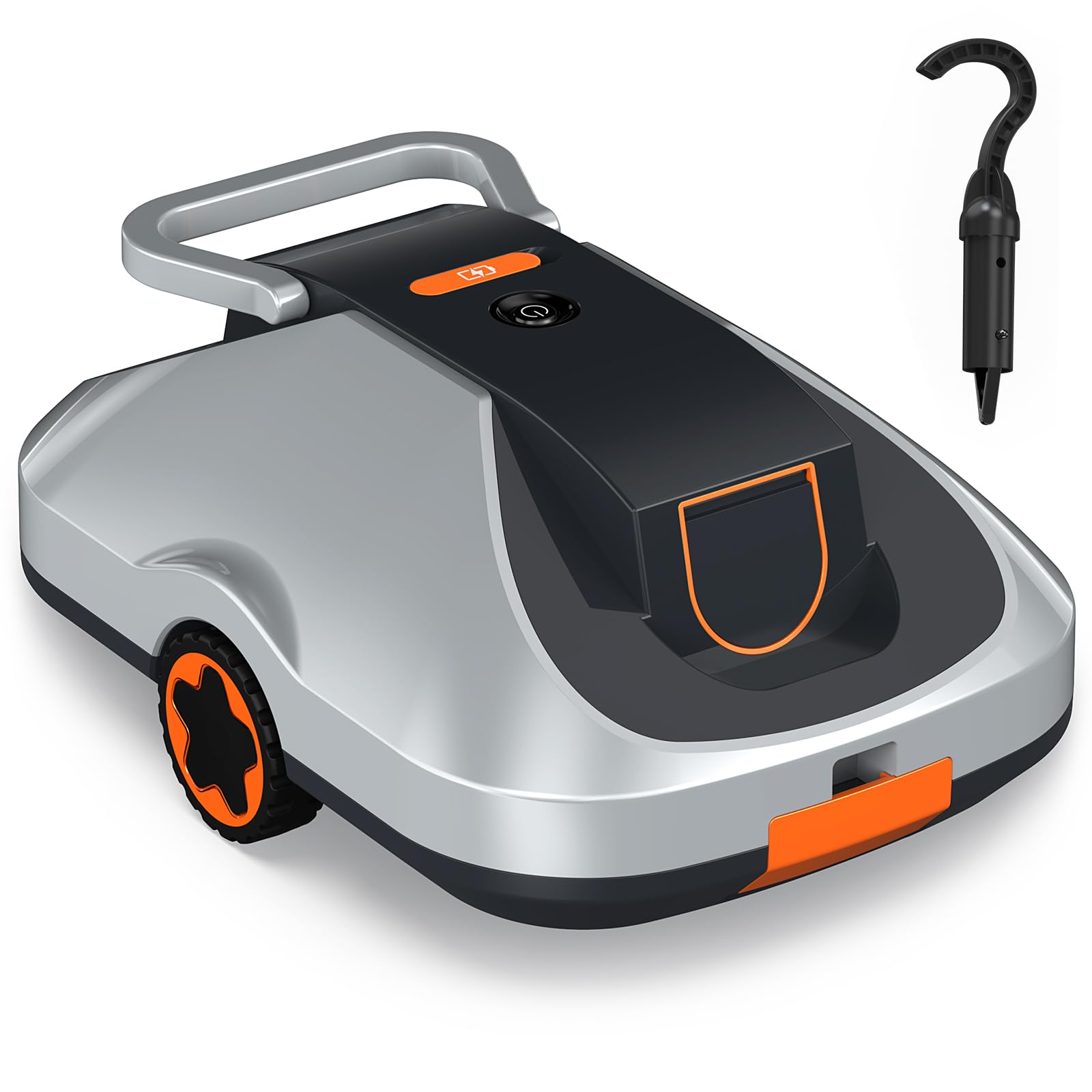
200 minutes on one charge and a 2.7-liter basket — a full clean without a mid-cycle stop.
For a robot in this class, 200 minutes of runtime from a 4500mAh six-cell battery is the headline. Compare it to the 125 minutes of the six-roller B1 at the top: this one keeps going roughly 75 minutes longer before it needs the charger. That gap matters when your pool sits under trees and one pass is not enough. The 2.7-liter basket is also large for a compact unit, and its 180μm mesh filter is built to catch sand and fine silt as well as leaves and twigs. The basket is washable and reusable, so no replacement filters to buy.
Navigation is where this C1 differs from a random-bounce robot. Dual sensors watch motor load and speed in real time and adjust the cleaning path, which reduces overlapping passes and keeps it from stalling on tricky floors. Debris pickup handles flat surfaces and slight inclines, and it is rated for above-ground and in-ground pools up to 2,500 sq. ft. When the battery drops or the cycle ends, it self-parks near the wall, and a 10-second drain releases retained water so you can lift it one-handed.
It is not a wall climber — Zebary states it is not intended for climbing walls — so the floor and the drains are its territory. Surfaces are covered across vinyl, concrete, fiberglass, and mosaic tile, and the non-abrasive design is meant to protect the liner. Charging runs on a 4500mAh pack rated at 64.27 watt-hours.
Where the C1 delivers
- 200 minutes of runtime from a 4500mAh battery gives you a full clean in one charge
- 2.7-liter washable basket means fewer empties and no filter replacements
- Self-parking plus 10-second drain makes retrieval a one-hand job
- Adaptive navigation with dual sensors cuts overlapping passes
What to weigh before buying
- Floor and drains only — the maker states it does not climb walls
- No app control; operation is push-button
Best matched to: a leaf-prone pool where one long cycle should finish the job.
Not the one for: waterline scrubbing — pair it with a wall climber if that is your concern.
5. Nepturox Cordless Robotic Pool Vacuum
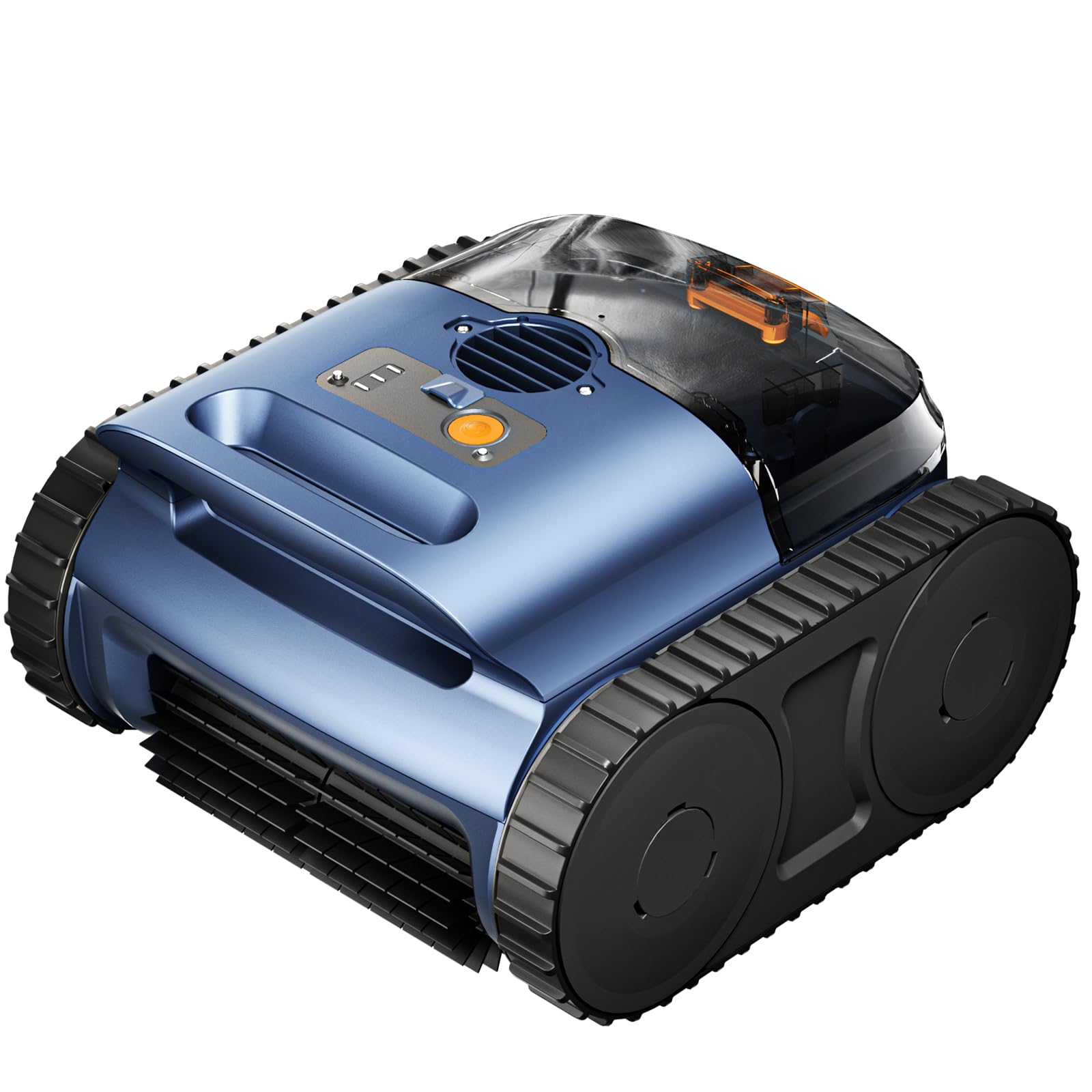
Two independent 180W motors grab the wall and climb — the muscle here is not subtle.
The defining spec is the motor set: dual 180W brushless motors, one per side, independently controlled. Compare that to the Hinice unit above at 40W, and you understand why this one climbs walls and scrubs waterlines while the lighter robot stays on the floor. Brushless means no carbon brushes to wear out, so the motors run quietly and hold up over time. An IP68-rated internal system (the highest dust-and-water ingress tier) keeps the works protected underwater.
Navigation uses sonar scanning, which maps the pool layout and plans a route instead of bouncing at random. You can choose Floor-Only, Wall-Only, or Full-Coverage mode, and the robot keeps its grip on tile, concrete, vinyl, and fiberglass across different pool shapes. Runtime is 150 minutes from a 144.3Wh battery at 18.5 volts, and recharge takes 2.5 hours. At 14.5 pounds it sits mid-pack for lifting, and its 14.1 by 14.2 by 8.7-inch body fits a compact pool footprint.
Reliability and performance are what buyers talk about most with this one — wall climbing that actually works, walls cleaned without hand scrubbing. The recurring note is stability on steps: it has a tendency to get stuck there, so set your mode deliberately if your pool has a wide set of stairs. Battery life draws mixed feedback too, so plan your cycle around the pool’s size rather than assuming a full 150 minutes on every run.
The verdict on power: dual 180W brushless motors make this the climber of the group, and the sonar path planning keeps it efficient on the floor while it is at it.
Set your expectations on steps: it climbs walls but struggles on wide steps, so use Floor-Only or target the ladder area manually.
Go here if: your pool has real walls and a waterline you want scrubbed, not just a floor to vacuum.
Consider skipping if: your pool is dominated by steps and ledges, where the robot can stall.
6. WYBOT B1 Robotic Pool Vacuum

Six liters of debris capacity in a 14.3-pound body — the emptier-once-a-month option.
A 6-liter basket is the reason to look at this WYBOT. The six-roller B1 at the top of this list holds 1.5 liters; this one holds four times that. In a small pool under heavy leaf cover, that difference means one emptying instead of several during the season. It runs up to 120 minutes and covers pools up to 1,150 sq. ft., which fits above-ground and small in-ground pools cleanly. A 1-hour Quick Clean Mode gives you a fast refresh when you do not need the full cycle.
At 14.3 pounds it is easy to lift and carry, and the compact body makes it simple to pull from the water. Enhanced bottom roller brushes give traction over drains, seams, slopes, and uneven floors, while dual front side brushes concentrate on edges and corners. Suction pulls in leaves, sand, dirt, hair, and fine debris. Power comes from a 58Wh lithium-ion pack at 29.4 volts on a 3-hour charge.
Five selectable cleaning modes and intelligent path planning let you set it for floor, walls, or multiple areas in one cycle. The WYBOT App handles schedules and mode selection, and OTA firmware updates keep improving navigation over time. The 6-liter basket and 308g battery keep the weight low; the trade-off is a slightly shorter runtime than the A1 below at 130 minutes versus this one’s 120.
Where it shines: the 6-liter basket is the largest in this group, and it is why those with leaf-heavy small pools pick this over a lighter, tighter-capacity robot.
One trade to note: 120 minutes vs. the A1’s 130 is a small gap, but if you want the longest single pass, the Zebary C1 at 200 minutes leads.
The right call for: a compact pool with real debris volume and a ladder-side pile-up problem.
Not your robot if: you want the longest runtime — 120 minutes sits below the 200 and 300-minute options here.
7. iGarden KN40 Cordless Robotic Pool Cleaner, 4-Hour Runtime

Four hours of cleaning and 4,133 square feet of coverage — the endurance machine of the group.
Where most small-pool robots stop at two hours, the KN40 keeps going for up to 4 hours. It puts that time toward 4,133 sq. ft. of coverage, and the flow figure is 4,500 GPH — more water moved per hour than the A1’s 2280 GPH and the Hinice unit’s 2200 GPH. Three brushless motors and a high-performance impeller drive that flow, lifting sand, leaves, and debris from the floor, walls, waterline, and shallow areas with water over 16 inches deep.
The 3.2-liter filter basket captures debris down to 180μm and needs emptying less often than a compact 1.5-liter basket. Intelligent motor control adjusts power to conditions, which stretches the battery through the cycle. At 17.9 pounds it is easy enough to carry in and out, and a quick-drain design releases retained water so it comes out light. When the cycle ends or the battery runs low, it parks itself at the pool wall for easy grabbing.
Navigation runs on sensor-guided S-paths, meaning it sweeps systematic strips rather than bouncing around randomly, which cuts repeated passes. The app and push-button controls let you pick modes. What buyers talk about most is how it performs and how effective the suction is — sand and dirt that go unseen come off the bottom. Value and wall climbing draw mixed notes, so judge the climbing against your pool’s design rather than expecting waterline surgery every cycle.
Why the endurance matters
- Up to 4 hours of runtime and 4,133 sq. ft. of coverage clears a bigger pool in one charge
- 4,500 GPH flow with triple brushless motors handles sand, leaves, and debris
- 3.2-liter basket with 180μm filtration cuts emptying frequency
- Sensor-guided S-path navigation reduces redundant passes
Where it asks for judgment
- Wall climbing draws mixed feedback — treat it as floor-first
- Four-hour recharge time is long between runs
Choose it when: your pool is on the larger side of small and you want the cleaning done in one long pass.
Think twice if: wall scrubbing is the main job — the mixed climbing notes suggest a dedicated climber like the Nepturox serves that better.
8. Beatbot Sora 10 Cordless Pool Vacuum Robot, 6800 GPH Suction
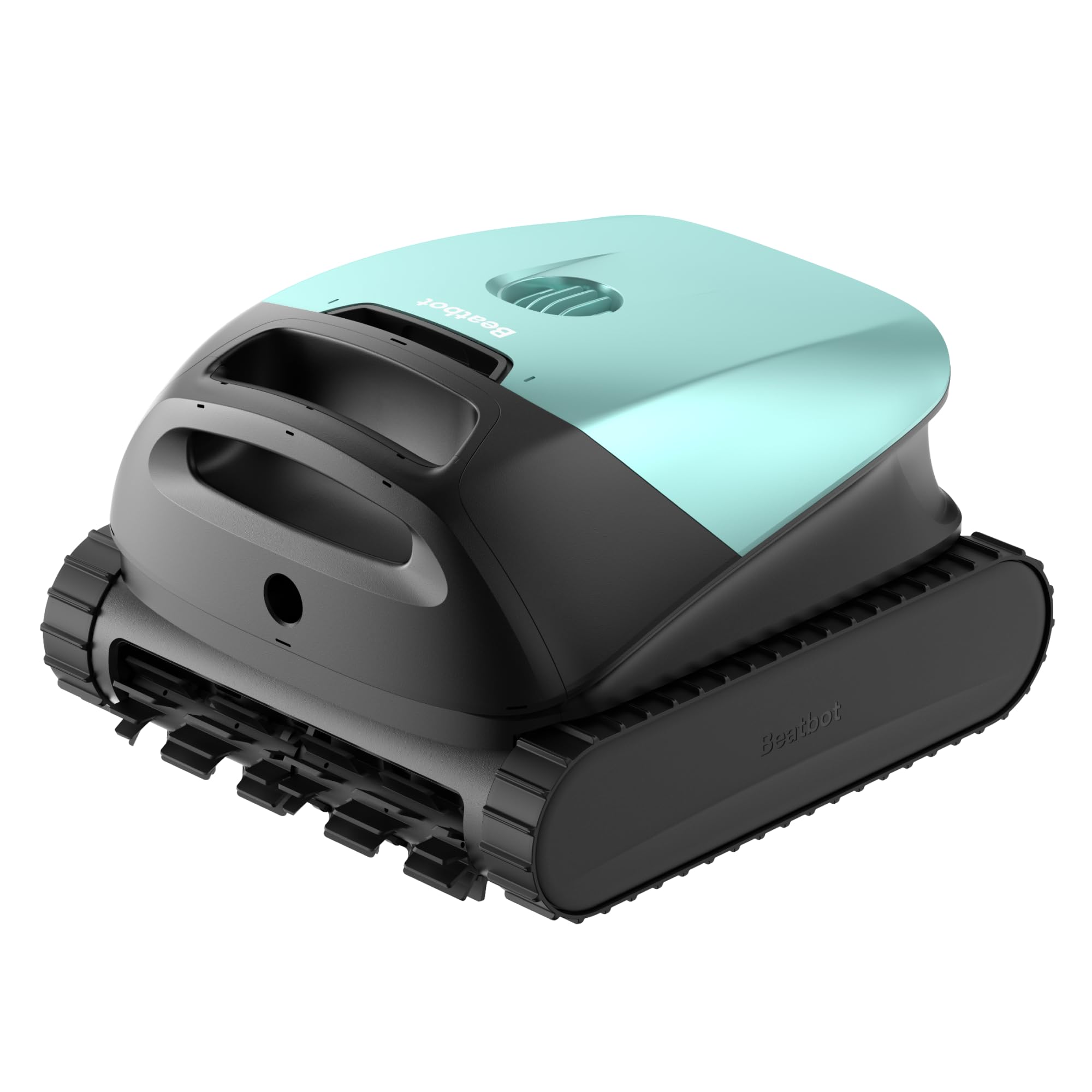
It cleans the tanning ledge — the shallow shelf where ordinary robots beach themselves.
Small pools increasingly mean sun shelves, splash pads, and shallow tanning ledges, and this is the robot built for exactly that. It cleans down to 12 inches of water depth, where conventional robots fail, and it still runs the floor, walls, and waterline. Suction is 6,800 GPH, the highest in this group by a wide margin, and that force is what draws large leaves, heavy sand, and debris without clogging.
Endurance is the other headline: a 7,800mAh battery delivers up to 300 minutes of floor cleaning and 3,229 sq. ft. of coverage on one charge. Its 5-liter basket holds a large volume — Beatbot rates it for enough leaves to cut emptying frequency considerably — and it ships with a 150µm (micron) filter for everyday debris, with a 3µm ultra-fine filter sold separately for microscopic particles.
Parking is designed around retrieval: when the cycle ends, it returns to the waterline and holds position for 10 minutes so you can grab it without wading in. The body is rated saltwater-safe up to a stated salinity, corrosion-resistant, and protected for two years. Wi-Fi on 2.4G and 5G plus Bluetooth run the app, and OTA updates improve navigation and cleaning over time. SonicSense ultrasonic sensors detect ladders, drains, and steps and steer around them.
What stands out: shallow-water cleaning to 12 inches and a waterline parking position mean it handles sun shelves and easy retrieval — two things small pools with ledges need most.
The consideration: 18.7 pounds is among the heavier bodies here, and the 3µm ultra-fine layer is an add-on, not standard.
Yours if: your pool has a sun shelf or tanning ledge that other robots miss.
Another route if: you want fine 3µm filtration included rather than sold as an extra.
9. Dolphin Nautilus AG Robotic Pool Vacuum

The above-ground workhorse: an active scrubber brush and a plug-in system that just runs.
This is the traditional above-ground pick, and it is built for a specific pool: above-ground units up to 33 ft. in length. It runs on AC/DC power through a plug-and-play hookup — plug it in, drop it in, power on, and it is working in 1.5 hours. It does not clean walls or the waterline; Dolphin is clear about that, so its job is the floor and its active scrubber brush.
The scrubber brush removes stains and dirt while staying gentle on the surface. A top-load filter basket means you reach in from above to empty debris instead of pulling the whole unit apart. Smart Navigation Technology scans your pool and works out an efficient path regardless of shape or surface. Everything filters through a lightweight body — easy in and out.
What it wins on is time: it cuts roughly 1 to 1½ hours of hand vacuuming per clean, and it handles pollen, leaves, and assorted debris with no fuss. The recurring note that matters most is durability — several reports of it stopping working after a year and a half — so plan on treating it as a replaceable appliance rather than a lifetime tool. With tens of thousands of verified buyers, the overall picture is clearly favorable, but the longevity caveat is real.
The case for it: plug-in simplicity, top-load filters, and an active scrubber brush in a lightweight body are why above-ground owners keep buying this one.
The honest catch: reports of units failing after a year and a half mean you should expect a limited service life and plan accordingly.
Fits best: an above-ground pool up to 33 ft. where you want plug-in simplicity and no batteries to charge.
Look elsewhere if: you want wall or waterline cleaning from the same machine — this one does the floor only.
10. BOTLIFE PC200 Automatic Robotic Pool Vacuum with Skimmer
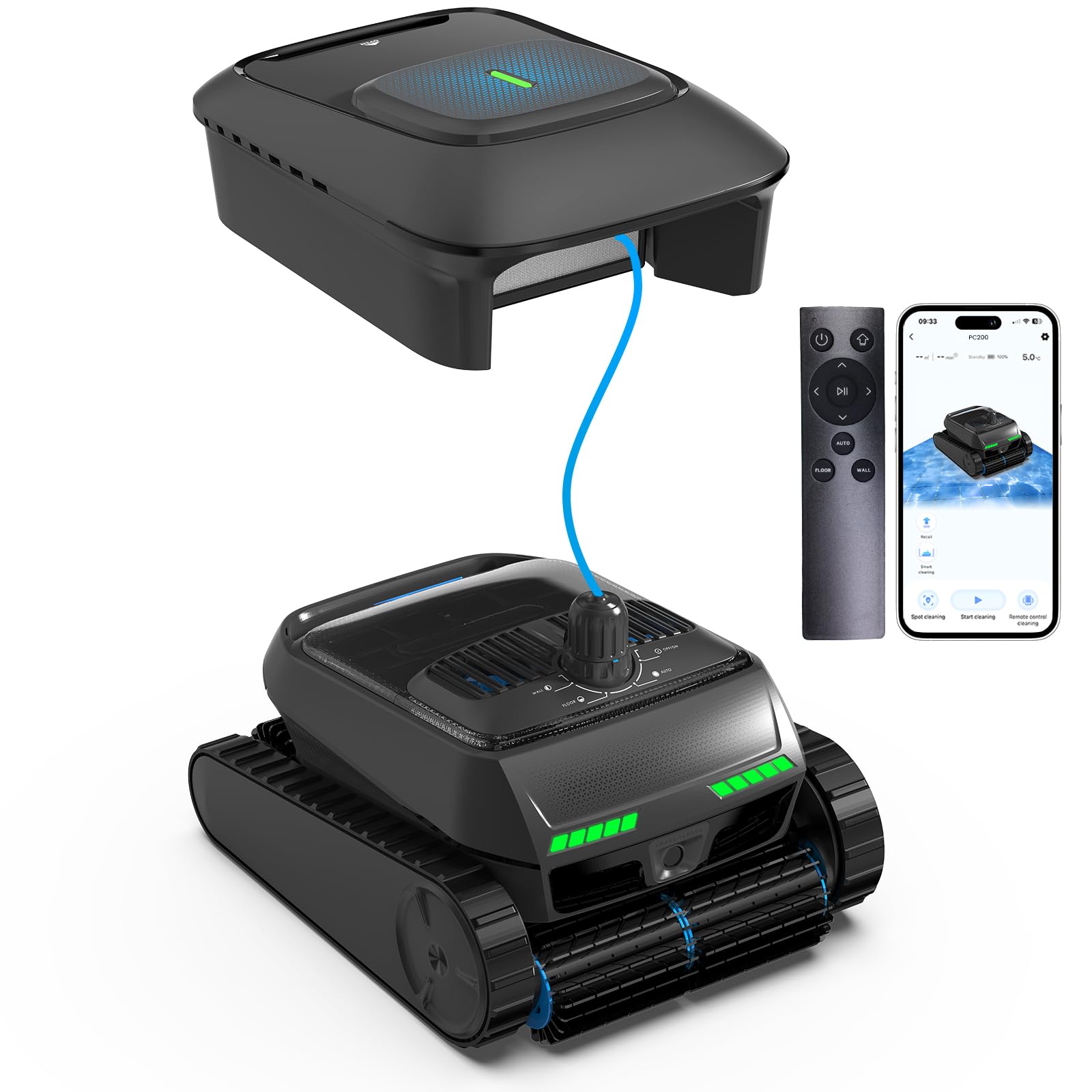
A skimmer-and-vacuum hybrid that claims four zones: floor, walls, waterline, and surface.
This is a multi-zone system on paper: floor, walls, waterline, and the water surface, cleaned with ultrasonic sensors, an H-pattern on walls, and an S-pattern on the floor. It is powered by 10,000 GPH suction — the largest figure here — through dual jets and dual-drive motors, with four roller brushes at the bottom and dual ultra-fine filter baskets rated to 150 microns. It also climbs 30° slopes and crosses 3 cm drains.
Control is through an app with 7 cleaning modes, scheduled times, and free lifetime OTA updates. You enter your pool’s dimensions and surface type and the app builds a cleaning plan. A 10,400mAh battery delivers up to 2.5 hours and recharges in 2 hours; self-parking at the waterline lets you retrieve it quickly. The body is compact at 12 by 9 by 10 inches. The charger rating on the battery listing is worth flagging as unusual, so confirm the power spec with the seller before ordering.
Buyer experiences here are mixed. Some find it effective on floors and walls; others report inconsistency and rate overall performance as not great. This is a pick for someone who is drawn to the four-zone, skimmer, high-suction feature set and is comfortable with a return window if the unit does not perform as expected.
The draw: surface skimming plus 10,000 GPH suction and four-zone coverage is a lot of capability for a compact robot.
The honest catch: consistency is the weak spot — feedback on reliability is mixed, so test yours thoroughly inside the return period.
Right for: a buyer who wants skimming and four-zone cleaning on paper and can verify the unit works on arrival.
Risk-averse buyers should consider: the proven WYBOT A1 instead, whose filtration and app controls have a longer track record.
11. AIPER Scuba V3 Pool Robot
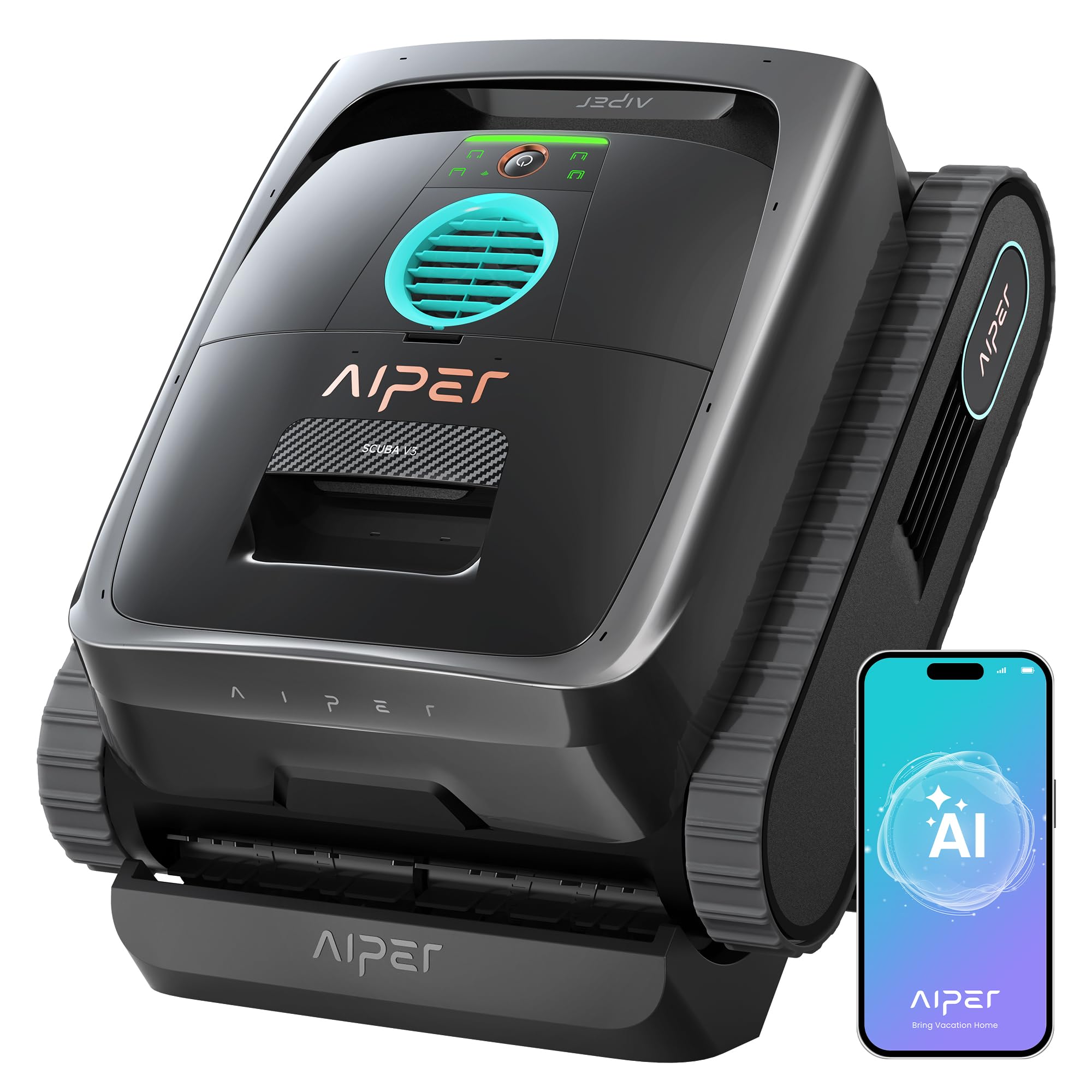
A front-facing AI camera that spots debris and drives straight to it.
The party piece here is vision. A single front-facing AI camera detects more than 20 types of debris and steers the robot directly toward them, which AIPER claims that camera-guided targeting cleans up to ten times faster than traditional methods. In practice, that means less time circling the floor and more time on actual debris. Runtime is up to 240 minutes in Eco Mode for daily upkeep, or up to 180 minutes in auto, floor, wall, and waterline modes for deeper cleaning.
Filtration is layered: a 180-micron debris filter paired with an ultra-fine 3-micron layer traps sand and fine particles that leave water hazy. When the cycle ends, it returns to the waterline and holds for 10 minutes, sending a real-time app notification so you know it is ready. At 18.1 pounds it is a two-hand lift, but AIPER built it for ergonomic removal with that waterline parking. The wireless charging dock needs no installation — set the robot on it and it charges without exposed connectors, and the dock doubles as storage when the robot is off duty.
It carries a two-year product care plan with advance replacement and access to support. The trade-off in this premium tier is the price relative to a 240-minute runtime and a 3-micron filter that competes directly with the Beatbot’s separate ultra-fine option. For a small pool with a sun shelf and a debris-heavy tree line, its AI camera targeting earns its keep as the smartest robot in this group.
The standout: AI vision that recognizes and targets debris is the differentiator, and the 3-micron filtration layer backs it up on the invisible stuff.
The consideration: 18.1 pounds and a premium-tier position mean you are paying for the camera and docking system, not for the shortest or lightest package.
Worth it when: you want the cleaning decisions made for you and a dock that stores the robot neatly off the deck.
Not essential if: your priority is simple suction and a lighter lift — a mid-tier pick covers that at a friendlier commitment.
Know the Specs
Suction in GPH
GPH stands for gallons per hour — how much water the robot moves through its filter in sixty minutes. A higher figure pulls leaves and sand faster. Compare the A1’s 2280 GPH with the Sora 10’s 6,800 GPH, and you can see why one suits a modest pool and the other handles heavy debris. Match the number to your debris load, not to the biggest figure on the box.
Battery Energy in Watt-Hours
A watt-hour (Wh) measures how much energy the pack stores. The B1 six-roller carries 35.97 watt-hours; the A1 carries 85; the Nepturox carries 144.3. More energy usually means longer runtime, but the robot’s weight and suction draw decide how that energy is spent. A robot with a big pack and a weak motor may not run longer than a lean one with an efficient design.
Filter Mesh in Microns
A micron (μm) is one thousandth of a millimeter, so lower numbers catch finer particles. A 180μm filter grabs leaves and sand; a 3μm layer traps the cloudy dust that keeps water hazy. If your pool clouds easily, a two-stage or three-stage filter matters more than extra suction, because it catches what suction alone cannothold. The A1’s two-layer setup and the Scuba V3’s three-micron layer are worth the extra filter care.
Runtime and Coverage
Runtime is the minutes of cleaning on one charge; coverage is the square footage it reaches in that time. The Zebary C1 runs 200 minutes for 2,500 sq. ft.; the iGarden KN40 runs up to 4 hours for 4,133 sq. ft. A small pool rarely needs the largest coverage, so pick a runtime that finishes your water surface with a little margin left over.
Weight and Retrieval
The weight in pounds decides whether you pull the robot out every week. The Hinice unit at 10.6 pounds comes out with one hand; the AIPER at 18.1 pounds wants two. Waterline parking — the robot returning to the wall and holding position — turns a heavy unit into an easy grab, which is why it matters as much as weight itself.
Waterproof Ratings
An IP rating states how well a body resists water and dust. IPX8 means the highest water-resistance tier, built to run fully submerged; IP68 adds full dust sealing. Any cordless pool robot needs at least a submersion-proof body, and a higher rating means the internals are better protected over a long season in chlorinated water.
Common Questions
Will a cordless pool robot work in a small above-ground pool?
How long does a small pool vacuum robot run on one charge?
Do I need to climb walls to clean a small pool properly?
What size filter basket do I need for a small pool?
How fine a filter do I need for sand and silt?
Is a cordless robot better than a hose-and-pump vacuum for a small pool?
How much does one of these robots weigh enough to lift out?
Can these robots handle a pool with steps or a sun shelf?
How long does it take to charge a small pool vacuum robot?
Do cordless pool robots work in saltwater pools?
The Bottom Line
For most small pools, the small pool vacuum robot worth starting with is the WYBOT B1 six-roller — it cleans walls and corners with its six-roller brush setup, covers 1,220 sq. ft. in up to 125 minutes, and lets you pick floor, wall, or waterline modes from the app. If fine silt is your fight, grab the WYBOT A1 for its dual-layer filtration and 3-liter basket. For a shallow sun shelf where ordinary robots beach, the Beatbot Sora 10 is the one to reach for, with cleaning to 12 inches deep and a 5-liter basket. The ratings favorite here is the Dolphin Nautilus AG at 4.0+ stars across thousands of above-ground owners — a proven plug-in choice if you want no battery to charge and can accept the durability caveat. Match coverage, runtime, and filter mesh to your pool’s surface area and debris load, and weekly cleaning drops to a two-minute drop-in.
How we choose
We do not accept paid placement. Every pick is matched to a real buyer and a real use-case; we do not hands-on test units.
Sources
Specifications: manufacturer listings and product documentation. Review insights: verified customer reviews, as of November 2026. Pricing: not shown on this page (it changes often); check the current price via the retailer link.
As an Amazon Associate, Tactical Gear Guy earns from qualifying purchases. This does not affect which products we feature.