Specs are compiled from manufacturer listings and verified buyer reviews and can change over time — please confirm the key details on the product page before buying.
You need to stamp dates, batch codes, or serial numbers onto cartons, bottles, or metal parts, and a regular office printer simply cannot do it. The right tool here is a handheld or small conveyor-fed inkjet coder — a compact marking machine you hold or mount at the line. Check print height in millimeters first, because it sets whether the head fits one line of small text or five lines plus a barcode on the same product.
This guide is built by comparing the manufacturers’ published specifications and the patterns across verified customer reviews, so you get each pick’s real strengths and trade-offs instead of marketing spin.
Below are eight compact coders compared on print height, ink type, and run time, so you can match one to your production surface and volume.
A small coder earns its keep when it prints clean, dry codes fast without needing a whole production line built around it — this breakdown of a small industrial inkjet printer covers every practical spec you will weigh.
Top Picks


How To Choose The Best Small Industrial Inkjet Printer
Buying a coder is not like buying a home printer. You are picking a marking tool for a specific surface, a specific code size, and a specific daily volume. Match all three and the coder runs clean; miss one and every shift turns into a fight with smeared or misaligned codes.
Start with print height in millimeters, not paper size
Print height is the tallest single line of ink the head can lay down, measured in millimeters. A 12.7 mm (half-inch) head gives you a bold date code or a few lines of batch text. A 25.4 mm (one-inch) head lets you print a large single-character code or a ten-line block. Match the head to the biggest thing you ever need to mark, not the smallest.
Match the ink to the surface you are coding
Quick-dry solvent ink is the standard for industrial coding because it grabs onto both porous surfaces (carton, wood, cloth) and non-porous ones (glass, plastic, metal). A cartridge that dries in a couple of seconds is what keeps codes crisp instead of smeared when the product moves down the line straight away.
Decide between a handheld gun and a mini conveyor unit
A handheld coder is a gun-shaped tool you sweep across the product one at a time. A mini conveyor unit feeds products under a fixed head so the machine codes them in a continuous run. Handheld suits low-to-mid volume and odd shapes; conveyor suits steady repetitive volume and frees up a pair of hands.
Side-by-Side Comparison
| Model | Best For | Print Height | Ink / Dry Time | Lines / Run Time | Amazon |
|---|---|---|---|---|---|
| v4ink BENTSAI BT-HH6105B2★ Best Overall | All-round handheld coding | 0.5 in (12.7 mm) | 42 ml quick-dry, waterproof | 1–5 lines / 8h+ | Amazon |
| YEV VP127Top Performer | Assembly-line auto coding | 0.8–12.7 mm | 42 ml, dries 2–5 sec | 1–5 lines / 16h+ | Amazon |
| BENTSAI BT-HH6205BWarehouse Favorite | Warehouse reliability | 0.5 in (12.7 mm) | Fast-dry black | Multi / 16h+ | Amazon |
| BESHENG TIJ2590 | Multi-method desktop coding | 2–12.7 mm | 42 ml quick-dry | Up to 5 lines / — | Amazon |
| BENTSAI BT-HH6105B2 (B09FLJVGBJ) | Fine detail & templates | 0.5 in (12.7 mm) | 42 ml, dries 2–5 sec | 1–5 lines / 8h+ | Amazon |
| OLYBSJET HH6105B2 | Budget multi-material handheld | 12.7 mm | Solvent black | 1–5 lines / — | Amazon |
| BESHENG 1″ JS740PLUS | Large-font conveyor coding | 2–25.4 mm | 42 ml quick-dry | 1–10 lines / — | Amazon |
Detailed Reviews
1. v4ink BENTSAI Handheld Inkjet Printer BT-HH6105B2 (Black)
Our pick — 4.0+★ from 100+ verified ratings; the strongest balance of quality and price.
The half-inch head that codes almost anything you can carry to it.
For most shops, this is the machine to start with. It prints a code up to 12.7 mm (half an inch) tall in 600 DPI (600 tiny dots of ink per inch, so fine text and small QR codes stay readable), across one to five lines. It handles a single print run up to 406 mm (about 16 inches) long for longer label blocks.
The ink is the practical part. You get a 42 ml black quick-drying, waterproof cartridge that dries in seconds and is rated to print up to 2 million characters before it runs dry. That means a code stamped on a chilled bottle or a metal part does not smear as it moves. The handheld body carries a 4.3-inch LED touch screen, an ergonomic grip, and 25 language settings, and it runs for more than 8 hours between charges. Buyers report the print quality is the star of the show — the machine earns the most praise for crisp output, which is exactly what a code reader needs. This model also outputs 60 pages per minute, one of the faster rates in this lineup.
The one habit you have to build into daily use: the cartridge needs its protective cap back on whenever the gun sits idle, or the quick-dry ink will clog the nozzle. It also has one battery class below the 16-hour handhelds here, so a very long single shift may need a recharge partway. Neither is a fault — both are part of running fast-dry ink well.
What earns it first place
- Prints up to 12.7 mm (0.5 in) tall in 600 DPI, so even tiny fonts and QR codes stay readable.
- 42 ml quick-dry waterproof ink is rated to 2 million characters per cartridge.
- Score of 4.0+ stars from 100+ ratings makes it the crowd favorite here.
Where it asks for care
- The cartridge must be capped when idle or the fast-dry ink clogs.
- 8-hour run time is shorter than the 16-hour handhelds in this list.
Go for this if: you need one flexible handheld that marks cartons, glass, metal, and curved surfaces in a single tool.
Think twice if: your shift runs past 8 hours straight with no chance to recharge the battery.
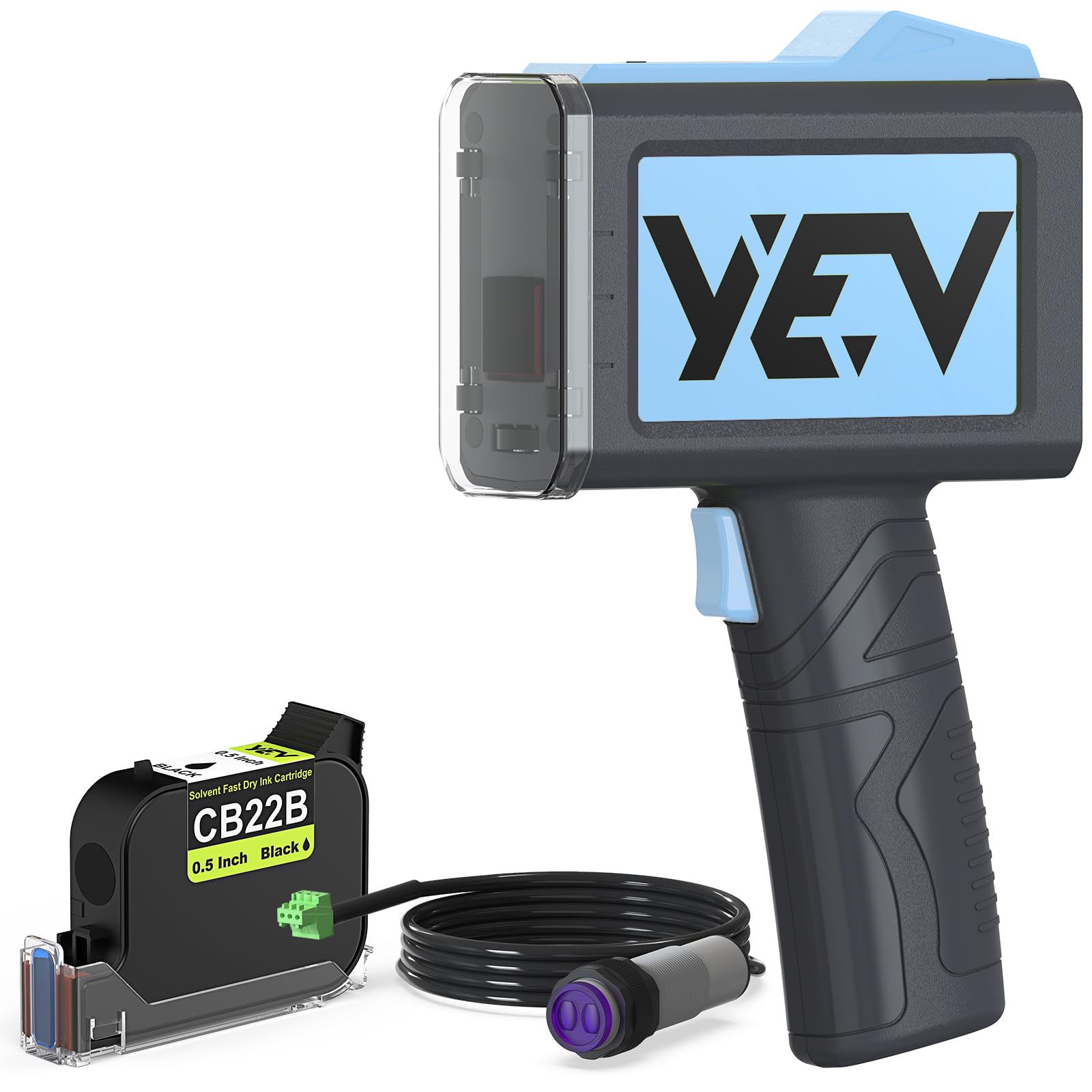
2. YEV VP127 Handheld Inkjet Printer
Built to keep going for a full shift without stopping to recharge.
Where this one pulls ahead of the v4ink BT-HH6105B2 is endurance. The VP127 is rated for more than 16 hours of continuous printing, double the 8-hour run time of the v4ink handheld above. On a long day of batch coding, that is the difference between finishing on one charge and hunting for the charger at lunch.
It also ships with an optical sensor built in, meaning it can trigger a print automatically as a product passes — handy if you are mounting it at a production line rather than sweeping it by hand. Print side, it flexes wider than most: heights from 0.8 mm up to 12.7 mm, one to five lines, 300 and 600 DPI settings, and 300 nozzles for even ink flow. The 42 ml cartridge is a 2–5 second fast-dry black, and five built-in rollers help keep the pass smooth and straight. It also reads USB files directly, including CSV, JPG, PNG, and BMP, plus TTF fonts for custom text and variable data.
If a long track record matters more to you than a lean spec sheet, the brands with hundreds of ratings feel safer. If you need 16+ hours per charge and a sensor that fires the print as product passes, this delivers both.
Runtime that changes the day: more than 16 hours of continuous printing against the 8 hours of the v4ink above, so a long shift finishes without a mid-run charge.
Flexibility on file types: direct USB printing with CSV, JPG, PNG, BMP, and TTF font support gives you variable data without extra software.
Reach for this if: you are coding along a line and want the sensor to fire the print for you while the battery lasts all day.
Look elsewhere if: you would rather buy on a large body of owner experience than on a lean spec sheet.
3. BENTSAI BT-HH6205B Handheld Inkjet Printer
Five rollers and a 16-hour tank for warehouse crews who code all day.
If your coding happens in a warehouse, on the move, for hours, this is the handheld tuned for that. It holds more than 16 hours of operation on the strength of its motherboard design — double the 8-hour run time of the v4ink pick — so a full shift runs without a shutdown cutting into your workflow. It weighs just 410 g, so holding it through a long stretch does not wear your hand out, and the 4.3-inch capacitive touchscreen keeps the interface simple.
The detail that owners single out as the star here is performance in a warehouse setting. What earns the machine its place, though, is stability: it uses 5 built-in rollers versus the 3 you find on most handheld guns. More contact points mean the head glides straighter across a curved carton, so codes come out even. Set-up, as buyers put it, is straightforward — the review pages sum it up as a machine that has someone coding roughly 30 minutes after opening the box.
Its one soft spot is raw throughput on paper: 30 pages per minute, which is half the 60 pages per minute of the v4ink and the OLYBSJET below. For date-and-batch stamping that figure rarely bites, but if you are marking dense pages of content all day, a faster unit serves you better. For cartons and bottles, it stays a strong pick.
Why crews go for it
- 16+ hours of continuous operation means no recharge interrupting a shift.
- 5 built-in rollers for steadier, straighter passes than 3-roller handhelds.
- 410 g body and a 4.3-inch touchscreen keep all-day handling comfortable.
The honest trade-off
- 30 pages per minute is slower than the 60 ppm units on this list.
- Fewer surface options compared to some multi-ink rivals.
Pick it for: warehouse and logistics coding where uptime and a steady hand matter more than page speed.
Pass if: your work is high-volume dense-content marking where 60 ppm matters.
4. BESHENG TIJ2590 Inkjet Coding Machine

Three ways to trigger a print — foot pedal, hand press, or sensor.
This is the pick for a shop that codes a mix of things and does not want to be locked into one method. It offers three printing modes: a foot pedal so your hands stay free, a hand-press trigger, and a photoelectric sensor for automated passes. There is an adjustable positioning plate too, so you can line up the print precisely on small and medium products.
The head prints from 2 mm up to 12.7 mm tall with adjustable line count, and each print run is 1–6.5 cm long — a good fit for batch codes, dates, and small QR or barcode blocks. The 5-inch high-definition touch screen has an intuitive, icon-driven interface. A 42 ml black fast-drying cartridge handles both porous and non-porous surfaces, from glass and metal to cartons, foil bags, cloth, and pipe. It also imports TTF fonts and prints text, serial lot numbers, barcodes, QR codes, variable QR codes, and JPG/PNG/BMP pictures.
One honest note: the value question splits owners. Some find it well worth the outlay for the three-method flexibility, while others feel the price-to-feature ratio misses for their use case. That split is fair rather than a fault: if you genuinely need foot-pedal coding, it earns its place; if one trigger mode covers your work, a simpler handheld does the job.
Trigger flexibility built in: foot pedal, hand press, and photoelectric sensor modes let you match the method to the product, not the other way around.
Matches well with: multi-product shops that want one machine handling small bottles, tubes, and flat items with a hands-free trigger option.
Less compelling if: you only ever need a single hand-press method and simpler controls.
5. BENTSAI BT-HH6105B2 Handheld Inkjet Printer

The coder that keeps even the tiniest fonts legible on cartons and metal.
Fine detail is where this BENTSAI variant shines. It prints a 12.7 mm (half-inch) tall code in fine, crisp characters — the kind of output owners specifically note, with even very small fonts coming out clearly readable. If your codes pack a lot into a small area (a serial plus a batch plus a QR code), clarity is the whole ballgame, and this delivers it.
The hardware echoes the brand’s other handhelds but adds template work. You can build your own print templates on the 4.3-inch high-resolution touchscreen, or load saved files in JPEG, PNG, and BMP format from USB. A 42 ml black cartridge dries in 2–5 seconds with strong adhesion and is rated to 2,000,000 characters at a 2.5 mm font size. The self-locking cartridge clip is a small touch that makes swaps faster, and the whole thing runs more than 8 hours per charge.
The distinctive add-on is photoelectric printing: you can mount this to a conveyor line and let the sensor trigger automatic coding. That turns a handheld into a light-duty automated marker. The limit is the same as the v4ink above — 8 hours of endurance and 60 pages per minute — so for the longest uninterrupted runs a 16-hour unit is the safer bet. For detail and template control on a handled tool, it stands out.
Where it pulls ahead
- Even very small fonts stay clearly legible — the standout quality owners praise.
- Custom templates plus JPEG, PNG, and BMP loading for repeat jobs.
- Photoelectric sensor lets you automate coding on a conveyor.
The limits to weigh
- 8-hour endurance sits below the 16-hour handhelds here.
- 42 ml cartridge needs its protective cap when idle to avoid clogging.
Best suited to: shops that pack serial, batch, and QR data into tight spaces and need maximum legibility.
Not for you if: you run non-stop shifts and cannot stop to recharge an 8-hour battery.
6. OLYBSJET HH6105B2 Handheld Inkjet Printer

A multi-surface handheld for buyers who want the lowest entry point.
This is the entry-level option in a lineup of machines that cost considerably more. It still covers the core job: printing on wood, carton, stone, MDF, light steel, pipe, plastic, aluminum foil, cable, and cloth, with the head laying down 1 to 5 lines up to a 12.7 mm font height and a maximum single-print length of 406 mm.
The picture and data capability is stronger than its price suggests. It handles text, numbers, symbols, QR codes, barcodes, pictures, time, date, and counters, with the highest printed-picture resolution running to 4800px by 150px in PNG, JPEG, or BMP — useful if you need a logo or graphic code, not just plain text. The 4.3-inch LED color touchscreen is sharp and sensitive, and there is no separate app: you edit directly in the printer’s own system or load pictures from USB.
Be clear-eyed about the trade-offs. Font uploading and functionality draw mixed reports, with some finding certain font imports awkward and a portion feeling the price-to-performance skips, while others find plenty of good value here. Print quality itself, though, draws the steadiest praise. This suits a smaller operation that needs multi-material coding on a tight budget, not a high-volume line where every second counts.
What it gets right: a genuinely broad surface list and 12.7 mm five-line output make it flexible well beyond its entry-level standing.
The honest caveat: font importing and overall functionality draw a split response, so smooth custom-font work may take some patience.
Best for: a small shop that wants multi-material coding at the lowest buy-in and can work with the occasional font quirk.
Choose differently if: easy custom-font importing is essential to your workflow.
7. BESHENG JS740PLUS Inkjet Coding Machine
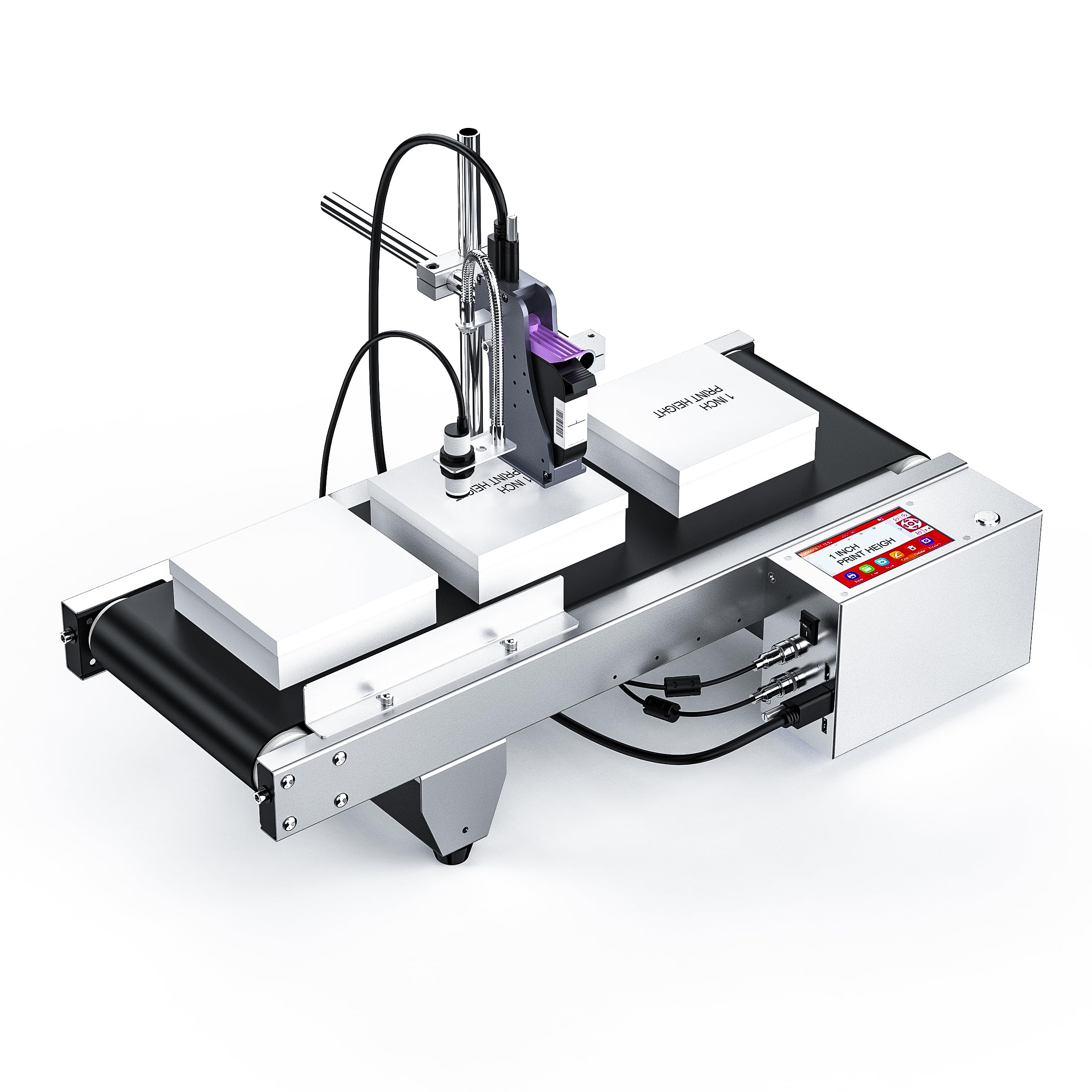
A one-inch head that stamps big, bold codes and feeds products for you.
No other pick in this list prints as tall as this one. Its 25.4 mm (one-inch) printhead handles heights from 2 mm all the way up to 25.4 mm across 1 to 10 lines — so you can lay down a large single-character code or a dense multi-line block that no half-inch head can match. For large cartons and products where the mark needs to be read from a distance, that head is the whole reason to buy it.
The real story, though, is the built-in mini conveyor belt. This is not a handheld you sweep by hand — it integrates with a production line for continuous, automatic operation. It ships with a 42 ml black fast-drying cartridge that codes both porous and non-porous surfaces (cartons, foil bags, glass, metal, plastic, ceramics, cloth, pipe, wood). Owners find it reliable, and the conveyor running smoothly is the thing that stands out. Expect a short start-up dance: you adjust the belt speed and dial in the Light Delay value, and after that one-time debug you are printing automatically.
Two things to plan for. This is a larger, floor-standing unit, not a pocket tool, so you need bench or line space for it. And the 1–10 line capability is powerful but demands you get positioning right first — as with any conveyor system, the set-up is front-loaded. Once dialed in, though, it codes continuously without an operator standing over every piece.
What makes it a line machine
- 25.4 mm (1 in) printhead and 1–10 lines: the largest font reach here.
- Built-in mini conveyor for continuous, hands-free automatic coding.
- 42 ml quick-dry ink covers both porous and non-porous surfaces.
What to expect first
- Belt speed and Light Delay need a one-time debug before smooth runs.
- It needs real floor or bench space as a conveyor unit.
Right call for: shops that need big, bold codes and want products fed under an automatic head.
Look elsewhere if: you code by hand on odd-shaped items and have no line setup.
Know the Specs
Print height and line count
Print height is measured in millimeters and tells you the tallest single line of ink the head can print — 12.7 mm (half an inch) is the common handheld standard, while 25.4 mm (one inch) heads print noticeably larger characters. Line count (often 1 to 5, or up to 10 on large heads) tells you how many stacked rows of text you can fit in one pass, so a serial, a batch number, and a date can all go on together.
Ink type and dry time
Industrial coders use quick-dry solvent ink because it clings to porous surfaces (carton, wood, cloth) and non-porous ones (glass, metal, plastic) alike, and dries in seconds so codes do not smear as products move. A 42 ml cartridge is the common size. Most heads warn you to cap the cartridge when idle — the same fast-drying trait that stops smears will clog a nozzle left open.
Run time and throughput
Run time is how long the machine prints on a charge, listed in hours — handhelds here range from more than 8 hours up to more than 16 hours, which matters for long single shifts. Pages-per-minute figures (from 30 up to 60 in this list) describe raw marking speed, and 600 DPI means finer detail for small fonts and QR codes.
Handheld versus conveyor
A handheld coder is a gun you sweep across the product — flexible for odd shapes and low volume. A conveyor unit feeds products under a fixed head for continuous automatic coding, which suits steady repetitive jobs. Conveyor units need a one-time set-up where you tune belt speed and the Light Delay value, then run hands-free.
Common Questions
What print height do I need for small product date codes?
Will quick-dry ink print on glass and metal as well as carton?
How long does the ink cartridge last?
Can a handheld coder be mounted to a production line?
Is a conveyor coder better than a handheld?
What does DPI mean for a coding printer?
Why does the cartridge need a cap when not in use?
Can I print logos and pictures, not just text?
How much run time should I look for on a handheld coder?
The Bottom Line
For most buyers working through the small industrial inkjet printer question, the answer is the v4ink BENTSAI BT-HH6105B2 — it pairs a 12.7 mm half-inch head and 600 DPI detail with a waterproof quick-dry cartridge rated to 2 million characters, and it carries the strongest reputation in this lineup at 4.0+ stars from 100+ ratings. If a full shift runs long, the YEV VP127 gives you more than 16 hours and a sensor-triggered print. And for high-repetition coding where you want the machine to feed products for you, the BESHENG JS740 conveyor unit keeps the belt and codes rolling without a hand on the trigger.
How we choose
We do not accept paid placement. Every pick is matched to a real buyer and a real use-case; we do not hands-on test units.
Sources
Specifications: manufacturer listings and product documentation. Review insights: verified customer reviews, as of November 2026. Pricing: not shown on this page (it changes often); check the current price via the retailer link.
As an Amazon Associate, Tactical Gear Guy earns from qualifying purchases. This does not affect which products we feature.