Specs are compiled from manufacturer listings and verified buyer reviews and can change over time — please confirm the key details on the product page before buying.
You can stop paying for channels you barely watch. A compact indoor antenna pulls in free local broadcasts — but only if it sits in the right spot, aims the right way, and plugs into the right port. The nine picks below cover every small form factor worth considering, from slim bars that tuck behind your TV to paper-thin panels that hang on a window. The NEOSIGN with its 13-foot cable is the one most people should start with: it balances price, range, and easy setup better than anything else here.
This guide is built by comparing the manufacturers’ published specifications and the patterns across verified customer reviews, so you get each pick’s real strengths and trade-offs instead of marketing spin.
Every antenna here works without a subscription and plugs into the coax port (the round screw-on connector) on the back of your TV. What changes is how far it reaches from the broadcast tower, how it handles interference, and how much room it takes up. Read on for the small antenna for TV that fits your window, your wall, and your local signal map.
Top Picks

How To Choose The Best Small Antenna for TV
The single mistake most buyers make is picking an antenna by appearance first. The slim bars and flat panels all look similar in photos, but the deciding factor is what is happening between your window and the nearest broadcast tower. Distance, building materials, and whether your local channels broadcast on VHF or UHF all shape what you actually pull in. Start there, then narrow down by form factor.
Check your distance to the tower before anything else
Every amplified antenna here lists a maximum range — 30 miles up to 60 miles. That number assumes a clear path. If trees, hills, or thick walls sit between you and the transmitter, the usable distance shrinks. The GE Indoor Bar tops out at 30 miles, while the RCA Flat reaches 40 miles and the Winegard FlatWave FL5500A goes to 60 miles. Pick a range with some headroom over your actual distance so obstructions do not eat your margin.
Amplified or passive matters more than the label suggests
An amplified antenna uses a small inline amplifier — often called a signal booster — to strengthen weak signals. That helps in fringe areas where the tower is far away. A passive antenna has no amplifier, which means it depends entirely on how strong the signal already is where you live. The NEOSIGN model is a passive receiver and works best in areas with good signal coverage. If you are far out, an amplified pick like the UltraPro or the Philips will usually do more for you.
Watch for the LTE filter
An LTE filter blocks interference from nearby cell towers that can bleed into the TV band. The GE Ultra-Thin and the Philips Hover both include one. If you live near a cell footprint, that is worth checking for. The RCA Flat uses Dual-Stage Amplification and Auto Gain Control instead, which adjusts gain automatically.
Coax cable length and impedance
Antennas connect through a coax port on your TV, and the cable length decides where you can place the unit. The NEOSIGN includes 13 feet, the RCA Flat gives you 15 feet, and the Channel Master FLATenna ships 12 feet of RG6. Impedance — measured in ohms — should match the 75-ohm standard most TVs use. The GE models and the Winegard run at 75 ohm. The RCA Flat lists 50 ohm, which is a different match and can cost you signal strength on a long run.
Side-by-Side Comparison
| Model | Best For | Max Range | Channels | Impedance | Amazon |
|---|---|---|---|---|---|
| NEOSIGN TV Antenna for Local Channels★ Best Overall | Most buyers | 30 miles | 100 | — | Amazon |
| UltraPro Amplified Bar AntennaSlim Bar Pick | Slim bar option | 50 miles | 100 | 75 ohm | Amazon |
| RCA Amplified Flat AntennaMulti-Directional Pick | 360° multi-directional | 40 miles | 82 | 50 ohm | Amazon |
| GE Indoor TV Antenna Bar | Reversible color match | 30 miles | 100 | 75 ohm | Amazon |
| Philips Hover Amplified | Top-of-TV mount | 50 miles | 100 | 75 ohm | Amazon |
| GE Ultra-Thin Amplified | Longest GE range | 55 miles | 75 | 75 ohm | Amazon |
| Channel Master FLATenna | Urban and suburban | 35 miles | — | 75 ohm | Amazon |
| Antennas Direct ClearStream Flex | Fringe-area pull | 50 miles | 2 | 75 ohm | Amazon |
| Winegard FlatWave FL5500A | Longest reach | 60 miles | — | 74.99 ohm | Amazon |
Detailed Reviews
1. NEOSIGN TV Antenna for Local Channels (Black)
Our pick — 4.5+★ from 14,000+ verified ratings; the strongest balance of quality and price.
The small black bar that covers 100 local channels over a 13-foot cable
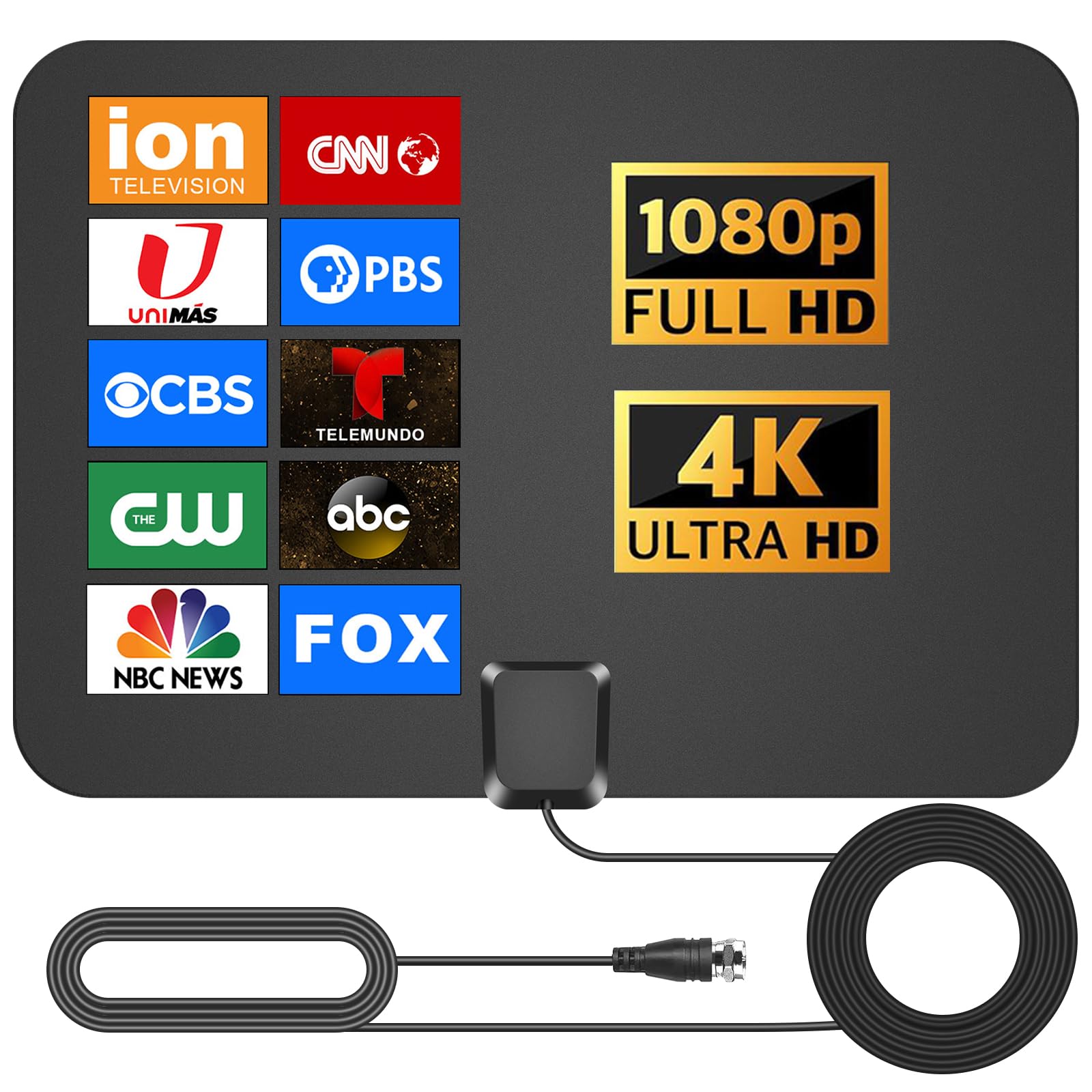
The NEOSIGN takes the top spot because it catches signal from all directions — 360° reception — so you do not have to aim it. It also ships with 13 feet of coaxial cable (the round signal wire), enough to reach a window, a shelf, or an outdoor spot. That extra length lets you test spots across the room instead of settling for the closest outlet. The 13-foot coax run is long enough to reach a window from most TV stands. It picks up the majors like ABC, CBS, NBC, PBS, and Fox, and handles 4K and 1080p formats (1080p is standard full HD).
What wins people over is how predictable the setup is: connect it to the CABLE-ANT IN port, switch the TV to AIR mode, and run a channel scan. That is the whole job. It is rated for both indoor and outdoor placement, so a window or porch mount is fair game. It is a passive receiver, so it thrives in areas with good signal coverage — the manufacturer is upfront that it does not generate signal, it only captures what is already in the air. Check what is broadcast near you before you buy, not after.
Where it falls short is range. It lists a 30-mile maximum, which is on the shorter side compared to the 60-mile Winegard and the 55-mile GE Ultra-Thin below. In a metro or strong-signal suburb that is plenty. Push out past 30 miles with trees or buildings in the way and you will want an amplified pick instead.
Why it earns first place
- 360° reception means you do not have to aim it like a dartboard
- 13-foot coax cable reaches a window or wall from most TV setups
- Handles ABC, CBS, NBC, PBS, Fox at 4K and 1080p with no subscription
- Rated for indoor and outdoor mounting near a window
What to weigh first
- 30-mile range cap is the shortest here, so fringe-area buyers should look amplified
- Passive design depends entirely on your local signal strength
Reach for this if: you live in a metro or strong-signal suburb and want the cleanest plug-and-scan setup.
Look elsewhere if: you are more than 30 miles from the tower or surrounded by hills.
2. UltraPro Amplified TV Antenna, Indoor Bar Design
A 50-mile bar hidden above the TV, with a booster that filters noise
If you want a small antenna that disappears into your living room, this 15.75-inch bar is about as clean as it gets. It replaces the old rabbit ears entirely and mounts above your TV or on a tabletop with the included stand. The built-in PureAmp Technology amplifier filters noise and boosts the signal, which is the reason it can stretch to 50 miles from the broadcast source and still pick up VHF and UHF channels in 4K and 1080p.
The range figure is the standout: 50 miles is 20 miles further than the RCA Flat’s 40-mile cap and the strongest of the three mid-tier bars here. Setup is straightforward — connect to the TV, connect the amplifier to a power source, mount, scan. The amplifier is doing real work, so you do need a nearby power outlet. That is the small catch of a powered antenna.
Buyers report mixed feedback on picture quality, so set your expectations. The bar design is engineered to enhance VHF reception (VHF is the older channel band, channels 2–13), and in a back bedroom or secondary room it does its job. Whether the picture rivals cable depends a lot on how strong your local signal is. In strong-signal zones it performs; in weaker ones, expect many local channels but not every one. If you live far from the towers, this is not the pick for you.
Standout spec: a 50-mile amplified bar with a limited-lifetime replacement pledge and U.S.-based consumer care.
The honest read: the amplifier needs a power outlet nearby, and picture results track how strong your broadcast signal already is.
Best for: anyone who wants a bar tucked above the TV with real amplification behind it.
Think twice if: you cannot get power to the mount spot or you are chasing distant fringe signals.
3. RCA Amplified Indoor Flat HDTV Antenna (ANT1360E)
The flat panel that spins in every direction so you stop re-aiming it
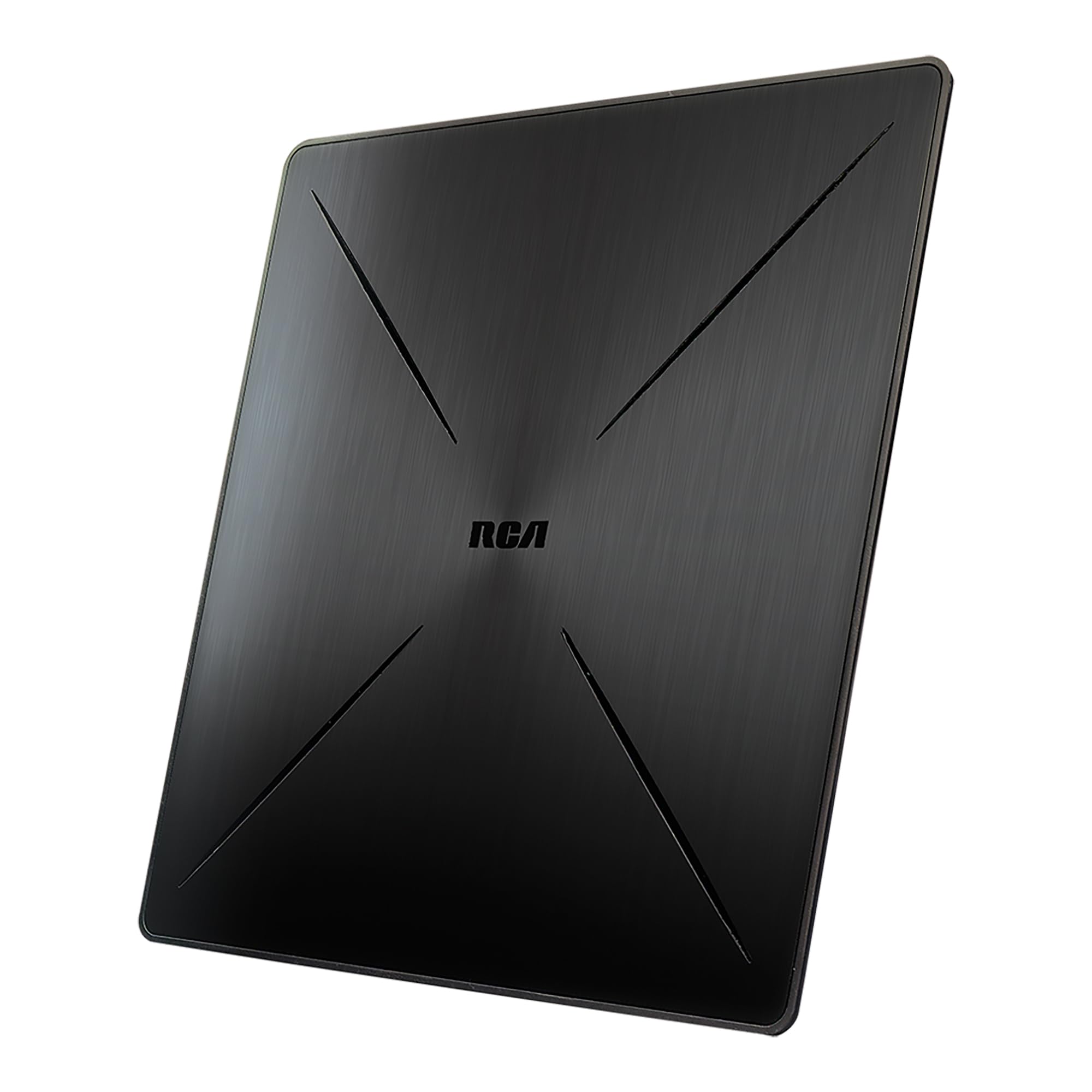
The problem with most flat antennas is that the moment a signal drops, you are up on a chair swiveling the panel. RCA solves that with a patented 360° multi-directional design that captures signals from every direction — so no constant adjustment. The amplifier uses Dual-Stage Amplification with Auto Gain Control, which automatically tunes the boost rather than making you guess. It receives 4K/8K and 1080p broadcasts up to 40 miles from the tower.
Placement flexibility is unusually good here: the panel is paintable, so you can mount it on a wall without it shouting at you, or lay it flat, or stand it on the shelf with the built-in easel. The 15-foot coax cable gives you room to reach a window, and a 3-inch USB power cable with adapter keeps the amplifier fed. It also works as a backup feed for a streaming setup when cable or satellite goes down.
The one spec worth flagging is impedance: the RCA lists 50 ohm, while most of the picks here — the GE bars, the Winegard, the Channel Master — use the 75-ohm standard. A mismatch can cost you a little signal on a long cable run. It is a small design detail, but if you are already on the edge of the 40-mile range, every bit counts.
The strength buyers latch onto: the 360° receiver means placement is genuinely flexible — no aiming skill required.
The caveat: 50-ohm impedance deviates from the 75-ohm TV standard, so keep the cable run short if your signal is already marginal.
Worth grabbing when: your towers sit in multiple directions and you are tired of micromanaging antenna position.
Skip the stretch if: you are far from the tower and need every ohm of signal to count.
4. GE Indoor TV Antenna, Bar Design, Reversible Black/White

A slim bar you can flip from black to white to match your shelf
Not everyone wants a black rectangle on a white wall. This GE bar ships with a reversible black-and-white finish so it can blend into whatever your living room already looks like. The 75-ohm impedance matches the standard TV input, and the built-in coax connection keeps the signal path clean. It handles ABC, NBC, CBS, PBS, and Fox at full HD, with 100 channels on the spec sheet.
The bar design replaces traditional rabbit-ear dipoles and is engineered to boost VHF reception — the channel band that a lot of flat panels still struggle with. You can mount it on the wall or use the included stand for tabletop display. It is also NEXTGEN TV (ATSC 3.0) ready, so it can pick up the newer broadcast standard as it arrives in your area.
What you should know up front: the maximum range is 30 miles, and it is the shortest in this line-up alongside the NEOSIGN. Owners also split on how many channels they actually pull in — some land around 30, others fewer than expected. That gap says less about the antenna and more about how different every neighborhood’s signal map is. Treat 30 miles as a hard ceiling and check your tower distance first.
The aesthetic angle: a reversible black/white bar with a 75-ohm match is rare at this size, and NextGen TV compatibility keeps it current.
The catch: 30-mile range and hit-or-miss channel counts mean you should verify your local signal before committing.
Pick it when: looks matter as much as reception and your towers are within 30 miles.
Pass if: you are outside that radius or in a spot where channel count has been unreliable for neighbors.
5. Philips Hover Amplified HD TV Antenna

The antenna that sits on the TV itself, out of sight and out of the way
Here is a smarter answer to the clutter problem: mount the antenna on top of your flat screen so it is improve, clean, and near the signal instead of on the floor. The Philips Hover is built for exactly that, with a mounting bracket that clips to the top of the TV or a wall. The bracket also comes off if you would rather lay it flat. The bar itself is long — 18.98 inches — so it tucks above the screen rather than dominating the room.
The amplifier uses Philips TruAmp Technology and includes a 4G/5G LTE filter, which is the feature that matters if you live near a cell tower. That filter reduces the cell-signal bleed that can fog your picture. Reception reaches up to 50 miles for HDTV, VHF, and UHF channels, and it is 4K/8K ready and NextGen TV compatible. A limited-lifetime replacement pledge and U.S.-based technical support back the thing.
What to weigh: this is an amplified antenna, so it needs a power connection near wherever it sits. And the top-of-TV placement is the feature — if your TV is in a corner far from a window, that improve spot may not be the best signal spot in the room. Placement flexibility is the trade-off for the clean look.
Where the Hover pulls ahead
- Top-of-TV bracket keeps the room clutter-free and the antenna improve
- 4G/5G LTE filter cuts cell-tower interference for a cleaner picture
- 50-mile range and 75-ohm impedance align with the standard TV input
- Bracket removes for flat-surface placement when you need to move it
What you give up
- Needs a power outlet within reach of the mount spot
- The built-in top-of-TV placement can pin you to a weaker signal location
Made for: tidy living rooms where the antenna should vanish above the screen.
Not for: rooms where the best signal is across the room by a window.
6. GE Ultra-Thin Amplified TV Antenna (48862)

A paper-thin panel reaching 55 miles with an LTE filter built in
The Ultra-Thin is the GE pick for anyone stretching past the 30-mile bar option: this one lists a 55-mile reception range for 1080p and 4K broadcasts. That is five miles further than the Philips Hover and the UltraPro bar, both at 50 miles. The amplifier includes a built-in 4G/5G LTE filter, so cell-tower noise gets filtered before it reaches your tuner, and the flat panel mounts on a wall or a window with a 5-foot coax cable.
The reversible finish — black on one side, white on the other — plus a paintable surface makes it easy to blend into whatever wall you stick it to. If you are trying to get a clean panel look without drilling a visible mount, this is a reasonable option. 75-ohm impedance keeps it matched to standard TV inputs.
And the review pattern reflects that this is a signal-dependent antenna — some buyers get better-than-expected reception, some get nothing. That spread is real, and it usually points back to location and placement rather than the hardware. Put it high, near a window, and scan again if the first try disappoints.
What it does well: 55-mile range plus a built-in LTE filter is the strongest GE combo for suburban fringe reception.
The honest edge: reception is inconsistent across homes, and the listed 75-channel count trails the bar design’s 100.
Choose it when: you want flat-panel looks with the longest GE range and a cell-interference filter.
Consider another if: you need maximum channel coverage or a placement-proof reception guarantee.
7. Channel Master FLATenna Indoor Digital HDTV Antenna
The thin white panel with the cable quality serious antenna buyers check first
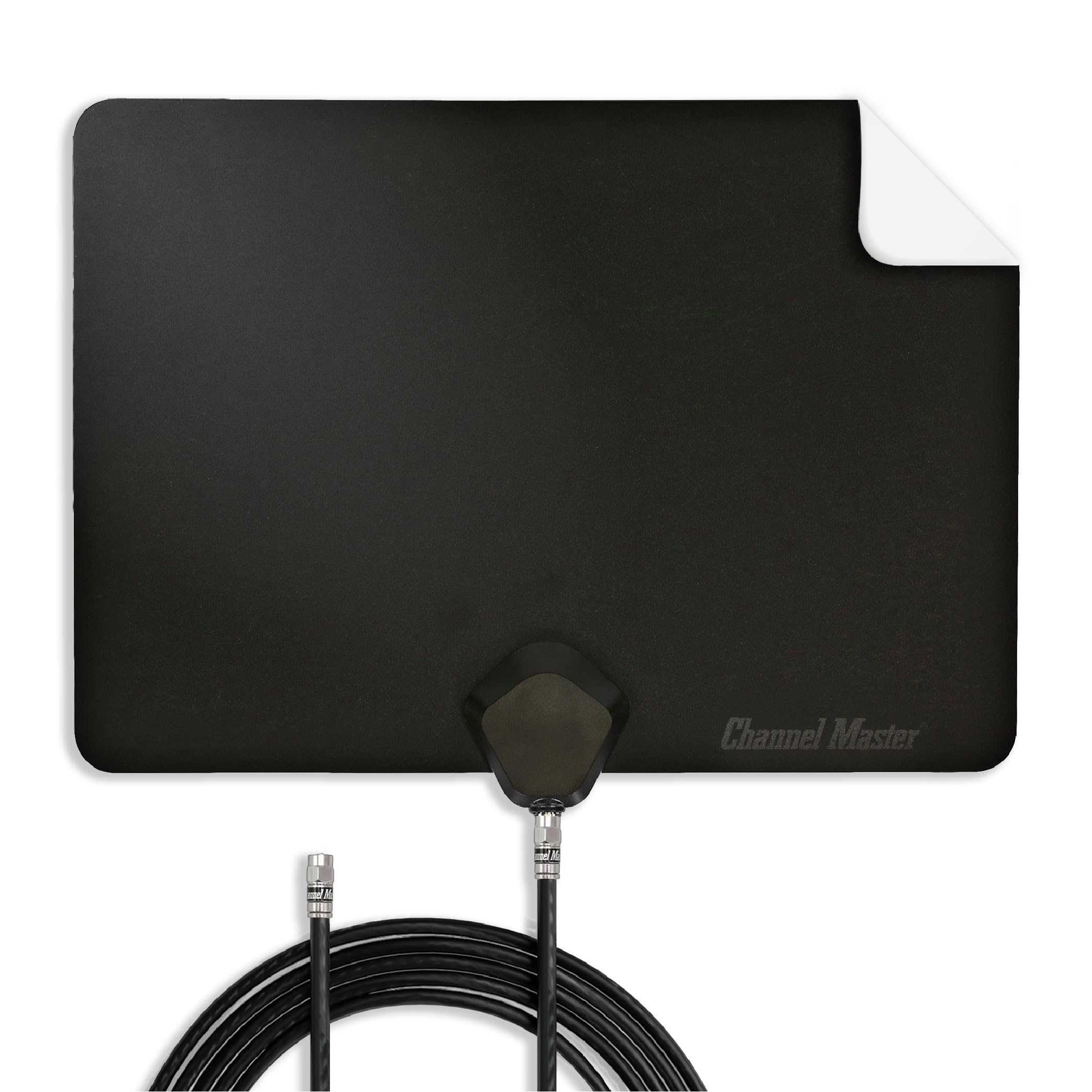
Channel Master has been building antennas since 1949, and the FLATenna is its compact indoor answer: a reversible black-and-white panel that mounts on a wall, a window, or a tabletop. The real advantage here is the cable. It ships with 12 feet of professional-grade RG6 coax with enhanced shielding — RG6 is the thicker, better-shielded coax type, and the enhanced shielding is what keeps signal clean across the run. At 75-ohm impedance it matches the standard TV input cleanly. Reception is rated at 35 miles, which the maker frames as a realistic figure that accounts for obstructions and interference rather than a best-case lab number.
What wins people over is functionality — the panel does what it says, pulling in HD and digital signals with clear reception that holds up against common flat antennas. It supports ATSC 3.0 NextGen TV and 4K broadcasts, covers local networks like ABC, CBS, FOX, NBC, PBS, Univision, and Telemundo, and handles wall mounting through pre-drilled holes in the panel. The thin, lightweight build makes it easy to tuck against a window frame.
The 35-mile range is the trade-off against the 50- and 60-mile picks here. In an urban or dense suburban setup — which is what Channel Master built it for — that is fine. Out in the country, you will probably want more reach. A few buyers also find the included 12-foot cable short for their layout, so measure your run before you commit.
Why urban buyers lean this way: 12 feet of RG6 coax with enhanced shielding keeps the signal stable in dense areas better than a basic thin cable.
The limitation: 35-mile range and a 12-foot run mean layout matters — measure first if your window is far from the TV.
Go this route if: you are in a city or suburb and want a flat panel with serious cable quality.
Look further if: the tower is beyond 35 miles or the TV is too far from any window.
8. Antennas Direct ClearStream Flex Amplified Indoor TV Antenna

A paper-thin loop panel with an on/off amplifier switch you control
Most amplified antennas give you a booster and no control over it. The ClearStream Flex flips that with a Jolt Switch — an inline amplifier you can toggle on or off in real time. That matters because a booster helps when a signal is weak, but it can cause overload when the signal is already strong. Being able to switch it off means you can tune per channel instead of living with one fixed setting. The panel itself is a patented loop element in a 0.04-inch-thick design, sized at 12 inches high by 16 inches wide.
It is built for fringe and suburban use, with UHF and Hi-VHF elements delivering range and reception where signals are thin. Range is listed at 50 miles, 75-ohm matched. The package comes complete: 12 feet of detachable high-performance coax, the Jolt Switch amplifier with its own coax and a 6-foot USB cable, plus hook-and-loop tabs and push pins for mounting. It is reversible black or white and paintable, so it can match your wall.
The trade-off is value perception. Some buyers consider the Flex overpriced for what it does, while others find it worth the spend because it pulls in channels in spots where cheaper panels failed. The 0.04-inch thickness is genuinely convenient for hiding, but it also means the panel should be handled with a bit of care.
What sets the Flex apart
- Jolt Switch amplifier lets you turn the boost on or off in real time
- 0.04-inch-thick loop panel hides almost anywhere
- 12-foot detachable coax plus 6-foot USB cable included
- UHF and Hi-VHF elements give strong range in fringe zones
Where the math gets tough
- Costlier than most picks here, and value opinion splits
- Paper-thin panel needs careful handling during setup
Sharp choice for: fringe-area setup where channel-by-channel signal tuning matters.
Hold off if: you are in a strong-signal metro and want the simplest, lowest-fuss option.
9. Winegard FlatWave FL5500A Amplified Indoor TV Antenna
The flat panel that reaches 60 miles — the longest range on this list
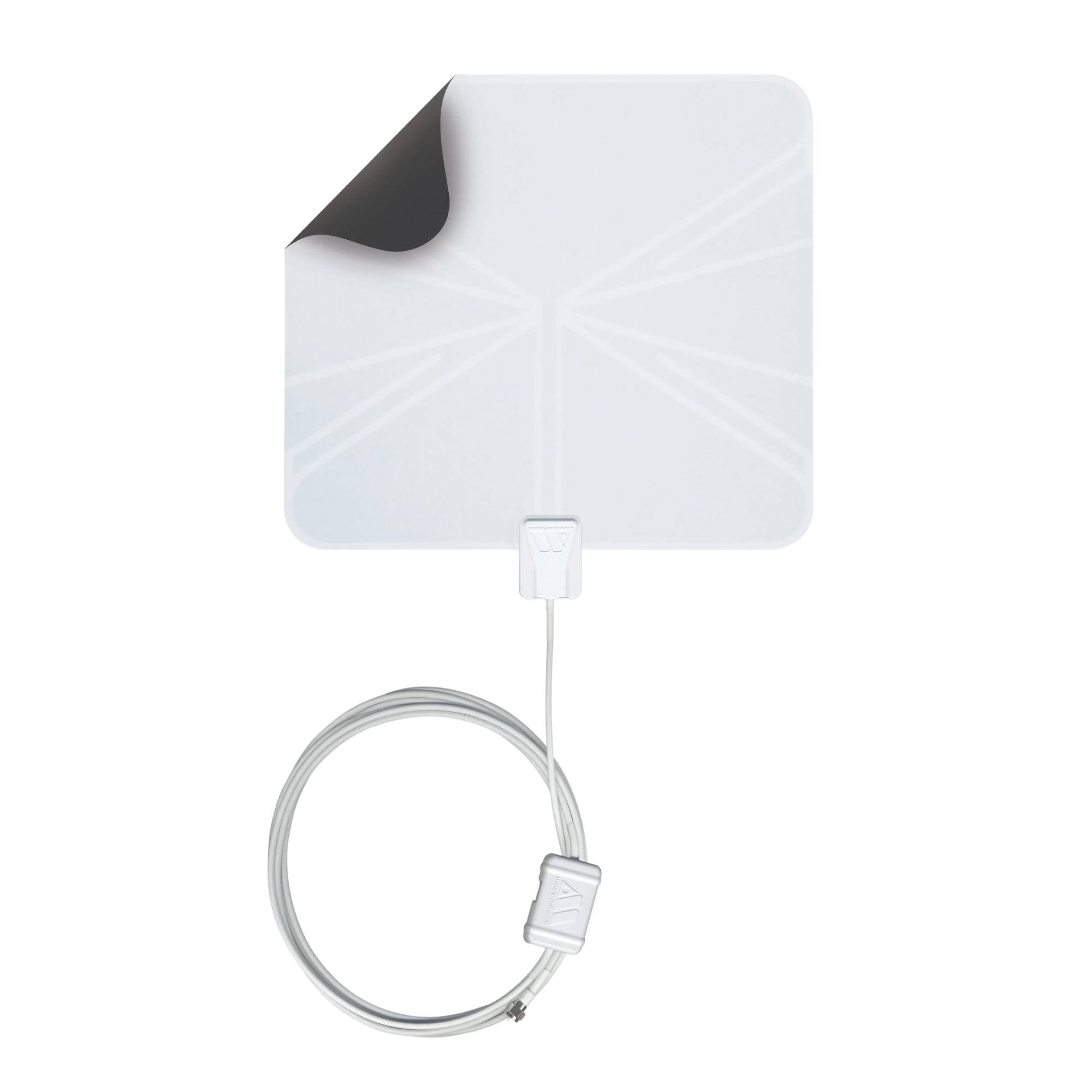
Live well outside the city? The FL5500A is built for that problem. It picks up VHF and UHF over-the-air signals (UHF is the higher channel band, channels 14 and up) up to 60 miles from the tower. That is the longest listed range here — 10 miles further than the 50-mile UltraPro and Philips bars, and 25 miles beyond the 35-mile Channel Master. It is designed for urban and suburban environments, with a low-profile dual-color panel that blends into most rooms without heavy mounting hardware.
Setup is genuinely simple: connect it to the TV’s coax input, run a channel scan, and the Winegard app walks you through the rest. No tools required. It is compatible with NextGen TV broadcasts and works with most smart TVs and streaming devices alongside local over-the-air channels. Owners mention it works well in upstairs windows, picks up around 30 channels, and delivers clear picture with minimal pixelation.
The trade-off lives in the reception consistency. Reports split on value for money and station coverage — that is the reality of a 60-mile claim, because obstructions shrink any antenna’s real reach. If your building materials and tree line are friendly, it delivers. If not, no flat panel will fix a fully blocked signal path.
The headline: 60-mile range plus NextGen TV support makes this the farthest-reach pick on the list.
What to plan for: reception and value opinions split, so placement near an upper window matters more than the spec sheet alone.
Made for: houses at the edge of the broadcast footprint that need every last mile of range.
Not ideal if: you have heavy obstruction between you and the tower and want a guaranteed pull.
Know the Specs
Maximum Range (in miles)
This is the manufacturer’s stated distance from the broadcast tower at which the antenna can still pull in a signal. It is the number buyers check first, and it is also the most misunderstood. Range assumes a fairly clear path. Trees, hills, and thick walls all shorten the usable distance, so pick a range with headroom above your actual tower distance. On this list, the figures run from 30 miles up to the Winegard’s 60 miles.
Impedance (ohms)
Impedance is the electrical match between the antenna and your TV’s coax input, measured in ohms. Most TV inputs use the 75-ohm standard, so a 75-ohm antenna mates cleanly. The RCA Flat lists 50 ohm, a different match — usually fine, but on a long cable run it can cost a little signal. Match the ohm rating to your TV input whenever you can; it is a small spec with a real effect on strength.
Amplified vs. Passive
An amplified antenna (also called a boosted antenna) uses an inline amplifier to strengthen weak signals, and it needs a power source. A passive antenna has no amplifier and depends entirely on the signal already present in the air. Amplified suits fringe or obstructed areas. Passive suits urban areas with strong signal. Several picks here are amplified, while the NEOSIGN is passive — which is why it performs best in good-coverage zones.
VHF vs. UHF
Local channels broadcast on two bands: VHF (very high frequency) and UHF (ultra-high frequency). Some antennas are tuned to favor one over the other. The bar designs — GE’s and UltraPro’s — are specifically engineered to enhance VHF reception. A multi-directional or dual-band design covers both. If your local lineup includes a lot of VHF stations, favor a bar or a dual-band panel.
Common Questions
Do indoor TV antennas actually get free channels with no subscription?
How do I know which channels are available in my area?
Why does my antenna pick up fewer channels than the listed number?
Can I use an indoor antenna outdoors or near a window?
What is the difference between an amplified and a passive TV antenna?
Do I need to rescan channels after moving my antenna?
Will an indoor antenna work with my smart TV and streaming box?
Does a 75-ohm antenna outperform a 50-ohm one?
How does an LTE filter help my TV antenna reception?
Can I paint or hide my indoor antenna to match my room?
The Bottom Line
For most people, the small antenna for tv winner is the NEOSIGN TV Antenna for Local Channels. Its 360° reception and 13-foot coax cable make setup forgiving in almost any room, and the passive design (no power plug needed) keeps it simple in strong-signal areas. Want a thin bar tucked above the screen? Grab the UltraPro Amplified Bar Antenna at 50 miles. For long-distance fringe reception, the Winegard FlatWave FL5500A reaches 60 miles — the farthest on this list. Near a cell tower? The LTE-filter pair (LTE filters block phone-network interference) of the GE Ultra-Thin and the Philips Hover is worth the look.
How we choose
We do not accept paid placement. Every pick is matched to a real buyer and a real use-case; we do not hands-on test units.
Sources
Specifications: manufacturer listings and product documentation. Review insights: verified customer reviews, as of November 2026. Pricing: not shown on this page (it changes often); check the current price via the retailer link.
As an Amazon Associate, Tactical Gear Guy earns from qualifying purchases. This does not affect which products we feature.