Specs are compiled from manufacturer listings and verified buyer reviews and can change over time — please confirm the key details on the product page before buying.
You bend down once at 5 a.m. to tie a lace, then again at lunch, then again after a shift that already wrecked your knees. Slip-on work boots kill that whole ritual — you step in, the elastic side panels grab your ankle, and you are out the door. But “slip-on” also means the boot has to hold itself onto your foot without laces, so the fit, the toe protection, and the outsole grip matter far more than they do on a lace-up.
This guide is built by comparing the manufacturers’ published specifications and the patterns across verified customer reviews, so you get each pick’s real strengths and trade-offs instead of marketing spin.
Below you will find nine laceless boots sorted by what they actually protect and who they fit, from wedge-sole pull-ons to waterproof Chelsea styles with a puncture-resistant plate. Every pick here has no laces, so the safety-toe ratings and the ankle hold are what separate a good day from a bad one — and this breakdown of slip-on work boots covers both in plain terms.
Top Picks


How To Choose The Best Slip-On Work Boots
A slip-on boot has one job a lace-up does not: it has to grip your foot with elastic alone. Everything else — the toe cap, the midsole plate, the outsole tread — sits on top of that fit. Get the ankle hold wrong and you will feel your heel lift with every step, which is the single most common reason people give up on a Chelsea-style work boot.
Toe Type: Steel, Composite Or Soft
Steel toe boots put a metal cap over your toes to meet impact and compression standards. Composite toe boots do the same protective job with a non-metal cap, which keeps the toe from getting cold in winter. Soft toe boots have no cap at all — they are lighter and flex more, and they suit warehouse, kitchen and driving work where nothing heavy drops on your foot. Decide this first, because it is the spec that decides how the rest of the boot is built.
Ankle Hold And The Gore Panel
The elastic panels on each side of a Chelsea boot are what let you pull it on and what hold your ankle afterward. Stretchier panels go on faster but can feel loose once you are walking; firmer panels take a week to break in but lock the heel down. Without laces to tighten, the only adjustment you get is the insole — several picks here let you pull the footbed out, which buys you a little width.
The Outsole And Puncture Protection
Slip resistance lives entirely in the outsole rubber and the tread pattern. Look for an outsole described as oil-, slip-, and abrasion-resistant if you work around grease or wet concrete. A puncture-resistant midsole is a separate layer under your foot, and it comes as a steel plate or a Kevlar layer — Kevlar bends with your foot and does not feel cold, which matters on long shifts.
Waterproofing That Survives A Shift
A waterproof treatment on the leather and a waterproof membrane inside the boot are two different things. The membrane is the one that keeps water from soaking through to your sock after you stand in a puddle. Look for a named waterproof system in the listing, then keep in mind that the elastic gore panels are the usual weak point over time.
Side-by-Side Comparison
| Model | Best For | Toe Type | Safety / Waterproof | Outsole | Amazon |
|---|---|---|---|---|---|
| Carhartt Chelsea Wedge★ Best Overall | All-day concrete and mixed trades | Steel or soft toe | FastDry lining; no waterproof membrane listed | Dual-density slip-resistant rubber wedge | Amazon |
| OUXX 6” Steel Toe ChelseaBest Certification | Wet sites and long warehouse shifts | Steel toe | ASTM F2413-24 I/75 C/75; EH rated; waterproof | Oil- and slip-resistant rubber | Amazon |
| Wolverine Trade Wedge Romeo | Flexible wedge comfort on hard floors | Soft toe | Waterproof | Wedge outsole for pressure spread | Amazon |
| Georgia Boot Eagle One | Rugged outdoor and wet conditions | Non-steel | Georgia Waterproof System | Oil, slip, chemical, heat and abrasion resistant rubber | Amazon |
| ROCKROOSTER Bakken | Laceless comfort with toe choice | Soft toe (AK303) or steel toe (AK323) | EH rated; Hydroguard waterproof membrane | Slip, oil and heat-resistant rubber | Amazon |
| Wolverine Wellington | Ten-inch coverage for heavy outdoor work | Soft toe | Water-treated leather; no membrane listed | Deeply treaded oil, water and abrasion treated | Amazon |
| Ariat Turbo Chelsea CSA | Cold-weather sites and rotating shifts | Carbon toe | CSA rated; waterproof | Rubber traction outsole | Amazon |
| Timberland PRO Nashoba | Metal-free sites and wide feet | Composite safety toe | Electrical hazard protection; no steel | All-weather TPU, heat/oil/slip/abrasion resistant | Amazon |
Detailed Reviews
1. Carhartt Men’s Chelsea Boots
Our pick — 4.0+★ from 950+ verified ratings; the strongest balance of quality and price.
The wedge-sole workhorse that carries a long shift without asking you to bend down.
If your day is eight to twelve hours on poured concrete, this is the boot built around that exact punishment. The wedge outsole is a single flat rubber sole that runs heel to toe with no separate raised heel, so your foot sits level and the pressure spreads out instead of jabbing into your arch. The top of the boot pulls on through oil-tanned leather and twin gore panels — those are the two elastic side strips that stretch as you step in and then close back on your ankle.
What wins people over is the build itself, with quality the thing buyers praise most. The Insite footbed inside delivers high-rebound cushioning and a podiatrist-shaped arch, the layer your foot presses into at hour nine. FastDry lining pulls sweat away from the foot so your sock is not soaked by the afternoon. The dual-density rubber outsole — two rubber densities layered for grip and stability — is the reason it holds on greasy shop floors.
The honest catch sits in two places. Durability draws split feedback, with some reports of the sole separating from the upper, so treat the welted seam as the part to watch rather than the leather. Fit also splits, because a laceless boot cannot be tightened — this one works best if your normal size lands you between a snug and a locked-in heel. The good news is the crowd verdict backs it anyway: 4.0+ stars across 900+ ratings, the highest-rated pick here with a real following behind it.
What Lands On The Jobsite
- Wedge outsole spreads pressure evenly underfoot on hard concrete
- Insite footbed delivers high-rebound cushioning and podiatrist-designed arch support
- FastDry lining moves moisture off the foot through a long shift
- Available in both steel toe and soft toe, so you pick your protection level
- Twin gore panels plus oil-tanned leather give a true step-in entry
Where It Demands Attention
- The sole-to-upper seam is the failure point to keep an eye on
- No waterproof membrane listed, so standing water will eventually soak through
- Fit splits down the middle, since there are no laces to dial in
Made for you if: you clock long hours on concrete or mixed shop floors and want a boot you never have to lace.
Pick another if: you spend the shift standing in puddles — grab a waterproof Chelsea instead.
2. 6” Steel Toe Slip On Work Boots
A six-inch steel toe Chelsea that shows you its safety paperwork before you buy.
Most listings make you guess at the safety rating. This one states it outright: ASTM F2413-24, the current standard for protective footwear, with I/75 C/75 ratings. Those two numbers are the impact and compression scores — the toe cap survives a set amount of dropped weight and a set amount of crushing force. It also carries an Electrical Hazard rating, which means the sole is built not to conduct current near live circuits.
The construction choice is the interesting part. The midsole — the protective layer under your foot — is Kevlar rather than a steel plate, so it stops nails, screws and metal shards the way steel does but bends with your foot instead of staying rigid. That is what keeps fatigue lower over a twelve-hour shift. Waterproofing comes from oiled leather with a waterproof treatment, and the rubber outsole runs an oil- and slip-resistant tread for wet or greasy floors. The high-stretch elastic side panels hold the ankle firm and keep dust from wandering in.
Two things to weigh. The fit runs on the roomy side for some buyers, so if you are between sizes, sizing down is the safer call with no laces to snug up. And the quality of the build is the strongest thing here — it is the most praised attribute by a wide margin — which explains why 600+ ratings land at 4.0+ stars. That is a real safety boot with real certification, not a fashion Chelsea dressed up as one.
The certification advantage: an explicit ASTM F2413-24 I/75 C/75 rating and an EH rating give you the two things a safety officer asks about, stated in the listing rather than buried.
Reach for this when: your site requires documented toe protection and you work wet or oily floors.
Look elsewhere if: you have a wide foot and want zero guesswork in the sizing.
3. Work Boots for Men, Steel Toe
A steel toe and a puncture plate in a boot that comes in 7 through 15, in medium and wide.
Sizing range is where this one earns its place. You get US sizes 7 through 15 in both medium and wide widths, which is a wider spread than most Chelsea work boots offer. The safety package pairs a steel toe cap with a non-metal Kevlar puncture-resistant innersole, so a nail coming up through the sole stops before it reaches your foot. Electrical Hazard protection rated at 18,000 volts / 1 mA is listed on top of that.
The outsole is PU and rubber in a dual-density build described as oil-, slip- and abrasion-resistant — three separate things you want when the floor is greasy rather than just wet. Genuine full-grain leather and a water-repellent finish round out the upper. Buyers who like a low-profile boot mention the slim shape, and quality is comfortably the most-praised trait in the feedback.
Here is the trade-off to plan around: the fit divides people. Some say it runs true, others find it a touch wide across a narrow foot. With no laces to cinch, a wide fit on a narrow foot means your heel can move — so if you are narrow, order down. It sits at 4.0+ stars from a smaller pool of ratings than the top picks, and that fit split is the honest reason why.
Width range as the headline: US 7 to 15 in both M and W covers feet that most laceless boots leave out, and the Kevlar innersole adds nail protection without a cold steel plate.
Best fit for: wider feet and anyone who needs puncture protection plus an EH rating on a budget-build boot.
Skip if: you wear a narrow size — the roomy last works against you here.
4. ROCKROOSTER Men’s Black Slip-on Work Boots
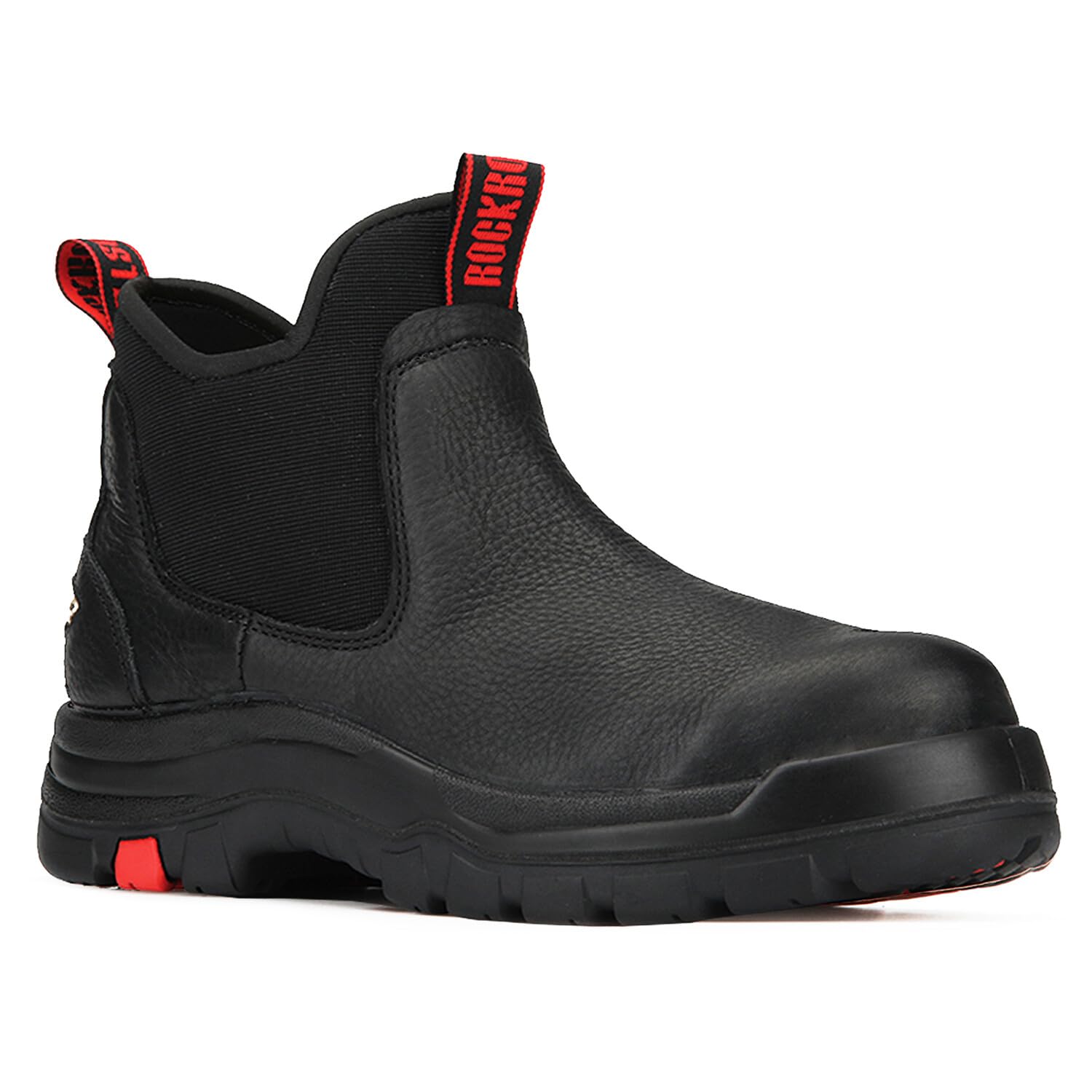
Two boots in one listing: pick a soft toe for speed or a steel toe for protection.
The AK303 is the soft toe version, the AK323 is the steel toe, and both share the same laceless Chelsea shell. The point of the soft toe is weight and flex — nothing metal pressing on your toes, so the boot feels quicker to pull on and easier to drive in. The steel version swaps in the protective cap for sites that require it. Waterproofing is handled by a Hydroguard breathable waterproof membrane, which is the inner layer that stops water crossing to your sock while still letting vapor escape.
The design leans hard on break-in. The elastic collar and soft leather are shaped so the boot does not chew your ankle while you get used to it, and buyers report it holds up well for at least 6 months of steady wear. An EH rating puts non-conductive soles under you near electrical work, and the rubber outsole is built to resist slip, oil and heat — the last one matters if you are around asphalt or a hot kitchen line.
Two pieces of honest guidance. First, sizing: this brand’s own chart says the boot runs a little big against sneaker size, and because laces are gone, they suggest going down a half size for a secure hold. Second, weight splits opinion — plenty call it light, some find it on the heavy side. What is not in doubt is the overall quality, which is the top praise by a clear margin, and 4.0+ stars keeps it comfortably in contention.
Why It Competes
- Soft toe and steel toe offered in the same model line
- Hydroguard waterproof membrane keeps feet dry in wet conditions
- Elastic collar and soft leather are built to skip the blister phase
- EH-rated soles with slip-, oil- and heat-resistant rubber
Before You Order
- The maker’s own chart says to size down a half
- Weight splits the room — not the lightest boot here
- Soft toe version offers no toe-cap protection
The smart move: start half a size down from your sneaker size and these pull on without a fight.
Think twice if: your site mandates a steel toe — order the AK323, not the soft model.
5. WOLVERINE Men’s Trade Wedge Waterproof Romeo Boot

The flat wedge sole that keeps you on your feet all day without a heel to fight.
A wedge outsole runs flat from heel to toe, and that shape is the whole pitch here — it flexes more naturally under your foot and spreads pressure across the whole sole instead of loading one spot on hard flooring. The Romeo cut means a low, laceless slip-on silhouette, and the boot is waterproofed for wet ground. Quality is the attribute that carries the most weight in the feedback, which is why a boot with a tricky sizing reputation still lands at 4.0+ stars.
The uncomfortable part has to be said plainly: sizing runs very big. That is not a minor note on a laceless boot, because there is no lace to pull in and take up the slack — too big means your heel moves with every step. Treat the listed size as a starting point and expect to size down. Buyers also note a smooth lining that lets the foot slide in easily, one of the small build details that makes daily wear pleasant.
Wear at the bottom is the other thing to watch, with reports of the sole wearing quickly on some pairs. Stack it against the rest of the field honestly: it beats a heavy lugged boot on flexibility and it drops weight on your feet, but it falls short of the Carhartt above on fit consistency. Buy it for the wedge flex and the low slip-on cut, and size with care.
Where the wedge wins: the flat outsole flexes and spreads load, which is what keeps legs fresh on concrete — and the low Romeo height makes it the easiest boot here to step into.
Good match for: workers on hard, flat surfaces who want maximum flexibility and a quick step-in.
The catch: it runs very big, so a true-to-size order will slide — size down.
6. Georgia Boot Eagle One Waterproof Chelsea Work Boot
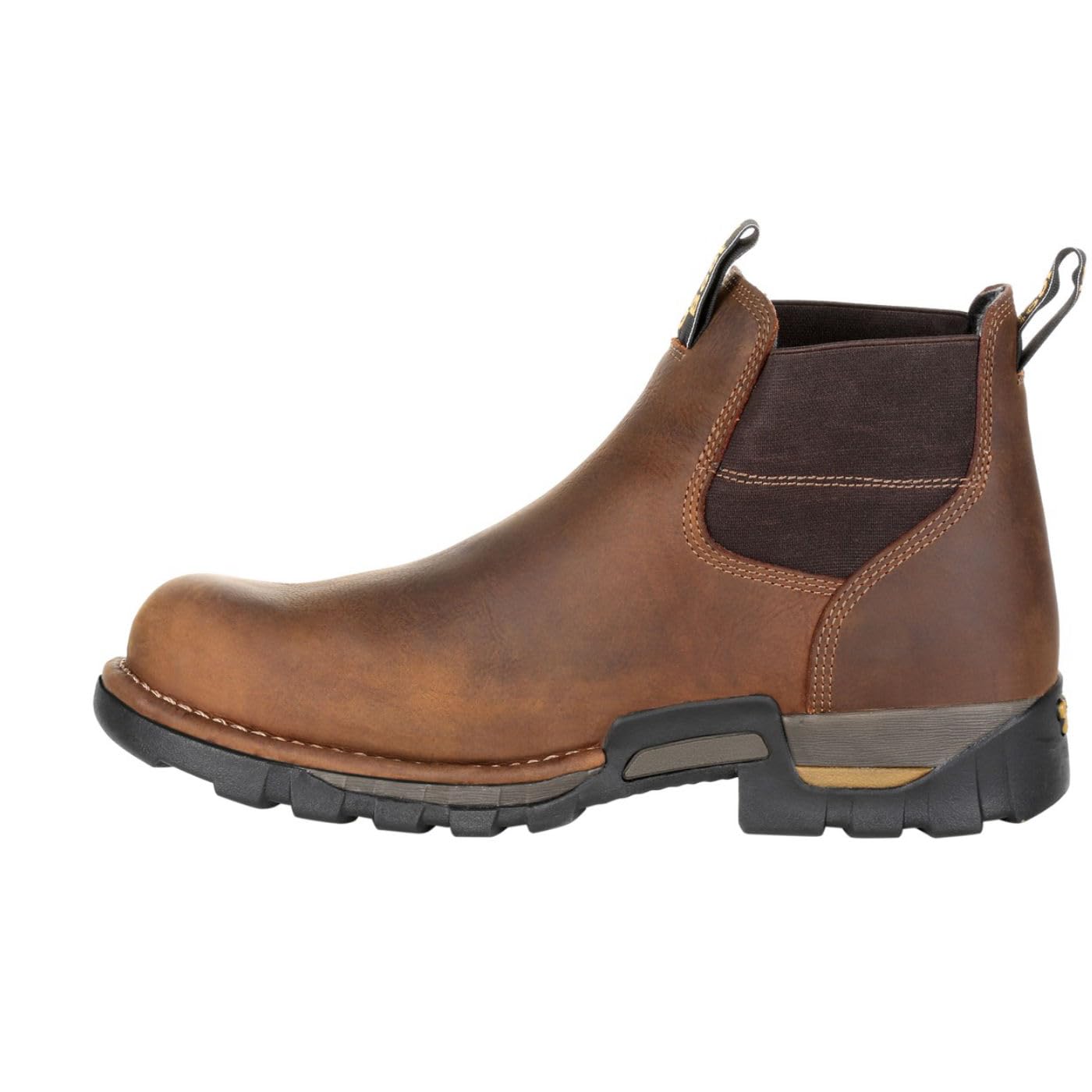
Memory foam under your foot and a full leather upper that goes on in one pull.
Comfort is the thing that lands here — it is far and away the most-praised trait in the feedback, and much of that comes from the AMP memory foam insole that molds under the foot as you walk. Underneath it sits an EVA midsole, which is the foam layer that does the cushioning, plus a wide TPU Shovel Shank for rigidity where the boot needs it. The upper is full-grain SPR leather with twin gore panels and nylon pull tabs, so entry is a single pull and a settle.
Wet-weather work is the target use. The Georgia Waterproof System is the barrier that keeps muck and water from seeping in, and the rubber outsole is rated to resist oil, slip, chemical, heat and abrasion — five separate hazards on a single tread. The package dimensions list the boot at 4.5 pounds, so it is a lighter build than a heavy lugged work boot, and it wears best in rugged outdoor conditions.
Durability is where the signs point down. There are reports of the sole separating from the leather and stitching failing at the upper-to-sole join, so this is a boot to watch at that seam rather than something you bury in mud and forget. Style is a genuine plus for buyers who want a work boot that cleans up. With 950+ ratings at 4.0+ stars and that comfort record, it is the pick for the person who values cushioned hours over tank-like toughness.
The comfort case: memory foam insole plus an EVA midsole is the combination that makes long days on your feet feel shorter, and the twin gore panels mean the boot does not fight you getting on.
Choose it when: comfort is the deciding factor and your work is wet and outdoors.
Look past it if: you need a boot that survives the roughest abuse — that sole seam is the weak link.
7. Wolverine Men’s Wellington Work boots
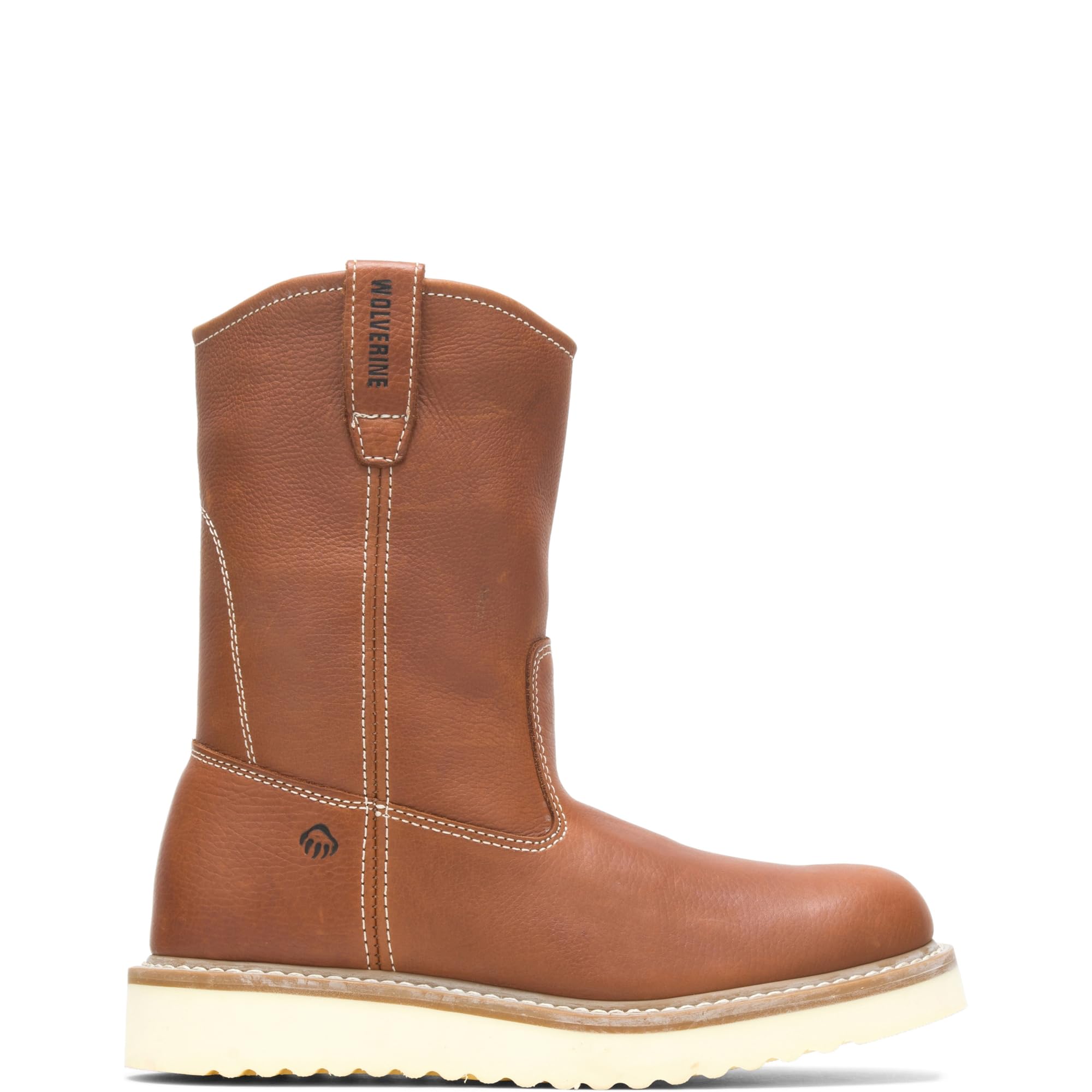
A ten-inch pull-on with Goodyear construction and a footbed you can pull out.
Ten inches of shaft changes what a slip-on boot does for you. Taller coverage means more ankle support and less debris getting down inside the boot, which is the reason Wellington-style pull-ons have stuck around on construction sites. Goodyear welt construction is the stitched method that ties the upper to the sole with a welt strip — it is the traditional build associated with long-lived boots, and Wolverine pairs it with a lightweight nylon shank and a springy rubber midsole.
Fit is the headline strength, and it is the most-praised trait by a huge margin — the sort of fit that makes a ten-inch boot feel less like a bucket on your leg. The full-grain leather upper takes a removable full cushion footbed, so you can swap the insole for your own or pull it out to gain width. The deeply treaded outsole is treated to resist oil, water and abrasion, which covers the wet-and-greasy floors of road and construction work.
The honest limit is wear over time. Durability splits — you will hear about pairs running several years and pairs coming apart, so expect the sole and welt seam to be the parts that age. Softness and ease of use also split, which fits a stiff, heavy-leather boot that needs a proper break-in. At 4.0+ stars with a big following behind the fit, it rewards someone who wants coverage and construction over light weight.
What You Gain In A Tall Boot
- Ten-inch shaft gives more ankle support and keeps debris out
- Goodyear welt construction is the stitched, durable build method
- Removable full cushion footbed lets you swap insoles
- Deep tread treated to resist oil, water and abrasion
- Fit is the single most-praised thing about it
What You Give Up
- Heavy leather takes real break-in time
- Durability splits, with wear showing at the sole and welt
- Taller shaft can feel like more boot than a low Chelsea
Worth it for: heavy outdoor and construction work where ankle coverage and welded construction matter.
Not your boot if: you want a light, supple slip-on straight out of the gate.
8. ARIAT Men’s Turbo Chelsea Csa Work Boot

The carbon toe that gives you protection without the cold bite of steel.
A carbon toe is a protective cap made from composite rather than metal, so it meets toe protection requirements while staying non-metal and skipping the cold that a steel cap transmits on a winter site. CSA rating plus waterproof construction puts this in the tier of boots built for Canadian-standard sites and wet, freezing conditions. Ariat’s own listing cites partnerships with biomechanical research groups and labs to tune performance, comfort and durability.
Fit is the attribute that stands out most, and that matters more on a laceless boot than on any other type. Once the elastic panels close, your only grip is the shape of the last — so a boot that fits right is the boot that stays on. Comfort is the second pillar. It also goes on and off without effort, which is the whole point of the Chelsea cut.
The question worth asking is how long it lasts. Durability splits here — some pairs run up to two years, others give out around six months, so this is a boot you maintain rather than abuse. Weight also splits; plenty find it extremely light, some find it heavy. With 350+ ratings at 4.0+ stars, it holds up as a premium pick for cold, wet sites where a carbon toe and waterproofing matter most.
Cold-weather reasoning: a carbon toe cap is non-metal, so it protects the toe without turning your toes to ice — the practical difference on a freezing job site.
Fits you best when: you work cold, wet sites and want a certified carbon toe under a waterproof Chelsea.
Be aware: lifespan varies widely between pairs, so plan for care and replacement.
9. Timberland PRO Men’s Nashoba Composite Safety Toe Work Boots

Built for metal-free sites and feet that need room at the toe box.
The Nashoba is a metal- and mutilation-free construction, which means no metal parts anywhere in the boot — the reason it suits sites that scan for metal and why the composite safety toe sits in place of steel. Electrical hazard protection goes with it. The two comfort layers are an Anti-Fatigue Technology footbed that absorbs shock and returns energy as you step, and a breathable, moisture-wicking lining made of ReBOTL material containing at least 50% recycled plastic.
Underneath, the outsole is a lightweight all-weather TPU rated to resist heat, oil, slip and abrasion, and it is described as gripping on wet and frosted ice surfaces — the kind of claim that matters on a winter loading dock. Quality is the most-praised attribute, and the fit draws praise for accommodating a wide 4E foot without pinching the pinky toe. That last point is the one worth underlining, because a laceless boot with a narrow toe box is unusable no matter how good the rest of it is.
The trade-off is durability, which splits between pairs, and material quality shows up as a concern in some feedback. At 4.1 stars it is not the highest-rated boot here — the Carhartt above holds 4.4 — but it leads on metal-free construction and wide-foot comfort. If your site bans steel and your toes need the room, this is the combination that fits.
Reasons It Belongs
- Fully metal- and mutilation-free build for scanned sites
- Composite safety toe with electrical hazard protection
- Anti-Fatigue footbed absorbs shock and returns energy as you step
- ReBOTL lining with at least 50% recycled plastic
- TPU outsole resists heat, oil, slip and abrasion
Real-World Notes
- Durability splits between pairs
- Material quality draws some criticism
- Lower overall rating than the top three picks
Made for: metal-free job sites and wide feet that need room across the toe box.
Consider something sturdier if: you want a boot that stays together without maintenance.
Know the Specs
ASTM F2413 Impact And Compression (I/75 C/75)
ASTM F2413 is the footwear safety standard, and I/75 C/75 are the two test scores on a toe cap. The impact rating covers a dropped load, and the compression rating covers a crushing force. A certified boot has passed both, so you can point a safety officer at a real number rather than a marketing claim. If your site requires certification, look for this standard by name in the listing.
Electrical Hazard (EH) Rating
An EH rating means the sole is built to resist conducting electricity from the ground up — the layer between you and a live circuit. It shows up as a stated standard on a boot listing, sometimes with a voltage figure. It is not the same as static-dissipative footwear, so check which one your site asks for before you buy.
Steel Toe Versus Composite And Carbon Toe
A steel toe cap is metal and transmits cold, so in winter it can chill your toes. A composite or carbon toe does the same protective job with a non-metal cap, which stays warmer and passes metal detectors. Composite also helps on sites that treat steel as a hazard. Match the toe to your site’s rules rather than to price.
Puncture-Resistant Midsole
This is a layer under your foot that stops nails, screws and shards from pushing up into the sole of your foot. It comes as a steel plate or a Kevlar layer. Steel is rigid and cold; Kevlar flexes with the foot. If you walk on debris-heavy sites all day, the midsole choice affects comfort more than the toe cap does.
Gore Panels And Ankle Hold
Gore panels are the elastic side strips that let a laceless boot open and close. Stretchier panels are quicker to get on; firmer panels hold the ankle tighter once you are walking. Because there is no lace to tighten, a good panel plus a correctly sized boot is the only thing keeping your heel from lifting inside the boot.
Outsole Resistance Ratings
Slip, oil, abrasion and heat resistance are separate qualities of the outsole rubber and tread, and a good listing names the ones it has. Oil resistance matters around grease and machinery; heat resistance matters around asphalt or a kitchen line. A wedge outsole spreads pressure for comfort, while a deeply treaded outsole prioritizes grip.
Common Questions
Do slip-on work boots hold your feet as securely as lace-up boots?
How do I size a Chelsea work boot when I cannot try it on?
Is a carbon or composite toe as protective as a steel toe?
What does an Electrical Hazard rating actually mean on a work boot?
Can I pull a slip-on work boot on without bending down?
How long do slip-on work boots usually last?
Are slip-on work boots waterproof or just water resistant?
Why do some slip-on boots have a wedge outsole?
Can I wear slip-on work boots in winter or on ice?
What is a puncture-resistant innersole and do I really need one?
The Bottom Line
For most people shopping for slip-on work boots, the winner is the Carhartt Chelsea Wedge Boot — a wedge sole that spreads pressure on concrete, an Insite footbed with podiatrist-designed arch support, and 4.0+ stars from 950+ ratings. If your site needs documented protection and you work wet floors, the OUXX 6” Steel Toe Chelsea spells out its ASTM F2413-24 I/75 C/75 and EH ratings and adds a flexible Kevlar midsole. And if you need a metal-free boot for a scanned site or a wide 4E foot, the Timberland PRO Nashoba is the one to reach for.
One last thing worth knowing before you order: almost every pick here asks you to size deliberately, because laces are no longer there to fix a loose fit. The ROCKROOSTER and the Wolverine Trade Wedge both run big enough that their own guidance is to go down a half, and the wider lasts on the steel toe Chelsea models reward a narrow foot with a size down as well. Nail the fit and the rest of the boot — the toe cap, the puncture plate, the tread — does its job quietly for years.
How we choose
We do not accept paid placement. Every pick is matched to a real buyer and a real use-case; we do not hands-on test units.
Sources
Specifications: manufacturer listings and product documentation. Review insights: verified customer reviews, as of July 2026. Pricing: not shown on this page (it changes often); check the current price via the retailer link.
As an Amazon Associate, Tactical Gear Guy earns from qualifying purchases. This does not affect which products we feature.