Specs are compiled from manufacturer listings and verified buyer reviews and can change over time — please confirm the key details on the product page before buying.
A slip-on duck shoe solves one specific morning problem: you need to get your feet into something waterproof without bending over, without tying laces, and without soaking your socks in the wet grass by the back door. The catch is that “slip-on” and “stays on” fight each other. A shoe loose enough to kick off in a mudroom is often loose enough to flop around a wet dock. Get that balance right and the shoe stays on your foot through mud and wet grass; get it wrong and it either flops off or rubs you raw.
This guide is built by comparing the manufacturers’ published specifications and the patterns across verified customer reviews, so you get each pick’s real strengths and trade-offs instead of marketing spin.
Below you will find nine pull-on builds ranked by what they actually do well, from ankle-height fishing boots to insulated cold-weather shoes. Each pick is matched to a real job, so you can choose the one that fits your mud, your socks, and your patience — read on for the picks that survive real slop.
Every pick here earns its place on a spec that matters: shaft height, insulation weight, sole compound, or a rubber shell you can hose off. My job is to help you match those specs to the job you actually have, which is where this list of the slip-on duck shoes for men picks begins.
Top Picks


How To Choose The Best Slip-On Duck Shoes for Men
A duck shoe is only useful if it slips on easy and stays dry. Those two goals pull in different directions, so the choice is really about which trade-off you can live with on a wet Tuesday morning.
Entry system: pull tabs, gore panels, or a stretch collar
You will see three ways to get your foot in. Twin side gore panels are stretchy fabric inserts at the ankle that spread open as your foot pushes down. Pull tabs at the front and back give your fingers something to grab. Some shoes rely on a stretch neoprene collar instead. The more give the entry has, the easier it goes on — and the more likely it feels loose. Try to buy from a brand whose fit notes tell you whether to size down.
Waterproofing: rubber shell vs. treated upper
A full rubber shell is a physical barrier — water has nowhere to pass through. A leather or synthetic upper usually relies on a treatment plus sealed seams, which works fine until the surface scuffs or the treatment wears. For a shoe you will hose down after yard work, the shell wins. For a shoe you will wear into town, the upper looks better and breathes more.
Insulation weight and what it means
Insulation is measured in grams, and the number tells you how much warmth is packed in. A 400-gram fill is a cold-weather shoe meant for real winter days. A plain shell with no insulation is a three-season shoe and a poor choice if you get deep snow. If you run hot, a lined but uninsulated boot keeps your feet drier over a long day.
Outsole grip on wet surfaces
Duck shoes live on docks, decks, muddy paths, and garage floors. Look for a rubber outsole with deep lugs (the raised blocks) and a slip-resistance rating where it is published. A chevron or cleated pattern sheds mud as you walk, while a flat sole packs it in and turns slick.
Side-by-Side Comparison
| Model | Best For | Shaft Height | Insulation | Upper Material | Amazon |
|---|---|---|---|---|---|
| XTRATUF Ankle Deck Boot★ Best Overall | Wet decks and fishing | 6 inches | Not listed | Hand-layered rubber | Amazon |
| Muck Boot Outscape Slip OnBest Value | Muddy yard work | — | Not listed | Rubber and neoprene | Amazon |
| Guide Gear 400 GramCold Weather Pick | Cold-weather chores | — | 400 grams | Water-resistant leather | Amazon |
| Bogs Digger Slip On | Garden and doorstep duty | — | Not listed | — | Amazon |
| FROGG TOGGS Storm Watch Vista | Camp and boat use | — | Not listed | Synthetic leather | Amazon |
| Sperry Cold Bay Chelsea | Town-and-weather wear | — | Not listed | Waterproof rubber | Amazon |
| Kenetrek Duck Shoe | Backcountry hunting | — | Not listed | Rubber bottom with upper | Amazon |
| Bogs Tillamook Bay Camo | All-season rough ground | Low profile shoe | 7mm neo-tech | Rubber and neoprene | Amazon |
| Skechers JDM Respected Swamper | Everyday waterproof wear | — | Not listed | — | Amazon |
Detailed Reviews
1. XTRATUF Men’s Duck Camo Ankle Deck Boot
Our pick — 4.5+★ from 500+ verified ratings; the strongest balance of quality and price.
The deck boot that keeps a wet boat deck under your feet instead of your back.
The first thing to understand about the XTRATUF Ankle Deck Boot is that it is not a tall rubber boot cut down. It is a 6-inch waterproof boot built on the same slip-resisting Chevron sole as XTRATUF’s Legacy collection, which is the detail that matters most if you spend time on a slick deck. That sole carries an SRA rating — a European slip-resistance standard measured on a wet, soapy floor — which is a published test rather than a marketing claim. For you, that means the shoe is engineered for the exact surface that puts fishermen on their backs.
Inside, an XPRESSCOOL cooling liner is designed to keep feet comfortable in both cool and warm environments, which is the right call for a shoe that might see a cold morning and a warm afternoon on the same trip. The hand-layered rubber construction keeps water out from the ground up. What wins people over most is the quality of the build itself, and comfort is the next thing that comes up again and again. The duck camo finish also gets steady praise for looking right on the water rather than like a work boot.
Two honest notes. First, XTRATUF states plainly that this is not a commercial-grade boot — if you need a heavy-duty ankle deck boot for daily professional work, the maker points you to its Wheelhouse model instead. Second, a recurring theme in the reviews is the sole separating after a couple of months of hard use, which is the single durability question to weigh. Treat this as a serious recreational and light-work boot, not an indestructible one. The brand-new XTRATUF Wheelhouse comparison is worth remembering if your job depends on the boot holding up.
Why the deck crowd rates it
- SRA-rated Chevron outsole gives tested grip on wet surfaces, not just deep tread
- 6-inch hand-layered rubber shell blocks water from the ground up
- XPRESSCOOL liner is built to handle both cold mornings and warm afternoons
- Pull tabs make it easy to get on without bending and tying
What to weigh before you buy
- The maker states this is not a commercial-grade boot — heavy daily trade use calls for a different model
- Sole separation after a couple of months is the durability gripe that recurs
- Hand-layered rubber construction asks for a little care rather than pure abuse
Wear these if: you fish, run a boat, or work a wet deck and want a short boot with a genuinely tested grip sole.
Look elsewhere if: you need a boot that survives commercial-grade daily punishment — the maker itself flags that limit.
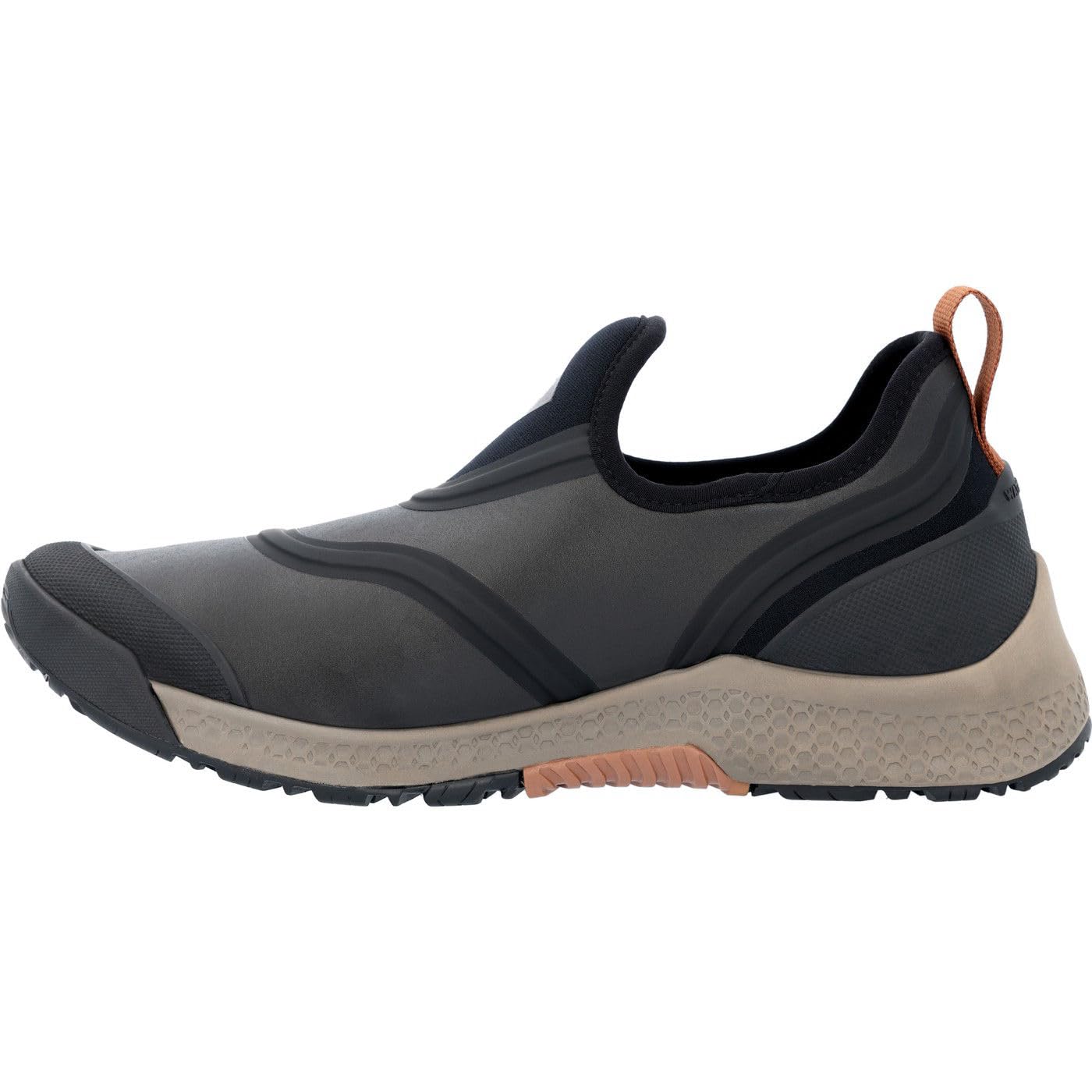
2. Men’s Mossy Oak Country DNA Outscape Slip On
A full-waterproof slip-on that treats muck as a problem to be solved, not endured.
Muck Boot built its name on a single promise — 100% waterproof footwear for the messiest conditions in every season — and the Outscape Slip On carries that directly. No laces, no ties, just step in and go. For a man who walks out to a muddy feed lot or a wet jobsite, the lack of laces is the whole point: nothing to soak, nothing to untie with cold fingers.
What people report most is the overall build quality, followed by comfort, and both track with a purpose-built rubber and neoprene design. Moisture wicking gets mentioned too, which matters because a fully sealed boot can turn into a sweat box if the lining does not move vapor. This one is lined to handle it. The rubber and neoprene shell backs up the 100% waterproof claim with a sealed barrier, not just a treated surface.
The fit is the one thing to plan around. Plenty of buyers find them easy to slide on and off, while a noticeable group reports they feel a whole size too big. So the smart move is to try a half size down if you are between sizes, or buy where you can return easily. Insoles are another small complaint point, and swapping in a firmer pair is a common fix. This is a value-priced waterproof slip-on, not a precision fit — buy it for the shell and the brand’s waterproofing, then fine-tune the fit to your foot.
Where it shines: a 100% waterproof build that handles mud and wet grass without a lace in sight, with comfort and moisture wicking both earning steady praise from owners.
The sizing catch: the mixed fit reports — including the “whole size too big” crowd — mean you should confirm the size chart before ordering, not after the first wet walk.
Reach for this if: you need a no-nonsense waterproof slip-on for muck, mud, and wet weather at a moderate price.
Think twice if: you wear a half size and cannot easily exchange — the fit runs generous by enough accounts to check first.
3. Guide Gear Men’s Insulated Leather Duck Boots
A leather-and-rubber winter boot with 400 grams of insulation and a shank underfoot.
If your duck shoe has to work in actual cold, the Guide Gear is the pick on this list with a real warmth number. It carries 400 grams of Thinsulate insulation — a measurable fill weight that puts it in genuine winter territory — inside a 100% waterproof rubber shell with a water-resistant leather upper. That combination is what you want for frozen ground, slush, and long cold mornings. The water-resistant leather upper gives it a boot profile for cold-weather chores, while the rubber shell blocks slush and frozen ground.
Underfoot, a steel shank runs down the middle of the sole for support and stability, which is what keeps your arch from folding over rough ground. The Ortholite open-cell foam insole is described by the maker as 95% to 100% breathable, moisture-wicking, and resistant to compression — so it keeps air moving and holds its shape over long wear rather than flattening into a pancake. Twin side gore panels give the entry its stretch, and front and rear pull-on tabs give your fingers a grip. A rubber-lugged, cleated outsole bites into soft ground.
The honest frictions are fairly well documented. Fit and ease of use both land as mixed: some buyers step in easily, while others say the boots run small and fight them on the way in. Durability is judged both ways, with a six-month wear-out showing up in a share of reports. The build quality itself is the trait that most earns praise, with value for money running close behind — which fits a boot this well-specified at a moderate price. Try a half size up if you wear thick winter socks, and remember a leather upper wants a wipe-down rather than a hose-off now and then.
The warmth case: 400 grams of Thinsulate plus a 100% waterproof rubber shell plus a steel shank is a genuinely cold-ready package, and the build quality is the thing owners talk about first.
Entry friction: the gore panels and pull tabs are there, but you should confirm your size carefully — the fit complaints center on boots that run small with thick socks.
Best for: cold-weather chores, winter dog walks, and anyone who wants insulation weight they can actually read on the label.
Not your shoe if: you want a light three-season slip-on — 400-gram Thinsulate is built for real cold, and it will run warm in summer.
4. BOGS Digger Slip On Men’s Slip On

The doorstep boot for the man who wants to step in and step outside.
BOGS built the Digger around a simple idea: a boot you step into and then step outside in. The fit and the slip-on feel are the two things the design gets right, and water resistance holds up for the wet grass and garden muck you meet on the way to the shed. Comfort gets consistent praise. No laces to soak and no ties to fumble with cold fingers, so it goes on in one step for a quick trip to the shed.
It is also the most honestly limited pick on the list, and that matters to know before you commit. The reports that recur are about the rubber splitting after about four months of use, and the overall durability picture is the weak spot. This is not a boot you buy for years of hard work. It is a boot you buy for easy entry, decent comfort, and water resistance at a moderate price — and you should expect to replace it sooner than a heavy rubber shell.
What it does well: comfort is genuine, water resistance holds for wet grass and mud, and the slip-on entry is exactly as easy as it should be.
The durability question: rubber splitting around the four-month mark is the recurring report, so treat this as a lighter-duty garden boot rather than a workhorse.
Suits: casual garden and doorstep use where you want easy-on comfort and reasonable water resistance.
skip it if: you need a boot built to take years of daily abuse — this one trades durability for a lower price.
5. FROGG TOGGS Storm Watch Vista Slip-On Shoe

A go-anywhere camp shoe with a waterproof shell and a lugged sole under a 16-ounce build.
FROGG TOGGS pitches the Storm Watch Vista as a camping, boat, yard, and slipper shoe all in one — a do-everything slip-on for the outdoors. The construction is a synthetic leather upper over a waterproof rubber shell, which is a sensible way to combine a cleaner look with real water blocking. Underneath, a rugged lugged outsole is designed to give traction wherever the day takes you, and the whole shoe weighs 16 ounces, so it is light enough to pack in a duffel without thinking about it.
The leather insole and flat heel keep it in casual territory, which is where a shoe like this belongs. Getting it on is where it divides people: some find it quick and easy, others have a harder time. Water handling also splits the room — some stay dry, some end up with wet feet. This is the kind of variance you expect in a moderately priced camp shoe, and a careful check of the fit before a long trip is worthwhile.
Durability is the weakest link here, with reports that the shoe comes apart sooner than it should. So the practical read is this: treat the Storm Watch Vista as a light-duty, wet-weather camp and boat shoe that is comfortable and easy to slip on, not a boot you rely on season after season. It is a good match for a weekend cabin, a wet dock, or a run out to the woodpile. It is not the pick for hard daily outdoor work.
Good match for: weekend camping, boat decks, and light yard work where you want a waterproof slip-on that packs small.
Consider a sturdier pick if: you need a shoe to survive heavy daily use — durability is the recurring weak point.
6. Sperry Men’s Cold Bay Chelsea

Sperry’s duck boot in a rubberized pull-on Chelsea, built for weather that will not let up.
Sperry took its best-known duck boot and reset it as a rubberized pull-on Chelsea — no laces, just a clean silhouette with a waterproof rubber shell and a microfleece lining inside. At 1.5 pounds it is one of the lighter builds here, which matters on a long walk through slush. The look is the sort that works with jeans in town as well as it does with work pants at the edge of a field.
Build quality and appearance are the two things that hold up best in the feedback. The microfleece lining keeps the shoe warm against your skin through the wet months without turning it into a heavy winter boot. That combination — a sealed shell and a soft liner — is why this one holds its place as the most town-friendly pick on the list.
The frictions are the ones to plan around. Comfort and fit both land as mixed; some buyers find a proper fit, others find the boot narrow. Getting the boot on and off is the most consistent complaint, which is ironic for a slip-on — the Chelsea opening is not a wide one. Seams and interior lining are the parts to watch over time. So: order with a return path in mind, expect a break-in period, and give the opening a real pull rather than a shove. On looks and weather protection, the Cold Bay holds up. On ease and long-term seams, it asks a bit of patience.
Pick this for: an everyday wet-weather boot you can wear in town without looking like you just stepped off a boat.
Weigh the entry: the Chelsea opening is tight enough that some owners fight it on and off — if that bothers you, look at a gore-panel boot instead.
7. Kenetrek Men’s Duck Shoe Waterproof Slip-On

A hunting-grade slip-on with a sealed rubber bottom, sized more like a boot than a shoe.
Kenetrek builds for the trail less traveled, and the Duck Shoe is the pair you take into the backcountry when the weather turns ugly. A sealed rubber bottom keeps the wet where it belongs — outside — and the build is meant to stand up to rough terrain. Construction quality is the trait that comes up most, with the durability and the styling both getting solid marks. For a man who hunts or hikes where it is wet and cold, this is a serious pair.
Expect it to feel heavy. Weight is the one thing that turns people off, and it shows on the foot at 2 pounds. That heft is the trade for a build that owners expect to last for years. Fit is the other thing to nail down: some buyers find it a great fit, some find it far too large. Comfort also splits, with a share of reports about blisters on the first trips out.
The practical guidance is to get your sizing right the first time and break them in with real socks. Buy from a place you can return to if the fit misses, because the “WAY too large” group is out there. What you are paying for is a purpose-built hunting shoe with a sealed rubber bottom and sturdy construction, not a light everyday sneaker. If your days involve wet, rough terrain and a heavy pack, the sealed rubber bottom and sturdy build are worth the 2-pound weight.
The backcountry case: a sealed rubber bottom, sturdy construction, and durable build make it a natural fit for wet, rough-terrain hunting.
Size it carefully: the fit runs large for a share of buyers and the shoe is heavy at 2 pounds — confirming the size chart is the move.
Right for: hunters and hikers who need a sealed rubber bottom and do not mind a heavier shoe.
Wrong for: anyone who wants a light everyday slip-on — the weight and the sizing quirks make it a specialist pick.
8. Bogs Men’s Tillamook Bay Waterproof Insulated Shoe

The low-profile camo slip-on rated to -20 F, with the most generous fit on this list.
This is the one build on the list with a published comfort rating for cold: BOGS rates the Tillamook Bay to -20 F. It pairs a 100% waterproof rubber and neoprene upper with flexible four-way stretch 7mm neo-tech insulation — a thicker neoprene fill than the 400-gram boot above, and built for stretch as well as warmth. The low-profile cut keeps it looking like a casual shoe, so it works for errands as well as wet grass.
Fit is the trait that most defines the Tillamook Bay. It comes up constantly and it comes up as a positive, which is unusual — most slip-on boots fight you on fit. The flexible upper and neoprene collar are what make that work, and it is why this boot goes on and off easily while staying put once it is on. Walking over rough ground and rocks is easy, and owners wear it across all seasons rather than hiding it in a closet. A cushiony foam insole supports the step, and a high-abrasion rubber outsole is there to prevent slips.
The one point to weigh is durability. Some report years of wear; others report the material cracking over time. So the honest read is that this is a very comfortable, very well-fitting all-season slip-on whose long-term life is the one thing not fully settled. If easy entry and a low profile matter most, it is hard to argue with. If you expect a bombproof shell for a decade, look at a heavier rubber boot. The BOGS were first built for Oregon farmers, and this pair carries that working heritage.
Why owners reach for it daily
- Fit is the standout: flexible four-way stretch upper makes easy entry without a loose flop
- Rated to -20 F with 7mm neo-tech insulation for genuine cold-weather use
- 100% waterproof rubber and neoprene upper keeps feet dry in wet grass and rain
- High-abrasion rubber outsole and cushiony foam insole handle rough ground
The caution on the label
- Material cracking over time is the reported weak point
- Long-term wear varies, so a heavy daily user should expect to replace it eventually
The pick for: year-round wet weather and rough ground where a reliable fit and a -20 F rating matter most.
Not for: anyone who wants a guaranteed decade of shell life — cracking is the reported trade-off.
9. Skechers Men’s JDM Respected Swamper
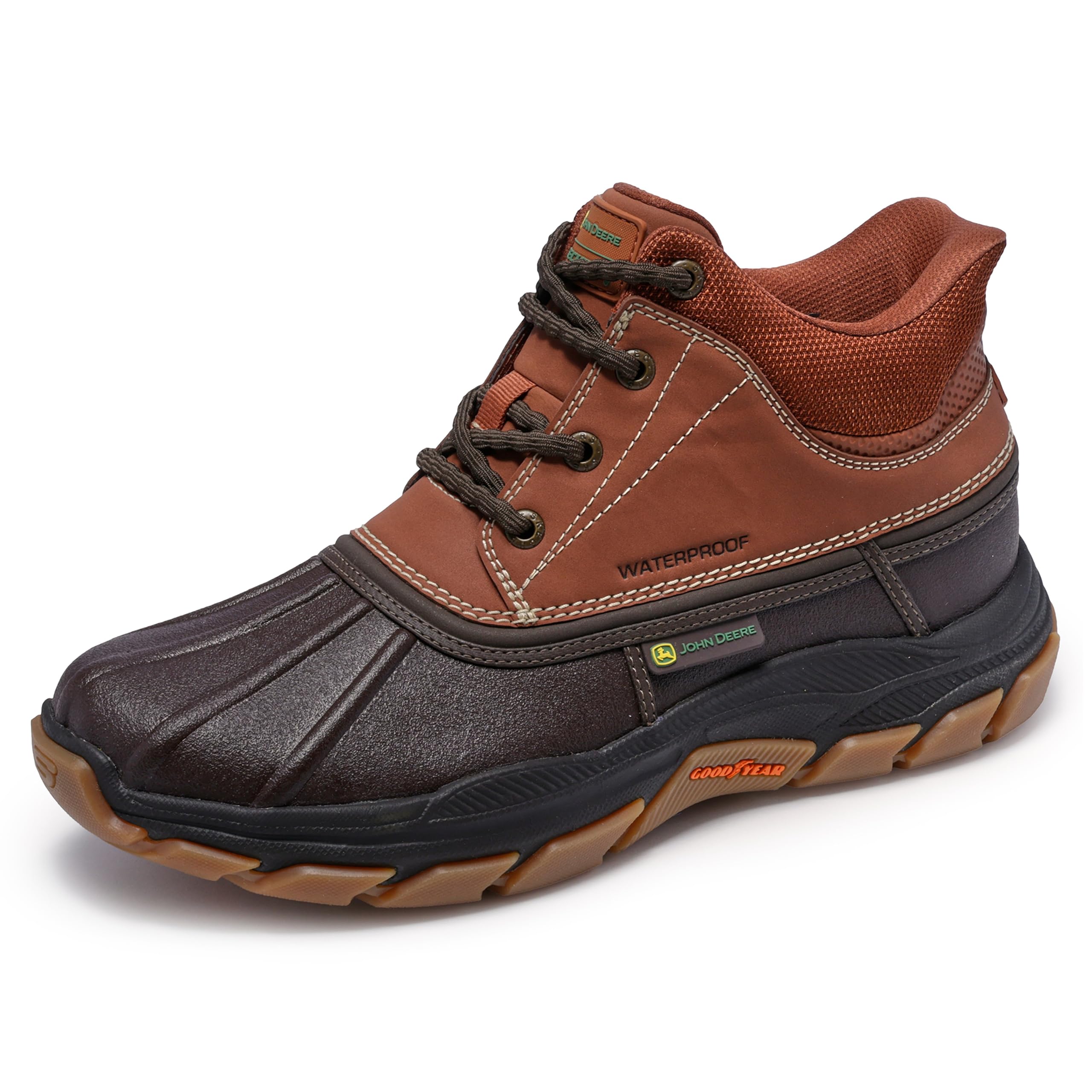
John Deere branding meets Skechers Slip-ins for a waterproof duck boot you wear every day.
The Skechers JDM Respected Swamper is a John Deere-branded, Skechers-built waterproof duck boot with the Slip-ins entry design. The quality of the build is what owners talk about most, and comfort comes next. Water resistance also gets solid marks — feet stay dry in wet weather, which is the bare minimum a duck boot has to deliver and this one does.
The thing to know is that the slip-on entry divides people. Some step right in and out, others struggle with the process, so the hand-feel of getting it on is the one variable to consider. Fit also lands as mixed, which means checking the size before you commit is worth the two minutes. Appearance gets steady praise — the John Deere graphics land with people who want a working look.
Durability is the weakest side, with reports of the boot wearing out over time. At a premium price for a Skechers build, that is something to weigh. Buy this one for the branding, the waterproofing, and the daily comfort. Do not buy it expecting the all-rubber build of a deck boot. It is a good everyday pick for a man who likes the John Deere style and wants a slip-in waterproof boot with brand-name comfort.
The daily-driver angle: good build quality, real comfort, and water resistance that keeps feet dry — plus Slip-ins entry for quick on and off.
The mixed parts: slip-on entry works for some and fights others, and durability over time is the concern to keep in mind.
Pick it for: everyday wet-weather wear with John Deere styling and Slip-ins convenience.
Pause if: you want a full rubber build that takes years of hard use — this one is a comfort-first everyday boot.
Know the Specs
SRA Slip Rating
SRA is a slip-resistance standard that measures grip on a wet floor using a soapy solution. It is a real test, not a marketing phrase, so when a sole carries the rating you know it has been checked on the surface most likely to put you down — a wet one. A Chevron tread pattern also sheds water as you walk rather than letting it pool under the foot.
Insulation Weight in Grams
Grams here measure how much insulating fill is packed into the boot. The higher the number, the more warmth — so a 400-gram boot sits in winter territory while a plain shell with no fill is a three-season shoe. If your feet run hot or you work indoors, less insulation keeps you drier over a long day. If you stand in frozen ground for hours, more fill is what you want.
Neoprene Stretch Uppers
Neoprene is a stretchy rubber sheet that moves with your foot while staying waterproof. When the upper is a rubber-and-neoprene blend, it can flex at the ankle for easy entry — that is how a boot can be snug once on and still easy to pull off. A thickness figure in millimeters tells you the warmth and the stiffness of the sheet.
Steel Shank and Insole Support
A steel shank is a flat metal strip set into the sole under the arch. It keeps the midsole from folding over rough ground, so you get stability on uneven surfaces. The insole is the soft layer on top — open-cell foam is one type that lets air and moisture pass through, which keeps a sealed boot from turning into a sweat box.
Common Questions
Are slip-on duck shoes actually waterproof or just water-resistant?
Should I size down for a slip-on duck shoe?
How long do slip-on duck shoes typically last?
What is the difference between a 400-gram and a 7mm neoprene boot?
Can I wear a slip-on duck shoe in winter?
Are slip-on duck shoes good for wide feet?
How do I get a slip-on duck shoe on when it fights back?
Is the XTRATUF Ankle Deck Boot commercial grade?
Do duck shoes need special care to keep them waterproof?
What is the best slip-on duck shoe for fishing?
The Bottom Line
The right pick depends on whether your morning starts on a wet boat deck, a frozen feed lot, or a muddy garden path. For wet decks and fishing, the XTRATUF Ankle Deck Boot is the strongest pick on this list, with an SRA-rated Chevron sole and a 6-inch waterproof shell built for the job. If you want the best combination of warmth and price, the Guide Gear 400 Gram gives you 400 grams of Thinsulate and a steel shank for cold-weather chores. And if you want the most comfortable, best-fitting all-season shoe on the list, the BOGS Tillamook Bay wins with its flexible four-way stretch upper and -20 F rating. Match the shaft height, insulation weight, and sole to the surface you walk on, and the slip-on duck shoe earns its spot by the door.
How we choose
We do not accept paid placement. Every pick is matched to a real buyer and a real use-case; we do not hands-on test units.
Sources
Specifications: manufacturer listings and product documentation. Review insights: verified customer reviews, as of November 2026. Pricing: not shown on this page (it changes often); check the current price via the retailer link.
As an Amazon Associate, Tactical Gear Guy earns from qualifying purchases. This does not affect which products we feature.