Specs are compiled from manufacturer listings and verified buyer reviews and can change over time — please confirm the key details on the product page before buying.
Buying a slide-in gas range is really a fight with your countertop cutout and your gas line, not with the showroom. A slide-in drops between your cabinets with its knobs on the front lip, so no rear console stands up behind the cooktop. That front-control layout is what lets the cooktop sit flush with your countertop edge. The three ranges below all fit a 30-inch opening and all burn gas, and each one solves a different problem: burner count, oven size, or cook precision.
This guide is built by comparing the manufacturers’ published specifications and the patterns across verified customer reviews, so you get each pick’s real strengths and trade-offs instead of marketing spin.
Width is the first gate, because a range that is a fraction too wide will not slide into the gap. Depth matters next if your cabinets sit tight against a doorway or a worktop return. Below, every pick is checked against those two numbers, plus the burner layout and oven capacity that decide how the thing actually cooks. This breakdown of the slide-in 30-inch gas range covers fit, flame control, and what each oven does well.
Top Picks

How To Choose The Best Slide-In 30-Inch Gas Range
Most buyers walk in thinking the oven size is the whole decision. It is not. Fit comes first, then flame control, and the oven lands third because every range here bakes and broils. Get the fit wrong and a 30-inch range will not slide into the gap at all. Get the flame control wrong and your lowest burner scorches every sauce you simmer.
Measure the opening, not the old range
A slide-in range is designed to sit flush between your cabinets with its front controls exposed, so the cabinet gap is the number that matters. Check the width of that gap and the depth from the back wall to the front of the counter. Depth is where surprises live: a deep range can push past the counter line, while a shallower one can leave a gap behind. Width plays out in fractions here too — the Nebula runs 29.8 inches wide and the Rangaire runs 30 inches.
Match burner BTU to how you actually cook
BTU (British thermal units) is a measure of heat output, and it tells you two things: how fast a pot boils and how gently a sauce can sit. High-output burners in the 15,000 to 21,000 BTU range are your sear and stir-fry stations. Low burners around 3,500 to 9,000 BTU are where you melt butter without scorching it. Five burners buys you more simultaneous dishes, which matters on a holiday or when you are cooking two components at once.
Decide if you want convection
Convection means a fan moves hot air around the oven cavity instead of letting heat rise and pool. The result is more even browning across racks, which helps when you bake two trays at once. Every pick here offers a convection fan, but the number of oven functions and the bake and broil burner output differ. If you mostly roast and reheat, a plain bake burner handles it; if you bake bread and pastries, convection earns its place.
Side-by-Side Comparison
| Model | Best For | Burners | Oven Capacity | Depth | Amazon |
|---|---|---|---|---|---|
| 30 in. Nebula Coll 5 Burner Gas Range★ Best Overall | Five-burner cooking in a tight cutout | 5 sealed | 5 cu ft | 25″ | Amazon |
| Empava 30″ Freestanding Gas Range | High-heat searing with an infrared broiler | 4 sealed | 4.2 cu ft | 27.3″ | Amazon |
| Rangaire RRG303TS 30″ Gas Range | Timer-driven cooking and big oven space | 5 sealed | 5.1 cu ft | 25″ | Amazon |
Detailed Reviews
1. Nebula 30 in. 5 Burner Gas Range
Five burners and five cubic feet, all within a 29.8-inch slot that hugs your cabinets.
For a cook who needs more pans going at once without giving up counter space, this is the one to beat. The Nebula packs five sealed burners into a body that is 29.8 inches wide and 25 inches deep, so it slots between standard cabinets and stops at the counter line instead of jutting past it. That is a hair narrower than the Rangaire’s full 30-inch width, which is the difference between sliding in cleanly and shaving a cabinet rail.
The burner lineup is the reason it earns the top spot. You get an 18,000 BTU burner for a fast rolling boil, a 12,000 BTU burner for frying, two 6,000 BTU burners for everyday simmering, and a 3,500 BTU burner for delicate sauces and melting. That is more burners than the Empava’s four, so you can hold a pot of pasta water, sear a chop, and warm a sauce all at once. The oven adds a 15,000 BTU bake burner and a 7,500 BTU broil burner, with four modes: Bake, Broil, Convection Fan, and Light.
The convection fan is where the even-heat claim lives. A fan circulates the hot air around the cavity so a tray of cookies browns more evenly than in a static oven, and the same airflow helps when you run two racks at once. Cast iron grates sit on top for heat retention, and the stainless exterior wipes down with a damp cloth. The honest catch: this is a new-to-market range with a thinner review history than the others, and some early buyers report the oven shutting down unexpectedly. If you want a proven track record before you commit, the Rangaire’s larger owner feedback pool is the safer bet.
Why this earns the top spot
- Five sealed burners give you more simultaneous dishes, with an 18,000 BTU high burner for searing and a 3,500 BTU low burner for delicate work.
- 25-inch depth and 29.8-inch width keep the front flush with standard counters.
- Four-function convection oven with a 15,000 BTU bake burner handles weeknight roasting and weekend baking.
What to weigh first
- The oven has a short review history, with a few early buyers reporting unexpected shutdowns.
- Liquid propane conversion kit is sold separately, so a propane home needs to budget for that part.
Reach for this if: you cook several dishes at once and want the widest burner spread in the tightest footprint.
Think twice if: you want a long track record of owner feedback before you swap out your range.
2. Empava 30″ 4-Burner Gas Range
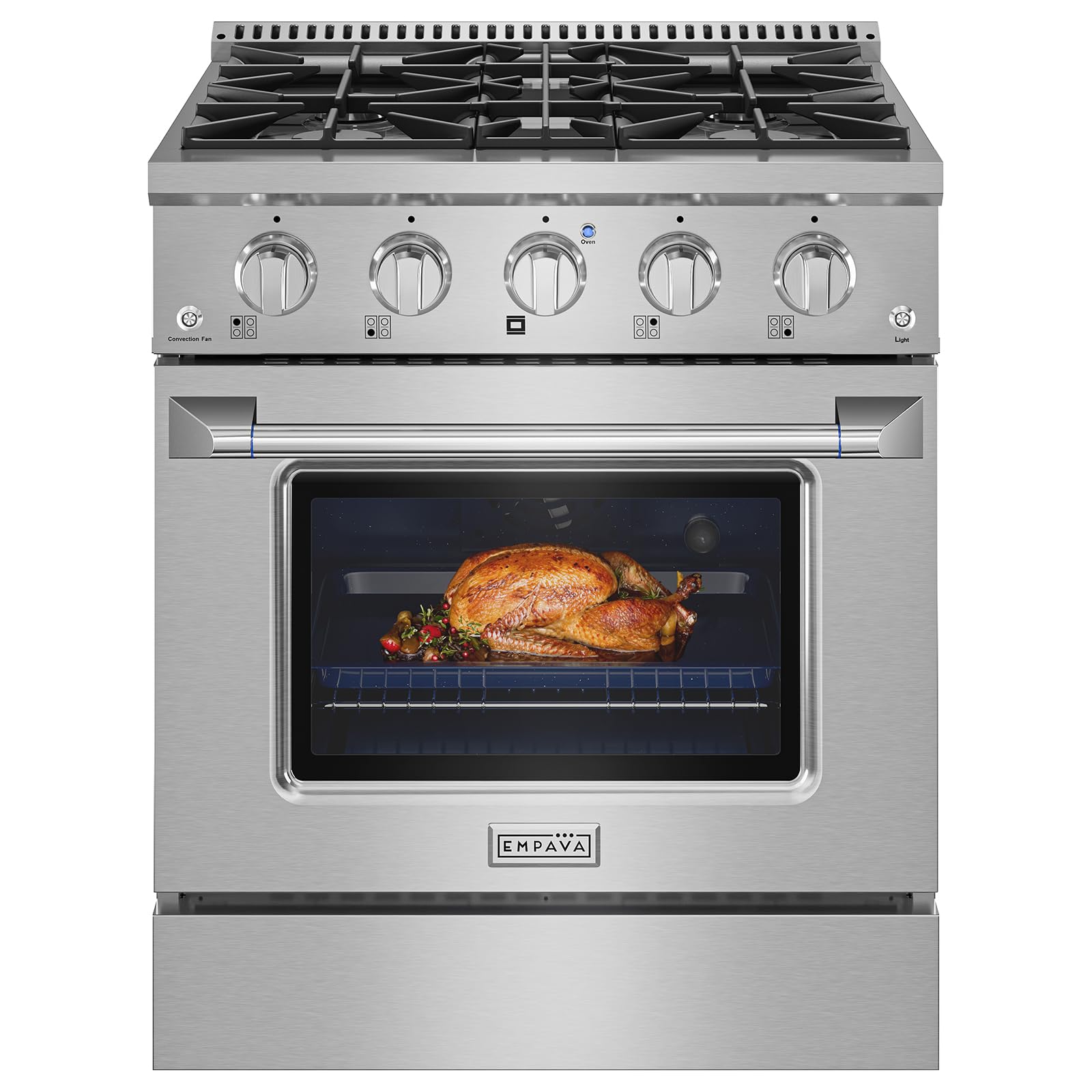
Two front burners at 15,000 BTU each, built for the cook who lives on high heat.
Searing, wok cooking, and a hard boil are the Empava’s home turf. It puts two 15,000 BTU burners right at the front, where your heaviest pans sit, plus two 9,000 BTU rear burners for sauces and slow simmers. On a four-burner range that is a deliberate layout: the heat is concentrated where you need it most, and the gentler burners stay out of the way at the back. Compared to the Nebula’s five burners, this is one fewer station, but the two front burners hit harder than most of the Nebula’s lineup.
The oven tells the same story. It measures 4.2 cubic feet against the Rangaire’s 5.1 cubic feet, so it gives up some interior room. What you trade for that is a 500°F broil setting and an upper infrared broiler, which concentrates heat from above for browning and finishing. The convection airflow circulates hot air for even distribution and supports multi-rack cooking. For a home chef who finishes dishes under a broiler rather than baking three trays at once, this is the more useful oven.
Fit is the real decision point here. At 27.3 inches deep and 37.6 inches tall, this is the deepest range on the list, and it will push further forward than the Nebula or the Rangaire at 25 inches. Measure the gap from your back wall to the front of the counter before you buy, because a little extra depth can leave the range standing proud of the cabinets. LP conversion components are included, though the maker recommends a qualified professional handle the gas installation.
Broiler advantage: A 500°F infrared broil setting is the standout feature — it gives you a hard, fast finish on steaks and casseroles that a standard broil burner cannot match.
Trade-off to note: The extra depth and height are worth measuring carefully, and the 4.2-cubic-foot oven is the smallest here.
Best matched to: cooks who sear and broil more than they bake, and want the heat up front.
Check before ordering: your depth clearance, since this range is the deepest of the three.
3. Rangaire RRG303TS 30″ Gas Range with Timer, Stainless Steel

The biggest oven of the three, plus a 21,000 BTU burner that goes from whisper to roar.
The Rangaire wins on two counts that matter over years of cooking: oven volume and control. Its cavity measures 5.1 cubic feet, the largest here and just ahead of the Nebula’s 5 cubic feet. The FlameMaster dual-ring, dual-valve burner is the headline, though, delivering 21,000 BTU for a fast boil and searing, then easing down to a gentle simmer without you fighting the knob. For anyone who has ever scorched a sauce because the low end was too hot, that range of control is worth real attention.
The oven adds conveniences that reduce guesswork. The PerfectCook glass touch timer lets you set a cook time and the oven shuts off when it is done, which means you can walk away from a roast without hovering. EasyReach telescopic racks pull dishes toward you, so you are not reaching over a hot door to grab the back rack. AirCook convection uses a fan to circulate hot air and even out hot and cold spots. A shut-off timer and pull-out racks cut the hovering and reaching out of a weeknight roast.
What owners talk about most is performance: the burners work well, the front controls are easy to read, and the stainless finish cleans up without much fuss. Installation is reportedly straightforward, and the different burner sizes suit a range of pots. The one caveat to weigh is oven temperature — the feedback is mixed, with some reporting steady heat and others noting the oven runs about 50°F hotter than the knob setting reflects. That is a calibration quirk worth knowing, not a deal-breaker, and an oven thermometer will settle it.
Built for precision: A 21,000 BTU dual-ring burner plus a shut-off timer and telescopic racks make this the most control-friendly range of the group, with the largest oven at 5.1 cubic feet.
One calibration note: Oven temperature runs hotter than the dial indicates for some owners, so a standalone thermometer is a smart pickup.
Ideal for: bakers and roasters who want the roomiest oven and a burner with a genuine low end.
Worth flagging: dial in the oven temperature with your own thermometer for the first few bakes.
Know the Specs
BTU and burner layout
BTU measures how much heat a burner puts out. A high burner in the 15,000 to 21,000 BTU range boils water fast and gives you a hard sear, while a low burner around 3,500 to 9,000 BTU holds a simmer without scorching. The layout matters as much as the top number: front burners are where you set your heaviest pans, so high-output burners up front save you reaching over a hot stockpot.
Oven capacity and convection
Capacity is measured in cubic feet and tells you how many racks and trays you can run at once. A 4.2-cubic-foot oven handles a roast and a side dish; a 5.1-cubic-foot oven leaves room for a sheet pan on more than one rack. Convection adds a fan that circulates hot air, which evens out browning and helps when you cook multiple racks together. Without the fan, heat rises and pools at the top of the cavity.
Slide-in width and depth
Width is the number that decides whether the range fits your cabinet gap at all, and on a 30-inch range it runs close to 30 inches. Depth tells you how far the front will sit from the back wall — a 25-inch range stops nearer the counter line, while a 27.3-inch range pushes further out. Measure both the gap and the clearance before ordering, because a slide-in has no rear console to hide a mismatch.
Gas type and LP conversion
Ranges ship configured for natural gas, and many include parts to convert to liquid propane for homes off the gas main. The Nebula requires the LP conversion kit as a separate purchase, while the Empava includes LP conversion nozzles. In every case, a qualified professional should handle the gas hookup and the conversion, because a poor seal on a gas line is a safety issue, not a DIY project.
Common Questions
Will a 30-inch slide-in gas range fit my existing cabinet opening?
What is the difference between a slide-in and a freestanding gas range?
How many BTUs do I need for searing and stir-frying?
Does convection really matter in a gas oven?
Can these ranges run on propane instead of natural gas?
How do I clean sealed burners versus open burners?
What does the timer on a range actually control?
How much depth clearance does a slide-in range need?
Why would my oven run hotter than the dial says?
Do I need a specific electrical outlet for a gas range?
The Bottom Line
For most kitchens, the winner is the 30 in. Nebula Coll 5 Burner Gas Range because its five sealed burners and 5-cubic-foot convection oven deliver the most cooking stations in a 29.8-inch body that slides into standard cabinets. If high-heat searing and an infrared broiler are what you cook for, the Empava 30″ Gas Range is the pick, with two 15,000 BTU front burners and a 500°F broil setting. And for the roomiest oven, the largest at 5.1 cubic feet, plus a burner that ranges from 21,000 BTU down to a true simmer, the Rangaire RRG303TS is the one to reach for. Whichever you choose, measure your cabinet gap and depth clearance first, since a 27.3-inch range sits further out than a 25-inch one.
How we choose
We do not accept paid placement. Every pick is matched to a real buyer and a real use-case; we do not hands-on test units.
Sources
Specifications: manufacturer listings and product documentation. Review insights: verified customer reviews, as of November 2026. Pricing: not shown on this page (it changes often); check the current price via the retailer link.
As an Amazon Associate, Tactical Gear Guy earns from qualifying purchases. This does not affect which products we feature.