Specs are compiled from manufacturer listings and verified buyer reviews and can change over time — please confirm the key details on the product page before buying.
Buying ski goggles with a color lens is mostly about one thing: matching the tint to the light you actually ride in. A dark mirrored lens is wonderful on a bluebird groomer and nearly useless when the clouds drop and the snow goes flat. So the right pick is the goggle you can either swap a lens into fast or trust across the whole day. Below you will find nine goggles with colored lenses, sorted by what each one genuinely does best, from entry-level value to premium optics.
This guide is built by comparing the manufacturers’ published specifications and the patterns across verified customer reviews, so you get each pick’s real strengths and trade-offs instead of marketing spin.
You will see lens tint percentages, over-the-glasses fit, and magnet swaps explained in plain terms, so you can pick the right ski goggles with color lens for your next day on the hill with confidence.
Top Picks

How To Choose The Best Ski Goggles with Color Lens
Start with the light you usually ride in, not the color you like in the product photo. Treat the tint as a tool, not a style choice. Get the VLT wrong and you will spend the afternoon squinting into glare or staring at a grey blur where the bumps should be.
Read the VLT number before anything else
VLT stands for visible light transmission — the share of incoming light that reaches your eye through the lens. A low VLT lens (roughly 8–10%) blocks most of the sun, which is what you want on a bright, exposed face. A high VLT lens lets more light in, so terrain stays readable under cloud, snowfall, or late-afternoon shade.
Two of the picks here publish their numbers clearly. The findway ships with a silver lens rated VLT 10%, and the Odoland range runs from VLT 8%–10% for sunny days up to VLT 78% for dark days. If a listing hides the VLT figure, treat that as a warning sign.
Decide if you need one lens or a swap system
If you ski a handful of days a season and mostly in similar weather, one good mirrored lens is enough. If you ride through changing conditions, a magnetic or clip swap system saves you from carrying a second pair. The findway uses 6 rare earth N45 magnets (strong magnets that hold the lens against the frame) plus a side-clip lock, and the maker states the swap takes under 60 seconds.
Check OTG depth if you wear glasses
OTG means over-the-glasses — the goggle has extra interior room so your prescription frames fit underneath. A goggle can say OTG and still pinch if the foam is too shallow. Look for listed OTG design and enough frame volume, then confirm the strap is adjustable so the whole thing sits over your helmet.
Match the frame to your helmet and face
A goggle that leaves a gap at the helmet brim will funnel cold air and snow straight onto the lens. That gap also invites fog. Full-rim frames seal tightly against the face, while semi-rimless designs open up peripheral vision. Full-rim suits riders who want a tight seal; semi-rimless suits riders who want a wider view.
Side-by-Side Comparison
| Model | Best For | Lens Type | VLT / Tint | Lens Swap | Amazon |
|---|---|---|---|---|---|
| Ski Goggles, Snowboard Goggles for Men & Women★ Best Overall | All-round value | Mirrored, magnetic X-Mag | 10–20% (stock lens) | Magnetic + side clips | Amazon |
| findway Ski Goggles OTGBest for Glasses | Glasses wearers | Spherical dual lens | VLT 10% (silver) | 6 N45 magnets + clip lock | Amazon |
| OutdoorMaster Ski Goggles PROBest Helmet Match | Helmet pairing | Interchangeable | Varies by lens | Interchangeable lens | Amazon |
| Odoland Ski Goggles | Two-lens kit | Spherical, detachable | 8–78% across range | Magnetic | Amazon |
| Giro Cruz | Contrast on snow | Cylindrical thermoformed | 89% (included clear) | PressFit system | Amazon |
| ZIONOR X11 | Panoramic view | Cylindrical dual-layer | Varies by lens | Magnetic | Amazon |
| Oakley O-Frame 2.0 PRO | Distortion-free optics | HDO lens, permanent anti-fog | Varies by lens | Not stated | Amazon |
| Wildhorn Pipeline | Wide field of view | Cylindrical aurora lens | 100% UV400 | Magnetic + clip lock | Amazon |
| SMITH Squad ChromaPop | Color and contrast | Semi-rimless cylindrical ChromaPop | Green Mirror | Extra lens included | Amazon |
Detailed Reviews
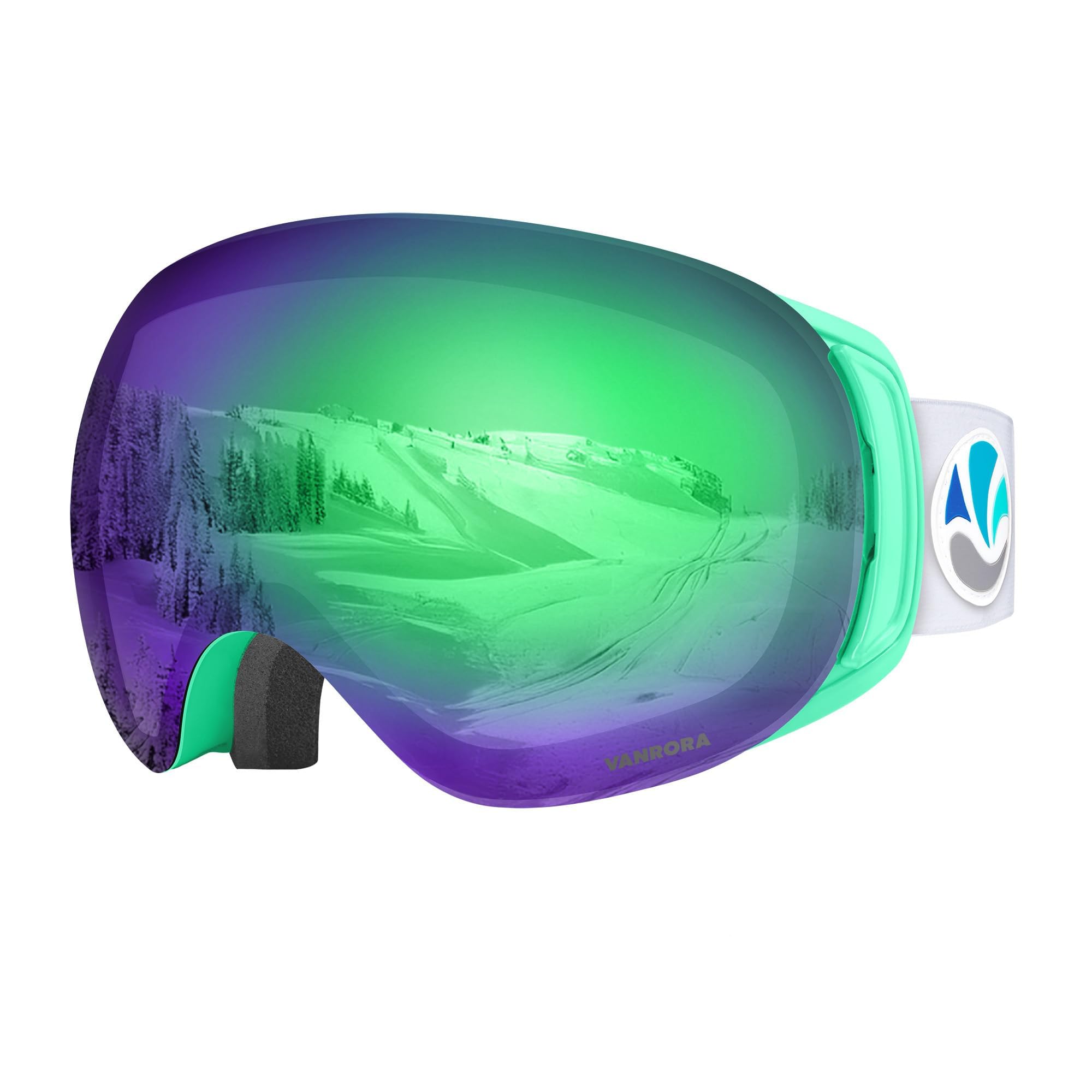
1. Ski Goggles
Our pick — 4.5+★ from 600+ verified ratings; the strongest balance of quality and price.
The goggle that swaps tint in seconds and still keeps the price sensible.
This is the crowd favorite for a reason — 4.5+ stars across 600+ ratings, and what wins people over is sheer build quality, with value and fog-free running close behind. The stock lens runs 10–20% VLT (visible light transmission — the share of light the lens lets through), which is the sweet range for sunny to partly cloudy days. On a bright groomer that means sharp shadows and readable moguls instead of washed-out white.
The X-Mag system is the star here. You open the side clips, pull the lens, align the new one, and let the magnets snap it home before closing both clips again. You can do the whole swap in about two minutes with gloves on, so a midday cloud bank does not end your visibility. If you want one goggle to cover a multi-day trip, this is the one to buy.
The honest catch: the stock lens is built for bright days, and the maker is clear that cloudy, overcast, or night runs want a different lens sold separately. Budget for one spare if you ride through mixed weather. The frame sits comfortably over glasses and helmets, and at 10.88 ounces it is light enough to forget you have it on.
What earns the top spot
- Magnetic X-Mag swap with clips — change tint without a fight
- 10–20% VLT stock lens tuned for sun and mixed cloud
- Fits over prescription glasses and most helmets
- 10.88 oz, so it rides light on the face all day
Where it asks more of you
- Other tints for storm and night conditions cost extra
- You have to remember to carry the spare lens
Pick this if: you want one dependable goggle for typical resort days and value a fast tint swap.
Think twice if: you ride mostly in flat light and would rather buy a single lens already built for it.
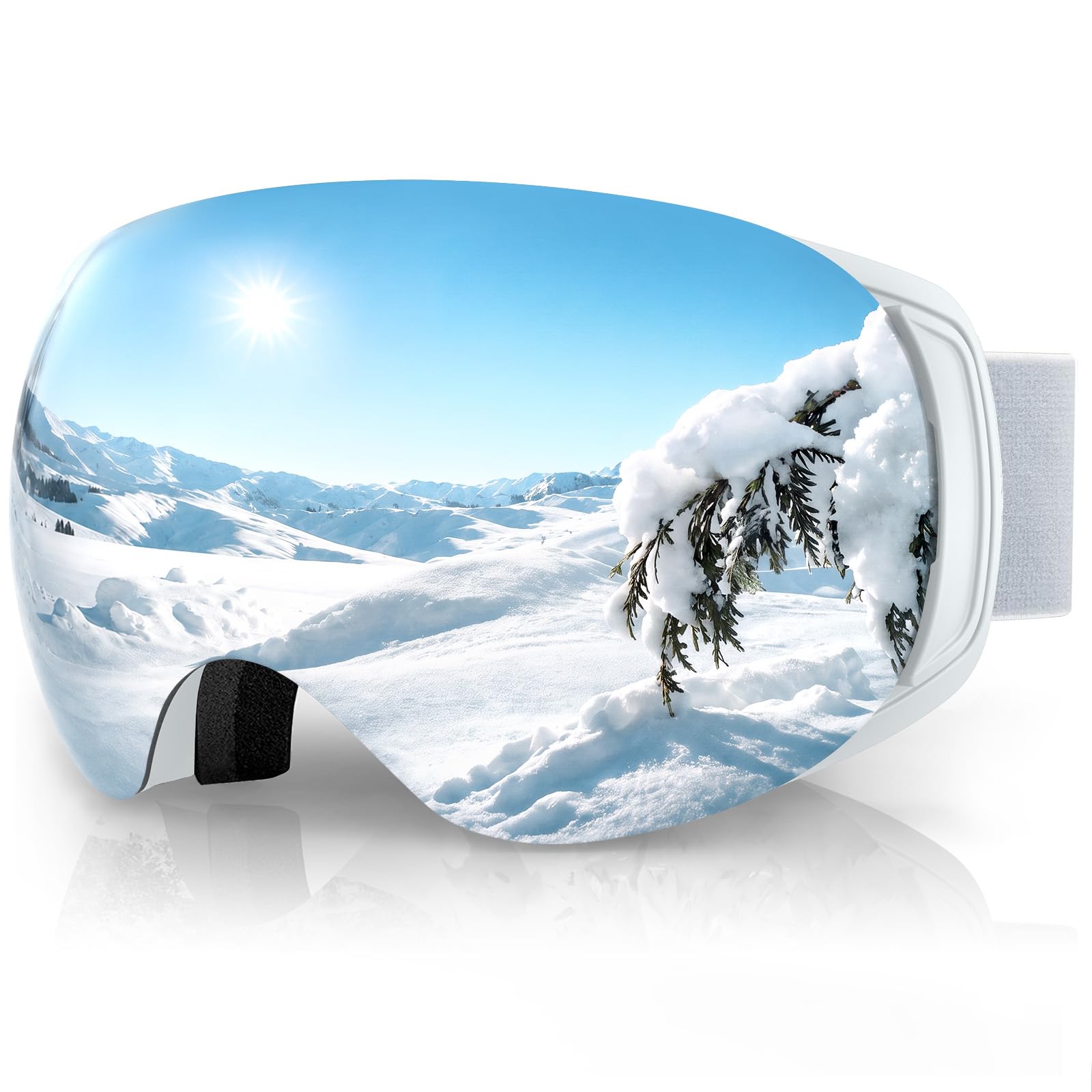
2. findway Ski Goggles OTG for Women Men Adult Youth
Built for the rider who wears prescription frames underneath — without the pinch.
If you wear myopia or reading glasses on the slope, this is the goggle that solves your specific problem. It is engineered with an OTG (over-the-glasses) interior that gives prescription frames real room, and the fit is the thing buyers talk about most. The triple-layer foam wraps your eye sockets in soft flannel, so the seal holds without digging into your cheeks.
Optically, the spherical dual lens creates a thermal barrier that cuts fogging compared with a single-lens design, and the silver lens ships at VLT 10% — a proper sun lens. The maker rates the frame at D3 on the ANSI dust and splash scale, uses a Thermoplastic Polyurethane (a flexible, tough plastic) frame, and adds a two-way venting system to move heat out. Six N45 magnets plus a side-clip lock hold the lens through crashes, and the maker says the swap takes under 60 seconds.
One thing to plan for: the included lens is a sun lens, so cloudy days want a clear or yellow lens bought separately. And a few buyers have found a scratch on arrival, so give the lens a look the moment it lands. The 4.5+ star consensus is strong, and clarity over the wide panoramic view is what keeps riders coming back.
Where the value sits: OTG depth, a spherical dual-lens anti-fog build, and a fast magnet swap at entry-level money — a lot of function for a casual rider.
Worth knowing: durability is the mixed note here. Most buyers report surviving hard falls, but scratches on delivery do happen, so inspect before your trip.
Reach for this if: you need goggles that sit over prescription frames and you want a quick lens change.
Look elsewhere if: you want one lens that handles storm days from the start.
3. OutdoorMaster Ski Goggles PRO, OTG Snow Goggles
The one that plays nice with nearly every helmet in the rental rack.
Helmet compatibility is the whole pitch here, and it holds up. The PRO is built with universal helmet compatibility and an OTG shape, plus a soft TPU (thermoplastic polyurethane — a flexible, resilient plastic) frame that bends rather than cracks. Swap the lens and you can ride the blue tint on sunny days and the green one when low light flattens the terrain.
Owners single out the field of view and the ease of changing lenses, and quality is what the reviews praise most. It carries 100% UV protection, and the frame comes in more than 30 color and lens combinations across the model line. For a rider who leases or borrows helmets and wants one goggle that seals against all of them, that versatility is the point.
Fog resistance is the split note. Some riders report a clear run all day, while others find it fogs in humid cold. Treat the vents as your friend and avoid sealing it tight over a neck gaiter. The 4.5+ star body of reviews is solid, and value for money ranks near the top of what people like about it.
The case for it: universal helmet compatibility, a bendable TPU frame, 100% UV protection, and a lens-swap design that lets you match tint to the sky.
The honest limit: fogging is inconsistent across riders, so if you run hot, keep the vents open and the foam dry.
Best for: riders who want one goggle to fit whatever helmet they end up with and swap tints as the day shifts.
Skip if: you consistently fog goggles and need the most aggressive anti-fog build.
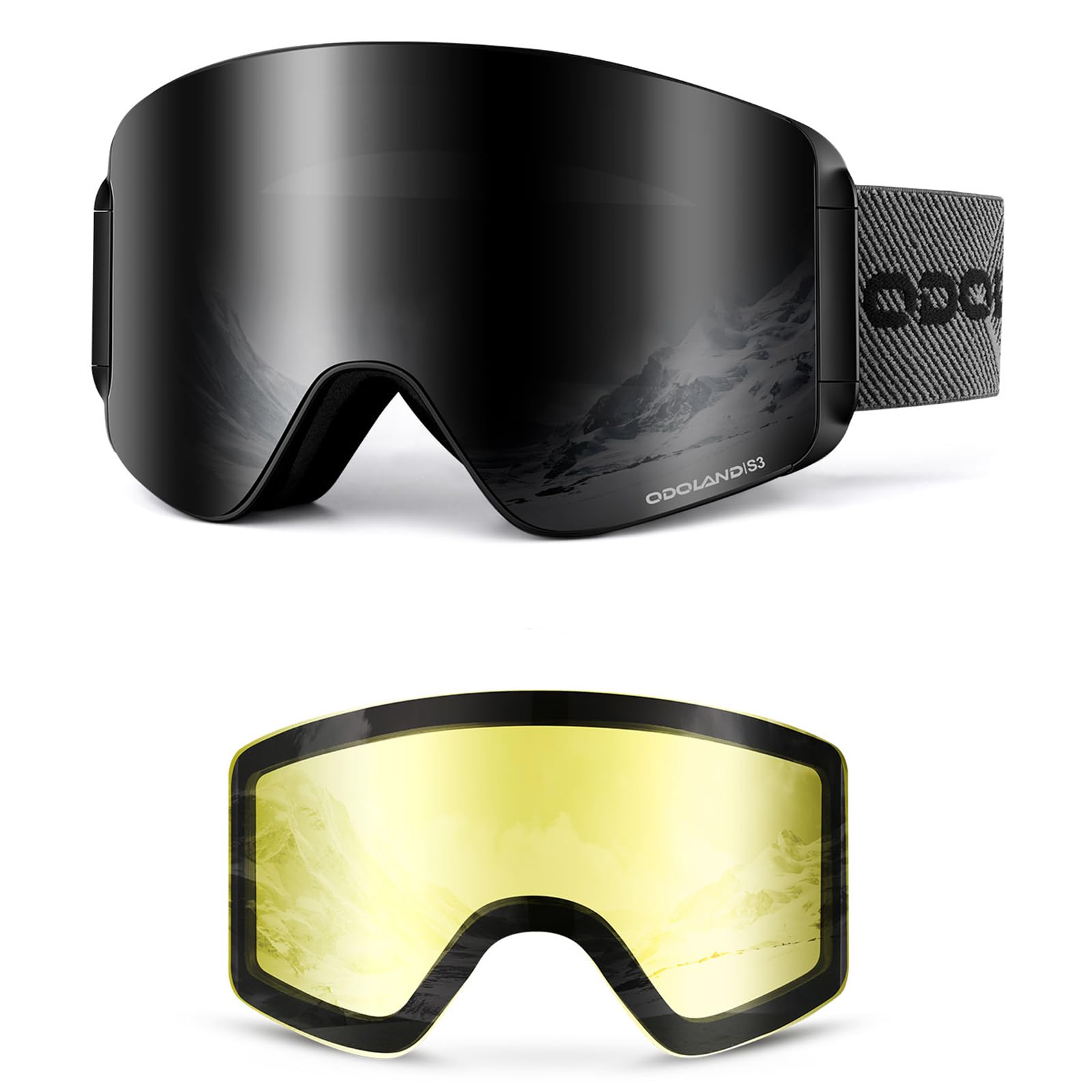
4. Odoland Ski Goggles, Snow Snowboard Goggles Anti-Fog 2 Lens
A spare lens in the box means the clouds never catch you out.
Buying two lenses up front is the smart move this goggle makes. The Odoland ships with a detachable lens and a bonus yellow lens, so you carry a bright-day option and a low-light option without a second purchase. The magnetic system swaps them in seconds, and owners mention the magnets grip firmly and the lens holds.
The spherical frameless lens is shaped around human engineering for a wide, undistorted view, and the triple-layer foam vents heat while holding the seal to your face. The bendable TPU frame takes a knock without cracking — handy when you clip a gate post. VLT varies by what you buy: VLT 8%–10% for full sun, VLT 15%–18% for sun and cloud, VLT 46% for cloudy and foggy days, and VLT 78% for dark days.
Lens protection is the trade-off worth naming. Some riders find the lens scuffs more easily than expected, so store it in the included carry bag between runs rather than loose in a pack. The 4.5+ star consensus points to quality and easy lens changes as the headline strengths, and the frameless build looks pricier than it is.
Why the kit works
- Bonus yellow lens in the box for changeable weather
- Magnetic swap that holds — customers note the lens stays put
- Spherical frameless view with triple-layer vented foam
- Bendable TPU frame that flexes on impact
The fine print
- Lens surface can scuff — keep it in the carry bag
- You need to know your VLT choice going in
Go for it if: you want two tints in one purchase and a magnet swap you can trust.
Pass if: you need a lens that shrugs off rough handling in a packed gear bag.
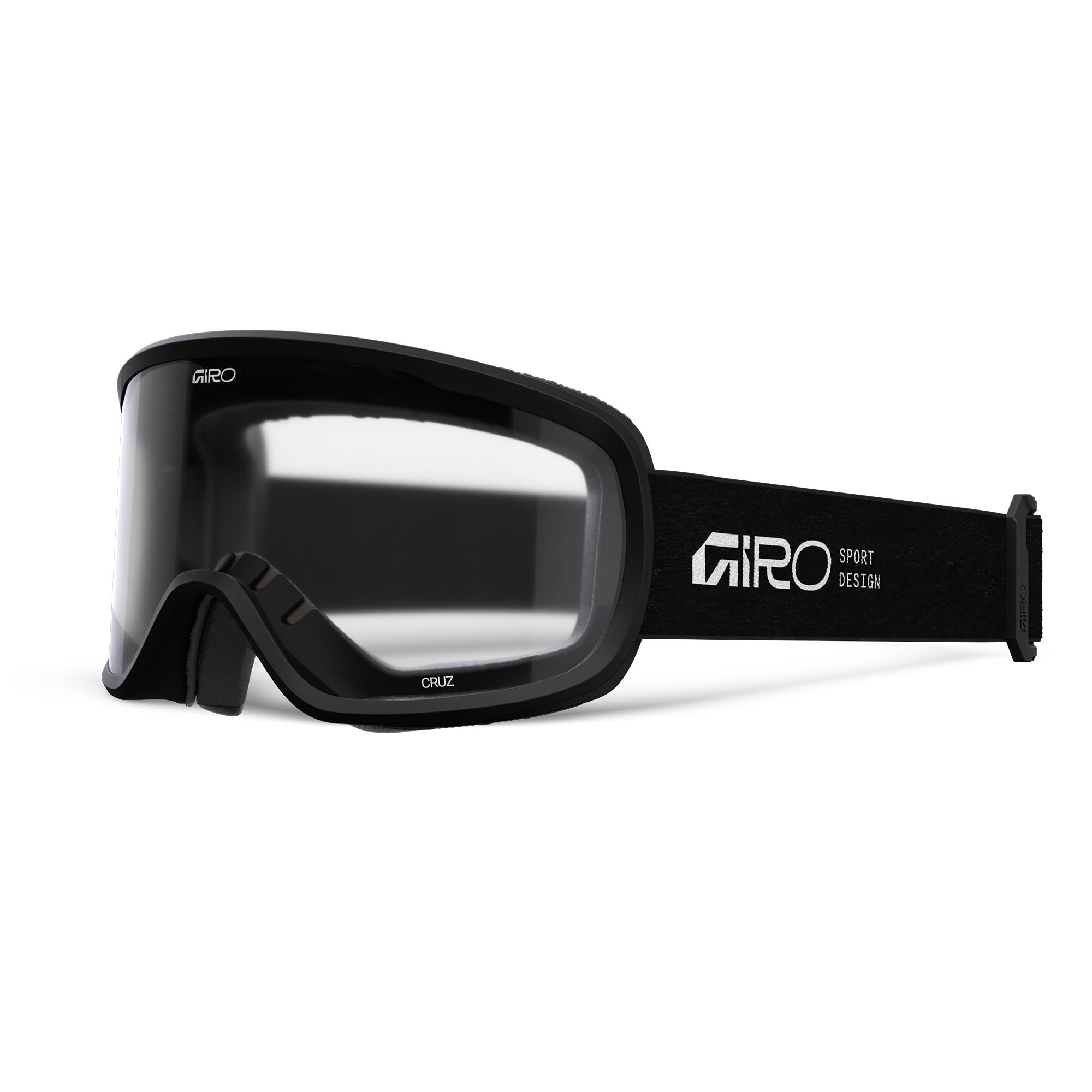
5. Giro Unisex Adult Giro Cruz Ski Goggles
Contrast that reads the subtle bumps in the snow, not just the bright ones.
Giro’s Cruz is the one for riders who care about telling snow texture apart. The anti-fog coating on the inner lens keeps your view on point, and the cylindrical thermoformed lens works with EXV (expansion view) technology — frameless zones that open up peripheral vision around a large spherical shape. The result is a wide, clear look at the terrain rather than a tunnel through the foam.
You can wear your prescription glasses underneath, because it is OTG friendly (OTG means over-the-glasses) with extra interior volume for frames and an air gap that helps keep things clear. A double-layer foam with microfleece facing sits soft against your face, and a silicone strip inside the strap stops it slipping over your helmet or beanie. The PressFit system lets you swap lenses when you want a different tint. The included lens is clear at 89% VLT (VLT means visible light transmission, or how much light reaches your eyes) — genuinely a night and storm lens, not a sun lens.
That clear stock lens is the trade-off to plan for: on a bright bluebird day you will want a tinted lens in the PressFit system. Fit is what owners love most about the Cruz, praised for how it stays put on the move. It is listed at medium weight, so it seats firmly rather than disappearing on the face.
Standout: contrast and peripheral vision — the EXV viewing zone plus a contrast-friendly lens give you a clear read on snow shadows and wind lips.
Caveat to plan around: the 89% VLT clear lens suits night and storm, so budget a tinted PressFit lens for sunny days.
Choose it if: you ride in flat light, wear glasses, and want a wide, secure fit.
Look past it if: sun glare is your main enemy and you want a tinted lens included.
6. ZIONOR X11 Ski Goggles Magnetic Cylindrical

A panoramic cylindrical lens with a magnetic swap for fast light changes.
The X11 leans into the panoramic view. Its cylindrical dual-layer lens is built to resist fogging, and the wider ventilation system spreads moist air out before it can build up. Triple-layer padding foam seals to the face with a breathable, moisture-wicking layer, so you get a snug, clear run without a sauna around your eyes.
Quality and appearance are what owners rate highest, and the goggle looks exactly as advertised — that matters when you are matching a tint to a jacket. The magnetic lens swap makes it easy to move between tints on the mountain.
Fit is the split note here, and it is worth hearing clearly: some riders say the X11 fits well, while others report it runs narrow across the width. If you have a wide face, measure your face width against the frame or look at a full-rim goggle instead. Visibility also draws mixed remarks, so test the view before committing to a distant trip. At 4.0+ stars, most riders are happy, but the fit note is the one to weigh.
Where it shines
- Panoramic cylindrical view with dual-layer anti-fog lens
- Magnetic lens swap for quick tint changes
- Triple-layer padded foam for a snug seal
- Appearance that matches the listing photo
Measure first
- Runs narrow in width for some faces
- Visibility is one of the mixed-feedback points
The right call if: you have a medium-to-narrow face and want a big panoramic look.
Check sizing if: you have a broad face and a wide helmet — the width is where this one divides opinion.
7. Oakley O-Frame 2.0 PRO Ski Goggles
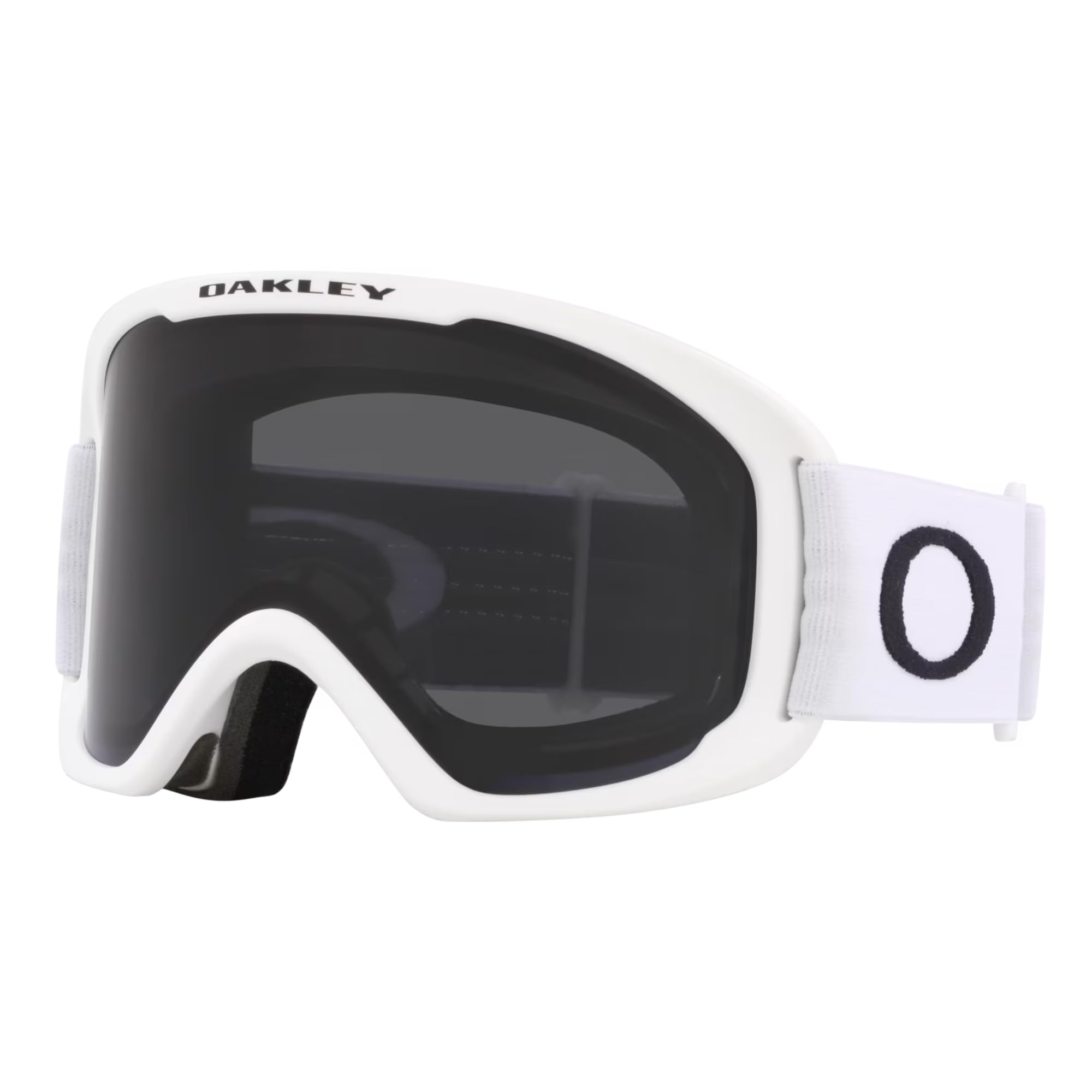
Optics that straighten out the slope so you see the line, not the distortion.
Oakley’s HDO (high definition optics) technology is the headline: it is built to cut distortion, which is what gives you a clearer, sharper read than a conventional lens. On a fast, choppy descent that means you spot ice patches before your skis do. The lens carries an anti-fog coating on the inside, and this one is permanent rather than a coating you reapply.
Prescription compatibility is real — the goggles are designed to sit safely over all eyeglasses, with room for your frames. The wide adjustable strap has a silicone lining that grips the helmet so the goggle stays put when you drop into a turn. Riders also praise the shading, calling the tint perfect for sunny days while still working in low light.
Anti-fog is the split note. Some reviewers point out no fogging at all, while others find it fogs badly in certain conditions. Keep the lens and foam dry, and avoid trapping warm breath from a pulled-up face mask. Quality and fit are what the reviews rate highest, and at 12.8 ounces it sits solidly on the face rather than featherlight.
What you are paying for: distortion-free HDO optics, a permanent anti-fog coating inside the lens, and a silicone-lined strap that locks to the helmet.
The honest caveat: anti-fogging divides riders — some stay clear, others fog in the wrong conditions, so manage your breath and keep the foam dry.
Suits you if: you wear glasses, want sharp undistorted optics, and ride a mix of sun and low light.
Not your pick if: you run hot and already have fog problems with most goggles.
8. Wildhorn Pipeline Ski Goggles OTG Swap Lens
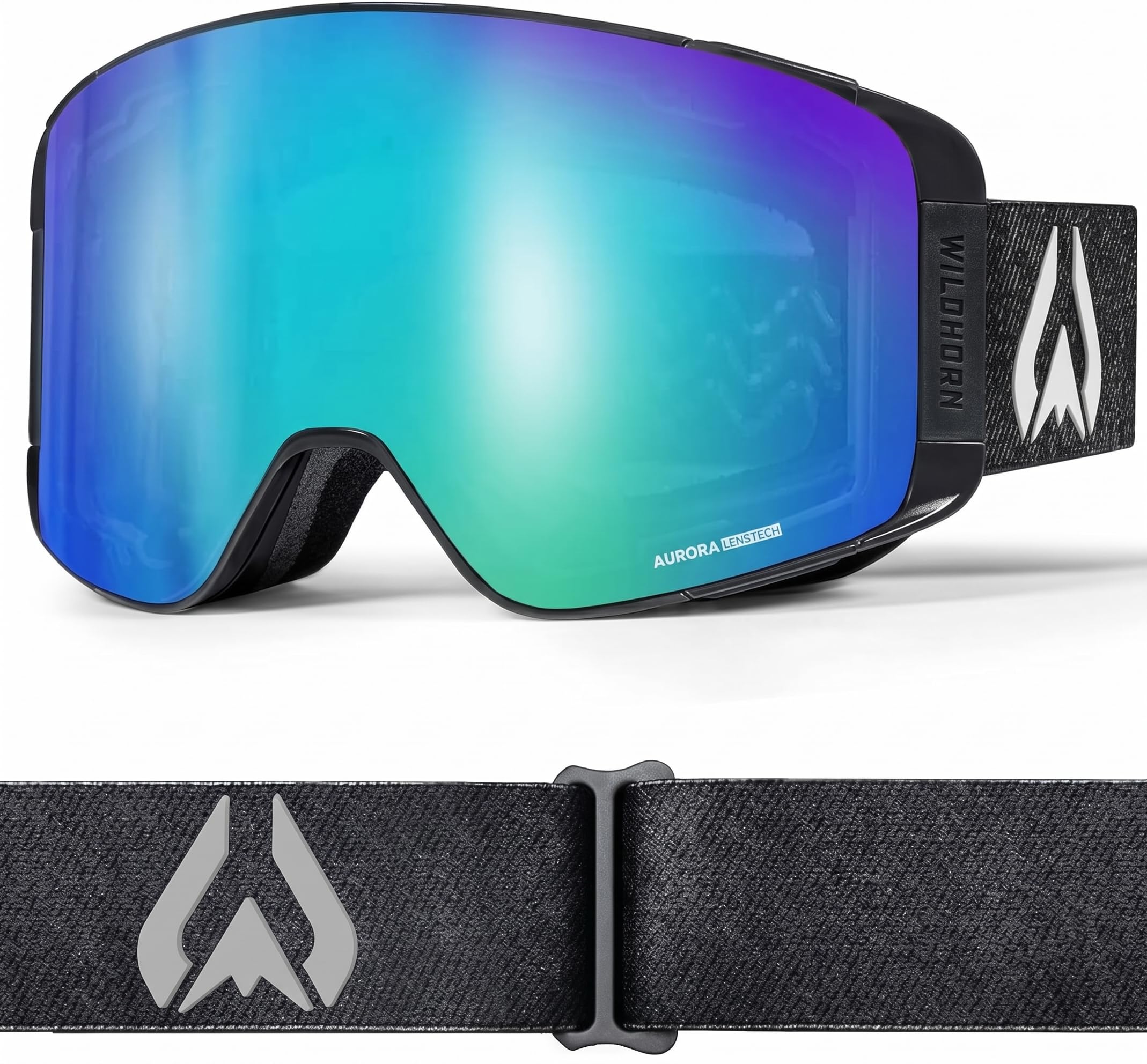
A wall-to-wall view that lets you see your edges without turning your head.
The Pipeline is built around peripheral vision. Its low-profile cylindrical design and dual-molded PC-ABS/TPU frame create what the maker calls wall-to-wall vision, with thinner foam and a close fit that eliminates the tunnel effect of typical goggle construction. On a crowded slope that lets you catch a rider crossing your line without turning your head.
The aurora lens is made of scratch-resistant polycarbonate, with 100% UV400 protection (blocks the full UV spectrum) and a fog-resistant coating. The quick-change magnetic lenses pair with an integrated clip locking system, so you can match the tint to the light in seconds. It is built for a precise helmet-to-goggle fit, and shoppers say the lenses swap fast and the goggle sits well over a helmet.
That same closeness is what gives it the wide view. Wildhorn is listed as a US Ski Team official supplier, and that is the vendor’s claim, not a performance guarantee.
Where it delivers
- Low-profile cylindrical lens with a wide field of view
- Quick-change magnetic swap with clip lock
- 100% UV400 protection on a scratch-resistant polycarbonate lens
- Precise helmet-to-goggle fit
Room to consider
- Thinner foam and a close fit take getting used to
- You need the right lens choice for changing light
Worth it for: riders who prize peripheral vision and a fast lens swap over plush padding.
Second-guess it if: you want a deep, cushioned foam fit against the face.
9. SMITH Squad Goggles with ChromaPop Lens

Color-separating optics for riders who want the slope to look vivid, not flat.
ChromaPop is the reason to look here. The lens technology is designed to enhance definition, contrast, and natural color, so the ridges, ruts, and bumps stand out instead of blending into a white sheet. The semi-rimless design and oversize cylindrical lens pair with that for a wide field of view and sharp optics, and the inner lens carries Smith’s anti-fog treatment.
The color option here is a green mirror on a black frame — a sun lens for bright and mixed days. Smith includes an extra lens for low light in the box, so the shift from sun to storm is covered without another purchase. The green mirror version is the sun-friendly pick; the low-light spare handles the flat-light run. The goggle is designed to pair with Smith helmets for comfortable, vented, fog-free performance, which is worth knowing if you already run a Smith lid.
The trade-offs are honest ones. The goggle runs medium in fit, so check it against a small or large head shape. Swapping lenses takes some patience and pressure — a tight seal by trade, so it goes on slow but stays on. And value is the split note: plenty of owners think the optics feel like a bigger spend, while others expect more for the money. Quality is what the reviews praise most, and the responsive foam conforms snugly without pinching.
The draw: ChromaPop contrast enhancement, an oversize cylindrical lens for a wide view, and a spare low-light lens included — a strong setup for changing mountain weather.
The catch: the medium fit and firm lens swap are the two things to accept, and value divides opinion given the premium tier.
Reach for it if: you want the most color-forward, contrast-focused optics and a spare low-light lens in the box.
Think again if: you want a soft fit across a very small or very large head shape.
Know the Specs
VLT (Visible Light Transmission)
VLT is the percentage of light that passes through the lens to your eye. A low VLT blocks more sun for bright days, and a high VLT lets more through for cloud, storm, and night. The Odoland range spans VLT 8%–10% for full sun up to VLT 78% for dark days, and the findway silver lens sits at VLT 10%. Match this number to your usual light, and you will spend less time squinting.
Lens Shape and Field of View
A cylindrical lens curves in one direction and gives a classic look, while a spherical lens curves both ways for a wider view. The ZIONOR X11 uses a panoramic cylindrical design, and the SMITH Squad uses an oversize cylindrical lens with a semi-rimless frame for a wide field. Width of view matters most when the slope is busy and you need to catch riders at the edge of your vision.
Anti-Fog and Venting
Fog builds when warm, moist air gets trapped between your face and the lens. Dual-layer lenses, inner anti-fog coatings, and venting systems are the three fixes. The Wildhorn Pipeline adds a fog-resistant coating, the Oakley O-Frame 2.0 PRO uses a permanent anti-fog inside the lens, and triple-layer foam on the Odoland and ZIONOR helps move heat out.
OTG (Over-the-Glasses) Fit
OTG goggles have extra interior room so prescription frames sit underneath. A lot of riders assume any large goggle is OTG, and that is the common mistake — the interior volume and width of the foam channel are what matter. The Giro Cruz, Oakley O-Frame 2.0 PRO, and findway are all built with this fit in mind.
Common Questions
Will a ski goggle lens work on both sunny and cloudy days?
Do magnetic ski goggle lenses stay on in a crash?
How do I stop my goggles fogging up in cold, humid weather?
Can I wear these ski goggles over prescription glasses?
Which tint is best for low light?
How much field of view does a cylindrical versus spherical lens give?
Will these fit over my helmet strap and stay put?
Do I need one lens or two for a full ski trip?
How should I clean and store colored ski goggle lenses?
Are colored lenses safe for my eyes in bright snow?
The Bottom Line
For most riders, the ski goggles with color lens winner is the Ski Goggles, Snowboard Goggles for Men & Women. The X-Mag magnetic swap with side clips lets you match tint to the light without a fight, and the 10–20% VLT stock lens handles sunny and mixed days. If you wear prescription glasses, grab the findway — its OTG interior and spherical dual-lens build give frames real room without pinching. And for wide, close-fitting peripheral vision with a fast lens change, the Wildhorn Pipeline is the one to reach for. Choose the lens for the light you ride in most, then let frame fit and swap system follow.
How we choose
We do not accept paid placement. Every pick is matched to a real buyer and a real use-case; we do not hands-on test units.
Sources
Specifications: manufacturer listings and product documentation. Review insights: verified customer reviews, as of November 2026. Pricing: not shown on this page (it changes often); check the current price via the retailer link.
As an Amazon Associate, Tactical Gear Guy earns from qualifying purchases. This does not affect which products we feature.