Specs are compiled from manufacturer listings and verified buyer reviews and can change over time — please confirm the key details on the product page before buying.
You only need to sleep one person, so why are you shopping through tents built for two? A true single tent for camping keeps the footprint small, the packed weight down, and the setup simple enough that you are not wrestling poles in the dark. The real decision is not which brand looks nicest — it is if you want a freestanding dome, an instant pop-up, or a canvas swag that rolls out of a pickup bed. This guide sorts all three shapes by how you actually camp.
This guide is built by comparing the manufacturers’ published specifications and the patterns across verified customer reviews, so you get each pick’s real strengths and trade-offs instead of marketing spin.
Three numbers decide whether a solo shelter works for you: weight, floor area, and rain protection. Each pick here handles them differently, so the best single tent for camping depends on matching those three to your trip, not to the loudest label.
Top Picks


How To Choose The Best Single Tent for Camping
Most people buy their first solo tent by looking at the picture. That is exactly backwards. The three things that decide whether you sleep dry and wake up rested are floor area, packed weight, and that water-resistance number on the rainfly. Get those right and the brand barely matters.
Floor area beats listed capacity every time
A tent labelled one-person does not tell you whether your pad and pack will fit beside you. Look for the floor dimensions in inches — a 32-inch-wide floor is snug for a broad-shouldered sleeper, while a 36-inch floor gives your elbows somewhere to go. Width matters more than length for most buyers, because pads run long but rarely wide.
Compare the ALPS Lynx 1 at 20 square feet against the Night Cat pop-up at 25.31 square feet and you feel the difference the moment you try to change clothes inside. Bigger floor means more condensation surface too, so pair a roomy tent with good mesh panels.
Read the waterproof rating as millimeters, not adjectives
That “PU2000mm” tag is a hydrostatic head figure — how tall a column of water the fabric holds before it seeps through. Higher is more protection in driving rain. A 1500 mm rainfly handles steady rain; 2000 mm and above shrugs off real storms. Seam tape and a full-coverage fly matter as much as the number itself, because water finds unsealed stitching first.
Match the shape to how far you walk
Backpackers want freestanding domes with aluminum poles and a packed size short enough to strap to a pack. Truck hunters and campers who park close want a canvas swag they can unroll in minutes. Instant pop-up shelters suit anyone who hates pole assembly — just know they fold back with a technique you have to practice once.
Condensation is the quiet deal-killer
You breathe out moisture all night and it collects on the inside skin. Mesh walls, two windows, and an improve vent let that vapor escape. A fully sealed four-season tent traps warmth in winter but needs its door cracked in summer. Where you camp decides which trade you want.
Side-by-Side Comparison
| Model | Best For | Floor Area | Stated Weight | Rainfly / Floor Coating | Amazon |
|---|---|---|---|---|---|
| ALPS Mountaineering Lynx 1★ Best Overall | Solo backpacking in rough weather | 20 sq ft | 4 lbs 1 oz | 1500 mm fly / 2000 mm floor | Amazon |
| Night Cat Pop-up 1 PersonFastest Setup | Fast pit-stop camping | 25.31 sq ft | Not stated | PU 2000 mm | Amazon |
| Underwood Aggregator 4 SeasonCold Weather Pick | Cold-weather camping | 2748.08 sq in | 4.4 lbs | PU 5000 mm | Amazon |
| KAZOO Ultralight 1 Person | First backpacking trips | 20.75 sq ft | 3.3 lbs | Above 3000 mm tested | Amazon |
| USGI Bivy Mesh Sleep System | Bug-heavy summer nights | 2490 sq in | Not stated | Not stated | Amazon |
| GEERTOP Ultralight Bivy | Minimalist fast movers | 84.6 x 29.5 in | 2.9 lbs | PU 5000 mm fly / 8000 mm floor | Amazon |
| Night Cat Lanshan Ultralight | Through-hikers counting grams | 0.5 sq m | 2 lbs | Waterproof rainfly | Amazon |
| Naturehike Star Trail | Headroom on a short pack list | 86.6 x 59.1 in | 2.3 lbs | 1500 mm fly / 3000 mm floor | Amazon |
| Kodiak Canvas Swag | Truck and ATV hunting camps | 20.01 sq ft | Not stated | Hydra-Shield cotton canvas | Amazon |
Detailed Reviews
1. ALPS Mountaineering Backpacking-Tents Lynx 1
Our pick — 4.5+★ from 900+ verified ratings; the strongest balance of quality and price.
A sealed two-pole dome that holds up to hail and packs to 3 lbs 5 oz.
If you walk into camp with everything on your back and you expect the weather to turn, this is the one to buy. ALPS builds it around a factory-sealed rainfly rated to 1500 mm (the water pressure it holds before leaking) over a poly taffeta floor rated to 2000 mm, so the ground stays dry under you too. The whole shelter runs 4 lbs 1 oz as shipped, or 3 lbs 5 oz if you leave the footprint and extras behind.
What wins people over, far ahead of anything else, is the build quality. Buyers report it “standing up to 30+mph winds and snowy mountain conditions,” and the review pages keep returning to the same scene — a week-long trek through rain and hail that ends with a dry sleeping bag. The frame is aluminum across two poles, and the whole thing pitches freestanding, so you can pick it up and slide it two feet left when the ground turns out to be lumpy. Expect roughly 15 minutes on your first setup.
You are not buying hotel room proportions here, and that is the honest part. What you do get is 3 feet of center height, which is enough for a 5’11” sleeper to sit upright in the middle. Half-mesh walls handle the condensation problem, and the vestibule keeps your pack out of the sleeping area.
What earns it the top slot
- Sealed 1500 mm fly over a 2000 mm floor — real protection, not just a coating claim
- 3 lb 5 oz minimum weight keeps a solo through-hike honest
- 22 inches longer than the Underwood Aggregator’s 86.6-inch floor, so long legs clear the wall
- Vestibule plus mesh pockets and a gear loft keep the floor clear of clutter
- Half-mesh walls cut overnight condensation on warm nights
Where it asks something of you
- 20 square feet is the smallest floor area in this lineup
- You pay for the weatherproofing in packed bulk compared with the bivy options
- A few units ship with loose stitching that needs trimming before your trip
Go for it: solo backpackers and weekend trekkers who rate staying dry above saving every ounce, and who want a tent that stands up without stakes in rock.
Think twice: if you are over 6’4″ or you pack a wide pad — that 32-inch floor width leaves little room for anything beside you.
2. Night Cat Pop-up Camping Tent
Toss it and it opens itself in about three seconds — no poles to thread.
Three seconds. That is the assembly time Night Cat claims, and it is not an exaggeration — you spread the pole, toss the tent, and it opens itself. If you pull into a campsite after dark with a headlamp on, that matters more than any coating figure. The shell is 190T polyester taffeta coated to PU 2000 mm (the water pressure it holds before seeping), with waterproof tape over every seam.
The interior is where this shape pays off. That extra real estate fits a twin air mattress, or a single pad with your gear stacked beside it. One big door and two wide windows move air through, and you can prop the door up with your own trekking poles to make a small shaded porch.
Here is the catch you need to hear before you buy. Folding it back down takes practice — you fold the frame like the number 8, twice, and the first few attempts are slow. Owners who master it are up and packed before anyone else has a pole in hand. Owners who do not report fighting it into the bag. Rain protection is the other honest split: several report staying dry in steady rain, and a handful describe water coming through the top in a light shower, so seam-seal it yourself before a serious trip.
Who it clicks with: riders and car campers who want shelter in under a minute. It also earns its keep as a beach shelter on a windy afternoon, since the whole thing staked down holds its shape.
Sizing reality check: the 6’4″ buyer who rides a motorcycle finds this on the short side. Anyone at that height should look at the Naturehike Star Trail, whose 86.6-inch floor runs longer.
Best fit: motorcycle tourers, festival campers, and anyone who values a 3-second pitch over a featherweight pack load.
Look elsewhere if: you need to strike camp in the dark and stay calm — that fold-back technique needs one practice run at home first.
3. 1/2 Person 4 Season Backpacking Tent
A rollable snow skirt and a PU 5000 mm fly for camps that start below freezing.
Most tents in this category stop at three seasons, which means spring, summer, and fall. This Underwood Aggregator runs four, and the difference is a rollable snow skirt that keeps drifts out in winter and rolls away when the ground is bare. The rainfly carries a PU 5000 mm coating — a genuinely high hydrostatic head — over an Oxford base, with a mesh inner layer for bug season.
Packed dimensions are 5.1 x 15 inches at 4.4 lbs, and the floor runs 31.8 x 86.6 inches with a 35.8-inch center height. Worth noting: that 86.6-inch floor is 3.4 inches shorter than the ALPS Lynx 1’s 90 inches, so a tall sleeper has less length to stretch into here. The upside for cold trips is real — the double-layer door and the full-cover fly trap warmth, and the four-season build handles snow load where a summer dome would sag.
Warmth is the metric that keeps coming up, sometimes with a laugh — plenty of owners find it holds heat almost too well on a mild night. Rain protection holds up through multi-day Rocky Mountain trips. The honest limit is the fabric itself. It is thin, and a plastic buckle can puncture the wall if you tighten a strap carelessly, so carry a patch kit. Interior space is snug once you add a winter bag and layers.
Cold-trip verdict: if your camping season runs into the snow line, this is the shelter that keeps the inside dry and the warmth in, and the aluminum poles take the wind load on exposed ridges.
Warm-trip caveat: in a muggy July, that sealed four-season fly becomes a sauna. Roll the snow skirt back and crack the double-layer door open.
Worth it for: winter backpackers and shoulder-season campers who sleep cold and want the fly to be the warmest thing in their kit.
Pass if: you only camp in summer heat — you would be paying for insulation you will fight all night.
4. KAZOO Waterproof Backpacking Tent

One clip-on aluminum pole, 3.3 lbs, and a first pitch a beginner can finish.
Setup is where a first-time backpacker quits, and KAZOO removes that hurdle with a single integrated aluminum pole you clip on rather than thread. It weighs 3.3 lbs and packs to 20 x 6 inches, so it rides easily on your back. The floor measures 36 x 83 inches — wider than the ALPS Lynx 1’s 32 inches but 7 inches shorter, a trade you feel if you are tall. The rainfly has passed waterproof testing above 3000 mm (a measure of how much water pressure it resists), and the joints are coated to stop leaks at the seams.
The materials story is unusual for this tier. Every fabric is recycled through the ECO CIRCLE system, and the tent carries a Global Recycled Standard certificate from Textile Exchange with an authenticity card in the box. Construction is what earns the most praise by a wide margin — solid poles, stakes that hold, zippers that run clean. The full-coverage 210T Ripstop rainfly over the 190T breathable liner handles wind well enough that 6-foot owners mention legroom to spare.
Durability is the fair warning. A minority of units arrive with hardware that fails early — a tie-down loop tearing or a zipper giving out on first use — so buy it, pitch it in the yard, and check every attachment before you drive to the trailhead. Water resistance splits similar to the Night Cat above: customers note staying dry through a Sierra rainstorm, while a small share find it marginal in sustained weather. The bright yellow shell is easy to spot from a distance, which is no small thing on a busy ridge.
Pick this if: you are buying your first solo backpacking tent and want a simple pitch, a recycled fabric build, and a wide floor without a premium-tier layout.
Know before you buy: check every zipper and loop on your first pitch — the hardware is the one part that can let an otherwise solid shelter down.
5. Bivy Tent, Self-Deploying Single-Person Mesh Sleep System
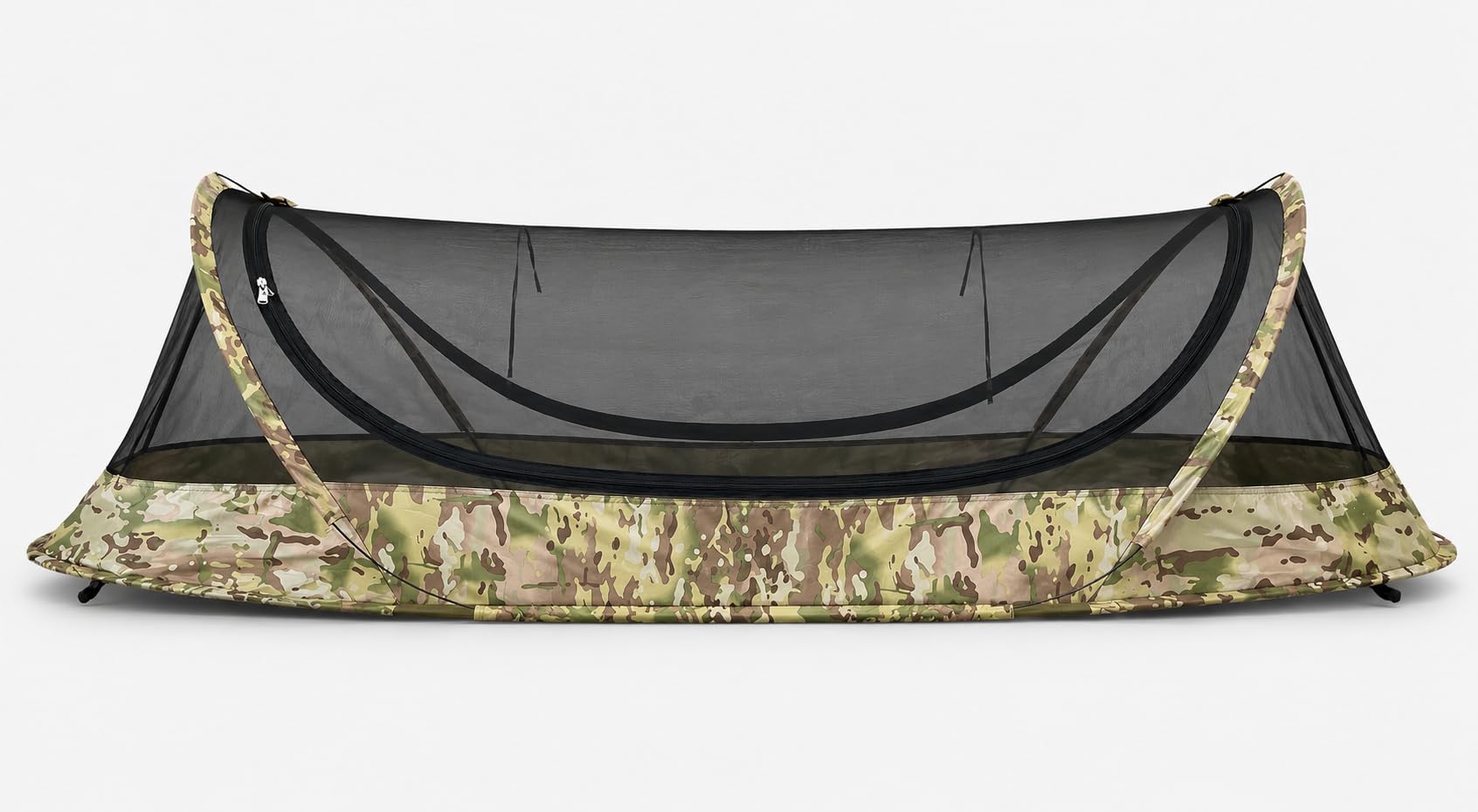
No poles to assemble — it springs open into a full-mesh bug barrier.
This one does not have poles to lose or instructions to misplace — it arrives assembled and springs open when you throw it. The body is mesh across the whole span, which makes it a genuine bug barrier on a humid summer night when a nylon dome would turn into a sweatbox. Inside dimensions run 83 inches long, 30 inches wide, and 23 inches tall, and it folds into an 18-inch bag that slips into most suitcases.
Where this design shines is the quick overnight — a hammock-adjacent sleep, a scout campout, a night in the truck bed. Kids take to it because it feels like a fort you can carry. The floor resists wet ground, there is a mesh pouch inside for a bottle or headlamp, and the dual-slider zipper lets you vent from either direction. Setup and teardown are near-instant for anyone who has done the fold once.
The honest complications come in two places. First, height — at 23 inches tall you are crawling in and lying flat, not sitting up to read. Second, folding. That spring-loaded frame resists the first few pack-downs, and if you force it the poles can warp. Stow the rainfly if you want full stargazing; keep it on in a drizzle.
The niche it owns: warm-weather sleeping where bugs rule and airflow matters more than headroom. Summer camp, backyard, a quick overnighter beside the car.
Reach for it: if your camping is a vehicle-adjacent summer night and you want bug protection with zero assembly.
Skip it: on a real hike — 30 inches of width, 23 inches of height, and an 18-inch packed bag are not built for a long carry.
6. GEERTOP Ultralight Bivy Tent
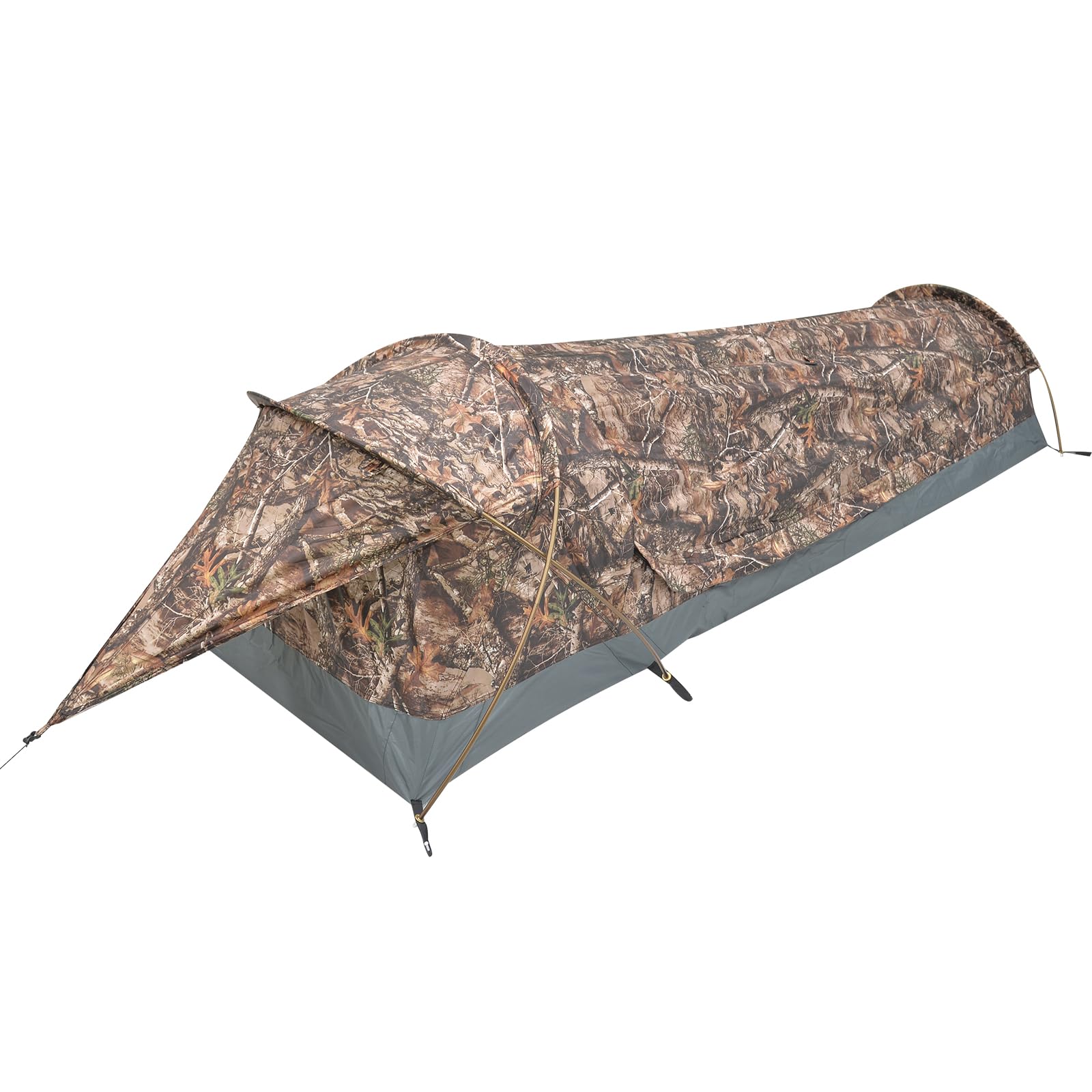
Camo nylon at 2.9 lbs with a PU 8000 mm floor — once you seal the seams.
Two-point-nine pounds packed to 17 x 5 x 5 inches is the number that sells this tent, and it is one of the lightest carry weights in this group. The floor coating is what stands out — PU 8000 mm, well above the PU 5000 mm you find on the Underwood above, and the fly runs PU 5000 mm, both fully seam-taped and double-stitched. A shock-corded three-pole aluminum frame pitches in about two minutes so you can beat a storm that rolls in fast.
Inside, you get 84.6 x 29.5 inches with a 24-inch height — long enough to lie flat, not tall enough to sit up. A top mesh panel and two windows move air, and in camo it disappears into the treeline. Setup speed is the standout: experienced reviewers point out it goes up in two minutes and comes down just as fast, which is exactly what you want when the sky changes on a ridge.
The catch that shows in the reviews is waterproofing consistency. Shoppers say that some keep dry through sustained rain, while several find water pooling in the floor after a soaking — a lot of that traces to the seams, and a coat of waterproofing spray before your first trip heads it off. Ventilation splits the same way; in a warm, still night the condensation can build, so leave the top flap open with the bug screen closed. The floor is the last honest note — no bathtub edge (a raised lip that keeps ground water out), so pick your pitch.
Minimalist verdict: for the hiker who counts grams and treats a bivy as a sleep system, not a cabin, this delivers the lightest usable shelter here at a fair, accessible tier.
The honest ask: budget one pre-trip waterproofing spray and a patch kit — you are paying for less fabric, and you seal it yourself.
Best for: fast-and-light backpackers, hunters, and solo travelers who want a 2.9-pound bivy that pitches in two minutes and hides in camo.
Not for: the camper who wants to sit cross-legged inside — 24 inches of height means lying flat or nothing.
7. Night Cat Ultralight Tent 1 Person

A 2 lb trekking-pole bivy for the hiker who already carries the poles.
Among the tents that actually make it onto a long trail, this is the weight leader in this lineup at a claimed 2 lbs. The trade is that it pitches around trekking poles — the description says poles are not included, though stakes and ropes are. Setup runs minutes once you know the sequence, and the nylon shell with its waterproof rainfly handles heavy rain and snow when the pitch is right.
Owners on long treks are the ones who love it. It is rated a four-season bivy, holds its shape through thunderstorms for some buyers, and packs into a bag small enough to disappear into a pack. The floor runs 125 by 100 centimeters, roughly 0.5 square meters, which a couple of owners find spacious enough for two people and sleeping pads. Setting it up is a 10-minute job for one person.
The honest worries are the poles and the sealing. Several note the pole sections come apart too easily while striking camp, and one reports grommets ripping out on the first night. The inner net can sag and let critters through zipper gaps if it is not tensioned correctly. So: practice the pitch at home, tension the inner net, and check every grommet. Get those right and this is a serious weight-per-dollar option among ultralight shelters.
Choose it if: you already hike with trekking poles and want a 2-pound bivy that pitches fast and packs tiny for a long trail.
Choose otherwise if: you do not carry trekking poles — you would be buying the poles separately, and this is not a freestanding shelter.
8. Naturehike Star Trail Ultralight Backpacking Tent
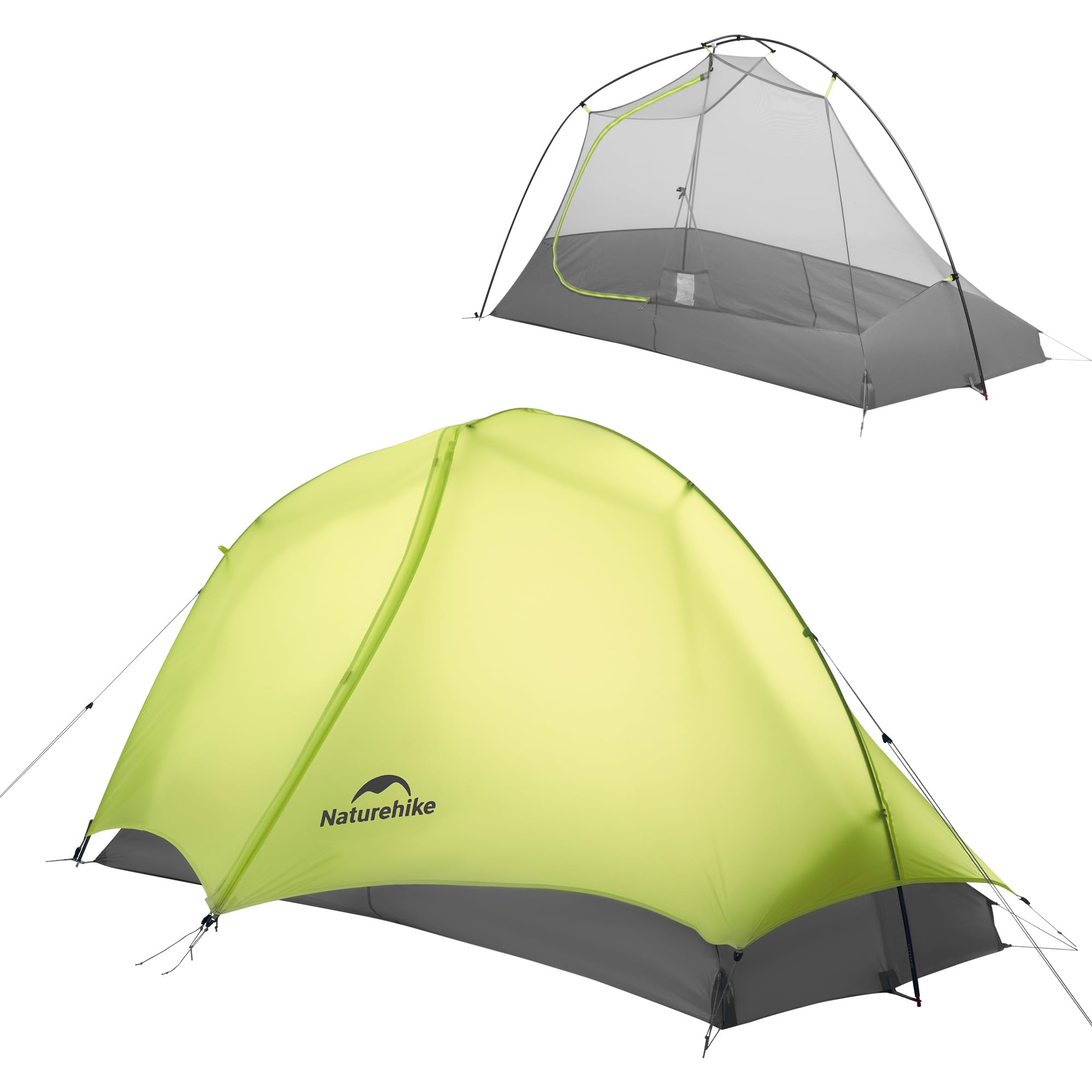
Sit up straight at two point three pounds — the headroom that most ultralight tents give away.
The pitch sells the comfort here. Naturehike raises the center peak so a single adult can sit upright inside, a small thing on paper and a big thing at 6 a.m. when your boots are by the door or your headlamp is on the floor. The outer tent is 10D nylon coated to PU 1500 mm, and the inner floor is 20D nylon at PU 3000 mm, so the ground layer holds water better than the fly. Total weight is 2.3 lbs packed to 17.7 x 5.1 inches.
Pitching takes about 3 minutes even for a first-timer, and the kit arrives complete: stakes, two poles, a footprint, guy lines, and a compression strap. The floor is 86.6 by 59.1 inches — the widest in this lineup — which is why a solo camper can spread out a pad and a duffel without folding themselves into a comma. A full-mesh inner keeps bugs out, and an improve clearance design moves air through, which makes it a summer tent above all.
The honest limit is durability at that weight. The fabric is thin, and while it holds up well through rainstorms in the mountains, it will not take the kind of abuse the Kodiak canvas swag survives. If you hike through brambles or pitch on sharp rock, think about the footprint — and this one ships with one. For a gram-counting solo hiker who values sitting up, it is right there.
Space-per-pound read: the 59.1-inch floor width against a 2.3-pound total is the whole argument here — more room to spread out than the ALPS Lynx 1’s 32 inches, at half the carry weight.
Suits: the solo backpacker or bikepacker who wants to sit up, stretch out, and still keep the pack light.
Not the one for: rough ground and thorny bushwhacks — thin nylon rewards care and a footprint.
9. KODIAK CANVAS 1-Person Canvas Swag Tent

A canvas swag that rolls out of the truck and becomes a bed in minutes.
This is not a backpacking tent and it never pretends to be. It is a swag — canvas walls, a 2-inch foam mattress pad with a flannel cover already included, and a whole 6’8″ of length to stretch into. The shell is Hydra-Shield 100% cotton duck canvas, and the top unzips and rolls back to convert into a screen shelter for a starry night. Setup is a matter of unrolling and letting the poles do their work.
Where it earns its place is the truck and ATV camp. Hunters who roll into a spot with a side-by-side or a sled and want shelter, insulation, and a bed in one item rate it highly for the fabric, the zippers, and the deadening of sound. Heat retention is the standout — the canvas holds warmth and the noise stays out, so a cold overnight feels far less raw than it would in nylon. The zip-open windows at head and foot let you manage temperature.
The honest trade is portability. Rolled up it is too large to carry into a backcountry site, and the floor measures 80 by 35 inches with 20.01 square feet, a snug single bed. Buyers who count on a sled or an ATV are delighted; buyers who hike in are asking the wrong product to do the right job. It is also the heaviest and most expensive-feeling option in this group, so treat it as a camp fixture, not a pack item.
Bed-in-a-bag verdict: for the hunter or truck camper who wants a mattress, canvas walls, and a screen shelter in one item, this replaces three pieces of gear.
Don’t haul it: it is a base-camp fixture, not a pack tent — the rolled size rules out any real walk in with it.
Buy it for: ATV, pickup, and side-by-side campers who want a canvas shelter with the sleeping pad built in.
Leave it for: the backpacker — this is a rolled canvas bed, not something you carry for miles.
Know the Specs
Hydrostatic head (PU rating)
The “PU 2000 mm” or “PU 5000 mm” figure is how tall a column of water the fabric holds before it seeps through — the higher the number, the harder the rain it shrugs off. A 1500 mm fly handles steady rain, while 3000 mm and above takes storms. The number only counts if the seams are taped; water finds unsealed stitching first, so look for “seam-taped” or “factory-sealed” alongside the coating figure.
Floor area and packed weight
Floor area in square feet tells you how much room a pad plus your gear actually occupies, which a “1-person” label never does. Packed weight is what you carry all day, and it drives the choice between a nylon dome and a canvas swag. A 2.3-pound tent and a 4.4-pound tent feel very different by mile eight, and the lighter tent usually gives up fabric thickness to get there.
Freestanding vs. staked
A freestanding dome stands on its own poles, so you can lift and reposition it before staking — useful on rock or hard ground where stakes barely bite. A trekking-pole bivy has no frame of its own and needs those poles plus stakes to hold shape. Freestanding is easier for beginners; a staked bivy saves weight and pack space.
Condensation and ventilation
You exhale moisture all night, and it condenses on the coldest interior surface. Mesh walls, two windows, and an improve vent let the vapor out. A sealed four-season shell traps warmth but needs the door cracked on a mild night, while a full-mesh bivy breathes freely but gives up insulation. Where you camp — humid summer forest or snowy ridge — decides which trade serves you.
Common Questions
Will a one-person tent fit a 6-foot-4 camper?
What does the PU number on a rainfly actually mean?
Can I use a three-season tent in winter?
How long does setup take for each type of solo tent?
Do I need a footprint under a single tent?
Why do some reviews mention water getting in during light rain?
Is a bivy or a dome better for backpacking?
How do I stop condensation inside a single tent?
Will a canvas swag work for backpacking?
Should I buy a tent with a vestibule?
The Bottom Line
If you want the single tent for camping that handles the widest range of weather without a fuss, the ALPS Mountaineering Lynx 1 is the strongest pick — a sealed 1500 mm fly and a 2000 mm floor (both rated for how much water pressure they resist), plus freestanding two-pole aluminum construction that sets up fast. For a quick motorcycle or festival pitch, the Night Cat Pop-up opens in 3 seconds and gives you 25.31 square feet, the most floor space here. And if you walk into camp with trekking poles and a gram-counting pack list, the Night Cat Lanshan bivy trims the load to a 2-pound carry.
Whichever you pick, pre-treat the seams once, pitch it in the yard before your first trip, and match the floor size to how you sleep — not to the label on the box.
How we choose
We do not accept paid placement. Every pick is matched to a real buyer and a real use-case; we do not hands-on test units.
Sources
Specifications: manufacturer listings and product documentation. Review insights: verified customer reviews, as of November 2026. Pricing: not shown on this page (it changes often); check the current price via the retailer link.
As an Amazon Associate, Tactical Gear Guy earns from qualifying purchases. This does not affect which products we feature.