Specs are compiled from manufacturer listings and verified buyer reviews and can change over time — please confirm the key details on the product page before buying.
You want internet that does not depend on a cable company, and you want to know which SIM card modem actually connects instead of fighting you. That is the whole decision: a modem that takes your carrier’s SIM and turns cellular signal into Wi-Fi for your house, RV, or job site. Most of the frustration in this category comes from two things — picking a modem that does not accept your carrier, and expecting speeds your local tower cannot deliver.
This guide is built by comparing the manufacturers’ published specifications and the patterns across verified customer reviews, so you get each pick’s real strengths and trade-offs instead of marketing spin.
Carrier compatibility and real-world speed are what separate a keeper from a return, and each pick below is matched to the SIM situation it handles best. Here is the honest breakdown of the best SIM Card Modem options you can buy.
Top Picks


How To Choose The Best SIM Card Modem
The first thing to settle is your carrier, not the modem. A SIM card modem is only as good as the network whose SIM you slide into it, and a device that is not certified on your provider will simply refuse to connect or crawl. Check the listing’s supported bands and whether it names AT&T, T-Mobile, or both before anything else.
Match the LTE category to your patience
Cat 4 modems top out around 150 Mbps on the cellular side — enough for browsing, email, video calls, and a couple of streams. Cat 12 and 5G devices push much higher, but only if your tower supports it. Buying more speed than your local signal can supply wastes money.
Decide between a router and a dongle
A full router gives you Ethernet ports, a real Wi-Fi network, and room for many devices. A USB dongle is pocket-sized and plugs into a laptop or power bank for instant internet. Pick the shape that matches where you will actually sit — a fixed cabin wants the router, a traveler on the move wants the dongle.
Check the SIM slot and device ceiling
Look at whether the slot takes a Nano SIM or a micro SIM, and whether there is a second slot for a backup carrier. Then check the maximum connected devices — a solo remote worker is fine with a small number, while a household streaming on several screens needs headroom.
Side-by-Side Comparison
| Model | Best For | Cellular Speed | Max Devices | Wi-Fi Standard | Amazon |
|---|---|---|---|---|---|
| Cudy LT500★ Best Overall | Whole-home cellular internet | 150 Mbps (Cat 4) | 128 | Wi-Fi 5 (AC1200) | Amazon |
| Spectrum Smart 4G DongleBest for Travel | Travel and laptop backup | 150 Mbps | 10 | Wi-Fi 6 | Amazon |
| NETGEAR AC797Top Performer | Portable hotspot on the go | 400 Mbps | 15 | Dual-Band | Amazon |
| TUOSHI LT16S | Budget multi-device router | 150 Mbps (Cat 4) | 32 | Wi-Fi 5 (AC1200) | Amazon |
| GL.iNet GL-X750V2 | Programmable rural gateway | Cat 4 LTE | — | AC750 Dual-Band | Amazon |
| GL.iNet GL-X2000 | Dual-SIM failover | Cat 12 LTE | — | Wi-Fi 6 (AX3000) | Amazon |
| NETGEAR Nighthawk M6 Pro | 5G travel hotspot | 8 Gbps (5G) | 32 | Wi-Fi 6E (AXE3600) | Amazon |
| GL.iNet GL-X3000 | RV and rural 5G | 5G Sub-6 | — | Wi-Fi 6 | Amazon |
| Cudy P5 | Large 5G networks | 3.4 Gbps (5G) | 256 | Wi-Fi 6 (AX3000) | Amazon |
Detailed Reviews
1. Cudy LT500 4G AC1200 Router
Our pick — 4.0+★ from 3,000+ verified ratings; the strongest balance of quality and price.
A Cat 4 router that turns one Nano SIM into a 128-device home network with four Ethernet ports.
If you are replacing a dead cable connection or setting up internet at a cabin, the Cudy LT500 is the pick that behaves like a real router rather than a hotspot. It takes a Nano SIM (the smallest card format) and pulls Cat 4 LTE downloads up to 150 Mbps — plenty for browsing, calls, and streaming on a couple of screens at once.
What wins people over is how completely it works as a router, not just a cellular bridge. The 4-stream Wi-Fi 5 setup delivers 867 Mbps on the 5 GHz band and 300 Mbps on 2.4 GHz, and beamforming (which aims the signal toward your devices) plus MU-MIMO (which serves several devices at once) push coverage up to 427 ft in open space. It handles up to 128 devices, with 40 as the recommended working ceiling — far beyond the 10 devices the Spectrum Smart dongle tops out at.
Setup is quick enough that most people are online in under five minutes, and you get four Ethernet ports plus a configurable WAN/LAN port for wired gear. The honest catch is carrier fit: the SIM slot is picky, and the device has a documented history of trouble with some European SIMs along with Verizon and T-Mobile. Match your carrier before you buy.
Where it earns its keep
- Four Ethernet ports plus WAN/LAN failover keep wired devices and a backup line running
- 128-device ceiling and 2,900 sq ft rated coverage suit a busy household
- VPN server and client modes with WireGuard, OpenVPN, and IPsec for secure remote access
- Cudy Mesh support lets you add nodes for larger spaces
Before you commit
- Carrier compatibility is the weak spot — not reliable on Verizon, T-Mobile, and some European SIMs
- Speeds are mixed; real-world downloads range widely depending on tower and signal
Reach for this if: you want a full home network with wired ports and your carrier is confirmed compatible.
Think twice if: you are on Verizon or T-Mobile — the SIM slot is the one thing that trips this device up.
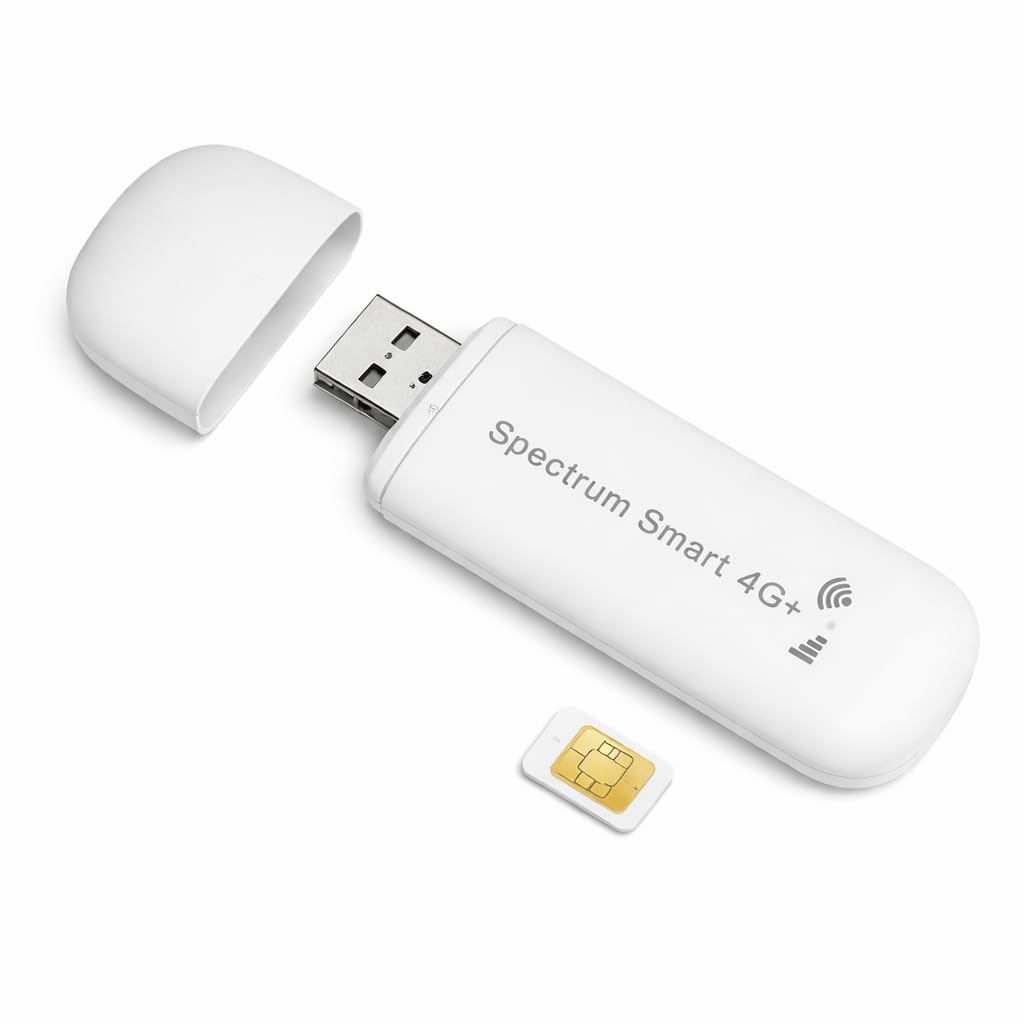
2. Spectrum Smart 4G LTE USB WiFi Dongle
A USB dongle with the SIM already included, so you plug in and get Wi-Fi on AT&T or T-Mobile.
Travelers and remote workers get the simplest possible setup here: the SIM is included, so you are not hunting for a card or a data plan before you can get online. Plug it into a laptop, a wall adapter, a car charger, or a power bank, and it creates a personal Wi-Fi network in seconds with no software to install.
It works on both AT&T and T-Mobile and automatically grabs the stronger signal — genuine double-carrier backup in one small device. Speeds reach up to 150 Mbps, and it connects as many as 10 devices at once, which covers a family or a small crew. The performance and portability are what buyers single out most.
The catch is the data economics. The included SIM start on a paid plan, and the value-for-money side is genuinely split — the device is convenient, but the recurring data cost is where people push back. Treat this as a travel and backup tool, not a budget replacement for home broadband.
Small and honest: at 1.25″L x 0.3″W x 3.75″H it slips into a pocket, and the internal antenna handles weak-signal areas better than its tiny frame suggests.
The real trade-off: no data plan is free — the SIM gets you connected, but the monthly cost is the number to weigh against a home line.
Best fit: a traveler who wants plug-and-play internet with a SIM already in the box.
Look elsewhere if: you want a fixed home network with Ethernet ports and heavy device support.
3. NETGEAR Mobile WiFi Hotspot AC797-100NAS 4G LTE Router
A battery-powered hotspot rated for 400 Mbps — faster than the 150 Mbps Cat 4 routers here.
The AC797 delivers up to 400 Mbps downloads — notably faster than the 150 Mbps the Cudy LT500 and Spectrum Smart dongle are rated for, so it leads those picks on raw cellular throughput. It is a GSM-open up device built for AT&T and other GSM carriers, and it creates a secure Wi-Fi network (WLAN) wherever you are, whether that is a hotel room, a job site, or a spot with no home DSL.
A 2930 mAh rechargeable battery runs up to 11 hours on a charge, which means you can carry it all day without hunting for an outlet. It connects up to 15 devices, enough for a small team or a family sharing one connection. The build quality holds up well and the device simply works as intended.
What to know before you commit: this is a renewed unit, and it is locked to GSM carriers, so it will not serve a Verizon-only household. Battery life is also the split point — some find it fine, others wish it lasted longer on heavy days.
Speed that shows: 400 Mbps is the headline, and it is why this beats the entry-level cellular routers for streaming and file transfers.
Carrier caution: confirm your provider is GSM before ordering — this is built for the AT&T side of the market.
Pick this if: you want a fast, self-powered hotspot for travel and fieldwork on a GSM carrier.
Pass if: you are locked to a CDMA carrier or you need a fixed router with Ethernet ports.
4. TUOSHI AC1200 WiFi 5 open up 4G LTE Modem Router, LT16S

Band coverage is this router’s strong suit — a long list of LTE frequencies aimed at AT&T and T-Mobile.
The LT16S supports an unusually broad set of LTE bands (B2, B3, B4, B5, B7, B8, B12, B13, B17, B25, B26, B66, B41) plus WCDMA bands, which gives it more chances of locking onto a usable signal with those two carriers. Cellular download runs up to 150 Mbps on Cat 4, with dual-band Wi-Fi reaching 1167 Mbps for streaming and file sharing.
You get four Ethernet ports, a standard SIM slot, and plug-and-play access — insert a local SIM and you are online without configuration. The web interface makes management straightforward, and WPA3 encryption plus OpenVPN, PPTP, and L2TP keep the connection private. It is built as a failover solution for cabins, remote offices, and holiday homes where fixed broadband falls through.
Be realistic about the connectivity side, though. Some setups connect flawlessly with an AT&T SIM and hit excellent speeds, while others never get online or see downloads of 0.1–0.5 Mbps — this is a router that lives or dies on your specific SIM and location.
Band-hunting edge: the broad frequency list is a real advantage when you are in an area where one band is strong and others are not.
The honest limit: connection success is genuinely split, so buy with a return path in mind.
Worth a look if: you are on AT&T or T-Mobile and want the most band options in a mid-range router.
Better to skip if: you need guaranteed connection from the start without any troubleshooting.
5. GL.iNet GL-X750V2 (Spitz) 4G LTE VPN Router, OpenWrt

An OpenWrt router with OpenVPN and WireGuard pre-installed for buyers who want to add their own firmware plug-ins.
This is the pick for the technical buyer. It ships with OpenWrt/LEDE pre-installed, meaning the firmware is open up and extendable through a software repository — you can add functions, not just accept the factory menu. It is AT&T certified for IoT data plans and works with both AT&T and T-Mobile. Build quality is the thing everybody raves about, and it is genuinely easy to set up for a device this configurable.
The hardware backs it up: 128MB RAM, 16MB NOR Flash, a TF slot supporting up to 128GB, USB 2.0, dual Ethernet ports (10/100M), and two SMA antennas. OpenVPN and WireGuard come pre-installed and it works with 30+ VPN providers, so every connected device runs behind an encrypted tunnel. Wi-Fi splits into 300 Mbps on 2.4 GHz and 433 Mbps on 5 GHz.
Speed is the honest caveat. Average 4G runs about 15–20 Mbps depending on carrier and location, and a few users hit limited LTE performance in weaker spots. Network compatibility is also the most finicky part — some AT&T setups need extra attention. It covers the US, Canada, and Mexico only.
Why tinkerers love it
- OpenWrt firmware with a huge plug-in library for custom setups
- Pre-installed OpenVPN and WireGuard with 30+ provider support
- Micro SD slot up to 128GB plus USB 2.0 for extra storage
- Compact at 86 g, easy to mount in an RV or cabin
What to weigh first
- Average 4G is roughly 15–20 Mbps — not a fast-lane device
- North America only, and some AT&T users report setup friction
For the hands-on crowd: buy it if you want open firmware, VPN routing, and storage in a compact LTE router.
Not for plug-and-plug users: if you want zero configuration and top speeds, look up the list instead.
6. GL.iNet GL-X2000 Spitz Plus Router
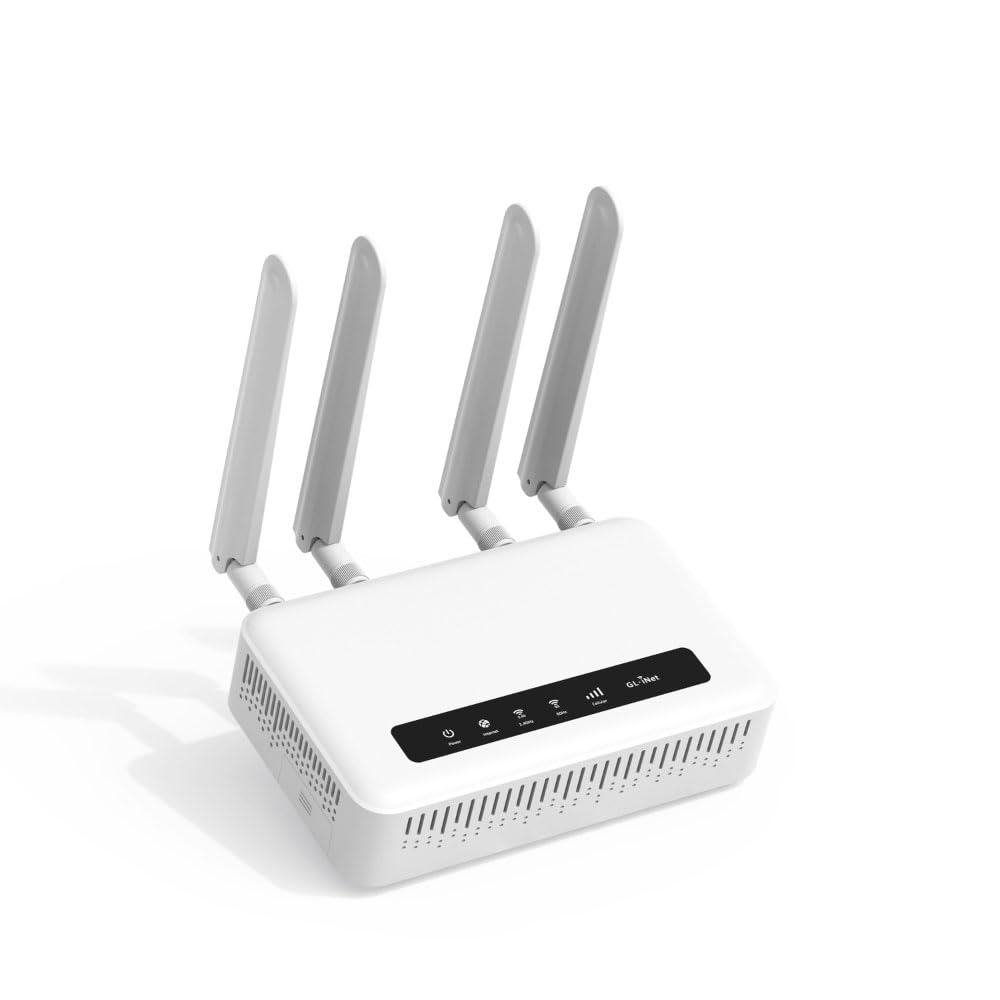
Two SIM slots with automatic failover, so a second carrier keeps you online when the first drops.
Two SIM slots with single standby is the feature that makes this router stand out — you can load two carriers and let it switch to whichever signal is stronger or faster, with network failover configurable between multiple connection methods. For a home or shop where internet cannot go down, that redundancy is the point.
The radio side is modern: Wi-Fi 6 pushes 574 Mbps on 2.4 GHz and 2402 Mbps on 5 GHz, and Cat 12 LTE on the cellular side uses three-carrier aggregation (3CA) to combine bandwidth for better coverage and speed. Multi-WAN lets you blend Ethernet, repeater, cellular, and tethering, with load-balancing you can proportion by hand. Both AT&T and T-Mobile are certified.
Reliability is what puts this over the line — it performs consistently and the feature set is packed. VPN tunnelling runs OpenVPN at up to 30 Mbps and WireGuard at up to 190 Mbps, though those figures are lab tests and real-world throughput depends on your setup. This is North America only.
Redundancy by design: the dual-SIM failover is the reason to pay up here — no single carrier outage takes you down.
Know the limit: it is a 4G Cat 12 router, not 5G, and it is sold for the North American market.
Choose it if: uptime matters and you want two carriers plus multi-WAN in one box.
Keep looking if: you need 5G speeds or you are outside North America.
7. NETGEAR Nighthawk M6 Pro 5G Mobile Hotspot (MR6500)

A pocket 5G hotspot with a 2.5G Ethernet port and 32-device support, though carrier fit is hit-or-miss.
On paper this is the most capable portable here: 5G mmWave and Sub-6 support, a Qualcomm SD X65 chipset, AXE3600 Wi-Fi rated at 2.9 Gbps on 5 GHz/6 GHz and 700 Mbps on 2.4 GHz, a 2.5G Ethernet port, and support for up to 32 devices. The 2.8″ color touch LCD makes setup and status checks straightforward.
In practice, carrier compatibility is the make-or-break. It is an AT&T open up version that works well with T-Mobile for many users, but plenty report it will not work with Verizon — and the locking mechanism has been a real sore point, with some units showing as locked on AT&T networks. Confirm your carrier and open up status before committing.
The other honest issue is battery. The 5040 mAh cell draws down quickly under heavy use, and some units stop charging. This is a renewed device, so check the condition and warranty. When the carrier aligns, it is a fast, full-featured hotspot; when it does not, it is the wrong tool.
What it does well
- 5G mmWave and Sub-6 plus Wi-Fi 6E (AXE3600) for top-tier throughput
- 2.5G Ethernet port and 32-device support for serious sharing
- 2.8″ touch LCD and Qualcomm SD X65 chipset
Where it can bite
- Carrier fit is mixed — solid on T-Mobile, unreliable on Verizon for many
- Battery drains fast; some units fail to charge
- Locking issues reported on some AT&T units
Ideal for: a traveler on T-Mobile or AT&T who wants max 5G speed in a portable hotspot.
Avoid if: you are on Verizon or you need a device that reliably stays open up.
8. GL.iNet GL-X3000 (Spitz AX) 5G Router for House & RV

An RV-ready 5G gateway with six detachable antennas and dual SIM slots for locking onto a distant tower.
For RV owners and rural setups, the Spitz AX is engineered around signal. Six detachable antennas and dual SIM slots let you place the hardware for the best reception and switch carriers on automatic failover — exactly what you need when the tower is miles away. It handles both NSA and SA 5G standards and is AT&T and T-Mobile certified.
Wi-Fi 6 delivers 574 Mbps on 2.4 GHz and 2402 Mbps on 5 GHz, and multi-WAN blends Ethernet, repeater, cellular, and tethering with load-balancing. OpenWrt v21.02 firmware opens more than 5,000 plug-ins for customization, and OpenVPN and WireGuard are pre-installed supporting 30+ providers. There is also support for GL.iNet’s physical eSIM card (sold separately) for switching operators abroad.
The effectiveness here is what gets people talking — it performs as a genuine gateway, not a toy. But reliability is the split point: some units run for the long haul, others stop working after a few months, and T-Mobile 5G connection failures come up. Buy knowing the return window matters.
Signal-first design: the six-antenna flexibility beats fixed-antenna routers when you are parked somewhere weak.
Real reliability note: a minority report units that quit within months, so test thoroughly on arrival.
The right call for: RVers and rural users who need 5G, dual SIM, and antenna freedom.
Not the right call for: a simple home user who wants no setup and a guaranteed five-year device.
9. Cudy P5 5G AX3000 Router

The highest device ceiling here at 256 clients, with dual Nano SIM slots and 5G Rel. 16 rated to 3.4 Gbps.
For a large household or a busy small office, capacity is the deciding spec, and the P5 wins that race. It handles up to 256 devices (with 100 as the recommended working limit), well above the 128 the Cudy LT500 tops out at. 5G Rel. 16 with 4CA and 4×4 MIMO pushes cellular downloads up to 3.4 Gbps, and Wi-Fi 6 delivers 2402 Mbps on 5 GHz and 574 Mbps on 2.4 GHz.
Two Nano SIM slots give carrier flexibility, and four detachable cellular antennas improve placement. On the wired side there are four Gigabit Ethernet ports including a configurable WAN/LAN, and OFDMA, MU-MIMO, and BSS Color keep a crowded network organized. VPN support covers WireGuard, OpenVPN, IPsec, ZeroTier, PPTP, and L2TP, with the Cudy app for cloud management.
Performance is solid — wired ports hit near-perfect gigabit speeds and Wi-Fi range is good. Reliability is the honest caveat: most units keep running, but some stop working, and a few users hit compatibility trouble on Verizon. Nothing here is cheap, so make sure the 5G coverage in your area justifies it.
Capacity leader: 256 devices is the largest ceiling in this group — the pick for crowded, high-demand networks.
The trade: it is the priciest option here, and 5G speeds only pay off if your local towers support them.
Perfect for: large homes and small offices with heavy device counts and good 5G coverage.
Overkill if: you run a few devices on a modest connection and want a simpler router.
Know the Specs
LTE Category (Cat 4 vs Cat 12)
The LTE category tells you the top cellular speed a modem can reach. Cat 4 devices like the Cudy LT500 and TUOSHI LT16S cap around 150 Mbps — fine for calls, browsing, and streaming. Cat 12 and 5G hardware push far higher, but only when the tower and the signal cooperate. A higher category is not automatically better if your coverage is weak.
SIM Slot Type and Dual-SIM
Most modems here take a Nano SIM, the smallest card size, though some use micro SIM. A dual-SIM slot lets you load two carriers and fail over automatically, which is what the GL.iNet GL-X2000 and GL-X3000 do. If you travel between networks or cannot afford downtime, dual-SIM is worth having.
Carrier Certification
A modem is only as good as its carrier support. Verify the device names your provider and its bands before buying. Devices certified for AT&T and T-Mobile work well on those networks but may refuse Verizon entirely. This single check prevents most returns in this category.
Connected Device Ceiling
The maximum device count is the number of phones, laptops, and smart-home gadgets that can share the connection. A solo traveler is fine with a small number; a family streaming on several screens needs headroom. The Cudy P5’s 256 ceiling and the Cudy LT500’s 128 lead this group.
Common Questions
Will a SIM card modem work with any carrier?
What is the difference between a SIM modem and a Wi-Fi hotspot?
Do I need a separate data plan for these devices?
Can a SIM card modem replace home broadband?
What is the difference between Cat 4 and 5G?
How many devices can these modems connect at once?
What kind of SIM card do these take?
Can I use a SIM card modem while traveling internationally?
Do these devices support VPN connections?
Why do some users report slow download speeds?
The Bottom Line
For most people, the best SIM Card Modem is the Cudy LT500 — a full router with four Ethernet ports, a 128-device ceiling, and a setup that runs in minutes, as long as your carrier is compatible. If you want portable 5G speed, the NETGEAR Nighthawk M6 Pro is the fast-lane choice on T-Mobile or AT&T. And for RV and rural deployments where uptime and antenna placement matter most, the GL.iNet GL-X3000 is built for exactly that job. Whichever you pick, verify your carrier first — that single step saves you from most returns in this category.
How we choose
We do not accept paid placement. Every pick is matched to a real buyer and a real use-case; we do not hands-on test units.
Sources
Specifications: manufacturer listings and product documentation. Review insights: verified customer reviews, as of November 2026. Pricing: not shown on this page (it changes often); check the current price via the retailer link.
As an Amazon Associate, Tactical Gear Guy earns from qualifying purchases. This does not affect which products we feature.