Specs are compiled from manufacturer listings and verified buyer reviews and can change over time — please confirm the key details on the product page before buying.
Buying a battery for a truck that uses side-post terminals is mostly a fit problem, not a power problem. The wrong box leaves your cables stretched to the wrong corner or forces you to run an adapter. Every battery below is a true side-terminal unit, so the cables land where your truck expects them. The other job is cold cranking amps — the punch a battery delivers on a freezing morning.
This guide is built by comparing the manufacturers’ published specifications and the patterns across verified customer reviews, so you get each pick’s real strengths and trade-offs instead of marketing spin.
You will see which side-post battery suits a daily driver, which one handles accessories, and which suits a truck that sits in the cold. Here is how each short side mount truck battery earns its spot under the hood.
Top Picks
How To Choose The Best Short Side Mount Truck Battery
A side-post battery sits in a tray where the positive and negative cables bolt onto threaded side receptacles instead of clamping on top. That shape is what makes the fit tricky. Two batteries can have identical power figures and still be useless to you if the terminals land on the wrong end for your truck’s cable length. Start with the fit, then match the power.
Confirm the group size and terminal layout first
Group size is a standard footprint code — Group 78 and Group 34/78 are the common ones for trucks that use side terminals. Even inside the same group, the positive and negative posts can sit on opposite corners. Reach under your hood and check which side each cable comes from before you order. The three Interstate and Optima batteries here are Group 78 side-post units; the Odyssey is a Group 34/78 with both top posts and threaded side receptacles.
Read cold cranking amps against your climate
Cold cranking amps (CCA) measure the current a battery can deliver for 30 seconds at 0°F while staying above 7.2 volts — in plain terms, how hard it can crank a cold engine. A warmer-climate truck gets by on less. A diesel or a rig that sits outside in a real winter wants the higher figure. The picks here range from 740 to 850 CCA, which is enough headroom for most gas trucks and plenty for accessory-heavy builds.
Reserve capacity tells you how long you can coast on battery alone
Reserve capacity (RC) is counted in minutes — how long the battery can keep the truck’s electronics alive if the alternator stops charging. A higher number buys you time to reach a shop instead of a tow. If you run a winch, a fridge, or a lot of plug-in gear, that margin matters more than the sticker power rating.
Check the warranty and the return path
Battery warranties here run from 36 months up to a 10-year claim depending on the model. Read what the coverage actually replaces. Also confirm whether the seller takes the old battery back — some listings build a core charge into the deal, and shipping a dead battery back is not something you want to discover after the fact.
Side-by-Side Comparison
| Model | Best For | Cold Cranking Amps | Reserve Capacity | Terminal Layout | Amazon |
|---|---|---|---|---|---|
| Interstate Batteries MTX-78 (Group 78 AGM)★ Best Overall | Everyday truck starting | 740 CCA | 115 minutes | Side Post | Amazon |
| OPTIMA 78 REDTOP Sealed AGM | Fast, vibration-heavy installs | 800 CCA | 100 minutes | GM Style Side Terminals | Amazon |
| Interstate MTZ-78 (Group 78 AGM) | Accessory-heavy trucks | 800 CCA | — | Side Post | Amazon |
| Odyssey ODX-AGM34 Extreme Series | Cold climates and heavy draws | 850 CCA | 134 minutes | Group 34/78 top posts + 3/8 inch threaded side receptacles | Amazon |
Detailed Reviews
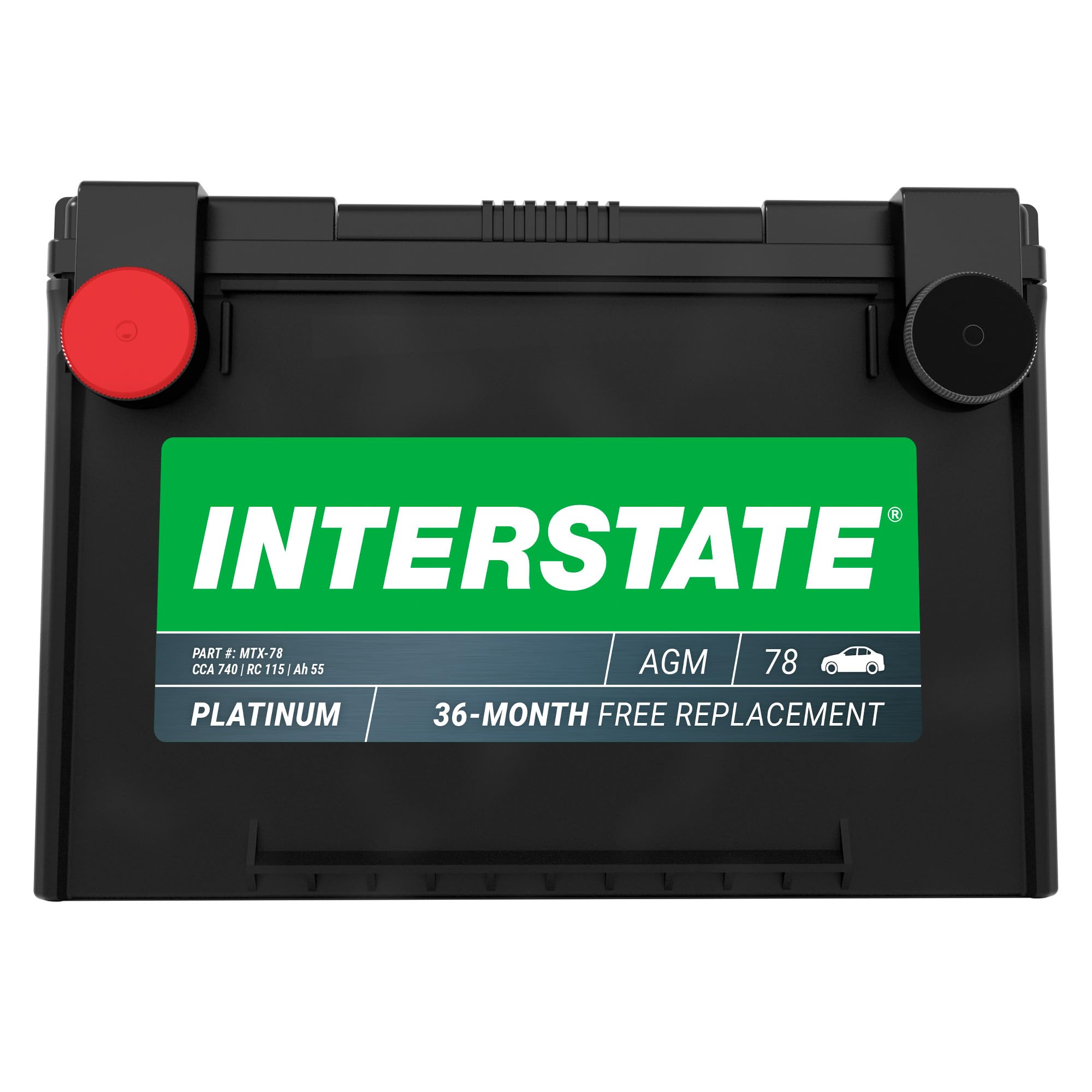
1. Interstate Batteries 55Ah Group 78 AGM
Our pick — 4.5+★ from 450+ verified ratings; the strongest balance of quality and price.
A Group 78 side-post AGM that drops in and cranks a cold truck on the first turn.
The number that matters here is 740 cold cranking amps — the punch that turns a cold engine over in one shot. That is paired with 115 minutes of reserve capacity, which is the longest backup window of the Group 78 picks in this list. It is a Group 78 side-post AGM (absorbed glass-mat — a spill-proof design that handles accessory drain better than a flooded battery), so your existing cables bolt straight on. Interstate lists coverage for 2,000+ year, make and model applications, and the 36-month warranty covers early failures.
Fit is the reason this takes the top spot rather than raw power. The Group 78 footprint and side-post terminals drop into a long list of trucks, vans and SUVs, and an AGM design means the battery holds up under the constant drain of phone chargers, GPS units and plug-in gear. The 55Ah capacity keeps a stock truck’s electronics fed without asking you to rewire anything. This is the pick for the owner who wants to swap the old battery out, bolt the cables on, and drive.
The trade-off is cycle life. The 100-cycle rating at 80% depth of discharge marks it as a starting battery, not a deep-cycle bank — draining it flat repeatedly will shorten its service. Treat it as an engine starter with light accessory duty and it will do its job well. Skip it only if you need a battery for a camper or winch rig run down to nothing regularly.
A fit that lands first time
- Group 78 side-post layout drops straight into most trucks with short cable runs
- 115 minutes of reserve capacity is the largest buffer in the Group 78 group
- 36-month warranty backs the early-failure window
- 55Ah capacity feeds chargers, GPS and plug-ins without a rewire
Where it asks for care
- The 100-cycle rating at 80% depth of discharge is a starting battery’s limit, not a deep-cycle spec
- Accessory-heavy trucks that drain the battery flat will shorten its life
Grab this one when: you want a side-post Group 78 battery that goes in cleanly and starts an everyday truck without drama.
Think twice if: you plan to run a winch or drain the battery flat regularly — that cycle figure will bite.
2. OPTIMA 78 REDTOP AGM Battery

Vibration-proof spiral design that spins a cold engine over every time.
At 39.5 pounds this is the lightest battery in the roundup — about 10 pounds lighter than the Odyssey and 5.8 pounds lighter than the Interstate MTZ-78, which makes a driveway swap easier when you are hauling it into place. It puts out 800 cold cranking amps with GM-style side terminals, so cables land on the correct corners of a Group 78 tray. Underneath, SpiralCell construction with 99.99% pure lead is built to shrug off the road vibration that shortens a standard flooded battery’s life.
The reserve capacity is 100 minutes, which is 15 minutes under the Interstate MTX-78’s 115 — a real gap if you ever need to idle to a shop on battery power alone. The C20 rating is 50 AH. The design shines when the truck gets worked hard: the maker lists it as fifteen times more resistant to vibration than a standard flooded battery and rated for up to three times the life, so a lifted rig on rough roads gets a battery that flexes with the bumps. The side terminals also make for a quick install.
The honest limit is the reserve capacity and the AH figure — both trail the other Group 78 batteries here, so if you run a big stereo or a bank of lights at idle, this one gives you less breathing room. For a truck that needs reliable, vibration-tough starting more than long backup power, it is a fair trade.
The vibration case: SpiralCell construction and the up-to-three-times-life claim are aimed at trucks that see rough ground and constant shake, where a flat-plate battery wears out early.
The honest read: it is the lightest of the four and the strongest on vibration resistance, but its 100 minutes of reserve capacity and 50 AH put it behind the MTX-78 and Odyssey if accessory draw is your priority.
Reach for this if: your truck lives on rough roads or you want a lighter battery that shrugs off vibration and starts on the first turn.
Look elsewhere if: you need the longest reserve window for running lights and accessories at idle.
3. Interstate Batteries MTZ-78 AGM Battery

Built for the truck pulling more juice than a basic starter needs.
The MTZ line is rated for more than 10,000 starts at 5% depth of discharge and 400 cycles at 80% DOD, well above a flooded battery’s cycle count. It is a Group 78 side-post unit, so the cables land where your truck expects them.
The build targets trucks that carry accessories: the maker claims 3X the life of a flooded battery and 40% more cranking power, plus a service life the maker says is 2X a conventional lead-alloy AGM. For a work truck or an SUV loaded with plug-in gear, that extra capacity and cycling ability is the reason to pick it over the lighter, less capacious Optima. It bolts on with side-post terminals and its 800 CCA is up 60 over the Interstate MTX-78’s 740, enough headroom for a diesel start.
One caution comes straight from the maker: Amazon’s Confirmed Fit tool is not currently accurate for this battery, so check your terminal layout against the product’s Compatibility Fit Guide before ordering. More than one owner has found the terminals on the opposite end from the stock setup, which is fit-check territory, not a power problem. Line up your layout first and this is a strong accessory battery.
What the extra capacity buys
- 62Ah holds more stored energy than any other battery here for chargers and plug-ins
- 800 CCA starts a diesel or a cold engine with headroom
- 400 cycles at 80% depth of discharge handles deeper accessory draw
The fitment warning
- Terminal position may be reversed versus some stock layouts — verify it against the maker’s fit guide first
- Amazon’s Confirmed Fit tool is flagged by the maker as inaccurate for this model
Reach for this if: your truck runs a lot of plug-in gear and you want the highest amp-hour capacity in the group.
Measure first if: your stock battery’s terminals are on a specific end — confirm the layout before you order.
4. Odyssey Battery ODX-AGM34 Extreme Series AGM Battery

The heaviest hitter here — 850 cranking amps and the longest reserve.
Two numbers set this apart. For a truck that sits outside in a hard winter or runs a winch, that combination is the strongest backup window in the roundup. It weighs 49.5 pounds, the heaviest of the four, which tells you how much lead you are lifting into the tray.
The terminal setup is the key detail for a side-mount truck. This is a Group 34/78 unit with both SAE top posts and 3/8 inch threaded side receptacles, so you can run it as a side-post battery or use the top posts. The negative terminal sits on the right side, which you should check against your cable routing before the install. Buyers report reliable cranking in all temperatures, and the Extreme Series design targets cold-weather starting. There is a 3-year manufacturer warranty behind it.
Here is the honest catch: the price sits at the top of this list, and 49.5 pounds makes the install a two-hand lift with a lean. Also note it does not ship with a bottom adapter plate, so if your tray uses one, plan for that. If cold starts and long reserve are the priority and you can manage the weight, it is the most capable battery here.
The cold-climate argument: 850 CCA and 134 minutes of reserve are the highest figures in this roundup — the battery holds up when temperatures drop and the truck has been sitting.
The install reality: 49.5 pounds with no bottom adapter plate included makes this a heavier swap than the Optima’s 39.5, so budget the lift and check your tray mounts.
Reach for this if: you face real winters, run a winch or fridge, and want the largest cranking and reserve numbers on the page.
Look elsewhere if: you want the lightest possible swap or your tray needs a bottom adapter plate that is not in the box.
Know the Specs
Cold Cranking Amps (CCA)
CCA is the current a battery can push for 30 seconds at 0°F while staying above 7.2 volts — the plain-English version is how hard it can crank a frozen engine. Higher numbers give you more margin on a diesel or a truck that sits outside. The picks here run from 740 to 850 CCA. Match the figure to your climate and your engine size rather than buying the biggest number for its own sake.
Reserve Capacity (RC)
Reserve capacity is counted in minutes — how long the battery can keep the engine and electronics running if the alternator stops. A 134-minute figure, like the Odyssey here, gives you a longer coast to a shop than a 100-minute one. Owners who run winches, fridges or big lighting rigs care about this number more than raw starting punch.
Amp-Hour Capacity (Ah)
Amp-hours measure how much total energy the battery stores — think of it as the size of the fuel tank for your electronics. The Interstate MTZ-78’s 62Ah holds more than the Optima REDTOP’s 50 AH, which matters if you add chargers, a stereo or plug-in accessories. More Ah means more run time before the battery is drawn down.
Terminal Configuration
Side-post terminals are threaded receptacles on the side of the case, and the positive and negative posts must land on the same corners your cables reach. A Group 78 side-post unit fits a specific tray, while a Group 34/78 with both top posts and threaded side receptacles gives you two ways to connect. Always confirm which side the negative post sits on before you lift the old battery out.
Common Questions
Will a Group 78 side-post battery fit my truck?
What is the difference between a side-post and a top-post battery?
How many cold cranking amps do I need for a truck?
What does reserve capacity mean in minutes?
Is an AGM battery better than a flooded battery for a truck with accessories?
How long should a truck battery last?
Why would the terminals be on the wrong side for my vehicle?
Do these batteries ship with the hardware I need?
Can I use a Group 34/78 battery where a Group 78 was fitted?
The Bottom Line
For most side-post truck owners, the short side mount truck battery to pick is the Interstate MTX-78 — its Group 78 side-post fit, 740 CCA and 115-minute reserve cover everyday starting with the least fuss. If you want the most stored energy for chargers and plug-ins, grab the Interstate MTZ-78 and confirm the terminal layout first. And for cold starts and the largest reserve window, the Odyssey ODX-AGM34 is the one to reach for, provided you can handle the 49.5-pound lift.
How we choose
We do not accept paid placement. Every pick is matched to a real buyer and a real use-case; we do not hands-on test units.
Sources
Specifications: manufacturer listings and product documentation. Review insights: verified customer reviews, as of November 2026. Pricing: not shown on this page (it changes often); check the current price via the retailer link.
As an Amazon Associate, Tactical Gear Guy earns from qualifying purchases. This does not affect which products we feature.