Specs are compiled from manufacturer listings and verified buyer reviews and can change over time — please confirm the key details on the product page before buying.
Most people shopping for a sewing machine for clothes get sold stitch counts they will never use. Here is the short version: if you sew garments regularly, the Janome JW8100 is the strongest all-round choice. It feeds fabric evenly through cotton, knits and layered seams, and it comes with a hard cover, an extension table and 22 accessories in the box. If you are sewing your first hem on a budget, the Singer M1150 is the easier entry point. Below, you will see which machine fits which kind of sewing, and why the spec sheet alone will not tell you.
This guide is built by comparing the manufacturers’ published specifications and the patterns across verified customer reviews, so you get each pick’s real strengths and trade-offs instead of marketing spin.
A machine that puckers stretch jersey or stalls on a denim hem wastes fabric and time. The right pick depends on feed dog quality, bobbin access and throat space. This breakdown of the sewing machine for clothes covers stitch counts, feed systems and the real trade-offs buyers report.
Top Picks


How To Choose The Best Sewing Machine for Clothes
Clothes sewing puts different demands on a machine than quilting or crafts. You are constantly changing fabric weight — a cotton shirt, then a jersey neckline, then a denim waistband — and you need a machine that keeps its tension steady through all three. The features below are the ones that actually decide whether a garment machine works for you.
Feed dogs and stitch consistency
A feed dog is the set of toothed bars under the needle plate that pull fabric forward. More pieces in that set mean more contact points, which is what stops thin knits from shifting and thick seams from puckering. The Janome JW8100 uses a 7-piece feed dog system for exactly this reason. A single-piece feed can still sew straight seams, but it struggles on stretch material and layered hems.
Bobbin loading: drop-in versus front-loading
A drop-in bobbin sits under a clear top cover, so you can see the thread level and swap it without pulling the machine apart. A front-loading bobbin goes in through a side door, which some sewers find more secure for heavy thread. Both work; the drop-in style is faster to rethread and easier to monitor mid-seam.
Buttonholes for garment work
Shirts, dresses and trousers all need buttonholes, so pay attention to the buttonhole system. A one-step buttonhole clamps the button and sews the right size automatically in a single run. A four-step system asks you to move the dial through each stage. On a machine with 7 one-step buttonholes, as on the Janome JW8100, you can match the hole to the button quickly. On a four-step machine you still get consistent results, just with a bit more handling.
Throat space, extension tables and portable weight
Throat space is the gap between the needle and the machine’s right pillar. It determines whether a skirt panel or a finished sleeve will bunch up as you sew. An extension table widens that support area for larger projects. Portability runs the other way: a 5.5-pound machine with a carry handle moves easily to a class, while a 17-pound machine stays on the table. Decide which matters more before you buy: a 5.5-pound machine with a carry handle travels to class, while a 17-pound machine stays on the table.
Side-by-Side Comparison
| Model | Best For | Built-In Stitches | Buttonholes | Weight | Amazon |
|---|---|---|---|---|---|
| Janome JW8100★ Best Overall | All-round garment sewing | 100 | 7 one-step | 12 pounds | Amazon |
| Brother SM1400Best For Beginners | First-time hemming | 14 | 4-step | 12.8 pounds | Amazon |
| Janome 2212Best For Small Spaces | Straightforward mechanical sewing | 12 | 4-step | 14.9 pounds | Amazon |
| SINGER Heavy Duty 4523 | Thick fabric and denim | 23 | 1-step | 17 pounds | Amazon |
| Brother CP100X | Decorative and quilting work | 100 | 8 auto-size | 10.5 pounds | Amazon |
| SINGER 6700C | Lettering and variety | 411 stitch applications | 7 styles, 1-step | 14.6 pounds | Amazon |
| Bernette B35 | Sturdy mechanical build | 23 | 1-step | 7150 g | Amazon |
| Juki HZL-F600 | Quilting and embroidery detail | 255 | — | 30 pounds | Amazon |
| StitchMaster Pro | Portable and beginner-friendly | 14 | — | 5.5 pounds | Amazon |
Detailed Reviews
1. Janome JW8100 Fully-Featured Computerized Sewing Machine
Our pick — 4.5+★ from 950+ verified ratings; the strongest balance of quality and price.
The garment machine that feeds a knit jersey and a denim hem without changing its manners.
The Janome JW8100 earns this spot because it sews clothes, not just samples. Its 7-piece feed dog system grips fabric at seven points under the needle plate, so cotton shirting, stretch knits and layered seams all advance at the same even rate. That even seven-point grip is why seams stay straight and knits resist puckering. Set that against a 14-stitch machine and the gap is not 100 versus 14 in stitch count — it is 100 versus 14 in how much fabric control the machine gives you.
What wins people over is the build: a 12-pound metal frame that runs quietly through a full day of garment work. It is a heavy 12-pound machine with a metal frame, and it runs quietly through a full day of garment work. The ease of use is the second thing that keeps coming up — the built-in needle threader and jam-proof drop-in bobbin cut threading to minutes. — the built-in needle threader and jam-proof drop-in bobbin mean you spend minutes threading instead of half an hour. The 22 accessories in the box are a genuine head start: a zipper foot, a satin stitch foot, an automatic buttonhole foot, class 15 bobbins, an assorted needle set and a seam ripper all ship with it. Then there is the hard cover and the extra-wide extension table, which give a full skirt panel somewhere to rest.
The honest catch sits in the electronics. Some units have stopped working early, and the durability picture is genuinely split — plenty of sewers say this is their forever machine, and a minority hit a fault in the first month. Buy from a seller with a clean return path and you are covered either way. The other thing to know: at 7 inches deep, this is a table machine, not something you carry to a class.
Where It Earns Its Place
- 7-piece feed dog system keeps knits and layered seams from shifting or puckering
- 100 built-in stitches and 7 one-step buttonholes cover shirts, dresses and repairs
- Hard cover, extra-wide extension table, even feed foot and ¼” quilting foot all included
- Built-in threader, needle up/down control and jam-proof drop-in bobbin cut setup time
What To Weigh Before Buying
- Durability is the split issue — most machines last years, but some fail within the first month
- At 12 pounds with a 16-inch width, it lives on a table rather than travelling to classes
Reach for this if: you sew garments regularly and want one machine that handles cotton, knits and heavier seams without a second purchase.
Think twice if: you need to pack the machine into a bag each week — the 12-pound frame and hard cover are built to stay put.
2. Brother SM1400 14-Stitch Sewing Machine
Fourteen stitches, four feet and a lit work area — a first machine that does not overpromise.
Here is the cleanest way to see it: the Brother SM1400 measures 6″D x 12.3″W x 15.4″H, while the SINGER M1150 comes in at 16.14″D x 12.6″W x 5.91″H. Read that as a footprint trade-off. The Brother stands taller and takes far less depth on a table, so it tucks against a wall where the Singer wants a wider surface. At 12.8 pounds it is a full-sized machine rather than a portable one, which is what you want if it is going to live on a desk and sew hems and seams all evening.
The 14 stitches cover the garment basics well — blind hems, stretch stitches and a four-step auto-size buttonhole. Four feet ship in the box: zigzag, zipper, buttonhole and button sewing, which is the exact set you need for a dress hem, an invisible zip and a shirt placket. The brightly lit LED work area is a small thing that matters more at 10pm than it does in a showroom.
The honest limit is needle handling. Needles smash and break on this machine far more often than on the Janome, and thread occasionally gets stuck in the tension path. Most of that traces back to setup rather than the machine — get the bobbin seated correctly and the tension dial squared away, and it sews well above expectations. It is a strong beginner machine; it is not a machine that forgives a rushed setup.
How it fits a first garment: the four-step buttonhole and four included feet cover a shirt front, a hem and a zip without extra purchases.
The habit it rewards: check the needle and thread path before every session — that is where nearly every reported break starts.
Pick it when: you want a full-sized machine on a narrow desk and your sewing is hems, repairs and simple garments.
Pass if: you want to sew heavy canvas out of the gate — buy a metal-framed heavy-duty model instead.
3. SINGER M1150 Sewing Machine
Twelve stitches, dial controls and a front-loading bobbin — no screen, no menus, no learning curve.
Twelve dial-selected stitches beat a long menu you never open. The Janome 2212 carries 12 built-in stitches with a four-step buttonhole, selected by a dial pattern control with separate stitch width and length adjustment. Every setting is a physical dial you can see and turn. For garment sewing that tactile layout is genuinely faster than tapping through an LCD — you glance at the dial, not a screen.
The mechanical details are what make it sew clothes rather than crafts. A 5-piece feed dog pulls fabric through evenly, and the drop feed lets you lower those teeth for free-motion work. The free arm exposes the narrow cylinder for cuffs, sleeve hems and small openings. Two retractable vertical spool pins handle twin-needle work, and a push-pull bobbin winder and extra high presser foot lift make the routine steps quicker. It weighs 14.9 pounds, so it sits still while you work.
Those extra stitches on the Brother CP100X are not what you are buying here. What you are buying is a machine that turns on and sews, with a front-loading vertical oscillating hook bobbin that threads from the side. The occasional top thread break and the rare motor failure are the trade-off that comes with any mechanical build at this level.
The case for dials: no menus, no mode buttons and no accidental setting changes between the shirt front and the sleeve seam.
Worth knowing: the free arm and drop feed give it range well past the 12 stitches it advertises.
Suits you if: you want your settings visible and physical rather than buried in a screen.
Not the pick for: sewers who lean on dozens of decorative stitches or lettering work.
4. SINGER Heavy Duty 4523 Next Evolution Sewing Machine
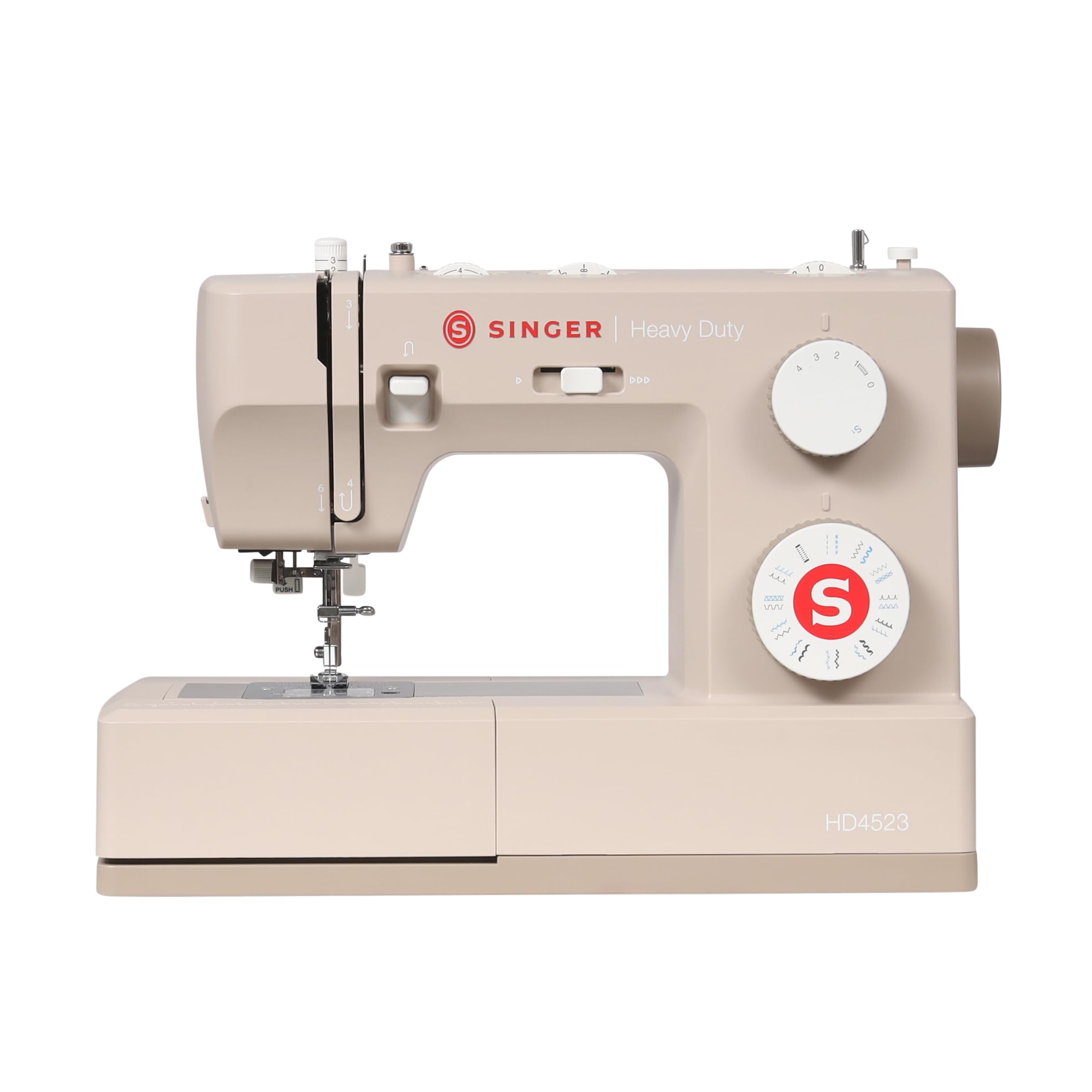
A 1,000-stitch-per-minute machine with a DC motor built for a denim waistband and a canvas bag.
The 4523 throws 23 built-in stitches and 97 stitch applications at garment work, but the real number here is 1,000 stitches per minute. That speed, driven by a DC motor through a full metal interior frame, is what lets you get through a long trouser hem without the machine labouring over the seam. A metal frame also keeps the needle steady when it bites into several layers, and that is where lightweight machines bend and skip.
Speed is only useful if you can control it, so SINGER added a speed control dial that caps the maximum — turn it down for a curve at the armhole or a detail at the cuff. The stainless steel bedplate lets fabric glide, and rubberized dial grips give you something to hold onto when you change settings. A large sewing space gives bigger panels somewhere to go. There is a one-step buttonhole for plackets, an integrated needle threader, and a top drop-in bobbin under a clear cover.
The one caveat is heft. Reliability stories run both ways on this machine — most love it as a workhorse, and a smaller group gets a unit that never behaves. It weighs 17 pounds and some sewers expect more mass for a machine badged heavy duty. Buy it for the motor and the speed, and it holds up. The Eco Mode that kills the light after 15 idle minutes is a neat touch, and pressing the pedal brings it right back.
The Strong Side Of The Ledger
- Sews up to 1,000 stitches per minute, so long hems finish in one pass
- DC motor and full metal interior frame power through layered denim and canvas
- Speed control dial lets you slow it for curves, corners and small sections
- Drop feed, free arm and adjustable presser foot pressure open up quilting and cuff work
What To Measure First
- 17 pounds on the table — plan a permanent spot for it
- Some units arrive unreliable, so keep the return window open until it has sewn a few real seams
Built for: anyone whose clothes sewing involves denim, canvas or several layers of fabric.
Stay with a lighter machine if: most of your work is thin cotton and jersey at a slow pace.
5. Brother CP100X Computerized Sewing and Quilting Machine

One hundred stitches, eight auto-size buttonholes and ten presser feet — a full garment workshop in one box.
The CP100X matches the Janome JW8100 at 100 built-in stitches, then pushes ahead on buttonholes: eight auto-size options against seven. That matters for shirt-making, because a placket, a cuff and a collar stand each want a different hole size. Select the slot, drop the button in, and it sizes itself. The 1-step automatic needle threader is described by owners as notably reliable at pushing thread through the eye, and the fixed needle bar keeps the needle from wandering mid-stitch for cleaner lines.
The accessory load is the differentiator. Ten feet come in the box — zigzag, buttonhole, zipper, button sewing, overcasting, blind stitch, monogramming, ¼-inch piecing, walking and quilting — plus a quilt guide, a wide table and a protective hard case. Most machines charge extra for the walking foot alone. At 10.5 pounds it is the lightest of the full-sized machines here, and the metal frame lets it take thick denim and heavy quilts when asked.
Where it wobbles is stitch quality on tricky setups. Some sewers get loose stitches, usually a tension or needle issue rather than a machine fault, and the lighter frame means it is less planted than a 16-pound machine at high speed. It also runs on 120 volts only — the warranty depends on US use.
Why the accessories matter: the walking foot and wide table alone can push a separate purchase past the price of this machine.
Check before you commit: if you plan to move it often, 10.5 pounds is a real advantage; if you sew at full speed on heavy layers, a heavier frame feels steadier.
The right call for: shirt-makers and quilters who want every foot included without buying add-ons.
Not the strongest fit if: you only ever sew straight cotton seams and never touch the extras.
6. SINGER 6700C Machine

The machine that treats a garment as a canvas — 411 stitch applications and a lettering font on tap.
For anyone personalising clothes, the 6700C is the one to look at hard. It carries 411 stitch applications, a lettering font and 7 styles of one-step buttonhole, all selected through an LCD screen with touch buttons. That is not the same job as a 14-stitch machine: it lets you monogram a shirt cuff, sew a decorative hem on a dress and match a buttonhole style to the garment, all on one machine.
Under the hood it is a heavy-duty build with a strong motor for thick fabric and multiple layers. It handles denim, leather and heavy quilting layers without complaint, and the speed control caps the top end so you can slow down for a delicate neckline. Ten presser feet ship in the kit, including an even feed / walking foot, an open toe foot and a cording foot, plus four bobbins, a seam ripper, needles and a soft dust cover.
Here is the honest part. Quality and durability get split reports — some machines run for years, others stop unexpectedly within weeks. The manual also arrives missing for some buyers, which is worth knowing if you are relying on written instructions rather than the free Creativate app. None of that makes it a bad machine; it makes the return policy worth reading.
What earns the space: 411 stitch applications and a lettering font turn a garment into a personalised piece without adding a second machine.
The realistic caveat: a missing manual and occasional early faults mean you should keep your paperwork close for the first month.
Choose it if: decorative stitching, monogramming and a wide buttonhole menu are the reason you are buying.
Choose something plainer if: you want a no-menu machine and will never use the lettering.
7. Bernette B35 Sewing Machine with 23 Stitches

A sturdy mechanical machine with seven presser feet and a one-step buttonhole, built like it expects to be used.
Bernette is the mechanical side of the Bernina house, and the B35 is the machine in this list for a sewer who trusts feel over screens. Every control is manual — stitch selection is a dial, thread tension is a knob you set by fabric type, and stitch length and width are adjusted by hand. That layout means no hidden menus and no firmware surprises, and for a lot of garment sewers it is the reason to buy.
The spec sheet is solid for garment work: 23 stitches covering utility and decorative options, a one-step automatic buttonhole that sizes itself in a single run, a drop-in bobbin, a built-in needle threader and a manual thread cutter. Seven presser feet come with it, along with bobbins, a spool winder and an extension table for larger projects. An LED light sits over the workspace, and the strong feed system holds even stitching on both thin textiles and thicker materials.
The trade-off is weight and the finer details. At 7150 g the machine is on the heavy side for its “portable” badge, and the needle threader is the recurring weak point — it works on most units but not all. It also lacks the stitch count of the computerised options above, so if you want 100 stitches or lettering, look elsewhere.
What the dials buy you: direct, tactile control with nothing between your hand and the stitch settings.
Where it gives up ground: 23 stitches is a trim menu beside the computerised models, and the threader deserves a careful first check.
Reach for it if: you prefer a mechanical machine with real torque and no screen to fail.
Look elsewhere if: you want the widest stitch menu or lightest carry weight.
8. Juki HZL-F600 Computerized Sewing and Quilting Machine

Two hundred and fifty-five stitches and even, quiet running — the finishing machine for serious garment work.
The Juki HZL-F600 is the premium benchmark in this list for stitch quality above all else. It carries 255 built-in stitches spanning basic, stretch, decorative, lettering and buttonhole sets, and selects them by a stitch selector switch shown on an LCD screen. Press a button, see the selection, sew. Simple as that — and that directness is what makes it comfortable for both beginners and advanced sewers working on detailed garment construction.
what separates it day to day is the way it runs. Stitch quality is the standout attribute, with the machine producing even, consistent stitches, and it runs quietly enough for a shared room. Owners mention that the automatic needle threader pushes thread through easily, and the machine is jam resistant, so the setup routine is quick and calm. The build is all metal, and the accessory tray keeps everything together, with a soft-sided dust cover included.
The reality check is scale. This is a 30-pound machine built to sit on a dedicated table, not to move between rooms. And at 255 stitches it has more range than a basic garment sewer will use — you are paying for the stitch quality and the quiet, steady running, not the count.
What you are paying for: even, quiet, consistently beautiful stitches and a threader that works — the parts you feel every single seam.
What you accept: 30 pounds on a permanent table, and a stitch menu that goes far past basic garment work.
Pitch-perfect for: sewers who judge a machine by the stitch it lays down and will keep it set up permanently.
Think again if: you need portability or mainly sew simple cotton hems at a basic level.
9. StitchMaster Pro Sewing Machine
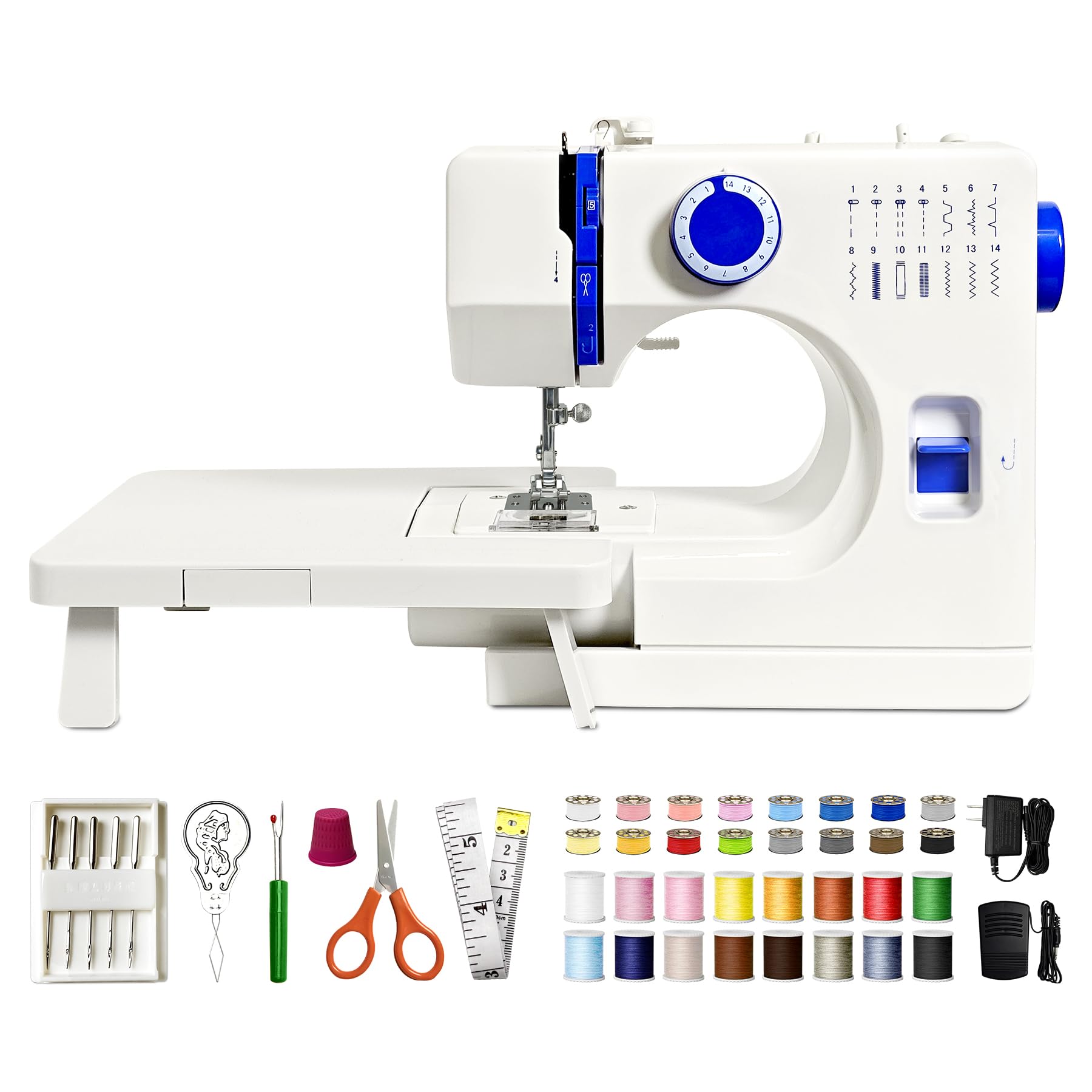
A 5.5-pound machine with a carry handle that treats a dorm room and a craft fair the same way.
The StitchMaster Pro is the portable option in this group, and the weight comparison makes it plain: 5.5 pounds here against 12.8 pounds on the Brother SM1400. Lift both and the difference settles it — this one goes in a bag with a handle and travels. That makes it the machine for a first-timer, a young sewer, or anyone who sews away from home. Twin and double needle work is supported too, which is unusual at this size.
Fourteen stitches cover straight, zigzag and blindstitch work, and dual-speed control lets you slow it down for delicate fabric and speed it up for denim. Two control modes mean you can use the foot pedal for a traditional feel, or the one-touch button for a young sewer just learning to control the needle without a pedal. Colour-coded threading guides and auto tension adjustment cut the setup to minutes. Dual power works from an AC/DC adapter or batteries, and the 10-foot power cord reaches across a room. Twelve thread spools, six needles, scissors, measuring tape and a seam ripper are in the box.
The honest fit is the size. The compact footprint that makes it portable is the same reason the sewing area feels small, and the build is lighter-duty than the metal-framed machines above. Against the Janome JW8100 at 100 stitches it is a narrower machine aimed at a narrower purpose.
Where it shines: 5.5 pounds, a built-in carry handle and battery operation make it a genuinely travel-ready machine.
The size reality: a small sewing bed means bigger projects are awkward — treat it as a learner and repair machine.
Reach for it when: portability, a low entry point and quick learning are the priorities.
skip it if: you plan to sew full skirts, layers and long runs — you will want more bed space and more heft.
Know the Specs
Feed Dog Pieces
Feed dogs are the toothed bars under the needle plate that pull fabric forward. More pieces in that set grip the fabric at more points, which keeps thin knits and layered seams moving evenly instead of shifting. A 7-piece system, as on the Janome JW8100, is a real advantage on stretch material.
Stitches vs Stitch Applications
A built-in stitch is a pattern the machine can physically produce. A stitch application is that same pattern used at a different length or width for a different job — so 16 stitches can become 45 applications. Compare machines on built-in patterns, then treat applications as a bonus.
Buttonhole Steps
A one-step buttonhole clamps the button and sews the correct hole in a single automatic run. A four-step system asks you to turn the dial through each stage. Both produce consistent buttonholes; one-step simply takes less handling, which matters if you sew plackets often.
Bobbin Loading
A top drop-in bobbin sits under a clear cover so you can watch the thread level and swap it fast. A front-loading bobbin goes in through a side door and threads from the side. Drop-in is quicker day to day; front-loading is favoured by some sewers for heavier thread.
Common Questions
How many stitches do I really need to sew clothes?
Can these machines sew stretch knit fabric without puckering?
What is the difference between a drop-in bobbin and a front-loading bobbin?
Will a portable machine handle denim and thick seams?
Do I need an extension table for sewing clothes?
How often should I change the needle on a clothes sewing machine?
Is a mechanical or computerized machine better for garment sewing?
Can I sew buttonholes on any of these machines?
How much table space does one of these machines need?
Do these machines come with the feet I need for zips and hems?
The Bottom Line
For most people sewing clothes, the machine to buy is the Janome JW8100. It wins on the thing garments actually demand: a 7-piece feed dog system (the toothed bars that pull fabric through) that keeps cotton, knits and layered seams moving evenly. It pairs that with 100 stitches, 7 one-step buttonholes, a hard cover and an extension table in the box. If your projects start with denim and canvas, go with the SINGER Heavy Duty 4523 and its 1,000-stitch-per-minute motor. And if you are learning in a small space, the SINGER M1150 folds away and threads up fast enough to make practice easy.
One last nudge before you decide: the Janome JW8100’s 4.5+ star score across 850+ ratings makes it the safest single bet on this list for garment work, but every pick here is a machine someone happily sews on. Match the machine to your fabric, your table and your patience for setup, and you will not regret the choice.
How we choose
We do not accept paid placement. Every pick is matched to a real buyer and a real use-case; we do not hands-on test units.
Sources
Specifications: manufacturer listings and product documentation. Review insights: verified customer reviews, as of November 2026. Pricing: not shown on this page (it changes often); check the current price via the retailer link.
As an Amazon Associate, Tactical Gear Guy earns from qualifying purchases. This does not affect which products we feature.