Specs are compiled from manufacturer listings and verified buyer reviews and can change over time — please confirm the key details on the product page before buying.
If your basement bathroom drains into a basin instead of a gravity sewer line, the pump inside that basin is the only thing standing between you and a flooded floor. A sewage pump tank is a basin that holds wastewater and a pump that lifts it up and away on its own. The four systems below all do that job, and each suits a different home. For most people with a basement bathroom and a standard vertical lift, the Liberty Pumps P372LE51 is the pick that keeps coming up — 4.0+ stars from 100+ owners, made in the United States.
This guide is built by comparing the manufacturers’ published specifications and the patterns across verified customer reviews, so you get each pick’s real strengths and trade-offs instead of marketing spin.
Below you get four complete kits, not bare pumps, so you can compare basin size, horsepower, and lift height side by side. The goal is simple: match the pump’s maximum lift height to your measured vertical rise so waste clears the sewer tie-in every time. That is exactly how this comparison of the best septic pump tank options helps you size a basin and pump that keep the floor dry.
Top Picks

How To Choose The Best Septic Pump Tank
Buying one of these is really a sizing job, not a brand job. Get the lift and the basin right and the pump runs quietly in the background for years. Get them wrong and the float switch trips the high-water alarm on a Sunday night.
Start with vertical lift, not horsepower
Maximum lifting height is the tallest distance the pump can push waste upward, measured in feet. It is the number that decides whether your basement toilet actually reaches the sewer line. A pump with a 24-foot ceiling and a pump with a 45-foot ceiling can look similar on the box, but only one may clear a tall rise. Measure from the bottom of your basin to the point where the discharge pipe ties in, then pick a pump with headroom above that figure.
Match the basin to your pit and your traffic
The basin is the tank that collects the waste before the pump fires. A larger basin holds more between cycles, so the pump starts less often. These kits range from an 18-inch by 30-inch basin up to a 21-inch by 31.5-inch basin. Check the hole cut in your floor before you buy, because a basin that will not fit the opening is a return shipment waiting to happen.
Decide if you need a grinder blade
A grinder pump chews solids into a fine slurry before pushing them through the discharge pipe. That lets it move waste through a smaller pipe and up a much taller lift. Standard sewage pumps pass solids whole, which suits a straightforward basement bathroom. If your discharge run is long, narrow, or climbs high, the grinder is the safer design.
Check the float switch and discharge size
The float switch is the sensor that turns the pump on when the water rises and off when it drops. Tethered and piggyback float styles mount differently, and the switch on your old pit may not match a new basin’s lid holes. The discharge is the pipe the waste leaves through, sized in inches. A 2-inch discharge is the common standard across all four kits here, so check your existing plumbing before you commit.
Side-by-Side Comparison
| Model | Best For | Horsepower | Max Lift | Weight | Amazon |
|---|---|---|---|---|---|
| Liberty Pumps P372LE51★ Best Overall | Everyday basement bathroom | 0.5 hp | 24 feet | 67 pounds | Amazon |
| VEVOR Sewage Grinder System | Long, high, narrow runs | 1 hp | 45 feet | 53.1 pounds | Amazon |
| Red Lion RL-WCS50TA | Tight pit openings | 0.5 hp | 22 feet | 46.6 pounds | Amazon |
| Little Giant WCR-9SS | Outdoor seepage collection | 0.4 hp | 20 feet | 69 pounds | Amazon |
Detailed Reviews
1. Liberty Pumps P372LE51 Sewage Pump System
Our pick — 4.0+★ from 100+ verified ratings; the strongest balance of quality and price.
The made-in-America workhorse that handles a standard basement bathroom without drama.
This is the pick for the homeowner who has a basement toilet and shower draining into a pit and needs a complete kit that drops in. You get the 21-inch by 30-inch basin, a 0.5 hp pump, and a 2-inch discharge — the common plumbing size, so it ties into typical existing pipework. Maximum lifting height is 24 feet, which covers a normal basement depth with room to spare. The pump body is cast iron and stainless steel, the materials that hold up to wastewater year after year.
What wins people over is the build quality — it is the thing owners bring up more than anything else, and the consensus reads as a system that simply works. Switching it out is quick work too, which matters if you are replacing a failed unit rather than installing fresh. That ease of replacement is the practical reason this kit suits an existing pit so well. It is also the one pick here with a United States country of origin stamped on it, which some buyers specifically want for a permanent home fixture.
Here is the catch worth knowing before you order. At 67 pounds, this basin kit is heavy, and the 24-foot lift ceiling is real — if your discharge line climbs higher than that, you need a stronger pump, not this one. The comparison to the VEVOR above is blunt: 0.5 hp and 24 feet versus 1 hp and 45 feet. For an ordinary basement bathroom that gap is headroom you will never touch. For a tall or long run, it is not enough.
Where this kit earns its keep
- Complete kit with the 21″ x 30″ basin included, so there is no separate tank to source
- 24-foot maximum lifting height clears a typical basement rise
- Cast iron and stainless steel pump body built for wastewater duty
- Quick to swap out of an existing pit
Where it runs out of road
- 24-foot lift ceiling is the lowest headroom among the picks that suit basement work
- 67 pounds makes the install a two-person job
Reach for this if: you have a standard-depth basement bathroom and want one box that covers the whole install.
Think twice if: your discharge needs to climb past 24 feet — step up to the grinder pick instead.
2. VEVOR Sewage Grinder System 1 HP
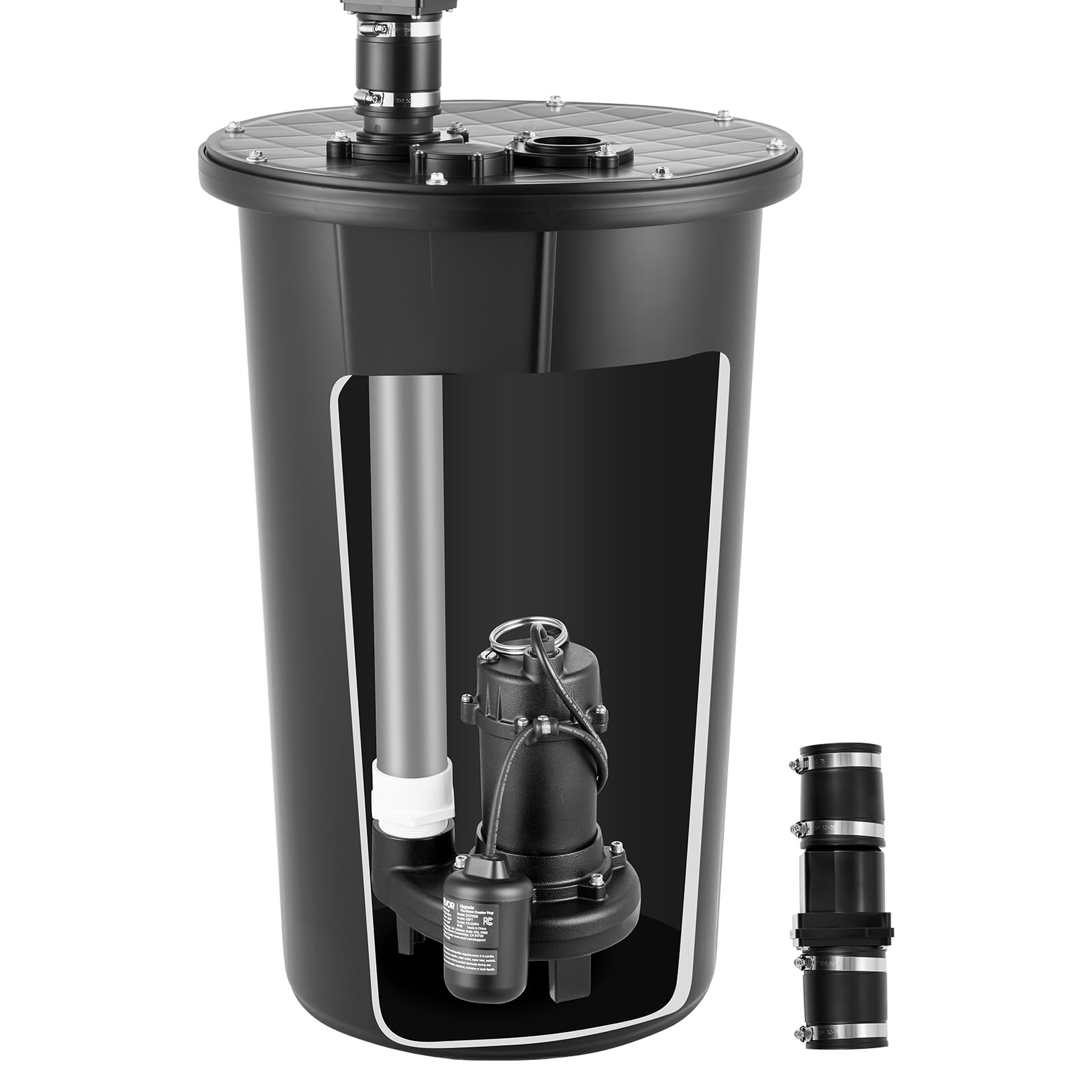
When the waste has to climb 45 feet, this grinder is the only one in the group built for it.
If your discharge line runs high, long, or narrow, a standard sewage pump taps out. This VEVOR kit pushes 1 hp through a grinding blade that chews solids down before sending them up a 45-foot maximum lifting height. That single figure is why it exists on this list. The Liberty Pumps above stops at 24 feet; this one nearly doubles that, so a deep basement or a long lateral run stops being a problem.
Flow rate is 85 gpm — gallons per minute, the volume it moves in open conditions — which is slightly behind the Little Giant’s 100 gpm. That is the honest arithmetic of a grinder: it trades raw open-flow volume for the ability to lift far higher. The basin measures 21.26 inches by 31.5 inches, the largest footprint here, so confirm your pit opening before ordering. The 2-inch discharge matches the standard plumbing size, and a float switch runs the cycle automatically.
The build is cast iron with a 120V motor, and it arrives complete with an accessory kit and manual. At 53.1 pounds it is the lightest full system in the lineup, which genuinely helps on installation day. This one is newer to the market with the smallest review base of the four, so it has less owner history to lean on. If you need the lift, though, the specification is the argument — no other kit here reaches 45 feet.
The spec that decides it: 45 feet of lifting height and a grinding blade turn a difficult discharge run into a routine install, and the 1 hp motor carries the load.
The honest trade: you give up the long track record the Liberty and Little Giant carry, and the 85 gpm flow trails the Little Giant’s 100 gpm — a fair swap for far more lift.
Best matched to: any home where the discharge must climb high or push through a narrow pipe.
Less suited to: a shallow basement where 24 feet is already plenty — you would be paying for lift you never use.
3. Red Lion RL-WCS50TA Automatic Sewage System

The lighter, narrower basin kit that slides into a tighter pit than the rest.
Pit openings vary, and an 18-inch by 30-inch basin — tapering to 15.75 inches — is the one that squeezes into tighter floor holes. That is the practical reason this Red Lion earns a spot. At 46.6 pounds it is the lightest system here, so one strong pair of hands can manage it, unlike the 69-pound Little Giant or the 67-pound Liberty. The pump itself is a 1/2 hp cast iron unit moving 5600 GPH at a 0-ft. lift, with a 22-foot maximum lifting height.
You can install it without hunting for extra parts, because the box holds a genuinely complete kit: the pump, the 18-inch by 30-inch polypropylene basin and lid, a 2-inch plastic check valve (a one-way valve that stops water flowing back), a 2-inch by 28.25-inch schedule 80 PVC discharge pipe (thicker-walled pipe built for pressure), plus grommets and fittings. The float is a tethered piggy-back switch (a float on a cord that rides the water level and flips the pump on and off), and it turns on at 17.5 inches and off at 7.5 inches, so the cycle points are fixed and predictable. That complete-parts list is why it suits a fresh basement bathroom build rather than a bare pump swap.
The 22-foot lift ceiling is the second-highest here but still well short of the VEVOR’s 45 feet, so a tall run rules it out. Red Lion backs it with a 2-year manufacturer warranty. Assembly is required, and the lid comes pre-cut with one 3-inch, one 2.5-inch, and one 4-inch hole to match your vent and discharge layout. Read that hole pattern against your plumbing before you buy, because it is the detail that trips people up.
Why the smaller basin wins: an 18-inch footprint and a 46.6-pound total make this the easiest of the four to wrestle into a tight basement pit, and the 5600 GPH rating keeps up with normal household flow.
What to check first: that pre-cut lid hole pattern and the 22-foot lift ceiling — both need to line up with your actual plumbing or the kit becomes a return.
Pick this one when: your pit opening is snug and you are building a basement bathroom from scratch with the full parts list.
Skip the fit check never: confirm the discharge climbs under 22 feet and the lid holes match your vents before ordering.
4. Little Giant WCR-9SS Automatic System

A steel-lidded seepage system built to sit outdoors and keep a low spot dry.
This one is aimed squarely at outdoor water and seepage collection, and the kit reflects that. The 20-inch by 30-inch polyethylene basin wears a steel lid and an epoxy-coated cast iron cover and housing, so it stands up to weather a polypropylene lid may not. The pump inside is a 4/10 hp continuous-duty model with a thermally protected motor, CSA listed in the USA and Canada. It moves up to 2-inch solids and pushes 100 gpm — the highest flow rate of any pick here.
Where the Little Giant earns its keep is basin size. The 20-inch by 30-inch footprint is the thing owners single out most, and the pump does the job of clearing standing water reliably. The discharge delivers 6000 GPH at a 5-ft. lift with a 20-ft. shut-off and 8.7 PSI, so it moves a lot of water at modest heights. A 20-foot piggyback float switch runs the cycle, switching on between 9 and 14 inches and off between 2 and 6 inches. Little Giant gives you a 3-year manufacturer warranty, the longest coverage here.
Now the honest part. At 69 pounds this is the heaviest system on the list, and 20 feet is the lowest maximum lifting height of the four. That combination means it is built for outdoor seepage and low-lift work, not a deep basement that needs waste pushed high. The 0.4 hp motor is also the smallest here. If your job is a high basement lift, the VEVOR’s 1 hp and 45 feet is the pair to look at instead.
My read: the steel lid, the 100 gpm flow, and the 3-year warranty make this a strong outdoor seepage choice. The 20-foot lift ceiling and 69-pound weight are the reasons to pass if your job is a deep basement instead.
The right tool for: outdoor water collection and low-lift seepage where a steel lid and long warranty matter.
Not the fit for: a deep basement that needs waste lifted high — 20 feet will not clear it.
Know the Specs
Maximum lifting height (feet)
This is the tallest vertical distance the pump can push waste, measured in feet. It is the spec that decides whether your basement waste reaches the sewer line. Our picks range from 20 feet up to 45 feet. Measure from the bottom of your basin to where the discharge ties in, then choose a pump with headroom above that number. A pump rated a few feet above your actual lift runs less strained and lasts longer.
Flow rate (GPH and gpm)
Flow rate is how much water the pump moves in a given time — GPH means gallons per hour, gpm means gallons per minute. Notice that a pump can be rated at a high GPH at 0-ft. lift and lower at 5-ft. lift, because pushing higher always costs volume. Compare flow at the lift height you actually need, not the best-case 0-ft. number. Our picks range from 85 gpm to 100 gpm.
Horsepower (hp)
Horsepower measures the motor’s output. A 1/2 hp pump suits a normal basement bathroom, while a 1 hp grinder carries the grunt for a long or high run. Horsepower alone does not tell the story — a well-matched 0.5 hp pump at low lift can outperform a larger one at a lift it struggles with. Match horsepower to the job, not to the biggest number on the box.
Basin size (inches) and basin material
The basin is the holding tank that collects waste before the pump fires. Its diameter and height in inches decide how well it fits your floor opening and how much it holds between cycles. Materials vary too: polypropylene and polyethylene basins are common, and some kits top the basin with a steel lid. Check both the footprint and the material against your install location.
Common Questions
How do I know what lifting height my basement needs?
Do I need a grinder pump or a standard sewage pump?
Will a 2-inch discharge fit my existing plumbing?
How often should the pump cycle on and off?
Can I install a septic pump tank myself?
What is the difference between GPH at 0-ft. lift and at 5-ft. lift?
How much does the weight of these systems matter?
Is a polypropylene basin worse than one with a steel lid?
How long is the warranty on these systems?
Can these pumps handle solids like toilet waste?
The Bottom Line
For most basements, the septic pump tank winner is the Liberty Pumps P372LE51 — a complete 21-inch by 30-inch kit with a 24-foot lift and a cast iron body that owners trust. If your discharge climbs high or runs narrow, grab the VEVOR Sewage Grinder System and its 45-foot lifting height with a grinding blade. For a snug pit opening and a from-scratch build, the Red Lion RL-WCS50TA is the one to reach for, and the Little Giant WCR-9SS suits outdoor seepage with its steel lid and 3-year warranty.
Whichever you pick, measure your vertical lift and your pit opening diameter before you order — those two numbers decide fit more than any brand badge. The Liberty earns its top slot on build quality and a United States origin, and it is the safest bet for an ordinary basement bathroom upgrade.
How we choose
We do not accept paid placement. Every pick is matched to a real buyer and a real use-case; we do not hands-on test units.
Sources
Specifications: manufacturer listings and product documentation. Review insights: verified customer reviews, as of November 2026. Pricing: not shown on this page (it changes often); check the current price via the retailer link.
As an Amazon Associate, Tactical Gear Guy earns from qualifying purchases. This does not affect which products we feature.