Specs are compiled from manufacturer listings and verified buyer reviews and can change over time — please confirm the key details on the product page before buying.
Your fuel gauge should tell you the truth every time you turn the key, and when it stops, the fix is almost always the sending unit inside the tank. This guide ranks nine real replacements by how well they actually fit, ohm out, and survive fuel, so you can match the right unit to your boat, truck, or classic car. The short answer up front: the Geloo 240-33 ohm stainless unit is the safest all-round pick, the 100TECH reed-switch sender is the most durable design, and the vehicle-specific units (A-Premium, Vphix, TRQ, Spectra Premium) only belong in the exact applications they name.
This guide is built by comparing the manufacturers’ published specifications and the patterns across verified customer reviews, so you get each pick’s real strengths and trade-offs instead of marketing spin.
Before you buy, the three numbers that decide everything are the ohm range, the sender length, and the mounting pattern — get one wrong and the gauge reads empty on a full tank. Below you’ll find those specs side by side, plus an explanation of what each one means in plain English so you can order once and install once.
Top Picks


How To Choose The Best Sending Unit for Gas Tank
A fuel level sending unit is a float-and-resistor device that bolts into the top of your tank and reports how much fuel is left to your dash gauge. The single most common mistake buyers make is ordering by length alone and ignoring the ohm range — a perfectly sized sender wired to the wrong gauge will peg the needle at full or empty and never move. Match all three numbers below before anything else.
Match the ohm range to your gauge first
The ohm range is the electrical resistance the sender reports at empty and at full, and it must match your gauge’s expected range or the needle reads wrong. Most of the units here use 240-33 ohms (240 ohms at empty, 33 ohms at full), a common American standard on boats, older trucks, and aftermarket gauges. The Bosch SP0F000013 also publishes a mid-point of 130 ohms at half tank, which tells you how the gauge will move between the two ends. If your existing gauge expects a different range, these units will not read correctly for you.
Measure your tank depth, then subtract an inch
The sender must hang down near the tank floor without touching it, so measure your tank’s outside depth and order a unit about an inch shorter, which is the guidance both the 100TECH and Sucicago units publish. The Geloo comes in lengths from 150 mm up to 500 mm, so you can match a wide range of tanks with one brand. Skipping this step is how you end up with a float that bottoms out and a gauge that sticks at empty.
Confirm the mounting pattern and float size
Most universal senders use the SAE 5-hole pattern (a standard five-bolt ring layout), but the hole spacing is not always equidistant, so check yours before drilling. The float diameter is another hidden gotcha: the 100TECH and Sucicago floats measure 1.38 inches (35 mm), and if you’re cutting a fresh hole, a 1.50 inch (38 mm) opening is the recommended size. Vehicle-specific units like the A-Premium, Vphix, TRQ, and Spectra Premium bypass all this by matching a named list of cars and trucks exactly.
Side-by-Side Comparison
| Model | Best For | Ohm Range | Length | Mount / Type | Amazon |
|---|---|---|---|---|---|
| Geloo 240-33 Stainless Steel Sender★ Best Overall | All-round universal pick | 240-33 ohms | 325 mm (many sizes) | SAE 5-hole, stainless | Amazon |
| Dorman 55818 Universal KitBest Value | Old tractors and adjustable tanks | 240 empty / 33 full | 16.54 in | Universal, adjustable | Amazon |
| Bosch SP0F000013Best for Deep Tanks | Bosch gauges, deep tanks | 240 / 130 / 33 ohms | 16.5 in | Panel mount, brass | Amazon |
| Sucicago Boat 240-33 Ohm (250 mm) | Boats that bounce on waves | 240-33 ohms | 250 mm | SAE 5-hole, IP67, stainless | Amazon |
| 100TECH 240-33 Ohm (280 mm) | Durability, no moving parts | 240-33 ohms | 280 mm | SAE 5-hole, reed switch | Amazon |
| A-Premium Fuel Tank Sending Unit | Named GM cars and trucks | — | — | Vehicle specific, rear | Amazon |
| Vphix 692-155 FG73A | 1973-1984 Ford trucks | — | — | Rear mount, 19 gal tank | Amazon |
| TRQ Rear Fuel Tank Sending Unit | Ford trucks, DIY video help | — | — | Rear mount, 19 gal tank | Amazon |
| Spectra Premium FG110B | OE-matched classic fit | — | — | Screw terminals | Amazon |
Detailed Reviews
1. Geloo 240-33 ohms Fuel Sending Unit
Our pick — 4.5+★ from 200+ verified ratings; the strongest balance of quality and price.
The sender that drops into almost any tank the first time, in fourteen lengths.
Buy this one if you want a straightforward swap and you don’t know your exact tank depth yet. The Geloo is made from SUS316 stainless steel — a marine-grade alloy that resists corrosion in fuel and water — and it covers fourteen lengths from 150 mm up to 500 mm, so you can order the size your tank actually needs instead of shimming something close. That size range is the reason it wins the top spot: most universal senders give you one length and hope.
The signal is the standard 240-33 ohms (240 at empty, 33 at full), which matches the common American fuel and water gauge wiring, and the body is a direct replacement for the older arm-type sender. It’s rated for operating temperatures of -40°C to +85°C, so it won’t drift in cold or heat. The kit includes the gasket and mounting screws, and the two-wire hookup is spelled out: blue goes to negative, brown goes to the gauge signal. With the gasket, screws, and labeled two-wire hookup in the box, install is nearly plug-and-play.
What wins people over is reliability — the thing owners bring up more than anything else about this unit, which is exactly what you want from a part you bury inside a fuel tank. The one honest catch is accuracy: it draws mixed feedback there, so a few buyers find the needle doesn’t track perfectly across the whole sweep. If your gauge is fussy about precise mid-range readings, a reed-switch design may suit you better. Note that at 325 mm this version sits between the shorter 250 mm boat sender and the longer units, so double-check your depth measurement.
Where It Delivers
- Fourteen length options from 150 mm to 500 mm cover a huge range of tanks
- SUS316 stainless steel resists corrosion in fuel and water
- 240-33 ohm output matches common fuel and water gauges
- Ships with gasket, screws, and clear two-wire instructions
What To Weigh
- Accuracy draws mixed feedback across the sweep
- This 325 mm version won’t suit very shallow tanks
- Universal fit still requires you to verify hole spacing
Reach for this if: you want one branded sender that fits your measured tank depth and a standard 240-33 gauge.
Look elsewhere if: you already own a Bosch-specific gauge or need a vehicle-specific drop-in for a named truck.
2. Dorman 55818 Universal Fuel Level Sending Unit Kit
The adjustable arm that molds itself around old tractor tanks and mixed-fleet repairs.
The Dorman 55818 is the one to grab when your tank isn’t a standard shape. It’s a universal sender with an adjustable arm, so you bend it to match the depth you find, and it reports 240 ohms empty and 33 ohms full to suit common gauges. Its measuring body runs 16.54 inches, which puts it within a hair of the Bosch SP0F000013 at 16.5 inches — practically the same reach, but with far more flexibility in how you mount it.
Where this kit earns its keep is old equipment. The functionality is the thing people praise most by a wide margin, and the reviews keep circling back to vintage tractors and tired machines where no factory part number still exists. Dorman backs it with a US-based product team and a long track record in automotive replacement parts. It restores a gauge that failed on internal sensor trouble, and it does the job for a fraction of what a dealership part would run.
Be honest about what “universal” costs you: fit, installation, and compatibility all draw a mix of opinions, so some buyers breeze through and others fight the arm into shape. If you’re a careful DIYer with a flexible tank, that’s a fair trade for the adjustability. If you want zero fiddling, a vehicle-specific unit is the cleaner path.
Dorman’s real selling point: an arm you can bend to fit oddball tanks, plus the widest real-world track record of any universal sender here.
The trade you make: universal fit means you do the tuning — budget an afternoon for the install rather than a ten-minute swap.
Your pick if: you’re reviving an old tractor or a nonstandard tank and can shape the arm yourself.
Pass it by if: you want a bolt-in replacement with zero adjustment on a modern vehicle.
3. Bosch SP0F000013 Fuel Level Sender with Gasket and Hardware
A brass-bodied sender built to reach down into tanks up to 26 inches deep.
If your tank is a deep one — up to 26 inches down — this Bosch unit is the one designed for the job, and it pairs with Bosch fuel level gauges. The brass body resists corrosion over the long haul. It publishes its full resistance curve rather than just the ends: 240 ohms empty, 130 ohms at half, and 33 ohms full, so you know exactly how the needle will behave between the two extremes. That three-point spec is more detail than most universal senders give you.
The kit is genuinely complete for installation — a gasket and mounting hardware come in the box — and setup is described as easy to test at the bench before it goes in the tank. Owners praise its functionality most of all, and buyers report it pairs cleanly with aftermarket dash gauges on older builds. The 16.5 inch length sits right alongside the Dorman at 16.54 inches, so the two are neck and neck on reach for a deep tank.
The recurring honest gripe here is durability: some units are reported to give out after a couple of weeks, which is a real risk on a part this buried. Fit and adjustability also split opinion — it’s said to struggle with irregular tank shapes and to need frequent adjustment. Treat those as the trade-offs of a sensor that prioritizes a detailed brass build over a bulletproof one, and buy confidently if your tank is regular and clean.
The precise-gauge draw: a published 240/130/33 ohm curve and a brass body make this a solid choice for regular-shaped, deep tanks paired with Bosch gauges.
The honest risk: durability is the weak spot — a minority of units fail early, so buy from a seller with easy returns and test it before you seal the tank.
Go with it if: you run a Bosch gauge and a deep, uniform tank that hangs up to 26 inches down.
Think twice if: your tank is irregular or shallow, where the adjustability complaints surface.
4. Sucicago Boat Fuel Tank Sending Unit 240-33 Ohm 10″ (250mm)

A reed-switch sender built so wave chop can’t send your gauge needle bouncing.
On open water, the gauge that flails around every time a wave hits is the problem this sender was built to solve. It uses a reed-switch design, which reports level without the swinging arm that constant motion throws off, so the reading holds steady when the boat rocks. The body is SUS316 stainless steel with an IP67 rating (that’s sealed against dust and able to survive brief immersion), and it works with 240-33 ohm gauges on boats, RVs, trucks, and diesel tanks. For calm-lake boaters this steady read is the main event.
This shorter 250 mm version is worth flagging next to the Geloo, which lists a 325 mm length — the Geloo reaches 75 mm deeper into the tank, so match your depth before you pick. Sucicago redesigned its sensing to be finer on short tanks: 10 mm resolution on 4-to-7 inch tanks and 21 mm resolution on 8-to-13 inch tanks, which is why it tracks fuel level more smoothly than a coarse arm design. It ships with an NBR gasket, five metric screws, and wiring instructions.
Crucially, you have to size it right: keep the sender about 1 inch shorter than a plastic tank’s depth and 0.5 inch shorter on metal, or it will hit the bottom. The float measures 1.38 inches (35 mm), and if you’re drilling fresh, a 1.50 inch (38 mm) hole is right. Sizing discipline is the entire ballgame for this one.
Built for you if: you’re replacing a sender on a boat or marine tank and want a needle that holds steady in chop.
Keep shopping if: you’re on a very deep tank — this 250 mm version won’t reach as far as the Geloo’s 325 mm.
5. 100TECH 240-33 Ohm Fuel Sending Unit

No moving parts to break, a Japanese reed switch, and a two-year warranty behind it.
Here’s the durability story in one line: this sender has no moving parts to wear out. It uses an OKI reed switch imported from Japan instead of the thick-film swinging-arm design, and 100TECH spells out why that matters — a sealed reed switch has no pivoting arm to wear as fuel sloshes. The body is heavy-duty 316 stainless steel, and it’s a direct replacement for the older arm-type sender. There’s no adjustment needed for the tank, either, which removes a whole step from the install.
The output is the standard 240-33 ohms, and it can drive either a fuel level gauge or a water level gauge on a boat or auto setup. It comes with a gasket, mounting screws, and illustrated instructions that walk the wiring. The float measures 1.38 inches (35 mm) with the same recommended 1.50 inch (38 mm) drill hole. And 100TECH backs it with a two-year limited warranty plus free lifetime technical support — longer coverage than most universal senders offer.
The trade-off is accuracy, which draws mixed feedback on this unit. Some buyers find the level readings very accurate with the holes lining up cleanly, while others report the gauge drifting or the hole spacing sitting uneven. If a perfectly linear gauge response across the full sweep matters more to you than long-term wear, weigh that. For most boaters the reed switch’s no-moving-parts build tips the balance. Measure from outside, top to bottom, and subtract 1 inch for the length — 100TECH makes that the headline instruction for a reason.
Why Owners Trust It
- Reed-switch design with no moving parts to wear out over time
- Two-year limited warranty and free lifetime tech support
- 316 stainless body with standard 240-33 ohm output
- Comes with gasket, screws, and illustrated instructions
The Fine Print
- Accuracy is mixed — some buyers see drifting readings
- Hole spacing complaints surface on a few units
- You must subtract an inch from your tank depth or the float bottoms out
My call: choose this when longevity matters most and you’re willing to verify hole spacing on arrival.
When to look on: if precise linear accuracy is your priority over a trouble-free mechanism.
6. A-Premium Fuel Tank Sending Unit

A rear-mount drop-in for a specific spread of late-’70s and ’80s GM cars.
This is a fitment-first part, not a universal one. The A-Premium unit is built for a named list of General Motors vehicles, from Buick Century and Regal to Chevrolet Malibu and Monte Carlo, Oldsmobile Cutlass variants, and Pontiac Bonneville, Grand Am, and Grand Prix — spanning roughly 1978 to 1988 depending on the model. It’s a rear-position unit with three outlets and cross-references to FG08A, 692-089, and 25001613, so you can match it against your original part number before you buy.
Where a universal sender makes you drill and bend, this one is meant to drop in as the factory part would. A-Premium includes a one-year unlimited-mileage guarantee, which is real coverage for a car that gets driven. If you’re restoring a Cutlass or a Monte Carlo and want the gauge to work like it did off the line, this removes the guesswork of matching a generic sender to a stamped-steel tank.
The obvious limit is that it fits only what it lists — buy it for anything outside that GM spread and you’re guessing. Check your vehicle’s year and tank against the fitment list first, and confirm the three-outlet layout matches your original. Do that, and it’s the least fussy path for a GM classic.
The GM-specific advantage: a rear-mount unit with OEM cross-reference numbers and a one-year unlimited-mileage guarantee, so the fit is engineered rather than improvised.
Fit check required: it covers only the named Buick, Chevy, Olds, and Pontiac applications — verify your year and outlets before ordering.
Order it if: your car is a listed ’78-88 GM model and you want an engineered drop-in.
Don’t if: you’re working on anything outside that GM list — a universal sender is the safer bet there.
7. Vphix 692-155 Fuel Tank Sending Unit
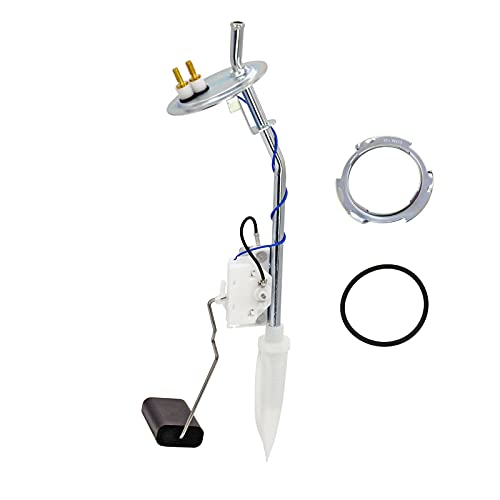
Purpose-built for the rear 19-gallon tank in Ford’s long-running F-Series.
Ford truck owners get their own dedicated part here, sized specifically for the rear-mounted 19-gallon tank. The Vphix 692-155 fits 1973-1983 F-100, 1975-1984 F-150, and 1973-1984 F-250 and F-350 gas trucks. It cross-references the factory numbers E0TZ9275A, SU601, 692-155, and FG73A, so you can confirm against your original before spending anything. That part-number match is the whole value of a vehicle-specific sender.
The kit doesn’t leave you hunting for seals: it includes the tank seal O-ring, lock ring, and sending unit together, which is more complete than many senders that ship bare. The fitting uses a barb connector and a tank-mount design. Buy it to avoid adapting a universal arm to a stamped factory tank and the fiddly sealing that always follows.
Two hard limits before you order: it does not fit the driver-side tank, and it is not for diesel. If your truck is a rear-tank gas F-Series in those years, this is the direct route. If you’re dual-tank or running diesel, look elsewhere — this one won’t cover you.
Matches up if: you’ve got a rear 19-gallon gas tank on a 1973-1984 Ford F-Series and want the O-ring and lock ring included.
Keep looking if: your tank is driver-side or you’re running diesel.
8. TRQ Rear Fuel Tank Sending Unit 19 Gal

The Ford sender that comes with a video showing you how to fit it.
Same Ford F-Series rear 19-gallon application as the Vphix, but the pitch here is support. TRQ runs a video library for its parts, so you can watch the replacement before you crawl under the truck — genuinely useful if you’ve never dropped a tank. The unit cross-references 692-155, PN4075, E0TZ9275-A, 4017002, E0TZ9275A, and FG73A, so it covers the same ’73-84 F-100, F-150, F-250, F-350 rear-tank gas trucks. It arrives pre-assembled as a direct replacement for the original, cutting out the fabrication a universal sender demands.
Quality is the thing that stands out about this one, and the fit is reported as exact — a straight swap rather than a fight. The connector is NPT (a standard threaded pipe fitting) and it handles either gasoline or diesel per its listing, so it’s a little broader in fueling than the Vphix unit that’s gas-only. TRQ has been in the direct-fit replacement business for a long stretch, and the limited lifetime warranty against material and workmanship defects covers you beyond the first year, excluding normal wear.
The caveat is to confirm fitment before you commit — use the vehicle-confirmation feature and check the compatibility chart, because a rear 19-gallon Ford tank is a specific thing. If you’re outside that application, neither this nor the Vphix will drop in.
what separates it: a video install library and a limited lifetime warranty make this the friendliest Ford-truck sender to fit for a first-timer.
Confirm first: it’s still the specific rear 19-gallon F-Series fitment — check your tank and year before you buy.
Pick it if: you want hand-holding on a Ford truck tank job and value the lifetime defect coverage.
Skip if: your truck falls outside the rear 19-gallon F-Series application.
9. Spectra Premium Classic Fuel Tank Sending Unit FG110B
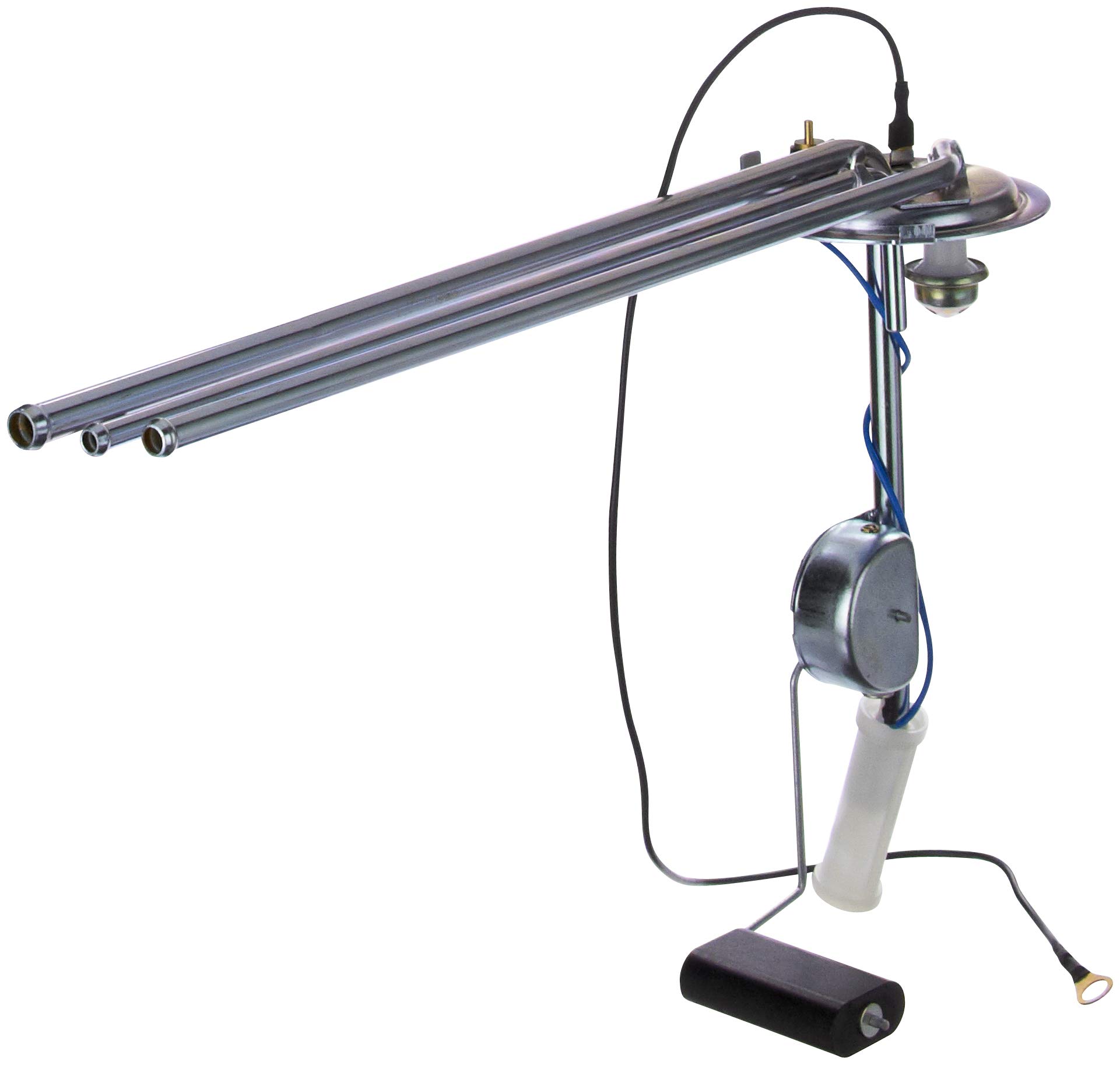
The classic-car pick that is designed to match the factory part exactly, screw for screw.
Spectra Premium builds this unit to meet or exceed the original equipment sender it replaces, and it says so directly: OE-matched electrical connections, a perfect-fit guarantee, and every fuel level sender tested before it ships. That 100 percent testing claim is why it sits at the top of the price range — it’s the premium bet for a restoration where you want the gauge to behave like it did from the factory. The connector uses screw terminals with copper contacts, a simple, serviceable hookup.
Where the universal senders ask you to adapt and adjust, this one is engineered as a direct fit, so a classic build keeps its original wiring layout rather than getting spliced into something improvised. If you’re restoring a vehicle and care about the gauge matching the dash rather than just moving, the factory-matched approach is the point.
The honest limit is that this is a classic-application part with a much shorter track record behind it — fewer buyers have fitted it, so you’re leaning on the maker’s fit guarantee and testing claim rather than a deep pile of owner experience. For a restoration where OE correctness matters, that’s the right trade. For a quick daily-driver fix, a universal sender gives you more flexibility for less.
Right for a restoration: pick it when matching the factory connections and tested quality matter more than saving on a generic unit.
The catch: it’s a classic-specific fitment with a thinner public track record, so confirm your application against the listing before ordering.
Know the Specs
Ohm Range (240-33 and What It Means)
The ohm range is the resistance the sender reports at empty and full, and it has to match your gauge or the needle reads backwards or not at all. The 240-33 ohm standard means 240 ohms at empty and 33 ohms at full, a layout common to American boats, older trucks, and aftermarket gauges. Some units, like the Bosch SP0F000013, also publish a mid-point such as 130 ohms at half tank, which tells you how evenly the needle will sweep between the ends. Always match the range to the gauge you already have.
Sender Length and Float Clearance
Sender length is how far the unit hangs into the tank, and getting it wrong is the most common install mistake. Measure your tank’s outside depth and order a sender about an inch shorter so the float never bottoms out — the 100TECH and Sucicago units both spell this out. Floats are commonly 1.38 inches (35 mm) across, and a 1.50 inch (38 mm) drill hole is the recommended opening if you’re cutting fresh. The Geloo’s spread of 150 mm to 500 mm lengths shows how wide the range can be across tanks.
Reed Switch Versus Swinging Arm
A swinging-arm sender uses a float on a pivoting arm that moves a resistor, while a reed-switch sender triggers sealed magnetic contacts as the float rises. In a tank that rocks — a boat on chop, a truck on rough ground — the arm can swing and send the needle bouncing, while a reed switch tends to hold a steadier read. The 100TECH and Sucicago units use reed switches and make that steadiness their main selling point. The trade-off some owners mention is uneven accuracy across the sweep, so weigh steadiness against precision.
Mounting Pattern and Vehicle-Specific Fit
Universal senders usually use the SAE 5-hole pattern, a standard five-bolt ring layout, but the hole spacing is not always equidistant, so verify yours before drilling. Vehicle-specific units skip the adaption entirely by matching a named list of cars and trucks and OE part numbers, which is why the A-Premium, Vphix, TRQ, and Spectra Premium units fit only their listed applications. If you have a factory part number, cross-reference it against the listing to confirm before you buy — it’s the single fastest way to avoid a return.
Common Questions
How do I know which ohm range my fuel gauge needs?
What length sending unit do I need for my tank?
Is a reed-switch sender better than a swinging-arm sender?
What is the SAE 5-hole mounting pattern and will it fit my tank?
Can I use a fuel sending unit for a water tank too?
Why does the float diameter matter when I’m drilling a new hole?
Will a universal sender fit an old tractor or odd-shaped tank?
How do I wire the sender correctly?
Do I need a vehicle-specific sender or a universal one?
Can a sending unit be tested before installation?
The Bottom Line
For most buyers, the sending unit for gas tank that earns the top spot is the Geloo 240-33 Stainless Steel Sender, because its fourteen lengths from 150 mm to 500 mm and standard 240-33 ohm output fit the widest spread of tanks — rated 4.5+ stars by 200+ owners. If you want a no-moving-parts reed switch and a two-year warranty, the 100TECH reed-switch sender is the one. For a Ford truck rear tank, grab the TRQ unit for the video install help, and for a GM classic, the A-Premium drop-in is the cleanest fit.
Match the ohm range, length, and mounting pattern to your tank before anything else, and the gauge will read accurately for years. The strongest all-round bet of the whole group is the Geloo — order it in your measured length and you’re set.
How we choose
We do not accept paid placement. Every pick is matched to a real buyer and a real use-case; we do not hands-on test units.
Sources
Specifications: manufacturer listings and product documentation. Review insights: verified customer reviews, as of November 2026. Pricing: not shown on this page (it changes often); check the current price via the retailer link.
As an Amazon Associate, Tactical Gear Guy earns from qualifying purchases. This does not affect which products we feature.