Specs are compiled from manufacturer listings and verified buyer reviews and can change over time — please confirm the key details on the product page before buying.
Picture walking through your screen door with a bag of groceries in each hand and hearing it swing shut behind you — no slam, no bounce, no turning back. That is what a spring-loaded self-closing hinge does. Picking the right one depends on three things: your door’s size, the weight it has to pull, and whether you can adjust the tension after it is screwed in. The picks below are split by door type, so you can match the hinge to the job instead of guessing in the hardware aisle.
This guide is built by comparing the manufacturers’ published specifications and the patterns across verified customer reviews, so you get each pick’s real strengths and trade-offs instead of marketing spin.
Most first-time buyers assume every spring hinge is the same stamped piece of steel. In reality, three things decide whether your door shuts cleanly or fights you for years: the hole pattern (where the screw holes sit), the corner radius (how rounded the leaf’s corners are), and the spring rating (how much door weight the spring can pull). That is why the list below sticks to self closing screen door hinges that match real door setups.
Top Picks


How To Choose The Best Self Closing Screen Door Hinges
The single most common mistake is buying a spring hinge that physically will not drop into the old screw holes. Everything else — tension, finish, weight rating — is secondary to that fit. Get the fit right and the install takes ten minutes with a screwdriver.
Match the corner radius before anything else
Look at the curve where the hinge leaf ends. A 5/8″ radius is a generous round; a 1/4″ radius is a tight, nearly square corner. If you are replacing an existing hinge, the new leaf has to carry the same curve or it will bind against the door cutout. Measure the old one with a ruler before you order, not after.
Size the hinge to the door, not the frame
Three-inch and 2-3/4-inch hinges are the light-door sizes, built for screen doors, storm doors, and utility doors. A 3.5-inch or 4-inch hinge is the standard interior-door size. Putting a heavy 4-inch spring hinge on a lightweight screen door frame is overkill and can pull the frame out of square.
Adjustable tension vs fixed tension
A hinge with an adjustment screw or an included hex wrench lets you change how hard the spring pulls the door shut. On a door that slams, you back the tension off. On a door that will not latch, you wind it up. Fixed-tension hinges work fine on a light screen door, but they leave you with no tuning room if the door swells in humid weather.
How many hinges your door needs
Weight capacity is usually quoted for a pair. If your door sits near the top of that range, adding a third hinge spreads the load. Many spring-hinge sets ship as a multi-pack configured this way — a couple of self-closing hinges plus one adjustable — so you can build the right combination for your door weight.
Side-by-Side Comparison
| Model | Best For | Size | Adjustable Tension | Hole Count | Amazon |
|---|---|---|---|---|---|
| Cauldham 4″ Spring Hinge (2 Pack)★ Best Overall | Solid-core interior and exterior doors | 4 in x 4 in, 5/8″ radius | Yes — tool included | 8 | Amazon |
| ISOKER 3.5″ Self Closing Hinges (2 Pack)Top Performer | Busy interior doors up to 100 lb | 3.5 in x 3.5 in, 5/8″ radius | Yes — tension screw | — | Amazon |
| QCAA Door Spring Hinges 2-3/4″ SetBest for Screen Doors | Lightweight screen and utility doors | 2.75 in x 2.75 in | One hinge in set | — | Amazon |
| Hardware Essentials 852868 (2 Count) | Screen doors needing tunable closing speed | 3 in x 3 in | Yes — rods included | 4 | Amazon |
| Wright Products V226WH (3-Pack) | Storm and screen doors, three-hinge setups | 4.5 in wide | One hinge in set | 6 | Amazon |
| KIW Matte Black Door Hinges (3 Pack) | Interior doors, matching black hardware | 3.5 in x 3.5 in, 5/8″ radius | Yes — hex wrench included | 6 | Amazon |
| QCAA Heavy Duty Adjustable 3″ (2 Pack) | Full-surface gate mounts, no mortising | 4.5 in x 3.5 in | Yes — pins included | 6 | Amazon |
| Luxbaro 4″ Adjustable Tension (3 Pack) | Heavy commercial and frequently used doors | 4 in x 4 in | Yes | — | Amazon |
| SORGMACH 3.5″ Matte Black (3 Pieces) | Quiet-close interior doors, damping shaft | 3.5 in x 3.5 in, 1/4″ radius | Yes | 6 | Amazon |
Detailed Reviews
1. Cauldham 4″ Self-Closing Spring Door Hinge
Our pick — 4.5+★ from 450+ verified ratings; the strongest balance of quality and price.
A full 4-inch spring hinge that carries an eight-hole leaf and a fire-door listing.
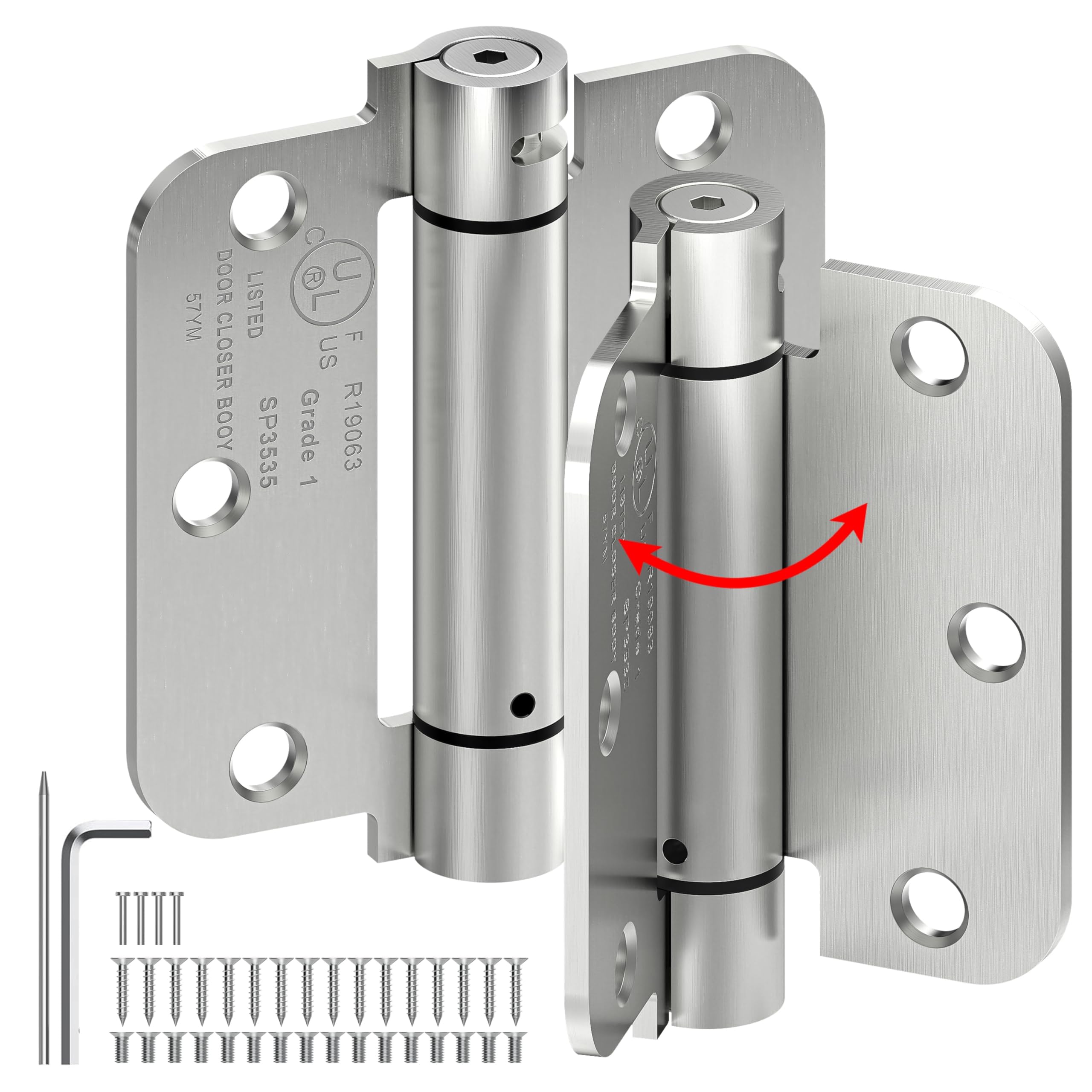
The number that earns this hinge the top slot is its eight-hole pattern. That is twice the hole count of the Hardware Essentials screen-door set, which runs four. More mounting points spread the pull of the spring across a wider area of the jamb, so a solid-core door does not slowly chew its screw holes loose. Each hinge measures 4 inches by 4 inches with a 5/8″ radius on the corner — the rounded curve where the leaf ends that has to match your existing cutout.
What it handles is broad. The maker rates it for interior or exterior, solid or hollow, light, medium or heavy doors, in wood, fiberglass and metal. It carries a UL listing for fire-rated doors and meets ANSI/BHMA standards, which matters if your door sits in a garage-to-house wall or a commercial hallway where an inspector will look. A tension adjustment tool ships in the box along with No. 9 one-inch wood screws, so there is nothing else to buy before you start.
The honest catch: the 5/8″ rounded corner and the 4-inch leaf mean this will not drop into a light screen-door frame or a 3.5-inch cutout. It is built for a heavy door, and the 16-ounce weight per pair feels every bit of that. Brass finish is the other thing to weigh — it looks rich on a wood door and loud on a white vinyl frame.
Two-pack spring doors
- Eight holes per leaf hold tension without wallowing out the jamb
- UL listed and ANSI/BHMA compliant for fire-rated doors
- Tension tool and No. 9 screws both included
- Rated for wood, fiberglass and metal, hollow or solid core
Heavy door needs check
- 4-inch size and 5/8″ radius will not fit a lightweight screen-door cutout
- 16 ounces per pair is real weight in the hand
- Brass finish is a strong look that suits wood more than vinyl
Bulk buy pick: you are hanging or replacing hinges on a solid-core, fiberglass or metal door that needs a fire-rated part.
Single unit better: your door is a lightweight screen door or your cutout is a 3.5-inch pattern.
2. 2-Pack 3.5 Inch Self Closing Door Hinges
The pair that carries a hundred pounds and still lets you dial the close down quiet.
Want the spring to do the work on a standard interior slab without a bang? Start with the weight rating. A pair of these ISOKER hinges supports doors weighing 85 to 100 pounds, so a solid bedroom or bathroom door closes on its own. A single hinge is rated up to 100 pounds on its own — a real number for a real door, not a vague “fits most.” They suit both left-hand and right-hand doors, so you do not have to sort out swing direction before ordering.
The tuning is where this pair separates itself. There is a tension screw on the hinge, and turning it clockwise speeds the close up; back it off and the door drifts shut gently. The internal spring pulls the door closed quietly instead of slamming it, sparing the frame and the wall behind it. All stainless steel mounting screws come in the box, and the finish is a brushed nickel that reads neutral against most interior colors.
It carries a UL-certified ANSI Grade 1 rating — the durability standard that says the hinge was built for repeated daily cycles. One note on sizing: this is a 3.5-inch leaf, so measure your old hinge before you commit. If you have a 4-inch cutout, step up to a 4-inch part rather than trying to bridge the gap.
Radius corner fit: the clockwise tension screw lets you go from a fast snap to a soft drift without swapping hardware.
Five-eighth sizing: 3.5-inch leaf only — it will not fill a 4-inch mortise, and the 5/8″ radius must match your cutout.
Rounded frame fit: a busy interior door in a kitchen, bathroom or garage entry that needs to shut itself every time.
Square cut only: a 4-inch door cutout or a lightweight screen door frame.
3. Door Spring Hinges 2-3/4″ Set
Built small for porch screens, with no mortising and a full 180-degree swing.
Screen doors are a different animal from interior slabs. They are light, they live outdoors, and the frame is thin enough that a heavy hinge will pull it out of square. This QCAA set is sized for that job at 2.75 inches by 2.75 inches — noticeably smaller than the 4-inch Cauldham hinges above, and lighter on a screen frame because of it. The spring swings the door to a full 180 degrees and pulls it back closed.
The install is genuinely simple. It is a full-surface application, so there is no mortising — you screw the leaf straight onto the face of the door and the jamb rather than chiseling a recess. The pin is tight, and the hinge mounts on either a right- or left-hand door. Each set gives you two self-closing hinges plus one adjustable self-closing hinge, steel construction throughout, in black.
Know the trade-off before you buy: this hinge is built for lightweight utility and screen doors, and that light build is the whole point. But it also means the spring on a hard-working porch door sees a lot of cycles. Some sets end up with a spring that gives out after a stretch of steady use, buyers report. If kids and dogs slam your door through every summer, plan on replacing a hinge now and then rather than expecting a decade of service.
Tight space pick: a porch or utility screen door where the old hinge was a small 2-3/4-inch surface-mount part.
Wide door no: your door is a solid interior slab or you have a 3.5 or 4-inch mortised cutout.
4. Hardware Essentials 852868 Screen Door Spring Hinge

Two adjustment rods in the box turn a slamming screen door into a gentle one.
Here is the part that makes this set stand out. The box includes twelve screws and two adjustment rods — dedicated tools for dialing the closing speed in or out on each hinge. The spring comes factory pre-set, then you tune it to suit your door. On a screen door that has always banged shut, that rod is the difference between a door you tolerate and one you stop noticing.
It is a three-inch hinge, engineered for screen and utility doors in residential and light commercial use. Mounting is left or right hand, so swing direction is not a barrier. The steel carries a plated, oil-rubbed-look finish the maker lists for corrosion resistance on a door that sits in the weather. Four holes per leaf keep the mounting simple and the screw pattern compact.
Be ready to spend a few minutes with those adjustment rods, though. The spring action on this model is not perfectly even from hinge to hinge from the start, so a little tuning after install is normal rather than a sign of a bad part. Dials it in and it works well; skips the tuning step and the door can drift rather than close. For a screen door with a stubborn slam, the included rods are the reason to pick this over a fixed-tension alternative.
Double-acting swing: the two included adjustment tools do the tension work that a bare fixed hinge cannot, so a hard-slamming screen door can be softened without buying anything extra.
Brass finish care: factory tension varies between the two hinges, so plan a tuning pass after the screws go in — and note the four-hole leaf is a compact pattern, so measure your old hinge first.
Swing both ways: you want to control exactly how hard your screen door shuts and you value tools in the box.
Single swing fine: you want a fixed, hands-off spring with no tuning step at all.
5. Wright Products V226WH Self-Closing Door Hinges

Three hinges in one box, so a storm door gets the full set on day one.
Most hinge sets give you a pair. This one gives you three — two self-closing hinges and one adjustable self-closing hinge — which fits the three-hinge configuration many storm and screen doors actually use. The set weighs 11.2 ounces, putting two of them at 22.4 ounces against the 16-ounce Cauldham pair, so you are getting more metal for the job. Each hinge opens the door to a full 180 degrees and springs it back closed.
The closing force is adjustable on the fly, which is the feature that separates a good storm-door hinge from an annoying one. White finish blends into a white frame and the six-hole leaf matches common door hardware. The maker backs the three-hinge set with a lifetime warranty, and all installation hardware ships in the box. That combination of three hinges, adjustable tension and a lifetime backing is what makes this the pick for a full door rehang rather than a one-for-one replacement.
Two honest notes. The spring-loaded design works well, but the hinge can develop a squeak over time — a drop of lubricant on the pin usually fixes it. And a couple of users find the value not quite there compared to a plain pair. If your door only needs two hinges, the pair options above will serve you just as well.
White trim match: a storm or screen door that takes three hinges and you want everything in one order.
Heavy door skip: a single-hinge replacement or a door that already has two good hinges in place.
6. KIW Self-Closing Matte Black Door Hinges 3.5 Inch

Matte black stainless hinges that close quiet and match modern door hardware.
If you are mid-renovation and every knob, lever and handle in the house is matte black, these hinges finish the look instead of leaving you with mismatched metal. They are 3.5 inches by 3.5 inches with 5/8″ rounded corners and six holes per leaf, made from stainless steel with a matte black finish. The frame between the leaves runs on a plain bearing the maker says keeps the swing smooth without a jam or squeak.
You tune the close with the hex wrench in the box: turn the tension clockwise and the door closes faster, back it off and it drifts. A pair of these hinges carries 30 kg (about 66 pounds), and the three pack carries almost 50 kg (about 110 pounds) — a useful way to decide if you need two hinges or all three on a door. The maker lists this for interior doors — bedrooms, bathrooms, closets, basement and garage entry — and also for lighter outdoor jobs like shed windows and shutters.
The durability is the one thing to size honestly. Some springs give out within a month of steady use on a hard-working door, so put these on doors that are opened now and then rather than a door the whole family pushes through fifty times a day. On a closet or a bedroom door, the spring holds up fine and the matte finish looks the part.
Matte black finish
- Matte black finish that matches modern door hardware
- Stainless steel construction with a plain-bearing pivot
- Hex wrench included for on-the-spot tension tuning
- Three hinges per pack lets you build a two or three-hinge install
Finish scratch risk
- Springs can let go within a month on a heavily used door
- Fit is a mixed bag — 5/8″ radius and 3.5-inch size must match your cutout exactly
- Not the pick for a solid, heavy exterior door
Dark door match: your interior doors wear matte black hardware and you want the hinges to finish the look.
Bright brass fans: the door is a heavy slider or a solid exterior door that sees constant daily use.
7. Heavy Duty Adjustable Spring Hinge 3″

A surface-mount spring hinge for gates and doors that never had a mortised cutout.
This is the pick for the job where a standard hinge will not work. There is no mortising required — the full-surface mount lets you screw the leaf straight to the face of a gate or door and be done. The hinge is 3 inches with a 4.5-inch by 3.5-inch footprint and six holes, built from cold-rolled steel. It is a thicker spring hinge made in Taiwan, and the tension is adjustable through a set of included pins, so you can tune the closing speed to the weight of the gate.
That adjustable tension is the key feature for a gate — a wood gate in damp weather swells and gets heavier, and a fixed spring would either stop pulling it shut or pull too hard. With the pins you can chase the tension to match. Six holes spread the load across the leaf and the footprint is wide, so the pull has room to distribute.
The honest caveat is durability under heavy load. These hinges work fine on a lightweight gate, but some users have had them fail when the gate or door was heavier than the hinge expected. Use them where the load matches the build — a light utility gate, a shed door, a small screen door — and treat a big, solid wood gate as a step up to a heavier hinge. That is the fit question, not a defect.
Thick no-mortise build: on a gate or a shed door with no mortised cutout, this is the practical install — screw the leaf to the surface and skip the chisel work entirely.
Load match crucial: these hold fine on a light gate, but a bay or heavy gate wants a heavier hinge — the build is set for lighter jobs.
Heavy door pick: a light utility gate or shed door where you want no mortising and an adjustable spring.
Light door overkill: your gate is solid, heavy timber and gets pushed hard every day.
8. 3 Pack Self Closing Door Hinges 4 Inch

Three four-inch hinges that lift the load rating of a heavy door with one extra part.
The math is simple. One hinge carries up to 40 pounds, a pair handles a door weighing 85 to 100 pounds, and the pack gives you three — so on a door near the top of the weight range, the third hinge spreads the pull and gives you margin. These are 4-inch by 4-inch leaves (the flat plates that screw to door and frame) made for commercial or frequently used doors, the kind that swing all day in a garage, a kitchen or an office. Both left-hand and right-hand doors take them without a swap.
The closing action is set up to pull the door gently shut rather than let it slam, and the tension can be adjusted to suit the door rather than the other way around. Installation follows the instruction manual and is written to be doable for a first-timer. The spring meets the UL-certified ANSI Grade 1 standard, and the metal surface is treated against rust. A matte black finish keeps the hardware looking neutral on most door colors.
The catch is that three 4-inch hinges are more hardware than a light interior door needs, and on a smaller cutout a 4-inch leaf simply will not seat. This is a pick for a solid, frequently swung door where extra capacity earns its keep — not for a bedroom closet door. Match the 4-inch size to your cutout and the rest is straightforward.
Multi-door deal: you are hinging a solid or frequently used door and want the extra capacity of a three-hinge install.
Odd count need: the door is light, or your existing cutout is a 3.5-inch pattern.
9. SORGMACH Self Closing Hinge 3 ½”

Damping oil in the shaft takes the metal-on-metal rattle out of the close.
The feature that defines this hinge is inside the pin. The central shaft contains a damping oil built to cut metal-to-metal friction, which is what quietens the swing and the close. If your door is a bedroom or a bathroom where a bang echoes down the hall, that oil makes the difference between a door that shuts and a door that announces itself. The hinges are 3.5 inches by 3.5 inches, 0.098 inches thick, with 1/4″ corners and six holes per leaf, in a matte black finish over flat iron.
The build is aimed at the same job as the ISOKER pair above, but it takes a different corner. Where those use a 5/8″ rounded curve, these use a tight 1/4″ radius — the near-square corner that matches a different set of door cutouts. Measure yours before ordering, because a 1/4″ leaf will not drop into a 5/8″ cutout and vice versa. Each pack gives you three hinges, six standard-length screws per hinge, a wrench, a pin and an instruction manual.
It carries a UL listing (a safety certification from Underwriters Laboratories), and the maker says the hinges are rigorously tested to close as intended. The damping oil and the smooth bearing design are aimed at a smooth open and close rather than a stiff one. The honest note: these are sized for standard interior doors. They will work on a kitchen or bath door all day, but a heavy exterior door is more load than this build is set for. Keep the job inside and the door weight moderate, and the damping shaft is reason enough to choose these.
Even swap fit: the door is in a bedroom, bathroom or hallway where you want a quiet close with no metal rattle.
Oversized door no: your cutout is a 5/8″ radius or your door is a heavy exterior slab.
Know the Specs
Corner Radius
The radius is the curve where the hinge leaf ends. A 5/8″ radius is a generous round; a 1/4″ radius is a tight, near-square corner. Your new hinge has to carry the same curve as the old one or it will bind in the door cutout. Grab a ruler and measure before you order — this one number decides whether the hinge drops in or fights you.
Hole Count
More holes per leaf spreads the pull of the spring across a wider area of the jamb, so the screw holes hold tight instead of wallowing out over time. An eight-hole leaf like the Cauldham carries more load than a four-hole screen-door leaf. On a solid or heavy door, the extra mounting points are worth having.
Weight Capacity
The maker usually rates the pair, not the single hinge. A pair that handles 85 to 100 pounds suits a standard interior door; a single hinge rated around 40 pounds tells you to add a third for a heavy door. Match the total capacity to the actual weight of your door, then decide how many hinges to mount.
Adjustable Tension
An adjustment screw, hex wrench or adjustment rod lets you change how hard the spring pulls the door closed. On a door that slams, back the tension off. On a door that will not latch, wind it up. Fixed-tension hinges work on light screen doors, but they leave you no room to tune when the door swells in humid weather.
Common Questions
Will a 3.5-inch hinge fit where my 4-inch hinge was?
What does a 5/8″ radius corner mean on a hinge?
How many self closing hinges does a screen door need?
Can I adjust how fast my screen door closes?
Is a 4-inch hinge better than a 3-inch hinge for a gate?
Do self closing hinges need special screws?
Will a spring hinge stop my door from slamming?
How long do self closing spring hinges last?
Can I use a self closing hinge on an exterior or storm door?
What is the difference between a full-mortise hinge and a surface-mount hinge?
The Bottom Line
For most doors, the self closing screen door hinges pick to beat is the Cauldham 4-inch pair. Eight holes per leaf, a UL listing for fire-rated doors, and a tension tool in the box make it the most capable all-rounder here. If your door is a standard 3.5-inch interior slab and you want the close dialed soft, the ISOKER pair is the better fit with its 85 to 100 pound rating. And for a light screen door on a porch, the Hardware Essentials 3-inch set gives you the two adjustment rods that turn a slamming door into a quiet one. Match the corner radius and hole pattern to your door first — that one step saves the whole install.
How we choose
We do not accept paid placement. Every pick is matched to a real buyer and a real use-case; we do not hands-on test units.
Sources
Specifications: manufacturer listings and product documentation. Review insights: verified customer reviews, as of November 2026. Pricing: not shown on this page (it changes often); check the current price via the retailer link.
As an Amazon Associate, Tactical Gear Guy earns from qualifying purchases. This does not affect which products we feature.