Specs are compiled from manufacturer listings and verified buyer reviews and can change over time — please confirm the key details on the product page before buying.
Every self-centering tape measure does the same basic trick: a second scale runs along the bottom of the blade so the halfway point of any span is printed right there for you. No dividing in your head, no hunting for the middle of a wall with a pencil. The Lufkin L625SC-02 is the one most people should buy — 4.5+ stars across 500+ ratings, a 25-foot high-carbon steel blade, and a center scale that sits under the main markings so you read both at a glance. The other three picks below earn their place for different reasons: a tougher carpenter-grade blade, a fine 1/32-inch scale for trim work, and a digital version with a green laser that shows you the line.
This guide is built by comparing the manufacturers’ published specifications and the patterns across verified customer reviews, so you get each pick’s real strengths and trade-offs instead of marketing spin.
You are about to see what separates a tape that stays stiff at full extension from one that folds over, and which center scale you can actually read in dim light. A good one lets you mark midpoints on a wall solo, without a second person holding the dumb end.
Top Picks

How To Choose The Best Self Centering Tape Measure
Start with the center scale, since that second row of numbers is the reason you are shopping. On a proper center-finding tape, the bottom row of numbers reads from the middle of the top row outward. Line the blade across a wall and the bottom row tells you the midpoint directly, without arithmetic. That bottom row is what lets one person hang a picture or lay out a run of drawer pulls without halving measurements.
Read the blade width before anything else
Blade width is the width of the metal strip itself, and it controls how far the tape can reach out before it bends and drops. A 1-inch blade (the width on both Lufkin tapes and the US Tape here) handles most indoor work, but it sags on long unsupported pulls. The REEKON T1 goes slightly wider at 1.06 inches, and that extra stiffness is part of what you pay for on a digital unit.
Decide how fine your markings need to be
Standard tapes mark down to 1/16 inch, which is fine for framing and rough carpentry. If you hang cabinets, set trim, or build drawers, the Lufkin Hi-Vis model’s 1/32-inch graduations give you a finer read on the blade — useful when a hair off shows. Both Lufkin tapes and the US Tape list accuracy at ±1/16 inch or better, so the graduations are about readability, not about the tape being sloppy.
Think about where the tape will live
A tape that rides in a pouch all day needs a lock you can hit with a thumb and a case you can spot on a cluttered bench. A hi-vis case and a name tag keep your tape from vanishing when three people share one truck. For solo work, an integrated nail slot lets you hook the blade on a nail head and pull the tape tight with one hand.
Side-by-Side Comparison
| Model | Best For | Blade Length | Blade Width | Accuracy | Amazon |
|---|---|---|---|---|---|
| Lufkin 25′ Self-Centering Power Tape – L625SC-02★ Best Overall | Most buyers, most jobs | 25 feet | 1 inch | ±1/16 in. | Amazon |
| US Tape 50035 ProTape XR Series CenterPoint | Carpentry and design layout | 25 feet | 1 inch | ±1/16 inch | Amazon |
| Lufkin Hi-Vis Orange Self-Centering 1″ x 25′ | Fine trim and cabinet work | 25 feet | 1 inch | At least 1/32 inch | Amazon |
| REEKON T1 Tomahawk 25 ft Digital Tape Measure | Digital capture and laser layout | 25 feet | 1.06 inches | +/- 0.02in | Amazon |
Detailed Reviews
1. Lufkin 25′ Self-Centering Power Tape – L625SC-02
Our pick — 4.5+★ from 500+ verified ratings; the strongest balance of quality and price.
The straightforward center-finder most people should carry, without paying for electronics.
This is the pick that wins on the plain arithmetic of ownership: 4.5+ stars across 500+ ratings, a 25-foot high-carbon steel blade, and a center scale that does the halving for you. The blade is 1 inch wide and weighs 0.35 kg in the hand — light enough to clip on and forget, stiff enough for indoor pulls. Accuracy is listed at ±1/16 in., so the readings you take are as tight as a standard tape gets.
Reviewers praise the case, the thumb-friendly lock, and the smooth blade return, then the accuracy and center scale. The center function shines on symmetrical work like drawer handles and picture hangers, where the bottom row of numbers hands you the midpoint and you never touch a pencil to a wall twice. The lock button sits where your thumb naturally lands, and high-legibility markings mean you are not squinting at a shadowed blade.
The honest catch is blade stiffness. A 1-inch strip this light will fold over on long unsupported pulls — one comparison put it plainly, saying the tape “is thin and flimsy” and wants a second pair of hands past about 2 ft. The internal spring return also draws a durability gripe from time to time. Both are fair notes rather than reasons to walk away: for cabinet layout, framing checks, and hanging art, for cabinet layout, framing checks, and hanging art, it covers the measuring most people do..
What earns it first place
- Center scale under the main markings hands you the midpoint on any span
- 25-foot high-carbon steel blade at ±1/16 in. accuracy
- 0.35 kg — light enough to ride in a pouch all day
Where it asks for care
- 1-inch blade sags and folds on long unsupported pulls
- Spring return has drawn occasional durability notes
Reach for this if: you want the center-finding trick without extra weight or electronics, and most of your measuring happens at arm’s length or closer.
Pair it with a wider blade: if your day is 10-foot unsupported pulls across an open floor, the extra stand-out matters more than the savings.
2. US Tape 50035 ProTape XR Series 1″ x 25′

Built like a framing tape first, with the center-finding scale along for the ride.
The ProTape XR carries a 25-foot alloy steel blade with all standard carpenter markings, and the case is ABS plastic wrapped in molded rubber grips so it stays put in a sweaty hand. It weighs 15.2 ounces — noticeably heftier than the 0.35 kg Lufkin above, and that mass is the point: a chunky case on a 1-inch blade takes knocks that send a lighter tape back to the drawer. Accuracy is ±1/16 inch, matching the Lufkin spec.
The center-point feature wins the most praise here after raw build quality, and for good reason beyond carpentry. Soap makers, upholstery students, and people hanging drapes all reach for it because it removes the arithmetic step entirely — one buyer in an upholstery class had it recommended by the instructor and never looked back. The push-button lock and the compact case keep the whole thing quick to grab and quick to stow.
Two quirks are worth knowing. The belt clip draws mixed feelings, and there is the occasional report of a spring letting go early — the kind of thing that can happen to any retracting tool and is not the common outcome. Weigh that against the fact that this tape is just as happy in a woodshop as on a jobsite, and it makes a strong case as the do-it-all middle pick.
The center-point payoff: the bottom scale reads the middle of any dimension directly, which is why it turns up in design work, drape hanging, and picture layout — not just framing.
The honest trade-off: at 15.2 ounces it is the heaviest steel tape here, and the belt clip is the part people like least. If you pocket-carry all day, that weight is real.
Pick this one when: you want a tape that feels like a tool, not a trinket, and you move between carpentry, craft, and hanging work in the same week.
Look elsewhere if: you want the lightest thing on your belt — the Lufkin above saves you real weight.
3. Lufkin Tape Measure 1 ” X 25 ‘
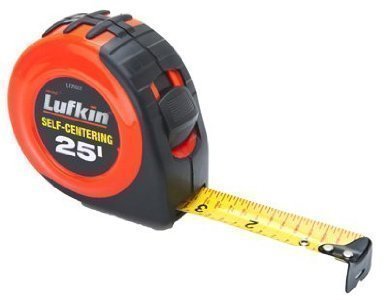
The trim carpenter’s version, with a 1/32-inch scale and a case built to fill your palm.
Here the headline is the graduation, not the length. This Lufkin marks down to 1/32 inch and holds accuracy of at least 1/32 inch, which is a finer read than the 1/16-inch blades on the two tapes above. On cabinet doors, mitered trim, and drawer fronts, that difference shows up the moment a joint sits a hair proud. The 25-foot steel blade is reinforced, and the case blends polypropylene, polycarbonate, ABS, and thermoplastic rubber — a shell that shrugs off a drop onto concrete.
The center scale does the same job as its sibling: the bottom measurement is the center of the top one, so you find the midpoint of a wall or a panel without dividing. The hi-vis orange case and the palm-shaped body mean you can spot it across a bench and grab it without looking. For anyone whose measuring happens at the millimeter end of the job, this is the tape that matches how you work.
The catch is money and muscle. Fine graduations cost more to produce, and this is the priciest steel tape on the list — so it only makes sense if 1/32-inch precision is something your work actually demands. If you are framing walls or checking rough openings, the coarser and cheaper Lufkin up top does the same center trick for a lot less.
Best matched to: trim carpenters, cabinet installers, and anyone laying out hardware where a 1/32-inch error is visible.
Think twice if: your work lives at 1/16 inch — you would be paying for precision your joints never ask for.
4. REEKON T1 Tomahawk 25 ft Digital Tape Measure
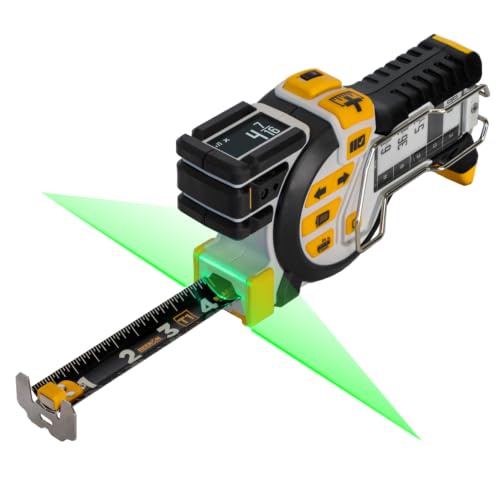
A tape that remembers your numbers, projects a laser line, and needs a charger.
Everything about the T1 is a different category of tool. The blade is 25 feet and 1.06 inches wide — a touch wider than the 1-inch strips on the Lufkin and US Tape models, which helps stand-out on long pulls. It reads to +/- 0.02in and self-calibrates, so the numbers on the side-mounted e-paper display are as trustworthy as the blade. That display holds up to 1,000+ measurements, and the BOLDR Pro App shares cut lists and markups wirelessly with anyone on site.
The green laser is the feature that changes how you work. It projects a fine line across from the front reference surface, so you can align and mark without a helper holding a pencil. Relative zero — setting zero from any point — drew steady praise from people measuring off beams and through penetrations, and center finding is built in alongside inches, feet, millimeters, and centimeters. Owners rate the overall build quality highly; a woodworking newcomer called it a genuine help from day one.
Now the weight, literally and figuratively. At 1.31 kg it is 3.7x heavier than the 0.35 kg Lufkin — a tool you carry deliberately, not one you forget in a pocket. Battery life draws the sharpest complaints, with reports of it not holding a charge past 4 hours, and some owners find the menus take learning. If small blade markings are hard to read, the e-paper display earns its keep; if you just need center marks on a wall, the Lufkin gets you there at 0.35 kg.
What the electronics buy you
- Green laser line extends the reference across the work for solo marking
- E-paper display stores up to 1,000+ measurements and syncs to the BOLDR Pro App
- Self-calibrating to +/- 0.02in with center finding built in
What you accept in return
- 1.31 kg — 3.7x the weight of the Lufkin L625SC-02
- Battery life is the most common frustration, with reports under 4 hours
Made for: tradespeople and serious DIYers who want stored measurements, a laser line, and app sharing on the same job.
Not the one if: you want a tape you never charge — a plain steel center-finder will always be simpler.
Know the Specs
Center Scale And How To Read It
A center-finding blade carries a second row of numbers on its lower half. That row counts outward from the middle of the main markings, so any point on the bottom reads as the midpoint of the top. Lay the blade across a window frame, find the bottom-row number you want, and mark it — no halving, no math. On the Lufkin tapes this scale is printed for you; on the REEKON T1 the same job is done digitally and shown on the display.
Blade Width And Stand-Out
Blade width is the metal strip’s width, and it sets how far the tape reaches before it buckles. The 1-inch blades on the Lufkin and US Tape models handle indoor spans well but fold on long unsupported pulls. The REEKON’s 1.06-inch blade is a little stiffer, but the real answer for long runs is to support the blade or use a helper — no 1-inch tape defies gravity for long.
Graduations And Accuracy
Graduations are the smallest marks on the blade; accuracy is how close the whole tape is to true. They are not the same number. A blade marked to 1/32 inch (the Lufkin Hi-Vis model) is rated accurate to at least 1/32 inch. The ±1/16-inch ratings on the Lufkin L625SC-02 and US Tape are coarser reads for carpentry, and the REEKON states +/- 0.02in with self-calibration.
Lock, Hook, And Solo Work
A positive lock (the type that clamps and holds) lets you extend a blade and keep it there while you move. A push-button lock works the same way with a thumb press. The integrated nail slot on the Lufkin L625SC-02 lets you hook the blade end on a nail and pull one-handed. Add a belt clip or holster and you have a layout setup one person can run alone.
Common Questions
How does a self-centering tape measure actually find the middle?
Is a 1/32-inch scale better than a 1/16-inch scale for trim work?
Will a 1-inch blade hold up on long unsupported pulls?
Do the Lufkin and US Tape models use the same center-scale idea?
What does the REEKON T1 do that a steel tape cannot?
How long does a digital tape measure run on a charge?
Can one person measure a full wall with these tapes?
Are the Lufkin tapes the same model just in different cases?
Can a center-finding tape replace a layout square?
Which tape has the finer accuracy rating, the REEKON T1 or the steel tapes?
The Bottom Line
The self-centering tape measure that earns the spot for most buyers is the Lufkin 25′ Self-Centering Power Tape – L625SC-02 — 4.5+ stars across 500+ ratings, a 25-foot high-carbon steel blade at ±1/16 in., and a center scale that does the halving for you at 0.35 kg. If you want a heavier, rubber-gripped feel for carpentry and craft work, the US Tape 50035 ProTape XR is the sturdier pick. For trim and cabinets where 1/32-inch graduations earn their keep, grab the Lufkin Hi-Vis Orange Self-Centering. And for stored measurements plus a laser line on the jobsite, the REEKON T1 Tomahawk is the digital answer — just plan on charging it.
How we choose
We do not accept paid placement. Every pick is matched to a real buyer and a real use-case; we do not hands-on test units.
Sources
Specifications: manufacturer listings and product documentation. Review insights: verified customer reviews, as of November 2026. Pricing: not shown on this page (it changes often); check the current price via the retailer link.
As an Amazon Associate, Tactical Gear Guy earns from qualifying purchases. This does not affect which products we feature.