Specs are compiled from manufacturer listings and verified buyer reviews and can change over time — please confirm the key details on the product page before buying.
You want a camera that keeps watching when the internet drops, the router dies, or a storm knocks the connection out — and one that does not bill you every month for the privilege. That is exactly what every pick below does: it records to a memory card or a local recorder inside your own home, so the footage stays yours and the system keeps rolling with no connection at all. The real question is not “does it work offline” — they all do. It is how much storage you get, how the camera stays powered, and how many cameras the system will grow to hold.
This guide is built by comparing the manufacturers’ published specifications and the patterns across verified customer reviews, so you get each pick’s real strengths and trade-offs instead of marketing spin.
Some of these are solar cameras that trickle-charge themselves on a fence post; others are wired systems that need a cable run but never touch a battery. Below you will find the differences that actually change how the system behaves on your property, laid out plainly. Here is the honest breakdown of the best security cameras without internet for a home that wants footage kept local.
Top Picks
How To Choose The Best Security Cameras Without Internet
The first thing to get straight is what “without internet” means for you. Every camera here records to storage that sits in your house — a microSD card in the camera, or a hard drive inside a recorder box. That is what keeps the recording going when the Wi-Fi drops. You may still use an app to watch live, but the recording itself does not depend on a connection.
Local storage is the whole ballgame
Look for the storage number before anything else. A camera with a 128GB card or recorder holds weeks of clips on a loop, meaning the oldest footage overwrites itself once the space fills. A system with a 4TB hard drive holds months. If the storage lives in a separate hub rather than the camera, a stolen or smashed camera does not take your evidence with it — an underrated detail on a property camera.
Solar versus wired power
Wire-free solar cameras mount anywhere in about five minutes with a drill and three holes. The trade-off is that a panel needs sun, and a run of grey days leans on the battery. A wired system never needs charging, but you are running cable from a recorder to each camera, which is a weekend job and not a renter’s friend.
Resolution and night vision you can actually use
A higher megapixel count helps you read a face or a plate, but only if the lens and sensor keep up. Night vision matters more than daytime sharpness for most driveways. Color night vision uses built-in LEDs to light the scene, which shows clothing and vehicle color; infrared night vision shows the scene in black and white.
Side-by-Side Comparison
| Model | Best For | Local Storage | Power | Cameras Included | Amazon |
|---|---|---|---|---|---|
| Vivideye 8Channel Expandable 4-Cam Kit★ Best Overall | Whole-property coverage | 128GB built in (to 256GB) | 8000mAh battery + 5W solar | 4 | Amazon |
| eufy Security eufyCam C37Best Single Camera | Single-camera starter | microSD to 256GB (sold separately) | 3W solar panel | 1 | Amazon |
| WYZE Solar Cam Pan 2KMost Storage Per Camera | Big-card storage | microSD to 512GB (sold separately) | Solar panel | 1 | Amazon |
| Vivideye 2-Cam Kit 4MP | Small yard, two angles | 128GB built in | 8000mAh battery + 5W solar | 2 | Amazon |
| eufy Security eufyCam E40 2-Cam Kit | Dark-driveway detail | 16GB in HomeBase 2 | Built-in solar + 13,000mAh | 2 | Amazon |
| ZOSI 3K Lite Wired System | Fixed, always-on budget | Pre-installed hard drive | Wired BNC cable | 4 | Amazon |
| Hiseeu 6-Cam Kit 1TB | Wide 360° coverage | 1TB HDD | Plug-in DC12V | 6 | Amazon |
| ARCCTV 6-Cam Solar Kit | Big property, no wires | TF card to 512GB + HDD to 6TB | Solar panels | 6 | Amazon |
| REOLINK 12MP PoE 8-Cam System | Serious long-term install | 4TB HDD (to 24 channels) | PoE wired | 8 | Amazon |
Detailed Reviews
1. Vivideye Security Cameras Wireless Outdoor 8Channel
Our pick — 4.5+★ from 100+ verified ratings; the strongest balance of quality and price.
Four solar cameras, one hub holding 128GB of footage, and not a monthly bill in sight.
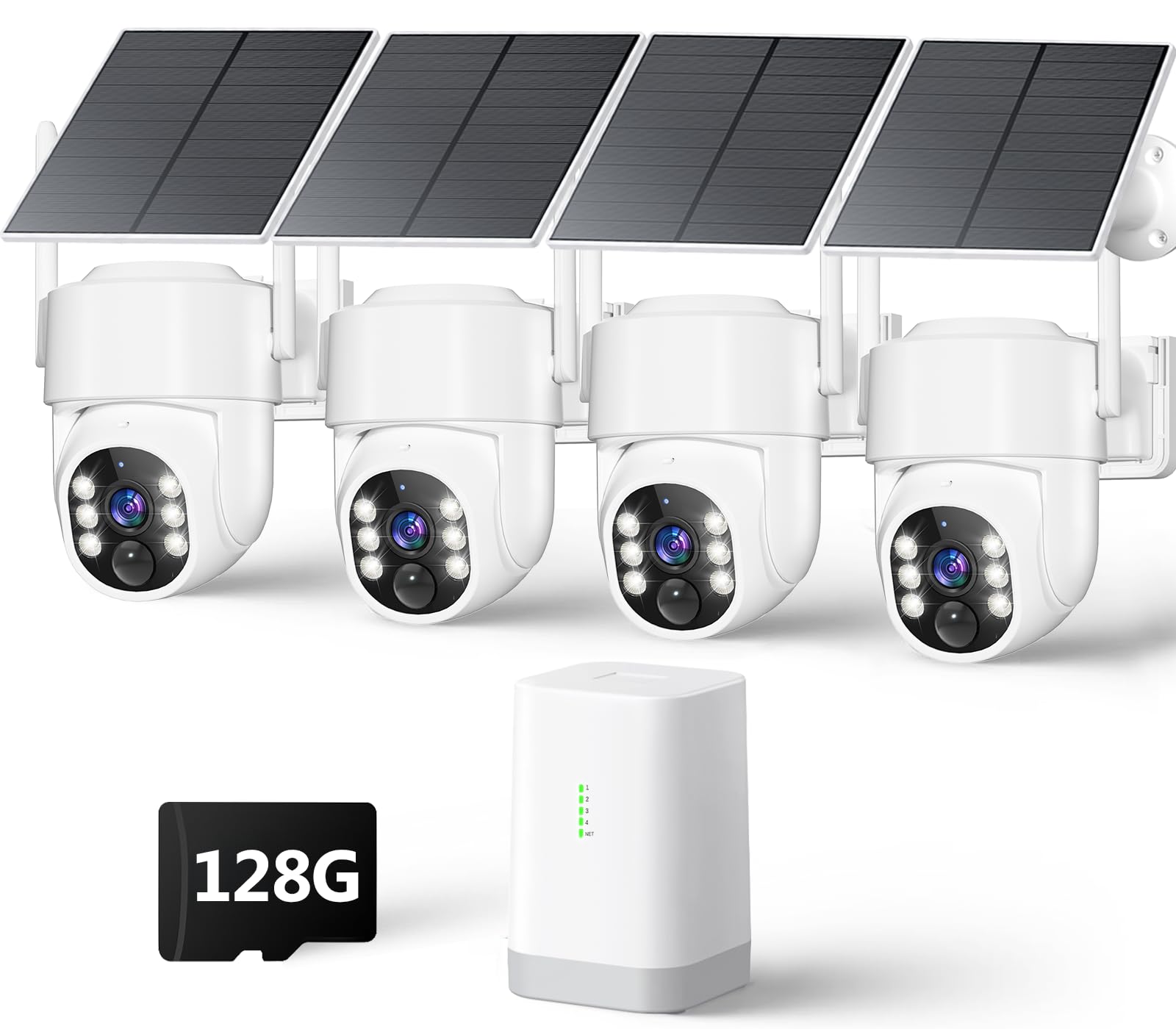
Recording starts the moment you power it up, because the hub has 128GB of card storage built straight into the base unit — no separate card to buy, no cloud account to open. That 128GB is four times the 32GB card the four-channel Vivideye kit further down ships with, and buying it here means one less thing on the install list. If the card fills, the oldest footage overwrites itself in a loop, and 128GB runs to roughly three months of continuous recording across the four cameras. The hub itself takes expansion cards up to 256GB if you ever want more headroom.
Power is handled by an 8000mAh battery behind a 5W solar panel on each camera. The maker’s figure is three hours of direct sun a day per panel, so mount them where midday light actually lands, not under a deck rail. That 5W matters against the eufyCam C37 below: this kit’s panel is the larger of the two, while the C37 runs a 3W panel. Mounting takes a drill and three holes per camera, and the cameras arrive already paired to the hub — no manual code-entry dance, which is why setup speed is the thing owners mention most in reviews.
Footage lands at 4MP with six LEDs for full-color night vision out to 65 feet, so faces and plates stay readable in the dark rather than washed gray. The pan-and-tilt head sweeps 360 degrees and can auto-track a moving subject, but tracking ships switched off — you have to switch it on in the app before the camera follows anything. That is the catch: enable it or the camera stands still. The 8-channel hub takes four more cameras later, so a garage or back gate is an easy add. Alexa owners can pull the live feed up on an Echo Show by voice.
Where the Vivideye pulls ahead
- 128GB of storage sitting inside the hub rather than a card wedged in a camera — a stolen camera leaves your footage behind
- 8000mAh battery paired with a 5W solar panel on every camera, with a maker-stated three hours of sun as the daily top-up
- Room for eight cameras total, so the system grows instead of being replaced
- 4MP sensor with six LEDs and color night vision to 65 feet
What to keep on your radar
- Auto-tracking is off until you switch it on in the app — expect a static camera on day one
- Recording defaults to human-only, so vehicle and pet detection needs a settings change
- Solar panels need real sun exposure or the battery leans on itself
Buy it for: a house or small property that wants four cameras, one hub, and no subscription ever — the built-in 128GB is the deciding spec.
Think twice if: every mounting spot is in shade, where the 5W panels cannot keep up.
2. eufy Security eufyCam C37
One camera that sweeps a full circle on its own, for a porch or a corner where you can only mount a single unit.
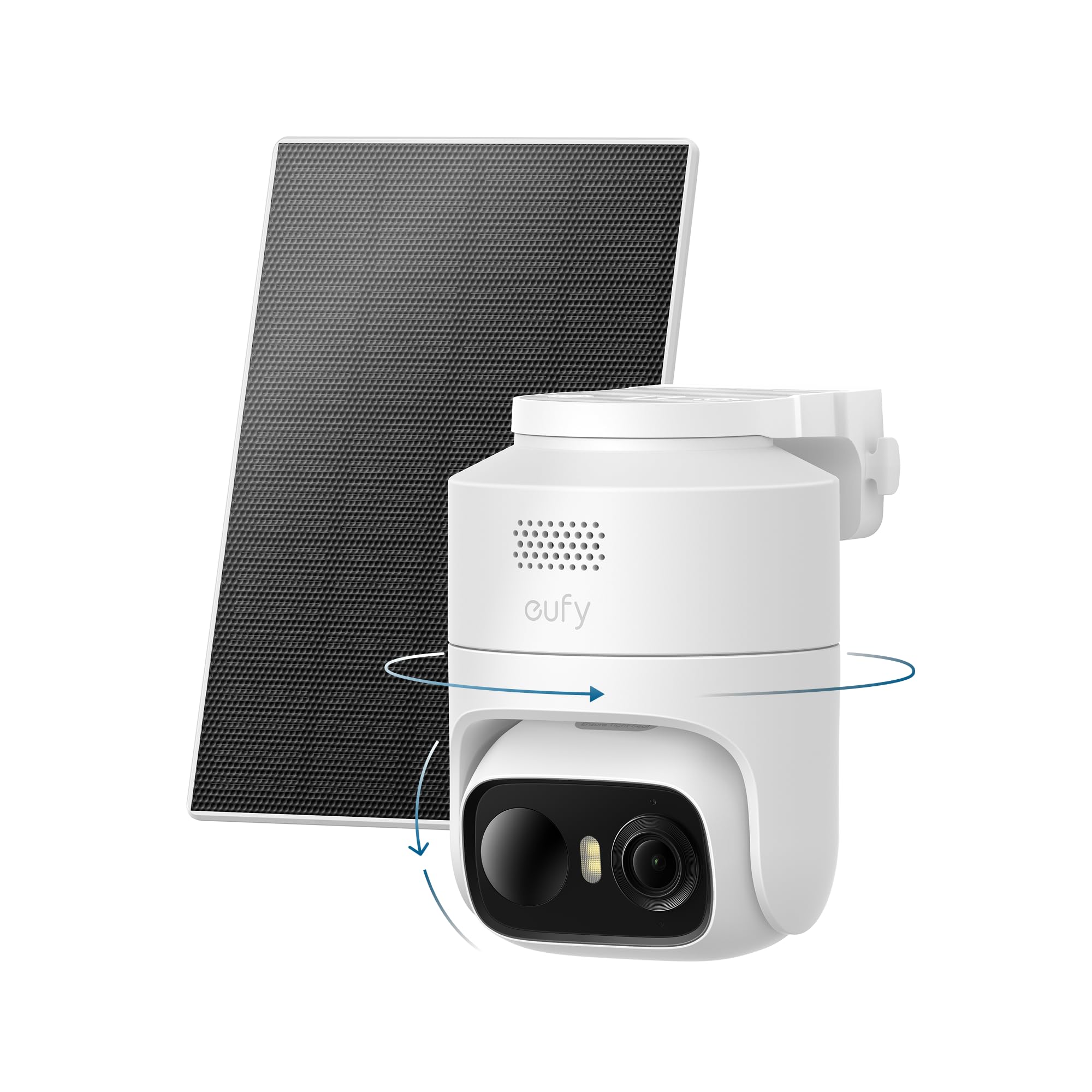
This is the pick for someone covering one spot — a front door, a side gate — who does not want to rig a whole system. The head pans and tilts through a full 360 degrees, and the auto-tracking keeps a moving person centered in the frame, so a single camera covers ground that would otherwise need three fixed ones. Add a microSD card up to 256GB, sold separately, and the footage writes straight to that card with no cloud account supported at all. Nothing leaves the house.
The 3W solar panel detaches from the camera, which is the clever bit — point the panel at the sun and the lens where you need it, rather than compromising one for the other. Daytime and night footage comes in at 2K, and an onboard spotlight lights up faces, plates, and clothing color in the dark.
Here is the honest part. This camera’s own review pattern shows a real split in reliability, with some units giving up after a few days while most hum along fine. That split is the reason it sits at 4.0+ stars while the 2K crowd largely holds higher. The 2.4GHz-only Wi-Fi is also note — no 5GHz band, so keep it within solid range of your router. A detachable panel and a 360-degree head are a lot of camera for a single-camera budget, as long as yours arrives healthy. Check it within the return window and set the app to the required version before setup.
The one-camera answer: 360 degrees of pan and tilt, detachable 3W solar, and microSD recording up to 256GB with no cloud support — for a porch or gate you want covered without a hub.
Buy with eyes open on: reliability is mixed in its own reviews, and the 2.4GHz-only Wi-Fi limits where you can place it.
Reach for this if: one mounting point has to cover a wide area and you want local recording without a base station.
Look elsewhere if: you need a guaranteed multi-camera setup with proven consistency — the kit picks are the safer bet.
3. WYZE Solar Cam Pan
The card slot that swallows half a terabyte — four times what the four-channel Vivideye kit stores from the start.
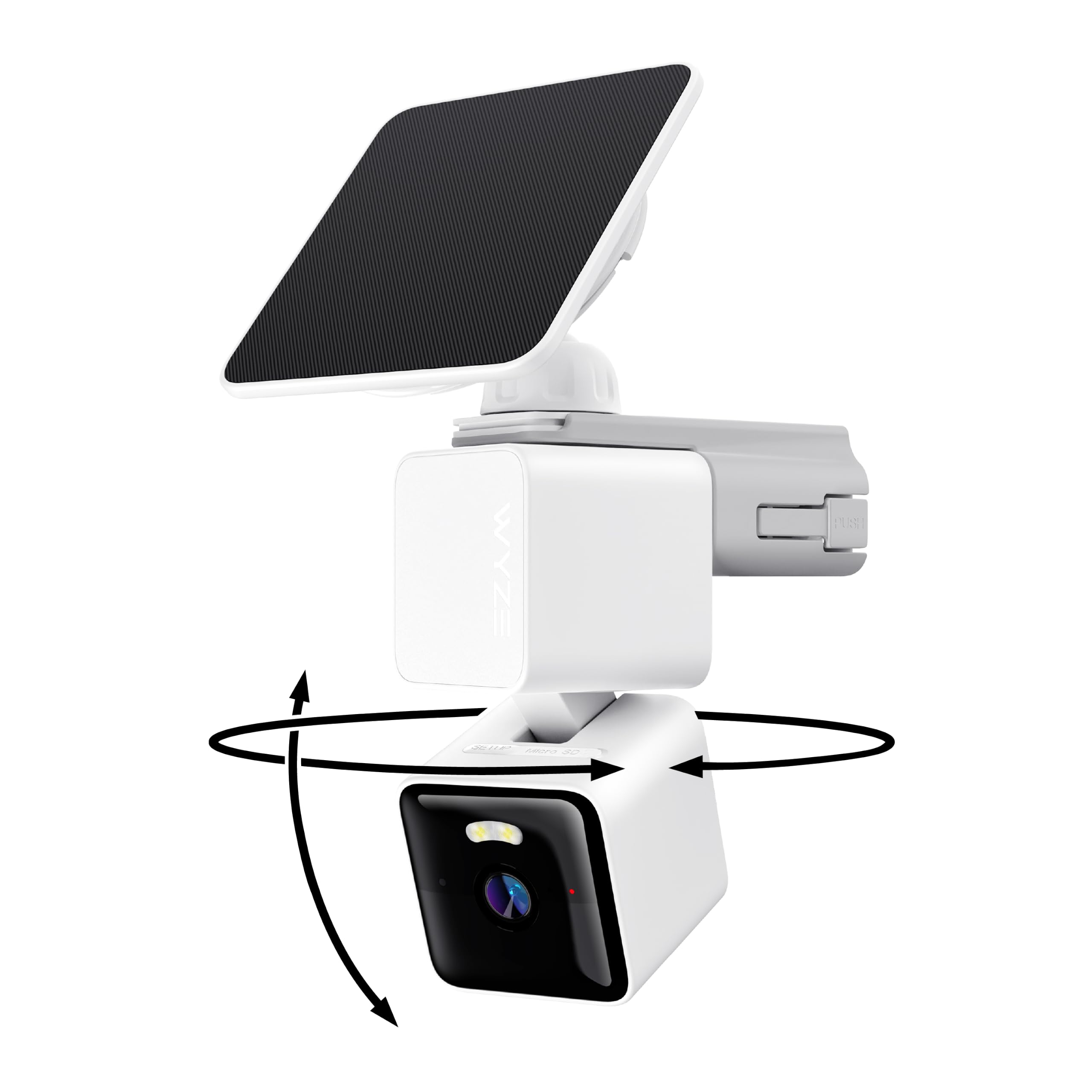
Storage is the headline here. This camera takes a microSD card up to 512GB, which is four times the built-in capacity on the Vivideye four-camera kit that tops this list — a single camera out-storing a four-camera system on raw card size. That works if you want one camera to hold months of motion clips without a hub in the mix. Just know the card is sold separately, so factor that into the setup.
A 360-degree pan with 70 degrees of tilt covers a wide sweep, and the AI tracks people as they move while cutting down on the false alerts that lesser motion sensors trip on. The built-in spotlight fires when motion is detected, and a 105dB siren can be triggered from the app — loud enough to send someone off a driveway. The IP65 rating means rain, heat, and snow are handled outdoors.
Power comes from the solar panel, and the maker’s line is that about an hour of sunlight a day keeps the battery topped up. The day-to-day reality of owning one is kinder than most: the pan-and-tilt tracking is the feature that keeps people happy, and setup is genuinely quick through Bluetooth pairing from the Wyze app. The 2.4GHz-only Wi-Fi is the limit worth knowing — no 5GHz band — so a camera far from the router will test your signal. Pair it with the Cam Plus subscription and you get 14 days of cloud event history alongside the card, but the card is what keeps it recording with no connection at all.
The storage play: a 512GB card slot, 360-degree pan with 70-degree tilt, and a 105dB siren — a single camera that can hold a big card and cover a wide arc.
The catch: the card is sold separately, and it runs on 2.4GHz Wi-Fi only.
Pick this if: one camera needs to see a lot of ground and hold a huge card locally.
skip it if: your router sits far from the mounting spot and you need the faster 5GHz band.
4. Vivideye Security Cameras Wireless Outdoor 2 Cam-Kit
The two-camera version of the winner — same 128GB hub, same solar power, a tighter footprint for a smaller yard.
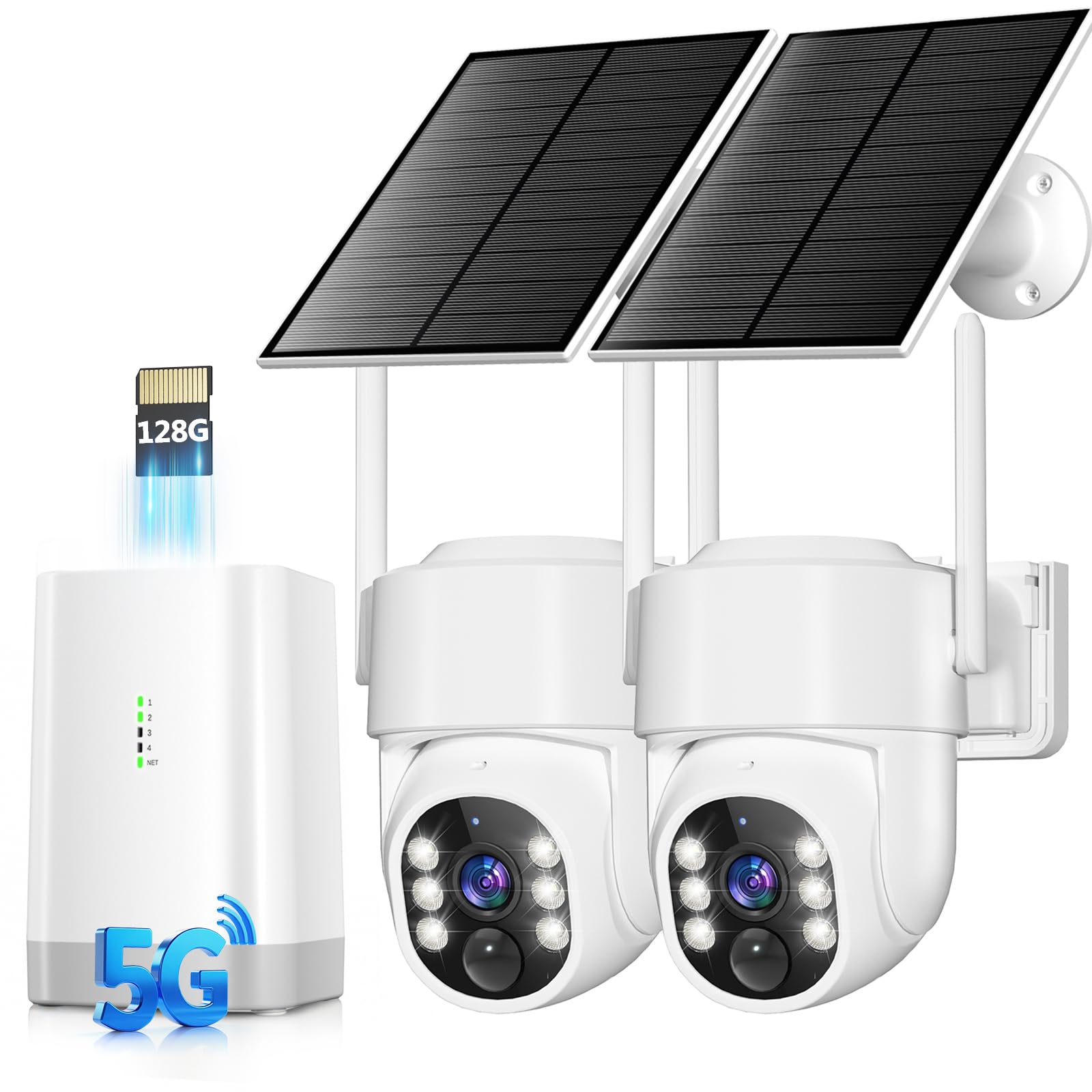
If the four-camera kit is more than your property needs, this is the same idea cut down to a pair. The 128GB card lives inside the hub, which means recording starts at power-up and no footage sits on the cameras themselves — lose a camera, keep the evidence. Cross-camera follow is the feature that earns its keep here: tracking moves from one camera to the other as someone crosses the yard, and you can pull both live views up on one screen in the Truisee app.
Each camera carries an 8000mAh battery under a 5W solar panel, and the pair ships already paired to the base unit — power it up and you are mostly done. The 4MP sensor with color night vision reads to 65 feet, and the housing carries an IP66 rating that the maker spec’s as working from -4°F to 122°F, so cold snaps and summer heat are covered. Same as its bigger sibling, auto-tracking is switched off until you enable it in the app, and the cameras record human motion by default until you change that for vehicles and pets.
Two cameras cover a driveway plus a back door, and the 4MP detail (4 megapixels, sharp enough to pick out faces and plates) comes through clearly, day or night. It supports either 2.4GHz or 5GHz Wi-Fi: the 2.4GHz band reaches further while 5GHz is faster at close range, so pick the band based on how far the base unit sits from your router. The one limit worth weighing: with only two cameras included, expanding means adding more Vivideye cameras later, not mixing brands.
What works in its favor
- 128GB card built into the hub — no separate purchase, no cloud
- Cross-camera tracking follows a subject from one lens to the next
- IP66 housing rated from -4°F to 122°F for year-round outdoor use
- Dual-band 2.4GHz and 5GHz Wi-Fi
Where it asks a little more of you
- Auto-tracking needs switching on in the app before it works
- Expanding to more cameras means staying within the Vivideye ecosystem
- Only two cameras in the box, so wide coverage needs a plan
Good match for: a driveway and a back door that want local footage and solar power without a four-camera budget of wall space.
Not the one if: you already know you need coverage on three or more sides — go for the four-camera kit instead.
5. eufy Security eufyCam E40 2-Cam Kit

A lens built for the dark — full-color footage with no harsh spotlight glare washing out the face you need to see.
Most color night vision works by shining LEDs at the scene, which lights the yard but can blow out a face at close range. This camera leans on an F/1.0 aperture instead — a wide lens opening that pulls in more light — to deliver color footage in near-total darkness without the spotlight harshness. If your one real concern is reading a face or a plate at a dark door at 2 in the morning, this is the pick built around exactly that.
Power is generous: each camera runs a built-in solar panel and a 13,000 mAh battery, with the maker stating months of runtime even through cloudy weeks, plus USB charging as a fallback. The pair records to HomeBase 2, which carries 16GB of local storage built in. That is the smallest storage figure on this list, so it fits a pair of cameras covering a door and a drive, not a long-archive setup. No cloud and no monthly fee on the base setup.
Setup is genuinely approachable — two screws per camera and the app, which is why ease of setup holds up so well in how people talk about it. The PIR sensor with AI detection sorts people, pets, and vehicles to keep the junk alerts down, and it plays nicely with Apple HomeKit, Alexa, and Google Assistant. The honest trade-off is connectivity: some buyers report rock-solid connections while others fight intermittent drops, so keep the cameras within reasonable range of HomeBase 2. Where the connection holds, the night picture is the reason to choose it.
Why the dark-driveway buyer picks it: an F/1.0 aperture for color footage in near-total darkness, 13,000 mAh batteries with built-in solar, and 16GB of local storage on HomeBase 2.
The trade-off to weigh: 16GB is the smallest archive here, and connectivity is mixed in its own reviews.
It suits: a two-camera door-and-drive setup where night clarity decides the purchase and a small local archive is enough.
Pass if: you need weeks of stored footage or a guaranteed-strong connection at long range.
6. ZOSI 3K Lite Wired Security Camera System

No batteries, no solar, no sun — a cable runs power and video, and the system just records, day in.
Every other pick on this list asks something of the weather — sun for the panels, a battery that ages. This one runs a 60FT BNC+DC cable from the recorder to each camera, carrying both power and video, so there is nothing to charge and nothing to top up. That wired connection is also more stable than a wireless one, which is the case for putting it on a shed or a gate where the signal would otherwise be thin. The price of that stability is the cable run, which makes it a fixed-installation job and not something you move around.
Four 1080p bullet cameras ride a 5MP-Lite 8-channel DVR, with night vision to 80 feet and a 90-degree view angle on each. The DVR holds a pre-installed hard drive and takes four more cameras if you want them. You can view it locally by plugging a monitor into the DVR with no internet at all — the clearest offline mode on this list, since the recorder is the whole system. H.265+ compression, per the maker, saves about 80% of storage versus H.264, so the 500GB drive holds more footage.
The honest note is reliability. Its own review pattern splits between units that run fine and some that fail to record properly, which is the main reason to buy from a seller with a clean return path. When it works, the night vision holds up well and the quality is what people are happiest with. The 1080p cameras will not give you the plate-level detail of a 4MP or 12MP system, so this is the value wired option rather than the sharpest one. Set it up, verify it records for a week, then trust it.
The wired case: 60FT BNC+DC cabling, four 1080p cameras with 80ft night vision, and a pre-installed DVR drive — reliable if it is set up right.
The check before trusting it: reliability is mixed, so confirm recording inside the return window.
Best for: a fixed install on a shed or gate where you can run cable and want zero battery maintenance.
Not for: renters or anyone wanting a no-cable mount, since the wired run is the whole trade-off.
7. Hiseeu Wireless Security Camera, 6 Cam-Kit, 1TB HDD
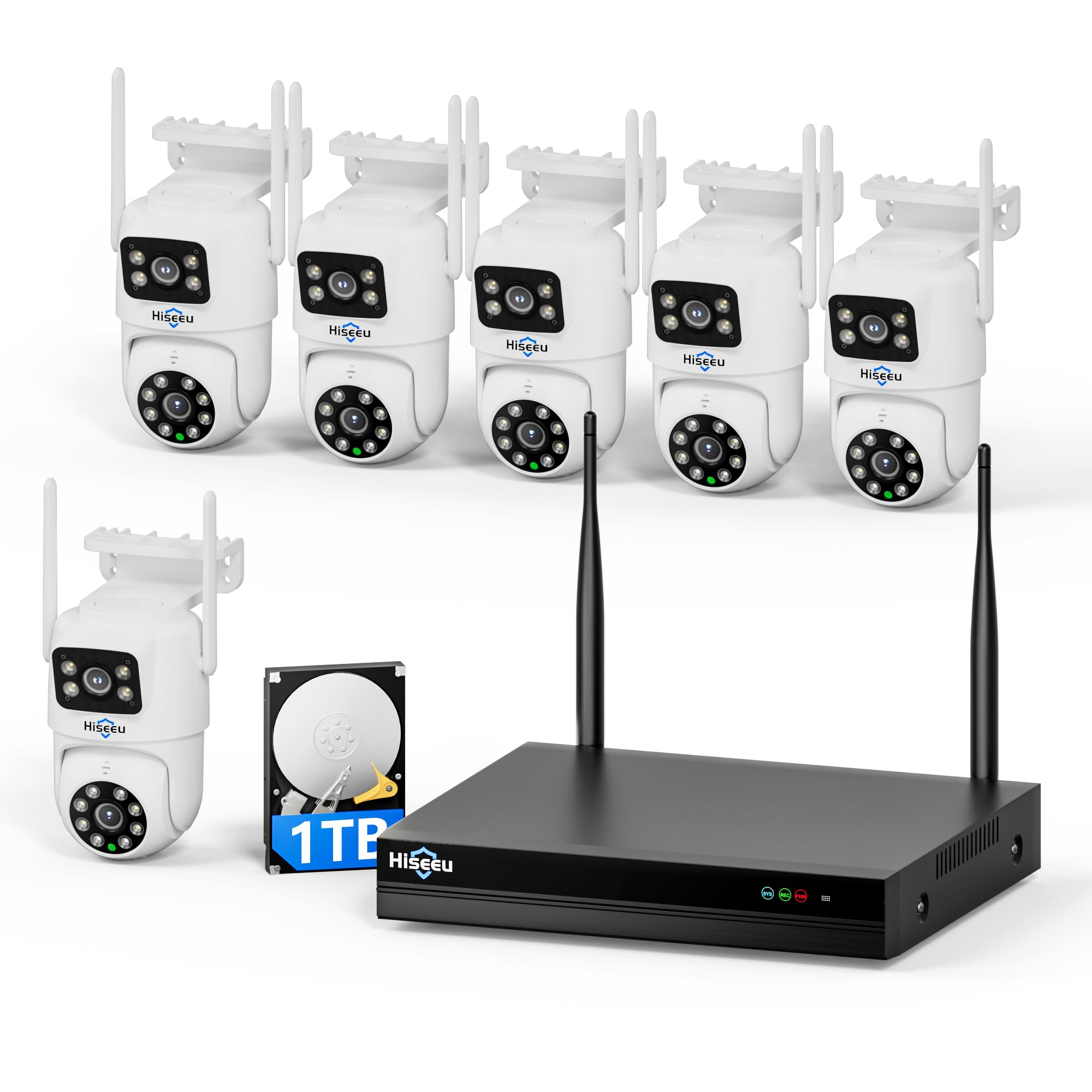
Six cameras, each with two lenses — one fixed, one that pans — and a whole terabyte of recorder storage behind them.
Six cameras with dual lenses give you a lot of coverage, and each unit pairs one fixed view with one pan-tilt camera, so you get a stable wide shot and a moving close-up from a single mount. A 1TB hard drive in the NVR (network video recorder, the box that stores the footage) records all six, so the storage question is settled for good — no cards to swap, no cloud. That 1TB beats the WYZE camera’s 512GB card slot by a wide margin on raw capacity, and it covers six cameras recording at once.
Cameras talk to the NVR over an upgraded 5GHz and 2.4GHz Wi-Fi Pro link, which the maker rates to 100 feet of coverage. Put the NVR within that range of each camera, because this is wireless only in the sense that it is not wired to a router — each camera still plugs into a DC 12V cord for power, so this is not a true wire-free kit. Plan for an outlet near each camera or a run of low-voltage cord.
Each camera is IP67-rated (sealed against dust and able to survive rain and snow), lights color night vision with built-in LEDs, and can trip a light alarm alongside the recording. Motion detection through PIR (a passive infrared sensor that spots body heat) plus auto-tracking on the PTZ lens (pan-tilt-zoom, a lens that follows movement) stays sharp after dark. The recurring caution in its own reviews is reliability — it is a mixed picture, with some buyers reporting intermittent issues — so the smart move is buying it for the wide coverage and checking the whole system during the return window. Where it works, the picture is clear and the station count pays off on a big yard.
Where it earns its place
- Six dual-lens cameras — a fixed view plus a pan-tilt view from each mount
- 1TB NVR hard drive recording all six with no subscription
- IP67 rating and color night vision with LED light alarms
- 100-foot wireless link between cameras and the NVR
What the buyer should know
- Each camera still needs a DC 12V power cord — not wire-free
- Reliability is mixed in its own reviews
- Tech-and-app control through EseeCloud is the learning curve
Built for: a big yard or multi-building property that wants six cameras and a full terabyte of local recorder drive.
Not the right one if: you cannot run a power cord to each camera or need battery freedom.
8. ARCCTV 360° PTZ Wireless Solar Security Cameras System 6-Cam-Kit
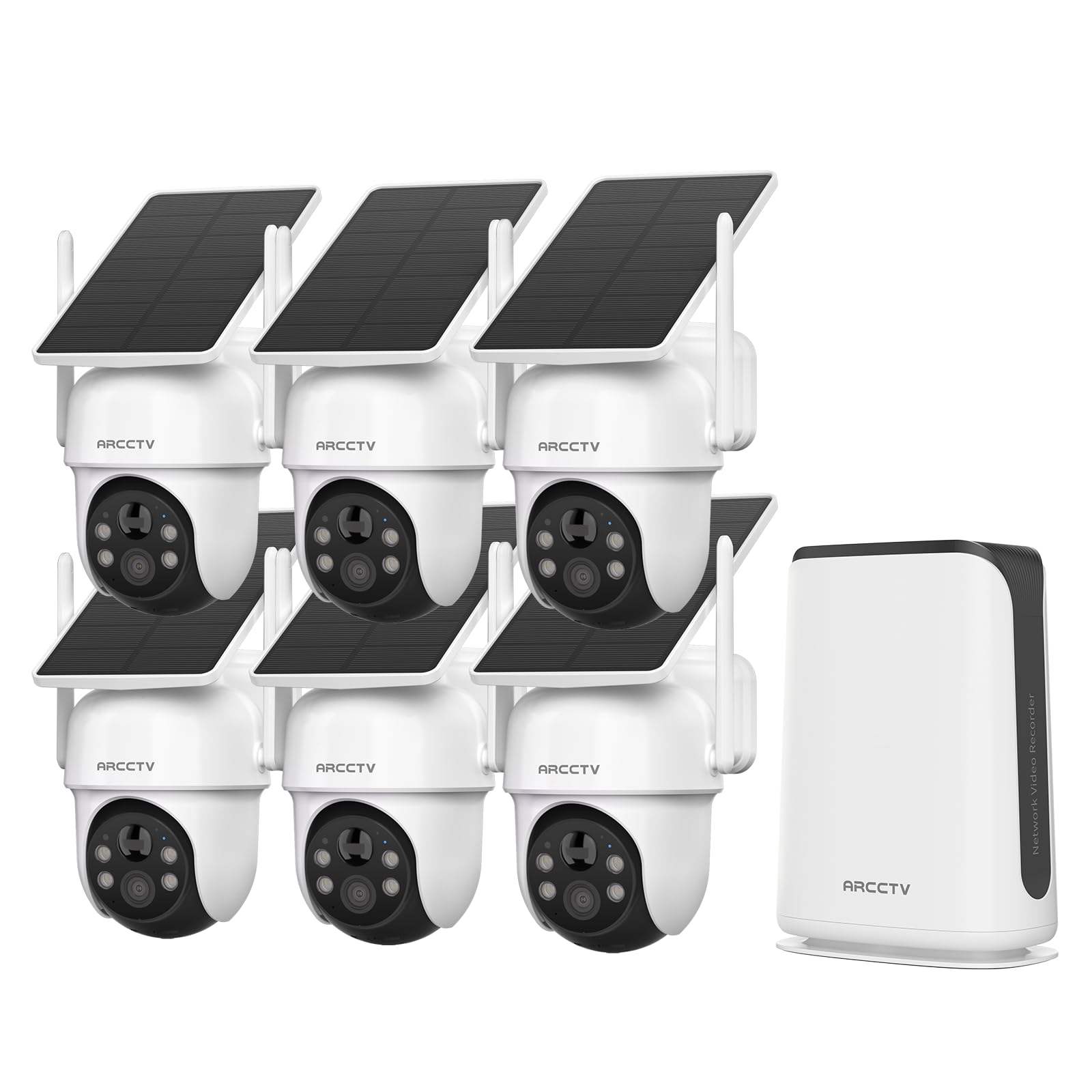
Six solar cameras, each sweeping a full circle on its own hub — a whole property covered without a single cable to run.
You can move the hub to wherever the cameras get the strongest signal, because the 2-in-1 hub works as both the wireless receiver and the NVR recorder and talks to your router over 2.4GHz or 5GHz Wi-Fi instead of a cable. Two local storage paths sit inside: a microTF card up to 512GB, and an internal hard drive up to 6TB. The recordings keep rolling with no internet access at all — you can plug a monitor and mouse into its HDMI and USB ports and watch everything locally.
Each of the six cameras is a 4MP PTZ head with a full 360-degree sweep and full-color night vision, and the smart AI sorts people, vehicles, and pets to cut the false-alert noise. You can draw custom monitoring zones so only motion inside those areas sets off an alert. The cameras are IP66-rated for outdoor weather and work with Alexa by voice.
For a farm, a small business lot, or a sprawling yard, this is a lot of ground covered with no cable runs. The genuinely honest catch is battery life — the mixed spot in its own reviews — so keep the solar panels clean and well-lit rather than letting debris or shade sap the charge. It is also a bigger-ticket multi-camera kit, so plan the six mounting spots before you buy. Where it is running properly, the wireless range and video quality hold up well, and the offline recording on the hub is the feature that makes it worth the space it takes.
The property-wide draw: a 2-in-1 hub recording to a card up to 512GB and a drive up to 6TB, with six 4MP PTZ solar cameras and offline recording as standard.
The caveat: battery life is the mixed spot in its own reviews, so panel placement and cleaning matter.
Pick this if: you have a large property, six mounting spots, and want solar cameras with a whole-home recorder — no monthly fee, no cable runs.
pass on it if: you want a simple two-camera setup, or every spot is deep shade.
9. REOLINK 16CH 12MP PoE Security Camera System RLK16-1200D8-A
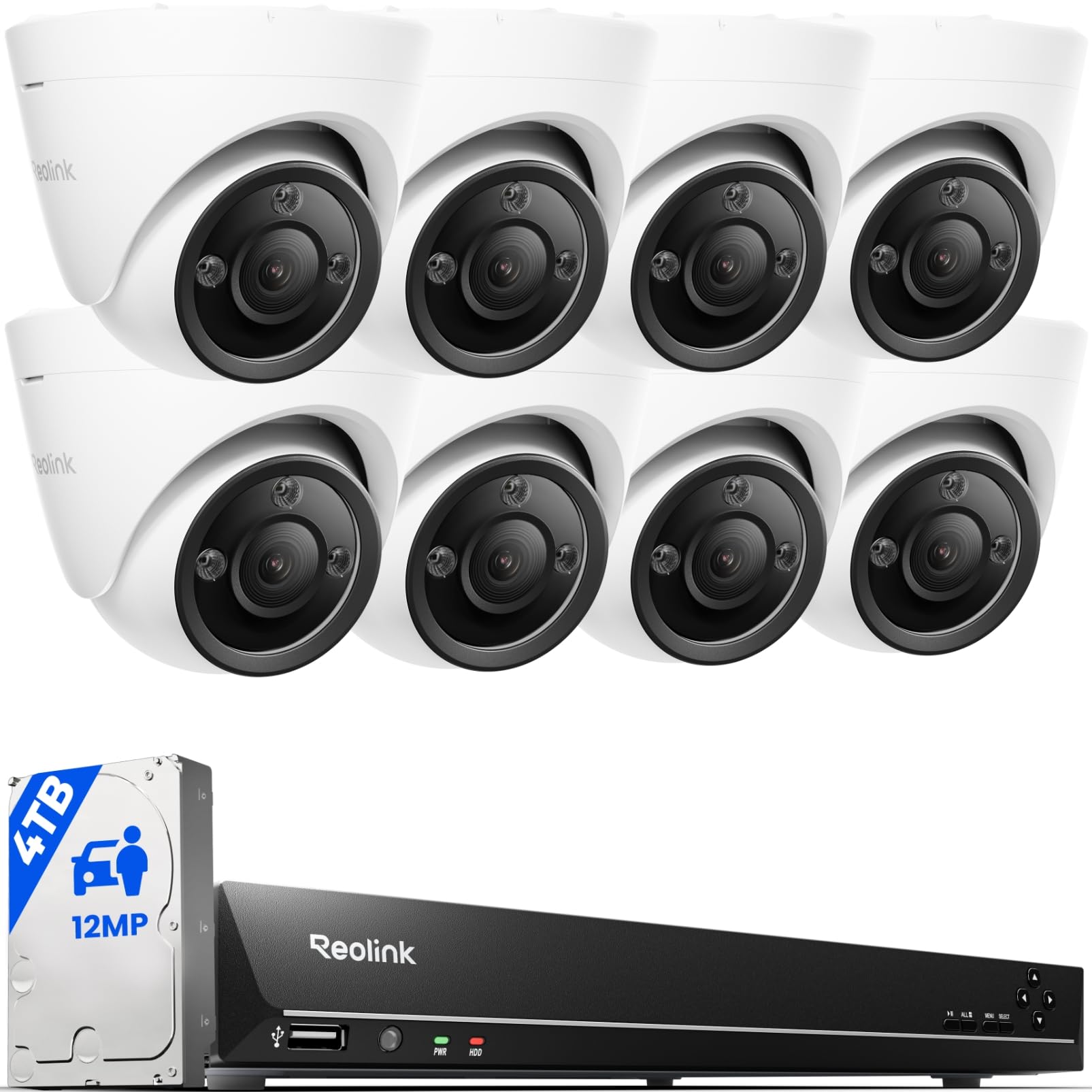
Eight 12MP cameras on a 4TB recorder that never needs a battery or a subscription — the serious install.
Twelve megapixels is the highest-resolution figure on this whole list, and per Reolink’s own spec it captures subtle details the lower-resolution picks miss. For a business lot, a long drive, or anywhere you actually need to read a face at distance, that resolution is the reason to pay for this class of system. The NVR’s 4TB drive holds the recordings, and with all eight cameras running on it, the storage question is answered for the long haul.
PoE means power over Ethernet — a single network cable carries both data and electricity to each camera, so there is no separate power cord and no battery. That cabling is a fixed install, but it is also the most stable connection you can give a camera. Full-color night vision runs on the cameras’ spotlights, which you can schedule or switch to infrared, and the spotlights work alongside a siren to deter intruders. Smart detection sorts people, vehicles, and pets so you are not wading through alerts about the neighbor’s cat.
This is not a budget buy and it is not a weekend DIY flip for a renter — it is the long-term backbone install with 16 PoE ports and room to grow to 24 channels. The honest note is that its own reviews show a mixed reliability picture, which is why a clean install and a proper return window matter on a system this capable. Where it works, the picture quality is what people come back to, and two-way talk through each camera’s built-in speaker adds a real deterrent you can use live.
The resolution lead: eight 12MP cameras, 4TB of recorder storage, 16 PoE ports, and full-color night vision with spotlights — the serious system on this list.
What it costs you: a fixed cable install and a system class that needs care in setup to get the best from it.
Choose it for: a business or large property where reading a face at distance justifies eight high-res PoE cameras and a 4TB drive.
Skip it for: a small home or a rental that cannot take a cabled installation.
Know the Specs
Local Storage (SD Card and Hard Drive)
Local storage is the memory that lives in your home and keeps recording with no internet. It comes two ways: a microSD card slipped into a camera, or a hard drive inside a recorder box. The number that matters is capacity — a large card holds weeks of clips before the oldest footage overwrites, while a big drive in a recorder holds months of multiple cameras. A camera that stores on a card loses its footage with the camera; a hub or recorder keeps it even if a camera is taken. Check which system you are buying before you mount.
Solar Panels and Battery Capacity
A solar panel trickle-charges the camera’s battery, and the battery capacity — measured in milliamp-hours — decides how long the camera rides through cloudy days. A bigger battery with a bigger panel means less worry. Panels can be fixed or detachable; a detachable panel lets you aim it at the sun while the lens points where you need it. A wired system skips all of this and never needs charging, at the cost of running cable.
Resolution and Night Vision
Resolution is measured in megapixels, and a higher number means more detail to read a face or a plate. Night vision comes two ways: color, using built-in LEDs to light the scene, or infrared, shown in black and white. Color night vision shows clothing and vehicle color; infrared reaches further in total dark. Pair the resolution with the night mode you will actually use on your property.
Connectivity: Wi-Fi, PoE, and BNC
Wi-Fi cameras connect wirelessly, with 2.4GHz reaching further and 5GHz faster at close range. PoE cameras pull power and data over one network cable, which is the most stable connection. BNC cabling, used in some wired kits, carries power and video together to the recorder. All three can record without an internet connection as long as the storage is local.
Common Questions
Do these cameras really work with no internet at all?
Do I still have to pay a monthly subscription?
What happens to the footage if a camera gets stolen or broken?
How much sun do the solar cameras need to stay charged?
Will a wireless kit work if my Wi-Fi is weak at the back of the property?
Can I add more cameras later?
Do these cameras record in color at night?
Is a wired system better than a solar one for an offline setup?
How many cameras do I actually need?
Can these cameras send me an alert when I am away from home?
Will a solar security camera survive cold winters and heavy rain?
The Bottom Line
For most homes, the winning pick is the Vivideye 8-Channel 4-Camera Solar Kit. It puts 128GB of storage inside the hub where a stolen camera cannot take it, runs four cameras on 8000mAh batteries with 5W panels, and grows to eight cameras when you want more. No subscription, no card to buy on day one. If you only need one wide-angle camera, the eufyCam C37 gives you a 360-degree pan with a detachable 3W solar panel; if you need the darkest-driveway detail, the eufyCam E40 kit leans on its F/1.0 aperture (a wide lens opening that lets in more light) for color footage in near-total dark.
A closing nudge on how to buy: the four-camera Vivideye kit carries 4.5+ stars from 130+ owners, and the built-in hub storage is the spec that keeps buyers coming back to it. Whatever you choose, verify the recording inside the return window — a system you have watched record for a week is worth far more than one you trust on faith.
How we choose
We do not accept paid placement. Every pick is matched to a real buyer and a real use-case; we do not hands-on test units.
Sources
Specifications: manufacturer listings and product documentation. Review insights: verified customer reviews, as of November 2026. Pricing: not shown on this page (it changes often); check the current price via the retailer link.
As an Amazon Associate, Tactical Gear Guy earns from qualifying purchases. This does not affect which products we feature.