Specs are compiled from manufacturer listings and verified buyer reviews and can change over time — please confirm the key details on the product page before buying.
If you are tired of dragging a heavy stepladder into the hallway every time you need a box from the loft, a pull-down scissor ladder folds away into the ceiling and gives you a fixed, stable climb instead. The short answer: match the ladder to your rough opening and ceiling height first, then check the load rating — get those three right and the install goes smoothly. This guide covers the six models worth your attention, what each one actually does well, and where each one will make you compromise.
This guide is built by comparing the manufacturers’ published specifications and the patterns across verified customer reviews, so you get each pick’s real strengths and trade-offs instead of marketing spin.
A folding loft stair only works if the opening size and ceiling height line up with your house — the wrong dimensions turn a weekend job into a rebuild. Below you will find the honest breakdown of every model, sized and rated for real attics, so you can pick the right scissor attic ladder without a second trip to the hardware store.
Top Picks
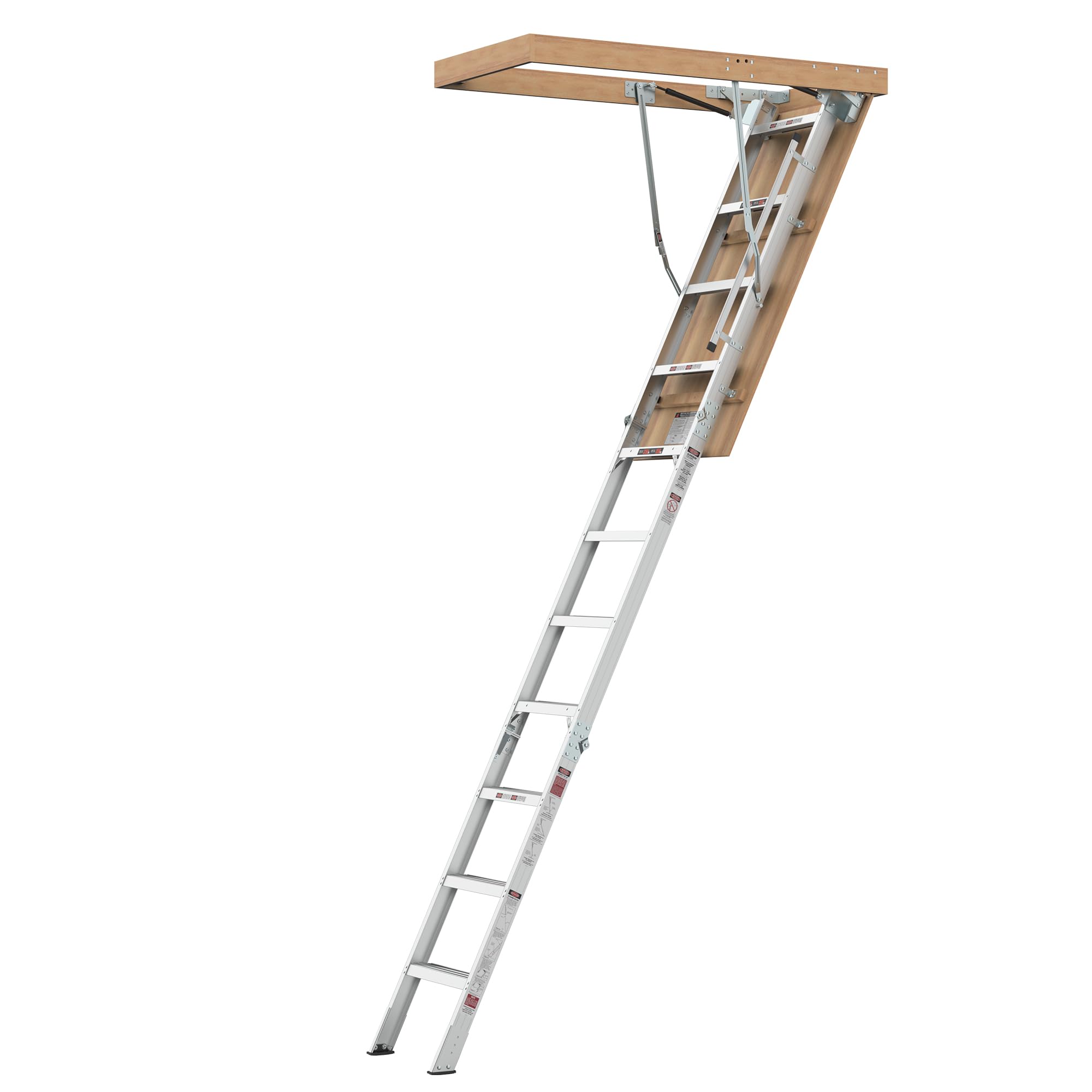
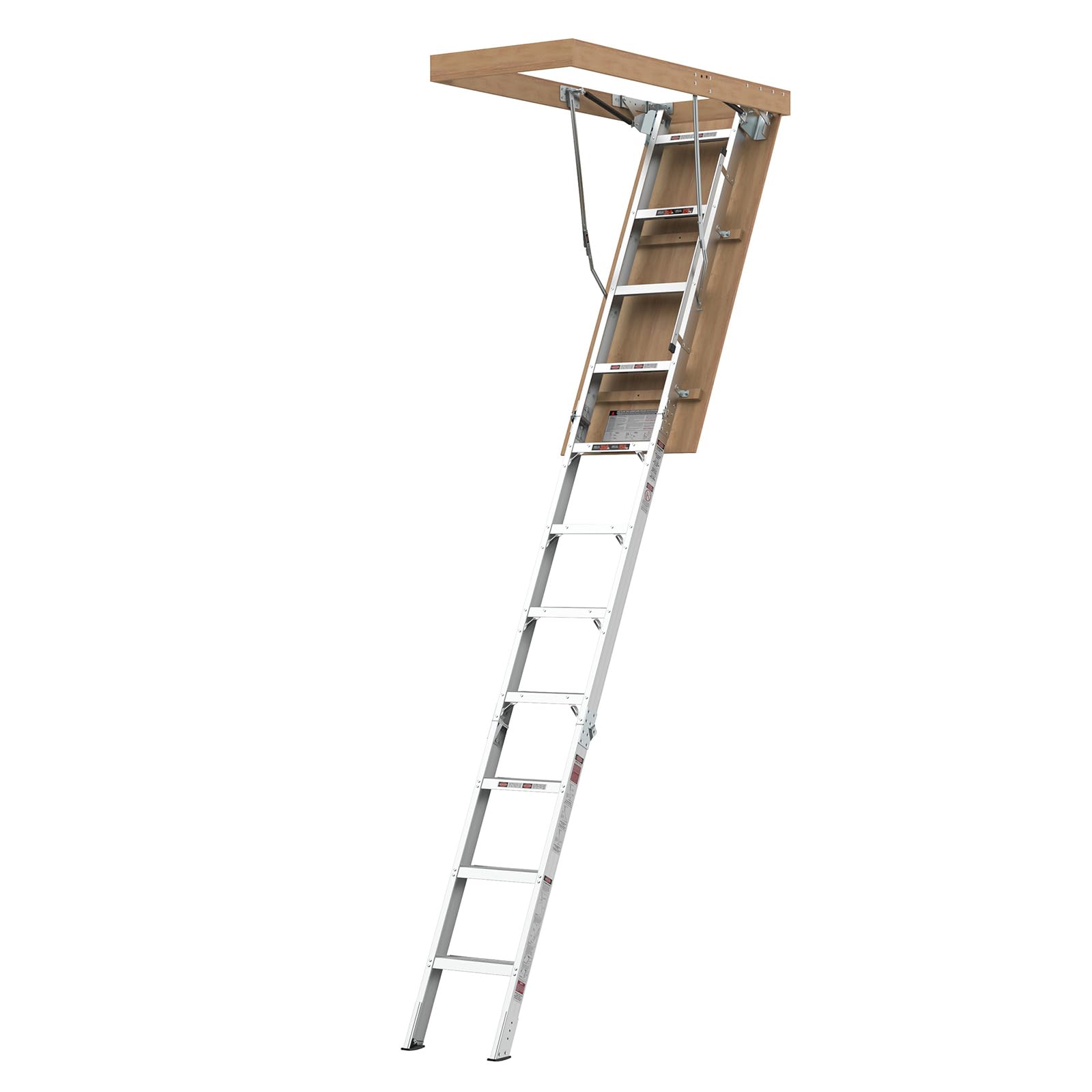
How To Choose The Best Scissor Attic Ladder
Most attic ladder regrets come from one mistake: buying before measuring the hole in the ceiling. A scissor ladder is a fixed piece of hardware, so it either drops into your existing framed opening or it does not. Measure that opening’s width and length, then measure your ceiling height from the floor to the top of the joist. Those two numbers narrow the field faster than any other spec.
Match the rough opening before anything else
The rough opening is the rectangular gap framed into your ceiling where the ladder drops through. Most models on this list are built around a 22.5-inch by 54-inch opening, while one wider model needs 25 inches of width and another asks for a 39.4 x 27.5-inch cut. If your opening is already framed, buy to that number. If you are cutting fresh, the smaller opening means less ceiling surgery and less patching afterward.
Check the ceiling height range against your actual joists
A ladder rated for 7’8″ to 10’3″ ceilings covers the vast majority of homes, and several picks here use that exact range. Older houses and garages sometimes sit higher, which is where a model built for 10.5 to 11-foot ceilings earns its place. Measure to the finished ceiling surface, not to the joist bottom, and leave yourself a little room inside the stated range rather than landing right on the edge of it.
Read the load rating and the hinge design together
Load capacity tells you how much weight the ladder is built to carry — 350 pounds on one pick, 375 pounds on several, and 660 pounds on the heavy steel model. The hinge system matters just as much, because a high rating on flimsy hinges still wobbles underfoot. Look for heavy-duty hinges and non-slip feet, and treat hydraulic or shock-assisted arms as a comfort feature that slows the drop when you pull the ladder down.
Weigh tread width against the space you have
Wider treads make climbing with a box in your arms noticeably easier, but a wider tread usually means a wider opening. One model here runs 5.5-inch steps and another 3.25-inch steps, and narrow treads are the most common gripe in owner feedback. If you regularly haul storage bins up and down, favor the wider step and accept the bigger cut. Favor the compact opening if your hallway ceiling is tight.
Side-by-Side Comparison
| Model | Best For | Rough Opening | Load Capacity | Ceiling Height | Amazon |
|---|---|---|---|---|---|
| WTRAVEL Aluminum Attic Ladder★ Best Overall | All-round home attic access | 22.5″ x 54″ | 375 lbs | 7’8″ – 10’3″ | Amazon |
| S.Walt Folding Loft StairsSteadiest Climb | Quiet, stable climbing | 22.5″ x 54″ | 350 lbs | 7’8″ – 10’3″ | Amazon |
| WIILAYOK 22.5″ x 54″ | Easy pull-down with shocks | 22.5″ x 54″ | 375 lbs | 7’8″ – 10’3″ | Amazon |
| WIILAYOK 25″ x 54″ | Wider treads and a hand hold | 25″ x 54″ | 375 lbs | 7’8″ – 10’3″ | Amazon |
| LITE 10 ft Aluminum | Lightweight one-person handling | 54″W x 22.5″H | 375 lbs | 7’8″ – 10’3″ | Amazon |
| VEVOR Attic Ladder | High ceilings and heavy loads | 39.4″ x 27.5″ | 660 lbs | 10.5 – 11 ft | Amazon |
Detailed Reviews
1. Aluminum Attic Ladder 375 lbs
Our pick — 4.5+★ from 150+ verified ratings; the strongest balance of quality and price.
Twelve aluminum steps that fold flat into the ceiling and carry 375 pounds.
The first thing that stands out here is the step count — 12 steps in a 7’8″ to 10’3″ ceiling range. More steps means each rise is shorter, so you are climbing in a more natural rhythm instead of hauling yourself up a steep pitch. For a household where somebody has to fetch a box every week, that rhythm matters more than any marketing claim on the box.
The build is aluminum alloy with heavy-duty hinges, non-slip footing, and a handrail across the climb. That combination is the difference between a ladder you trust and one you brace against — the rail gives you something to hold when your other arm is full. It fits a 22.5-inch by 54-inch rough opening and weighs 41.3 pounds, which is light enough for one adult to pull down and press back up without a second pair of hands.
Owners two years in still report the hinges and steps working as they did on day one. The honest caveat sits in the step width: the treads measure 12 inches, and that narrower top section makes hauling a big, bulky item upstairs an awkward job. It is outstanding for boxes, bins, and holiday decorations. It is not the ladder for moving a sofa into a finished loft.
Where it earns the top spot
- 12 steps across the 7’8″–10’3″ range keep the climb as easy as a staircase
- 375-pound load rating gives you margin for heavier storage boxes
- Heavy-duty hinges and non-slip footing hold steady underfoot
- 41.3 pounds folds away into the ceiling and stays out of the hallway
The part worth knowing before you buy
- 12-inch treads are narrow at the top — awkward for oversized items
- You need the exact 22.5″ x 54″ opening framed already
The pick for most homes: a standard ceiling, a standard opening, and weekly trips up for storage — this one covers it with the most steps in the group.
Measure first: the 12-inch tread width is the one thing to plan around if you move large furniture.
2. Aluminum Attic Ladder 350 lbs
Widened aluminum steps and big rubber feet — built to feel planted, not springy.
If the thing you fear most is that mid-climb wobble, this is the model to look at closely. The 350-pound capacity sits a notch below the 375-pound group, but the design emphasizes stability in other ways: widened aluminum steps with a non-slip surface, sturdy hinges, and large rubber feet that grip the floor instead of sliding out from under you.
It uses the same 22.5-inch by 54-inch opening as the top pick and adjusts across 7’8″ to 10’3″ ceilings, so it drops into the same framed hole with no extra carpentry. The aluminum build is rust-resistant, which matters in a damp garage or an unheated ceiling cavity where steel quietly starts to show its age. Folding it back up retracts the whole unit into the ceiling frame and gives you your floor space back.
Compared with the twelve-step option above, this one trades step count for tread comfort — fewer, wider steps rather than a longer run of narrower ones. That suits a household where the ladder is used to carry something bulky rather than just to reach a single box. The trade-off is the lower load ceiling: 350 pounds instead of 375, which is still more than one person plus a heavy bin, but worth weighing if two of you climb together.
The stability argument: non-slip treads plus large rubber feet are aimed squarely at the wobble problem, and the rust-resistant aluminum makes it a sensible pick for garages and damp outbuildings.
Worth flagging: the 350-pound rating is the lightest on this list, so make sure that figure covers your heaviest realistic load before you commit.
Reach for this if: your attic sits above a garage or a damp space and you want a ladder that feels anchored.
Look elsewhere if: you regularly carry loads near the top of the rating and want the extra headroom of a 375-pound unit.
3. 22.5″ x 54″ Aluminum Attic Ladder, 375 lb, Fits 7’8″-10’3″
Shock-assisted arms take the yank out of opening and closing the hatch.
Manual ladders ask you to haul the whole unit down and press it back up against gravity. This one adds hydraulic arms and shocks that ease both motions, so the drop feels controlled rather than sudden. That single change is the reason it gets recommended to people who are not looking for a workout every time they need the loft.
The rest of the spec sheet lines up with the category standard: 22.5-inch by 54-inch rough opening, 375-pound load capacity, and a 7’8″ to 10’3″ ceiling range. The hinge system is heavy-duty and the treads carry a non-slip surface, so the climbing surface itself is conventional and proven. It comes with the retractable folding design that tucks away into the frame when the hatch is shut.
Owners repeatedly note how steady it stays when fully extended — one installer who fits attic access for a living called it among the nicest ladders of this type he had used, and the hydraulic shocks are named again and again as why closing it takes so little effort. The genuine caveat is the feel: some describe a slight shake underfoot even though it holds weight fine. Expect a small amount of flex in a folding aluminum ladder and you will not be surprised by it.
The comfort upgrade: hydraulic arms change the daily experience of opening the hatch — less effort on the pull, less slam on the close.
Set expectations on rigidity: it carries 375 pounds without complaint, but a folding ladder of this type can feel a little lively underfoot, and that is normal rather than a fault.
Best matched to: anyone who finds manual pull-downs tiring, or who wants a gentler close so the hatch does not bang.
One honest limit: if you want a ladder that feels dead-solid like a staircase, the shock-assisted flex may not be to your taste.
4. 25″ x 54″ Aluminum Attic Ladder, 375 lb, Fits 7’8″-10’3″
A hand hold on the right side and wider treads for carrying a box up one-armed.
Twenty-five inches of opening width is the headline here — wider than the 22.5-inch models that make up most of this list. That extra width buys you treads that feel more like stairs than rungs, which changes the experience of climbing with something in your hands. If you have ever balanced a storage bin against your hip on a narrow ladder, you know exactly why that matters.
The treads themselves carry an anti-slip surface with a 3-inch width and an uneven structure that adds friction as you move. There is also a portable handle on the right side, positioned so you can keep your balance on the way up and down. The hinge system is heavy-duty, rated to 375 pounds, and the whole thing retracts and folds away into the ceiling frame when not in use.
Here is the trade-off you have to accept: that extra width means the rough opening has to be 25 inches by 54 inches, so it will not drop into a standard 22.5-inch hole without carpentry work. The unit also weighs 50 pounds — noticeably heavier than the 22-pound LITE model further down this list, which makes one-person handling more of a two-hand job. Choose it when you are cutting a fresh opening and want the wider climb; let it go if your frame is already set at the narrower size.
Why the extra width pays off
- 25-inch opening delivers treads that feel closer to a real staircase
- 3-inch anti-slip treads with an uneven structure for extra grip
- Side handle gives you a balance point during the climb
- 375-pound rating matches the strongest aluminum models here
What you give up
- Needs a 25″ x 54″ rough opening — will not fit a standard 22.5-inch frame
- At 50 pounds, it is the heaviest aluminum unit on this list to handle
The choice for a fresh cut: if you are framing a new opening and want the widest, most staircase-like climb, this is the one.
Not for a set frame: an existing 22.5-inch hole means passing on this and picking a narrower model instead.
5. LITE 10 ft Aluminum Attic Ladder

Twenty-two pounds of aluminum that stays rock solid once it is bolted in.
The weight is the story. At 22 pounds this is the easiest ladder on the list to maneuver into place, which matters on install day when you are lifting it overhead into a framed opening. Compare that with the 50-pound WIILAYOK 25-inch model and the 121.9-pound VEVOR steel unit, and you can see why this one gets picked for solo jobs and tight ceilings where you cannot get help up there.
It fits a 54-inch by 22.5-inch rough opening and spans 7’8″ to 10’3″ ceilings, with a 375-pound load capacity and heavy-duty hinges that unfold smoothly and resist wobble. The cross treads carry a slip-resistant surface at 3.25 inches of depth.
What wins people over is how solid it feels once bolted in — owners say it firms up completely after mounting and carries the stated 375 pounds without complaint. The recurring gripe is narrower than it sounds: the treads are thin and the top of the climb asks you to step slightly sideways because of the panel, which makes the ascent a bit more deliberate. None of that stops it from doing the job. It just means you pay attention on the way up.
The install-day win: 22 pounds is light enough that one adult can position it, and the light frame does not translate into a flimsy climb once the hinges are bolted down.
The real compromise: thin treads and a panel that forces a sideways step near the top make it a climb you do carefully rather than casually.
Pick it when: you are installing solo or working in a tight ceiling where a heavier unit would be a two-person struggle.
Think twice if: generous tread depth is your priority — the 3.25-inch steps are on the thin side.
6. VEVOR Attic Ladder, 660LBS Fits 10.5 to 11 ft Ceiling Heigh
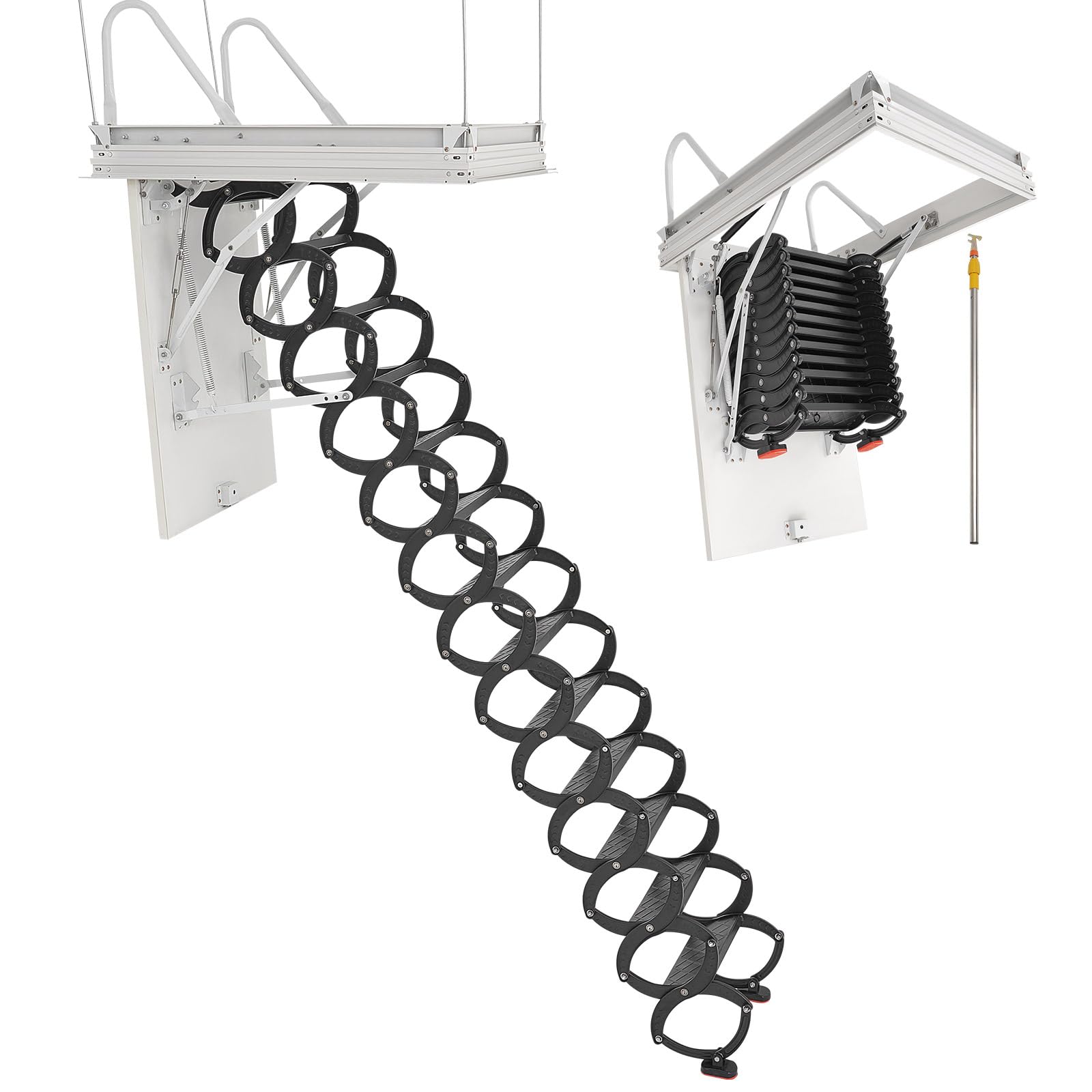
Six hundred and sixty pounds of alloy steel for ceilings the others cannot reach.
Nothing else on this list operates in the same league. The 660-pound rating is close to double the strongest aluminum model here, and the build is impact-resistant alloy steel with durable hinges, support rods, and an X-frame that adds rigidity. The 5.5-inch steps are the widest on the page, and anti-slip rubber feet keep the base from shifting when you are hauling something heavy up top.
The ceiling range is the other reason to pick it: 10.5 to 11 feet, well above the 7’8″ to 10’3″ span every other model is built around. If your loft sits high, this is the only one here that will reach. It handles a ceiling thickness of at least 5.12 inches, works with 2 inches of wall clearance, and asks for a 39.4 x 27.5-inch opening — the largest cut on this list, and one you will want to plan for before you start cutting. Must be mounted on a load-bearing area.
The dual hydraulic rods let the ladder lower slowly and steadily rather than dropping, which makes the opening motion calmer and suits anyone with limited strength. A pull rod and ring let you open and close it without extra tools. Weighing 121.9 pounds, though, this is a serious piece of steel that needs proper installation help and a load-bearing spot above. Detachable steps give you flexibility in how it is set up, which helps in an awkward attic layout.
Where nothing else here competes
- 660-pound rating for genuinely heavy storage loads
- Fits 10.5 to 11-foot ceilings that the other picks cannot span
- 5.5-inch steps — the widest climb on this list
- Dual hydraulic rods lower the ladder slowly and steadily
The investment side of the trade
- Needs a large 39.4 x 27.5-inch opening cut in the ceiling
- 121.9 pounds and load-bearing mounting — not a solo install
Built for the hard case: a high ceiling, a heavy-load loft, and space for a large cut — this is the ladder that solves all three at once.
The single constraint: the 39.4 x 27.5-inch opening means checking your joist layout carefully before you commit.
Know the Specs
Rough Opening Dimensions
The rough opening is the framed rectangular hole in your ceiling that the ladder drops through. Every model on this list is built around one, and the number must match your home. Most picks use 22.5 inches by 54 inches, one uses 25 inches by 54 inches, and the VEVOR steel unit needs a 39.4 x 27.5-inch cut. Too small and the ladder will not seat; too large and you are patching drywall. Measure the opening before you compare ratings, because a perfect ladder for the wrong hole is no ladder at all.
Load Capacity and Hinge Type
Load capacity is the weight the ladder is engineered to carry — 350 pounds, 375 pounds, or 660 pounds depending on the model. That figure is only as trustworthy as the hinges and support rods behind it. Heavy-duty hinges keep the ladder from wobbling mid-climb, non-slip feet stop the base from sliding, and hydraulic or shock arms slow the drop when you pull it down. Read the two together: a high rating on weak hinges still feels unstable underfoot.
Ceiling Height Range
Ceiling height range is the floor-to-ceiling span the ladder is built to span safely. The 7’8″ to 10’3″ range covers most homes, while the VEVOR unit is built for 10.5 to 11-foot ceilings. Land inside the range rather than right at its edge — measuring to the finished ceiling surface, not to the bottom of the joist, keeps you honest. A ladder that is genuinely suited to your height keeps every step at a comfortable rise.
Step Count and Tread Width
Step count and tread width work together to decide how the climb feels. Twelve steps over the same height means a shorter rise between each; seven steps means a steeper pitch. Tread width decides how much of your foot lands on each step, with 3-inch and 3.25-inch treads appearing here and a 5.5-inch step on the VEVOR unit. For hauling boxes up and down, wider treads are worth the extra opening width they demand.
Common Questions
Will a scissor attic ladder fit my existing ceiling opening?
How do I measure my ceiling height for an attic ladder?
Is a 350 lb or 375 lb ladder strong enough for regular use?
Do I need two people to install an attic ladder?
What is the difference between a scissor attic ladder and a fixed wooden staircase?
Will the ladder wobble when I climb it?
Can I install an attic ladder in a garage ceiling?
How much space does a folded attic ladder take up?
What does Type IAA mean on an attic ladder rating?
Are the steps wide enough to carry a storage box up safely?
The Bottom Line
The strongest all-round choice for a normal home is the WTRAVEL 12-step aluminum ladder, because its 12 steps over the 7’8″ to 10’3″ range give you the most staircase-like climb in the group. If you want the pull-down to feel gentler, the WIILAYOK 22.5-inch model with hydraulic arms takes the strain out of opening and closing. And for a high loft with heavy loads, the VEVOR steel ladder is the only one here that reaches 10.5 to 11-foot ceilings with 660 pounds behind it.
How we choose
We do not accept paid placement. Every pick is matched to a real buyer and a real use-case; we do not hands-on test units.
Sources
Specifications: manufacturer listings and product documentation. Review insights: verified customer reviews, as of November 2026. Pricing: not shown on this page (it changes often); check the current price via the retailer link.
As an Amazon Associate, Tactical Gear Guy earns from qualifying purchases. This does not affect which products we feature.