Specs are compiled from manufacturer listings and verified buyer reviews and can change over time — please confirm the key details on the product page before buying.
Your dish keeps drifting off aim because the pole underneath it was never strong enough for the job. That is the whole problem in one sentence. A satellite dish is a narrow-beam target, and every bit of sway in the mast turns into lost signal on your screen. The fix is not a smarter dish — it is a mast with real wall thickness, a bracket that locks, and hardware that will not rust into your fascia board after one winter. Below you get seven poles and mounts ranked by how well they actually hold a dish still, from a stainless J-pole that bolts to concrete to a collapsible tripod for tailgating weekends.
This guide is built by comparing the manufacturers’ published specifications and the patterns across verified customer reviews, so you get each pick’s real strengths and trade-offs instead of marketing spin.
You will see which mast diameters match which dish adapters, why gauge thickness beats length, and where a reversible J-pole saves you a return. Read on for the shortlist that makes a satellite dish pole choice simple, with the trade-offs spelled out in plain words.
Top Picks


How To Choose The Best Satellite Dish Pole
A dish mount is a lever, and you are bolting the long end of it to your house. That is why the first thing to check is not length — it is how thick the steel is where the bracket grips the mast. Get that wrong and you will be back on the roof in a fortnight re-aiming.
Match the mast diameter to your dish adapter first
Dishes do not clamp straight onto a pole. They use an adapter, and that adapter is built for one size range. The Skywalker and the imbesel 33.25-inch pole run a 1.66-inch and a 1.25-inch outer diameter respectively, while the heavy-duty 17.25-inch mount uses a 1 11/16-inch outer with a 1.5-inch inner bore. Write your adapter’s size on a note before you shop, because a pole that is a hair too fat or too thin will not tighten no matter how hard you crank it.
Gauge thickness is what stops the wobble
A 1.5 mm steel mast (roughly 16-gauge) paired with a 2 mm (roughly 14-gauge) bracket is the pairing you want for a full-size dish on a windy wall. Thinner masts flex under load, and flex is what lets the aim creep. The lighter aluminum pole in this list trades some of that stiffness for rustproofing — a fair deal for a weather station, a risky one for a big dish in a gale.
Decide if you need portability or permanence
If the dish stays put for years, a bolted J-pole is the right call. If the dish travels with a camper or shows up at a tailgate, you want a tripod that collapses into a bundle you can stow in the vehicle. Those are two different products and no single pole does both well.
Reversible masts give you a second chance at clearance
Several poles here let you flip the J-pipe end for end, which buys extra horizontal standoff from the wall or a taller reach over an eave. That is a genuinely useful feature when the obstruction — a chimney, a roofline, a neighbour’s tree — is the reason your signal is marginal.
Side-by-Side Comparison
| Model | Best For | Mast Diameter | Length | Material | Amazon |
|---|---|---|---|---|---|
| J-Max Pivot/Lock Antenna Mount Pole★ Best Overall | Stainless wall and concrete mounts | 1.5 in | 18 in | 304 stainless steel | Amazon |
| imbesel Heavy Duty Antenna Mount PoleBest for Weather Stations | Weather stations and light dishes | 1 11/16 in outer | 17.25 in | Powder-coated alloy steel | Amazon |
| imbesel Universal Mounting Pole 33.25 in | Garden weather stations | 1.25 in | 33.25 in | Powder-coated steel | Amazon |
| CeKay Universal Mounting Pole 49.5 in | Height and extra reach | 1 in | 49.5 in | Rustproof aluminum alloy | Amazon |
| CEKAY Antenna Mount J-Pole 1.5x35in | Heavy dish on a long arm | 1.5 in | 35 in | Powder-coated steel | Amazon |
| Skywalker J Pipe Mount Mast | Clearing a roofline | 1.66 in | 38 in | Powder-coated metal, one-piece | Amazon |
| STEREN Satellite Tripod | RV, camp and tailgate setups | 2 in and 1 5/8 in ends | 34 in | Zinc and galvanized steel | Amazon |
Detailed Reviews
1. J-Max Antenna Mount Pole 1.5″x18″
Our pick — 4.5+★ from 450+ verified ratings; the strongest balance of quality and price.
The stainless mast that refuses to rust onto your house.
The material is the reason this one takes the top slot. Both the bracket and the arm are 304 stainless steel — a marine-grade alloy that will not rust onto your wall when the rain and salt air get at it for a few seasons. The included mounting hardware is stainless too, so your bolts come back out if you ever need to move the dish. That is the difference between a mount you own and a mount that owns your fascia board.
This pole stays put in the wind, and its short build is why. It measures 18 inches long with a 1.5-inch mast, so there is less unsupported arm for the wind to twist. A locking pin fixes the pivot at 0, +45 or -45 degrees, so once you find the aiming angle for a dish on a flat wall or a sloped eave, it holds instead of creeping a degree at a time. Bolted to concrete, it goes up once and stays put.
You can flip the reversible J-pipe to add wall standoff, which matters when your own roofline is the obstruction. At 1.3 kg, one person can hold it on a ladder while drilling the first hole. It is also 0.42 kg lighter than the imbesel 17.25-inch mount, a difference you will notice after five minutes with your arms above your head.
What holds up on the wall
- 304 stainless steel bracket, arm and hardware so rust never becomes the weak point
- Locking pin locks the pivot at 0, +45 or -45 degrees instead of trusting bolt tension
- Reversible J-pipe lets you dial in extra standoff from a wall or eave
- Universal fit works across satellite, HDTV, weather station and signal-booster antennas
Where it asks a little more of you
- 18 inches of arm reaches a nearby roofline but not a distant obstruction
- Starlink owners often need a hose clamp to cinch the dish adapter down tight
- Getting a precise sub-degree aim takes a bit of patience once the pin is set
Worth bolting up: anyone mounting a dish to a concrete wall, roof or eave who wants rust off the list of future problems.
Hold off if: you need a long reach over an obstruction — this arm measures 18 inches and no more.
2. Heavy Duty Antenna Mount Pole 1.69 x 17.25 in
Fat bore, short arm, and a clamp kit that will not budge in a gale.
Two install routes in one box is what sells this mount. You can bolt the bracket to a wall or roof, or use the V jam brackets and U-bolt to clamp the whole thing onto an existing pipe between 1 inch and 2 inches in diameter. That second option is gold if you already have a mast standing from an old aerial — you are not drilling anything new.
The bore is the widest of the wall-mount poles here at 1 11/16 inches outer with a 1.5-inch inner, and the arm runs 17.25 inches. It is made from 2 mm, 14-gauge tube and a matching 2 mm bracket, so it carries a small weather station or a compact dish without the sag you get from a thin mast. The 1.72 kg mass also means it sits heavy in the bracket. That is not a drawback when it is stationary; it is exactly why it shrugs off storms that leave lighter poles swinging.
For an anemometer (a wind-speed sensor), a rigid mast keeps your wind readings honest, because a wobbly pole makes every gust reading suspect. The powder-coated finish does the long-term work against wear. Go in knowing the value question is real: some owners felt the tag ran high for the size of the tube. Weigh that against the hardware in the box — four ST6×50mm stainless self-tapping screws and two clamp U-bolt kits — plus a one-year warranty.
The honest read: the 1 11/16-inch bore is wider than the 1-inch CeKay mast, so adapters that clamp snugly here will rattle loose on a slimmer pole.
What to watch: the 17.25-inch arm is compact by design — great for tight eave work, less reach than the 35-inch CEKAY if your dish sits behind a chimney.
Reach for this if: you are hanging a weather station or small dish and want the option to clamp onto an existing pipe instead of drilling fresh holes.
Look elsewhere if: you need long standoff from a wall — the arm tops out at 17.25 inches.
3. Universal Antenna Mounting Pole 1.25 x 33.25 in

The garden-workhorse pole with the depth of buyer experience behind it.
If you want the safest bet in this category, this is the pole with the largest crowd behind it. The 33.25-inch arm and 1.25-inch mast sit in the middle of the size range, so it fits a huge spread of weather stations, WiFi repeaters, small dishes and signal boosters. The 180-degree rotation lets you swing the J-pole around to point wherever the signal is strongest, whether you are mounting on a vertical wall, a horizontal fascia or a sloped roof line.
The build is 1.5 mm steel mast with a 2 mm bracket, both powder-coated against rain and damp. It ships with ST8 × 50 mm stainless hex-head self-tapping screws, plastic anchors and a screw sleeve wrench, so you are not making a hardware-store run mid-install. Hung on the side of a house, the offset keeps a weather station sensor clear of the shingles, which keeps rainfall and wind readings clean.
Two things to know before you buy. First, it does not clamp to Starlink without a separate adapter, and the fit on that adapter is hit or miss. Second, the mounting bracket adjusts in one plane only, and cranking the bolts can twist the arm out of line — drill your pilot holes last, after everything is positioned and snug. Neither is a deal-killer for the weather-station job it was clearly designed around.
What wins people over: the combination of a mid-size 33.25-inch arm, a rock-solid 2 mm bracket and every screw you need in the box.
The catch: slimmer hardware tolerances mean some units need a washer or a re-drill to stop the arm shifting under torque.
Built for: garden and rooftop weather stations, WiFi repeaters and small dishes where adjustability matters more than long reach.
Think twice if: the plan is a Starlink dish — you will need a compatible adapter and the fit is not guaranteed.
4. CeKay Universal Mounting Pole 1 x 49.5 in
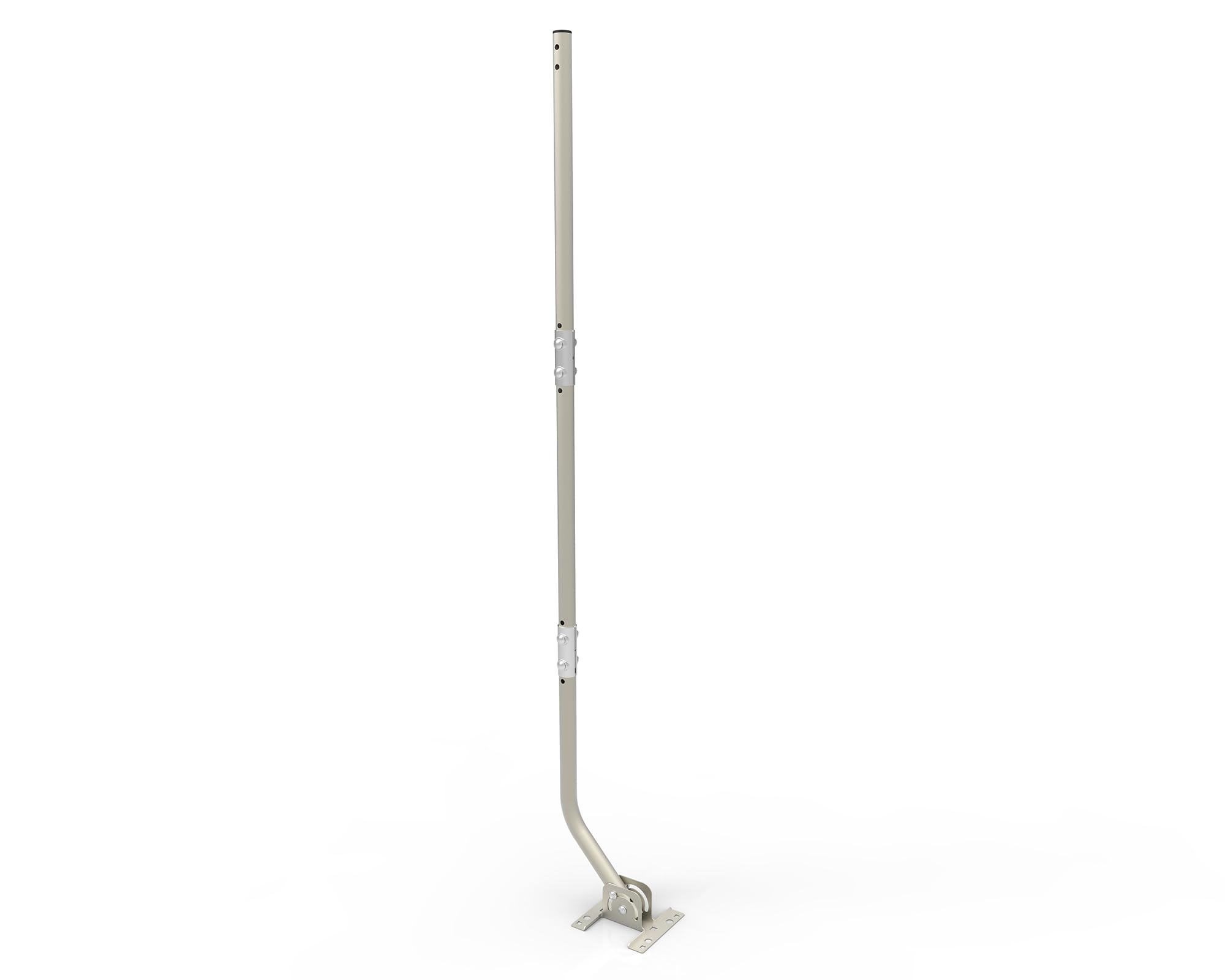
Half a metre of extra height — if you can live with a slimmer mast.
You get far more reach here, and the numbers are not close. This mast runs 49.5 inches against the imbesel J-pole’s 17.25 inches — roughly 2.9 times the arm. That is the difference between a weather station at head height and one sitting about 10 feet off the ground on a fence post. If a shed, a hedge or your own roof currently shadows your sensor, that extra reach is the fix.
The material choice is a deliberate trade. It is rustproof aluminum alloy rather than steel, so it will not corrode through wet winters the way bare steel can, and the reversible dual-end J-pole lets you flip it for more height or more horizontal clearance. The 180-degree rotation gives you aiming flexibility, and the hardware kit includes the screws and anchors for a wall, eave or roof install.
Now the honest part. Aluminum saves weight and rust at the cost of stiffness, and the 1-inch mast diameter is the thinnest in this group. On a long 49.5-inch arm, that thinness shows: buyers report the mast tilting at the pivot after a few weeks and paint flaking off the bracket. For a light weather station that is manageable. For a full dish catching wind at the top of half a metre of arm, it is the wrong tool. Match this pole to a light load and it does its job well.
Why it earns the height badge
- 49.5-inch arm is the longest wall-mount pole in this lineup, clearing fences and low obstructions
- Rustproof aluminum alloy will not corrode like untreated steel
- Reversible dual-end J-pole gives you a choice of reach or standoff
- Full screw and anchor kit included for wall, eave or roof mounting
The trade you are making
- 1-inch mast is the slimmest here and flexes under a heavy dish load
- Some units tilt at the pivot over time and lose their setting
- Paint flaking reported on the bracket after outdoor exposure
Go for it when: you need maximum height for a lightweight weather station, WiFi repeater or small antenna.
Pass if: you are hanging a heavy dish at full extension — the slim 1-inch mast is not built for that leverage.
5. CEKAY Antenna Mount J-Pole 1.5x35in
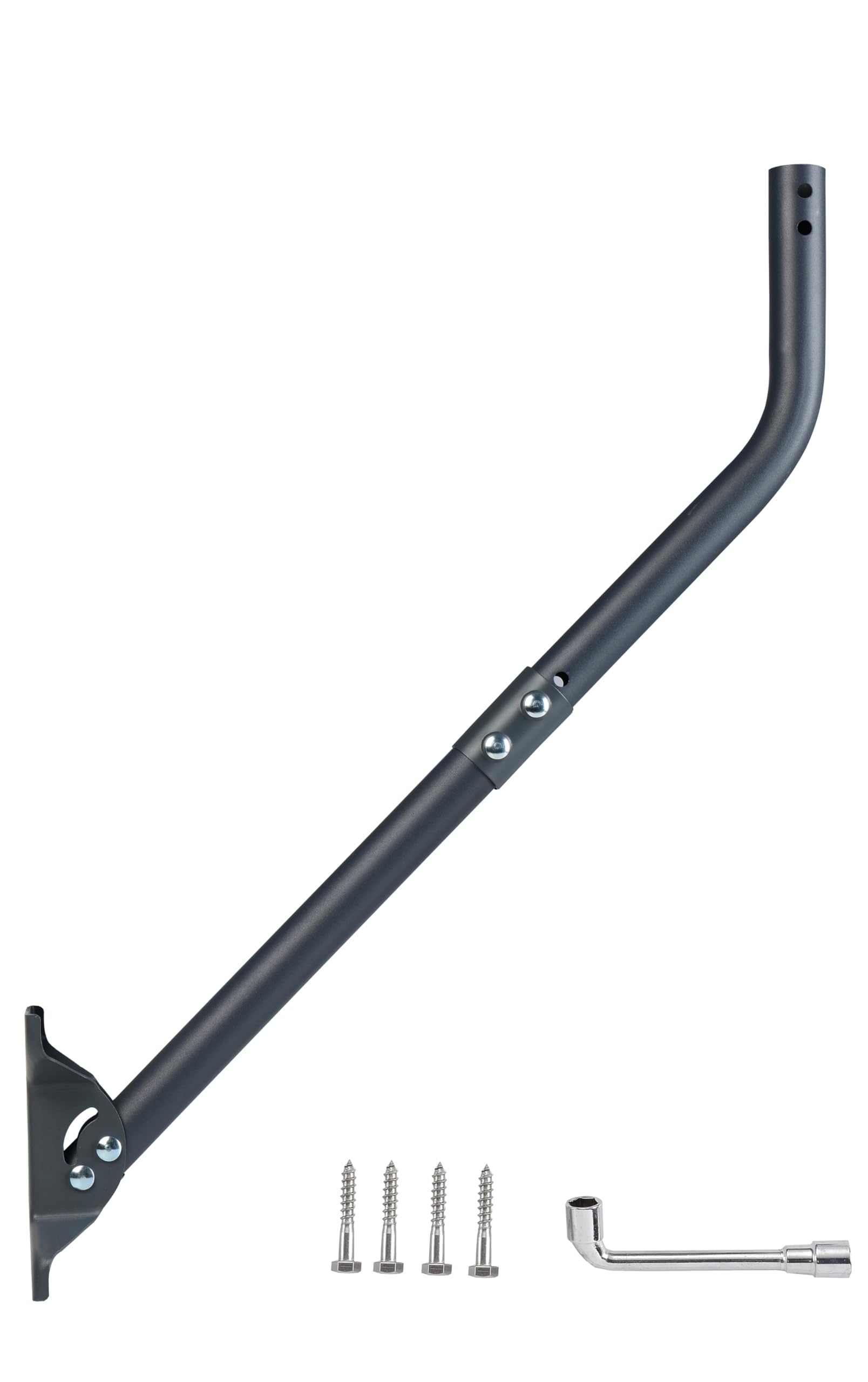
Heavy dish, long arm, and a bracket built to hold the aim.
Stiffness at full extension is what separates this pole from the slimmer options. The mast is 1.5 mm thick, roughly 16-gauge steel, and the bracket behind it is 2 mm, roughly 14-gauge — a heavy pairing along a 35-inch arm. That combination is aimed squarely at someone hanging a full-size dish rather than a palm-sized weather sensor. Where the aluminum CeKay gives up stiffness for rustproofing, this one keeps the steel and adds a powder coat against moisture.
The details matter on a long arm. The pivot rotates 180 degrees for precise aiming, and the locking pin fixes the bracket at two points so it does not rely on bolt tension alone. Both ends of the J-pole are usable, letting you choose more height or more wall standoff. You also get ST8 × 50 mm stainless screws, plastic anchors and a screw sleeve wrench in the box, plus a two-year warranty — the longest coverage on this list.
One thing the build cannot fix: the bolt holes are a touch oversized, and that can leave a small amount of play in the pole that makes a perfectly level mount hard to nail first time. Reversible design softens the pain, since you can flip the arm rather than fight the bracket. Beyond that, this is the pick to beat for a dish that lives high on a windy wall.
Where it shines: a thick 1.5 mm mast on a 35-inch arm is the most supportive combination in the wall-mount group for a full dish.
Minor nit: oversized bolt holes can introduce a little wobble — snug everything down, then re-check level before the final torque.
The one to grab for: a heavy satellite or HDTV dish that needs both a long arm and a stiff mast, backed by a two-year warranty.
Skip if: you want a tool-free fit from the start — a touch of play in the bolt holes needs a little patience.
6. Skywalker J Pipe Mount Mast 38″

One solid piece of metal built to put a dish above the roofline.
The pitch from the maker is blunt and honest: this mast exists to place the dish higher than the pole most dishes ship with. At 38 inches long and 1.66 inches in outer diameter, it clears a roofline that has been clipping your sight line to the satellite. There is no joint, no pivot to slip, no pin to work loose — a single piece of powder-coated metal that goes up and stays up. Simplicity is the feature.
Both ends accept the mount foot, so you can install it whichever orientation your roof geometry demands. The 4-pound weight is on the heavier end, which for a stationary roof mount is exactly what you want: mass and rigidity in the wind. Bolted to wood with the included bolts, it stands firm through high winds and rain, and the powder coat resists rust where cheaper poles turn orange.
The trade-off is that this is a fixed mount, not an adjustable one. If your install needs a precise angle change to fine-tune the aim, you want a pivoting pole like the J-Max instead. If your dish just needs to sit higher and point where it is supposed to, the one-piece build is the simpler, sturdier answer.
Straight from the reviews: strong, simple, and everything needed for install is in the box — a favourite for roof mounts on satellite and omni antennas.
The limit: no pivot means no fine-tuning of the aim once it is bolted down.
Right call for: getting a dish over a roofline with a rigid one-piece mast and zero moving parts.
Consider a pivot instead if: your install depends on dialling in a precise angle at the bracket.
7. STEREN Satellite Tripod

The dish stand that packs away with the camper and goes up on any surface.
A tripod solves a problem no wall-mounted J-pole can touch: you do not own the ground you are parked on. This stand is designed for the larger HD dishes and ships with a universal mast that measures 2 inches on one end for DirecTV and 1 5/8 inches on the other for Dish Network. The 34-inch mast from feet to tip puts the dish up where it can see the sky, and the whole thing collapses into a bundle you can stow in an RV or a passenger car.
The steel build uses zinc and galvanized surfaces to resist rust, and the swivel feet rotate to grip a pitched surface — a deck, a slope, a gravel pad. You can bolt it permanently to a roof, deck or concrete with your own anchor bolts if you want a fixed install, or leave it as a portable stand for camping and tailgating. It suits satellite at camp, a mobile marine radio, and ham setups that come and go.
The one thing to plan for is the metal-on-metal fit. The tripod is strong and assembles easily, but a couple of the locking nuts can work loose or seize over time, and owners have epoxy’d them in place to keep them useful. Treat the hardware as something to snug up before every setup and this stand delivers season after season.
Why travellers pick it
- Dual-fit mast takes 2-inch DirecTV and 1 5/8-inch Dish Network dishes
- Collapses into a bundle that stows in an RV or passenger car
- Swivel feet rotate to sit flat on pitched surfaces
- Can be permanently bolted to a roof, deck or concrete with anchor bolts
What to prep for
- Locking nuts can loosen or seize — snugging or epoxy is often needed
- You must level the dish and dial the correct degree yourself to get a lock
- Portable means the ground under it has to be reasonably firm
Made for: RVers, campers and tailgaters who need a full dish stand they can pack down and set up anywhere flat.
Better with a wrench: budget a minute to tighten the locking hardware each time it goes up.
Know the Specs
Mast Diameter and Adapter Fit
The outer diameter of the mast is what your dish adapter clamps onto, and it is the single most common reason a pole gets returned. A 1-inch mast, a 1.25-inch mast and a 1.66-inch mast each need a differently sized adapter. Measure the adapter that came with your dish before buying, and remember that a Starlink install usually needs a dedicated adapter sold separately regardless of which pole you pick.
Steel Gauge and Stiffness
Gauge is a measure of how thick the metal is, and lower numbers mean thicker steel. Here you see 1.5 mm (roughly 16-gauge) masts paired with 2 mm (roughly 14-gauge) brackets. Thicker metal flexes less, and less flex keeps the dish on target when the wind picks up. A long arm made from thin metal is the setup most likely to drift out of aim.
Pivot Lock and Aiming
A pivot lets you set the angle of the pole; a locking pin holds that angle once you have found it. Poles without a pin rely on bolt tension alone, which can creep over a season. Angle adjustment works in different ranges — some poles fix at set degrees like 0, +45 and -45, others rotate through 180 degrees continuously. More adjustment range is not automatically better; it just means more flexibility if your mounting surface is awkward.
Rustproofing and Material Choice
Outdoor mast material decides how the pole ages. Stainless steel, powder-coated steel, galvanized steel and aluminum alloy each behave differently in wet weather. Aluminum will not rust and stays light but flexes more easily; stainless resists corrosion and stays stiff but costs more and weighs more. For a weather station, weight and rust resistance might be the priority; for a heavy dish catching wind, stiffness wins.
Common Questions
Will a 1.5-inch pole work with a Starlink dish?
How do I know what mast diameter my dish adapter needs?
Is stainless steel better than powder-coated steel for a dish pole?
How high should a satellite dish pole be mounted?
Can I mount a dish pole to concrete?
What is the difference between a J-pole and a tripod mount?
Why does my dish keep losing signal after a few weeks?
Do satellite dish poles come with mounting hardware?
Can a dish pole be used for an antenna or weather station instead?
How long will an outdoor dish pole last?
The Bottom Line
For most homes, the satellite dish pole answer is the J-Max Pivot/Lock Antenna Mount Pole. Its 304 stainless steel bracket, arm and hardware mean it will not rust onto the wall, and the locking pin keeps the aim fixed at 0, +45 or -45 degrees. If you want a thinner mast with a longer arm for a weather station or small antenna, reach for the CEKAY 35-inch J-Pole with its 16-gauge steel mast and two-year warranty. And for a dish that needs to come with you, the collapsible STEREN Satellite Tripod with its dual 2-inch and 1 5/8-inch mast is the one to pack.
How we choose
We do not accept paid placement. Every pick is matched to a real buyer and a real use-case; we do not hands-on test units.
Sources
Specifications: manufacturer listings and product documentation. Review insights: verified customer reviews, as of November 2026. Pricing: not shown on this page (it changes often); check the current price via the retailer link.
As an Amazon Associate, Tactical Gear Guy earns from qualifying purchases. This does not affect which products we feature.