Specs are compiled from manufacturer listings and verified buyer reviews and can change over time — please confirm the key details on the product page before buying.
If you wear readers and work around flying debris, the real question is simple: which bifocal safety glasses keep your up-close vision sharp without fogging, sliding, or failing an impact test? The answer for most people is a Nemesis-style wraparound with a hard-coated polycarbonate lens and a sweat-channeling nose piece — and the KleenGuard V60 in smoke +2.0 is the safest all-round bet on this list. Below you get five real prescription-capable pairs, ranked by how they actually wear through a full shift.
This guide is built by comparing the manufacturers’ published specifications and the patterns across verified customer reviews, so you get each pick’s real strengths and trade-offs instead of marketing spin.
You will see how base curve, lens tint, diopter strength, and impact standard change what a pair can do for you on a job site or a shooting line. Read on for the honest breakdown of the rx safety eyewear worth strapping to your face.
Top Picks


How To Choose The Best Rx Safety Eyewear
Buying prescription-capable safety glasses is not the same as buying reading glasses at a drugstore. You are matching a corrective lens to an impact standard, and the fit has to survive eight hours of sweat and movement. Get the impact rating, diopter, and fit right and the rest falls into place.
Start With the Impact Rating, Not the Style
Look for the ANSI / ISEA Z87.1+2010 mark on the pair you pick. That standard is the baseline proof the lens and frame were built for personal eye protection against impact. The “+” added to Z87.1 means the eyewear passed the higher-velocity impact test, which is the version you want anywhere chips or fast particles fly. A pair without that marking has not passed the high-velocity test, no matter how tough it looks.
Match the Diopter to Your Reading Distance
Diopters are the magnifying strength built into the lower part of the lens. Common strengths run +1.0, +1.5, +2.0, +2.5, and +3.0. If you already use drugstore readers, choose the same number you wear for close work. A +2.0 is the most common pick for detail tasks like reading a tape measure or threading a fitting.
Decide Between Built-In Bifocals and an RX Insert
A built-in bifocal is the grab-and-go choice — you put the glasses on like any other pair. An RX insert frame, like the one bundled with the Browning kit, lets an optician fit a custom prescription lens behind the shield. The insert route costs more and takes a trip to the optician, but it covers astigmatism and other corrections a simple reader cannot.
Check the Fit for Sweat and Slippage
A soft-touch nose piece with ridges, plus flexible temples, is what keeps the lens from sliding down when you get hot. A neck cord is a small detail that saves a lot of dropped-and-scratched pairs on a ladder or a range line.
Side-by-Side Comparison
| Model | Best For | Diopter / Lens Option | Lens Tint | Impact Standard | Amazon |
|---|---|---|---|---|---|
| Kleenguard V60 Nemesis RX 22518 (3 Pair)★ Best Overall | Everyday shop and site work | +2.0 bifocal | Smoke | ANSI / ISEA Z87.1+2010 | Amazon |
| Jackson Safety V60 Nemesis RX 22518 (2 Pair)Best All-Day Comfort | Best all-day comfort | +2.0 bifocal | Smoke | ANSI / ISEA Z87.1+2010 | Amazon |
| NEMIS RX Safety Glasses 1.5 | Bright indoor work | +1.5 diopter | Clear | ANSI / ISEA Z87.1+2010 | Amazon |
| Browning Comp Series Shooting Glasses Kit | Clay shooting in changing light | RX insert frame included | Five interchangeable lenses | ANSI-rated impact protection | Amazon |
| KleenGuard Nemesis Readers 28624 (Qty 6) | Outfitting a whole crew | +2.0 diopter | Clear | ANSI Z87.1+ | Amazon |
Detailed Reviews
1. Kleenguard V60 Nemesis RX 22518 3 Pair
Our pick — 4.5+★ from 60+ verified ratings; the strongest balance of quality and price.
Three pairs, one +2.0 bifocal, and a smoke lens built to cut glare — the shift-long workhorse.
The reason this pair takes the top spot is the combination of a smoke-tinted lens and a +2.0 bifocal reading zone in the same ANSI / ISEA Z87.1+2010 package. Smoke tint knocks down the bright-sky glare that tires your eyes outdoors, while the +2.0 zone keeps a tape measure or a bolt thread sharp without you swapping glasses. Because you get three pairs in the box, you can keep one at the bench, one in the truck, and one in your bag — and never be caught without protection.
The frame is the part that earns its keep over an eight-hour day. A base curve of 8 bends the wraparound around the side of your face, so grit and chips are blocked at the edges rather than sailing in. Soft-touch temples and a nose piece with integrated ridges channel sweat away, which is the single most common reason safety glasses end up pushed up on your forehead instead of over your eyes. A neck cord comes in each pair, so you can pull them off in a dusty moment and still have them on you seconds later.
What wins people over most, though, is the comfort over long shifts. The polycarbonate lenses carry a hard coating for scratch resistance, so a run of cleanings does not fog the reading zone. They also block 99.9% of UVA, UVB, and UVC light, which matters on outdoor shifts under open sky. The trade-off is honest: a smoke lens is not the pair you want indoors or in a dim shop, so plan on a clear pair for inside work.
What earns the top spot
- ANSI / ISEA Z87.1+2010 impact rating — the “+” version, not the basic mark.
- Base curve of 8 wraps the lens for peripheral protection at the sides.
- Hard-coated polycarbonate resists scratching through repeated cleaning.
- Three pairs in the box covers bench, truck, and bag.
- 99.9% UVA, UVB, and UVC coverage for outdoor shifts.
What to keep in mind
- Smoke tint is a poor match for indoor or low-light work.
- +2.0 is fixed — you cannot swap magnification later.
Land this one if: you work outdoors or under harsh light and want one pair that stays put, blocks glare, and keeps a +2.0 reading zone within reach.
Keep shopping if: your work happens in dim interiors, where the smoke lens will cost you too much light.
2. Jackson Safety V60 Nemesis RX 22518 2 Pair
Same smoke +2.0 lens as the winner, pared down to a two-pair pack that slips into a smaller drawer.
Strip away one pair and you have the Jackson Safety twin of the top pick, and the specs mirror it step for step. You still get the ANSI / ISEA Z87.1+2010 impact rating, the base curve of 8 wraparound, soft-touch temples, and the ridged nose piece that pushes sweat aside. The +2.0 bifocal sits in the same lower-lens spot for close work, and the smoke polycarbonate lens still filters 99.9% of UVA, UVB, and UVC light. If two pairs is all you need, this is the same optics in a tighter box.
Where the pair packs split is storage. This kit ships in a package measuring 6 x 4 x 2 inches, which is compact enough for a glovebox or a toolbox top tray. If shelf space at the shop is tight, the smaller footprint here is a genuine point in its favor.
The one caveat follows the tint, not the build. A smoke lens is designed for daylight, so this is not the pair you grab for a dim welding bay or a basement job. Use it where the sun is on you and it does exactly what the spec sheet says.
Compact storage edge: the 6 x 4 x 2 inch package tucks away where bigger kits will not, so it disappears into a glovebox without a fight.
The tint limit: smoke is a daylight lens, so plan a clear pair for indoor shifts.
Reach for this if: you want the same proven +2.0 smoke optics as the top pick but only need two pairs and a smaller package.
Look elsewhere if: you need magnification other than +2.0 — this pack locks you in.
3. NEMIS RX Safety Glasses 1.5

A clear +1.5 lens for the shop floor, where light is scarce and smoke tint would be a mistake.
Here the defining number is the +1.5 diopter in a clear lens, and that pairing is what makes this the indoor pick. Clear polycarbonate lets the maximum light through, so a dim basement or a shaded assembly bay stays readable. The +1.5 magnification is a lighter strength than the +2.0 packs above, which suits anyone who reads fine print at arm’s length rather than nose-to-page. It still carries the full ANSI / ISEA Z87.1+2010 impact rating and the same 99.9% UVA, UVB, and UVC filtering.
Fit follows the Nemesis template. The base curve of 8 wraps the lens for side protection, the temples are soft-touch, and the nose piece has ridges to push sweat away from the eyes. A neck cord ships with the pair, so it hangs around your neck between tasks instead of landing on a gritty bench.
The catch is the magnification. Some buyers discover +1.5 is not quite strong enough for very close detail and step up to +2.0. The data also lists a broader diopter family of +1.0, +1.5, +2.0, +2.5, and +3.0 across this line, so a different strength is available if you need one.
Why the clear lens matters: it is the indoor workhorse — no tint stealing light in a low-lit bay, and 99.9% UV filtering when you do step outside.
The strength question: +1.5 is a light reader, so very close detail work may want the +2.0 versions instead.
Fit this to your face if: you work indoors, wear light readers, and want a clear, ANSI-rated lens that keeps the shop floor sharp.
Pass if: your daily reading strength runs heavier than +1.5.
4. Browning Comp Series Shooting Glasses Kit

Five swappable lenses and an RX insert frame — the kit built for changing light on the clays line.
No other pair on this list gives you five lenses to swap for the conditions. The Comp Series kit includes clear and yellow lenses for high light transmission on overcast or nighttime shooting, plus orange and deep purple lenses for moderate transmission and strong color contrast that makes orange targets pop off a natural background. A smoke lens handles bright, sunny days so you are not squinting into the light. Every lens is polycarbonate and ANSI-rated for impact protection, with anti-fog and anti-glare coatings applied to each one.
The part that makes this an Rx solution is the included RX insert frame. An optician can fit your prescription into that insert, then you slide it behind whichever shield lens the light calls for. That is a different approach from the built-in bifocals above — it handles a full prescription, not just a reading zone. The frameless design and high brow keep your field of view open, and the fit is adjustable: low-profile temples have a wire core you can bend to your head shape, and the removable nose piece adjusts for both height and width.
The honest limit is bulk. The kit ships in a package measuring 8.62 x 7.95 x 3.15 inches, which the data contrasts with the Jackson 22518’s 6 x 4 x 2 inch carton. That bigger case is the price of carrying five lenses and an insert frame — fine for a range bag, less handy in a pants pocket. For a shooter who wants one case that covers dawn to dusk, though, that trade is the whole point.
One kit, every sky: clear, yellow, orange, deep purple, and smoke lenses cover night, overcast, contrast, and full sun without a second purchase.
Bulk to plan for: the 8.62 x 7.95 x 3.15 inch case wants a range bag, not a pocket.
The kit for you if: you shoot clays across shifting light and want a prescription insert that rides behind five lens options.
The wrong buy if: you want to pull a pair from your pocket and go — this is a case-and-insert system.
5. KleenGuard Nemesis Readers 28624 Qty 6
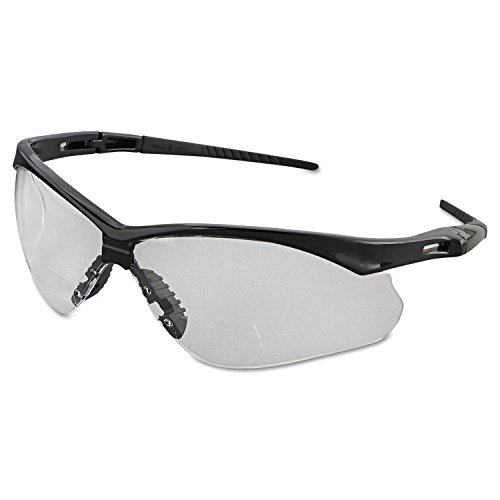
Six clear +2.0 pairs in one box — the box you hand out to the whole crew on day one.
The number that defines this pick is the quantity: six pairs per box, each with a clear lens and a +2.0 diopter. That is a stronger reader than the +1.5 NEMIS above, and the data contrasts the two by diopter as a broader spread than the 1.5+ rating on that lighter pair. For a supervisor buying PPE for a team, six clear +2.0 pairs in one order means everyone who needs magnification gets the same proven setup without a second shopping trip.
The lens and frame carry the same safety story as the rest of the Nemesis line. The clear polycarbonate lenses deliver 99.9% UVA, UVB, and UVC protection and a hard coating that resists scratches from repeated cleaning. The pair meets ANSI Z87.1+ standards for personal eye protection, and the sporty, flexible, lightweight frame is meant to be worn all day rather than stashed in a drawer. The fit type is universal, and the line is marked unisex for men and women.
What owners come back to is the Patented FLEX-DRY nose piece — designed to be extremely flexible, channel sweat away from your eyes, and resist sliding down your nose. A neck cord is included with each pair. The trade-off is that you are committing to stock: six clear +2.0 pairs is right for a crew or a family shop, but heavy for one person who only needs a spare.
Why a supervisor notices
- Six pairs per box — one order outfits a team.
- Clear +2.0 lens in every pair, so strengths stay consistent.
- Patented FLEX-DRY nose piece channels sweat and resists slipping.
- ANSI Z87.1+ rating on each pair.
Where it asks more of you
- Six pairs is a lot to store for one wearer.
- Clear lens only — no tinted option in this box.
Buy this for the crew: it is the cleanest way to give six people the same clear +2.0, ANSI-rated pair in a single order.
Think smaller if: you are one person who wants a single backup pair — a two-pack covers that better.
Know the Specs
ANSI / ISEA Z87.1+2010 and the “+”
This is the safety standard that proves a lens and frame were built for personal eye protection. The “+” attached to it marks the higher-velocity impact test, which is the version to want anywhere fast particles fly. A pair marked only Z87.1 without the plus has not cleared that tougher test. When a spec sheet says “ANSI-rated for impact protection,” check for the full Z87.1+ mark if the work is rough.
Base Curve of 8
The base curve is how sharply the lens curves around your face. A base curve of 8 gives a pronounced wraparound that extends protection to the sides of your eyes, so dust and chips are blocked at the edges instead of finding a gap. If you have ever had grit sneak in past a flat-lens pair, the curve is the fix. It also keeps the lens closer to your face, which reduces the chance of a chip slipping in from below.
Diopters Explained
A diopter is the magnifying strength built into the reading zone of the lens. Nemesis readers run +1.0, +1.5, +2.0, +2.5, and +3.0, and the number you pick should match the readers you already use for close work. A +2.0 is the most common all-purpose choice. Getting the strength wrong is the most frequent reason a pair gets returned, so try your normal reader strength first.
UV Coverage and Lens Coating
Polycarbonate lenses here filter 99.9% of UVA, UVB, and UVC light, which matters on any outdoor job under open sky. The lenses also carry a hard coating for scratch resistance, so the reading zone stays clear across repeated cleaning. A scratch in the bifocal zone is what kills most safety glasses long before the frame fails, which is why the coating is worth checking.
Common Questions
Can I get my actual eyeglass prescription put into these safety glasses?
What diopter should I pick for close work?
Is a smoke lens okay for indoor work?
What does the ANSI Z87.1+ mark actually guarantee?
Will these fit over my regular glasses?
How do I stop safety glasses sliding down my nose when I sweat?
Do these block UV light as well as impact?
How many pairs do I actually need for a crew?
What is the difference between a built-in bifocal and an RX insert?
The Bottom Line
For most people, the strongest rx safety eyewear buy is the Kleenguard V60 Nemesis RX 22518 three-pair pack, because it pairs a +2.0 bifocal with a base curve of 8 wraparound and a full ANSI / ISEA Z87.1+2010 rating — and it gives you three pairs to spread across bench, truck, and bag. If you need clear optics for indoor work at a lighter strength, the NEMIS RX Safety Glasses 1.5 is the one to reach for. And if you shoot clays and want a custom prescription insert behind five swappable lenses, the Browning Comp Series kit covers dawn to dusk in a single case. Whichever way you lean, pick the diopter you already wear and insist on the Z87.1+ mark — those two choices keep your eyes both sharp and protected.
How we choose
We do not accept paid placement. Every pick is matched to a real buyer and a real use-case; we do not hands-on test units.
Sources
Specifications: manufacturer listings and product documentation. Review insights: verified customer reviews, as of November 2026. Pricing: not shown on this page (it changes often); check the current price via the retailer link.
As an Amazon Associate, Tactical Gear Guy earns from qualifying purchases. This does not affect which products we feature.