Specs are compiled from manufacturer listings and verified buyer reviews and can change over time — please confirm the key details on the product page before buying.
You pull into a campsite after a long drive, and the last thing you want is a bad pedestal quietly cooking your RV’s wiring, converter, or air conditioner. A plug-in RV outlet tester answers that question in about a second. The picks below are ranked by what matters at the pedestal: TT-30P vs 14-50P plug type, how many wiring faults the LEDs can name, and whether the housing survives a gravel campsite.
This guide is built by comparing the manufacturers’ published specifications and the patterns across verified customer reviews, so you get each pick’s real strengths and trade-offs instead of marketing spin.
Match the tester to your rig’s plug first — 30A and 50A pedestals do not share a connector shape, and the wrong tester simply will not seat. Everything after that is about how clearly the lights tell you what is wrong, and the rv outlet tester picks below cover both plug families with honest trade-offs on each one.
Top Picks


How To Choose The Best RV Outlet Tester
The first decision is not brand or brightness — it is the shape of the plug. A 30A pedestal uses the TT-30P plug, a three-prong connector exclusive to the RV world. A 50A pedestal uses the NEMA 14-50P, the four-prong plug with two hots, a neutral, and a ground. These are physically incompatible. Buy the 50A tester for a 30A rig and it will not go into the outlet at all.
Match the plug to your rig, not your adapter
Plenty of campers carry a dogbone adapter to run a 30A rig off a 50A pedestal. That adapter changes what your rig draws, not what the pedestal provides. A 50A tester reads both hots on a 50A source; a 30A tester reads the single hot of a 30A source. If you routinely stay at parks with both pedestal types, a tester per plug type is the honest answer.
Count the fault codes, not the lights
A tester with three indicator lights that combine into patterns can name more conditions than three fixed lamps would suggest. The useful question is how many distinct wiring conditions the chart covers. Open ground, open neutral, reversed polarity, and a reversed hot are the four that matter most on a campsite pedestal, because each can send current through your rig’s chassis instead of back up the neutral.
Look for ETL or UL listing and real metal in the pins
You are plugging a diagnostic tool into a live outdoor outlet. The listing matters. ETL is tested to the same safety standards publishers cite as Underwriter Laboratories. The plug pins matter too — pure copper or thickened nickel-plated copper carries current to the LEDs without voltage drop that would make a good pedestal read as bad.
Side-by-Side Comparison
| Model | Best For | Plug Type | Voltage / Watt Rating | Certification | Amazon |
|---|---|---|---|---|---|
| Nilight 50 AMP RV Circuit Tester★ Best Overall | 50A rigs, full fault readout | NEMA 14-50P | 125V / 6250W | ETL | Amazon |
| WELLUCK 30 AMP RV Circuit AnalyzerBudget Champion | 30A rigs on a tight budget | TT-30P | 125V / 30A | ETL | Amazon |
| Nilight 30 AMP RV Circuit Tester | 30A rigs, compact carry | NEMA TT-30P | 125V / 3750W | ETL | Amazon |
| WELLUCK 50 AMP RV Circuit Analyzer | 50A rigs, budget entry | 14-50P | 125V / 50A | ETL | Amazon |
| Progressive Industries RRT-30 | 30A rigs, swivel-handle pull | 30A RV receptacle | Minimum 85V | — | Amazon |
| Progressive Industries RRT-50 | 50A rigs, long-term reliability | 50A RV receptacle | 85V–240V | — | Amazon |
Detailed Reviews
1. Nilight 50 AMP RV Circuit Tester with LED Indicator Light
Our pick — 4.5+★ from 150+ verified ratings; the strongest balance of quality and price.
Plug it into the pedestal before your RV cord, then read the LED chart.
If your rig runs a 50A connection, the Nilight 50 amp tester covers the most ground for the money. It is the crowd favorite here too — 4.5+ stars across 180+ owners. Two facts make the case. The plug is a NEMA 14-50P, the four-prong connector built to seat into a 50A pedestal, and the tester is rated for 125 volts and 6250 watts.
The diagnostic chart is the part you actually use. The LEDs combine into nine readable conditions — Power ON / Correct Wiring, NO Power, L1 Open, L2 Open, Open Ground, Reversed L1-Neutral, Reversed L2-Neutral, Reversed L1-Ground, and Open Neutral. That last one matters. An open neutral on a 50A pedestal can send voltage where it does not belong in your rig. The chart tells you which condition you are looking at, then you take it to the park staff before your RV’s electronics ever see it.
What wins people over is how often owners describe it as a genuinely useful thing to keep in the trailer rather than a gadget they bought once and forgot. The anti-slip shell helps here — plugging into a wet pedestal in the rain is exactly when you want a firm grip. The shell is coated in flame-retardant, heat-resilient ABS, and the pins are 100% pure copper, so the reading you get is the pedestal’s, not a loss from the tester itself.
Where it earns its keep
- Nine named LED fault conditions, including both L1 and L2 open on a 50A source
- 125V / 6250W rated with a NEMA 14-50P plug that fits 50A pedestals without an adapter
- 100% pure copper pins and a flame-retardant ABS body
- ETL listed, so the tester itself has been through a safety lab
What to plan around
- The 50A plug will not seat in a 30A TT-30R pedestal — you need the matching 30A tester for those sites
- Not a surge protector; it reads wiring faults at the pedestal but does not clamp spikes
- You must switch the pedestal breakers to OFF before plugging it in
Reach for this if: your rig runs a 50A 14-50P cord and you want the fault chart that tells you more than “something is off”.
Not the right fit for: sites where you only get a 30A TT-30R outlet.
2. WELLUCK 30 AMP RV Circuit Analyzer TT-30P ETL Certified
The budget 30A TT-30P tester that reads a pedestal’s wiring in about one second.
This is the entry-level pick for 30A rigs, and its job is narrow: answer one question fast. Is the pedestal at this site safe to plug my camper into? The WELLUCK tester plugs into a TT-30P outlet, the standard 30A RV connector, and lights three combination indicators that show the power status. You read the pattern, you either plug in or walk to the office.
The straightforward reliability is what does it for owners — the tool simply works. It is ETL certified, and the case is weather-resistant PVC with flame-retardant material, which is the right spec for a tool that lives outside on a pedestal for a few seconds then goes back in the bag. The plug pins are thickened nickel-plated copper, so the current reaches the LEDs without a voltage drop that would make a good pedestal read as weak.
Small details add up on a camping tool. The compact body and light weight mean it disappears into the same pocket as your adapters. The anti-slip design increases friction so you can pull it out of a stiff outlet without wrestling it. The honest limit: the indicator logic is three lights combining into patterns, which covers the essential faults but does not give you the same level of named readout as a chart-style tester.
Small cost, useful payback: this is the tester you buy when a surge protector with the same purpose costs a lot more and you mainly want to know if the pedestal will hurt your rig.
Best for: 30A trailer owners who want a cheap second set of eyes at every new site.
Look elsewhere if: you want a printed LED-to-fault chart on the tester body itself.
3. Nilight 30 AMP RV Circuit Tester with LED Indicator Light

The 30A TT-30P version of Nilight’s chart-style tester, rated 125V / 3750W.
The small scale of a 30A tester matters in ways you feel when you use it. The Nilight 30 amp version is rated for 125 volts and 3750 watts on a NEMA TT-30P plug — the two-digit difference from the 50A version is real and visible. The 50A tester handles 6250 watts and the 30A handles 3750, so you should never expect one to substitute for the other. A 30A pedestal has one hot; a 50A pedestal has two.
The diagnostic chart is the same family format as its bigger sibling, scaled to a single hot leg. That gives it fault coverage the WELLUCK 30A does not match on paper: Power ON / Open Hot, Open Ground, Reverse Polarity, Open Neutral, Hot/Ground Reverse, and Hot/Neutral Reversed with Neutral Open. If a pattern shows up, you go to the office. The chart is the whole game here — reading it means the difference between plugging in and poring over a dead pedestal with a multimeter.
Owner view is that it simply works well and is easy to use, which is exactly the bar a 30A tester has to clear. The pins are 100% copper, the shell is flame-retardant ABS with an anti-slip coating, and it ships with installation guidance. A handful of 30A owners found the unit did not catch a specific fault they suspected, so treat the chart as a guide and not a full load test — if the pedestal looks suspicious and reads clean, the technician at the office is still the next call.
Same chart, smaller plug: if your rig carries a TT-30P cord, this is the fuller-featured 30A tester and the one that reads closest to the 50A Nilight above.
Go with this: a 30A trailer where you want the named fault chart without buying the entry-level three-light unit.
One trade-off: the 30A tester only reads a single hot, so it cannot report an L2 fault the way a 50A tester can.
4. WELLUCK 50 AMP RV Circuit Analyzer 14-50P ETL Certified

A glovebox-sized 14-50P tester for 50A pedestals.
Here is a direct size comparison worth having. The WELLUCK 50A tester measures 4.72 x 3.15 x 1.57 inches; the Progressive Industries RRT-30 measures 8 x 5.13 x 3.38 inches. The WELLUCK is the one that fits in a glovebox pocket without taking up space next to your adapters. It weighs 352 grams, so it is a serious plug with a metal core, not a hollow shell.
Practicality is what owners keep coming back to — the tester is there to answer one question before you commit your rig’s electronics to a stranger’s pedestal. It uses a 14-50P plug on a 125V 50A source and reads the power quality with three combination LED indicators. The case is weather-resistant PVC with flame-retardant material and the pins are thickened nickel-plated copper, which matters on a 50A circuit where the current is high and a weak connection would show up as a false fault.
It is ETL certified and the anti-slip body makes it easy to pull out of a tight outlet in the rain. A handful of buyers report that the tester works exactly as designed, and a few note the LED logic takes a moment to learn. The real catch is coverage depth: three combination lights are not a nine-fault chart. If you want to know exactly which leg is bad on a 50A pedestal, the Nilight 50A tester above spells it out line by line.
What it does best
- Compact 4.72 x 3.15 x 1.57 inch body that slips into a glovebox
- ETL certified, weather-resistant PVC case, thickened nickel-plated copper pins
- 14-50P plug seats in a standard 50A pedestal without an adapter
- Anti-slip body for easy plugging and unplugging
Where it asks you to accept less
- Three combination indicators cover essentials but not the fault-by-fault detail of a chart tester
- The LED logic takes a minute to read at first
- Only useful on 50A pedestals; not the tool for a 30A site
Pair it with: a 50A fifth wheel or motorhome where you want a compact tester that takes the guesswork out of a new site.
Step up if: you want the tester to name the fault instead of just blinking it.
5. Progressive Industries RRT-30 RV Receptacle Tester
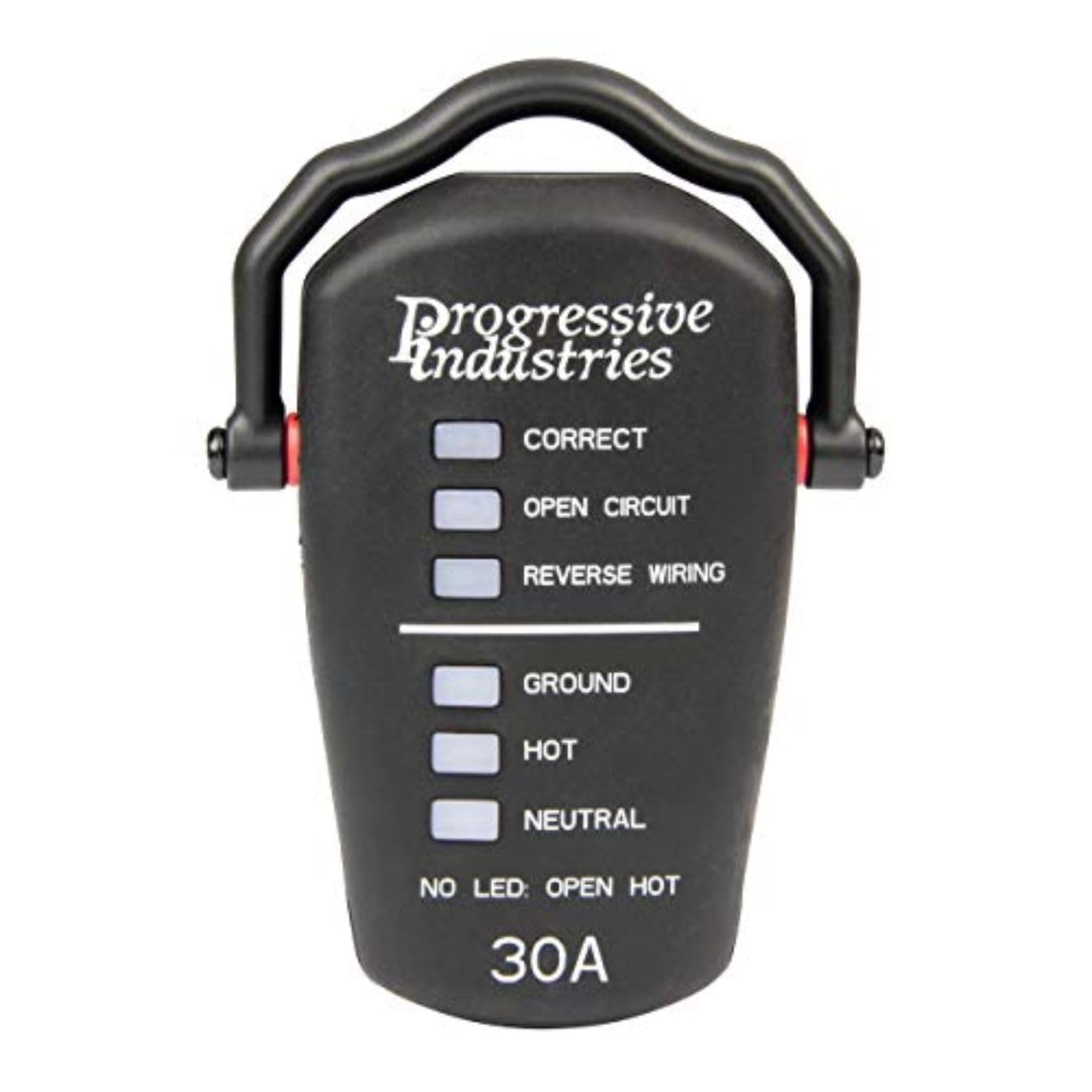
An 8 x 5.13 x 3.38 inch shop-grade body with a swivel handle for pulling a stiff 30A plug.
Progressive Industries made its name in RV power protection, and the RRT-30 shows that industrial-shop mindset in the body. It measures 8 x 5.13 x 3.38 inches, which is clearly larger than the WELLUCK 50A analyzer at 4.72 x 3.15 x 1.57 inches. That size buys room for a swivel handle, a feature you notice the first time you pull a stiff plug out of a 30A pedestal in the rain.
The fault list is the workhorse set: open ground, open neutral, open hot, hot and neutral reversed, and hot and ground reversed. One spec that matters for anyone testing an older park with saggy voltage — the RRT-30’s minimum operating voltage is 85 volts, meaning it can still register a source whose voltage has dropped well below nominal. That is useful on a 120V pedestal fed by an overloaded loop at a packed summer campground. It doubles as a receptacle tester around the house too.
The build quality is what earns the premium tier. Owners describe it as a solid, well-made tool that does exactly what it says. Quality is the thing that keeps coming up — this feels like a meter you own for a decade, not a plug that rattles after one season. The catch is small but real: the size makes it a bag item rather than a pocket item, and the price puts it above the entry-level 30A testers. You are paying for build and the swivel handle.
A 30A tester that acts like gear: the swivel handle and the 85V floor are the two details that separate this from a cheap plug.
Best for: 30A owners who are hard on tools and want one that survives a full season of gravel campsites.
Not for you if: you want something that fits in your pocket — this is bag-sized on purpose.
6. Progressive Industries RRT-50 RV Receptacle Tester
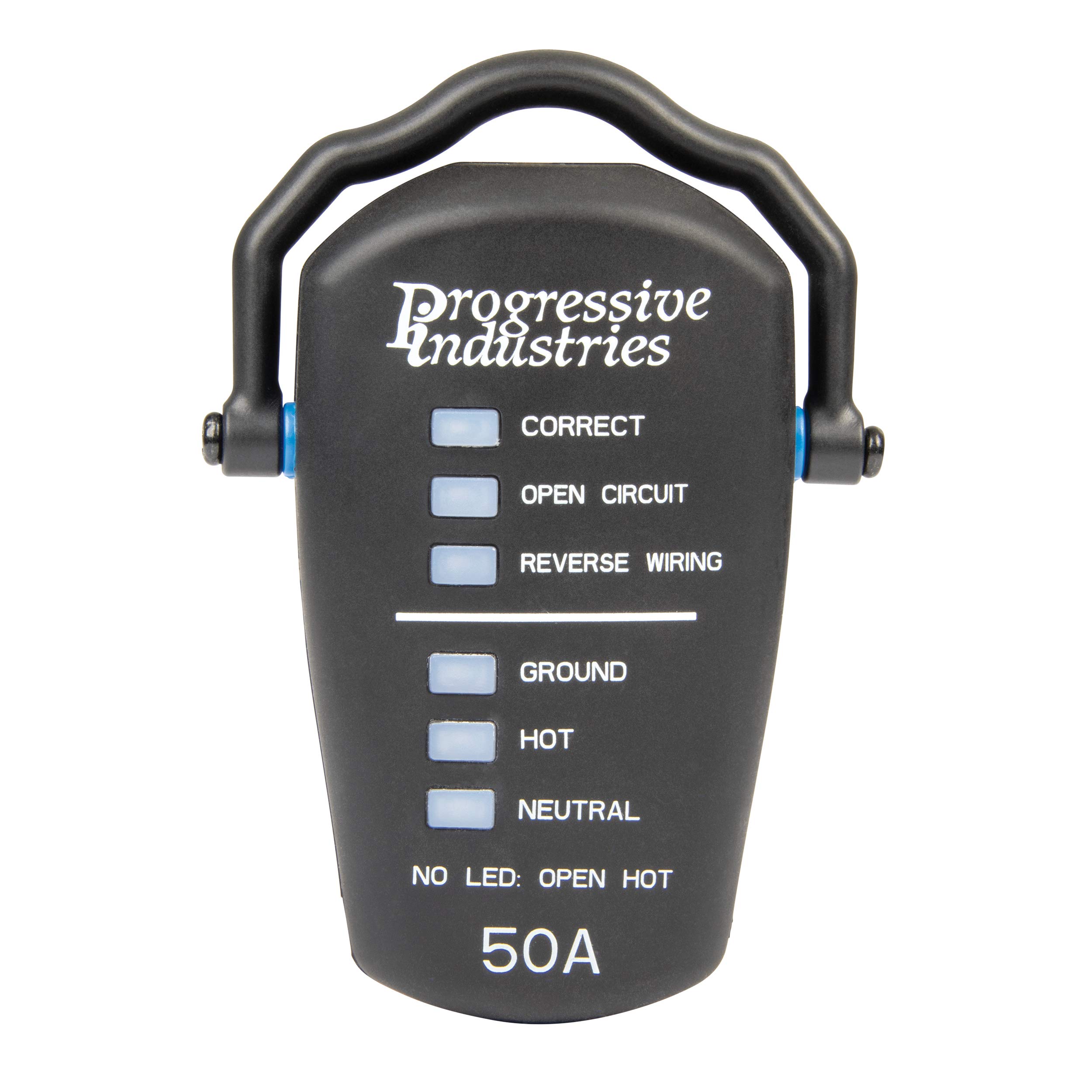
The one that reads both hots and hands you a handle to pull.
The RRT-50 is the premium 50A counterpart to the RRT-30, and it takes the widest voltage range in this lineup — a minimum of 85 volts AC up to a maximum of 240 volts DC on the spec sheet. What that buys you is tolerance for a saggy campground loop. A pedestal dropping to 85 volts will not make the tester quit on you before it shows the reading.
The fault list matches its 30A sibling: open ground, open neutral, open hot, hot and neutral reversed, and hot and ground reversed. The body is 6 x 3 x 2 inches, sized between the compact WELLUCK and the larger RRT-30. The swivel handle makes a real difference on the disconnect — you tilt the handle, the plug comes out, less strain on the cord end.
Straightforward function is what owners call out — it does the job, it is simple, and it is done in seconds. The fast test is what makes it a time saver at a new campground. One owner found their unit did not catch a fault that showed up on a multimeter later, so treat any tester as a guide. The two-caveat stack: no ETL listing printed in the data here, and the price is the highest in the lineup. You are paying for the swivel handle, the 85V–240V range, and the Progressive Industries build.
The reasons it costs more
- 85V to 240V spec range handles a saggy campground loop
- Swivel handle eases disconnect and reduces strain on the cord
- Fault list covers open ground, open neutral, open hot, and both reversal faults
- Compact 6 x 3 x 2 inch body fits a side pocket
What to weigh first
- No ETL or UL listing named in the product data, unlike the Nilight and WELLUCK testers
- The highest cost in the lineup, so the handle and range are the justification
- Still not a load test — a suspect clean reading should get a second opinion
Reach for this if: you run a 50A rig and want the swivel handle and wide voltage range more than you want the lowest price.
Look to the Nilight 50A instead: if a printed fault-by-fault LED chart and an ETL listing top your list.
Know the Specs
Plug type: TT-30P vs 14-50P
The plug shape is the first spec that eliminates half the shelf. TT-30P is the three-prong 30A RV connector; 14-50P is the four-prong 50A connector with two hots, a neutral, and a ground. A 14-50P tester will not seat in a TT-30R outlet, and a TT-30P tester will fall out of a 14-50R. There is no universal tester — match the plug to the pedestal you are actually going to plug into.
Voltage and watt rating
The wattage figure tells you the ceiling the tester is comfortable reading. A 125V / 6250W tester is designed for 50A service; a 125V / 3750W tester is built for 30A service. The math is baked into the spec, so there is no need to convert. If the pedestal is a 50A source and your tester is 30A-rated, you are using the wrong tool for that pedestal.
LED fault code count
More LED combinations means more named conditions. A three-light tester will show you the essential faults — power present, open ground, reversed polarity. A chart-style tester can run nine combinations, breaking out L1 and L2 faults separately and calling out an open neutral on each leg. On a 50A pedestal, that extra detail is worth having.
ETL vs UL vs unlisted
ETL is tested at a lab to the same safety standards published by NRTLs, the same body of standards Underwriter Laboratories tests against. That listing means the tester itself has been vetted as a live-electrical device. Unlisted testers still work, but the listing is your evidence that the tool was designed and checked to hold up under a fault, not just an open circuit.
Common Questions
Will a 30 amp RV outlet tester fit a 50 amp pedestal?
What does open neutral mean on an RV pedestal?
Is an ETL listing as good as UL for an RV tester?
Can an RV outlet tester tell me if the voltage is too low?
Do I still need a surge protector if I use an RV outlet tester?
How do I use a 50 amp RV circuit analyzer safely?
Why does my tester’s chart show L1 and L2 separately?
Can I use an RV outlet tester in a regular house outlet?
What is a hot and ground reversed fault on a campsite pedestal?
Does the anti-slip or swivel handle actually matter on a tester?
The Bottom Line
For most 50A rigs, the rv outlet tester winner is the Nilight 50 AMP RV Circuit Tester because it names nine separate wiring conditions and carries an ETL listing — you get a chart, not a blink. If your rig uses a 30A TT-30P cord, the Nilight 30 AMP RV Circuit Tester gives you the named fault chart at 125V / 3750W on the right plug. And if you want a compact tester with a swivel handle and a wide 85V–240V range, the Progressive Industries RRT-50 is the premium end of the lineup.
Every tester here does the same core job: tell you whether the pedestal at this site is safe before your rig’s electronics ever see it. Pick the plug that matches your rig, check the chart, and go enjoy the trip.
How we choose
We do not accept paid placement. Every pick is matched to a real buyer and a real use-case; we do not hands-on test units.
Sources
Specifications: manufacturer listings and product documentation. Review insights: verified customer reviews, as of November 2026. Pricing: not shown on this page (it changes often); check the current price via the retailer link.
As an Amazon Associate, Tactical Gear Guy earns from qualifying purchases. This does not affect which products we feature.