Specs are compiled from manufacturer listings and verified buyer reviews and can change over time — please confirm the key details on the product page before buying.
You do not need a rooftop unit or a generator roaring all night to sleep cool in a camper. A 12-volt split system runs straight off your battery bank and keeps the cab cold with the engine off. The catch is that this is a small, specialized corner of the market — only a couple of units are genuinely built for RV and truck use. Below are the two worth your attention, both 10,000 BTU, both driving off 12-volt power, and what each one really asks of your battery setup.
This guide is built by comparing the manufacturers’ published specifications and the patterns across verified customer reviews, so you get each pick’s real strengths and trade-offs instead of marketing spin.
These two units share a lot of the same hardware, so your choice really depends on noise and price. Here is exactly where they differ before you wire anything in.
Quick Picks
- Aspligo 12V Mini Split Air Conditioner 10000 BTU — Best Overall
- Truck Air Conditioner 12V 10000BTU Electric — Best for Overnight Sleep
How To Choose The Best RV Mini Split
Most buyers walk in thinking a mini split is a mini split. In an RV or truck cab, the rules change. You are not plugged into a house grid — you are pulling from a battery bank with a fixed number of amp-hours. Every watt the compressor eats comes back out of your range and your sleep. So the three things that actually decide a purchase here are cooling output, battery load, and how the unit mounts.
Start with BTU, not brand
BTU (British thermal units) is the measure of how much heat the unit pulls out of the air. Both picks here run at 10,000 BTU, which is the working class for a truck cab or a camper sleeping area. A lower-BTU unit has to run longer to hit the same temperature, and a longer runtime drains the battery faster. Do not size down to save power — you will spend more amp-hours getting nowhere.
Check the power draw against your battery bank
The Aspligo unit lists power consumption around 800W and a rated current of 60-80A. That is a real load. The Truck Air Conditioner lists 960 watts of annual energy consumption and, in its own fit note, states that only a battery over 350Ah can cool for 3 hours in the day and 6 hours at night. Those are the numbers to compare against your own bank. If you run a smaller AGM setup, neither unit will last the night.
Decide how much noise you can live with
The Truck Air Conditioner publishes a 50dB indoor noise figure from a silent brushless evaporator. The Aspligo listing does not publish a decibel rating. That gap matters more than it sounds if you plan to sleep with the unit cycling on and off above your bunk.
Budget for what is not in the box
Both listings state refrigerant is not included and call for 500-550g of R134a. Both are also non-inverter systems, meaning the compressor runs at a fixed speed rather than ramping. Plan for a proper install and a refrigerant top-up as part of the real cost, not an afterthought.
Side-by-Side Comparison
| Model | Best For | Cooling Power | Power / Current | Indoor Noise | Amazon |
|---|---|---|---|---|---|
| Aspligo 12V 10000 BTU Mini Split | Trucks, RVs, campers and boats on a tight budget | 10,000 BTU | 800W, 60-80A rated | — | Amazon |
| Truck Air Conditioner 12V 10000 BTU | Overnight sleeping with the engine off | 10,000 BTU | 960 watts annual | 50 dB | Amazon |
Detailed Reviews
1. Aspligo 12V Mini Split Air Conditioner 10000 BTU

The camper cooler that runs off your battery bank and cuts the idle.
For a truck or camper owner who wants to stop burning diesel to stay cool at a rest stop, the 10,000 BTU output is the number that earns this the top slot. That figure is the rated cooling capacity, and the maker states it is 15% more than selected AC-powered cooling systems currently on the market. In plain terms, it is sized to pull the heat out of a cab or a small camper box rather than a whole house.
What separates it in daily use is the fuel story. The compressor is driven by battery power, so it keeps running after the vehicle is shut off or the main power is cut. The maker says this is expected to cut annual fuel costs compared to running a traditional engine-driven AC. Whether that figure lands for you depends entirely on how much you idle today, but the direction is real — no engine running means no fuel burned to stay cool.
The 12mm² pure copper wire core carries a higher current load than conventional wiring and is wrapped in thickened PVC insulation to hold steady through voltage swings. That matters because this is a non-inverter system — the compressor does not ramp down, so the electrical path has to cope with the full draw. Between that and the low-voltage protection that lets it start without stressing the battery, this is built for the reality of running a compressor off a vehicle bank.
What earns it first place
- 10,000 BTU of cooling output, which the maker frames as 15% more than selected AC-powered systems
- Runs off your battery with the engine off, so no idling to stay cold
- Low-voltage protection helps it start cleanly and protects the battery
- 12mm² pure copper core and thickened PVC insulation for stable operation
The honest limits
- Refrigerant is not included — you need 500-550g of R134a before it runs
- No published decibel figure, so noise is a leap of faith compared with its rival
- Non-inverter compressor means a steady, unvarying power draw rather than a gentle ramp
Good fit for: the truck or camper owner already running a large 12-volt bank who wants cooling with the engine off and the widest vehicle fit — trucks, RVs, campers, box trucks, boats, and more.
Check first: the power consumption sits around 800W with a rated current of 60-80A, so you need a bank built to deliver that without sagging.
2. Truck Air Conditioner 12V 10000BTU
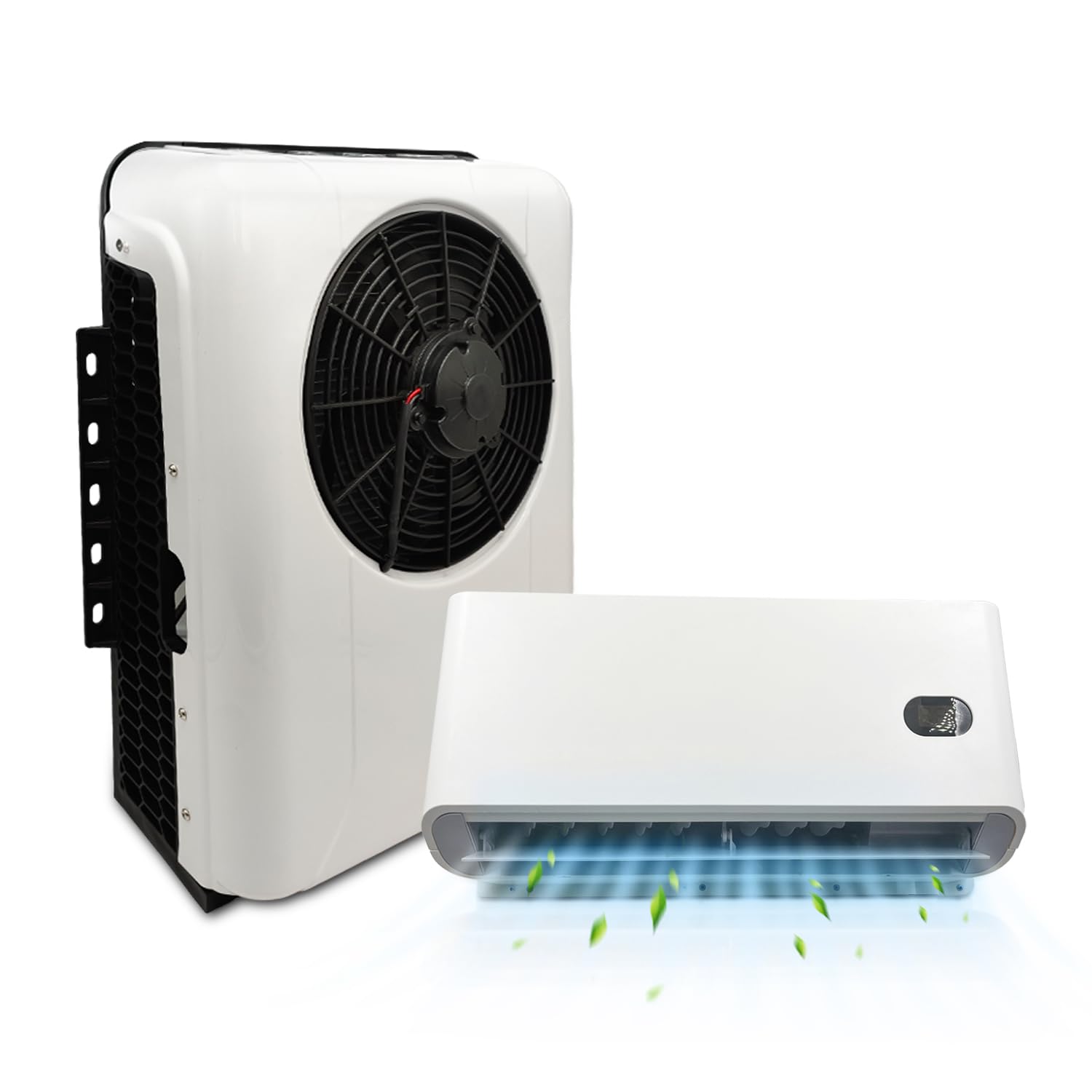
The quieter of the two, built for sleeping above the bunk not just driving.
Here is the number that decides it: 50dB from the indoor unit, produced by what the listing calls a silent brushless evaporator. A decibel is a unit of loudness, and 50dB sits roughly at the level of a quiet conversation. That is the figure the Aspligo does not publish, and for anyone who sleeps in the cab, it is the whole ballgame. Cool air at night without a roar over your head is what you are buying.
It shares the 10,000 BTU cooling output with the Aspligo — the same 15% increase claim over selected AC-powered systems — and the same 9″D x 19.5″W x 26″H outdoor unit dimensions. Where it takes the lead is the noise figure and the fit note. The maker states plainly that only a battery over 350Ah will cool for 3 hours in the day and 6 hours at night. That is an unusually specific admission, and it saves you a costly mistake: budget your bank before you order.
Build quality is what carries it in the field: reviewers describe a solid build that holds up. Value holds too — one driver who installed it himself spent 6 hours on the job and called it worthwhile. Another noted drawing only 45% of a 2,300Ah lithium bank through a hot summer day and night. Performance is mixed: some units run well, and some arrive with a compressor that fails to pump refrigerant.
The battery math you have to do: the fit note says over 350Ah for 3 hours of daytime cooling and 6 at night. Run a smaller bank and you will be out of power long before morning.
What to weigh before ordering: performance is the most-discussed theme in the reviews and it cuts both ways. Build quality earns the most praise, but a unit that arrives not cooling properly is the risk you accept going in. Refrigerant (the gas that makes cooling work) is not included either, so 500-550g of R134a is on you.
Reach for this one: if you sleep in the truck or camper and want the quietest indoor running, this is the pick — 50dB and a 10,000 BTU output that matches its rival.
Look elsewhere: if your battery bank sits well under 350Ah, the daytime runtime simply will not stretch far enough.
Know the Specs
BTU (Cooling Output)
BTU measures how much heat the unit removes from the air. Both picks run at 10,000 BTU, the working class for a truck cab or camper sleeping area. A lower-BTU unit has to run longer to reach the same temperature, which drains the battery faster — so do not downsize hoping to save power.
Amp-Hours and Battery Fit
Amp-hours (Ah) is how much energy your battery bank stores. The Truck Air Conditioner states only a bank over 350Ah can cool for 3 hours by day and 6 at night. That figure is the single most useful warning in either listing — check it against your own bank before you buy.
Decibels (Noise)
Decibels (dB) measure loudness. The Truck Air Conditioner publishes 50dB from the indoor unit, roughly a quiet conversation. The Aspligo does not publish a figure. If you sleep above the unit, this is a spec worth weighing heavily.
Inverter vs Non-Inverter
Both units here are non-inverter, meaning the compressor runs at a fixed speed rather than ramping up and down. That keeps the design simple but means a steady power draw. An inverter system would modulate, but neither of these offers it.
Common Questions
Will a 12-volt mini split cool a camper with the engine off?
Is 10,000 BTU enough for a truck cab or small camper?
Does the refrigerant come included?
How much battery bank do I need?
How loud is an RV mini split inside?
Can these run in a semi truck as well as an RV?
Do these units protect my battery from draining too far?
Are these inverter air conditioners?
What size is the outdoor unit?
The Bottom Line
The strongest pick here is the Aspligo 12V Mini Split, because it pairs 10,000 BTU of cooling with battery-driven operation that keeps running after the engine is off, and it fits the widest range of vehicles. If sleeping quietly is the priority, the Truck Air Conditioner is the one — its published 50dB indoor figure makes it the easier unit to live with overnight. Whichever you choose, check your battery bank against the fit notes first; that single number decides whether either unit lasts the night.
How we choose
We do not accept paid placement. Every pick is matched to a real buyer and a real use-case; we do not hands-on test units.
Sources
Specifications: manufacturer listings and product documentation. Review insights: verified customer reviews, as of November 2026. Pricing: not shown on this page (it changes often); check the current price via the retailer link.
As an Amazon Associate, Tactical Gear Guy earns from qualifying purchases. This does not affect which products we feature.