Specs are compiled from manufacturer listings and verified buyer reviews and can change over time — please confirm the key details on the product page before buying.
A rugged portable charger is not a phone battery with a tough paint job. It is a battery that survives being dropped on rock, dunked in a creek, and left in a truck bed overnight — and still gives your phone a full top-up the next morning. If you are buying one for hiking, hunting, overlanding, or emergency prep, the question is not which has the most milliamp-hours. It is which one still works after the abuse. That is what this guide settles for you.
This guide is built by comparing the manufacturers’ published specifications and the patterns across verified customer reviews, so you get each pick’s real strengths and trade-offs instead of marketing spin.
Water and dust ratings mean nothing if the port lid is loose, and a huge battery means nothing if it dies on month three. Below you get the real drop ratings, the waterproofing details, and the honest trade-offs, so you can pick the right rugged portable charger without guessing.
Top Picks

How To Choose The Best Rugged Portable Charger
Three numbers decide almost everything about a rugged power bank: the water rating, the capacity, and the charging wattage. Get those right for your own trips and almost everything else is detail. Here is how to read each one without a spec sheet in front of you.
Read the IP rating, not the marketing word
An IP rating (Ingress Protection — a two-digit score for how well a case keeps out dust and water) tells you exactly what abuse a pack survives. The first digit covers dust, the second covers water, and a “7” in that second slot means it survives being submerged. Several picks here carry IP67, which is rated for 30 minutes at a depth of 1 meter. One goes further with IP68 and a 45-minute submersion claim. Both ratings assume the port lid is sealed tight — a pack with a loose gasket is just a battery in a puddle.
Match milliamp-hours to your trip length
Capacity in mAh (milliamp-hours — roughly how much charge the pack holds) runs from 5,000 to 15,000 across this list. A 5,000 mAh pack is a top-up for one phone on a day hike. A 10,000 mAh pack is an overnight or two-device pack. A 15,000 mAh unit stretches to multi-day trips and can top up a tablet. Bigger cells also weigh more, which matters when the pack lives in your chest rig.
Understand why charging speed gets mixed reviews
USB-C PD (Power Delivery — a fast-charging standard that negotiates wattage with your device) is the spec to look for. A 20W output refills a modern phone quickly; an 18W output is close behind; a 15W output is slower but still fine for an overnight. Note that charging speed draws mixed customer feedback on nearly every pack here — some of that is the pack, and some is the cable and wall adapter the owner supplied. A PD adapter of 18W or above is the usual recommendation for refilling the pack itself.
Side-by-Side Comparison
| Model | Best For | Capacity | Water/Dust Rating | Weight | Amazon |
|---|---|---|---|---|---|
| DEWALT Heavy Duty 10,000 mAh★ Best Overall | Jobsite and truck duty | 10,000 mAh | IP67 | 218 g | Amazon |
| BLAVOR Rugged 15,000 mAhLongest Lifespan | Long trips, built-in cable | 15,000 mAh | IP67 | 15.2 oz | Amazon |
| ASWAYKE P10 10,000 mAh | Tripod mounting, digital readout | 10,000 mAh | IP67 | 7.68 oz | Amazon |
| NESTOUT 5,000 mAh | Featherweight day hikes | 5,000 mAh | IP67 | 4.9 oz | Amazon |
| NESTOUT 10,000 mAh | EDC pouch and pack carry | 10,280 mAh | IP67 | 241 g | Amazon |
| Goal Zero Venture 35 | Emergency kit with light | 9,600 mAh | IP67 | — | Amazon |
| Dark Energy Poseidon Pro | Extreme cold and submersion | 10,000 mAh | IP68 | 0.56 lbs | Amazon |
Detailed Reviews
1. DEWALT Heavy Duty Portable Charger, 10,000 mAh
Our pick — 4.5+★ from 950+ verified ratings; the strongest balance of quality and price.
The jobsite pack that clips to your belt and shrugs off rain, dust, and a drop onto concrete.
If your charger lives on a work belt or in a truck console rather than a padded hiking pouch, this is the one to start with. The build is the whole pitch: a rugged exterior that takes repeated wear, a molded carabiner loop for hooks, lanyards, and work belts, and IP67 dust and water resistance with the port cover closed. That rating means it handles rain and a splash without drama — it is not a dive-rated pack, so keep the lid seated before you trust it.
The 10,000 mAh cell is enough for a phone plus a smartwatch or headphones on a normal shift, and DEWALT lists Type-C PD and Quick Charge USB-A ports so you can top up two things without waiting your turn. Charge-indication LEDs on the body show how much is left, which saves you from discovering an empty pack in the truck bed. It also carries 10,000 mAh where the BLAVOR holds 15,000 mAh — a 50% larger reserve on the BLAVOR side.
Build quality wins people over here — owners consistently call it durable, compact, and functional rather than flashy. The recurring gripe is charging speed, and it is a fair one to plan around: refilling the pack from empty runs long, so the smart move is plugging it in overnight rather than expecting a quick turnaround. This is the highest-scoring pick on the list and the one most owners have already taken a chance on, so it earns the top slot.
Where The DEWALT Pulls Ahead
- IP67 dust and water resistance with the port cover closed, so rain and grit are a non-issue.
- Molded carabiner loop hangs the pack off a work belt, hook, or lanyard.
- Charge-indication LEDs show remaining battery without a screen or app.
- Type-C PD plus Quick Charge USB-A covers two devices at once.
What To Plan Around
- Refilling from empty takes about 3 hours, so overnight charging is the realistic routine.
- At 218 g and nearly an inch thick, it is the bulkier choice for a chest rig.
- The 10,000 mAh reserve is smaller than the BLAVOR’s 15,000 mAh cell.
Reach for this if: you want a hard-wearing pack that clips to your gear and handles a wet, dusty jobsite.
Look elsewhere if: you need a fast top-up from empty or a multi-day reserve — a PD wall adapter and a longer charge window are part of the deal here.
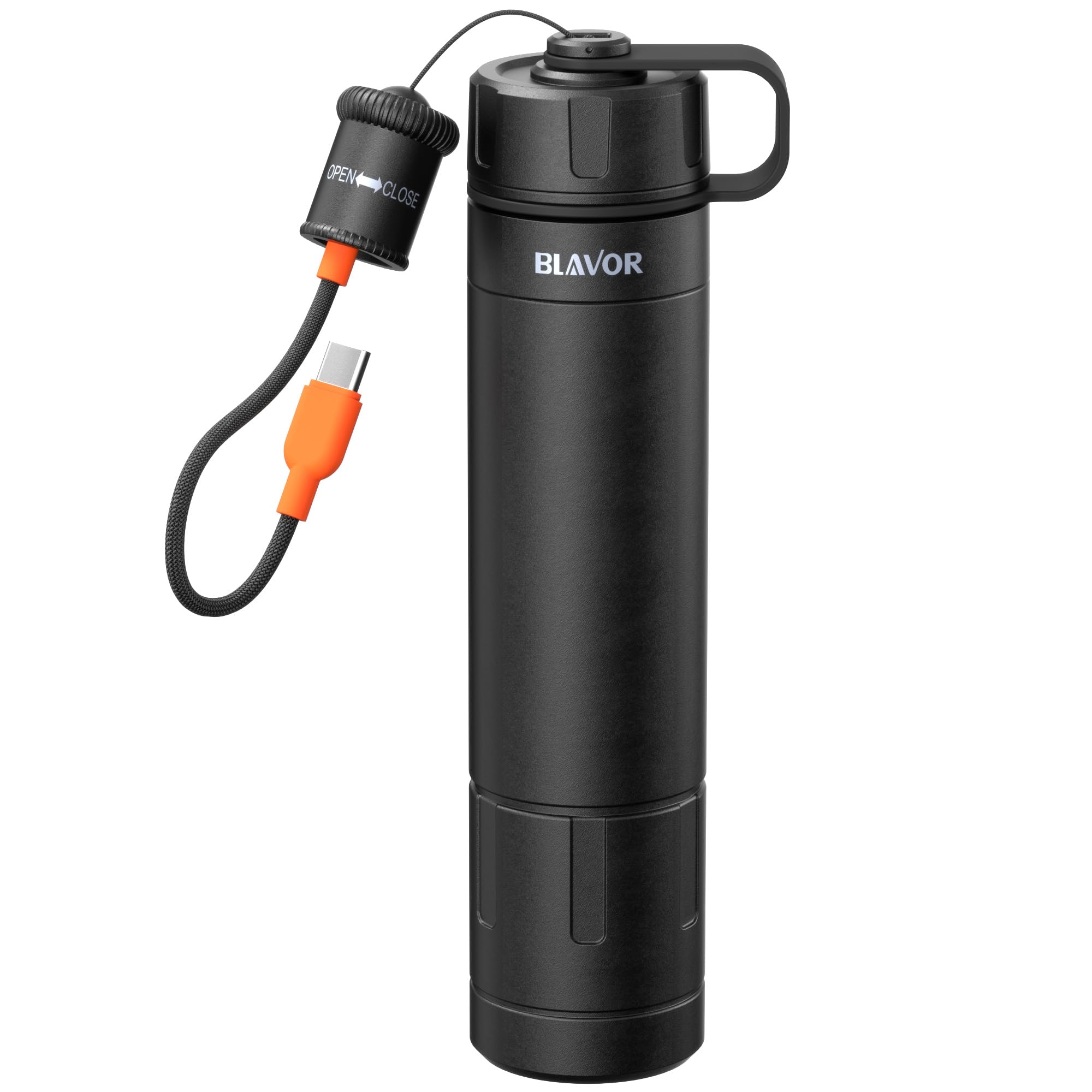
2. BLAVOR Rugged Power Bank 15,000 mAh, LiFePO4
The battery chemistry play: a cell rated for thousands of cycles instead of a few hundred.
Most power banks die of old age before they die of damage. BLAVOR attacks that directly with a LiFePO4 (lithium iron phosphate — a battery chemistry known for surviving far more recharge cycles than standard lithium-ion) pack rated for 3,500+ charge cycles. The maker claims 3x the lifespan of standard lithium-ion and 80% capacity retained after 3,000 cycles. That cycle rating is why this pack suits weekly chargers who want years of use without watching capacity fade.
At 15,000 mAh it holds the largest reserve on this list. It is also the heaviest option here at 15.2 ounces — double the 7.68 oz ASWAYKE — so this is a pack-for-the-trip unit, not a pocket carry. The clever bit is the lanyard: the USB-C to USB-C cable is built into it, so the strap doubles as your charging cord and you never dig for a cable in the dark.
Protection is full IP67 — rugged ABS plastic, a secure-seal lid, and tight silicone gaskets that the maker rates for 30 minutes submerged in 1 meter of water with zero ingress. Dual USB-C ports push 20W, enough to take an iPhone 16 to half charge in about 30 minutes, and both can run at once. The 7 × 1.6 × 2.1-inch cylindrical body fits a one-handed grip, which is the one design detail that separates it from every boxy pack here.
Chemistry over marketing: the LiFePO4 cell is the defining feature, and 3,500+ cycles is a genuinely different durability class from a standard lithium-ion pack.
The honest trade-off: at 15.2 ounces it is the heaviest pick here, and the built-in lanyard cable means you lose the cable if the strap ever fails.
Suits you best when: longevity and capacity matter more than carry weight, and you want a cable you cannot forget.
Think twice if: you plan to pocket-carry — 15.2 ounces in a trouser pocket is a noticeable lump.
3. ASWAYKE P10 10,000 mAh Rugged Power Bank
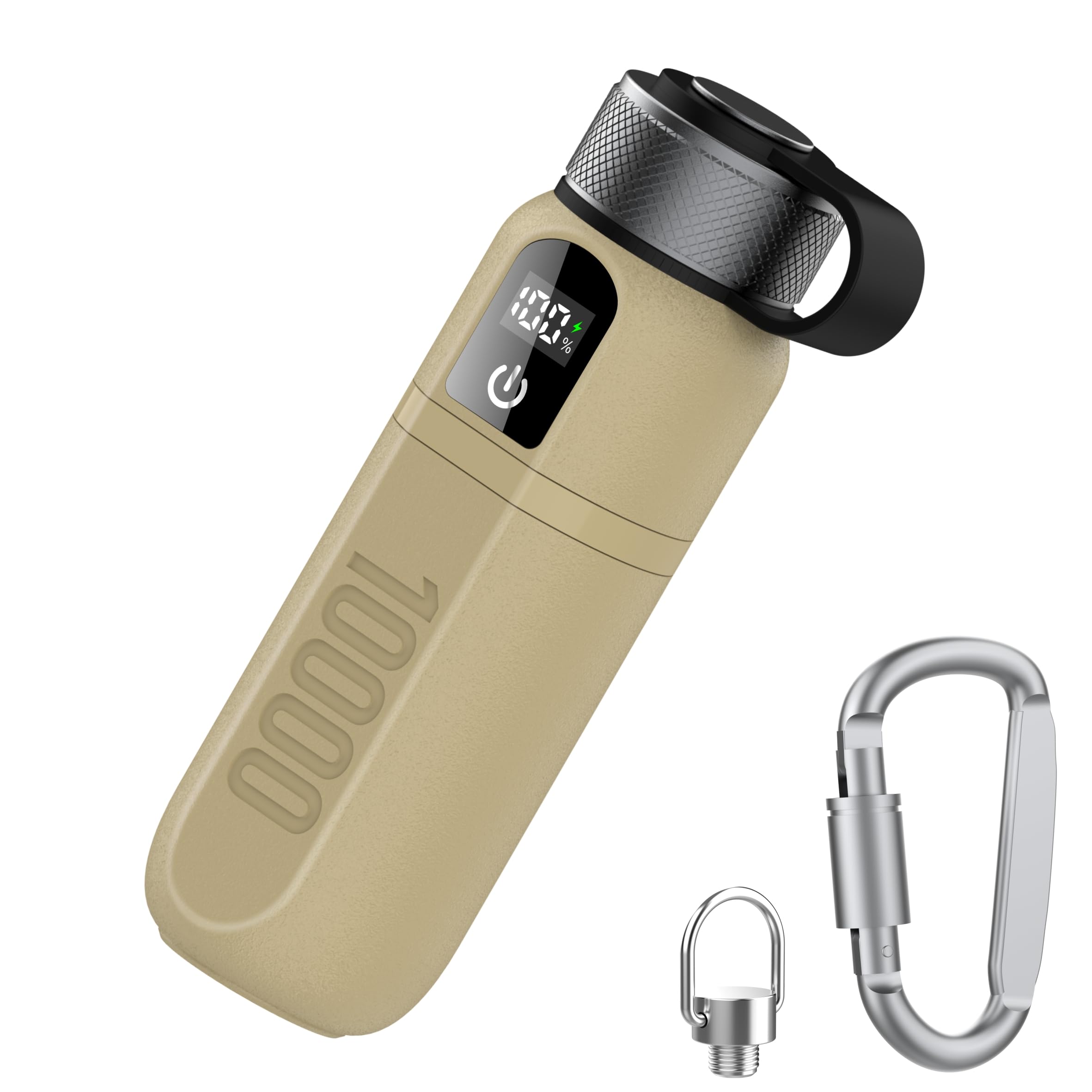
A screen that tells you the exact percentage instead of three blinking dots.
Guesswork is the small daily annoyance of power bank ownership, and this pack kills it. The smart digital display shows remaining battery from 0 to 100%, plus input current while it charges and output current while it powers a device. You know before you leave camp whether you have 60% or 6%. The Type-C port is bidirectional too, so the same port fills your phone and refills the bank.
Physical abuse is handled with a 3.5mm ABS+PC shell (a tough plastic blend used for hard cases) built to survive 2m drops, and an IP67 rating that covers 1m water submersion for 30 minutes plus resistance to dust, sand, and mud. ASWAYKE rates it against vehicle runs as well. At 7.68 ounces it is well under half the 15.2-ounce BLAVOR and noticeably lighter than the 218 g DEWALT, which makes it the better choice for a daypack. The capacity is 10,000 mAh, or about three full phone charges.
Two niche details deserve a look. There is a standard tripod mount on the base, so it screws onto most outdoor tripods for hands-free use — hang it from a tent pole or use it as a fill light during night photography. And honestly: this model has no built-in flashlight, which is a deliberate choice to keep the body compact, though it accepts the LA-1 light accessory sold separately. Build quality lands well above average in owner feedback, and the camping crowd specifically calls out that it holds charge deep into the night. The mixed note is reliability, mostly tied to that lamp accessory some buyers expected to work — judge it as a power bank and the picture is much cleaner. A 6-month replacement warranty backs it.
Why the display earns its keep: real-time percentage and current readouts mean you never haul a dead pack up a hill, and the bidirectional Type-C port cuts your cable count.
Not for light-seekers: no built-in LED here — you would need the separate LA-1 accessory if camp lighting matters.
Made for: the tripod-shooting, percentage-watching camper who wants the lightest 10,000 mAh pack here.
Not your pick if: you want a flashlight built into the body rather than a clip-on extra.
4. NESTOUT 5,000 mAh Rugged Power Bank
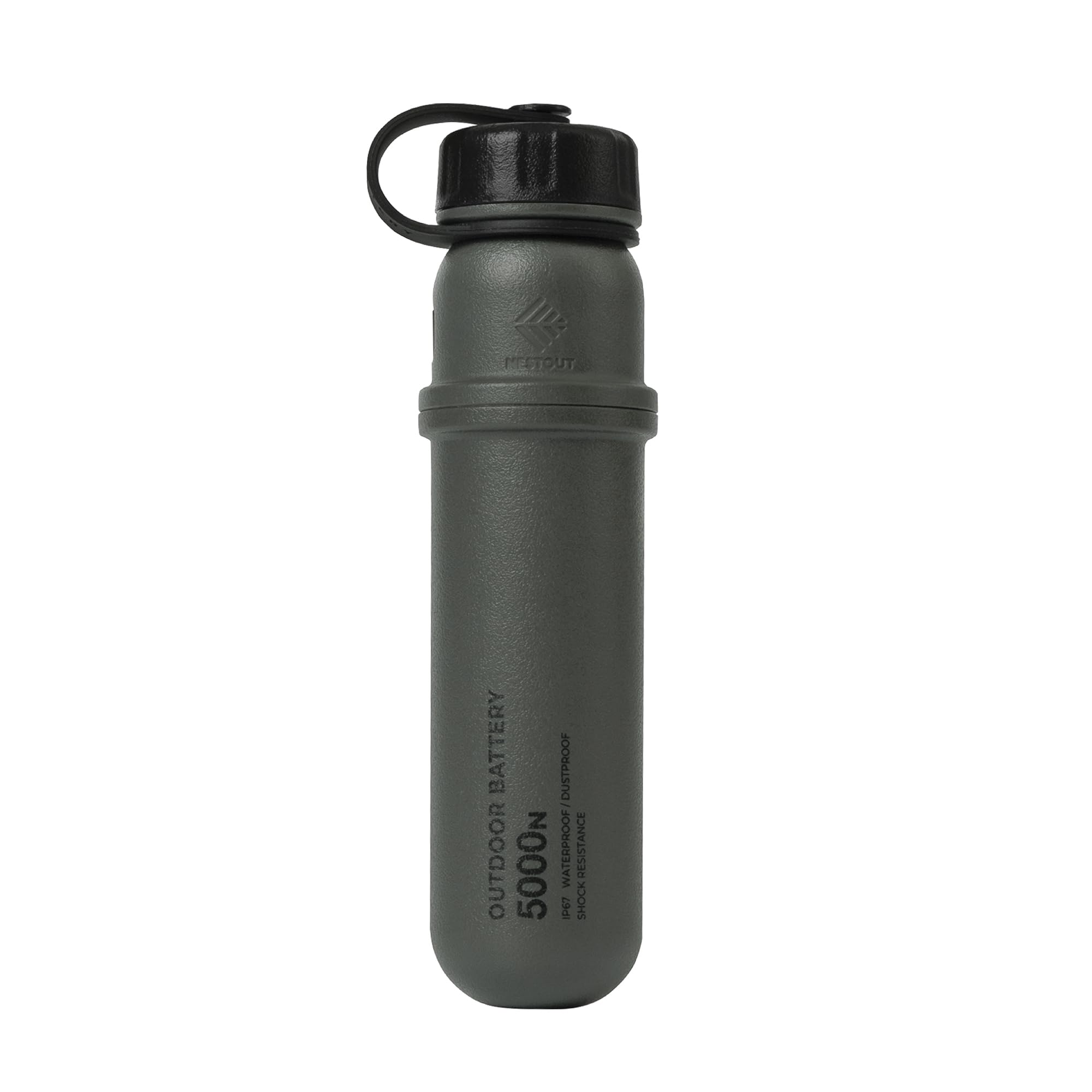
A 4.9-ounce stick that disappears into a pouch until the moment you need one charge.
Sometimes you do not want a battery pack. You want insurance. At 5,000 mAh and 4.9 ounces, this NESTOUT is the smallest and lightest charger on this list — light enough to ride in a chest rig or jacket pocket without you noticing it, and small enough at 5.31 × 1.42 × 1.42 inches to vanish into the bottom of a daypack. It delivers one solid top-up rather than three, and for a short outing that is the whole job.
The shock protection is the interesting engineering. The lithium-ion cell sits inside a silicone cushion that absorbs vibration and impact, and it has been tested to US Military Standard MIL-STD 810G 516.7 for drop resistance. Waterproofing is IP67, rated for 30 minutes at 1 meter of depth, which covers a stream crossing or a downpour. Charging runs through USB-C PD at 15W, and the pack also has a ¼-20 tripod mount on the bottom — the same thread as a camera — so you can screw it to a mini tripod or a light mount.
Buyers consistently value the construction quality, how it takes weather and knocks in stride, and how easily it stashes for a quick trip. The design itself won an iF Design Gold Award and mimics a vintage fuel bottle, so it looks deliberate rather than anonymous. Two honest limits: charging speed draws split feedback — some owners see a full refill in 45 to 60 minutes, others find it never fully tops a phone overnight — and the size surprises people in a good way, sitting smaller than expected. Refilling the bank takes about 2 hours.
The carry argument: 4.9 ounces and a 5-inch bottle profile is the difference between carrying a charger and forgetting you have one.
Set expectations on capacity: 5,000 mAh is one phone charge — this is a day-trip pack, not a weekend reserve.
Pick this when: every ounce counts and you only need one backup charge on a short trip.
Skip it for: multi-day trips or two devices — its 5,000 mAh cell runs dry after one top-up.
5. NESTOUT 10,000 mAh Rugged Power Bank

The bigger brother of the bottle pack, with enough reserve to carry a pouch full of gear.
Where the 5,000 mAh NESTOUT is a top-up, this 10,280 mAh version is a real reserve. It powers a phone, a tablet, or a camera through a full day and then some, and it steps up the charging to 20W USB-C PD — fast enough that a useful top-up is a short coffee break rather than a whole evening. Smart Power Delivery automatically detects what you have plugged in and routes extra power to the hungrier device, so your tablet is not starved behind a phone.
Protection mirrors the smaller sibling: IP67 for 30 minutes at 1 meter, a hard shell with the cell in a silicone cushion, and MIL-STD 810G 516.7 drop testing. There is the same ¼-20 tripod mount on the bottom and the same compatibility with the brand’s LAMP-1 lantern and FLASH-1 LED panel, both sold separately. It measures 5 × 2.4 × 1.4 inches and weighs 241 g. Refilling from empty takes about 3.58 hours, and the maker suggests an 18W-or-above PD wall adapter to hit that time.
Owners rate the build and reliability highly — several say they would recommend it outright, and the recurring praise is that it feels rugged and never misses a beat. It fits neatly in backpack cases and mag pouches, which is exactly the use case it is built for. The known split is charging speed: some owners see fast full refills while others report the pack only reaching phones at 10–60%. That pattern is common across this category and usually lands on the cable or the phone’s charging handshake rather than the cell, but it is worth knowing going in.
What Earns It A Spot
- 20W USB-C PD output for fast phone and tablet top-ups.
- IP67 water and dust rating plus MIL-STD drop testing on a silicone-cushioned cell.
- Tripod mount and modular accessory compatibility with the brand’s lantern and LED panel.
- Mag-pouch and backpack-case friendly at 241 g.
The Fine Print
- Charging speed earns split feedback — results vary by cable and phone.
- A full refill takes about 3.58 hours, so overnight charging is the routine.
- Lantern and LED panel are sold separately, not included.
The right call for: a carried-every-day pack that needs enough reserve for phone plus camera plus tablet.
Second-guess it if: you expect a fast charge straight from the start with any cable — bring a PD-rated cord.
6. Goal Zero Venture 35 Power Bank, 9,600 mAh

Half go-bag power pack, half flashlight, built for the night the grid goes down.
This is a pack for the glovebox and the emergency bag, not the summit push. The defining feature is the integrated 50-lumen flashlight, which turns an otherwise ordinary battery into something you can grab in the dark without hunting for a lamp. Add an IP67 rating with a protective sleeve and a waterproof port plug, and you have a pack that handles rain, snow, and dust while sitting in a car for months. At 9,600 mAh it holds enough for a couple of phone refills, and it charges over USB-C PD at 18W.
The case earns attention. A protective sleeve wraps the body and the port plug seals the connections, which is the detail that usually fails first on a pack that lives outside. It measures 4.41 × 2.68 × 1.1 inches and carries a 3A output. The brand is a long-standing name in off-grid power, with the pack engineered in the U.S. If you want a pack that doubles as a light and a charger for a roadside emergency or a power cut, the two-in-one design is genuinely useful.
The honest note is slow refills of the pack itself. Charging the pack itself runs long, and the light plus the cell can feel slower than owners expect on a straight USB-C PD pack. That is a fair caution for anyone planning to lean on it as a primary trip battery. Treated as a compact emergency pack with a built-in lamp, though, it does exactly what it advertises, and a 9,600 mAh cell in a small sleeve is the right size for a go bag.
The emergency-kit value: a 50-lumen flashlight and a 9,600 mAh charger in one compact sleeve means one item covers two failures.
The catch: refilling the pack takes patience, so charge it ahead of time rather than counting on a fast turnaround.
Best for: a go bag, glovebox, or nightstand where light plus backup power both matter.
Look elsewhere if: you need a big multi-day reserve — 9,600 mAh is a compact emergency figure, not a trip battery.
7. Dark Energy Poseidon Pro 10,000 mAh
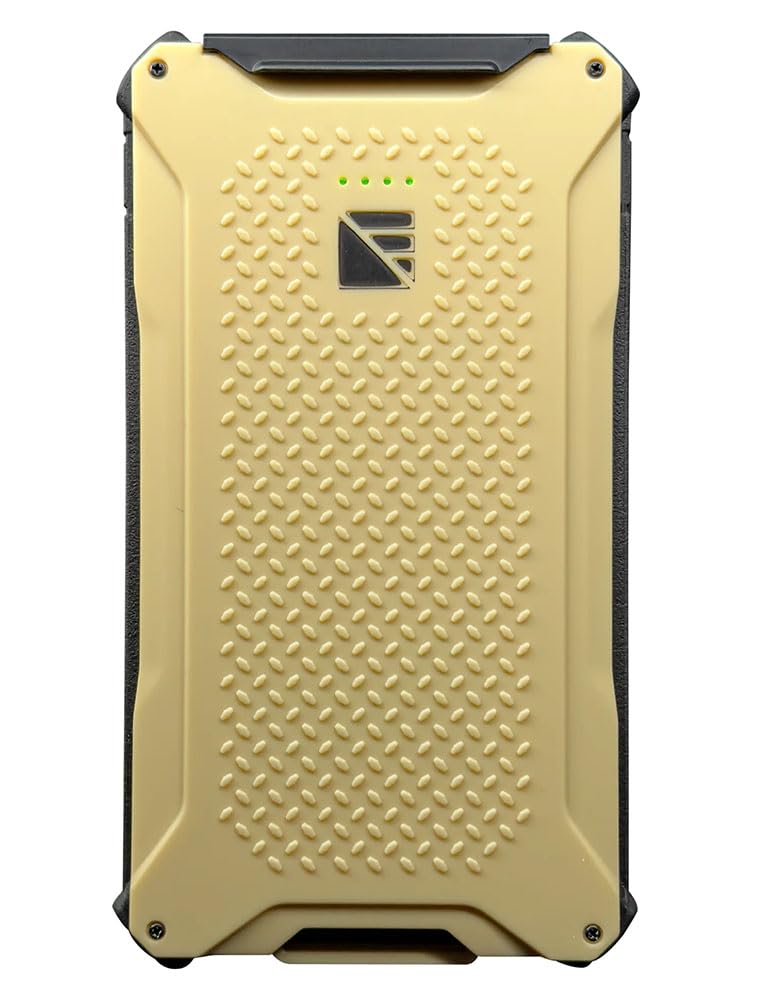
The pack that survives 45 minutes underwater and waits eight years to be needed.
If your definition of rugged includes being dropped in a lake or left in a vehicle through four seasons, this is the most extreme option here. Dark Energy also claims it has been tested across extreme temperatures from -15 to 100 degrees, and the Armorflex exterior is built for exactly that abuse.
The headline for preppers is the shelf life. Dark Energy claims the pack holds a charge for 8+ years, which is the whole point of an emergency battery: it is there when you open the bag, not dead in a drawer. At 10,000 mAh it covers 30+ hours for smartphones, 4+ hours for laptops, and 10+ hours of camera gear. Ports are one USB-A at 5V/3A plus two USB-C fast-charging ports up to 12V/1.5A, and a single button handles power with a timer mode for scheduled charging and a low-power mode for small devices like earbuds.
It is genuinely pocketable at 0.56 lbs and 6 × 3.25 × 0.63 inches — about the size of a phone. What owners appreciate most is battery performance and build solidity, and the construction is described as tough rather than merely cased. The mixed feedback worth planning around centers on charging speed and long-term performance. It is the premium pick here, so expect the trade-offs to be about patience rather than protection.
The preparedness case: IP68, 45-minute submersion, and an 8+ year claimed storage window make this the set-and-store pack of the list.
Weigh the price of extreme: charging speed lands mixed, and this is the priciest option — you are paying for the rating, not the wattage.
Choose it when: your pack gets submerged, frozen, or stored for years between uses.
Don’t choose it for: budget or a fast full refill — the extreme IP68 build is the reason you pay more here.
Know the Specs
IP67 vs IP68
Both ratings mean a pack keeps out dust and survives being dunked, but the second digit sets the water limit. IP67 covers 30 minutes at 1 meter of depth, which handles rain, a stream crossing, and a splash in a boat. IP68 goes deeper and longer — Dark Energy rates the Poseidon Pro for 45 minutes of submersion. Both assume the port cover is seated; a loose lid turns either rating into a paper promise.
Battery Capacity in mAh
Milliamp-hours measure how much charge the cell holds. A 5,000 mAh pack is one phone top-up and weighs the least. A 10,000 mAh pack handles a phone plus headphones or a tablet through a day. A 15,000 mAh pack stretches across a multi-day trip but adds bulk and weight. Match capacity to trip length, not to the biggest number on the shelf.
Charging Wattage and USB-C PD
USB-C PD (Power Delivery) negotiates the fastest safe charge your device accepts. A 20W output refills a phone quickly; an 18W output is close; a 15W output is slower but fine overnight. No charger here can outrun a weak cable, so use a PD-rated cord and an 18W-or-above wall adapter when refilling the pack itself.
LiFePO4 vs Standard Lithium-Ion
LiFePO4 (lithium iron phosphate) batteries are rated for far more recharge cycles than standard lithium-ion. The BLAVOR pack claims 3,500+ cycles and 80% capacity retained after 3,000 — the kind of longevity that matters if you charge weekly for years. Standard lithium-ion packs are lighter and cheaper but do not hold capacity as long over many cycles.
Common Questions
Can a rugged power bank survive being dropped on rock?
Does IP67 waterproof mean I can take my power bank swimming?
How many charges will a 10,000 mAh power bank give my phone?
Why does my power bank take hours to recharge from empty?
Is LiFePO4 better than lithium-ion for an outdoor power bank?
Can I charge two devices at once on these packs?
What is the tripod mount on a power bank for?
How long can a rugged power bank sit before it loses its charge?
Do rugged power banks work in freezing temperatures?
The Bottom Line
For most buyers, the rugged portable charger winner is the DEWALT Heavy Duty 10,000 mAh because it pairs IP67 dust and water resistance with a carabiner loop and a shell built for repeated wear — it is the pack that survives a jobsite and still shows you its charge level. If you want the longest-lived cell and the biggest reserve, grab the BLAVOR 15,000 mAh with its LiFePO4 chemistry and built-in lanyard cable. And for a go bag or a worst-case night, the Goal Zero Venture 35 gives you a 50-lumen flashlight and a charger in one sleeve. The honest nudge: the DEWALT’s 4.5+ stars across 900+ ratings make it the most-proven pick here, while the BLAVOR’s 4.8 rests on far fewer ratings — weigh proven history against raw chemistry.
How we choose
We do not accept paid placement. Every pick is matched to a real buyer and a real use-case; we do not hands-on test units.
Sources
Specifications: manufacturer listings and product documentation. Review insights: verified customer reviews, as of November 2026. Pricing: not shown on this page (it changes often); check the current price via the retailer link.
As an Amazon Associate, Tactical Gear Guy earns from qualifying purchases. This does not affect which products we feature.