Specs are compiled from manufacturer listings and verified buyer reviews and can change over time — please confirm the key details on the product page before buying.
If your only internet option is a cable that nobody will run to your door, a router with a SIM card slot fixes that in about five minutes. You plug in a data SIM, the router grabs a cellular signal, and every phone, laptop and TV in the building gets Wi-Fi. The catch is that these routers are not interchangeable: some need 5G, some are certified only for specific carriers, and a few are built for a cabin roof rather than a living room shelf.
This guide is built by comparing the manufacturers’ published specifications and the patterns across verified customer reviews, so you get each pick’s real strengths and trade-offs instead of marketing spin.
Below you will find the carrier certifications, SIM arrangements and real-world coverage limits laid out side by side, so you can pick the one that actually locks onto a signal where you live. That is the whole job of a router with sim card — turning a mobile data plan into usable home or job-site Wi-Fi.
Top Picks

How To Choose The Best Router with SIM Card
The first decision is not brand or speed — it is carrier certification. It is which of your local carriers will actually accept the router. A cellular router has to register on a network the same way a phone does, and many units are certified only for specific providers. Check that certification list before anything else — a fast router that refuses your SIM is a paperweight.
Check carrier certification before you buy
Look for a router that names the carriers it is certified with. T-Mobile and AT&T appear most often in this group. Certification is not a guarantee of perfect reception, but it means the device has been tested to register and hold a connection on that network. If your provider is not listed, expect to configure APN settings manually and accept some risk.
Decide if you need 5G or 4G LTE
5G brings far higher headline download speeds, but the signal travels shorter distances and struggles through walls. A 4G LTE router tends to hold a usable connection in rural pockets where 5G has not arrived. If you are wiring a fixed location in the countryside, LTE is often the steadier choice. If you are near a city tower or move large files daily, 5G earns its place.
Think about how many SIM slots you want
A single SIM slot is fine if you have one solid data plan. Dual SIM slots let the router switch to a second carrier automatically when the first drops — that is what failover means. For a home office, a job site, or an RV where a dropped connection costs you real work, the second slot is worth having. For a cabin that only needs email and light browsing, one slot is plenty.
Side-by-Side Comparison
| Model | Best For | Cellular Tech | Stated Data Rate | SIM Slots | Amazon |
|---|---|---|---|---|---|
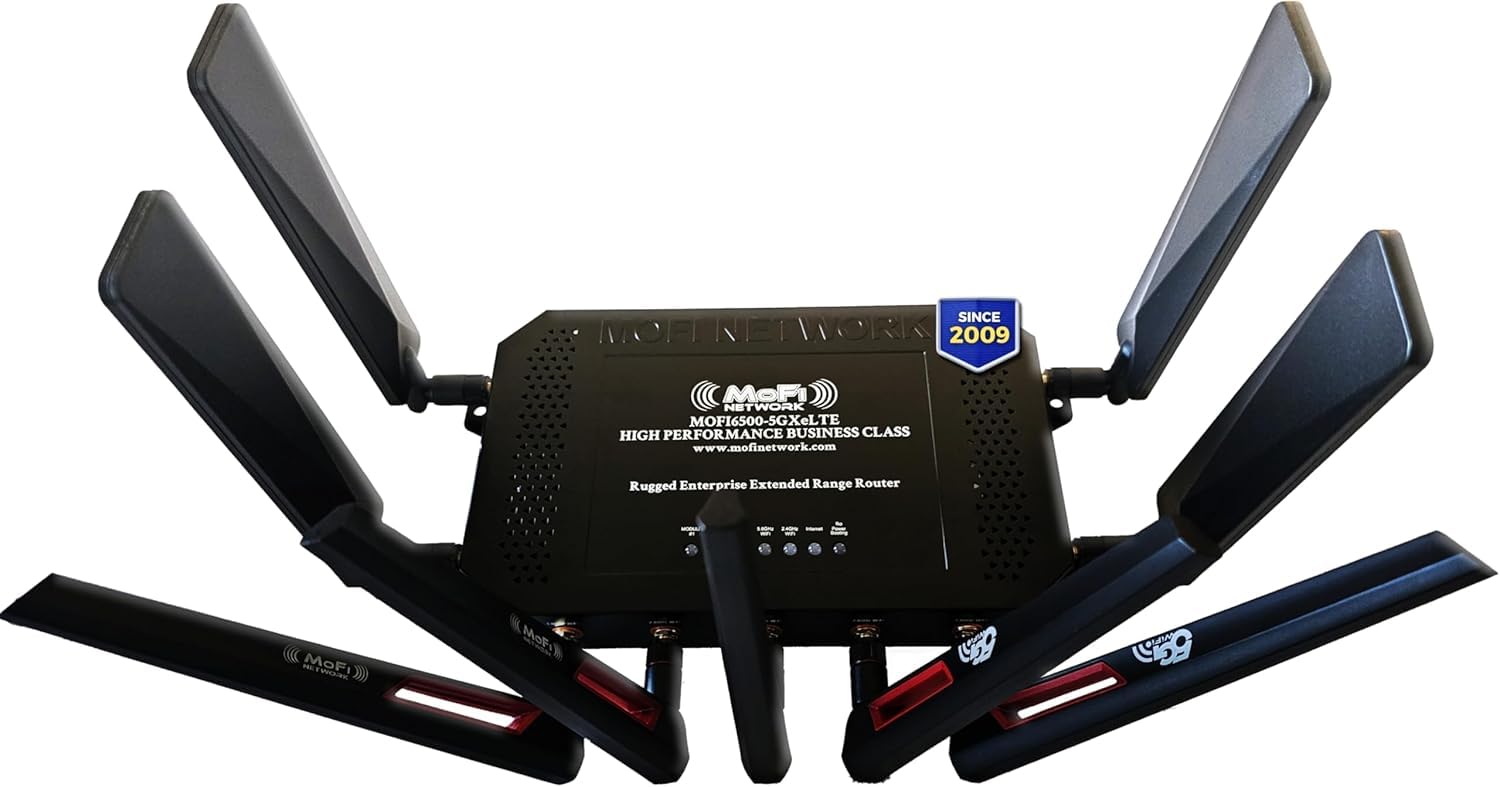
| MOFINETWORK MOFI6500★ Best Overall | Business-grade 5G with amplified Wi-Fi | 5G and 4G LTE | 3.4 Gbps | Dual SIM | Amazon |
| Cudy LT500EBest Value | Simple budget indoor Wi-Fi | 4G LTE Cat 4 | 1200 Mbps | Single SIM | Amazon |
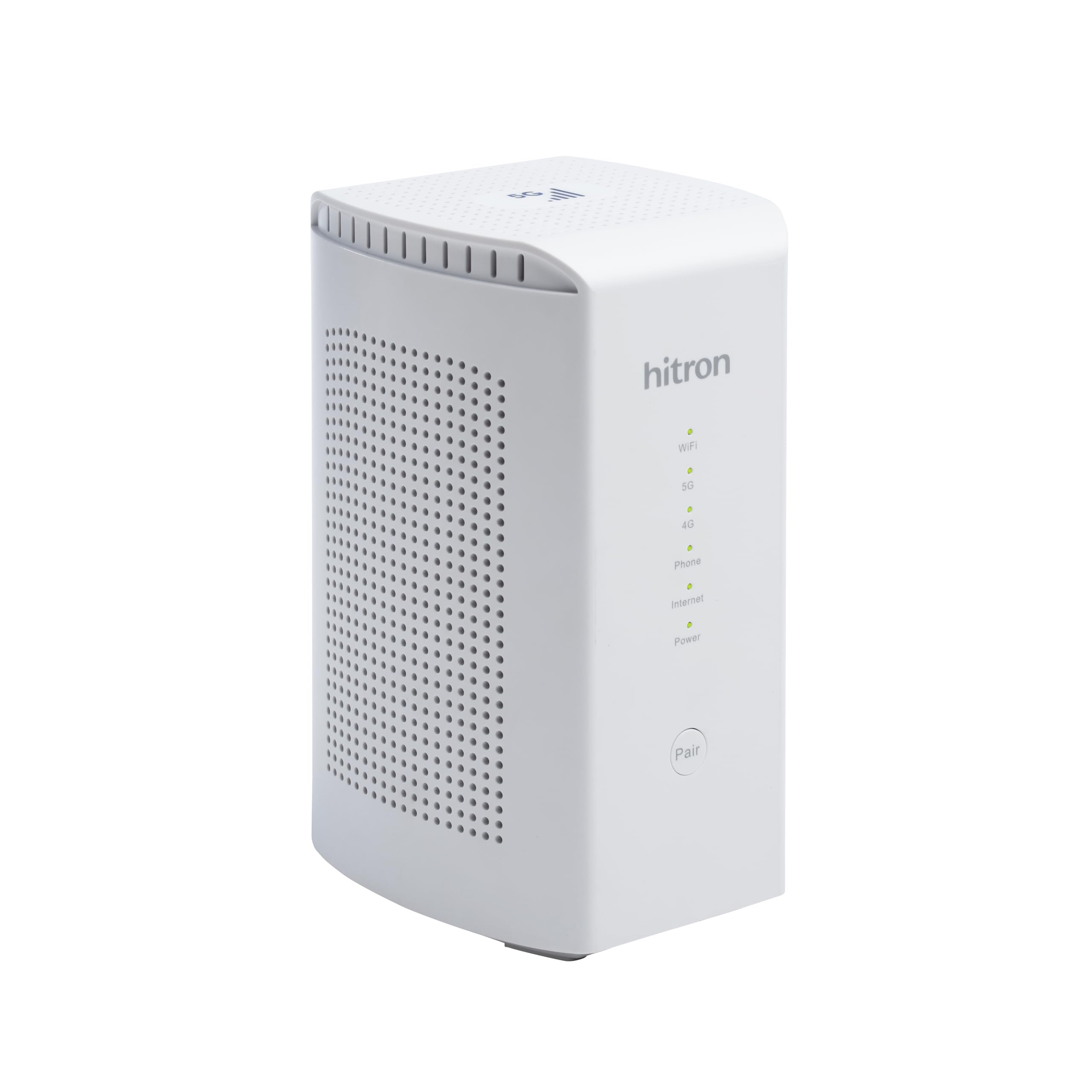
| Hitron D60 5GFailover Pick | Failover backup for a home or small office | 5G and 4G LTE | 3.4 Gbps | Nano SIM and eSIM | Amazon |
| GL-X750V2 Spitz | Rural and RV internet with OpenWrt control | 4G LTE Cat 4 | 750 Mbps | Micro SIM | Amazon |
| Cudy LT400 Outdoor | Mounting outside in the weather | 4G LTE Cat 4 | 300 Mbps | Single SIM | Amazon |
| GL.iNet GL-X3000 Spitz AX | RV and remote work with dual SIM 5G | 5G NR and 4G LTE | 3000 Mbps | Dual SIM | Amazon |
| Cudy P5 5G AX3000 | Heavy device loads on Wi-Fi 6 | 5G SA/NSA | 2976 Mbps | Dual Nano SIM | Amazon |
| GL.iNet GL-XE3000 Puli AX | Staying online through a power cut | 5G and 4G LTE | 3000 Mbps | Dual SIM | Amazon |
| Teltonika RUTX11 | Industrial and commercial installs | 4G LTE Cat 6 | — | Dual SIM | Amazon |
Detailed Reviews
1. MOFINETWORK MOFI6500-5GXeLTE Router
Our pick — 4.0+★ from 850+ verified ratings; the strongest balance of quality and price.
The metal-bodied workhorse that treats a SIM card like a proper business connection
This is the pick for someone who cannot afford a dropped line — a shop, a job trailer, a home office running on cellular. It takes two SIM cards and swaps between them on its own, which is the single feature that separates a serious cellular router from a cheap one. If your primary carrier goes quiet, the second card takes over without you touching anything.
The headline number is a 3.4 Gbps data transfer rate, meaning the cellular side can pull down roughly 3.4 gigabits of data every second in good 5G conditions. Wi-Fi 6 plus internal signal amplification then pushes that out across the building, so the range reaches further than a bare-bones unit. There are 5 x 2.4/5GHz Wi-Fi antennas in the box alongside 4 x 5G cellular high-gain antennas, and the full metal case is there to spread heat rather than just look tough. The box also includes a 10 ft CAT6E Ethernet cable and a 3.5AMP certified power adapter.
Configuration depth is what owners tend to talk about — IP pass-through, band lock, VPN compatibility and Zerotier certification all sit in the admin panel. Setup behaves like plug-and-play once the SIM is in. The catch is carrier fit: T-Mobile setups get the most consistent results, while AT&T users run into trouble on some plans, so confirm your provider before committing. A toll-free support line is listed for setup help, which matters on a unit this configurable.
What earns the top spot
- Dual SIM with automatic failover keeps the connection alive when one carrier fades
- 3.4 Gbps data rate with amplified Wi-Fi 6 for genuinely wide indoor coverage
- Full metal housing and detachable antennas for heat spread and flexible placement
- Band lock, IP pass-through and VPN support for people who want to tune the network
Where it asks more of you
- AT&T compatibility is inconsistent depending on your plan — verify before buying
- The deep settings menu is overkill if you just want Wi-Fi and a password
Built for: anyone running a business or home office on cellular where a dropped line costs money.
Think twice: if your data plan is AT&T, confirm support first — that is the one carrier gap buyers hit.
2. Cudy LT500E Router
A quiet white box that turns one LTE SIM into solid dual-band Wi-Fi
The Cudy LT500E is the cheapest way into cellular Wi-Fi here, and it hides its antennas inside the case. That means no external sticks to knock or position — it looks like a plain white router on your shelf. It weighs 300 g, so it sits on a windowsill without you noticing it. Compare that with the GL-X750V2 further down at 86 g: you trade 214 g of housing bulk for those internal antennas. If you want a tidy box that never needs antenna aiming, this is the one. If you need to squeeze every bit of signal in a weak area, the external-antenna GL-X750V2 is the better pick.
The real workhorse number is a 1200 Mbps data transfer rate across dual-band Wi-Fi — up to 867Mbps on the 5GHz band and 300Mbps on 2.4GHz. The cellular side is 4G LTE Cat 4 with up to 300Mbps download speed, which is honest LTE rather than 5G. It also carries 100Mbps Ethernet ports, so wired devices are capped at that speed. For everyday browsing, video calls and streaming, that is plenty. Just do not expect to saturate a gigabit wired link through it.
Where it gets interesting for tinkerers is the software: Mesh support through Cudy’s whole mesh system, VPN client support, DNS over TLS, band lock and TTL settings all come baked in. The trade-off is that this is 4G only — if your area has strong 5G and you need speed, the Cudy P5 or the GL.iNet GL-X3000 will serve you better. For rural internet or a backup line, though, this is the budget-friendly answer that does the basic job cleanly.
The value read: a compact 300 g unit with 1200 Mbps dual-band Wi-Fi and a full set of VPN and band-lock tools for far less than the 5G picks.
The honest limit: 300Mbps LTE and 100Mbps Ethernet ports mean it is a steady connection, not a fast one.
Reach for this if: you want dependable LTE Wi-Fi on a budget and are happy with 4G speeds.
Look elsewhere if: 5G speed or gigabit wired ports are part of the plan.
3. Hitron D60 5G Cellular Router with SIM Card Slot (AX3000)
The backup line that steps in the moment your wired internet dies
Picture a home or small office where the cable connection is usually fine — except when it is not. The D60 is built for that exact gap. You keep it as a secondary path, and when the main wired broadband goes down, it switches the whole network over to cellular. That is the reliability angle owners talk about, and it is the reason to consider this one over a plain travel router.
On the cellular side it is genuinely quick: up to 3.4 Gbps download on 5G NSA, which is the non-standalone flavour of 5G that most carriers run today. It handles both standalone (SA) and non-standalone (NSA) 5G and drops back to 4G LTE where 5G is thin. It is certified with T-Mobile, AT&T and US Cellular and needs a Nano SIM from one of those three. There is also eSIM support, which lets the unit carry a second profile for dual failover without a physical card.
The practical constraint is coverage and time. The 5G here is the selling point, but the unit weighs 1.14 kg and is not built for mounting outdoors, so it belongs indoors near a window. It also ships with a 3 Month Limited Warranty, which is far shorter than the 2-year coverage on the GL.iNet units. Rural buyers tend to get good results, especially where a wired line is unreliable, but expect the app-based controls to be the main way you manage it.
Reliability first: 5G and 4G LTE with SA/NSA support, certified on T-Mobile, AT&T and US Cellular, and eSIM for a second profile.
The trade-off: a 3 Month Limited Warranty and a 1.14 kg indoor-only body, so plan on keeping it near a window.
Made for: homes and small offices that need cellular as a safety net under a shaky wired line.
Not ideal if: you need long-term warranty cover or an outdoor install.
4. GL.iNet GL-X750V2 (Spitz) 4G LTE VPN Router

Eighty-six grams of open-source router built for cabins and campsites
The GL-X750V2 weighs 86 g, so it is built to travel to a holiday cabin, an offshore boat or a rural site and still work. It turns a 4G LTE signal into Wi-Fi at 300Mbps on the 2.4GHz band and 433Mbps on the 5G band — enough to stream video and browse on a few devices at once. It is certified for AT&T IoT data plans, with T-Mobile support as well. GL.iNet says it rebuilt the board and antennas on this version to improve 4G pickup in rural places. That 86 g body is 214 g lighter than the 300 g Cudy LT500E, which is why this one goes in a bag and the Cudy stays on a shelf.
The reason a certain kind of buyer loves this router is OpenWrt. The open-source firmware comes preinstalled, along with 30+ VPN service compatibility, Cloudflare support, 128MB RAM, 16MB NOR Flash, a MicroSD/TF slot up to 128GB and dual 10/100M Ethernet ports. That is a lot of control in a tiny box, and it is why setup and build quality draw steady praise. You get a 2-year warranty and a full package including the power adapter and Ethernet cable.
Honesty time: the signal side is where expectations need setting. Average 4G speed sits around 15-20Mbps, and the LTE capability is limited by the EC25-AFFA Cat 4 module. Mixed reports on signal strength and connectivity show up because rural reception varies so much by location. Network compatibility is the sharpest gripe — some carriers simply are not supported. Check that your provider is on the AT&T or T-Mobile list before you order.
Why it earns its place
- 86 g and pocketable, so it rides along to cabins, boats and campsites
- OpenWrt preinstalled with 128MB RAM and up to 128GB TF storage
- Certified for AT&T IoT data plans with T-Mobile support
- 2-year warranty and a complete box
What to expect honestly
- Average 4G speed lands around 15-20Mbps — this is not a speed demon
- Carrier compatibility is narrow; unsupported networks are a real dead end
- Dual Ethernet ports are 10/100M, not gigabit
Best fit: the traveler who wants OpenWrt control and a router that weighs less than a phone charger.
Skip the gamble if: your carrier is not AT&T or T-Mobile — check first, this one will not budge.
5. Cudy LT400 Outdoor Router

Built to bolt to a pole in the rain and still hand out Wi-Fi
Most routers in this group live indoors. This one does not. It carries an IP65 rating, which means the housing is sealed against dust and against water jets — the kind of protection you need on a fence post or a cabin wall. There is 4KV lightning protection built in as well, a detail that matters when the unit is mounted high and outside.
The install story is the standout feature: 24V passive PoE power supply, with an adapter included, sends both power and Ethernet down a single cable. That means you mount the router where the signal is best and run one wire back to your indoor network. Pole or wall mounting hardware comes in the box. Inside, it takes a BYOD SIM from a major 4G provider for up to 150Mbps download, and the detachable 5dBi cellular antennas improve sensitivity and let you swap in a higher-gain antenna via the SMA connectors.
Here is the number that gives away its role: the data transfer rate sits at 300 Mbps, and that is the whole wireless budget on a single 2.4GHz band. Compare that with the Cudy LT500E indoors at 1200 megabits per second and you can see the outdoor unit trades raw Wi-Fi speed for weatherproofing and range. It is a coverage device, not a throughput device. Set your expectations to “gets signal to a shed or a remote camera,” and it does that job well.
Weatherproof by design: IP65 housing, 4KV lightning protection and 24V passive PoE down a single cable.
Speed reality: 300 Mbps on a single 2.4GHz band — plenty for cameras and basic browsing, not for heavy streaming.
Choose it when: the router has to live outside on a pole, wall or farm building.
Stay indoors if: you need dual-band speed — this one is a single-band coverage tool.
6. GL.iNet GL-X3000 (Spitz AX) Cellular Gateway 5G Router

One box that carries a dual-SIM 5G signal and a VPN tunnel to the road
For a remote worker living out of an RV, this is the router people point at first. It pairs two SIM slots with 5G on both NSA and SA standards, so you can hold two carriers and let the unit fail over to the stronger one automatically. That combination — 5G speed plus dual-SIM redundancy — is what makes it a genuine mobile-office device rather than a home gadget.
Wi-Fi 6 (the newer, faster Wi-Fi standard) keeps pace with the cellular side: up to 574Mbps on the 2.4GHz band and 2402Mbps on the 5GHz band, so a 4K stream and a video call can run at once. MU-MIMO (multi-user MIMO, which lets the router serve several devices at the same time) shares that airtime across your phones and laptops. The stated data transfer rate is 3000 Mbps. For VPNs (private encrypted tunnels), OpenVPN and WireGuard come preinstalled and 30+ VPN services are supported. Max VPN speed is 150 Mbps on OpenVPN and 300 Mbps on WireGuard — though GL.iNet notes those figures come from local network testing and real-world results depend on your setup.
What gets attention is the feature depth: OpenWrt v21.02 with more than 5,000 ready-made plug-ins, six detachable antennas, dual SIM slots, a physical eSIM card option, and multi-WAN with load balancing and failover priorities. It is certified for AT&T and T-Mobile IoT devices. A small number of T-Mobile 5G connections refuse to lock on, so carrier behaviour in your area is worth checking. The GL.iNet ecosystem here is its own — this is not a place to expect a different brand’s app.
The RV case: dual-SIM 5G with automatic failover, six detachable antennas and multi-WAN load balancing.
The honest note: T-Mobile 5G can be stubborn in some locations, and VPN speeds depend on your real-world setup, not the test-bench numbers.
Built for: RV owners and remote workers who need 5G plus a second carrier as backup.
Look elsewhere if: you want a simple plug-and-play home unit without OpenWrt menus.
7. Cudy 5G SA/NSA AX3000 4-Port Gigabit Wi-Fi 6 Router (P5)

The wired-and-wireless office router that keeps a hundred clients happy
If your setup is a desk, a NAS, a couple of game consoles and a house full of laptops, this is the one to look at. It pairs 5G cellular with real wired muscle: four Gigabit Ethernet ports, one of them configurable as WAN or LAN, so you can run a cable modem and a SIM as competing sources. That flexibility is rare in this price band.
The cellular side is 5G Rel. 16 with 4CA and 4×4 MIMO, rated for up to 3.4 Gbps downloads, and the data transfer rate is 2976 Mbps. Wi-Fi 6 delivers 4-stream dual-band output at 2402 Mbps on 5GHz and 574 Mbps on 2.4GHz, with Beamforming to focus the signal. The stated maximum capacity is 256 devices with a recommended upper limit of 100 clients. OFDMA, MU-MIMO and BSS Color help keep a busy network from choking.
Setup tends to go smoothly, and the customization options are a highlight — you can configure things directly in the UI without workarounds. That said, reliability and value-for-money reports come in mixed, and those are worth weighing honestly against the performance praise. Two Nano SIM slots and four detachable cellular antennas give you room to move things around. For homes and businesses with lots of wired gear, the four Gigabit ports here beat the Cudy LT500E’s 100Mbps ports outright.
Where it shines
- Four Gigabit ports, one configurable WAN/LAN, for a wired-heavy setup
- 5G Rel. 16 with 4CA and 4×4 MIMO, rated up to 3.4 Gbps
- Capacity of 256 devices, with a recommended upper limit of 100 clients
- Two Nano SIM slots and Cudy Mesh expansion
The fair caveats
- Reliability reports are mixed — worth buying from a seller with a return path
- Value-for-money feedback is also mixed given the premium-tier positioning
Made for: busy homes and small businesses running plenty of wired and wireless devices at once.
Weigh carefully if: you want the simplest possible setup with no troubleshooting risk.
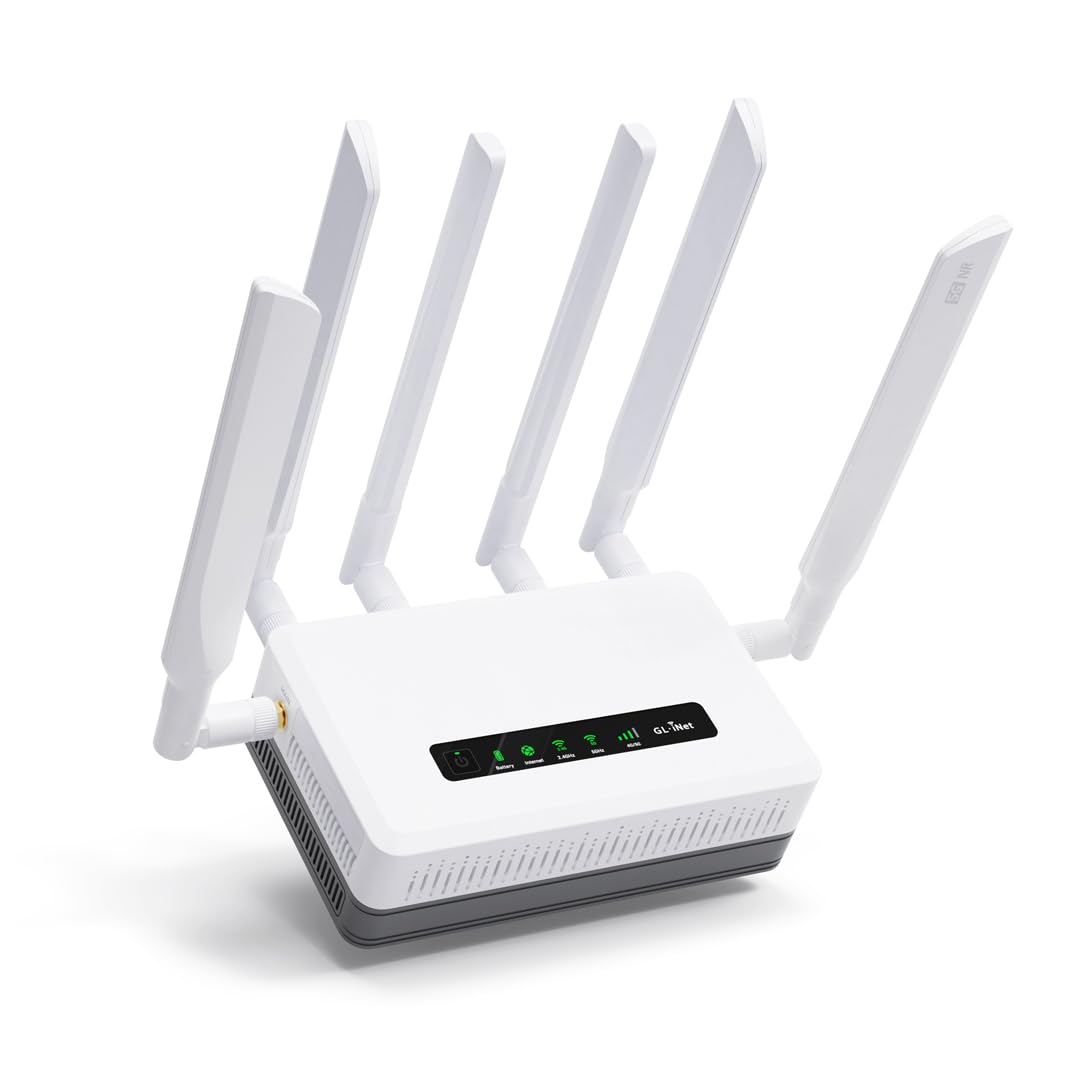
8. GL.iNet GL-XE3000 Puli AX 5G Router with 6400mAh Battery
Keeps the meeting running when the power strip goes dark
Almost every router in this group needs wall power. This one carries a built-in 6400mAh battery that GL.iNet says provides up to 8 hours of uninterrupted connectivity. That single feature reframes the whole product: it is a router for construction sites, temporary offices, event stands and any place where the mains supply is not guaranteed. The battery is the reason to pick it over the GL-X3000.
This model keeps the same Wi-Fi 6 foundation as its sibling: up to 574Mbps on 2.4GHz and 2402Mbps on 5GHz with MU-MIMO, and a stated data transfer rate of 3000 Mbps. It handles 5G on both NSA and SA standards (the two main ways 5G networks are built) with dual SIM and automatic failover — if one SIM drops, the other takes over so your connection stays up. It is certified for AT&T and T-Mobile IoT devices, and OpenVPN and WireGuard come preinstalled with the same 150 Mbps OpenVPN and 300 Mbps WireGuard figures.
Buyers report strong speed and range, and the customizability draws a lot of comment — more features than most people will ever use. OpenWrt with 5,000+ plug-ins, multi-WAN with load balancing and failover, detachable antennas and a physical eSIM card option all sit inside. The honest trade-off is complexity plus the same T-Mobile 5G caveat that runs through the GL.iNet family: in some spots it will not hold a 5G lock, so test with your own SIM.
The standout: a 6400mAh battery rated for up to 8 hours, backed by Wi-Fi 6 at 3000 Mbps and dual-SIM 5G failover.
The catch to weigh: heavy feature depth and occasional T-Mobile 5G lock issues mean it rewards someone who will tune it.
Best fit: job sites, event setups and temporary offices where power itself is unreliable.
Think twice if: you already have steady power and want the same open-source package without the battery cost.
9. Teltonika RUTX11 Industrial 4G LTE Cat 6 Router

Aluminum-clad networking kit for a control cabinet, not a coffee table
This is the odd one out in the best possible way. Where the other picks float around a home or an RV, the RUTX11 is built for cabinets, kiosks, cameras and controllers. The housing is rugged aluminum, and it is designed to be managed remotely through Teltonika RMS — centralized monitoring, configuration, firmware updates and troubleshooting from wherever you are. Remote RMS management is the difference between a consumer router and infrastructure.
The cellular side runs on 4G LTE Cat 6 technology with carrier aggregation, which combines bands for better throughput than plain Cat 4. Dual SIM with automatic failover handles carrier redundancy, so a network outage or changing conditions switch the link without a site visit. Wired and wireless coverage is generous: dual-band Wi-Fi 5 (802.11ac), Bluetooth LE and four Gigabit Ethernet ports for computers, cameras, controllers and IoT gear.
For secure remote access there is an advanced firewall and support for multiple VPN protocols, covering site-to-site links and protected data movement. Coverage is listed for North, Central and South America, and it is compatible with AT&T, Verizon and T-Mobile. The caveat is fit rather than fault: this is not a plug-and-play home router, and it expects someone comfortable with industrial networking. If that is you, the four Gigabit ports and aluminum body are exactly right.
Industrial backbone: LTE Cat 6 with carrier aggregation, dual SIM failover, Wi-Fi 5 and Bluetooth LE in a rugged aluminum case.
Know before you buy: B2B-style management through Teltonika RMS and a multi-protocol VPN stack assume an administrator, not a first-time buyer.
Choose it for: kiosks, control cabinets and remote sites that need centralized, remote-managed networking.
Not the one if: you want a router you can set up in five minutes at home.
Know the Specs
Cellular Tech: 5G vs 4G LTE
This is the biggest split in the whole group. 5G routers like the MOFINETWORK MOFI6500 or the Cudy P5 are rated for multi-gigabit downloads, which suits dense areas and heavy data use. 4G LTE routers such as the Cudy LT500E or the GL-X750V2 run slower but hold a signal over longer distances and through walls, which is why they often fit rural installs. Pick the technology your location can actually receive, then match the router to it.
Data Transfer Rate and What It Means
The data transfer rate is the theoretical ceiling of how much data the unit can move per second. High figures only matter if your carrier signal can feed them, so treat the number as headroom rather than a promise. A 3.4 Gbps rating is meaningless if your tower delivers 20 Mbps. Cross-check the rate against the Wi-Fi bands, too — the Cudy LT400 Outdoor hits 300 Mbps while the Cudy LT500E reaches 1200 Mbps, and that gap shows up in real-world streaming.
SIM Slots and Failover
A router with two SIM slots can hold two carriers and switch automatically when one fails. That is failover, and it is the feature that turns a router from a convenience into an uptime tool. The MOFINETWORK MOFI6500, the Hitron D60, the GL.iNet GL-X3000, the Cudy P5, the GL.iNet GL-XE3000 and the Teltonika RUTX11 all offer dual-SIM arrangements. A single SIM slot is fine if you only need one steady connection.
Carrier Certification and Bands
Certification means the maker has tested the router on that carrier’s network. T-Mobile and AT&T show up most often on this list, with Verizon and US Cellular appearing on specific models. If your carrier is not certified, the router may still work but you will be configuring APN settings by hand and accepting a compatibility gamble. An uncertified carrier is the single most common reason a cellular router disappoints a buyer.
Indoor vs Outdoor Build
The Cudy LT400 Outdoor is the only unit here carrying an IP65 rating, meaning it resists dust and water jets, plus 4KV lightning protection and passive PoE for single-cable installs. The rest are indoor designs, including the metal-cased MOFINETWORK and the aluminum Teltonika. Placement matters: put an indoor unit near a window facing the tower, and mount an outdoor unit where the signal is strongest rather than where the cable run is easiest.
Ethernet Ports and Wi-Fi Capacity
Wired ports decide what your desktop, NAS and console can get. The Cudy LT500E uses 100Mbps ports, while the Cudy P5 and Teltonika RUTX11 offer four Gigabit ports each. Wi-Fi capacity is a separate limit: the Cudy P5 states a 256-device maximum with a recommended upper limit of 100 clients. If everyone in the house streams at once, look at the device count as carefully as the headline speed.
Common Questions
Will a router with a SIM card slot work with my phone contract SIM?
Do I need 5G or is 4G LTE enough for a rural cabin?
What does dual SIM failover actually do?
Which carriers are these routers certified with?
Can I mount one of these routers outside?
Does a SIM router replace my cable internet entirely?
How fast will the Wi-Fi be in practice?
What is OpenWrt and do I need it?
Can I connect a security camera to an outdoor SIM router?
The Bottom Line
For most people needing a reliable cellular line, the MOFINETWORK MOFI6500 is the pick because it pairs 3.4 Gbps 5G with amplified Wi-Fi 6 and the dual-SIM failover that keeps a business online when one carrier stumbles. If budget is the deciding factor and 4G handles your daily load, the Cudy LT500E delivers 1200 Mbps dual-band Wi-Fi and a full VPN toolset without the premium price. And if the router has to live outside on a pole or fence post, the Cudy LT400 Outdoor is the only one here with the IP65 housing and passive PoE to survive the job.
How we choose
We do not accept paid placement. Every pick is matched to a real buyer and a real use-case; we do not hands-on test units.
Sources
Specifications: manufacturer listings and product documentation. Review insights: verified customer reviews, as of November 2026. Pricing: not shown on this page (it changes often); check the current price via the retailer link.
As an Amazon Associate, Tactical Gear Guy earns from qualifying purchases. This does not affect which products we feature.