Specs are compiled from manufacturer listings and verified buyer reviews and can change over time — please confirm the key details on the product page before buying.
A 24-tooth framing blade on a trim cut tears the grain and leaves a ragged edge you will sand for an hour. A 60-tooth fine-finish blade ripping a pressure-treated 2×4 bogs your motor and burns the wood. The nine blades below cover both jobs, plus the metal-cutting outlier, and each one is picked for a specific task rather than a spec-sheet fantasy.
This guide is built by comparing the manufacturers’ published specifications and the patterns across verified customer reviews, so you get each pick’s real strengths and trade-offs instead of marketing spin.
Tooth count, kerf width and arbor size decide whether a blade suits your saw and your material, and the picks below are grouped by the job each one does best — so the right round saw blade is a matter of matching teeth to task, then matching arbor to your saw.
Top Picks


How To Choose The Best Round Saw Blade
Three questions settle most blade choices: what material you are cutting, which saw it mounts on, and how clean the edge needs to be. Everything else — coating, carbide grade, brand — refines those three.
Match the tooth count to the material
Low tooth counts clear chips fast. A 24-tooth blade is built for ripping framing lumber and pressure-treated stock, where speed matters more than a glassy finish. High tooth counts, in the 40 to 60 range, slice cleaner through trim, plywood and melamine but cut slower. Buying a 60-tooth blade for deck framing wastes its edge — and buying a 24-tooth blade for cabinet trim means sanding every edge.
Check the arbor size before anything else
The arbor is the center hole that slips over your saw’s spindle. Most 6-1/2-inch and 7-1/4-inch circular saws run a 5/8-inch arbor, which is why nearly every blade here lists that size. Some saws use a diamond knockout (a stamped shape in the hole that lets the blade seat on a different spindle style). Confirm your saw’s arbor before you order, because a blade that will not seat cannot be saved by any other spec.
Understand kerf and why it matters on battery saws
Kerf is the width of the slot the blade carves out. A thinner kerf removes less material, so the motor works less and a cordless battery stretches further. Thicker kerf means a stiffer blade that resists wobble. If you cut all day on one battery, favor a thin kerf; if you cut nail-embedded lumber, favor the stiffer plate.
Side-by-Side Comparison
| Model | Best For | Diameter | Teeth | Kerf / Thickness | Amazon |
|---|---|---|---|---|---|
| Makita T-01426 2 Pc. Set★ Best Overall | Cordless trim work | 6-1/2″ | 16 and 24 | 0.06 in | Amazon |
| WEN BL0760Burn-Free Finish | Burn-free finish cuts | 7.25″ | 60 | 1.6 mm | Amazon |
| FOXBC 7-1/4″ 60-ToothChip-Free Cuts | Chip-free trim and veneer | 7-1/4″ | 60 | 0.04 in | Amazon |
| Diablo Framing 2-Pack | Framing and nail-embedded wood | 6-1/2″ | 24 | 0.06 in | Amazon |
| CMT P07060 ITK Plus | Two-sided melamine | 7-1/4″ | 60 | 0.07 in | Amazon |
| Diablo Tracking Point 2-Pack | Framers and roofers | 7-1/4″ | 24 | — | Amazon |
| DEWALT DWA1714243 3-Pack | Bulk wood cutting | 7-1/4″ | 24 | 0.07 in | Amazon |
| DEWALT DWA11040 10″ | Table saw all-rounder | 10″ | 40 | — | Amazon |
| Diablo Steel Demon DO748F | Cutting mild steel | 7-1/4″ | 48 | — | Amazon |
Detailed Reviews
1. Makita T-01426 Circular Saw Blade Set
Our pick — 4.5+★ from 700+ verified ratings; the strongest balance of quality and price.
Two blades, one case, and a cordless saw that suddenly feels like it has more motor.
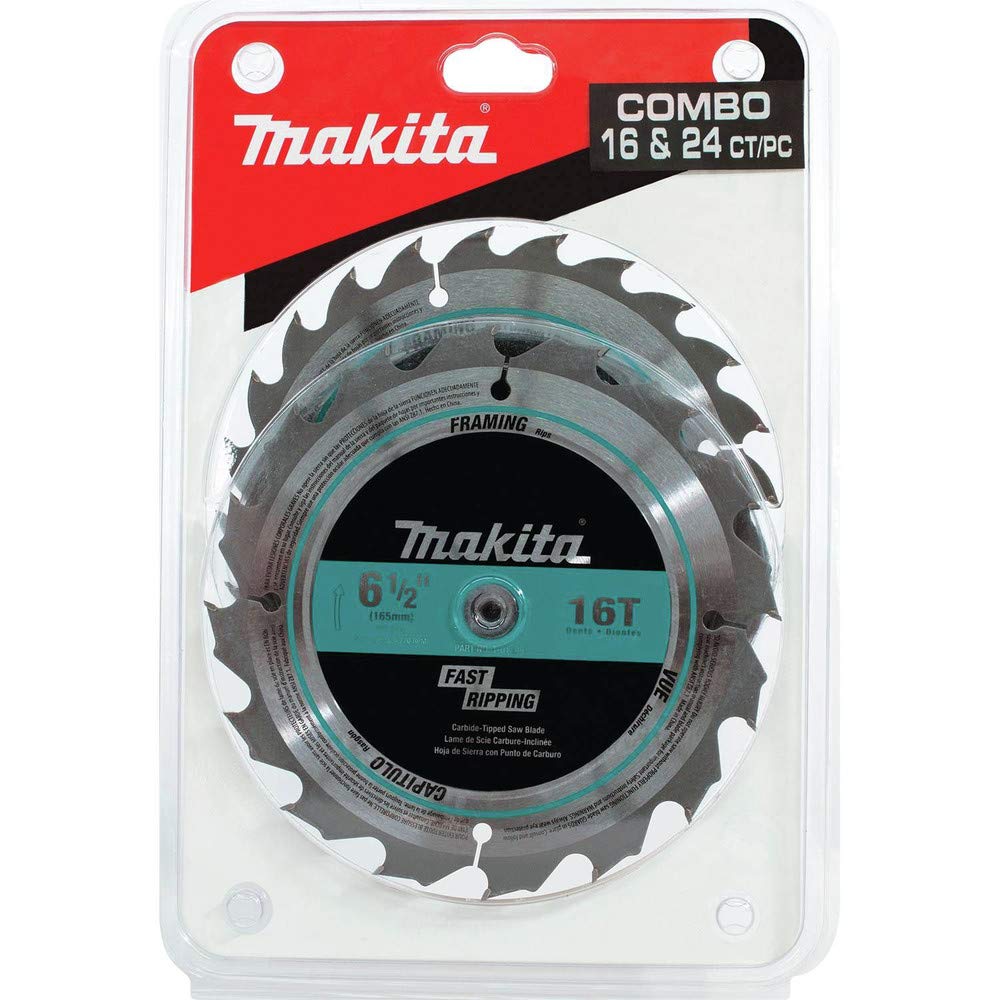
You get a 16-tooth blade and a 24-tooth blade in one set, both 6-1/2 inches across for saws with a 5/8-inch arbor. That pairing covers the two jobs a small cordless saw actually does: fast ripping with the 16-tooth, cleaner crosscuts with the 24-tooth. The ultra-thin kerf cuts down drag on the motor, and Makita built the set specifically so cordless saws finish more cuts per charge. The 4.5+ star rating across 700+ owners backs up the cordless-saw pitch.
The build is where this set earns its keep. The steel plates are fully hardened and hand-tensioned, which is the process that keeps a blade running true instead of wobbling through a long rip. It tipped the scales at 13.12 ounces for the pair — noticeably heavier in hand than the Diablo Tracking Point pack at 6.4 ounces, which is a fair trade for two different tooth counts.
Where this set shines
- Two tooth counts (16T and 24T) give you a rip blade and a crosscut blade without buying twice.
- Ultra-thin kerf and hand-tensioned steel plates smooth out motor drag — the main reason cordless saws hesitate in thick stock.
- Fits 6-1/2″ cordless circular saws with a 5/8″ arbor and handles wood, plastic and non-ferrous metal.
What to weigh first
- Neither blade is a fine-finish cutter, so trim work with visible edges still wants a 60-tooth.
- The 6-1/2″ diameter rules out 7-1/4″ saws entirely.
Buy this one if: you run a small cordless saw and want one box that covers framing and everyday crosscuts.
Pass if: you need glassy finish cuts on exposed trim — that is a higher tooth count’s job.
2. WEN BL0760 Circular Saw Blade
The coating is the story here — it is what keeps the wood from scorching on the way through.
Sixty wear-resistant carbide-tipped ATB teeth across a 7.25-inch body is a finish-cut recipe, and ATB means alternating top bevel: the teeth tilt left and right in sequence so each one slices the fibers instead of chopping them. Where the WEN separates itself is the non-abrasive heat-resistant PTFE cool-cut coating. PTFE is the same slick material as a non-stick pan, and here it stops the blade from scorching the workpiece — burn marks being the usual giveaway that a finish blade is dragging. Running it alongside the FOXBC above, the WEN carries a 7.25-inch diameter against the FOXBC’s 7-1/4 inch, a hair smaller but functionally the same saw fit.
The 1/16-inch kerf — that is the slot width, 1.6 mm — keeps material loss low and the cut clean, and the 5/8-inch arbor (15.875 mm) matches most 7-1/4-inch miter saws, chop saws and circular saws. It is rated to 7000 RPM, so check your saw’s no-load speed dial before you mount it. The 0.26 kg body is 0.01 kg lighter than the FOXBC’s 0.27 kg, which is a rounding error in the hand but tells you both are built on a thin plate.
What the users say: clean, smooth results and a blade that outran expectations for the money — the cut quality leads the conversation, with blade quality close behind.
Honest limit: a single 60-tooth blade will not rip framing lumber efficiently. It is a finish tool, so pair it with a low-tooth blade for the rough work.
The right call for: trim carpenters and cabinet hands who want burn-free edges straight off the saw.
Look elsewhere if: your day is deck framing — 60 teeth will slow you down.
3. FOXBC 7-1/4″ Circular Saw Blade Ultra Fine Finish 60-Tooth
A drop-in for Diablo and DEWALT blade mounts that cuts veneer plywood without tearing it.
Sixty ATB teeth on a 7-1/4-inch body, a 0.063-inch kerf and a 5/8-inch arbor with diamond knockout — that last detail is a stamped shape in the center hole so the blade seats on either spindle style. It is a direct replacement for the Freud Diablo D0760A and D0760X, the DeWalt DWA171460 and the Bosch DCB760. High-density tungsten carbide gives it the toughness and wear-resistance a finish blade needs, and FOXBC builds it for crosscutting oak, pine, melamine, veneer plywood and delicate molding.
The chip-free pitch is the sell: 60 ATB teeth that leave melamine and veneer plywood needing little to no sanding at the edge. Compare tooth counts across the line and the split is stark: this blade’s 60 teeth against the Diablo Framing blade’s 24 is a 2.5x gap. That is not a flaw in either — it is the whole reason you own both. The plate is 0.04 inches thick, slimmer than the CMT P07060 at 0.07 inches, so it flexes less resistance through the cut but demands a steady hand on deep rips.
Why it sells: sharpness and smoothness on materials that punish a dull blade — melamine and veneered sheet goods — plus a value story that keeps coming up.
The thing to know: durability gets mixed read-back over time. Carbide holds an edge well, but a 60-tooth finish blade is not the tool for nail-embedded lumber, and treating it that way shortens its life.
Reach for this if: you finish cabinets, trim or veneer plywood and want factory-smooth edges with a pass or two of sanding.
Not the pick for: demolition or reclaimed wood with hidden nails.
4. Diablo Framing Saw Blade 2-Pack

Twenty-four chunky teeth that chew pressure-treated lumber and shrug off a nail strike.
The geometry here is chamfer ATB — the teeth tilt on both faces so the blade tracks straight and stays put in a rip, which is the difference between a straight line and a wandering one at full depth. TiCo Hi-Density Carbide is the tooth material, and Diablo specs twice the carbide surface area on each tooth, which is what lets the 24-tooth blade chew through nail-embedded lumber without snapping a tip. The laser-cut thin kerf is tuned so a cordless saw gains more cuts per battery charge, and the Perma-SHIELD non-stick coating fights heat, gumming and corrosion.
The 24-tooth count is the lowest practical count for framing speed. Set it next to the 60-tooth FOXBC above and the 2.5x gap in teeth explains everything: one rips 2x stock fast, the other finishes trim slow. Twenty-four teeth clear chips quickly in green pressure-treated lumber, where a fine blade would load up and burn. Both blades run a 0.06-inch thickness and a 5/8-inch arbor, so they mount the same way — swap them by job, not by saw.
The appeal: a two-pack of framing blades that arrives as advertised, cuts fast in lumber and plywood, and holds up to the abuse a jobsite throws at it.
One honest note: the 6-1/2-inch diameter is smaller than the 7-1/4-inch blades most full-size saws run. Check your saw before ordering — this is a compact-saw blade.
Built for: framers, roofers and remodelers running a 6-1/2-inch cordless saw who want two blades in the box.
Check first: that your saw takes the 6-1/2-inch diameter — a 7-1/4-inch saw will not use it.
5. CMT P07060 Saw Blade
A shear-angle tooth grind built to leave both faces of melamine clean at once.
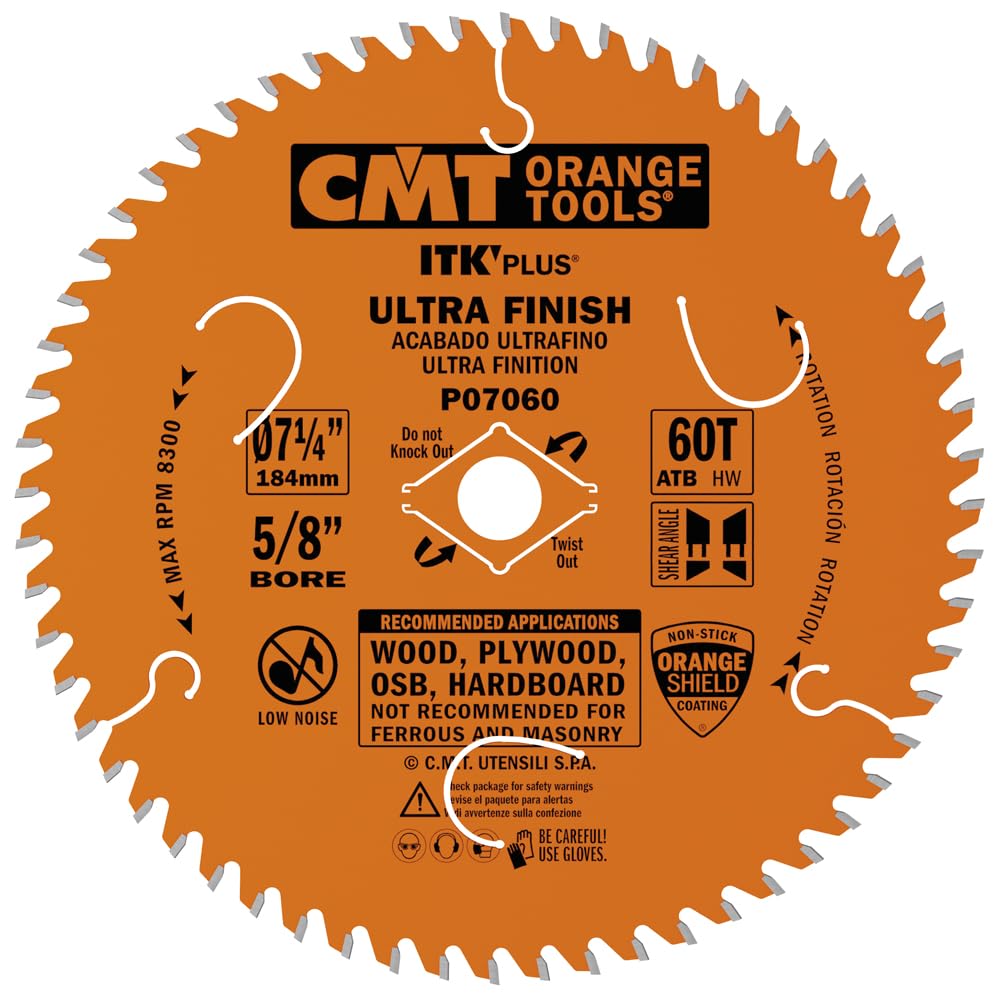
Melamine is the tell. Cut it badly and the laminate chips on the exit side, and the whole panel is scrap. CMT answers that with a 10-degree ATB shear and a 5-degree cutting angle — the shear is a slicing geometry that lowers cutting force and speeds the cut, which is what keeps the edges intact on two-sided melamine, wood and plywood. Sixty teeth on a 7-1/4-inch body, a 5/8-inch bore, and a super-thin kerf that trims material waste while the Orange Shield non-stick coating keeps pitch from building up.
The plate here runs 0.07 inches thick, the heaviest in this comparison — CMT specs a 0.069 kerf and a 0.043 plate, but the plate carries the cut. That extra mass is heavier than the FOXBC above at 0.04 inches, and it is exactly what keeps a long crosscut in sheet goods from wobbling. Special carbide is there to prevent material failure in hard sheet stock, where a brittle tip would let go.
Why cabinet makers gravitate to it: the finish on two-sided melamine is what the blade is engineered for, and durability and a finish that needs almost no cleanup come up often.
Fit note: this is a finish specialist. It wants clean sheet goods and a light hand, not a day of framing.
Pick this if: you cut visible melamine or panel stock and cannot afford chip-out on the second face.
Skip the swap if: your work is rough lumber — a 60-tooth finish blade is the wrong tool for it.
6. Diablo Tracking Point Circular Saw Blades

Twenty-four teeth with laser-cut stabilizer vents that keep the blade quiet and tracking true.
Stabilizer vents are laser-cut slots in the plate that soak up noise and vibration. Fewer vibes means the blade tracks straighter, and a straight track means a cleaner cut at speed. Tracking Point is Diablo’s name for the tooth and plate geometry that keeps a 24-tooth framing blade on line through pressure-treated wood, 2x lumber, plywood and hardwood. TiCo Hi-Density carbide is what powers through heavy-duty stock without dulling fast, and Perma-SHIELD coating resists heat, gumming and corrosion.
This is a two-pack, and at 6.4 ounces per blade it is markedly lighter than the Makita T-01426 set at 13.12 ounces for its pair — a 2.0x weight gap. Lighter blades spin up faster and feel easier to handle overhead. The 24-tooth count and 7-1/4-inch diameter are the standard framing spec, so it drops into most full-size circular saws without fuss. Framers, roofers and remodelers are the intended owners, and the blade is built for the pace those trades keep.
What earns it a place on the truck
- Low-vibration plate keeps the blade tracking true in fast framing cuts.
- Two blades at 6.4 ounces each — easier handling than heavier sets.
- Cuts pressure-treated wood, 2x lumber, plywood and hardwood.
The trade-off
- 24 teeth is a rough-cut count — visible trim edges come out ragged.
- It is a framing blade, so do not expect finish on exposed faces.
Makes sense for: production framers who need clean fast cuts and a spare blade in the case.
Think twice if: your cuts land on visible surfaces — 24 teeth will show.
7. DEWALT DWA1714243 Circular Saw Blade

Three 24-tooth wood blades on the shelf so a dull blade never stops the day.
The DEWALT toughtrack tooth design is patent-pending geometry that keeps the blade tracking accurately over its whole life, not just when it is new. Twenty-four teeth on a 7-1/4-inch body is a wood-cutting count — fast through 2x stock, plywood and rough framing. High-density tungsten carbide gives the toughness and wear-resistance to hold an edge, and a reinforced shoulder adds impact resistance for nail-embedded wood. ToughCoat anti-stick coating keeps friction and gumming down so the blade keeps cutting smooth.
Three blades per pack is the real selling point — you keep a fresh one mounted and a spare in the case, so a dull edge never becomes a downtime problem. The thin kerf design is built for smooth cuts, and the 6.56-ounce weight is lighter than the Makita set’s 13.12 ounces for two blades. That light plate spins easily on a cordless saw, which matters when you are cutting overhead or at arm’s length.
The value read: three blades, real quality and a value story that keeps repeating across the reviews — plus durability that shows up on hard wood.
Fit note: the 0.07-inch plate is stiffer than a thin-kerf finish blade, so it draws a little more from the motor. For framing that is the right trade; for a battery-stretching trim cut it is not.
Worth it for: anyone who burns through framing blades and wants three at once instead of one at a time.
Not for: finish carpentry, where a 24-tooth blade leaves a ragged edge.
8. DEWALT DWA11040 Table Saw Blade
Forty teeth on a 10-inch table saw plate — the count that rips and crosscuts without swapping.
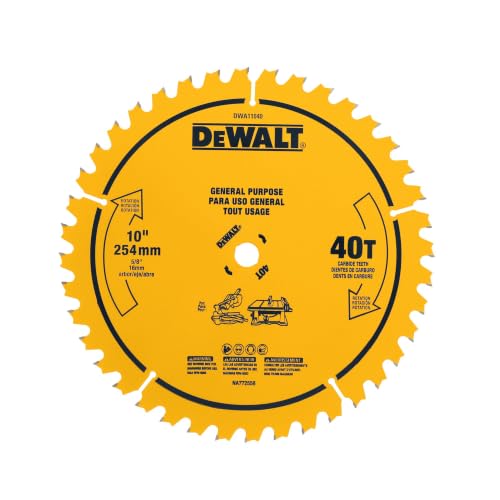
Forty teeth is the all-purpose count for a table saw: enough to crosscut cleanly, low enough to rip without bogging the motor. DEWALT’s tune tooth geometry is built for increased accuracy, and the ultra-sharp carbide handles clean cutting in wood. This is a 10-inch blade, which puts it in a different class than the 7-1/4-inch handheld blades above — a 10-inch table saw plate. It cuts red oak and pressure-treated lumber with a smooth, consistent stroke.
The 40-tooth count sits between the 24-tooth framing blades and the 60-tooth finish blades in this lineup, which makes it the do-most-things choice for a table saw owner. DEWALT’s up-to-3x-life claim is measured against its own prior blade, not against competing 40-tooth table saw blades. The 40 teeth run a fine finish, so glue-ready joints and clean rips come out of the same blade.
What buyers report: an all-purpose blade that cuts like butter through red oak and pressure-treated lumber, with durability and smooth operation named again and again — sharpness and consistent performance round out the picture.
The honest catch: forty teeth is a compromise count. For a mirror finish on trim it is a touch short, and for fast rough ripping a 24-tooth is quicker.
Best fit: the table saw owner who wants one blade that rips and crosscuts without swapping.
Look elsewhere if: you want a dedicated rough-rip blade or a dedicated trim blade — this sits between both.
9. Freud Diablo Steel Demon DO748F Circular Saw Blade

A triple chip grind blade that slices 1/4-inch mild steel on a circular saw.
TCG means triple chip grind: the teeth are shaped with a flat-topped raker between two beveled cutters so they shave metal instead of chopping it. That geometry is what lets this 48-tooth blade cut through up to 1/4 inches of mild steel. Shock-resistant brazing holds the carbide tips through extreme impact, which is what a metal blade faces every time it hits a hard edge. The laser-cut arbor etchings keep the plate level and reduce vibration, and Perma-SHIELD non-stick coating fights heat and gumming.
It fits most 5/8-inch bores on 7-1/4-inch circular saws — the same arbor the wood blades above use, so it drops onto the same saw. Freud’s TiCo Hi-Density carbide tips are claimed to outlast and outcut other carbide blends, and the 48-tooth TCG blade is priced as a metal-cutting specialist. Forty-eight teeth on a 7-1/4-inch body sits between the coarse framing counts and the 60-tooth finish counts, because metal wants a middle count and a tough grind.
The consensus: it cuts through unistrut and steel like butter, works well in worm drive saws, and saves serious time on metal jobs.
The trade-off to know: durability is the mixed part of the story — some owners mention long service, others find it wears faster than expected. Treat it as a metal-cutting blade, not an all-material one, and keep it away from wood with nails.
The one to grab for: cutting metal studs, unistrut, steel siding and 1/4-inch mild steel with a circular saw.
Wrong tool for: wood, laminate or any job that is not ferrous metal.
Know the Specs
Tooth Count
The number of teeth on the rim decides what the blade does well. Low counts, like 24, clear chips fast and rip lumber quickly. High counts, like 60, slice finer and leave cleaner edges but cut slower. Buy the count that matches your main job, not the biggest number on the shelf.
Kerf Thickness
Kerf is the width of the slot the blade cuts. A thinner kerf removes less material, so the saw motor works less and a cordless battery stretches further. A thicker kerf gives a stiffer plate that resists wobble in heavy stock.
Arbor Size
The arbor is the center hole that mounts on the saw’s spindle. Most 6-1/2-inch and 7-1/4-inch circular saws run a 5/8-inch arbor. Some blades also carry a diamond knockout, a stamped shape in the hole that lets the blade seat on either spindle style.
ATB vs TCG Grind
ATB (alternating top bevel) tilts the teeth left and right in sequence for clean cuts in wood. TCG (triple chip grind) uses a flat raker tooth between beveled cutters, which is what lets a blade shave metal instead of chopping it.
Common Questions
Will a 7-1/4-inch blade fit my 6-1/2-inch circular saw?
How many teeth do I need for clean cuts in plywood?
Can the Diablo Steel Demon cut wood as well as metal?
What is a diamond knockout on a saw blade?
Does a thinner kerf really help cordless saw battery life?
Is a 60-tooth blade good for ripping 2×4 lumber?
What is the difference between ATB and TCG teeth?
Do I need a different blade for a table saw than a circular saw?
How long does a carbide-tipped saw blade stay sharp?
Can I use a wood blade to cut plastic and non-ferrous metal?
The Bottom Line
The round saw blade I would hand a first-time buyer is the Makita T-01426 2 Pc. Set, because two tooth counts in one box cover framing and everyday crosscuts on a 6-1/2-inch cordless saw. If clean edges are the goal, the FOXBC 7-1/4″ 60-Tooth gives you a chip-free finish on veneer and melamine. And when the job turns to steel, the Diablo Steel Demon DO748F is the one that cuts metal instead of wood. Nine blades, one rule: match the teeth to the material, then match the arbor to the saw.
How we choose
We do not accept paid placement. Every pick is matched to a real buyer and a real use-case; we do not hands-on test units.
Sources
Specifications: manufacturer listings and product documentation. Review insights: verified customer reviews, as of November 2026. Pricing: not shown on this page (it changes often); check the current price via the retailer link.
As an Amazon Associate, Tactical Gear Guy earns from qualifying purchases. This does not affect which products we feature.