Specs are compiled from manufacturer listings and verified buyer reviews and can change over time — please confirm the key details on the product page before buying.
You want one wall-mounted unit that cools a whole room without cutting a hole in your wall or dragging a heavy window box up a ladder. That is exactly what a ductless mini-split does. It hangs high on the wall, pushes cold air across the space, and heats the same room in winter. The picks below are all real wall-mounted indoor units, and the crowd favorite holds 4.5+ stars across 600+ owners. Start with the Senville AURA if you want the strongest overall balance of efficiency, quiet running, and proven reliability.
This guide is built by comparing the manufacturers’ published specifications and the patterns across verified customer reviews, so you get each pick’s real strengths and trade-offs instead of marketing spin.
Every option here hangs indoors and needs a pro to charge and connect the lines, so the real question is matching BTU output to your room size. The right room wall air conditioner keeps your bedroom cold and your winter bills calm.
Top Picks

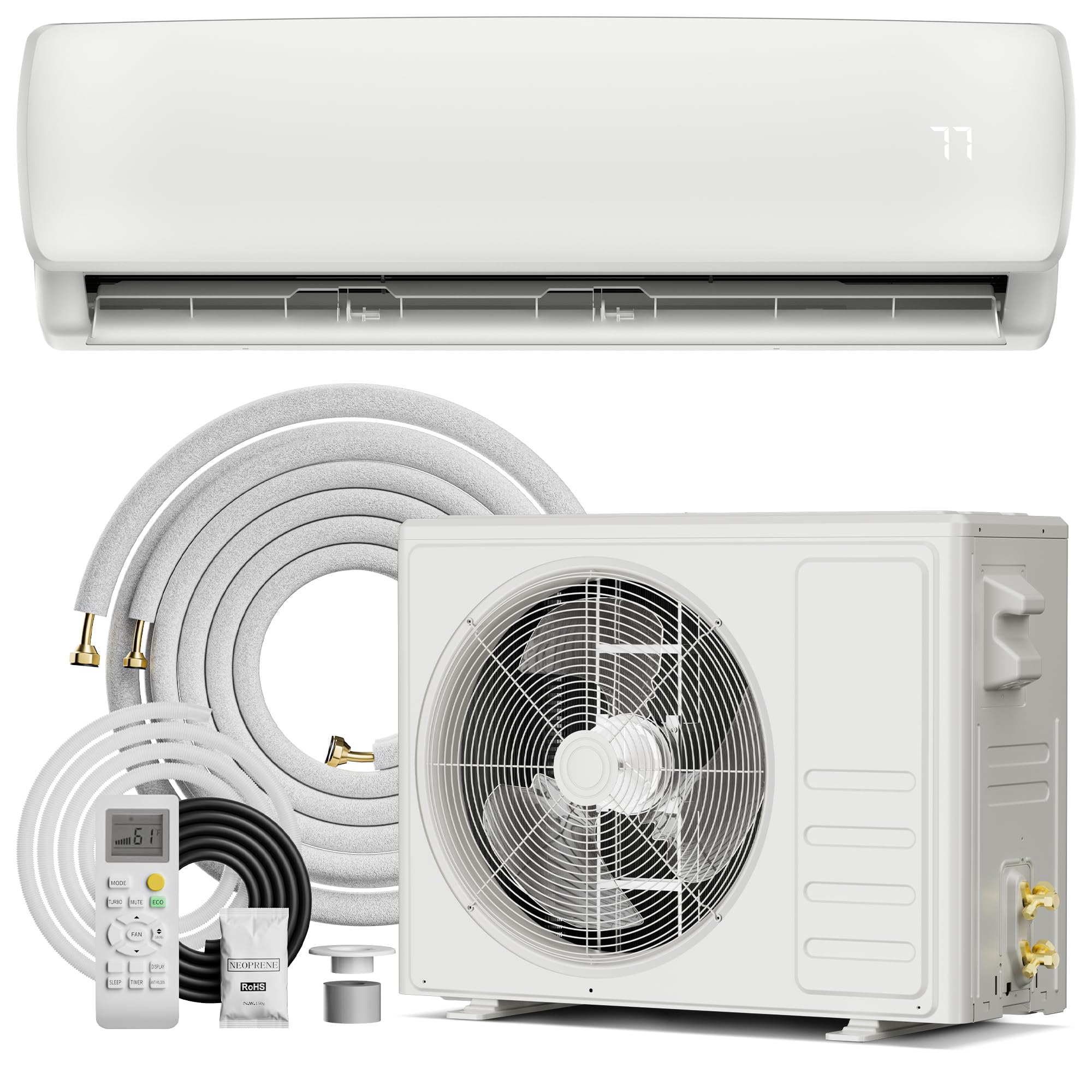

How To Choose The Best Room Wall Air Conditioner
Buying a wall-mounted split is a bigger decision than grabbing a window box. You are choosing equipment that gets bolted to your wall, wired to a breaker, and left running for years. Get the sizing and the install path right and the unit fades into the background. Get them wrong and you spend the first summer listening to a machine that never quite keeps up.
Match the BTU rating to your actual room
BTU stands for British thermal units — the standard measure of how much heat a unit can pull out of a room. A 9,000 BTU unit suits a smaller bedroom or den. A 12,000 BTU unit is the common middle choice for a living room or large bedroom. A 24,000 BTU system is built for open-plan spaces and additions. Pick too small a unit and it runs flat out forever without reaching your set temperature. Pick too large and it cycles on and off in short bursts, which feels clammy and wastes energy.
Read the SEER2 number before anything else
SEER2 is the efficiency score for the whole cooling season — higher means less electricity for the same cold air. The jump from a mid-teens SEER2 unit up to a mid-20s model is the single biggest lever on your summer power bill. The Senville AURA’s 25.5 SEER rating cuts summer power draw month after month, while an 18 SEER2 system costs noticeably more to run over the same season. Energy Star certification is worth looking for because it confirms an independent lab verified the rating.
Understand that these are not DIY installs
Every unit on this list needs a professional to purge the lines, torque the flare fittings, and verify the refrigerant charge. A few models come pre-wired or pre-charged to shave time off the job, but that reduces labor cost rather than removing the need for a tech. Budget for the install as part of the purchase, because a botched vacuum on the line set is the most common reason a brand-new split underperforms.
Check the heating floor for your climate
A mini-split heat pump is a two-for-one machine: it cools in summer and warms in winter. The catch is that heat output drops as the outdoor air gets colder. Some units are rated to keep working down to 5°F, and a couple claim operation well below zero. If your winters dip into single digits, read the low-temperature spec on the listing before you buy.
Side-by-Side Comparison
| Model | Best For | Cooling Capacity | Efficiency (SEER2) | Coverage | Amazon |
|---|---|---|---|---|---|
| Senville AURA 12,000 BTU★ Best Overall | Overall balance of efficiency and reliability | 12,000 BTU | 25.5 SEER | 750 sq ft | Amazon |
| Mountman 12,000 BTUQuietest Bedroom Pick | Quiet bedroom comfort on a budget | 12,000 BTU | 19 SEER2 | 750 sq ft | Amazon |
| ROVSUN 9,000 BTUBudget Champion | Small rooms and tight budgets | 9,000 BTU | 20 SEER2 | 450 sq ft | Amazon |
| Albott Easy DIY 12,000 BTU | Lowest running cost in a big room | 12,000 BTU | 18 SEER2 | 750 sq ft | Amazon |
| Pioneer Diamante Pro 12,000 BTU | Cold-climate heating backup | 12,000 BTU | 20.0 SEER2 | 500 sq ft | Amazon |
| TOSOT Aoraki 12,000 BTU | Highest efficiency and quietest indoor fan | 12,000 BTU | 24.5 SEER2 | 750 sq ft | Amazon |
| Cooper & Hunter MIA 12,000 BTU | Smart control for a mid-size room | 12,000 BTU | 21.2 SEER2 | 550 sq ft | Amazon |
| Cooper & Hunter 24,000 BTU | Large open-plan spaces | 24,000 BTU | 18.7 SEER2 | 600 sq ft | Amazon |
| Daikin Entra 12,000 BTU | Brand-name air purification and precision | 12,000 BTU | 18 SEER2 | 550 sq ft | Amazon |
| Pioneer WYS018G-22 18,000 BTU | Mid-size rooms that need extra punch | 18,000 BTU | 20.8 SEER | 650 sq ft | Amazon |
| MRCOOL Easy Pro 24,000 BTU | Whole-floor cooling with voice control | 24,000 BTU | — | 1,000 sq ft | Amazon |
Detailed Reviews
1. Senville AURA Mini Split Air Conditioner
Our pick — 4.5+★ from 650+ verified ratings; the strongest balance of quality and price.
The efficiency king that keeps a big room cold without rattling your nerves.
A 25.5 SEER rating is the number that puts the Senville AURA at the top of this list. That is the seasonal efficiency score for the whole system, and a figure in the mid-twenties is high for a ductless split. It means less electricity for the same cold air all summer. Paired with a 12,000 BTU cooling capacity and a 750 sq ft coverage area, it handles a large living room or a master bedroom without straining.
The unit is Energy Star Certified, UL Listed, and AHRI Certified, and the manufacturer rates it for heating in conditions down to -22°F/-30°C. That cold-weather figure matters if you live somewhere the mercury drops hard in January. The indoor air handler, outdoor condenser, and a 16ft line set with communication wire all come in the box, plus a remote. Voice control works through Alexa-enabled devices when you add a supported smart controller, and app-based scheduling covers the rest.
What wins people over is raw dependability — the review pages describe a machine that simply does its job, cooling and heating steadily with no drama. Quiet operation is the other recurring theme; it fades into the background once the room is cool. The honest catch is the remote. It draws the most mixed feedback of anything on this unit, with gripes about the display being small and occasional communication glitches. The app is the better way to run it day to day. Professional installation is required — this is not a DIY kit.
Where it earns its keep
- 25.5 SEER keeps summer power use down over a 750 sq ft room
- Rated to heat in conditions down to -22°F/-30°C
- Steady temperature control that owners describe as reliable and quiet
- Alexa voice control and app scheduling available with a smart controller
What to plan around
- The handheld remote is the weak spot — lean on the app instead
- Needs a licensed installer; the line set must be properly vacuumed
- Annual energy use is rated at 2100 kilowatt hours per year
Reach for this if: you want one high-efficiency unit to handle a big room in both summer and a cold winter.
Think twice if: you plan to run everything from the included handset rather than the app.
2. Mountman 12000 BTU Mini Split AC/Heating System, 19 SEER2
A 26dB sleep mode that disappears the moment your head hits the pillow.
If your bedroom is the target room, start with the noise number. The Mountman runs its sleep mode at 26dB, which is about as quiet as a whisper in a library. That is the spec that turns a wall unit from something you notice into something you forget is running. The 12,000 BTU cooling capacity covers up to 750 sq ft, so it has plenty of headroom for a normal bedroom or a small living area.
Efficiency sits at 19 SEER2, a solid middle-of-the-road figure that keeps the power draw reasonable without premium pricing. You get four modes — Cool, Heat, Dry, and Fan — plus four fan speeds and a Turbo Boost for fast cool-downs. The maker rates ECO mode to cut energy use by up to 30%. The remote has a 24-hour timer, and its display auto-shuts off after 10 seconds so a bright screen does not glow at you in the dark. Self-cleaning and auto-defrost handle the maintenance chores between seasonal cleanings.
The one thing buyers keep circling back to is how completely silent the thing runs — it is inaudible until you crank the fan to its top setting. Performance and build quality both get strong marks, and several note the unit feels a step above entry-level hardware. Two real caveats: the printed instructions are thin, so a good installer matters, and a handful of units have arrived dented in transit. Inspect the crate before you sign for it.
Silence first: 26dB in sleep mode is the headline feature, and it delivers a genuinely quiet bedroom.
Honest note: the manual is weak and freight damage happens — check the box on delivery.
Best fit: a light sleeper who wants cold air without fan noise.
Look elsewhere if: you need self-explanatory instructions in the box and no installer help.
3. ROVSUN 9000 BTU Mini Split
Small-room cooling that sips electricity and swings air into every corner.
The ROVSUN keeps its footprint modest on purpose. A 9,000 BTU cooling capacity and 450 sq ft coverage is the sensible ceiling for a bedroom, den, or home office — the kind of room where a bigger unit would just cycle on and off. It runs at 20 SEER2 efficiency, which is a strong figure for this tier. The 115V/60Hz power supply is the standard household voltage, so wiring is simpler than a 230V system. Annual energy use is rated at 1050 kilowatt hours per year.
For a small unit, the ROVSUN packs in convenience. The 4-way swing function moves air up, down, left, and right so the cold reaches across the room instead of blasting one spot. A 24-hour timer, ECO mode, Turbo mode, and Mute mode all live on the remote, and the temperature range runs from 61°F to 88°F. The maker lists a 28 to 42 dBa noise range, and the heat pump adds 10,000 BTU of heating capacity for the shoulder seasons.
The reliability story here is genuinely strong — owners describe a unit that just keeps working, and several mention cutting their power bills by around a hundred dollars a month. Two honest limits. The cooling performance gets mixed feedback in the deep cold: some report it stops heating below a certain outdoor temperature in winter. And a minority of units have failed after roughly seven months, so the build consistency is not perfect at this tier. Add a warranty check to your checklist.
Value read: a compact 450 sq ft system at 20 SEER2 with a full remote feature set.
Fair warning: winter heating has a floor, and a small share of units have not lasted.
Go here if: you are cooling one modest room and want low running costs.
Skip the winter plan if: your January temperatures plunge well below freezing.
4. Albott Easy DIY Series 12,000 BTU Mini Split
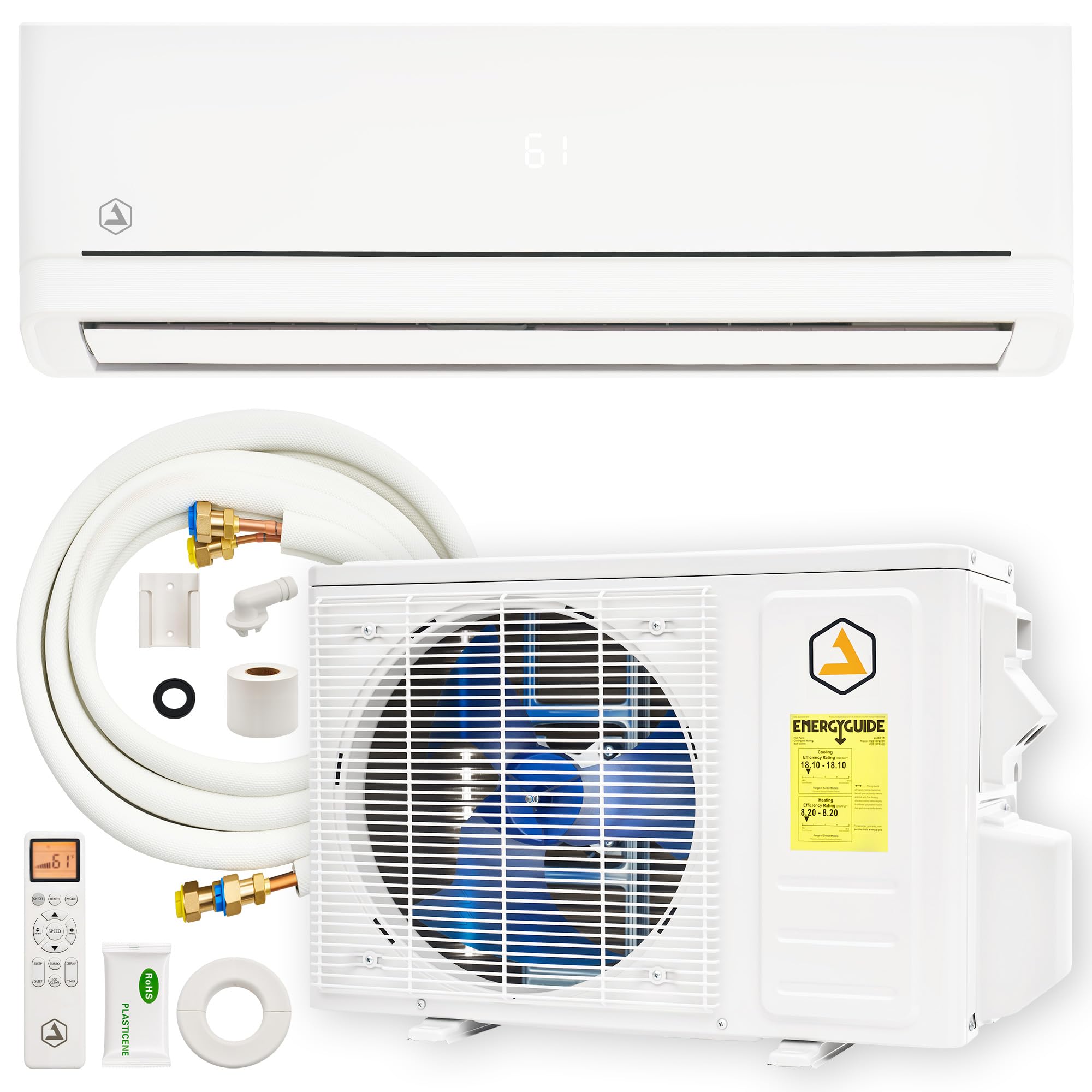
A do-it-with-help design that trims install labor without cutting corners on output.
Here is a fact worth turning over: the Albott rates its annual energy use at 750 kilowatt hours per year, against 2100 kilowatt hours per year for the Senville AURA above. That is the lowest running projection in this group by a wide margin. The 12,000 BTU cooling capacity matches the AURA, and it covers the same 750 sq ft. Efficiency is rated at 18 SEER2 with an inverter heat pump.
The install story is the other selling point. The indoor side arrives pre-wired, which cuts on-site wiring time, and the outdoor unit needs no vacuuming before startup. That does not make it a true DIY job — professional help is still recommended for anyone without solid skills — but it does shave labor cost. The system runs in outdoor temperatures from 5°F to 122°F and handles cooling, heating, dehumidifying, and fan duty across a 61°F to 90°F range. Sleep mode and a 24-hour timer are on the remote, and WiFi lets you control it from your phone.
Performance is the thing people rave about — the unit cools rooms down and holds a steady indoor temperature without fussing. Quiet fan noise is a common note, and most owners call it a good purchase for the effort. The honest trade-offs: the remote is fiddly to learn, the printed instructions are sometimes called misleading, and a few buyers felt the hardware was more involved than a casual DIY-er expects. A 5-year compressor warranty and 7-year parts warranty give you real backup.
Why it stands out
- 750 kWh/year projected — the leanest running cost here
- Pre-wired indoor unit and no-vacuum outdoor unit speed the install
- WiFi app control plus a 24-hour timer and sleep mode
- 5-year compressor and 7-year parts warranty
Where it asks patience
- The remote takes some learning to get comfortable with
- Instructions are thin and occasionally steer you wrong
- Best with an installer on hand, even if it is a partial DIY job
The case for it: the cheapest system to run all summer in this entire lineup.
Not for you if: you want a plug-and-play install with a manual that walks you through every step.
5. Pioneer Diamante Pro Mini Split Air Conditioner

Built to keep heating when the outside air drops below zero.
The spec that separates the Diamante Pro from most of this list is its cold-weather rating. It is certified to operate down to -4°F in heating mode and up to 122°F in cooling. That NEEP ASHP cold-climate recognition means the unit holds meaningful heat output well past the point where cheaper systems give up. The 12,000 BTU cooling capacity, 20.0 SEER2 rating, and 9.5 HSPF2 heating score back it up. Recommended coverage sits at 350 to 500 sq ft, so it runs a bedroom or a defined zone.
The airflow hardware is a step above basic. Motorized up-down and left-right louvers sweep cold air across the whole room, and the remote carries an I FEEL sensor that reads the air temperature near the handset rather than only at the wall unit. Turbo, Mute, Eco, Sleep, Timer, and Memory functions are all on the remote. A washable reusable dust filter saves you buying replacements, and a self-clean cycle handles upkeep between cleanings. The install kit includes a line set, signal cable, drain hose, wall sleeve, and rubber feet.
Build quality is where this unit wins people over — it feels well-made and controls the temperature consistently. The honest caveat is that this is a smaller-volume model, so the feedback pool is thin and performance notes are split. Installation experiences divide between those who found it straightforward and those who did not. App control requires a separately sold module, so plan for that if you want phone control from the start.
What sold us: a -4°F heating floor and the motorized dual-axis louvers that push air where you need it.
Keep in mind: smaller feedback pool, and phone control needs an add-on module.
Right for: a cold-winter bedroom where heating has to work through a hard freeze.
Not right for: a buyer who expects app control without adding the AirLink module.
6. TOSOT Aoraki Series Mini Split
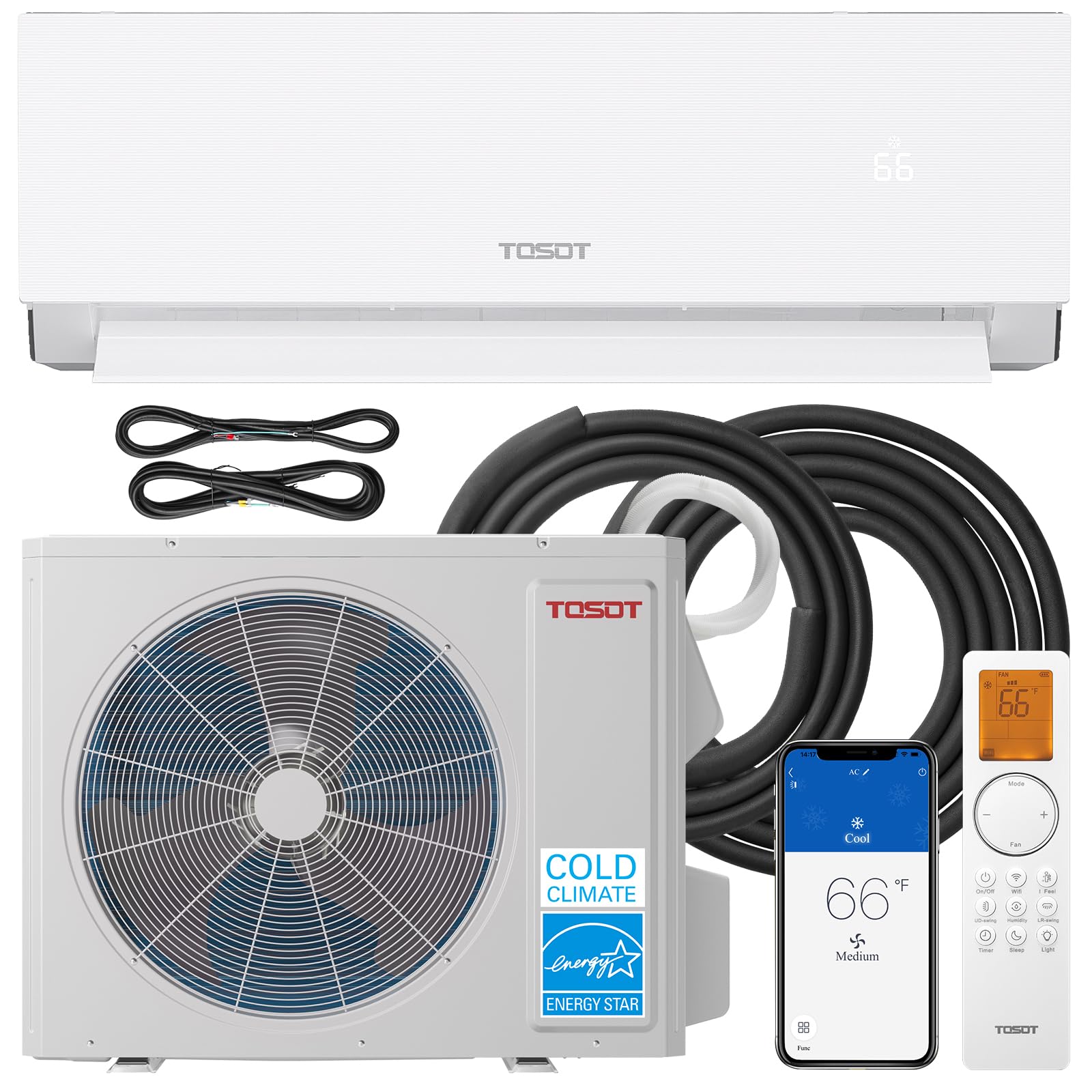
A near-silent 20dB indoor fan paired with a 24.5 SEER2 efficiency score.
Two numbers stand out on the TOSOT Aoraki. The first is 24.5 SEER2, which the maker rates as saving up to 35% on energy bills versus 16 SEER2 units. That is a big efficiency jump, and it holds ENERGY STAR, COLD CLIMATE, ETL, and AHRI certifications. The second is the 20dB indoor noise level, the quietest figure anywhere in this lineup. It cools and heats 12,000 BTU of capacity across up to 750 sq ft.
You get cooling even when it is freezing outside: this unit handles ambient temperatures as low as -20°F in specific scenarios such as server rooms. TOSOT also calls the Aoraki the first in the US to offer an optional ERV integration — an energy recovery ventilator (a separate add-on that recycles energy from exhaust air to pre-condition incoming fresh air and balance indoor humidity). It requires extra wall vents, so plan that into the install.
Owners describe a system that works and works efficiently, heating and cooling equally well. Quality gets consistently strong marks and several call it a great system. Whether it earns its tax-credit qualification is worth checking against your local program. One install note: your order may ship in multiple packages that arrive on different days, so line up the installer only after everything shows up.
Efficiency mic-drop: 24.5 SEER2 with a rated 35% savings over a 16 SEER2 unit.
Plan ahead: multi-package shipping means you need to receive everything before the install date.
Pick it when: efficiency and silence matter most and you want tax-credit eligibility.
Think twice if: your installer needs the whole system on one delivery date.
7. Cooper & Hunter MIA 12,000 BTU Mini Split AC

Smart control baked in, with a 21.2 SEER2 score and a full 16ft install kit in the box.
A 21.2 SEER2 rating is a genuinely efficient figure for a 12,000 BTU system. That inverter compressor adjusts output to demand so it holds a steady temperature without hammering the grid. Coverage comes in at 550 sq ft, a good match for a large bedroom or a mid-size living room. The smart kit is included, not an add-on — you get app scheduling, remote temperature adjustment, and smartphone control from anywhere without buying an extra module.
The system is UL Listed and AHRI Certified, and the box includes a 16ft pre-flared insulated copper line set, 16ft communication wire, a 16ft drainage extension, and small accessories. The indoor unit is built from copper core materials. Heating works in ambient temperatures as warm as 5°F on the cold end. U.S.-based technical support is available if you ever need help. Shipping goes by freight due to size and weight, so the carrier will coordinate delivery to the nearest accessible point outside your home.
Where this unit shines is the cooling itself — owners describe it as ice cold and remarkably quiet, and the quality gets strong marks. The honest part is that reliability is uneven across the fleet: while the majority run fine, a share of units have never worked or broke within six months. Freon and condensation leaks show up in a minority of reports. This is the one pick where buying an extended warranty and pressing the seller on the return window is the smart move.
Reasons to pick it
- 21.2 SEER2 inverter efficiency in a 550 sq ft unit
- Smart kit included for app scheduling and remote control
- Full 16ft line set, cable, and drainage in the box
- Owners describe the cooling as ice cold and near-silent
Reasons to look hard
- Reliability is inconsistent — some units fail early
- A minority of buyers report refrigerant or condensation leaks
- Freight delivery lands curbside, not inside
Made for: the smart-home buyer who wants app control without extra hardware.
Step back if: a spotless reliability record is your top priority in this category.
8. Cooper & Hunter 24,000 BTU Mini Split AC
Two tons of cooling aimed straight at the biggest room in the house.
When your 12,000 BTU unit leaves the far corner warm, this is the upgrade. At 24,000 BTU and 2 tons of capacity, the Cooper & Hunter is the heavyweight of this group. It is rated for 600 sq ft, and the 18.7 SEER2 inverter keeps the running cost down despite the doubled output. Both heating and cooling land at 24,000 BTU, so it warms and cools the same large space through the year. It runs on 230V and is UL Listed and AHRI Certified.
The smart kit is included, which lets you set schedules and adjust the temperature from your phone. The outdoor condenser arrives pre-charged, and your order includes a 16ft insulated copper line set, 16ft communication cable, a 16ft drainage extension, and accessories. It ships by freight due to the size and weight. U.S.-based tech support is on hand if anything needs help after the install.
Reliability is the theme owners keep returning to — it runs as expected, and the satisfaction notes read as genuinely impressed. It is very quiet for the capacity it delivers. The honest balancing act is that value splits down the middle: some see it as an amazing unit, others feel the cost is high relative to what they got. And a small share of units broke down early, so confirm the warranty terms. This is a lot of machine for the money if your room truly needs 24,000 BTU.
The draw: 24,000 BTU heating and cooling for a 600 sq ft open space.
The tell: value reviews split, and early failures happen to a small few — check the warranty.
Choose it for: a bonus room, large garage, or open-plan living space that a smaller unit cannot reach.
Leave it if: your room is under 550 sq ft and a 12,000 BTU unit already gets cold enough.
9. Daikin Entra R32 Series Mini Split

The recognisable name in the room, with a filtration story the others do not tell.
This is the pick for the buyer who has heard of Daikin and wants that brand on their wall. The Entra delivers 12,000 BTU of cooling with a range from 4,400 BTU up to 13,300 BTU, and 11,300 BTU of heating that stretches from 4,400 up to 16,400 BTU. Efficiency lands at 18 SEER2, 9 HSPF2, 8.5 EER2, and a 3.30 COP. It covers up to 550 sq ft, and the DC inverter compressor handles the fine temperature adjustments.
The features run deeper than basics. You get Powerful Operation for fast recovery, ECO+ for efficiency, and a Titanium Apatite Photocatalytic Air Purifying Filter that adds a filtration layer the cheaper units skip. Blue Fin Protection coats the coil against corrosion. Cooling works from 50°F to 115°F, and heating from 5°F to 65°F. The kit includes the wall unit, the pre-charged R-32 condenser, a remote, a 15 ft line set with cables, and a Maxwell wall bracket. It is well-suited to renovations, sunrooms, basements, attics, and garages.
Owners describe it as reliable and very quiet, and it cools and heats to their needs. The honest trade-off is the price stance: value splits, with some calling it great for the money and others feeling it is not worth the outlay. That is the brand premium at work. If you want the name, the air-purifying filter, and a system that keeps tuning itself, this earns the nod. If you are shopping purely on efficiency dollars, the higher-SEER units above give more per dollar.
Strength in the details: R-32 refrigerant, Blue Fin coil protection, and the Titanium Apatite air-purifying filter.
The honest catch: you pay a brand premium, and value reviews split because of it.
Suited to: the buyer who trusts the Daikin name and wants filtration plus precision control.
Better to skip if: you want the absolute most efficiency for your outlay and brand prestige means nothing to you.
10. Pioneer WYS018G-22 Mini Split Heat Pump

The middleweight that splits the difference between a bedroom unit and a whole-room bruiser.
An 18,000 BTU system is the sensible step between the common 12,000 BTU units and the 24,000 BTU monsters. This Pioneer delivers 18,000 BTU/h of cooling and heating across 450 to 650 sq ft, so it covers a room most 12,000 BTU units would struggle with. The 20.8 SEER efficiency keeps running costs in check, and it carries a 5 Star BEE rating. The unit measures 33.3 inches wide and 27.6 inches high and weighs 108 lb, and it runs on 208-230V at 60Hz.
Two engineering touches earn their keep. The intelligent on-off technology drops standby draw from 5W to 1W or 0.5W per hour, which the maker counts as 80% to 90% of standby savings. And when the unit starts a heating cycle, the indoor fan speed is regulated up from the lowest grade to your setting according to the evaporator temperature, which stops cold air blowing at you and avoids that initial chill. Both the left and right sides of the indoor unit can route the piping and drain hose, so a tricky wall layout does not stop the install.
Quality is the thing people rave about — the reviews read as high-quality all the way through, and performance clears expectations. It runs super quiet, holds temperature well, and running costs come in remarkably low. The honest note is that value opinions split, and a minority of buyers fell short of their expectations. At 61dB, the noise spec is the highest number on this list, so keep it away from a reading nook or a nursery.
What holds up
- 18,000 BTU hits rooms a 12,000 BTU unit cannot
- Standby draw cut from 5W to 1W or 0.5W per hour
- Smart fan ramp-up prevents cold-air shock at startup
- Left or right piping routing for awkward wall layouts
What to weigh
- At 61dB it is the loudest-rated unit here — not a bedroom-first pick
- Value opinions split between satisfied and underwhelmed
- 208-230V hookup needs a proper breaker circuit
The right room for it: a 500 to 650 sq ft living area that needs more punch than a standard bedroom unit.
Not for you if: silence is the goal — 61dB is noticeable background noise.
11. MRCOOL 24,000 BTU Mini Split Air Conditioner
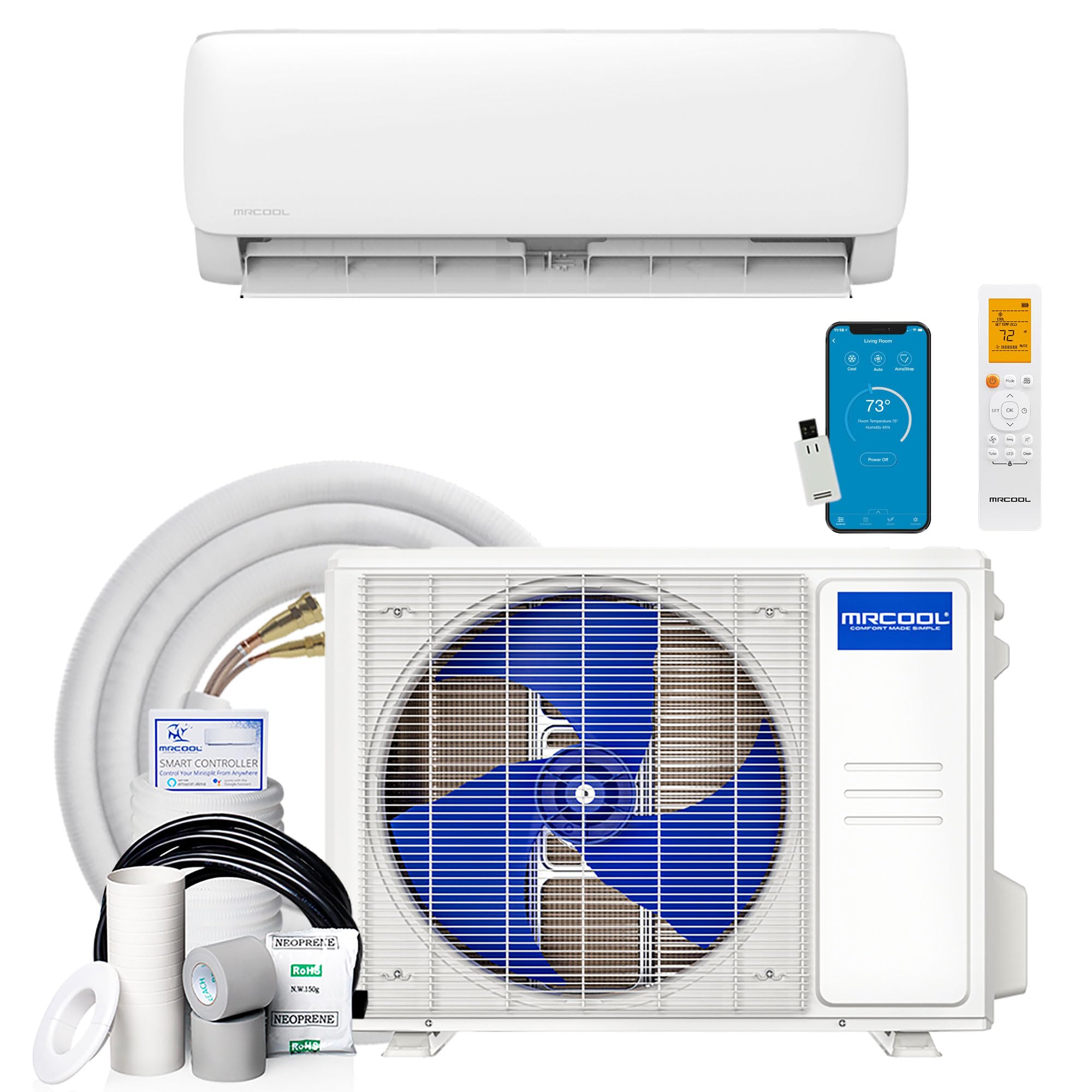
The widest coverage on the list, with voice control for the whole floor.
Nobody else here covers this much ground. At 24,000 BTU and up to 1,050 sq ft, the MRCOOL is the largest-coverage unit in the lineup — big enough for a whole open floor or a home-plus-office layout. The inverter system handles heating and cooling for residential and small-commercial spaces, and the DIY-friendly install is designed to reduce mess and cut labor costs. It carries a 4 Star BEE rating.
Built-in Smart HVAC technology works with Google Assistant and Amazon Alexa, so you can talk to it instead of getting up. A washable filter means no replacement cartridges, and sleep mode handles the overnight schedule. The copper core materials and the sleek white finish are meant to blend into any interior. This is the unit you put where the family gathers — the great room, the finished basement, the home office that needs real capacity.
What the owners seem most pleased with is the performance-to-effort ratio. The install reads as straightforward for a pro, the unit cools the house effectively, and it holds its own on value. The honest bit is that the feedback pool is small for a system this size, and there is no SEER2 figure printed on the listing, so ask the seller directly if efficiency matters to your decision. Pair it with a licensed installer who has done 230V line sets before.
Coverage crown: 24,000 BTU (British thermal units, a measure of cooling power) and 1,050 sq ft make it the largest-area pick in this guide — enough to cool a large open-plan living area.
Verify first: the SEER2 figure is missing from the listing, so confirm it before you commit.
Built for: a whole floor or a big open living space where one unit needs to do the heavy lifting.
Not for you if: you are cooling a single bedroom and a 12,000 BTU unit already fits the bill.
Know the Specs
BTU and Square Footage
BTU stands for British thermal units — the measure of how much heat the system removes from your room each hour. A higher BTU number keeps a larger room cold but needs more power and a bigger outdoor condenser. Most
BTU and Square Footage
BTU stands for British thermal units — the measure of how much heat the system removes from your room each hour. A higher BTU number keeps a larger room cold but needs more power and a bigger outdoor condenser. Most manufacturers publish a matching floor area in square feet, and that figure is your most useful sizing tool. A 9,000 BTU unit tends to suit a smaller bedroom, while a 12,000 BTU system covers a typical living room. Go too small and the unit never reaches your set temperature. Go too large and it short-cycles, which feels clammy and wastes electricity.
SEER2 and Energy Bills
SEER2 is the seasonal efficiency score for cooling — it tells you how much cold air you get per unit of electricity across a whole summer. A higher number means lower running costs. The difference between an 18 SEER2 system and a 24.5 SEER2 system is real money over a cooling season. Energy Star certification confirms an independent lab verified the rating, so look for that badge when you compare units at the same BTU level.
Inverter Compressors and Steady Comfort
An inverter compressor is a variable-speed motor that slows down and speeds up to match demand instead of switching fully on and off. That is why inverter units hold a more even temperature and run quieter. A traditional fixed-speed compressor blasts cold air, shuts off, then starts again — you feel the swings. Every pick in this guide uses an inverter, which is one reason they all manage to run so quietly.
Heat Pump Range and Cold-Weather Limits
A heat pump reverses the cooling cycle to warm your room in winter, so one wall unit handles both seasons. The catch is that heat output drops as outdoor air gets colder. Some units are rated to keep heating down to 5°F, and a few claim operation at -22°F or -4°F. If your winters go below freezing, read the heating temperature range on the listing before you buy. A unit without a real cold-weather rating becomes a summer-only machine in a hard climate.
Common Questions
Can I install a wall-mounted mini split myself?
How many BTU do I need for my room size?
Do these wall units heat as well as they cool?
Will a mini split work with Alexa or Google Assistant?
Is a higher SEER2 rating worth the extra cost?
What is the typical noise level of a wall-mounted air conditioner?
How much power does a 12,000 BTU unit use per year?
Is a 24,000 BTU unit too big for a normal room?
Do I need a 230V circuit for these units?
How do I keep a wall-mounted unit clean?
The Bottom Line
For most rooms, the room wall air conditioner worth putting on your wall first is the Senville AURA. A 25.5 SEER rating, 12,000 BTU output, 750 sq ft coverage, and a -22°F heating floor cover both seasons in one unit, and the reliability story holds up across a large feedback pool. If your priority is the cheapest summer to run, the Albott Easy DIY projects 750 kilowatt hours per year — the leanest figure here — and its pre-wired indoor unit trims install labor. And for a cold-winter bedroom where heating must survive a hard freeze, the Pioneer Diamante Pro is rated to hold heat down to -4°F.
One last nudge: the top pick sits at 4.5+ stars with a deep pool of owners behind it, and that consistency is worth more than a single flashy feature when you are bolting hardware to a wall for years. Match the BTU to your room, confirm your voltage and installer, and the right unit will quietly disappear into your summer.
How we choose
We do not accept paid placement. Every pick is matched to a real buyer and a real use-case; we do not hands-on test units.
Sources
Specifications: manufacturer listings and product documentation. Review insights: verified customer reviews, as of November 2026. Pricing: not shown on this page (it changes often); check the current price via the retailer link.
As an Amazon Associate, Tactical Gear Guy earns from qualifying purchases. This does not affect which products we feature.