Specs are compiled from manufacturer listings and verified buyer reviews and can change over time — please confirm the key details on the product page before buying.
You want your upstairs windows clear without dragging out a ladder, and the real question is whether a robot will hold tight to the glass and actually finish the job. Almost every model here grips with suction and sprays water, so the differences that matter are suction strength in pascals, how long the backup battery holds on during a power cut, and whether the pads reach the corners. Below you get the ones worth buying, sorted so you can pick by your window type and your comfort level with height.
This guide is built by comparing the manufacturers’ published specifications and the patterns across verified customer reviews, so you get each pick’s real strengths and trade-offs instead of marketing spin.
A robot window cleaner only earns its keep if it grips the glass hard enough to stay up and still reaches the corners. Below is a practical shortlist of robot window cleaner options, focused on the safety systems and spray setups that separate a reliable cleaner from a frustrating one.
Top Picks
How To Choose The Best Robot Window Cleaner
These machines only work on smooth, flat glass, so check your panes match the spec sheet before you buy. After that, your decision depends on three things: how hard the robot sucks itself onto the glass, what happens if the power dies while it is up high, and whether the spray and pads leave a film behind.
Suction is the safety number you read first
Suction is measured in pascals (Pa), and a higher number means the robot presses harder against the pane so it does not slide. The picks below run from 2600 Pa up to 7200 Pa. On tall or floor-to-ceiling glass, lean toward the upper end. On a small bathroom mirror, a lower figure is plenty.
The UPS battery is your rescue window
A UPS (uninterruptible power supply) battery is a small internal cell that keeps the robot stuck to the glass if your outlet loses power mid-clean. It buys you time to walk over and pull the unit down safely. The models here hold anywhere from 20 to 30 minutes on that backup, so check that number if you clean high exterior panes.
Edge detection and route shape decide corner coverage
Edge detection uses sensors to spot the frame so the robot stops spraying and turns before it runs off the glass. Route planning then decides the path — an S-shape covers a rectangle systematically, while a round body can slip closer into tight frames. Neither replaces the safety rope, which you anchor to something solid for overhead work.
Pads and spray control the streaks
Most streaks come from too much water or a dirty pad, not from the robot itself. A dual-nozzle spray that mists in the direction of travel wets the glass evenly. A wet-lift pad followed by a dry-polish pad gives the clearest finish. Plan to swap or rinse pads between windows.
Side-by-Side Comparison
| Model | Best For | Suction | Backup Hold | Water Tank | Amazon |
|---|---|---|---|---|---|
| WA9C Pro★ Best Overall | Wide-path wet cleaning | 2600–3200 Pa | 25 minutes | — | Amazon |
| Tosima W6 ProBest Suction | Storage and spare pads | 6400–7200 Pa | 20 minutes | 300 ml | Amazon |
| X1Entry Pick | Entry into robotic glass cleaning | 4800–6400 Pa | — | 85 ml | Amazon |
| X1 Pro | High panes on a budget | 7200 Pa | 25 minutes | 0.5 liters | Amazon |
| X6 Pro | App control and portability | 6400 Pa | 30 minutes | 85 ml | Amazon |
| HUTT DDS55Pro | Edge-to-edge scrubbing | 6500 Pa | — | 80 ml | Amazon |
| ECOVACS WINBOT W2S | Seven cleaning modes | 8000 Pa | — | — | Amazon |
| HUTT H10 | Dual-stage wet then dry | 6500 Pa | 30 minutes | 80 ml | Amazon |
| ECOVACS WINBOT W3 Omni | Fully hands-free pad washing | — | — | 1.1 liters | Amazon |
Detailed Reviews
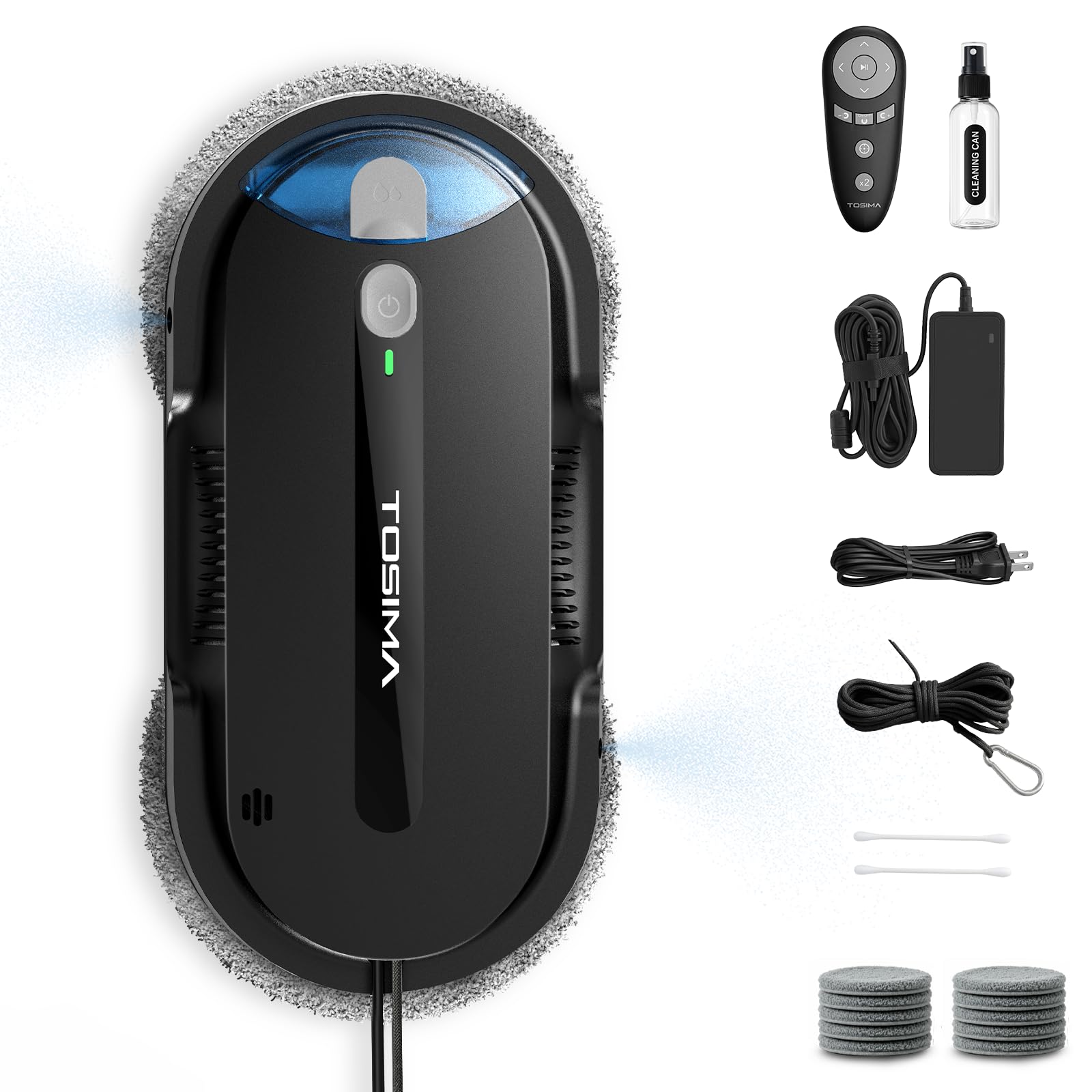
1. WA9C Pro Window Cleaning Robot
Our pick — 4.5+★ from 200+ verified ratings; the strongest balance of quality and price.
The wide-track washer that lays down water from four nozzles instead of one.
If your glass is broad and grimy, the WA9C Pro covers ground in fewer passes than most rivals. Its 8-inch cleaning path is the widest stroke in this lineup. For contrast, the Tosima W6 Pro wipes a 5.5-inch path, so the WA9C covers a broader band each run. Four nozzles — two on each side — push water evenly across that band, which means fewer dry patches and fewer refills of your patience.
The suction that anchors it runs 2600 to 3200 Pa, the lower end of the picks here, so treat this as a machine for mirrors, shower glass, and interior panes rather than third-floor exterior work. A smart air pressure monitor and a bottom drop sensor watch the surface and keep the grip firm. If the power cuts out, the internal battery holds it on the glass for up to 25 minutes with warning sounds and lights while you walk over.
Six intelligent modes do the route work — an N-shape for straight vertical runs, a Z-shape for wide horizontal coverage, and a manual mode you steer by remote for stubborn spots. The kit is unusually complete: four mops, an unclogging needle kit, a refill bottle, spare nozzles, and the AC cable. What wins people over is the cleaning performance, which draws far fewer streak complaints than some rivals. The honest caveat is a familiar one — too-wet glass or a dirty pad leaves streaks, so wring the pad and swap it before you finish.
Where it pulls ahead
- 8-inch path covers more glass per pass than the 5.5-inch Tosima W6 Pro
- Four nozzles spread water evenly for fewer dry streaks
- 25-minute power-failure hold with lights and sound alerts
- Starter kit includes four mops, spare nozzles, and a bottle
What to weigh first
- 2600–3200 Pa suction is lower than the high-suction picks here
- Streak results depend on pad cleanliness, not just the machine
Reach for this if: your windows are wide, low, and reachable by hand and you want one pass to lay down even moisture.
Look elsewhere if: you clean tall exterior panes, where the stronger-suction models make more sense.
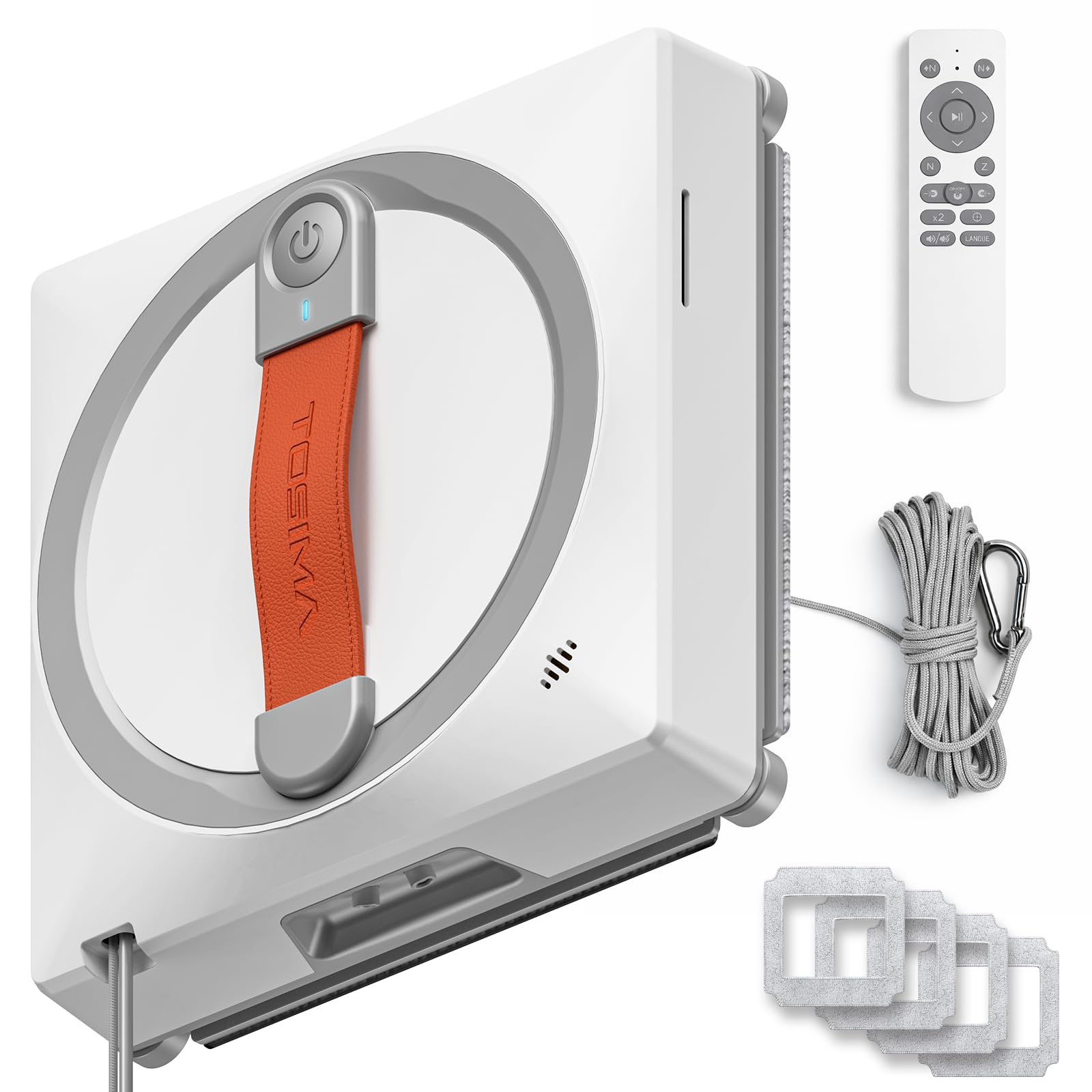
2. Tosima W6 Pro Window Cleaning Robot 7200Pa with App & Remote
Grip hard enough to matter, with a box that keeps all the parts together.
Suction is the spec that decides whether a window robot feels safe on a tall pane, and this one leans into it at 6400 to 7200 Pa — twice the range of the WA9C Pro above. That grip holds on vertical glass, mirrors, tiles, and smooth surfaces. It also helps on conservatories and terrace roofs where the surface is large and the drop is real. A 500mAh UPS battery keeps the robot stuck for up to 20 minutes after a power failure, with an acoustic alarm so you know it needs collecting.
The spray system is a dual-nozzle affair with ultrasonic atomization: the right nozzle fires when it moves right, the left when it moves left, which wets evenly without wasting water. A 300ml tank runs a long session between refills. An S-shaped route covers a rectangle without gaps, and you can steer the direction from the app or the remote. It handles framed and frameless windows alike, though inclined surfaces need the manual’s rules followed.
The box is part of the appeal — a storage box, twelve microfiber mops, spare nozzles, cotton swabs, a water bottle, a safety rope, and the adapter all ship together. Owners find it performs well on out-of-reach glass and shower doors, and the setup is quick enough that it saves real time. The recurring gripe is streak removal: keep mops clean and expect to dry-wipe a heavy-soiled pane twice. The 5.5-inch cleaning path is narrower than the WA9C Pro’s 8-inch stroke, so it takes more passes on wide glass.
Why owners keep it
- 7200Pa grip feels steady on tall exterior glass
- 300ml tank handles long sessions without refills
- Twelve mops and a storage box in the box
- App and remote both steer direction
The catches to know
- Streaks show up if mops stay dirty
- 5.5-inch path needs more passes than a wider one
Best for high glass you cannot reach: the strong suction and 20-minute backup make it a sensible pick for conservatories and terrace panes.
Think twice if: you want one swipe on a wide window — the narrower path means more laps.
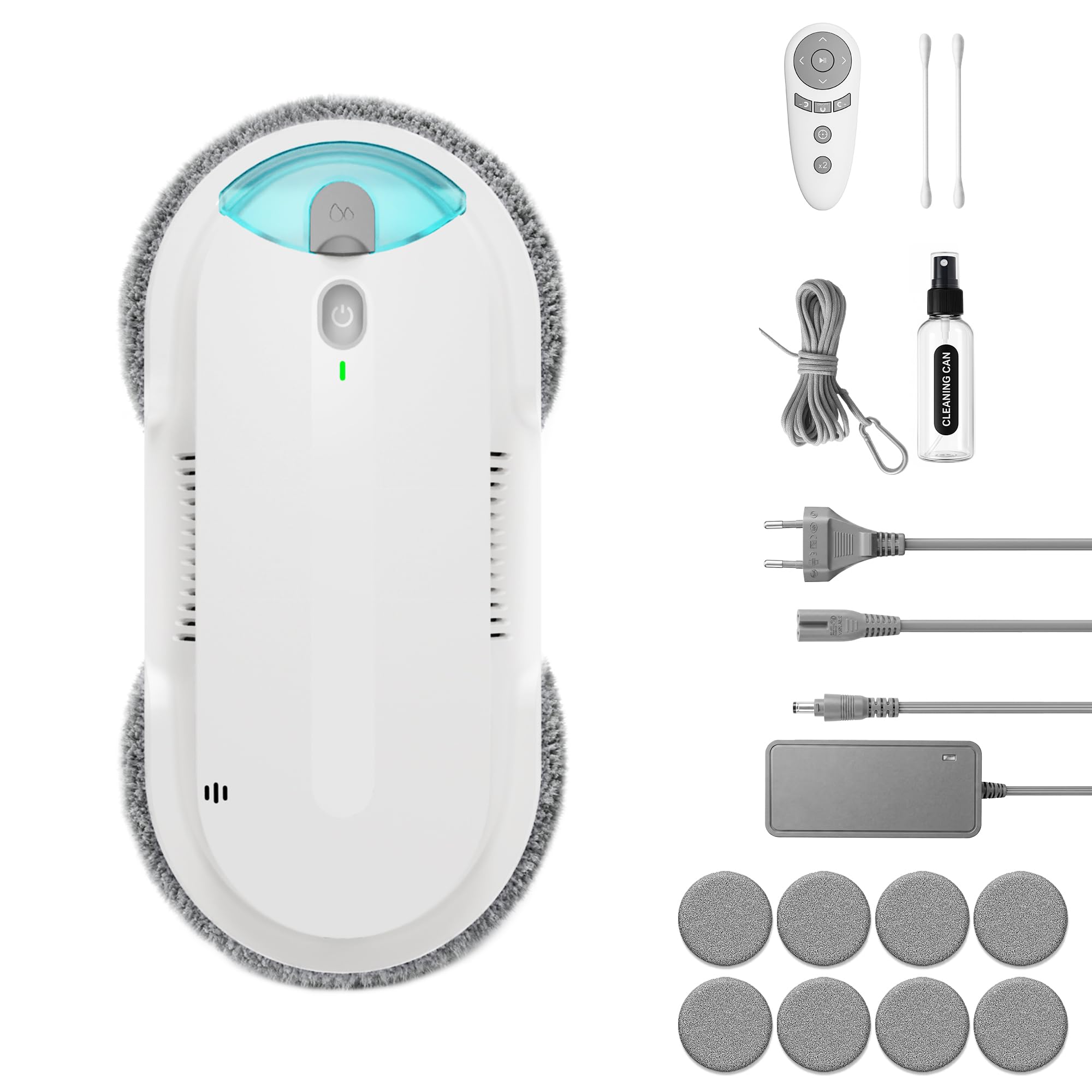
3. X1 Window Cleaning Robot – Double Helix 4800-6400Pa Suction
A first robot for the smaller panes, with spray that follows its direction.
The X1 is the simplest way into robotic glass cleaning, and it keeps the specs honest for its place in the lineup. Suction runs 4800 to 6400 Pa in a variable range, so it adjusts to the dirt it meets rather than blasting one fixed force. That range is narrower than the Tosima W6 Pro’s 6400 to 7200 Pa, but wider than the WA9C Pro’s 2600 to 3200 Pa. On a normal interior window it grips well enough to feel stable.
Bidirectional ultrasonic atomization sprays from the side in the direction of travel, so the glass gets an even coat without handing you a puddle. The 85ml tank is externally visible, which makes it easy to see when it needs topping up, and it sprays twice per movement for wider coverage. Edge detection senses the frame and stops spraying so it does not soak your sill or trim.
Safety comes from an air pressure sensor and AI edge detection that together work to keep the unit from running off the pane. This is the smaller machine in the pair of X1 models, and it fits tighter interiors better than a wide-track unit would. It is a fair place to start if your windows are modest and you want the routine handled. Just keep the spray light — an over-wet pane is where streaks begin on any robot.
Plain-spoken take: a modest unit that does the basic job on interior glass without asking much.
Suits first-timers: small panes, mirrors, and shower glass where a simple pass is enough.
Not for: big floor-to-ceiling exteriors, where you want the higher-grip models.
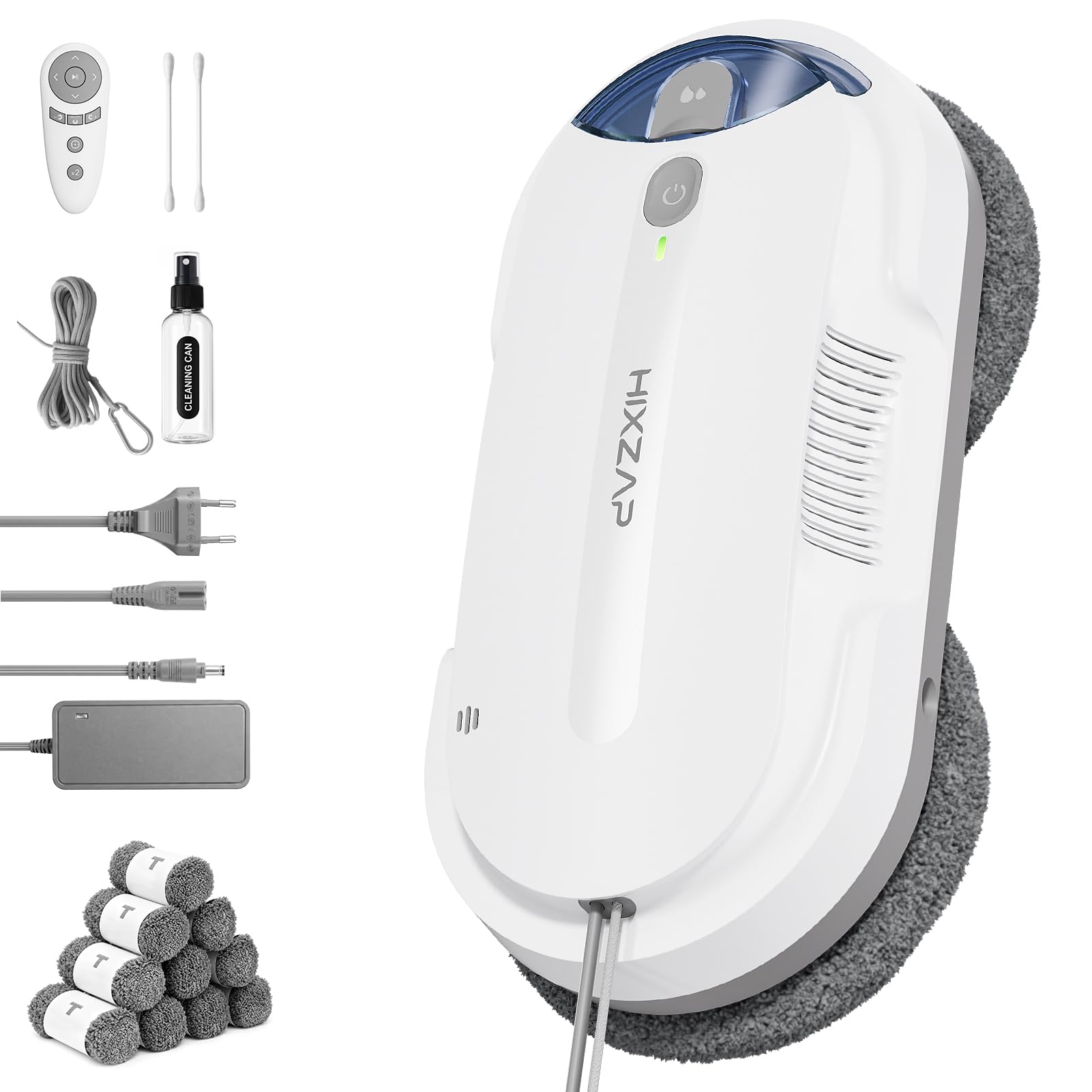
4. X1 PRO Window Cleaning Robot – Double Helix 7200Pa Suction
The strong-suction climber that ships with twenty washable pads.
Where the base X1 stops at 6400 Pa, this PRO version pushes to 7200 Pa, a fixed high grip built for thick glass. That force holds from glass 3mm thick and up, so it stays put on floor-to-ceiling windows and high-rise exterior panes. If your cleaning happens two or three storeys up, that difference matters more than any app feature.
Safety is layered for exactly that situation: a safety cable rated to hold the full weight of the device, a UPS (uninterruptible power supply) backup that keeps suction for 25 minutes if the power drops, and real-time suction monitoring that sounds an alert if anything goes wrong. Dual ultrasonic nozzles mist in both directions as it moves — left nozzle going left, right nozzle going right — which keeps glass evenly moist and dissolves grime faster. The 0.5-litre tank is large enough for a whole run.
The path is fully automatic: place it, press start, and the built-in AI chip runs an S-shaped route top to bottom, then stops and beeps when done. A spot mode handles tough stains with focused back-and-forth scrubbing. Twenty reusable microfiber pads arrive with it, which is enough to keep working while a batch washes. A remote controls spray intensity and manual steering, so no app or WiFi is needed.
Safety-first read: the 7200Pa grip, cable, and 25-minute backup together make this the pick for anyone nervous about height.
Worth pairing: the 20-pad count lets you swap a mucky pad mid-job instead of smearing around it.
For exterior glass at height: strong suction, a backup hold, and a cable combine for confidence up high.
Manual steering only: no app, so you either love the remote or you don’t.
5. X6 Pro 6400Pa Suction Window Cleaning Robot with Storage Bag
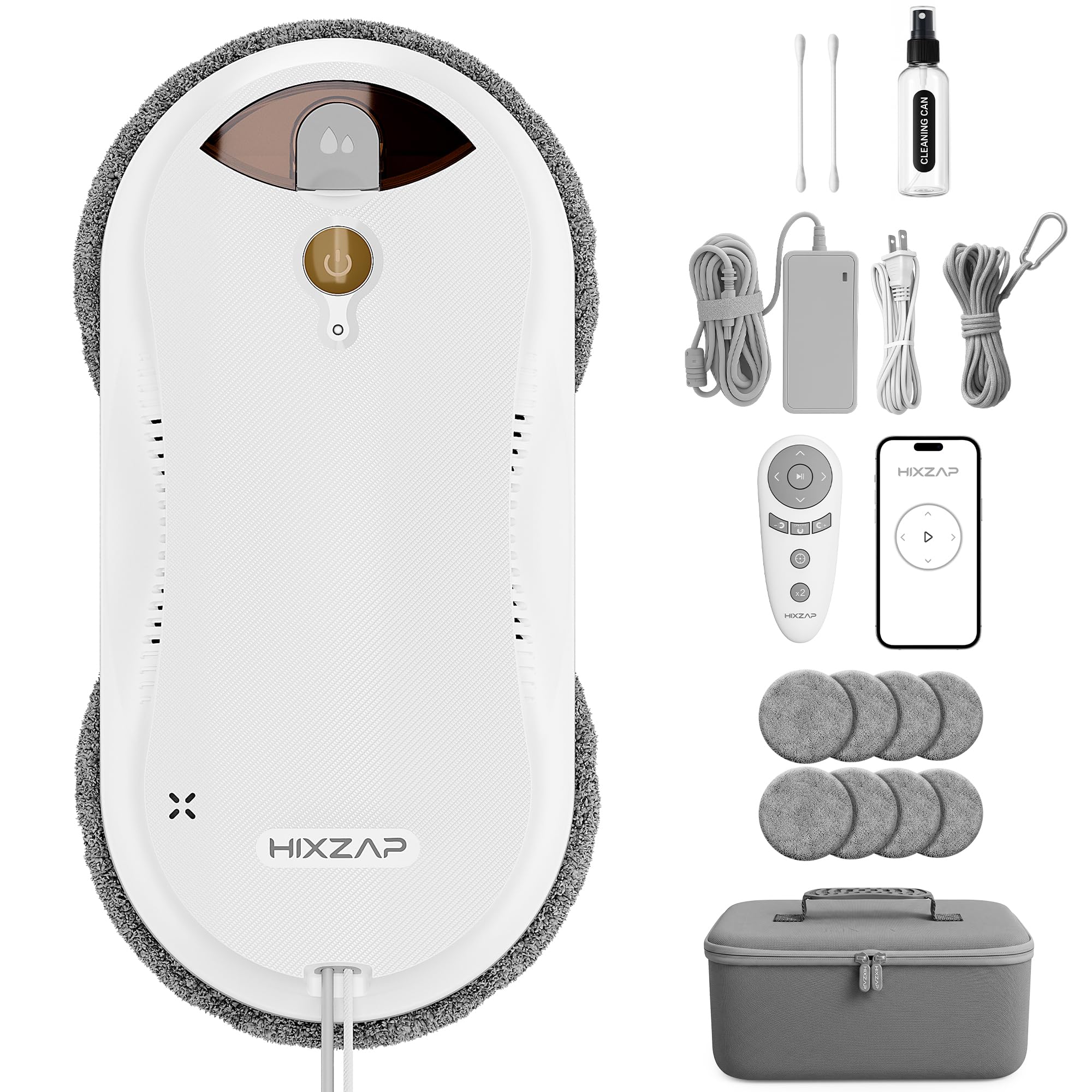
Round-bodied and bag-ready, built to reach the frames square robots skip.
The X6 Pro leans on its shape. Its round body covers up to 95% of the glass per the maker, while square-bodied robots leave blind spots in narrow frames. Suction is 6400 Pa and variable, so the robot dials it to the grime it meets, whether that is bird droppings, hard-water stains, or dust. Dual-spray nozzles wet the glass evenly for a streak-free finish.
Safety stretches to ten levels, and the key one is the UPS function that keeps the unit stuck for 30 minutes if the power cuts. A heavy-duty safety cable rated to at least 150lbs and anti-fall edge sensors back that up. The 85ml tank is on the smaller side, so a big run means a mid-job top-up. A custom storage bag keeps the robot and accessories together for moving between rooms.
The app and remote both work here — schedule cleanings, adjust modes, or stop it from anywhere. The maker claims a 3.3㎡ window takes about 7 minutes, and the unit carries a 1-year warranty. To avoid smears, the routine is simple: don’t over-wet the glass, swap dirty pads promptly, and finish with a clean pad to dry-wipe. The slim round body fits narrow window frames, and it handles skylights, mirrors, and tile walls too.
What makes it handy
- Round body reaches up to 95% coverage per the maker
- 30-minute UPS hold plus a cable rated to at least 150lbs
- App and remote both control it
- Storage bag keeps parts together
Trade-offs to expect
- 85ml tank needs topping up on larger jobs
- Streak-free results depend on light spray and clean pads
Pick this for narrow frames: the round shape slips in where a square body cannot, and the bag makes it easy to move room to room.
Refill often: the small tank is the one routine chore you will notice.
6. HUTT DDS55Pro Window Cleaning Robot with 3D Floating Pads

Two pads that spin like a hand polishing the glass, pressed on springs.
Most robots drag a flat pad and hope for the best. This one rotates two pads at up to 70RPM, a continuous circular scrub that mimics hand polishing to lift fingerprints, dust, and everyday smudges. The pads sit on spring supports, so they flex over small surface variations instead of skipping. That keeps wiping pressure even right along the window edges.
Suction tops out at 6500 Pa, and the system adjusts it during the run to keep the unit steady on the glass. An 80ml transparent tank feeds the HydroJet spray, which puts down a fine controlled mist before the pads wipe it away. The wide-angle coverage spreads moisture evenly and helps cut the drips that turn into streaks. A UPS backup and intelligent suction monitoring round out the safety side.
SLAM 4.0 navigation uses smart algorithms and sensors to plan a path, spot window edges, and work the surface automatically. Multiple cleaning modes plus an automatic return function make routine upkeep less of a chore. For large windows and glass doors, the spinning-pad approach is a real step up on stubborn marks. Leave it to plain wiping on light dust, though — the circular scrub is only an advantage on glass that needs the extra work.
Scrub-power verdict: the 70RPM dual pads are the standout, giving you polishing action rather than a simple swipe.
One to note: the 80ml tank is modest, so plan a refill on big panes.
For glass with stuck-on grime: the spinning pads and HydroJet mist earn their keep on smeared doors and windows.
Skip if: your glass only gathers light dust — a plain swipe does that job.
7. ECOVACS WINBOT W2S Window Cleaning Robot
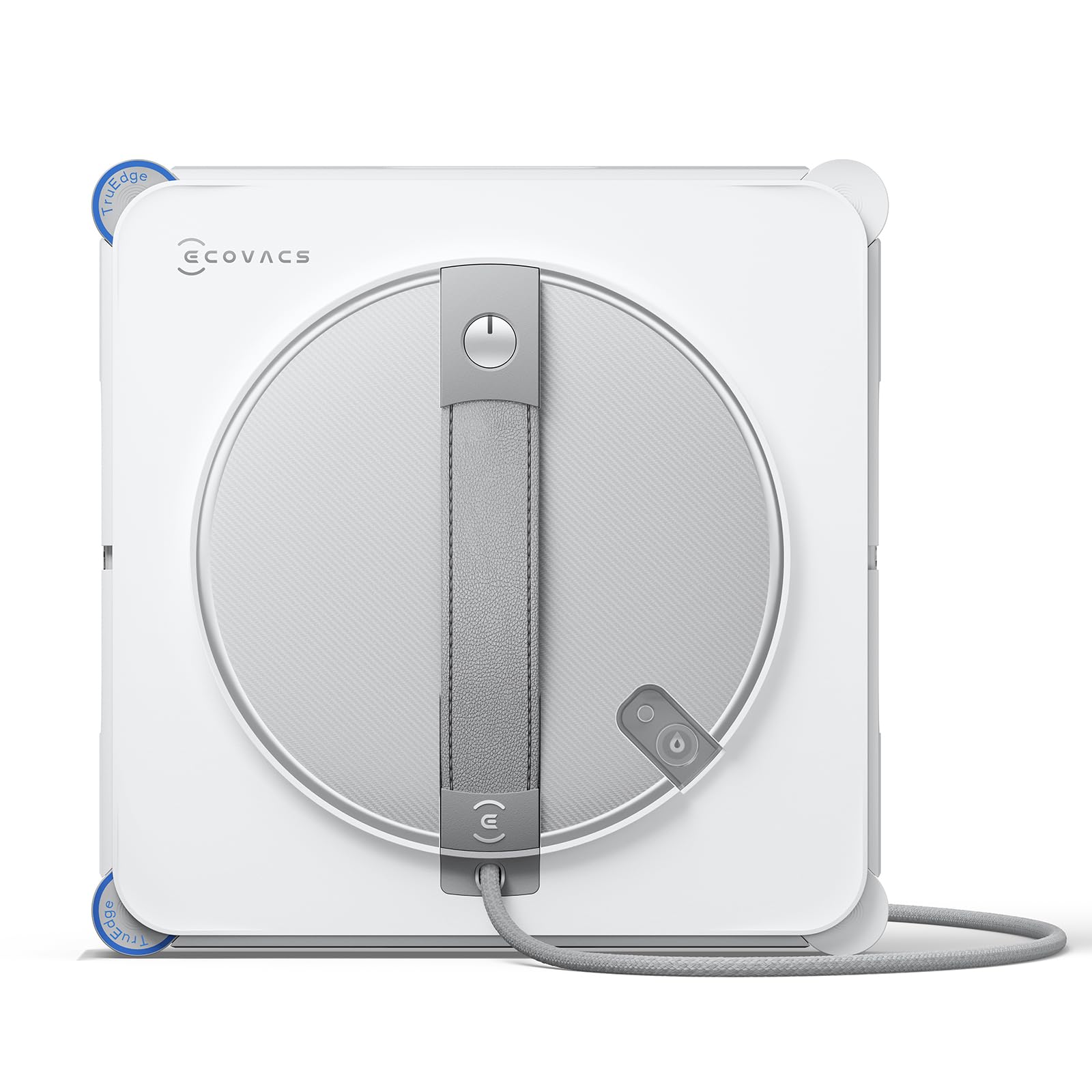
The high-suction edge specialist that runs seven modes off an app.
The headline number is 8000 Pa — higher suction than any other pick on this list, and it gives the WINBOT W2S a steady hold on tall glass. TruEdge scrubbers work with a dedicated Edge Cleaning Mode to clean close to window borders and into corners. The maker claims it reaches roughly 1.1mm from compatible edges in lab tests, though a small margin may remain depending on the frame and seal.
Seven modes — Fast, Deep, Thorough, Edge, Spot, Zone, and Heavy-Duty — run through the ECOVACS HOME app, and WIN-SLAM 4.0 plans systematic paths and detects edges to reduce missed areas. Three wide-angle nozzles apply cleaning solution as it moves, and the spray can be intermittent rather than continuous. Its core job is interior glass, where its structured grid pattern is what does the work.
The biggest thing to plan for is power. This W2S package is corded — it needs a working outlet through its adapter and cable during cleaning. The internal battery is a safety backup for a power interruption, not a cordless cleaning supply. It needs flat, smooth glass of at least 11.8 × 15.7 in with glass thickness of at least 0.12 in, and it is not built for curved, domed, or heavily textured panes. The sturdy build and smooth glide win people over; the recurring snag is that a raised seal or obstacle can briefly stop it.
Why it earns a spot
- 8000Pa suction is the highest grip in this lineup
- TruEdge mode reaches close to frames and corners
- Seven modes through the ECOVACS HOME app
- WIN-SLAM 4.0 plans systematic paths
The honest caveats
- Corded — it is not a cordless model, so you need an outlet
- Rubber seals and raised obstacles can briefly stop it
Choose it for edge-to-edge glass: the 8000Pa hold and TruEdge scrubbing give you confident coverage right up to the frame.
Know before you buy: it plugs into an outlet, so keep a cable run in reach of your windows.
8. HUTT H10 Window Cleaning Robot
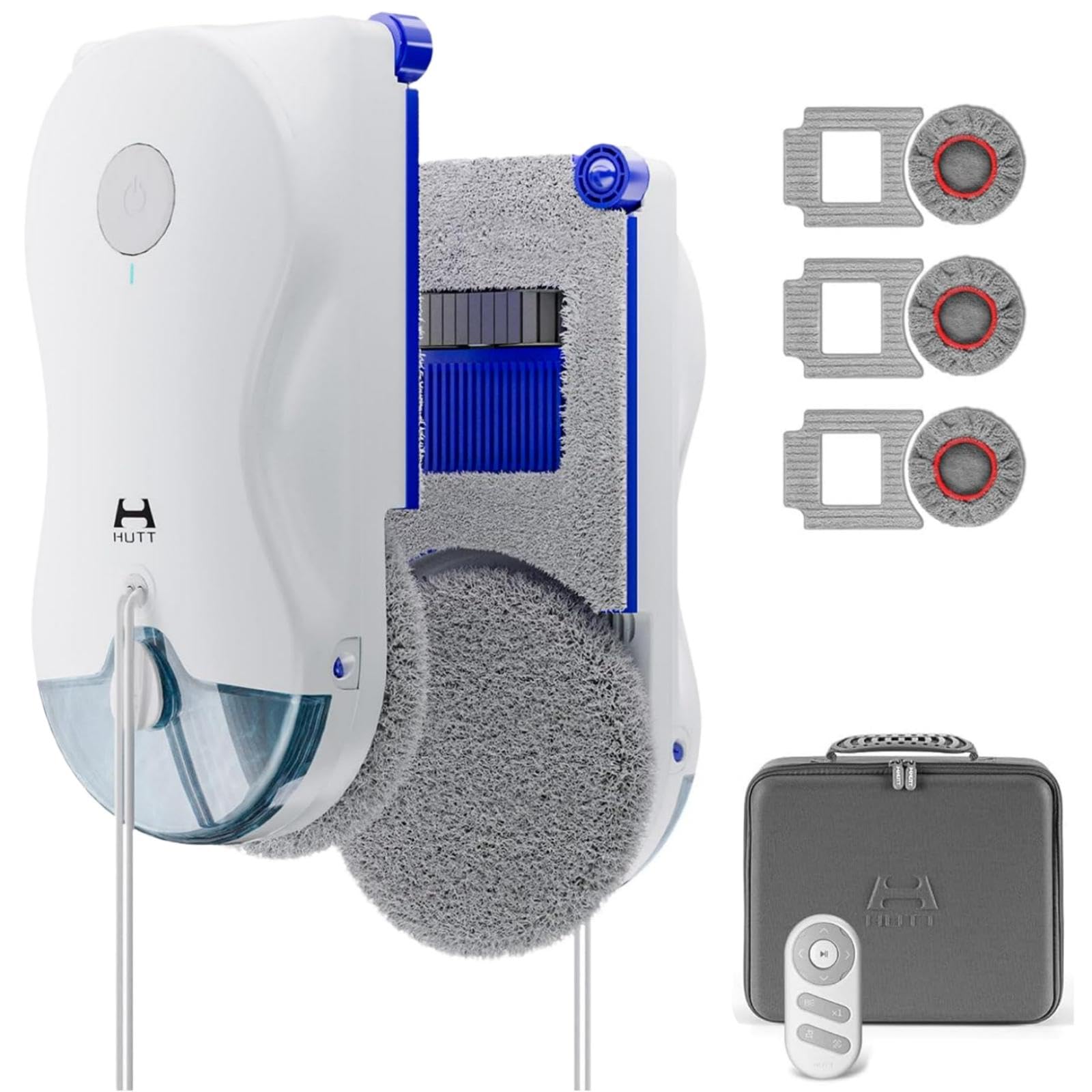
A round pad lifts the wet grime, a square pad polishes it dry.
The H10 does two jobs in one pass: a 70 RPM round pad lifts wet dirt, then a precision square pad wipes dry and polishes. That two-stage approach is built to cut streaks at the finish rather than just spread moisture around. The maker says German outlet n-tv named it a test winner in a three-model comparison covering pollen, fingerprints, everyday dirt, streaks, and edge work.
Suction reaches 6500 Pa from a brushless motor for stable vertical grip. A 3D suspension base presses the pads against the glass at up to 55N (listed as 12.3 lbs) for better stain removal. Dual ultrasonic mist in both directions hydrates the glass, and the 80ml visible tank is rated for up to 60㎡ (646 sq ft) per refill.
NAVI 7.0 detects the window dimensions and plans a route, with 14 sensors watching edges, pressure, and movement. Safety is solid: a 30-minute UPS hold and a safety rope rated to 220kg. It runs as low as 65dB, and at 1.3kg it is easy to lift into place. It works on glass from 30 × 30cm up and suits windows, mirrors, shower doors, and sliders. Use purified water to limit mineral buildup, and wring the round pads out well before use.
The two-pass logic: wet-lift then dry-polish is the reason this one fights streaks instead of causing them.
Worth knowing: no cleaning liquid is included, and grimy tracks or soggy pads will send it off course.
Best for a streak-free finish: the dual-pad sequence and 14-sensor navigation make it a strong choice for large glass doors.
Keep it serviced: clean, dry drive tracks are the difference between a smooth run and a wandering one.
9. ECOVACS WINBOT W3 Omni Robot Window Cleaner
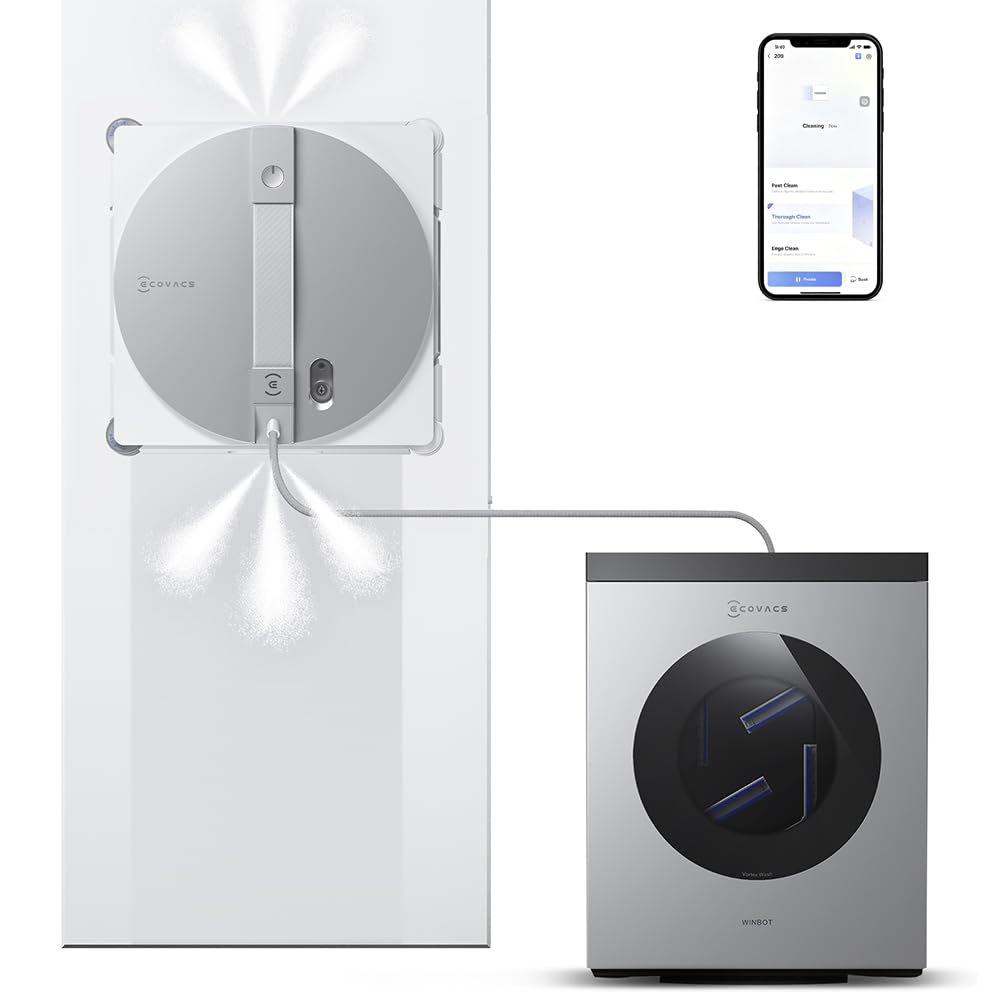
The one that washes its own pads so your hands never touch the mud.
Every other robot here needs you to rinse a pad by hand. The W3 Omni ships with a cleaning station that washes the wiping pads with 16 high-pressure nozzles in just 1 minute, and an optional self-cleaning cycle keeps the station itself fresh. That is the real point of this machine — the routine chore of washing pads disappears. The station also holds a 1.1-litre reservoir, the largest tank on this list.
TruEdge technology actively lowers a scrubber along edges and into corners at 200 RPM, so dirt comes off in a single pass. The scrubber retracts automatically to help prevent cross-contamination as it works. WIN-SLAM 5.0 navigation brings dynamic obstacle avoidance at 1mm precision, with Fast, Intensive, and Zone modes to match different window layouts. Three nozzles spray a wide angle at higher pressure to loosen dirt before the pad wipes.
The set-up is quick and owners find the grid pattern a serious time-saver. It is the priciest pick by a wide margin, and the maker’s pitch rests on the station removing the pad-washing labor. Streak results are mixed: on salty or heavily soiled glass it can smear if you rush the passes, and two passes help. The suction keeps it steady — it holds fine even used outside at height. If washing pads by hand is the part you hate most, this is the machine built for you.
What sets it above the rest
- Station washes pads with 16 nozzles in 1 minute
- 1.1-litre reservoir is the biggest here
- 200RPM TruEdge scrubber lowers into corners
- WIN-SLAM 5.0 avoids obstacles at 1mm precision
What you pay for
- Premium tier — the costliest pick in the lineup
- Salty or heavy soil may need a second pass to clear streaks
For the pad-washing avoider: the auto-clean station removes the chore that puts most people off robotic window cleaning.
Worth it only if: hands-off convenience matters more to you than the higher rating-per-outlay of simpler picks.
Know the Specs
Suction in Pascals (Pa)
Suction is the force pressing the robot against the glass, measured in pascals. Higher numbers mean a firmer hold, which matters most on tall or exterior panes where a slip is a problem. The picks here range from 2600 Pa up to 7200 Pa. Think of it as grip strength: a mirror on a vanity copes with less, a floor-to-ceiling lounge window wants more.
UPS Backup Hold Time
The UPS battery is a safety cell that keeps the robot stuck to the glass if the power fails. Its hold time — anywhere from 20 to 30 minutes across these models — is the window you get to walk over and pull it down safely. If you clean high exterior glass, a longer hold is worth having.
Cleaning Path Width
Path width is how wide a band the robot wipes in one pass, measured in inches. A wider path covers a large window in fewer trips; a narrower one means more laps. Neither is better on its own — it depends on whether your windows are big and open or small and framed.
Tank Size and Spray System
The water tank feeds the spray nozzles that wet the glass before the pads wipe. Tank sizes here run from 80ml up to 1.1 litres. A larger tank means fewer refills on a long run. Dual or triple nozzles spray in the direction of travel so the glass wets evenly, which is what keeps streaks down.
Common Questions
Will a robot window cleaner work on my curved or textured glass?
What happens if the power goes out while the robot is on the glass?
Is the WINBOT W2S cordless?
Why does my robot leave streaks on the glass?
Do I need the safety rope if I clean ground-floor windows?
Will a robot clean the corners and edges?
What is the smallest window a robot will work on?
How loud is a robot window cleaner?
Does the robot wash its own cleaning pads?
The Bottom Line
For most homes with wide, reachable glass, the WA9C Pro is the easy pick — an 8-inch cleaning path and a four-nozzle spray cover more in each pass than the narrower Tosima W6 Pro. If your windows sit up high, the WINBOT W2S gives you the firmest grip of the lot with 8000Pa suction and TruEdge scrubbing right to the frame. And if washing pads is the chore you dread, the WINBOT W3 Omni’s auto-clean station is the one to reach for, with a 1.1-litre reservoir that outlasts every other pick here. Match the suction to your window height, set aside an outlet for the corded models, and any of these will spare you the ladder.
How we choose
We do not accept paid placement. Every pick is matched to a real buyer and a real use-case; we do not hands-on test units.
Sources
Specifications: manufacturer listings and product documentation. Review insights: verified customer reviews, as of November 2026. Pricing: not shown on this page (it changes often); check the current price via the retailer link.
As an Amazon Associate, Tactical Gear Guy earns from qualifying purchases. This does not affect which products we feature.