Specs are compiled from manufacturer listings and verified buyer reviews and can change over time — please confirm the key details on the product page before buying.
Most adult buyers get burned by the same trap: they buy a helicopter that looks impressive in the photos but fights them in the air. The ones worth owning share two things — a six-axis gyroscope (a motion sensor that auto-corrects the tail so the heli doesn’t spin on you) and a real altitude-hold function (it locks its own height so you can focus on steering). Get those two right and you can actually learn to fly instead of chasing a runaway rotor around the living room.
This guide is built by comparing the manufacturers’ published specifications and the patterns across verified customer reviews, so you get each pick’s real strengths and trade-offs instead of marketing spin.
Below you’ll find nine helicopters sorted by what they actually do well, from tiny living-room trainers to brushless stunt machines. Every entry lists the gyro type, channel count, and battery setup so you can match a model to your skill level. That’s the whole game with the remote control helicopter for adults.
Top Picks

How To Choose The Best Remote Control Helicopter for Adults
The single biggest mistake adult buyers make is buying on looks. A scale Huey body is gorgeous, but if the gyro is weak or the altitude hold drifts, you’ll spend your first weekend fighting the sticks instead of flying. Start with stability electronics, then worry about the paint job.
Gyro and stabilization: the electronics that keep you in the air
A 6-axis gyroscope is the piece of hardware that senses tilt and rotation and quietly corrects it, dozens of times a second. On a good setup, you can take your thumbs off the sticks and the heli just hovers. On a weak one, the tail swings and the nose wanders. Look for the words “6-axis gyro” and, ideally, “altitude hold” or “optical flow” in the listing — those are the two features that separate a trainer from a handfull.
Channels, ailerons, and what the numbers actually mean
Channel count is simply how many separate control inputs the radio sends. A 4-channel heli gives you throttle, rudder, elevator, and aileron — enough for forward flight and turns. A 6-channel (6CH) adds collective and pitch, which is what enables inverted flight and 3D stunts. An “aileronless” design skips the ailerons and relies on the gyro and rotor head for roll, which makes it lighter and more forgiving. If you’re a total beginner, aileronless and 4CH are your friends; if you’ve flown before, go 6CH.
Battery voltage and flight time: reading the label correctly
Voltage tells you the power class. A 3.7V single-cell pack is a small indoor-class battery; a 7.4V two-cell pack drives a bigger, heavier airframe with more punch. Milliamp-hours (mAh) tell you how long it lasts — a 1200mAh pack runs noticeably longer than a 450mAh pack, all else being equal. And a “modular” or “smart” battery system means you swap packs in seconds instead of fiddling with a battery hatch.
Indoor vs outdoor: pick your flying field first
Small, light helicopters (under about 120g) are living-room machines — they bounce off ceilings and sofas without drama. Heavier brushless models need open space and calm air. If you plan to fly in the yard, look for a model that lists brushless motors and wind tolerance; if it’s a basement flyer, favor low weight and a no-aileron head.
Side-by-Side Comparison
| Model | Best For | Channels | Gyro | Battery | Amazon |
|---|---|---|---|---|---|
| GoolRC C186★ Best Overall | First-time indoor pilots | — | 6-axis | Modular, alkaline-described | Amazon |
| GoolRC C129Best Battery Bundle | Longer sessions on a budget | 4CH | 6-axis | 3× Li-ion included | Amazon |
| Blade Revolution 90 FPBest Living-Room Trainer | Living-room trainer with SAFE tech | 6-channel transmitter | SAFE stabilization | 150mAh 1S 3.7V LiPo | Amazon |
| RC ERA C032 UH-1 Huey (Yellow) | Scale looks plus stunt mode | 6CH | 6-axis + optical flow + TOF | 7.4V brushless system | Amazon |
| Helidirect RC ERA C032 Huey | Highest-rated trainer | 6CH | 6-axis | 7.4V modular | Amazon |
| 315MM UH-1 Expert 6CH | Hobbyists wanting mode-swap radio | 6CH | Barometric + optical flow + TOF | 2 batteries included | Amazon |
| C032 UH-1 Huey Flybarless | 3D stunt practice with spare packs | 6CH | 6-axis | 3 batteries included | Amazon |
| WLtoys K110S | Aerobatic flyers with experience | 6CH | 6-axis | 3× 3.7V 450mAh | Amazon |
| UH-1 Huey Collectable 1/27 | Collectors wanting a display piece | 6-channel | 6-axis | 2 batteries, 7.4V 1200mAh | Amazon |
Detailed Reviews
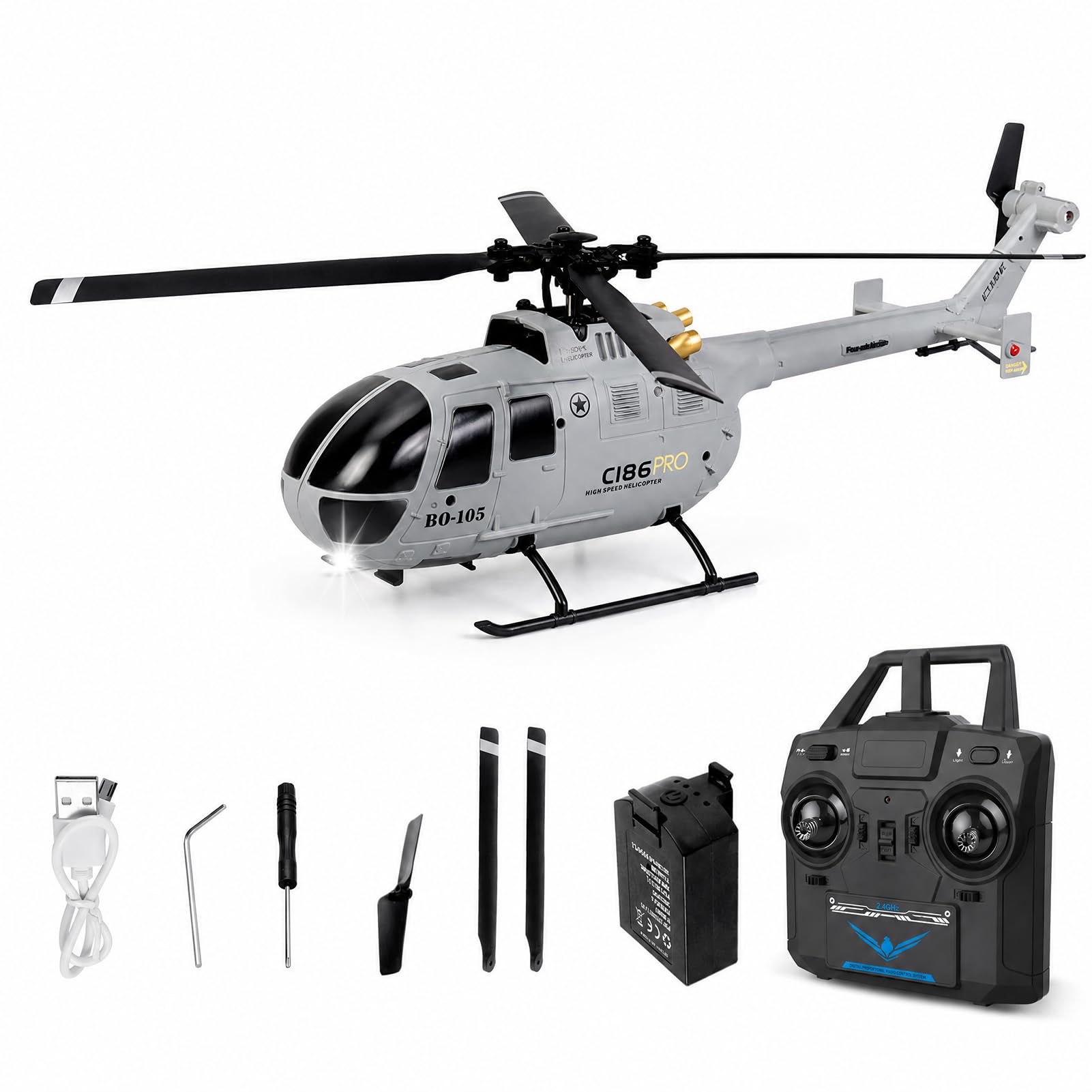
1. GoolRC C186 Remote Control Helicopter
Our pick — 4.0+★ from 150+ verified ratings; the strongest balance of quality and price.
A scale-bodied trainer that keeps its cool indoors and lands itself when you panic.
This is the one to start with if you’ve never flown a helicopter that wasn’t a toy. It pairs a 6-axis gyroscope with an aileronless single-propeller head, which means the electronics do the balancing act for you while the missing ailerons shave off weight and drag. The result is a stable, forgiving machine that hovers indoors without constant stick correction.
What wins people over is simply the fun factor — it’s the most talked-about quality in the feedback, and for good reason. The auto takeoff and landing work as advertised, and the altitude hold means the heli parks itself at a height while you get your thumbs sorted. Flight performance gets its own steady praise, and the scale looks hold up on a shelf too.
The honest catch is durability and function at the margins. A handful of units have had motors quit on a second flight, and a few fliers find it feels less like a true collective-pitch helicopter than they expected. It ships as a full RTF kit — screwdriver, spare propeller, tail propeller, USB cable, and battery all in the box — so you’re flying out of the gate. For an entry-level adult flier, the trade-off is fair.
Where it earns its keep
- 6-axis gyro plus altitude hold keeps it upright for beginners
- Aileronless head means less drag and more forgiving handling
- Auto takeoff and landing that actually work
- Complete RTF kit with spare propeller, wrench, and screwdriver
Where it asks for patience
- Durability is the split — a few units break early
- Some fliers want more true-helicopter feel
- Indoor-focused, so outdoor wind is not its friend
Reach for this if: you want a complete, gyro-stabilized starter helicopter you can fly the day it arrives.
Look elsewhere if: you already fly real collective-pitch helis and want something that feels like the real thing.
2. GoolRC C129 RC Helicopter for Adults
Three batteries, a 100-meter range, and a hover so steady it could pass for a coffee break.
This is the longer-session pick. The C129 comes with three Li-ion batteries, and the listing pins flight time at roughly 15 minutes per pack. If you’re the kind of flier who wants to actually practice rather than land and recharge every five minutes, that bundle is the whole point.
The 4-channel setup keeps things simple — up, down, turn, side-fly — and the 6-axis gyro keeps it level. The 2.4G radio reaches up to 100 meters and lets several helis fly in the same space without cross-talk. The pressure-sensor altitude hold locks the hover, so you can take your thumbs off the sticks and it just sits there.
The thing that trips people up is control sensitivity. The sticks respond more like a skilled-user machine than a novice one, and a couple of fliers had to hand it off because their family members couldn’t tame it. It’s also durable in a hot-glue-and-super-glue kind of way — it takes crashes but expects a little repair. That’s a fit note, not a flaw.
The bundle math: three packs at roughly 15 minutes each add up to a genuine afternoon of flying, and the modular battery hatch means you swap in seconds.
Adjust your expectations: this rewards a gentle thumb. If you’re brand new, budget a little patience for the first few flights.
The long-haul choice: go here when session length matters more than beginner hand-holding.
Think twice if: you want a pure first-timer machine with feather-soft controls.
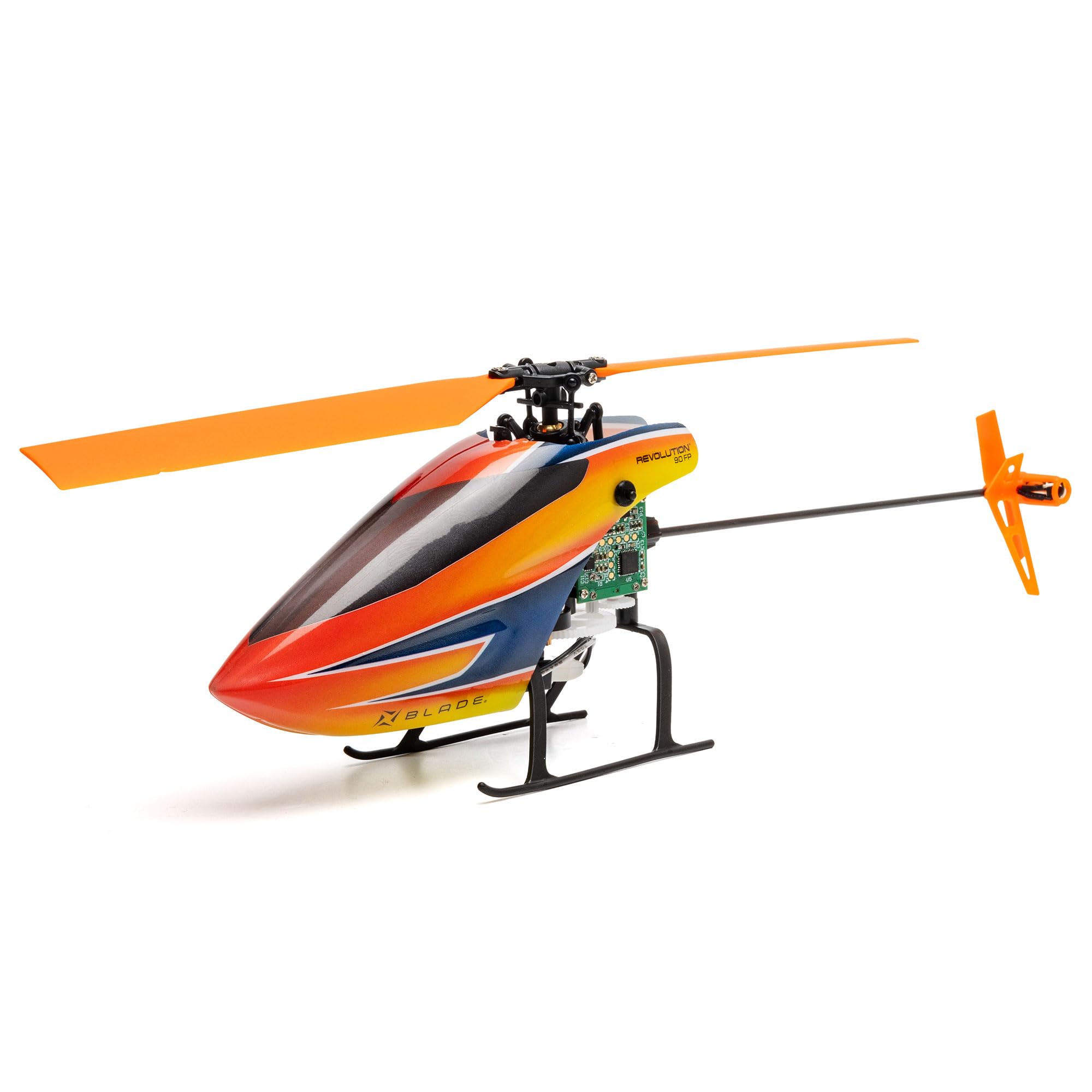
3. Blade RC Helicopter Revolution 90 FP RTF
Built to slam into a ceiling and keep flying — this micro is a trainer with a sense of humor.
Blade’s Revolution 90 FP is the smallest and lightest machine here, and that’s exactly why it makes such a good trainer. Its SAFE technology (a stabilization mode that limits how far the heli will tilt) and an optional flight-altitude mode let you dial down the difficulty until the sticks feel natural. There are three modes on the controller — beginner, intermediate, and advanced — so it grows with you instead of getting boring.
The dimensions are 12.7 x 11.9 x 4.5 inches, and the flight weight is light enough to survive indoor bumps. It ships with a 150mAh 1S 3.7V LiPo battery and a USB charger, and flight time runs about five minutes per pack. That’s short — the advice from experienced fliers is to buy extra batteries before you even unbox. The coreless motors are efficient, the build is plastic, and it’s ready to fly with no assembly.
What everyone raves about is the sheer cuteness of the thing — it’s a proper little scale model, and owners get attached. It’s also remarkably tough: fliers report flying it into ceilings and furniture, and it keeps flying. It’s not a large-airframe machine, and it won’t tolerate outdoor wind, so treat it as an indoor trainer and it delivers.
What the indoors crowd loves
- SAFE stabilization plus three difficulty modes
- Ready-to-fly — no assembly needed
- Flies well after repeated ceiling strikes
- Spektrum 6-channel transmitter included
What to plan around
- About five minutes per 150mAh pack
- Too small and light for breezy outdoor days
- Extra batteries are a near-must
Best fit for: the apartment-bound beginner who wants to learn inside without breaking anything.
The honest limit: a five-minute flight window per pack means you’ll want a battery drawer before long.
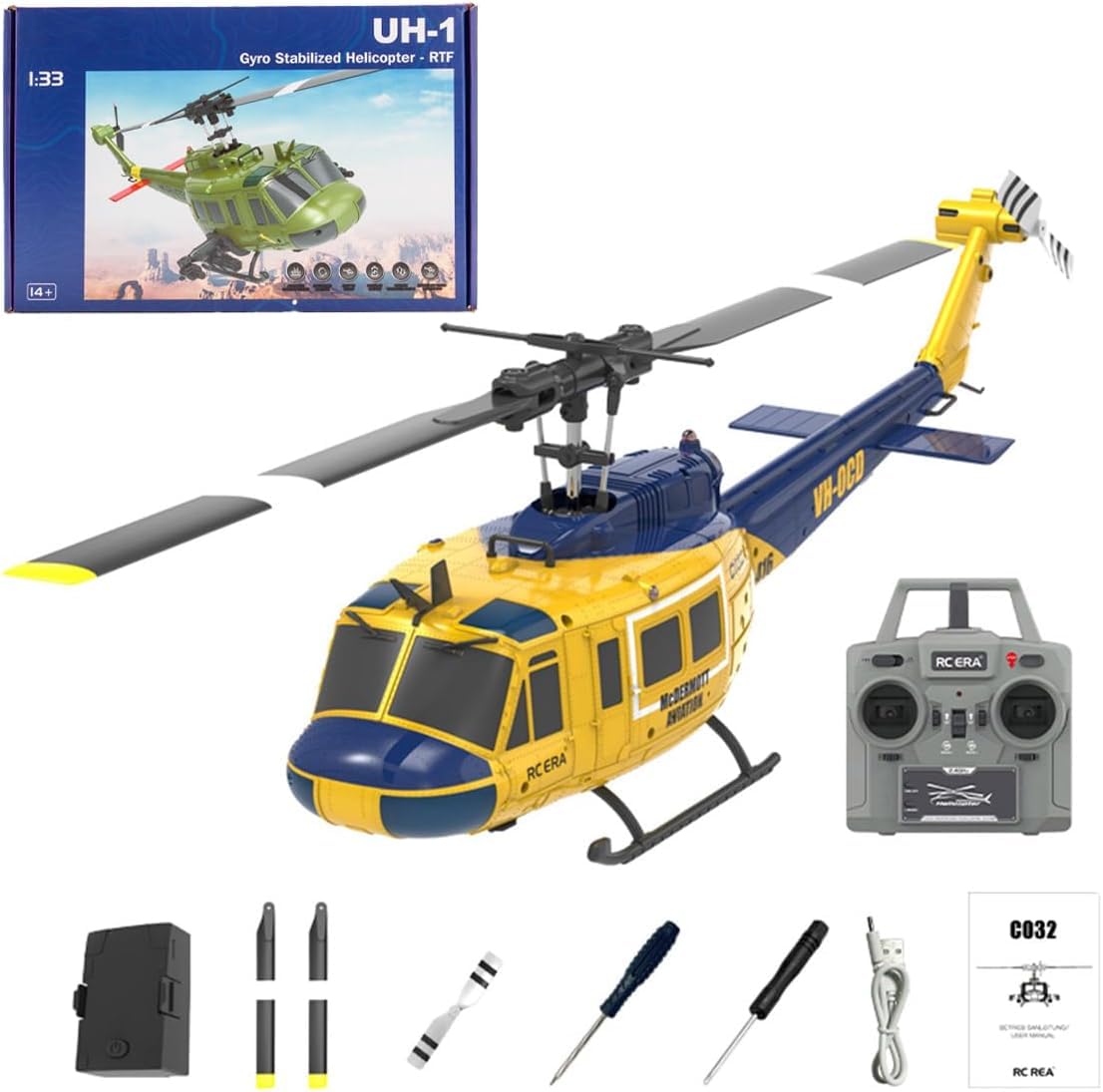
4. RC ERA C032 UH-1 Huey Helicopter
A 1/48-scale Huey that looks the part and can roll inverted when you’ve earned it.
Here’s the geometry that separates this from the Blade above. The Huey measures 12.4 x 8.86 x 3.54 inches against the Blade’s 12.7 x 11.9 x 4.5 inches, so it’s close in footprint but a bit leaner in the body — which makes sense for a scale warbird versus a bubble-canopy trainer. The brushless motor pushes a 7.4V system, a full power class above the 3.7V single-cell pack in the Blade.
The six-axis gyroscope works alongside a barometer, an optical flow sensor (a downward camera that reads the ground to hold position), and a TOF lidar (a laser rangefinder that measures height) to keep the hover locked. Three flight speeds let you build up gradually. Low-voltage alerts, motor lock, runaway protection, and one-button takeoff/landing round out a genuinely beginner-friendly package, and it’s brushless throughout.
The reality check is durability and setup. A few upper control arms have come off early in flight, and replacement parts are hard to track down on the manufacturer’s site. One unit arrived with a defective controller switch that cut out mid-flight. But what lands in the feedback is the quality of the thing — it’s the most-praised trait by a clear margin, with flying performance right behind. Fly it in open space or a big garage rather than a tight room.
Where it shines: the optical flow and TOF sensor stack is real hover tech, not marketing filler, and the 3D inverted mode adds long-term challenge.
The honest catch: parts availability is the weak spot — a mid-flight break can mean a long wait for a replacement arm.
Right for: fliers who want scale looks now and stunt capability later.
Not for: anyone who wants zero-maintenance plug-and-play.
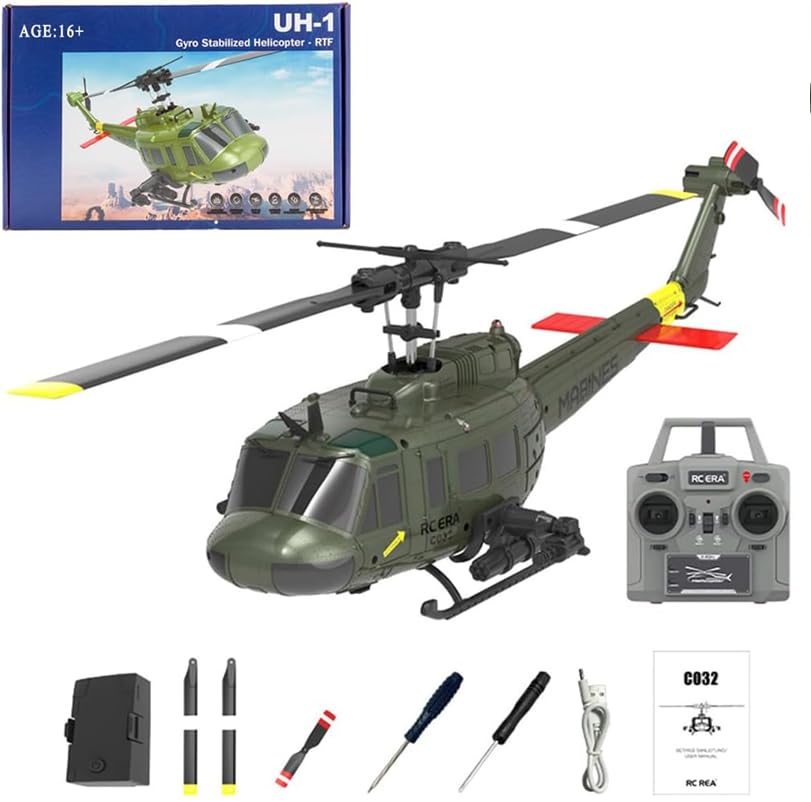
5. Helidirect RC ERA C032 Huey UH1
Featherweight at 115 grams, with a 315mm rotor that punches above its scale.
The single number worth starting with is 115 grams — that’s the flying weight. A helicopter that light can fly indoors and in tight spaces where a heavier brushless machine would be unmanageable, and it survives the inevitable bumps with less drama. The 315mm rotor diameter is what gives it that authority in the air despite the low weight. The 7.4V battery is exactly double the voltage of the Blade Revolution’s 3.7V pack, and it flies for up to 13 minutes per charge.
The electronics are the same family as the other C032s — altitude hold, optical flow, and TOF sensors that keep the hover steady — plus a 6-channel system with three digital servos that can pull one-button inverted flight. The safety net is complete: low-voltage alarm, stall protection, and one-button takeoff and landing. The modular battery goes in and out in seconds.
The verdict is simple. This is the best-scoring helicopter in this group, and the praise centers on build quality — an RC veteran with 40-plus years flying choppers called it a great little machine. One buyer is already ordering a second. The trade-off is that it’s a compact airframe, so keep it out of strong wind and treat the light weight as a feature, not a limitation.
Why it tops the list: 115g plus a 315mm rotor is a genuinely unusual combination — light enough for indoors, big-rotor enough to fly with purpose.
The one caveat: at that weight, a gusty day outside is a challenge, so pick your flying window.
Pick this if: you want the strongest overall performer and don’t mind a light airframe.
Skip if: your flying field is a windy park with no sheltered corners.
6. 315MM UH-1 Remote Control Helicopter Expert 6CH
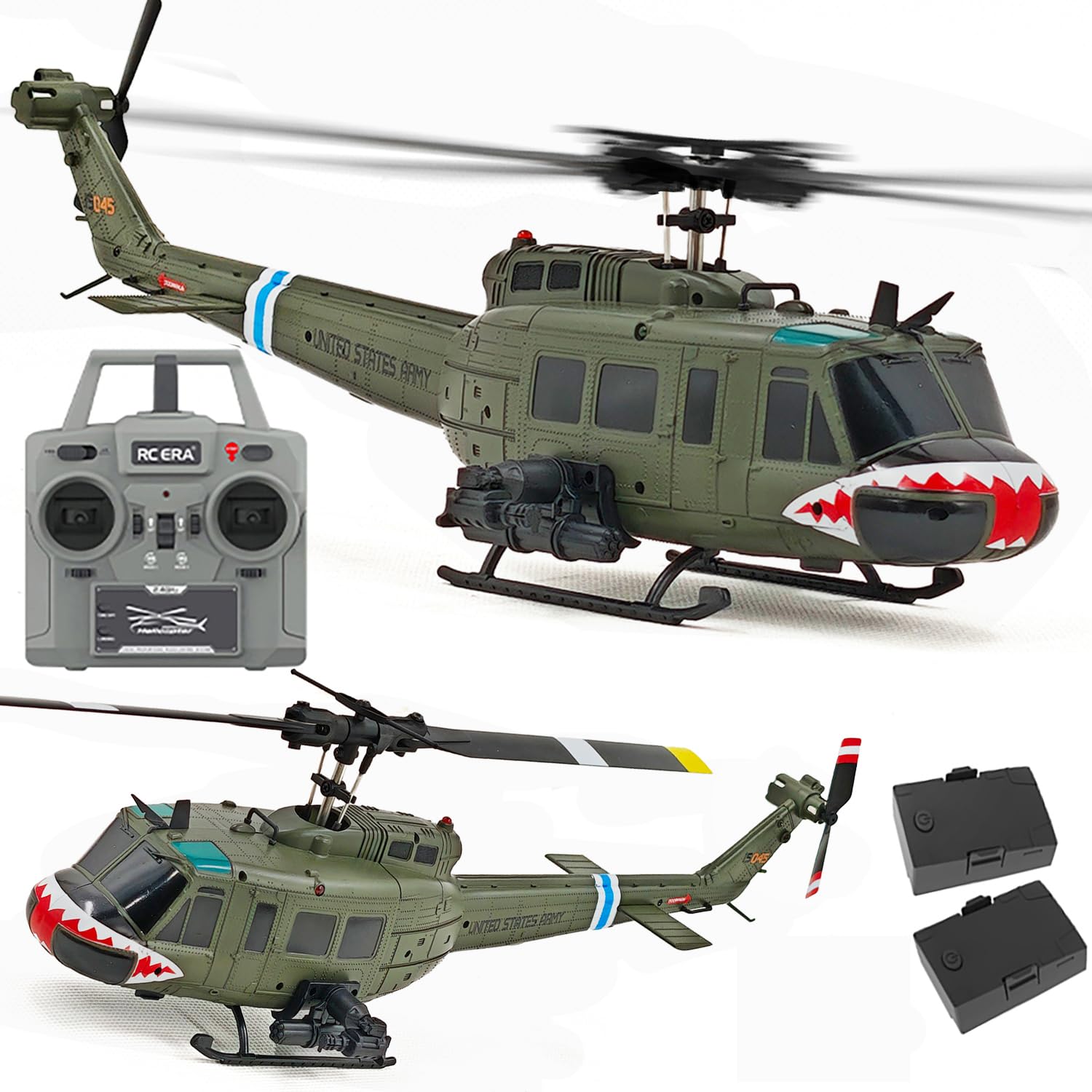
A bearing-gimbal radio you can flip for left- or right-throttle habits — and a 200-meter leash.
The standout hardware here is the transmitter. It uses a bearing-gimbal design that delivers smoother joystick travel with less play, and it supports Mode 1 / Mode 2 swapping so you can fly left-throttle or right-throttle the way your thumbs learned. The control range stretches to 200 meters, which is more leash than you’ll likely use flying a scale Huey in a park.
The airframe is a proper UH-1 with a 315mm rotor diameter and a 297mm fuselage length. It’s stabilized by barometric altitude hold, optical flow, and TOF laser radar dual-stabilization, all working to cancel horizontal drift. There’s an inverted-flight function for advanced pilots, plus a pause button that triggers an emergency landing if anything goes wrong mid-flight.
Two warnings worth hearing straight. The manufacturer itself says horizontal drift can happen and is normal for a hobby helicopter — you fine-tune it with the joysticks. And optical-flow positioning weakens in strong wind or poor light, so fly it in calm, bright conditions. The inverted-flight button is explicitly not for beginners; new pilots attempting it are likely to crash. This is an enthusiasts’ machine with a good safety net, not a first-flight toy.
The right owner: someone who already flies and wants a mode-swappable radio and a 200-meter range.
The caution: that inverted-flight button is a crash waiting to happen in untrained hands.
7. C032 UH-1 Huey Flybarless RC Helicopter
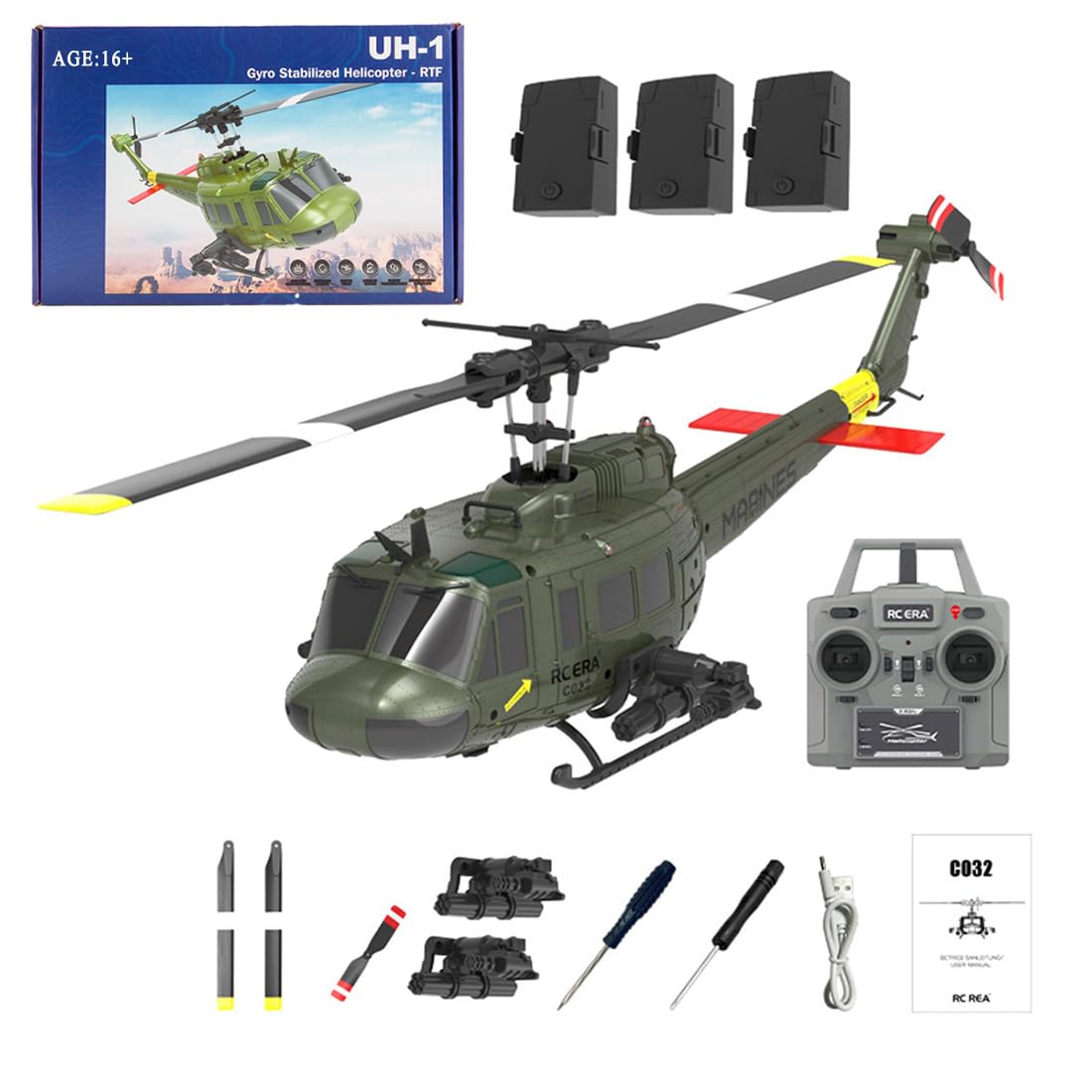
A flybarless head, three battery packs, and 3D stunt capability in one green Huey.
A flybarless rotor head (no mechanical stabilizer bar on top — the gyro does that job electronically) gives this C032 a cleaner silhouette and, in theory, a more responsive feel than a flybar design. The 6-axis gyroscope handles the stabilization. The intelligent battery system includes a power-management chip and a battery-life indicator so you’re not guessing your charge level.
It ships with three batteries, which is the real draw for a stunt-capable heli — you’ll want the spares because 3D practice eats flight time. The 6-channel system plus three digital servos enables one-key 3D inverted flight, route flight, and funnels. Safety features include a low-voltage alarm, stall protection, and signal-loss protection, so if the radio link drops the heli doesn’t just fly off into the sunset.
What lands best in the feedback is straightforward build quality — it’s the most-discussed positive in the reviews by a comfortable margin, with flight performance next. One flier who’d watched plenty of footage of this Huey bought one and reports it “really flies and looks like the real thing.” Another has crashed it repeatedly and it still flies. The scale warbird framing is a bit loose on the manufacturer’s age range, which lists up to 10 years — treat it as an adult hobby machine regardless.
The case for the green Huey
- Flybarless head with 6-axis gyro stabilization
- 3 battery packs in the box
- Safety stack: low-voltage alarm, stall protection, signal-loss protection
- 3D inverted, route flight, and funnels on the menu
The fine print
- 3D intent means you’ll crash — plan for it
- Spare parts aren’t as easy to source as big brands
- Age listing is inconsistent with the adult hobby framing
Worth it for: stunt-curious fliers who want the battery spare count already solved.
Think it over if: you’d rather avoid the repair cycle that 3D practice brings.
8. WLtoys K110S XK RC Helicopter Brushless 6CH

An 11000Kv brushless screamer with a low-rate mode — and the frailty that comes with all that punch.
This is not a toy and the listing says it plainly. The 11000Kv brushless motor (that “Kv” figure is a measure of how fast the motor spins per volt — higher means more punch) drives a fast, responsive airframe with 2g digital servos and a 6-channel system. There are two modes: 6G, a soft setting for first-timers, and a 3D expert mode for rolling inverted flight. The 2.4Ghz radio reaches about 150 meters and resists interference from other radios nearby.
The full kit includes three 3.7V 450mAh batteries and a smart USB charger that can charge two packs at once. The airframe measures 10.6 inches long with a 9.6-inch wingspan, so it wants open, windless grass — the manufacturer says so directly. Everything about this points at hobbyists who want speed and aerobatics, not a living-room hover.
Now the realistic warning. The landing gear is fragile, and a swash plate that comes apart on small impacts is a known weak point — one flier sheared off a rotor linkage nub hitting couch cushions indoors in under 20 seconds. Part support exists though, and fliers who keep it in open space find it an easy, fun flyer. If you take it outside and respect the wind, the punch is the payoff. If you fly it in the living room, expect repairs.
The payoff: an 11000Kv brushless motor plus 6G and 3D modes gives you a machine that grows from trainer to aerobat.
The reality: fragile landing gear and linkage failures on hard impacts mean a repair budget is part of the deal.
The buy for: an experienced flier who wants brushless speed from a compact airframe.
Not for: indoor-only beginners — the fragility shows up fast.
9. UH-1 RC Helicopter Huey Collectable 1/27 Scale

A 1/27-scale Bell UH-1D built for history buffs who want a display piece that flies.
This one is aimed at the connoisseur, not the beginner. It’s a 1/27-scale replica of the Bell UH-1D Iroquois, with the authentic colors and livery honoring the Vietnam War-era helicopter. The build uses a hot-runner injection-molded shell, nylon and carbon-fiber composite blades, and a CNC-machined swashplate — details aimed at realism rather than crash tolerance.
Underneath, the electronics are serious. It runs a 2511 1200KV brushless motor, three 4.3g metal-gear servos, dual-axis co-driven motors, and a 6-axis gyroscope with automatic and manual flight modes plus auto-hover. The 7.4V 1200mAh 25C lithium-polymer battery is rated for 11 to 13 minutes of flight and over 500 charge cycles, and it charges over USB-C, so there’s no proprietary charger to lose.
The trade-off is control feel. It’s stable in the air, but it tends to wander a bit with small stick inputs, and a couple of units have had a main rotor that wouldn’t activate. The bigger consideration is that this is a collector’s piece — the price tier is high, and a hard crash hurts more emotionally than mechanically. Buy it to display it and fly it gently, and it delivers a lot of detail per gram.
What the history buffs get
- Authentic 1/27-scale Bell UH-1D livery and colors
- 7.4V 1200mAh 25C pack rated for 11-13 minutes and over 500 cycles
- CNC swashplate plus carbon-fiber and nylon blades
- Auto-hover and USB-C charging
What asks for care
- Wanders with small inputs, so precision takes practice
- A few units arrived with a rotor that wouldn’t spin up
- Collector-tier price means a crash hurts
The collector’s pick: a display-grade Huey that happens to fly, for the history-minded hobbyist.
The trade-off to accept: precision hovers need correction, and the price tier assumes you’ll treat it as an heirloom.
Know the Specs
6-axis gyroscope
A motion sensor that detects tilt and rotation and corrects the helicopter’s attitude automatically. Six axes means it senses both movement and rotation in all three dimensions. In plain terms, it’s the hardware that lets you take your thumbs off the sticks and the heli holds its hover instead of wandering. Every helicopter on this list has one, but the quality varies — lower-rated entries tend to have weaker correction and a drift-prone tail.
Altitude hold and optical flow
Altitude hold locks the helicopter’s height so you can focus on steering without feathering the throttle. Optical flow uses a downward-facing camera to read the ground and hold horizontal position, while TOF (time-of-flight) lidar measures height with a laser. When these two work together, the heli hovers in place much more steadily than a gyro-only machine. Note that optical flow weakens in strong wind and poor light, so these features favor calm, bright conditions.
Channel count (4CH vs 6CH)
Channels are the separate control signals the radio sends to the helicopter. A 4-channel setup gives you throttle, rudder, elevator, and aileron — enough for forward flight, turns, and hovering. A 6-channel (6CH) adds collective and pitch control, which is what enables inverted flight and 3D stunts. More channels means more capability, but also more to learn. Beginners are generally better served by 4CH or an aileronless design, while experienced fliers will want 6CH.
Battery voltage and milliamp-hours
Voltage tells you the power class. A 3.7V single-cell pack is a small indoor-class battery; a 7.4V two-cell pack drives a heavier airframe with more punch. Milliamp-hours (mAh) indicate how long a pack lasts — a 1200mAh pack runs considerably longer than a 450mAh one, all else being equal. “Modular” or “smart” batteries slide in and out quickly and include charge-protection circuitry, which is worth prioritizing if you plan to swap packs mid-session.
Common Questions
What does 6-axis gyro actually do on a remote control helicopter?
Is 4CH or 6CH better for a beginner adult?
How long does a flight battery actually last?
Can I fly an RC helicopter indoors?
What is the difference between aileronless and flybarless?
Do these helicopters come ready to fly or do I need to assemble them?
What happens if I lose radio signal mid-flight?
Are spare parts easy to find for these helicopters?
Why does my helicopter wander or drift sideways?
What battery chemistry do these helicopters use?
The Bottom Line
For most adults starting out, the remote control helicopter for adults to buy is the GoolRC C186 — a 6-axis gyro, altitude hold, and auto takeoff/landing in a complete ready-to-fly kit is exactly what a first-time flier needs. If you want the highest-rated machine in this group, the Helidirect RC ERA C032 Huey is the one, with a 115g airframe and a 315mm rotor that flies like something twice its size. And if you already fly and want a brushless aerobat, the WLtoys K110S delivers speed and 3D capability — just respect its fragility and fly it in open air.
How we choose
We do not accept paid placement. Every pick is matched to a real buyer and a real use-case; we do not hands-on test units.
Sources
Specifications: manufacturer listings and product documentation. Review insights: verified customer reviews, as of November 2026. Pricing: not shown on this page (it changes often); check the current price via the retailer link.
As an Amazon Associate, Tactical Gear Guy earns from qualifying purchases. This does not affect which products we feature.