Specs are compiled from manufacturer listings and verified buyer reviews and can change over time — please confirm the key details on the product page before buying.
Off-grid power on a camper depends on one question: how many watts can you actually pull out of the sky on a normal cloudy morning? Every kit below has a real wattage rating and a real charge controller, so the difference is how well each one holds that number when the sun is low, a tree branch is overhead, or the roof of your rig is already crowded.
This guide is built by comparing the manufacturers’ published specifications and the patterns across verified customer reviews, so you get each pick’s real strengths and trade-offs instead of marketing spin.
The picks below are split by what you drive and how you park, from a fold-out suitcase for a weekend van trip to a full rooftop array for a rig that lives off battery. Here’s the honest rundown of Recreational Vehicle Solar so you can size the kit to the roof you actually have.
Top Picks


How To Choose The Best Recreational Vehicle Solar
Two kits can both say “400W” on the box and deliver very different amounts of energy into your battery. What separates them is the controller type, the panel technology, and how much of that rating survives shade, heat, and real-world angles. Get those three right and the rest sorts itself out.
Charging controller: MPPT vs PWM
The controller is the box that takes raw panel voltage and feeds it into your battery at a voltage the battery can safely accept. An MPPT (maximum power point tracking) controller actively hunts for the best operating point and converts the surplus, so it wastes less of what the panels collect. A PWM (pulse width modulation) controller is a simpler switch that throttles the panel down to battery voltage. On a full-sun roof array, MPPT typically recovers more usable power from the same panels.
Wattage and how it maps to daily use
Wattage is the headline number, but what matters is how much of it reaches your battery over a day of charging. Two 200W panels and four 100W panels both add up to 400W on paper, yet panel spacing, the controller, and how cleanly the panels are wired into the roof all change the delivered amount. Budget for the roof space first, then choose the kit that fills it without overlapping.
Mounting style: rigid, flexible, or portable
Rigid glass panels screw down to a flat roof and shrug off hail and wind. Flexible panels bond to curved or uneven surfaces and weigh very little, which is why they show up on camper shells and van roofs. A folding suitcase panel stays off the vehicle entirely and lets you aim it at the sun. Pick the mount that matches the roof you already own, because moving a rigid panel later means drilling new holes.
Side-by-Side Comparison
| Model | Best For | Max Power | Controller | Weight | Amazon |
|---|---|---|---|---|---|
| Renogy 400Watt Premium Solar Kit★ Best Overall | Full-time rigs | 400W (4x100W) | 40A MPPT | 56.4 lb | Amazon |
| DOKIO 200W Portable Solar SuitcaseMost Portable | Weekend camping | 200W | PWM (built in) | 28 lb | Amazon |
| XINPUGUANG Flexible 200W KitBest Flexible | Curved roofs | 200W (2x100W) | 20A | 2.2 kg | Amazon |
| Renogy 200W N-Type Kit | Small rigs | 200W (2x100W) | 30A PWM | 16.5 lb | Amazon |
| ECO-WORTHY 400W Premium Kit | Off-grid living | 400W (4x100W) | 40A MPPT | 32.66 kg | Amazon |
| Go Power Overlander 200W | Dry camping | 200W | 30A PWM | 35 lb | Amazon |
| ECOBOSS 1200W 6-Panel Set | Big rooftop builds | 1200W (6x200W) | Not included | 23.8 lb | Amazon |
Detailed Reviews
1. Renogy 400Watt Premium Solar Kit
Our pick — 4.5+★ from 550+ verified ratings; the strongest balance of quality and price.
Four full-size panels and a smarter controller, built for a rig that leaves the hookup behind for weeks.
This is the kit you buy when the camper stops being a weekend toy and starts being where you sleep. It ships as four 100W monocrystalline panels — monocrystalline being the higher-purity cell type that squeezes more watts from the same square of glass — paired with a 40A MPPT Rover controller. That controller actively converts the panel output instead of just throttling it, which is why 400W of panel has a real chance of filling a decent battery bank by afternoon.
Compare it directly on the numbers that separate it from the smaller Renogy kit lower down: this one carries a 56.4 lb shipping weight and delivers 200 watts of maximum power per its own spec line against the 16.5 lb, 400W-config figure of the other kit, so the trade you are making is roof real estate for raw panel area. The neat part is what comes in the box — Z-brackets, the adaptor kit, tray cable, and a Bluetooth module, so you are not hunting down a separate mounting hardware order the night before a trip.
The performance is what wins people over. Owners describe the system running like a champ and repeatedly point to how much panel quality they got for the layout, and the completeness of the shipment stands out — everything needed arrives together, which is rare for kits this size. The honest catch is cable length: the wiring, particularly the 8-foot run to the batteries, comes up short on some installs, so measure your roof-to-battery path before you drill. Renogy backs the four panels with a 5-year material and workmanship warranty.
What earns it top billing
- 40A MPPT controller harvests panel output rather than throttling it.
- Four 100W panels plus Z-brackets, adaptor kit and tray cable in one box.
- Bluetooth module included for remote monitoring.
- Build quality and completeness both come in for steady praise.
Where it makes you think
- At 56.4 lb, plan for two people on the roof for the lift.
- The 8-foot battery run is short for some rigs — check the routing first.
Built for: the full-timer or long-tripper who wants one box that covers the whole roof.
Think twice: a short cable run will need an extension to reach your battery bank.
2. DOKIO 200W Portable Solar Panel Suitcase
A 200W panel that folds shut like a briefcase and charges the moment you clamp it on.
No drilling, no roof access, no ladder. Unfold the DOKIO, clip the alligator leads onto a 12V battery, and it starts pushing charge — the only thing to get right is matching the polarity when you connect the clips. That makes it the natural fit for a van owner who camps in shade one weekend and full sun the next and wants to move the panel to follow the light.
The cable is the detail that makes it work: a 9.8 ft run lets you set the panel out where the sun actually is without dragging your power station into the weather. There is an adjustable bracket so you can angle the panel to roughly face the sun for better output, and the folding aluminum frame folds down to a manageable carry size. Two built-in USB ports mean phones and small devices charge directly off the panel too.
Functionality is where this one shines — it works from the start, and the carrying case earns consistent praise for making transport easy. The fair warning is sturdiness and real-world output: the frame and sliding stand feel lightweight to some, and buyers report pulling around 70 watts in real conditions, occasionally up to 75-80. Treat the 200W rating as the ceiling rather than the average and it will not disappoint. DOKIO backs the panel with a 25-year transferable power output warranty.
Portability is the whole pitch: a folding 200W suitcase with a 9.8 ft cable and an adjustable tilt bracket is a different tool from a bolted-down roof panel — you can chase the sun instead of parking under it.
Reach for it if: you move camp often or have no roof to spare and want charging that starts the minute you clamp on.
Set expectations: the frame and stand are light by design, so handle the hinge and the tilt arm with care.
3. Flexible Solar Panel 200W
Two thin panels that bend around a camper shell instead of forcing you to build a flat deck.
Curved van roofs and pop-top campers are exactly where rigid glass panels fail. This kit answers that with a panel you can flex up to 260° and bond straight onto an uneven surface — a fiberglass shell, a trailer nose, a boat deck. At 4.0 pounds per panel and 0.098 inch thick, the lift onto the roof is a one-person job, which no glass-panel kit on this list can say.
Where it pulls ahead on paper is current handling: the amperage capacity reads 5.55 A, and it uses monocrystalline cells rated at 24%-25% conversion efficiency with a built-in bypass diode to help protect output when part of the panel is shaded. The IP67 waterproof rating and the 5400 Pa snow load and 2400 Pa wind load figures are the numbers to keep in mind for a panel that lives outdoors year-round. A 20A charge controller, parallel connectors, alligator clip cable and an extension cable are all included.
Quality and reliability are the two things owners keep coming back to, and installation is manageable even for a first-timer. If your expectation is “200W on the label, 200W into the battery,” this is not that panel; if your expectation is a lightweight semi-flexible sheet that fits a curved roof and does the job in decent sun, it earns its keep.
The spec that decides it: a 260° bend radius and 4.0 lb weight mean this is the only kit here you can conform to a curved shell without a mounting frame.
What to size honestly: real-world output is the weak spot — plan your battery math with margin rather than assuming the full 200W arrives.
Its natural home: a camper shell, teardrop, or boat with a curve you cannot bolt glass to.
Match it carefully: if you need every rated watt delivered, look at a rigid N-type panel instead.
4. Renogy 200W 12V N-Type RV Solar Panel Kit

Half the panel area of the top pick, less than a third of the weight, and a controller built to sit flush on a camper wall.
If your roof is small or your battery bank is modest, 400W is overkill and the extra pounds are a chore. This kit trims to two 100W monocrystalline panels and lands at 16.5 pounds — the same 200 watts of maximum power as the flexible kit above, in a rigid glass format rated for 2400 Pa wind and 5400 Pa snow loads. That is the trade: no bending, but real durability and a much easier lift.
The controller is the interesting choice here. The Adventurer-Li 30A is a PWM unit rather than the MPPT unit on the 400W kit, so it is a simpler switch rather than an active converter. What it gains is a flush wall mount designed for campers and RVs and protection against overcharging, overload, short-circuit, and reverse polarity. It also supports lithium, lead-acid, and gel batteries, and the kit adds three pairs of Y-branch connectors for parallel setups — plus a BT-1 Bluetooth module and a cable entry housing.
Installation is the strongest signal: pre-drilled holes and plug-and-play cables on the back make mounting quick, and owners describe the whole job as straightforward. Panels keep batteries topped up through the day. Keep two things in mind before you buy — Bluetooth connectivity splits cleanly down the middle in owner reports, with some getting a working app and others getting nothing, and the supplied wiring leaves some installers short of what they need for both panels. Renogy covers the kit with a 5-year warranty and 24/7 technical support.
Why small rigs like it
- Only 16.5 lb for the full 200W kit — a solo one-person install.
- Pre-drilled holes and plug-and-play cables speed up mounting.
- Handles lithium, lead-acid and gel batteries off one controller.
- Flush-mount Adventurer 30A controller fits a camper wall cleanly.
The trade-offs to weigh
- PWM rather than MPPT, so less of the panel output gets converted.
- Bluetooth pairing is a coin flip across owner reports.
- Wiring length comes up short for some two-panel layouts.
Made for: a compact trailer or van with a small battery bank and a flat roof panel.
Check before ordering: budget extra wire if you are expanding to parallel panels.
5. ECO-WORTHY 400 Watt 12 Volt Premium Solar Panel Kit
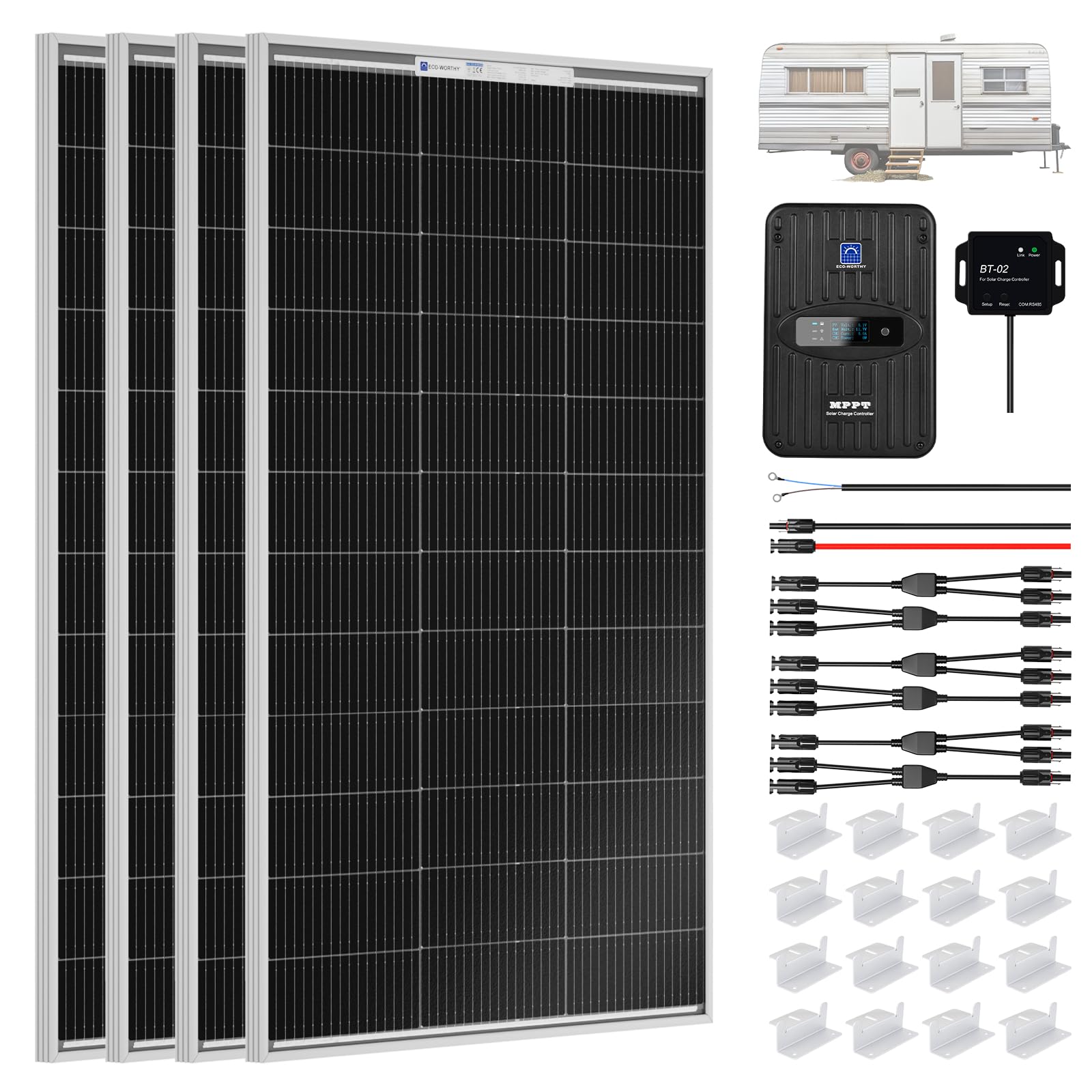
Four panels, an MPPT controller, and 99% tracking efficiency for a rig that lives off its battery bank.
This kit makes its case on the controller. The MPPT unit tracks at up to 99% efficiency and converts at a peak of 98%, which ECO-WORTHY frames as 40% more efficient than a traditional PWM controller. If you are running a 12V off-grid bank and want every amp that arrives at the roof to make it into the battery, that gap is the number to focus on. The four 100W monocrystalline panels are rated at 25% cell efficiency with 3.2 mm low-iron tempered glass.
Where it separates from the top pick is the monitoring and the panel build. A BT-02 Bluetooth module with Bluetooth 5.0 reaches up to 82 feet, so you can open the app and read solar, battery, and load data from inside the camper rather than climbing onto the roof. Panels carry a pair of 35-inch cables each, pre-installed bypass diodes inside an IP-65 junction box, and a frame that is 2–5 mm wider than competing panels for extra rigidity. ECO-WORTHY’s 1.6 kWh average daily production figure is the maker’s own estimate and assumes good sun.
Functionality and value land well overall — the system works and the price-to-kit ratio reads healthy. If you want a kit that will not need a separate Bluetooth dongle or MPPT upgrade later, this is a sensible pick.
Strengths worth the money
- 40A MPPT tracks at 99% efficiency and converts at 98% peak.
- Bluetooth 5.0 module reaches up to 82 feet for in-camper monitoring.
- IP-65 junction box with pre-installed bypass diodes per panel.
- Wider 2–5 mm frame adds rigidity to the panels.
The fine print
- Real-world output falls short of the rated wattage in some setups.
- Instructions are inconsistent — clear for some, not for others.
Right for you if: you want an MPPT kit with phone monitoring and a rigid frame without adding parts.
Worth knowing: expect to measure the installed output honestly rather than assuming the panel rating arrives at the battery.
6. Go Power Overlander 200W 12V Solar Panel Charging Kit
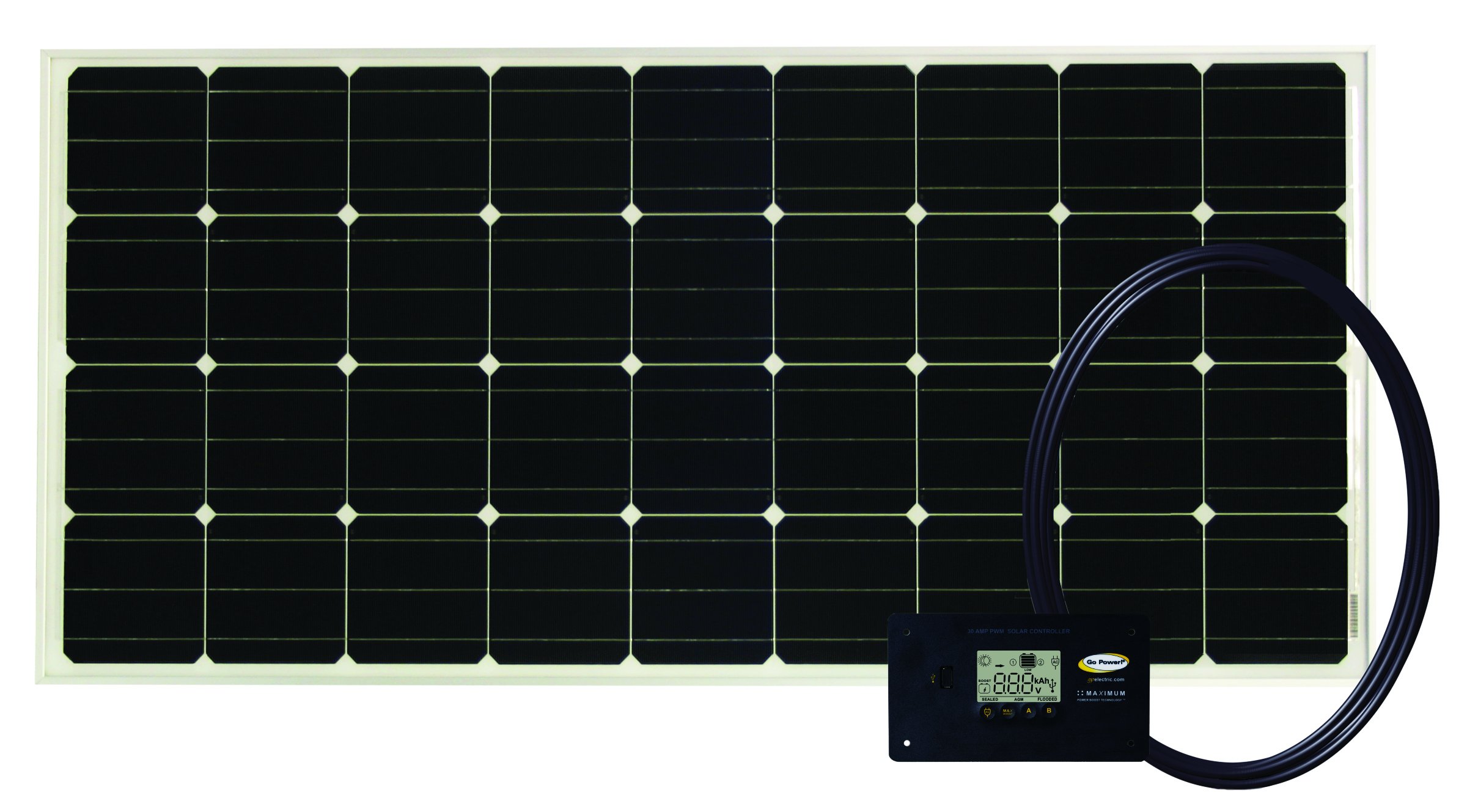
A 200W starter kit with a controller that keeps growing with your roof.
Most kits cap out where the controller sits. The Overlander runs a 30-amp controller rated to handle up to 600 watts of solar on the same unit, so adding a second or third panel later does not mean replacing the electronics box in your rig. That single spec is why it makes sense as a first install in a camper you plan to keep and upgrade — you buy 200W now, wire the roof for more, and scale without re-doing the controller.
The panel itself is a single 200W module producing 9.6 amps of charging capability with an MC4 connector — the industry-standard solar plug that mates with a whole world of pre-made cables. Two 25 ft solar output cables come in the box, male and female, alongside the Bluetooth-enabled 30A PWM Solar Controller. That is 50 feet of output cable total, more routing slack than most rigs need, and flexibility to mount the panel far from the controller.
Functionality is where this earns its place: the panel kit works without complaint, and the controller keeps batteries charged during extended dry camping through the day. Quality and install both meet expectations across the board, and its 25-year limited output power coverage is the longest output warranty here. It is a PWM controller rather than MPPT, which is the trade you accept for the expandability, and the 35 lb panel is a two-person lift onto a roof.
Future-proofing is the pitch: a single 30-amp controller that supports up to 600 watts of solar means you can add panels as your power needs grow without replacing the brain of the system.
The honest limit: PWM rather than MPPT, so a same-wattage MPPT kit will convert more of what the panel collects.
Go with it if: you plan to grow your roof array over several years and want a controller that scales with it.
Skip if you can: you want maximum conversion efficiency from day one and can live without the extra 400 watts of headroom.
7. 1200W Solar Panel 6PCS

Six high-efficiency panels for the rig that is already full-time and needs a real rooftop array.
This is not a starter kit — it is panel supply for a serious rooftop build. Six 200W N-type panels total 1200W, and the cells hit 25.6% conversion efficiency using 16BB combiner technology, which is the highest efficiency figure on this list. The glass is 3.2 mm high-transparency low-iron tempered, framed in anti-corrosion aluminum, so it is built for desert, coastal, and hot-climate installs where panels take a real beating.
The differentiator is certification: TÜV testing under IEC 61215, IEC 61730 and UL 61730 means the panels have been independently checked for electrical and mechanical safety and durability, not just rated by the maker. The N-type cells also hold up better in heat, which is the enemy of solar output in summer. You supply the controller and mounting — it does not ship with either — and the panel fits 12V battery systems matched with MPPT or PWM controllers and most mainstream outdoor power stations.
Owners are close to unanimous on the basics: it works well, the build quality is right, and the output lands where it should. The wiring limit is the one thing that will bite a careless build — the maker specifies a maximum of 3 panels in parallel or 3 in series, because pushing more current than the connectors handle can overheat and damage the panels. The 1-year manufacturer warranty is the shortest coverage on this list, which is worth weighing against the number of panels in the box.
Certification is the differentiator: independent TÜV testing under IEC 61215, IEC 61730 and UL 61730 is what lifts this above the unflagged panels at this size.
Wire it correctly: cap your array at 3 in parallel or 3 in series — exceeding the connector’s current capacity can damage the panels.
Designed for: a long-term rooftop build where certification, heat tolerance and 25.6% cell efficiency justify the six-panel commitment.
Know before you install: you supply the controller and mounting, and the warranty is only one year.
Know the Specs
MPPT vs PWM charge controllers
An MPPT controller actively converts the panel’s output voltage to what your battery needs, so less energy is lost in the transfer. A PWM controller simply throttles the panel down to battery voltage. On a full sun roof array, MPPT typically delivers more usable charge from the same panels — which is why the 400W Premium Renogy and ECO-WORTHY kits both run a 40A MPPT unit. PWM is simpler and cheaper to build, and it is what the Renogy 200W and Go Power Overlander kits use.
Wattage, efficiency, and the real number
A panel’s wattage is its rated output under standard test conditions, which assume full sun, controlled temperature, and no shading. Real-world output at camp is usually below that figure — which is why the ShadowFlux reports in the 350 to 365 watt range and the DOKIO suitcase lands nearer 70 watts at real angles. Cell efficiency (24%-25.6% across these panels) tells you how much of the panel’s surface area converts to power, so a smaller panel with higher efficiency can match a larger one.
N-type vs P-type cells
N-type is a newer solar cell formulation built for lower losses and better performance in heat and partial shade. P-type is the older standard. The Renogy ShadowFlux and ECOBOSS panels both use N-type cells with a 16BB layout — 16BB referring to the busbar grid that gathers current across the cell — which reduces internal resistance and hot-spot risk. On a rig that camps in shade or in hot country, N-type is the panel tech to look for.
Mounting format: rigid, flexible, portable
Rigid glass panels are the most durable and are the right call for a flat roof. Flexible panels bend up to 260° and weigh around 4.0 pounds, which suits a curved camper shell. A folding suitcase panel like the DOKIO travels in its own bag and lets you aim it at the sun, giving up the permanent mount in exchange for mobility. Your roof shape and how often you move camp is what decides which of the three you buy.
Common Questions
Will a 400W RV solar kit run my camper’s fridge and lights?
Do I need an MPPT or PWM charge controller for an RV solar setup?
How much does shade from a tree actually cut my panel output?
Can I add more panels later to a starter RV solar kit?
How do I mount flexible panels on a curved camper roof?
Will the DOKIO suitcase panel charge my RV battery directly?
How long do RV solar panels actually last?
Does an RV solar kit include everything I need to install it?
Is a portable solar suitcase better than a fixed roof panel for RV use?
What does the TÜV certification on the ECOBOSS panels mean for my RV install?
The Bottom Line
For most people planning Recreational Vehicle Solar, the Renogy 400Watt Premium Solar Kit is the pick that covers the most ground — 400W of panel, a 40A MPPT controller, and the brackets, adapters and Bluetooth module all in one box, with the strongest rating-to-kit balance on this list. If your roof is small or your bank is modest, the Renogy 200W N-Type kit cuts the weight to 16.5 pounds and still delivers the same 200 watts. And for a curved camper shell or a rig that camps under trees, the XINPUGUANG flexible 200W kit is the one that fits where glass cannot.
One last thing worth knowing: the ShadowFlux’s 4.0+ stars across 300+ buyers is the result of anti-shading tech that genuinely holds output under tree cover — exactly the condition that flattens most roof arrays — so if shade is your daily reality, it is worth the panel-only purchase.
How we choose
We do not accept paid placement. Every pick is matched to a real buyer and a real use-case; we do not hands-on test units.
Sources
Specifications: manufacturer listings and product documentation. Review insights: verified customer reviews, as of November 2026. Pricing: not shown on this page (it changes often); check the current price via the retailer link.
As an Amazon Associate, Tactical Gear Guy earns from qualifying purchases. This does not affect which products we feature.