Specs are compiled from manufacturer listings and verified buyer reviews and can change over time — please confirm the key details on the product page before buying.
A dead battery almost never warns you. It quits in a cold driveway, at a trailhead, or on the morning you need the truck. The fix is not a new battery every couple of years; it is a charger that tops the battery up and then holds it at float voltage without overcharging it. That second job — maintenance, or float charging — is what this shortlist is built around.
This guide is built by comparing the manufacturers’ published specifications and the patterns across verified customer reviews, so you get each pick’s real strengths and trade-offs instead of marketing spin.
You will see how amperage, charging stages, and battery chemistry matching decide whether a unit suits a motorcycle, a boat, or a workshop truck — and which one is the crowd favorite at 4.5+ stars across 50,000+ ratings. Read on for the full breakdown of every Recommended Car Battery Charger here.
Top Picks


How To Choose The Best Recommended Car Battery Charger
The wrong charger is the one whose chemistry and amperage do not match your battery, not the one that costs a little more. Get the chemistry and the amperage right and the stages, clamps, and cable length fall into place. Here is what actually decides it.
Match the charger to your battery chemistry first
Lead-acid, AGM (absorbed glass mat, a sealed lead-acid type), gel, and lithium (LiFePO4) batteries all want slightly different charging voltages. A unit that lists all four chemistries is the safe buy for a mixed fleet. A unit that names only lead-acid can still be fine for an old flooded battery, but do not assume it handles a lithium pack.
Several chargers here also add a repair or desulfation mode, which pulses current to break down sulfate buildup on plates that sat discharged too long. That mode is a rescue attempt, not a miracle — a battery that will not hold any voltage at all usually stays dead.
Amperage decides speed, stages decide health
Amperage is the current the charger pushes, in amps (A). More amps means a faster refill on a big battery; fewer amps means a gentler, slower top-up that suits a motorcycle or a battery in storage. Stages are the steps the charger walks through — several units here run a multi-stage program that ends in float mode, a low-current hold that keeps the battery full without overcharging it.
For a car you drive weekly, a maintainer around 2 to 5 amps is plenty. For a deep-cycle boat battery or a truck that sits for months, a 10-amp or 15-amp charger refills faster and still drops into maintenance when done.
Cables, clamps, and where it lives
Ring terminals bolt permanently to the battery posts so you can plug in without opening the hood wide; alligator clips are the quick on-off option. A fused-ring harness adds a layer of safety if the cable ever shorts. Cable length matters more than people expect — a short run forces you to park nose-in to an outlet.
Side-by-Side Comparison
| Model | Best For | Amperage | Input Voltage | Battery Types | Amazon |
|---|---|---|---|---|---|
| Battery Tender Junior 12V, 750mA★ Best Overall | Motorcycles and long-term storage | 0.75 A | 12 volts | 12V lead-acid, AGM, gel | Amazon |
| NEXPEAK NC202 10-AmpBest Value | Cars, trucks, and lawn equipment | 10 A | 110 volts | LiFePO4 and lead-acid | Amazon |
| NOCO GENIUS2 2ASmallest Footprint | Small batteries and dead-battery recovery | 2 A | 12 volts | 6V/12V lead-acid and LiFePO4 | Amazon |
| Schumacher SC1280 15A | Fast charging in a home garage | 15 A | 120 volts | 6V/12V standard, AGM, gel, deep-cycle | Amazon |
| CRAFTSMAN CMXCESM258 12A | Mixed fleets including lithium | 12 A | — | Standard, AGM, LiFePO4, deep-cycle | Amazon |
| Clore PL2310 10-Amp | Shop use with a power-supply mode | 10 A | 12 volts | 6V/12V batteries | Amazon |
| NOCO GENIUS5 5A | Faster recovery on larger batteries | 5 A | 120 volts | 6V/12V lead-acid and LiFePO4 | Amazon |
| CTEK NXT 5 | Outdoor and year-round mounting | 4.3 A | 120 volts | Lead-acid and LiFePO4, 1.2–160 Ah | Amazon |
| Schumacher SC1446 | Jump-starting and heavy shop duty | 200 A engine start | 120 volts | 6V/12V standard, AGM, gel, deep-cycle | Amazon |
Detailed Reviews
1. Battery Tender Junior 12V, 750mA Charger and Maintainer
Our pick — 4.5+★ from 50,000+ verified ratings; the strongest balance of quality and price.
The pocket-sized maintainer cyclists and bikers plug in and then forget until spring.
Here is the number that tells you what this is: 0.75 amps. That is a trickle, not a fast charger, and it is exactly why the Battery Tender Junior works so well for things that sit — motorcycles, ATVs, a seasonal car, a lawn tractor. It walks the battery through a four-step program (initialization, bulk charge, absorption, then float) and then holds it at a safe voltage instead of hammering it. Compared with the 15-amp Schumacher below, that is a 20x gap in charging current, and in a storage role that gap is a feature, not a shortfall.
The footprint is about the size of a pack of cigarettes, so it tucks onto a shelf or into a tank bag without complaint. You get both a fused-ring terminal harness and alligator clips in the box, plus a 12-foot output cord, so a battery buried under a seat is still reachable. Spark-proof circuitry and automatic reverse-hookup detection round out the safety story — hook it up backwards and it notices instead of frying.
The thing buyers rave about most is the overall build and reliability, and it shows in the long float sessions this unit tolerates. The honest limit is speed: at 0.75 amps, a deeply drained car battery will take its time coming back. That is the trade for gentleness, and it is the right trade for a maintainer.
What earns the top spot
- Four-step charging ending in float mode, so a stored battery never overcharges
- Ring terminal harness and alligator clips both included
- 12-foot output cord reaches hidden batteries
- 5-year warranty and spark-proof, reverse-hookup-safe circuitry
Where it asks patience
- 0.75 A is a trickle — slow to refill a big, deeply discharged car battery
- Compact housing means no display for voltage readout
Reach for this if: you want a set-and-forget maintainer for a motorcycle, ATV, boat, or stored car.
Look elsewhere if: you need to revive a flat truck battery fast — go for the 15-amp Schumacher instead.
2. NEXPEAK NC202 10-Amp Battery Charger
An eight-stage charger that reads out what it is doing, on a screen you can see in daylight.
What sets the NEXPEAK NC202 apart is the screen — an extra-large LCD that shows charging voltage, current, internal temperature, charge percentage, and both a summer and winter mode. It runs an eight-stage process, moves into trickle/float when full, and adds a pulse repair function for batteries that have sulfated from sitting.
Amperage runs 10 A on 12-volt batteries and 5 A on 24-volt, with the ten-foot charging cable giving you some reach. It handles both lithium (LiFePO4) and lead-acid, including AGM, GEL, SLA, and flooded, so it covers cars, trucks, SUVs, motorcycles, and lawnmowers. Temperature compensation adjusts the charge in hot and cold climates, which matters if your garage swings from freezing to sweltering.
The recurring honest note is about value: quality lands well, but opinions on what you get for the money are mixed. And like every repair-capable charger here, it will not bring a totally dead battery back from zero — that is a physics limit, not a defect. Functionality is what buyers praise most, and it does that job well.
Screen advantage: the readable LCD with charge percentage and temperature makes diagnosing a weak battery far easier than a simple two-color light.
Fair caveat: value sentiment is split, and the pulse repair mode repairs sulfation — it does not resurrect a battery that reads zero.
Best for: the DIY owner who wants to see charging stats instead of guessing.
Skip if: you only need a silent maintenance trickle for a motorcycle you store indoors.
3. NOCO GENIUS2 2A Smart Battery Charger
The 1.2-pound charger that can wake a battery most others will not touch.
NOCO’s Force Mode is the standout here. It lets you manually push a charge into a battery sitting at zero volts — the flat-dead pack that ordinary smart chargers refuse. Outside Force Mode it still charges from as low as 1 volt, so a neglected battery has a real chance of coming back. It covers 6-volt and 12-volt lead-acid (AGM, Gel, SLA, VRLA) and lithium (LiFePO4), and the desulfator pulses to break down sulfate buildup on a battery that sat too long.
The integrated thermal sensor adjusts charging based on ambient temperature, so a hot summer garage does not push it to overcharge and a cold winter does not leave it undercharged. Weighing 1.2 pounds against the 2.7-pound Schumacher SC1280, it is the easy one to stash in a toolbox or mount on a wall bracket. It ships with the bracket, screws, and a 3-year warranty.
What wins people over is how much NOCO packed into such a small body — it also reports 30% smaller than the G1100 it replaces while delivering over 140% more power. The natural limit: at 2 amps, a full charge tops out around the listed 10-hour charge time, so it is a recovery and maintenance tool first, a fast refiller second.
Pick this one when: you want a tool that rescues dead batteries and lives in a glovebox.
Think twice if: you need to top a big car battery back up in a hurry rather than overnight.
4. Schumacher Electric 15A SC1280 Charger & Maintainer

Fifteen amps of garage muscle that brings a flat car battery back in an afternoon.
If the job is speed, this is the one. The SC1280 pushes 15 amps and reports going from 10% to fully charged in roughly 4 hours — a huge step up from the 2-amp NOCO above on a large car battery. It is a 4-in-1 unit: it charges, maintains, tests, and restores, with auto voltage detection for both 6V and 12V and a microprocessor controlling the whole sequence. Standard, AGM, gel, and deep-cycle batteries are all in scope.
The advanced desulfation mode is the rescue tool for batteries that sat through winter, and the 3A trickle function steps charging down once the battery is full. The package is simple — just the charger and a manual — but the reach and clean automatic operation make it a natural garage fixture for cars, trucks, ATVs, and boats.
Most of what people want to know lands on functionality and build, and this unit delivers on both. The honest catch sits in the reliability discussion, which is mixed rather than universal — treat the clamps and connections like any power tool and it behaves. At 2.7 pounds, it is genuinely easy to move from car to car.
The speed proof: 15 amps and a reported 4 hours from 10% to full — the fastest refill on this list for a standard car battery.
Fit note: reliability sentiment is mixed, so check the clamps and cables sit cleanly before every session.
Choose it for: a garage that needs fast charging and stays on maintenance between drives.
Not ideal for: someone who only ever needs a slow overnight trickle — it is more charger than that job requires.
5. CRAFTSMAN 12A CMXCESM258 Charger & Maintainer
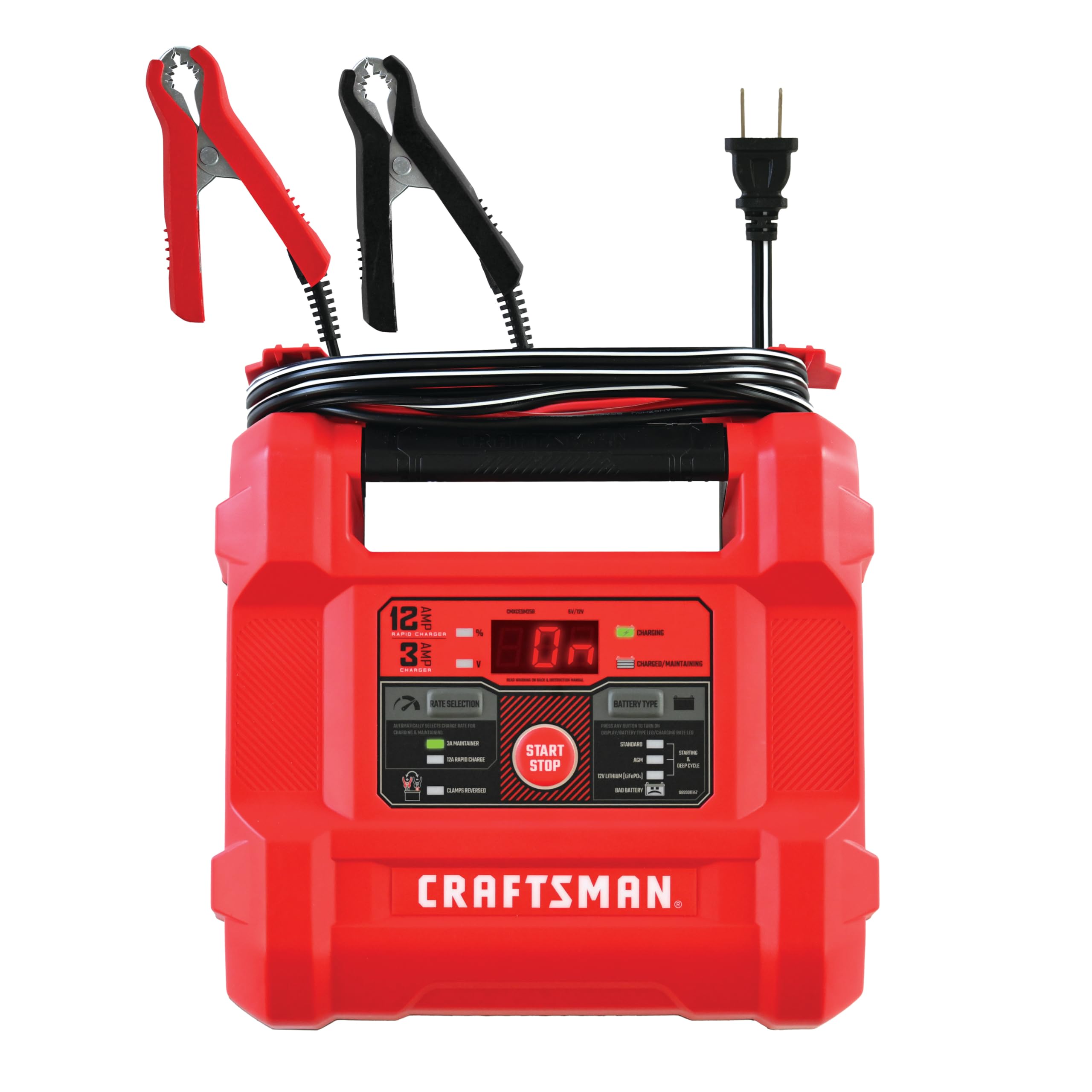
Twelve amps that handles lithium and lead-acid under one hood without a fuss.
The CRAFTSMAN CMXCESM258 is a 4-in-1 unit — charge, maintain, test, restore — pushing 12 amps with a digital display and auto voltage detection for 6V and 12V. What makes it flexible is the chemistry reach: standard, AGM, deep-cycle, and 12V lithium (LiFePO4), so a modern car with a lithium pack and a traditional truck battery can both run on it. Reverse hook-up protection guards against damage if the clamps go on wrong, and a 6-foot power cord plus 6-foot battery cables give 12 feet of total reach.
Owners tend to focus on reliability, and the feedback lines up — automatic charging and maintenance, with a dead battery reportedly reaching 100% in about five hours. The desulfation mode and multi-stage charging make it a solid seasonal-revival tool.
The honest story is split on battery life: some report that batteries stayed dead after use. Given the reliable-charging consensus, that reads more like a fit mismatch with a deeply failed battery than a recurring defect. It is also not the lightest unit on the list, so pick a shelf and leave it there.
Why it earns a spot
- 12-amp charging with a digital display and auto 6V/12V detection
- Handles lithium LiFePO4 alongside AGM and deep-cycle
- 12 feet of combined reach from cord and cables
- Reverse hook-up protection guards against clamp mistakes
The fine print
- Battery-life sentiment is mixed — best suited to reviving, not rescuing zero-volt packs
- Heavier than the compact NOCO options, so not a grab-and-go tool
Ideal for: a household with a mix of lead-acid and lithium batteries to keep topped up.
Pass if: you already know every battery you own is traditional, where a simpler charger does the job.
6. Clore Automotive PL2310 10-Amp Smart Charger
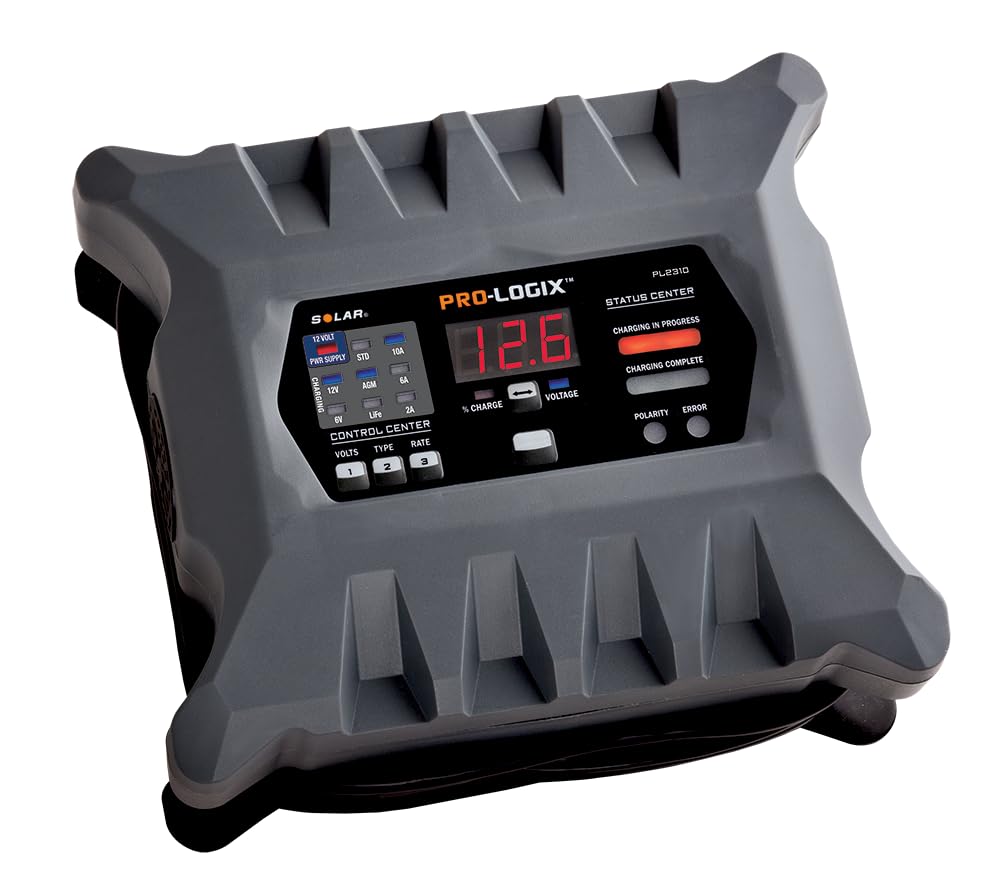
A shop-grade charger that doubles as a stable power supply while you work.
What separates the Clore PL2310 from the rest is its power-supply mode. It holds a steady voltage so you can keep a vehicle’s systems live while a battery is out — a genuinely useful ability when you are swapping a battery or running diagnostics. It charges and maintains 6 and 12-volt batteries, runs an advanced multi-phase charging process with temperature compensation, and offers three selectable charge rates at 2, 6, and 10 amps for matching the current to the battery size.
The display shows voltage and percentage charge, which makes the whole process far easier to read than a single indicator light. It measures 8 by 9.4 by 4.5 inches — a bench unit rather than a pocket tool — so plan a spot for it. Owners note that it holds its own against the NOCO Genius line while offering more features, which is saying something for a charger in this class.
The trade is that this is not the tool for a quick dash-mount or a glovebox. It is a deliberate garage or workshop resident, and the power-supply function is why. If you want flexible charging rates and a steady 12-volt feed while you wrench, this fits; if you want plug-and-forget portability, go smaller.
The right tool for: DIY and pro mechanics who want a selectable-rate charger and a stable power supply in one box.
Not the fit for: a portable maintainer you carry to a stored motorcycle.
7. NOCO GENIUS5 5A Smart Battery Charger

The bigger NOCO that keeps the dead-battery recovery trick and nearly doubles the amperage.
Step up from the GENIUS2 above and you get 5 amps instead of 2, with roughly an 8-hour charge time listed for a full fill. Everything else that makes NOCO desirable stays: Force Mode to charge a completely dead battery down to zero volts, an integrated thermal sensor that adjusts for hot and cold, and precision pulse charging for desulfation and acid stratification. It handles 6-volt and 12-volt lead-acid (AGM, Gel, SLA, VRLA) and lithium (LiFePO4).
It is reported as 34% smaller than the G3500 it replaces while delivering over 65% more power, and it ships with a mounting bracket, screws, and a 3-year warranty. The thing buyers appreciate most is how quickly it works for a unit of this size — reviving a battery from 25% to 100% and finishing fuller jobs in about 3 hours. It also fits under a closed bonnet, which makes hardwiring it a genuinely low-friction option.
What holds it from the very top is the same thing that touches every NOCO: reliability sentiment runs mixed, so treat the clamps and the sealed case with care. But for a broad spread of vehicles — cars, boats, motorcycles, ATVs, RVs, tractors, jet skis — it does the job without drama.
The step up: 5 amps to the GENIUS2’s 2, with the same Force Mode recovery and a shorter 8-hour full-charge time.
The caveat: reliability feedback is mixed — check the unit’s behavior before leaving it connected long-term.
Reach for this if: you want NOCO’s dead-battery recovery with more amperage for bigger batteries.
Look elsewhere if: you operate a full shop with multiple vehicles and want a beefier multi-rate charger.
8. CTEK 40-658 NXT 5 Battery Charger
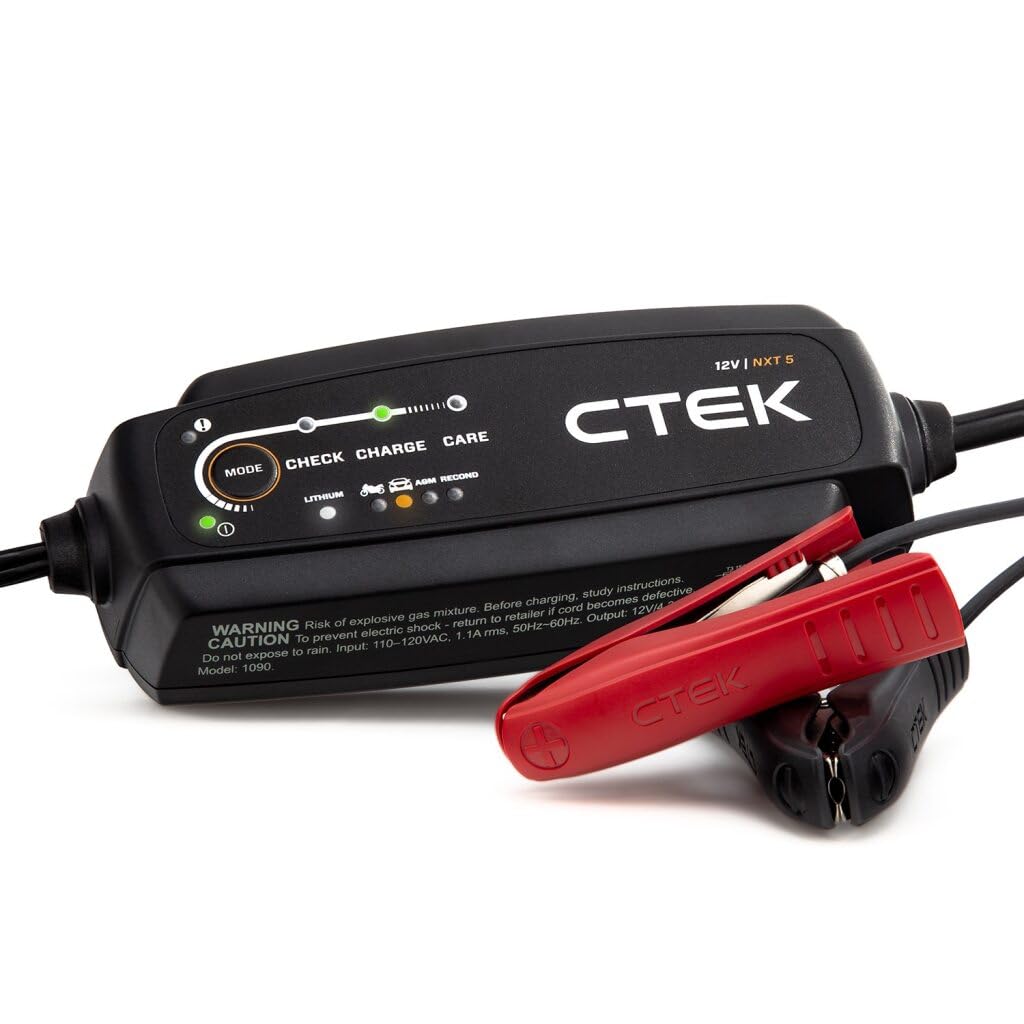
The one built to live outside, bolt to a wall, and stay plugged in all winter.
Two specs set the CTEK NXT 5 apart. First, the housing is IP65 rated — sealed against dust and water jets — so it can sit in a carport or under a bonnet where the others would be nervous. Second, it handles batteries from roughly 1.2 Ah up to 160 Ah, covering lead-acid (WET, MF, Ca/Ca, AGM, EFB, GEL) and lithium (LiFePO4). At 4.3 amps it is a measured, careful maintainer rather than a fast refiller.
Temperature compensation adjusts the charging voltage for extremes from -4°F to +122°F, so a freezing garage or a baking one still gets the right charge. Desulphation and a dedicated Recond mode revive deeply discharged or sulfated lead-acid batteries, and the included Connect U-terminal lets you leave the charger permanently mounted to the battery. Spark-free operation and reverse polarity protection round out the safety story.
The thing buyers value most is compatibility — it just works across a huge battery range — and performance follows. It requires a little thought, though: the maker advises running recondition once per year and after deep discharge, so it is not pure set-and-forget if you want maximum life. The housing is compact and, given the rating, easy to leave in a damp space year-round.
Made for: longtime storage in a garage, carport, or under-bonnet mount where weather is a factor.
Not for you if: you want the most amperage for the money — several picks here charge faster.
9. Schumacher Electric SC1446 Charger with 200A Engine Start

A wheeled shop anchor that both charges and jump-starts, no second tool required.
The headline number here is 200-amp engine start, with a 40-amp boost to revive a dead battery quickly — this is a charger that can also jump-start a car, truck, or high-performance vehicle on its own. A 135-minute timer gives you precision manual control over the charging cycle, and it handles 6V and 12V standard, AGM, gel, and deep-cycle batteries across automotive, marine, and power-sport vehicles.
Wheeled and substantial, it is built to stay put in a shop rather than ride in a trunk. The generous 40-amp boost mode is what cuts downtime on a deeply discharged battery before a workday. The 135-minute manual timer suits someone who wants to control the process rather than trust an automatic circuit.
The honest trade is build quality, which draws mixed reviews — some love the heavy-duty feel, others find it less solid than expected. Given the power and the jump-start ability, it earns its spot for heavy shop duty, not for occasional home use. If you need one tool to start a dead truck and charge it after, this is it.
Two tools in one: a 200-amp engine start plus a 40-amp boost means a dead battery both starts and refills from a single wheeled unit.
The trade-off: build-quality feedback is mixed, and its bulk means it lives in the shop, not the trunk.
Built for: a workshop or heavy-use garage that needs jump-start power and charging in one machine.
Wrong pick if: you want a compact maintainer for a bike or boat — this is a bench and floor tool.
Know the Specs
Amperage: the speed dial
Amperage is the current a charger pushes, measured in amps. A 0.75 A trickle or a 2 A maintainer suits motorcycle and stored batteries because it tops up gently. A 10 A or 15 A charger refills a car battery faster and then drops into float mode when done. Bigger is not always better — match amps to battery size and how fast you need it back.
Charging stages and float mode
Stages are the steps a smart charger follows: bulk charge, absorption, then float. Float mode holds the battery at a safe voltage without overcharging, which is why you can leave a good maintainer connected for months. Units here range from the four-step program on the Battery Tender to the eight-stage process on the NEXPEAK.
Battery chemistry matching
Lead-acid, AGM, gel, and lithium (LiFePO4) batteries want different charging voltages. A charger that lists every chemistry is the safest buy for a mixed fleet. Check that list before you buy — especially if you own a lithium pack, which not every lead-acid charger handles.
Temperature compensation and desulfation
Temperature compensation adjusts charging voltage as the garage heats up or cools down, to avoid overcharging in summer and undercharging in winter. Desulfation pulses current to break down sulfate buildup on plates that sat discharged. Both help battery life, but neither will rescue a battery that reads zero volts for good.
Common Questions
Will a 750mA trickle charger keep a car battery topped up over winter?
Can these chargers handle a lithium LiFePO4 battery?
Is a 15-amp charger too strong for a small motorcycle battery?
What does Force Mode on the NOCO chargers actually do?
Do I need temperature compensation in a hot climate?
Can a desulfation mode revive a battery that has sat for years?
How long does a charger take to fully charge a car battery?
Which charger suits a boat or RV that sits for months?
Can I leave a maintainer connected for months at a time?
Do I need a jump-start charger instead of a maintainer?
The Bottom Line
For most owners the simplest answer is the Battery Tender Junior 12V — a 0.75 A trickle that walks a battery through four stages into float mode, so you can plug it in and leave it. If you want speed, the Schumacher SC1280 pushes 15 amps and reports 4 hours from 10% to full for a car battery. And if you need dead-battery recovery or jump-start power, the NOCO GENIUS2 and the Schumacher SC1446 have the tools that actually get a battery moving again.
How we choose
We do not accept paid placement. Every pick is matched to a real buyer and a real use-case; we do not hands-on test units.
Sources
Specifications: manufacturer listings and product documentation. Review insights: verified customer reviews, as of November 2026. Pricing: not shown on this page (it changes often); check the current price via the retailer link.
As an Amazon Associate, Tactical Gear Guy earns from qualifying purchases. This does not affect which products we feature.