Specs are compiled from manufacturer listings and verified buyer reviews and can change over time — please confirm the key details on the product page before buying.
Spending flagship money on speakers means one thing: you should hear details in your own recordings you have never noticed before, at volume levels that still stay clean. The catch is that expensive does not automatically mean better, because some very pricey boxes need an external amplifier, some need a specific app, and some simply suit a room and a taste that are not yours. This guide sorts the real high-ticket towers, active systems and statement pieces by what they actually deliver in a living room, so you can match the speaker to how you listen rather than to the price tag.
This guide is built by comparing the manufacturers’ published specifications and the patterns across verified customer reviews, so you get each pick’s real strengths and trade-offs instead of marketing spin.
You will see which towers need a separate amp, which all-in-one systems simply plug into the wall, and where each design puts its money. The picks below cover the full spread of really expensive speakers so you can choose with confidence instead of guesswork.
Top Picks


How To Choose Really Expensive Speakers
At this level you are not buying volume, you are buying accuracy and control. The right speaker for you depends less on the badge and more on three practical questions: does it have its own amplification, how big is the bass driver, and what will you plug into it.
Active or passive decides half your budget
A passive tower is a box of drivers that needs a separate amplifier to make any sound at all. An active speaker, like the KEF models here, has the amplification built in, so you plug it into the wall and stream straight to it. Active systems simplify the setup and remove one big purchase, while passive towers let you pick your own amplifier voicing later. Decide this first, because it decides whether you also need to buy an amplifier.
Driver size in inches tells you how much air moves
A woofer’s size in inches is a rough guide to how much air it can push, and that is what you feel as bass weight. A pair of towers with 8 inch woofers moves noticeably more air than a compact 5 inch design. Bigger drivers also tend to fill a larger room at lower volume, which keeps the sound relaxed instead of strained. Match driver size to your room: a small study rarely needs a pair of 8 inch towers.
Horn versus dome tweeters
The tweeter handles everything above roughly the vocal range, so it shapes how cymbals, strings and voices sit in the mix. A horn-loaded tweeter, like the Tractrix designs on the Klipsch speakers here, throws sound forward with high efficiency, which many buyers describe as lively and immediate. A dome tweeter, like the aluminium domes on the SVS and the ring radiator on the Polk, tends to sound smoother and more spread out. Neither is better; horns suit buyers who want forward dynamics, domes suit buyers who want a calmer presentation.
Inputs and streaming decide convenience
An HDMI eARC port lets a speaker take the TV’s audio over one cable and follow the remote’s volume, which matters if movies are half your listening. AirPlay 2, Chromecast and Spotify Connect cover phone and tablet streaming without extra boxes. If you own a turntable or a CD player, check for analogue, optical or coaxial inputs before you fall for the finish. A gorgeous cabinet with no input for your turntable is a very costly ornament.
Finish and footprint are part of the purchase
At this tier the speaker sits in your room for years, so the finish matters as much as the crossover. Walnut, piano gloss and mineral white all read differently against furniture, and real wood veneer or lacquer shows dust and fingerprints at different rates. Check the mounting and feet too, since some designs ship with spikes for carpet and rubber pads for hard floors. Measure the footprint and the distance to the wall before you commit.
Side-by-Side Comparison
| Model | Best For | Driver Size | Amplification | Key Inputs | Amazon |
|---|---|---|---|---|---|
| Klipsch Reference Series 5.1 Pack★ Best Overall | Full cinema in one box | 12 inches (subwoofer) | Powered subwoofer | Home theater receiver wiring | Amazon |
| Bowers & Wilkins AM-1Best for Outdoors | Patio and outdoor walls | 5 inches | Passive | Wired auxiliary | Amazon |
| Klipsch RP-8000F II PairTop Performer | Lively two-channel and theater | 8 inches | Passive | Coaxial, bi-wire terminals | Amazon |
| SVS Prime Tower Pair | Neutral reference sound | 6.5 inches | Passive | Speaker wire | Amazon |
| Polk Reserve R700 | Hi-res movie soundtracks | 8 inches | Passive | Binding posts | Amazon |
| SVS Prime Pinnacle Pair | Big-room impact | 6.5 inches | Passive | Speaker wire | Amazon |
| KEF LS50 Wireless II | Compact all-in-one hi-fi | — | Fully active | HDMI eARC, optical, coaxial, AirPlay 2, Chromecast | Amazon |
| Klipsch Heresy IV Pair | High-efficiency horn sound | 12 inches | Passive | Speaker wire | Amazon |
| B&O Beosound Balance | Sculptural one-box streaming | 5.25 inches | Fully active | Wi-Fi, AirPlay 2, Beolink | Amazon |
| Devialet Phantom Ultimate 108 dB (Deep Forest) | Statement-piece impact | — | Fully active | AirPlay, Google Cast, Roon, Bluetooth 5.3, Wi-Fi 6 | Amazon |
| B&O Beosound A9 (5th Gen) | Art-piece room filler | 20 centimeters | Fully active | Bluetooth, Wi-Fi, AirPlay 2 | Amazon |
| KEF LS60 Wireless | No-subwoofer floorstanding system | 6.5 inches | Fully active | HDMI eARC, optical, coaxial, RCA, AirPlay 2, Chromecast | Amazon |
Detailed Reviews
1. Klipsch Reference Series 5.1 Home Theater Pack
Our pick — 4.5+★ from 350+ verified ratings; the strongest balance of quality and price.
One order builds an entire Atmos cinema, towers and subwoofer included.
If you are starting from nothing and want the whole room shaking on day one, this is the simplest path on the list. You get two R-625FA floorstanding towers with built-in up-firing elevation channels, so overhead effects come from the towers themselves, plus an R-52C center, two R-41M bookshelf surrounds and an R-12SW powered subwoofer. That is a complete 5.1 Dolby Atmos layout in a single box, which is why it takes the top spot.
The bass engine is a 12 inch powered subwoofer with a 400W peak all-digital amplifier, the biggest driver figure of any subwoofer here and the reason explosions land hard rather than politely. The towers carry Klipsch’s Tractrix Horn and LTS aluminum tweeters, so dialogue stays forward and intelligible in busy scenes. Owners consistently describe hearing low, mid and high detail separated cleanly, and instrument reproduction that stays crisp instead of muddy. It is the crowd favorite too, holding 4.5+ stars across 300+ ratings.
Cabinets are scratch-resistant black textured wood grain over reinforced MDF with magnetic grilles, and Klipsch backs the system with a 5-year limited warranty. Setup is the trade-off: this is a passive system, so you still need a home theater receiver to power it, and every speaker needs its own run of wire. The powered sub does its own amplification, but the towers and surrounds do not. Budget for that receiver and a weekend of cable management before you plan the movie night.
What makes it the anchor pick
- Complete 5.1 Dolby Atmos layout in one purchase — towers, center, surrounds and powered sub
- 12 inch 400W peak powered subwoofer gives the deepest driver figure in this lineup
- Up-firing elevation channels in the towers create overhead sound without extra ceiling speakers
- 5-year limited warranty and scratch-resistant textured cabinets
Where it asks more of you
- Passive design means you must supply a home theater receiver separately
- Five speakers and a subwoofer means a lot of cabling to route and hide
The full-cinema move: Buy this if you want an Atmos movie room built from one order and you are happy to add a receiver.
Worth knowing: The towers need external amplification, so the subwoofer is the only self-powered piece in the box.
2. Bowers & Wilkins AM-1 Outdoor Speakers
A patio speaker pair built to survive weather and still sound refined at low volume.
Most high-ticket speakers never leave the living room, which is exactly what makes this pair unusual. Bowers & Wilkins built the AM-1 as a weatherproof loudspeaker for patios, gardens and poolside walls, with a rust-proof aluminium grille and a rigid glass-filled plastic cabinet that resists dust, moisture and UV exposure. It is the one pick here you can mount outside and genuinely leave there.
The driver story is compact: a 5 inch glassfibre cone bass/midrange, a 1 inch Nautilus tube-loaded aluminum dome tweeter, and an Auxiliary Bass Radiator for extra low-end from a small cabinet. Compare that to the 12 inch subwoofer driver in the Klipsch pack at the top and the size gap is obvious — a 5 inch unit versus 12 inches. What you trade in sheer output you get back in dispersion and control. The thing everyone raves about is the clarity: the detail holds up even at gentle background volume, which is the hard part for an outdoor speaker.
Installation is genuinely thoughtful. A cast aluminium wall bracket and one-plug mounting system let you rotate each speaker 110° in either direction, in landscape or portrait, so you can aim sound at the seating area rather than the fence. The mixed feedback centers on mounting and value — some want a more forgiving bracket, and a few find the price steep for an outdoor pair. Neither is a reason to walk away. Just go in knowing you are paying for weatherproofing and that bracket, not for room-shaking bass.
The clarity payoff: Owners talk about hearing every element of a track even when the volume is turned right down, which is the real test of an outdoor speaker competing with wind and conversation.
Set expectations on bass: The 5 inch driver and passive radiator give a full midrange, but this is a dispersion-first design, not a subwoofer substitute.
Reach for this if: Your best listening happens on a deck or by a pool and you need speakers that survive the seasons.
Look elsewhere if: You want deep cinematic bass — this pair is about even coverage, not weight.
3. Klipsch Reference Premiere RP-8000F II Speaker Pair
The walnut tower pair that makes horns sound notable rather than shouty.
This is the purest two-channel pick here: two RP-8000F II towers in walnut, each with 8 inch Cerametallic woofers (a ceramic-coated metal cone that stays stiff to cut distortion). Up top sits a larger 90° x 90° silicone composite hybrid Tractrix horn (a flared guide that spreads sound wide). That wider horn pushes the soundstage further into your room than a narrow horn would, so the balance is not one chair. The 1 inch LTS titanium diaphragm tweeter (a lightweight metal dome for highs) keeps distortion down, and the vented tweeter design helps it breathe.
Owners appreciate the tweeter’s horn most at low to medium volume, where the detail and presence still come through without needing to crank the dial. The matte face around the copper cone gets called out for looking the part too, and the walnut finish reads warm rather than glossy-black industrial.
Dual input terminals allow bi-wiring or bi-amping, letting you split high and low frequency current into separate cables to reduce distortion in the midrange. That is a genuine upgrade path if you later add a second amplifier. The honest limit is that this is a passive pair: no amplification, no streaming, no HDMI. You feed it from your own amp or receiver. Cast aluminium feet and a strong removable grille round out the build.
Why the horn wins here
- 90° x 90° hybrid Tractrix horn widens the listening area beyond one seat
- Bi-wiring and bi-amping terminals give a real upgrade path
- Walnut finish and copper cones make it a furniture-grade tower
- High efficiency means modest amplifiers can drive it loud
The sensible caveat
- No built-in amplification, streaming or HDMI — you supply the source and power
- Horn voicing is bright and forward; some ears prefer a softer dome
The two-channel call: Pick this pair if you already own a decent amp and want towers that bring dynamics and detail to vinyl and film alike.
The honest catch: It is a passive design, so factor in the amp before you compare it to an all-in-one.
4. SVS Prime Tower Speakers – Pair (Premium Black Ash)

A tower pair tuned for accuracy, with a midrange that refuses to be coloured.
The engineering choice that defines this pair is the 4.5 inch midrange driver, which sits in its own dedicated and completely sealed compartment. That separation keeps vocals and instruments free from the pressure of the bass drivers, so the midrange sounds precise instead of smeared. Below it, dual 6.5 inch woofers handle the low end, and a 1 inch aluminum dome tweeter covers the top with a light, rigid diaphragm that stays clear at high volume.
The tonal result is even and honest — full and rich according to the owners who live with it, and remarkably consistent even at modest volumes. A proprietary SVS SoundMatch 3.5-way crossover keeps the handoffs between those three driver types smooth. Chamfered front baffle edges cut down edge diffraction, which in plain terms means a more solid, three-dimensional image of where each instrument sits.
Where it differs from the Klipsch RP-8000F II above is temperament. The Klipsch horn pushes detail forward; this SVS is the calmer, more impartial read of the same recording. If your taste runs to jazz, acoustic and classical, that neutrality is worth more than extra excitement. It is passive, so an amplifier is required, and the black ash finish is understated rather than showroom-shiny.
The accuracy argument: When you want to hear what the recording actually did rather than what a house sound emphasizes, the sealed midrange detail is the reason to choose this pair.
One practical note: Plan on a capable amplifier — passive towers with dual woofers reward a bit of current.
Best match: Buyers chasing a faithful, uncoloured sound for music-first listening.
Think twice if: You want built-in streaming and one-cable setup, because this pair is wired and passive.
5. Polk Audio Reserve Series R700 Tower Speaker

Built around a down-firing bass port that keeps movie soundtracks clean and rumble-free.
Polk’s R700 earns its place on film duty through one specific design: a bass reflex cabinet with a down-firing opening, paired with Polk’s Patented Power Port 2.0 and X-Port Technology. In plain terms, the port fires into the floor rather than at your wall, which cuts the chuffing noise that can muddy a bass-heavy scene. Dual 8 inch long-throw drivers back it up, and the 1 inch Pinnacle Ring Radiator tweeter handles the top end.
It is certified Hi-Res and supports Dolby Atmos and IMAX Enhanced, plus hi-res formats including DSD, FLAC, WAV, ALAC and MQA. The clear high end and warm midrange vocals are the traits owners keep coming back to, and it doubles as a front, side or rear surround in a multichannel setup. Add the Reserve R900 Height Module separately if you want vertical effects, since that piece is not in the box.
Cabinet work is careful: cross-braced construction to reduce internal resonance, anti-diffraction magnetic grilles, and both rubber feet for hard floors and spike feet for carpet, all pre-installed. The honest notes are that a few units have shown up with tweeter damage from the factory, and it is a demanding load for modest amplifiers. Feed it sensible power and it rewards you.
Standout traits
- Down-firing Power Port 2.0 with X-Port reduces port noise in loud scenes
- Hi-Res Certified with Dolby Atmos and IMAX Enhanced support
- Ships with rubber feet and spike feet for either floor type
- Clear highs and warm vocals make dialogue and music both sit well
Fair warnings
- Needs a solid amplifier to get the most from those dual 8 inch drivers
- Height effects require the separate R900 module, sold on its own
Lean this way if: Movies are the main event and you want bass that stays composed rather than boomy.
Consider the alternative if: Your amplifier is modest — this tower asks for real power.
6. SVS Prime Pinnacle Floorstanding Speakers

Three woofers per tower for a room that swallows smaller speakers whole.
The Prime Pinnacle takes the neutral SVS recipe and scales the bass up. Each tower carries a 1 inch aluminum dome tweeter, a 5.25 inch midrange driver, and three 6.5 inch woofers, so the low end has far more moving surface than a standard tower. In a large open-plan room that is exactly what you need to keep the sound pressurised at the back of the space without turning the volume to painful levels.
Owners describe crystal clarity across all frequency ranges, plus build quality and the piano gloss finish that get praised as much as the sound. It is smooth and refined rather than aggressive, with the bass weight to fill a big room. Head-to-head with the Prime Tower above, this model adds that third woofer per cabinet while keeping the same 6.5 inch driver size and the same aluminium dome tweeter.
What the data makes clear is the trade: more bass surface means a larger, heavier cabinet to place, and it is still a passive speaker needing your own amplifier. The piano gloss black looks superb but shows fingerprints and dust in a way a matte cabinet does not. If you have a cloth and a big room, neither is a problem.
The room-scale benefit: Triple 6.5 inch woofers per tower push far more air than a two-woofer design, so a large space still feels filled.
The upkeep reality: Piano gloss is stunning in daylight and unforgiving about smudges — keep a microfibre cloth nearby.
Choose this if: Your listening room is generous and you want towers that carry the low end without a separate subwoofer.
Not for you if: A compact footprint matters more than bass authority.
7. KEF LS50 Wireless II Active HiFi Speakers, Mineral White

A full stereo system with the amplifiers already inside, streaming built in.
You skip the separate amp, the receiver and the cable spaghetti, because the LS50 Wireless II packs its own amplification. Inside is a 12th-generation Uni-Q driver array (a tweeter set in the middle of the woofer so sound spreads evenly through the room). It also uses Metamaterial Absorption Technology, which the maker says absorbs 99% of unwanted sound from the rear of the driver. In practice you get a wider, more natural soundstage, so more than one seat still gets good sound.
Streaming covers Apple AirPlay 2, Google Chromecast, Spotify Connect and Tidal Connect, and there is an HDMI eARC port so the TV becomes a one-cable source with the remote following along. Analog, optical and coaxial inputs handle turntables, CD players and consoles, and a dedicated subwoofer output lets you add bass later. Bluetooth range reaches 10 meters, so walking around the room with your phone does not drop the stream.
The connectivity is where opinions split. A number of listeners hit connection drops and find the KEF Connect app frustrating, and some report trouble with Spotify specifically, so a wired or eARC connection is the steadier path. When it is playing, the rich sound and room-filling quality are what people keep pointing to. Treat the app as a convenience layer, not the main event.
The simplicity win: Amplifiers, streaming and a TV input all live inside the cabinet, which removes a whole rack of electronics from your budget and your shelf.
The app caution: Wireless control is not this system’s strongest suit — plenty of owners end up preferring the HDMI or analog route.
Ideal owner: The listener who wants premium sound with nothing else in the chain and a compact footprint in a smaller room.
The counterpoint: If a rock-solid app and drop-free wireless are deal-makers for you, plan to lean on the wired inputs instead.
8. Klipsch Heritage Series Heresy IV Speaker Pair
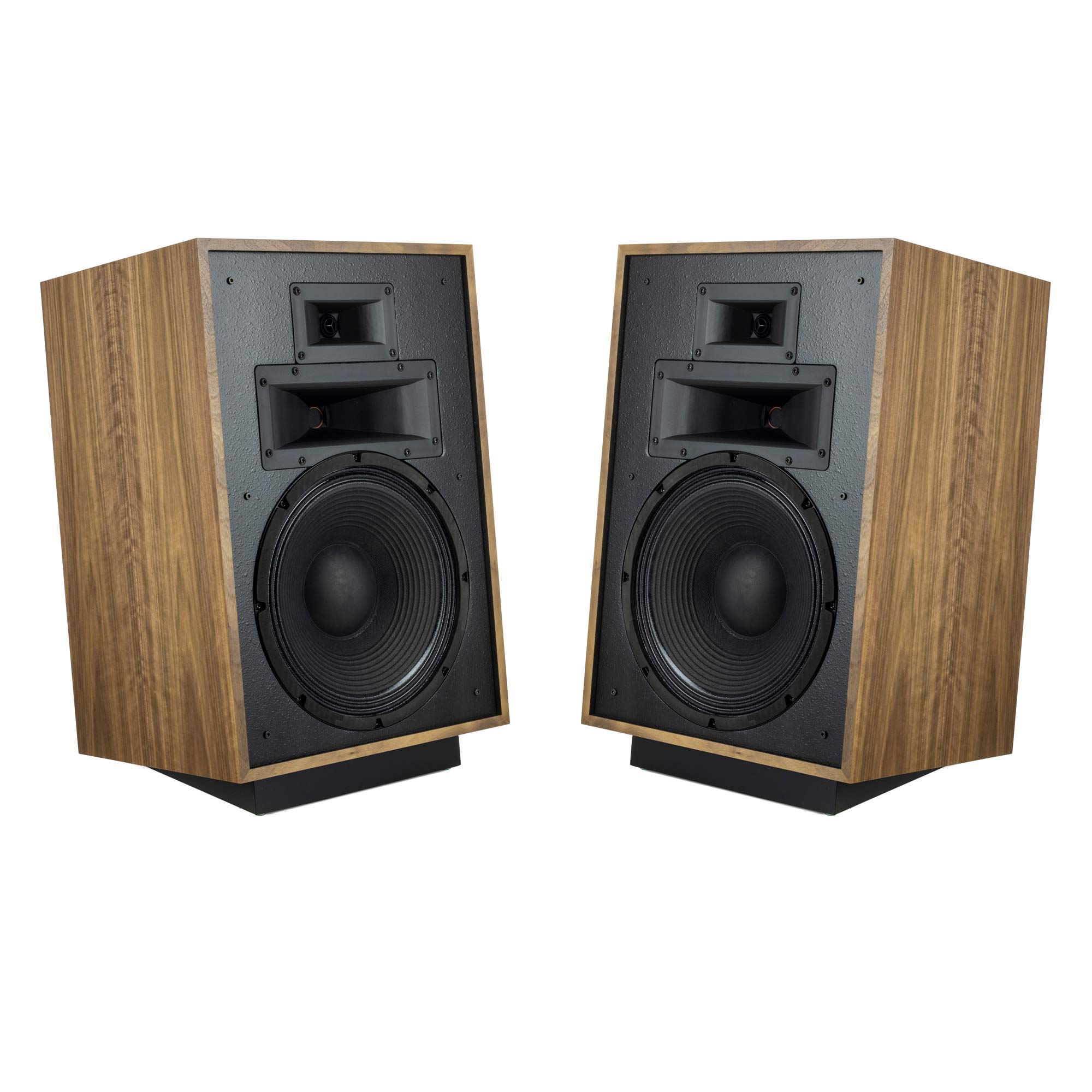
American-built walnut heritage boxes with a horn midrange that throws detail straight at you.
The Heresy IV is the most traditional speaker on this page, and unapologetically so. It is designed and assembled in the USA with an all-new K-702 midrange compression driver on a polyimide diaphragm, feeding a K-704 Tractrix horn for a wide coverage pattern. Up top sits a K-107-TI titanium diaphragm high-frequency driver with a wide dispersion phase plug, pushing even high-frequency response across the room.
What that delivers in real life is startling presence at low power. The all-new high-fidelity network gives truer-to-life sound along with high efficiency and power handling, meaning a modest amplifier reaches serious volume without strain. Buyers describe orders of magnitude more detail and presence than the speakers they replaced, and the American walnut cabinet is a genuine piece of furniture rather than a black box.
That 12 inch driver is a woofer inside a horn-loaded three-way design (a speaker split into three frequency ranges, with the woofer fed through a horn). So expect punch and efficiency rather than subwoofer depth. It matches the 12 inch figure of the Klipsch pack’s subwoofer, but does a different job. These speakers are passive and need an amplifier, and the heritage look is a strong opinion: you either love the retro walnut or you do not.
The heritage payoff
- K-702 compression midrange on a Tractrix horn for wide, forward coverage
- Very high efficiency — small amplifiers play loud without strain
- Designed and assembled in the USA with American walnut cabinets
- Titanium diaphragm tweeter with a wide dispersion phase plug
Stay honest on this
- Passive pair with no built-in amplification or streaming
- The retro heritage styling is a strong taste, not a neutral one
This is your pair if: You value high-efficiency horn sound and a cabinet that looks inherited rather than bought.
Steer away if: You want a modern minimal cabinet or an all-in-one streaming setup.
9. Bang & Olufsen Beosound Balance Speaker

Half sculpture, half speaker — an aluminium Fibonacci grille over solid oak.
The Balance is a single cabinet designed to be looked at as much as heard. A precision-crafted aluminium grille with a Fibonacci pattern sits over a solid oak wood base, and the effect is a piece that reads as decor first. Inside, a 5.25 inch driver handles the work, with an audio engine that lets you adjust how spacious the output feels — from a focused, directional presentation to a room-filling ambient wash.
Sonically, the detail in vocals and midrange instruments is what stands out, and the volume headroom surprises people: half the dial is plenty to fill a bedroom. Streaming runs over Wi-Fi with AirPlay 2, and Beolink Multiroom lets you link multiple Bang & Olufsen speakers. An approach sensor wakes the interface when you come close, and the B&O app handles the rest.
Two honest limits. This is the non-voice version, so there is no voice assistant built in by design. And the connectivity gets mixed feedback — some owners find the options limited for the money, and value in general divides opinion. It is a design-led purchase, so buy it for the look and the focused vocal clarity, not for a long list of ports.
Where it excels: Clear vocals and midrange, plus a genuinely adjustable sense of space that adapts to a small room.
Read the spec sheet closely: Wi-Fi and AirPlay 2 are the streaming routes here, and there is deliberately no voice assistant.
The decor-first choice: For buyers who want one beautiful object in a room and value vocal clarity over input count.
Keep shopping if: You need HDMI, a subwoofer output or broad wired connectivity.
10. Devialet Phantom Ultimate 108 dB Speaker
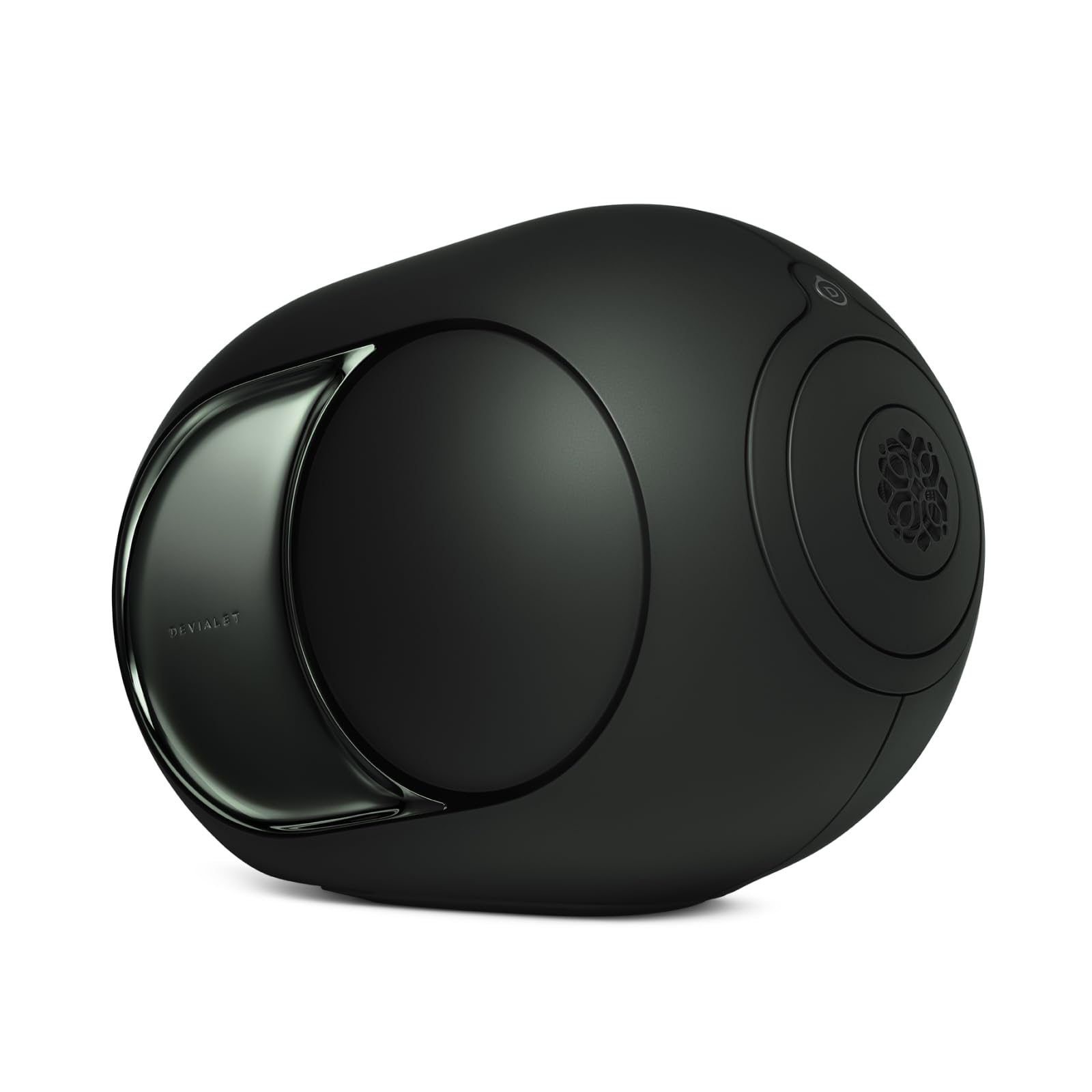
A French sphere built to push a full frequency range from one impossibly small cabinet.
The number that defines this speaker is its frequency range: 14 Hz to 35 kHz. That low figure is the reason a single spherical cabinet can suggest real low-end weight, and the 32 bit / 96 kHz audio processing keeps the signal clean from distortion, saturation and background noise. Designed and manufactured in France, it is as much an object as a loudspeaker — a sleek sphere in metal with a tactile interface of four touch sensors and a status LED.
Streaming is broad: AirPlay, Google Cast, Roon, Spotify Connect, UPnP and TIDAL Connect, plus Bluetooth 5.3 and Wi-Fi 6 for low latency and a stable link. It can pair in stereo, so two units become a proper pair. In a room, that frequency range and processing power make it a full-body listening experience for a single-chair setup rather than a background music box.
The catch is scale. One Phantom makes a statement for a dedicated listening chair or a single open room. Filling a large home theater from it is not what it is for, and at this tier it is a considered purchase rather than an impulse one. Plan on a proper stand or shelf with room behind it for its 13.5 inch depth.
The range argument: A 14 Hz to 35 kHz frequency response is the headline, and it is the spec that separates this from every box speaker on the page.
Placement need: Its 13.5 inch depth means it needs real clearance, so map the stand before you order.
Buy it for the sound object: A one-chair listening room, a stereo pair, or a design-led living space.
Look elsewhere if: You need a floorstanding pair driven by an AV receiver.
11. Bang & Olufsen Beosound A9 Bluetooth Speaker

A giant circular canvas on legs with seven drivers and room-scanning brains.
Seven effective drivers sit behind this circular textile face, which is why one cabinet can pressurize a whole living space rather than just a listening chair. Active room compensation scans the space around the speaker and adjusts the sound to where it actually sits — a genuinely useful trick for a piece most people place against a wall or in a corner. A 20 centimeter driver anchors the low end of that seven-driver array.
The sound character owners describe is deep yet crisp, with the depth holding together even at normal listening levels rather than only when cranked. Controls are physical and clever: slide your hand across the surface to change volume, tap to skip tracks or play and pause. Bang & Olufsen’s app handles sound profiles, timers and alarms, and Beolink Multiroom plus AirPlay 2 let you link it to other speakers in the house.
Two things to weigh. Connectivity draws mixed feedback, with some buyers finding the app and wireless setup harder to use than expected, and value divides opinion at this tier. The design, though, is the point — wall-mounted or on legs, with exchangeable wooden legs and textile covers to match your decor. Buy it as an art piece that happens to fill a room with sound.
Room-scanning benefit: Active room compensation adapts the output to its position, so you are not stuck fighting a corner placement.
The honest trade: Setup and connectivity take some patience, and the piece rewards buyers who value the look as much as the sound.
Made for: Open living spaces where the speaker is on show and one object should carry the whole room.
Not the pick if: You want plug-and-play simplicity or a compact footprint.
12. KEF LS60 Wireless Active Floor Speakers, Mineral White

A fully active floorstander that shakes the room without a subwoofer in sight.
This is the top of the active ladder here, and the bass design is the reason. Each speaker carries four force-canceling bass drivers, which push against each other so the cabinet does not walk across the floor while the low end stays deep and controlled. The result is room-shaking bass without an external subwoofer, which keeps the room looking like a room instead of a cable run.
Single Apparent Source technology, derived from KEF’s flagship Blade speakers, makes all frequencies radiate from a single point for precise imaging and a realistic soundstage. The 6.5 inch driver size matches the SVS towers, but because the LS60 is fully active and adds those four bass drivers per cabinet, it produces low-end weight those passive towers hand off to a separate sub. Connectivity covers HDMI eARC for the TV, plus optical, coaxial and RCA for turntables and consoles, and streaming via AirPlay 2, Chromecast and Spotify Connect. Bluetooth range reaches 10 meters and audio latency is listed at 150 milliseconds.
Bass performance is the trait people point to first, and the convenient part is that everything is inside the cabinet — amplification included. The mixed feedback lands on wireless connectivity, which is a common theme with active streaming speakers, so keep a wired option handy. For a floorstander this capable, that is a small price.
What earns it the top tier
- Four force-canceling bass drivers per speaker deliver deep bass with no subwoofer needed
- Single Apparent Source imaging borrowed from KEF’s Blade flagships
- Fully active with HDMI eARC, optical, coaxial and RCA inputs built in
- Streaming via AirPlay 2, Chromecast and Spotify Connect
Know before you commit
- Wireless connectivity draws mixed reports — wired inputs are the steadier route
- Fully active means the electronics are part of the purchase, not upgradeable separately
The end-game floorstander: Buy this if you want flagship bass and imaging with zero outboard electronics.
Go passive instead if: You want to choose and upgrade your own amplifier over time.
Know the Specs
Active versus passive amplification
An active speaker has its own amplifier built into the cabinet, so you plug it into the wall and stream or connect a source directly. A passive speaker is only the drivers and crossover, so it needs a separate amplifier or AV receiver to produce any sound. Active systems simplify the chain and fold the amp cost into the speaker; passive systems let you pick your own amp and upgrade it later. The KEF LS50 Wireless II and LS60, the Devialet Phantoms and both Bang & Olufsen models here are active. The Klipsch, SVS and Polk towers are passive, so budget for an amplifier or receiver alongside them.
Driver size and what it means for bass
Driver size in inches is a rough measure of how much air a woofer can move, which is what you hear as bass weight. A tower with 8 inch woofers, like the Klipsch RP-8000F II or the Polk R700, moves more air than a 6.5 inch design such as the SVS towers. Larger drivers tend to fill bigger rooms at lower volume, keeping the sound relaxed rather than strained. A pair of 5 inch drivers, like the Bowers & Wilkins AM-1, is built for even coverage in a smaller outdoor space rather than room-shaking low end.
Frequency response and hi-res audio
Frequency response describes the range of pitches a speaker can reproduce, from the lowest bass to the highest treble. The Devialet Phantom Ultimate 108 dB quotes a 14 Hz to 35 kHz range, and the low end of that range is the reason a single cabinet can suggest real bass weight. Hi-Res certification, found on the Polk Reserve R700, means the speaker is rated to handle high-resolution formats such as DSD, FLAC, WAV, ALAC and MQA. For most listeners the practical benefit is cleaner detail on well-recorded albums rather than a dramatic difference on compressed streaming.
Streaming, inputs and multiroom
Streaming platforms like AirPlay 2, Google Chromecast, Spotify Connect and Tidal Connect let you send music from a phone or tablet without extra hardware. An HDMI eARC port lets a speaker take the TV’s audio over one cable and follow the TV remote’s volume, which matters if movies share your listening time. Beolink Multiroom and similar systems let you link several speakers in different rooms. Check that the inputs match your sources: a turntable needs an analogue or phono-capable input, and a games console needs optical, coaxial or HDMI.
Horn versus dome tweeters
The tweeter handles the higher frequencies, so it shapes how vocals, cymbals and strings sit in the mix. A horn-loaded tweeter, like the Tractrix designs on the Klipsch speakers here, uses a flared guide to throw sound forward with high efficiency, which many listeners find lively and immediate. A dome tweeter, like the aluminium domes on the SVS towers or the Pinnacle Ring Radiator on the Polk, tends to sound smoother and more spread out. The right choice depends on your room and your taste rather than on one being objectively better.
Cabinets, finishes and placement
At this level the cabinet is part of the sound. Cross-bracing inside reduces resonance, and cabinet materials such as reinforced MDF or glass-filled plastic affect how much vibration reaches your ears. Finishes range from scratch-resistant textured wood grain on the Klipsch pack to piano gloss black on the SVS Pinnacle and solid oak on the Beosound Balance. Feet matter too: the Polk R700 ships with both rubber feet for hard floors and spike feet for carpet. Plan where the speaker will sit and how you will hide the cables before you buy.
Common Questions
Do really expensive speakers need a separate amplifier?
Can I use outdoor speakers like the Bowers & Wilkins AM-1 indoors?
What is the difference between a horn tweeter and a dome tweeter?
How much bass can I get from a single active speaker?
Do these speakers support TV connection over HDMI?
Is a 5.1 system like the Klipsch pack better than a pair of towers?
Will streaming from my phone sound as good as a wired connection?
Do these high-end speakers include a subwoofer?
What does bi-amping mean on the Klipsch RP-8000F II?
Will a large tower speaker work in a small room?
The Bottom Line
For most buyers, the clear winner among these really expensive speakers is the Klipsch Reference Series 5.1 Pack. It builds a complete Dolby Atmos cinema (overhead-style surround sound) from one order: two up-firing towers, a center, surrounds and a 12 inch powered subwoofer. It also holds 4.5+ stars across 300+ ratings, the strongest owner consensus in the group. If you want a purer two-channel tower with a wider listening balance, the Klipsch RP-8000F II brings that 90° x 90° hybrid horn and 8 inch woofers. And for a fully active floorstander (built-in amps, no subwoofer required), the KEF LS60 Wireless is the one to reach for, thanks to four force-canceling bass drivers per cabinet.
One last honest nudge: the top pick earns its place on real owner experience across hundreds of ratings, and that is the safest starting point if you are building a room from scratch. Match the design to how you listen, feed the passive pairs a capable amplifier, and give any active streaming model a wired backup — then the money you spend goes into the sound you actually hear.
How we choose
We do not accept paid placement. Every pick is matched to a real buyer and a real use-case; we do not hands-on test units.
Sources
Specifications: manufacturer listings and product documentation. Review insights: verified customer reviews, as of November 2026. Pricing: not shown on this page (it changes often); check the current price via the retailer link.
As an Amazon Associate, Tactical Gear Guy earns from qualifying purchases. This does not affect which products we feature.