Specs are compiled from manufacturer listings and verified buyer reviews and can change over time — please confirm the key details on the product page before buying.
Walk into an empty listing shoot with the wrong glass and the room shrinks. Corners bow, door frames lean, and a bright window blows out the wall beside it. For interiors, the lens matters more than the body: the picks below are chosen to keep rooms wide, walls straight, and dim corners bright. One honest note before you read: several picks are the same type of lens in a slightly different focal length or mount, so not every option matches the exact number you searched — each one still does the same job of pulling a whole room into frame.
This guide is built by comparing the manufacturers’ published specifications and the patterns across verified customer reviews, so you get each pick’s real strengths and trade-offs instead of marketing spin.
You will see how focal length changes what a room looks like on screen, why a fast f/2.8 lens saves you from a flash in a dim corner, and which mounts actually fit your camera body. Every pick below solves at least one of those three problems, so you can match the glass to the rooms and light you actually shoot.
Top Picks


How To Choose The Best Real Estate Photography Lens
Start with your camera’s mount, not the brand name or the price tag. It is your camera’s mount, because a great lens that will not attach to your body is useless. Sony bodies take Sony E-mount glass, Nikon mirrorless bodies take Nikon Z, Nikon DSLRs take Nikon F, and Canon DSLRs take Canon EF. Confirm the mount before you compare focal lengths or apertures.
Focal length decides how much room you see
An ultra-wide lens pulls a whole living room, kitchen, and hallway into one frame. A 10mm or 16mm lens shows a huge slice of the scene, which is what makes a tight bathroom or a small spare bedroom look workable in a listing photo. A 20mm to 24mm lens shows less but keeps proportions closer to what your eye expects, so furniture and walls do not look stretched at the edges. Measure your tightest bathroom or hallway first, then pick the focal length that fits it.
Why aperture matters in dim interiors
A lens rated f/2.8 or f/1.8 lets in more light, so you can shoot a shadowy hallway or a room with one small window without cranking up a flash. That wider opening also blurs the background more, which is not always wanted in an interior where everything should read sharp. Many shooters stop down to a smaller aperture to keep the full frame in focus, and the faster lens just buys you a brighter viewfinder and easier autofocus in low light.
Straight lines, coatings, and build
Barrel distortion is the bowing at the edges that makes a straight wall look curved, and lens makers correct it with special glass elements or software. A tilt-shift lens adds physical movements to pull vertical lines upright, which is why architectural shooters reach for one. A fluorine or nano coating helps shed dust and fingerprints off the front element, and moisture-resistant construction matters if you shoot during a drizzle or on a dusty new-build site.
Side-by-Side Comparison
| Model | Best For | Focal Length | Max Aperture | Mount | Amazon |
|---|---|---|---|---|---|
| Sony FE 20mm F1.8 G★ Best Overall | Fast indoor shooting | 20mm | f/1.8 | Sony E | Amazon |
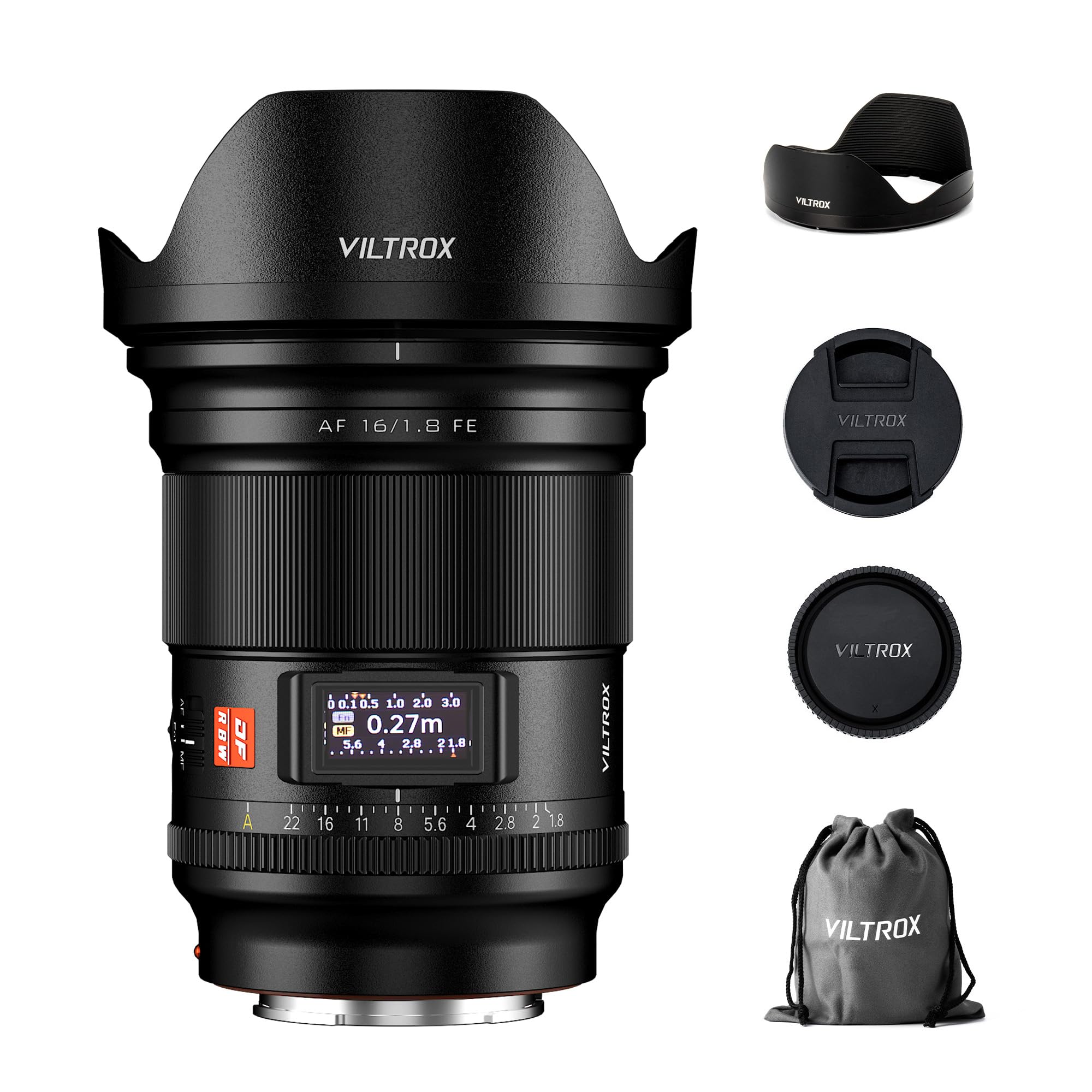
| VILTROX AF 16mm F1.8Best Value | Budget-friendly interiors | 16mm | f/1.8 | Sony E | Amazon |
| Nikon 10-24mm f/3.5-4.5G EDWidest Nikon DSLR Reach | Widest Nikon DSLR reach | 10-24mm | f/3.5-4.5 | Nikon F | Amazon |
| TAMRON 11-20mm F/2.8 | APS-C on a diet | 11-20mm | f/2.8 | Sony E | Amazon |
| Laowa 10mm f/2.8 Zero-D | Maximum field of view | 10mm | f/2.8 | Sony E | Amazon |
| Tamron 16-30mm F/2.8 Di III VXD G2 | One lens, many room sizes | 16-30mm | f/2.8 | Sony E | Amazon |
| Sigma 16-28mm F2.8 DG DN | Still and video mixed shoots | 16-28mm | f/2.8 | Sony E | Amazon |
| Canon EF 16-35mm f/4L IS | Handheld interior stability | 16-35mm | f/4 | Canon EF | Amazon |
| Sony FE 16-25mm f/2.8 G | Compact zoom travel kit | 16-25mm | f/2.8 | Sony E | Amazon |
| Nikon NIKKOR Z 14-24mm f/2.8 S | Nikon mirrorless workhorse | 14-24mm | f/2.8 | Nikon Z | Amazon |
| Canon TS-E 17mm f/4L | Perfect verticals, straight off | 17mm | f/4 | Canon EF | Amazon |
Detailed Reviews
1. Sony FE 20mm F1.8 G Full-Frame Ultra-Wide Prime Lens
Our pick — 4.5+★ from 650+ verified ratings; the strongest balance of quality and price.
The lens that sees a whole room and still shoots fast when the light gives up.
A 20mm focal length on a full-frame body takes in a wide slice of a room without stretching the far corners into mush. The number that matters here is the aperture: f/1.8, a very wide opening that pulls in a lot of light. That means you can shoot a north-facing living room at dusk and still get a usable frame without setting up a flash. The 13.2 ounces of weight keeps the camera balanced in one hand while you move furniture with the other.
Owners keep coming back to the sharpness. The lens holds detail wide open, which is rare on a fast wide prime, and its close focusing distance keeps distortion low when you get near a doorway or a shelf. It also adapts to APS-C bodies (smaller-sensor cameras), though a crop-sensor shooter sees a narrower field of view from the same glass. Autofocus uses two XD linear motors — two small motors that move glass quickly — so it locks on quietly and precisely, and Nano AR plus fluorine coatings on the front element help keep dust and fingerprints from sticking.
The catch is the fixed 20mm length. You cannot zoom in to tighten a shot on a small detail, so you have to move your feet. There is also no image stabilization built in, which means steady hands or a stabilized body matter.
What earns the top spot
- f/1.8 aperture means dim interiors stay bright without a flash
- Sharp wide open with low distortion up close
- Two XD linear motors focus fast and quietly
- 13.2 ounces keeps the kit portable
Where it asks more of you
- Fixed 20mm length means no zoom to tighten a shot
- No in-lens stabilization, so you lean on a steady body or tripod
Reach for this if: you shoot Sony full-frame and want one prime that handles tight rooms and low light in the same afternoon.
Think twice if: you want a zoom to frame wider or tighter without moving your feet.
2. VILTROX AF 16mm F1.8 Lens
Sixteen millimeters of field of view, one-eighteen aperture, and a price that undercuts the big brands.
The VILTROX throws a 105.6-degree angle of view onto your sensor, which is the kind of sweep that gets a whole bathroom into one frame from a corner. Pair that with the f/1.8 aperture and you have a lens that works in a dim hallway without a flash and pulls focus on a doorway detail when you want one. Compared to the Sony 20mm above, the VILTROX reaches 16mm, so it fits more room into the same shot.
What buyers talk about most is the build and the value. The lens is all metal but stays at 19.5 ounces, which is heavier than the 11.8-ounce TAMRON below but still handleable on a gimbal or a tripod. The optics run 12 groups of 15 elements, three of them aspherical (shaped to bend light more precisely), and the result reads sharp with clean bokeh (smooth background blur). Autofocus uses an STM stepping motor with eye and face detection, so it tracks a moving subject without noise, and there is a built-in LCD on the barrel that shows aperture and focus distance without you lifting your eye from the viewfinder.
The honest trade-off is weight and the absence of stabilization. Nineteen and a half ounces is on the heavier side for a prime, and there is no in-lens stabilization, so a stabilized body helps. Some shooters also find the LCD a gimmick they never use. Neither of those stops it from being the strongest value here for a Sony full-frame shooter on a tighter budget.
Where the money goes: The 105.6-degree view and f/1.8 aperture are the two specs that do the work in an interior. The three aspherical elements and 15-element design keep detail crisp, and the f/1.8 opening means you are not forced to raise ISO in a shadowed room.
What you give up: The 19.5-ounce weight is real, and no stabilization means you rely on steady hands or a tripod. But the metal body and dust-protected structure are built for real job sites, not just a studio.
Pick this one when: you want the widest view and the fastest aperture your Sony body can mount without paying premium-brand money.
Look elsewhere if: you need a zoom range or absolutely must keep the kit under 16 ounces.
3. Nikon 10-24mm f/3.5-4.5G ED AF-S DX Lens
Ten millimeters at the wide end turns a cramped bathroom into a room you can actually read.
If you shoot a Nikon DSLR, this is the widest reach on the list. The lens zooms from 10mm to 24mm and renders a picture angle of 109 degrees down to 61 degrees, which is equivalent to 15-36mm on a full-frame body. That 10mm setting is what lets you stand in one corner of a small bedroom and still show the window, the closet, and the doorway without backing through a wall.
The optical design uses ED glass (extra-low-dispersion glass that keeps colors clean) and aspherical elements to cut chromatic aberration (the colored fringing that shows up on window frames) and to reduce coma, the stretching that hits point lights near the frame edge. Autofocus runs on Nikon’s SWM motor (a fast, quiet focus motor), which is fast and quiet. The zoom ring is the real story here — buyers consistently note the 109-degree coverage at the 10mm setting as the reason they bought it, and the wide zoom range lets you frame a large great room or a tight powder room without swapping glass.
The limitation is the aperture. At f/3.5-4.5 it lets in less light than the f/2.8 zooms below, so a very dim interior will need a tripod or a flash. It is a Nikon F-mount lens built for DX-format bodies, so a full-frame Nikon will crop it or refuse it entirely.
The wide-end story: 10mm with a 109-degree angle is the number that sells this lens. No other Nikon DSLR option here gets that wide, and the zoom to 24mm covers the normal-wide framing you need in a larger room.
The light penalty: f/3.5-4.5 is a slower aperture than the f/2.8 options, so you will lean on a tripod in dark rooms. That is the trade for the extra field of view.
Matches well with: Nikon DSLR shooters who want the widest possible view and do not mind a tripod in poor light.
Less ideal if: you shoot available-light interiors at dusk or you are on a mirrorless Nikon body.
4. TAMRON 11-20MM F/2.8 DI III-A RXD

The APS-C zoom that disappears into a bag and still covers a whole living room.
Eleven-point-eight ounces. That is the figure that decides this one. Compared to the VILTROX above at 19.5 ounces, the TAMRON is the lighter lens to carry all day. It is also 3.4 inches long, so it stays compact on a small APS-C body. The zoom range runs 11-20mm, which is equivalent to 16.5-30mm on full frame, and the f/2.8 aperture holds constant across that whole range — so you get the same light-gathering at 11mm as at 20mm.
Close focusing is the quiet win. The minimum focus distance is 5.9 inches at 11mm and 9.4 inches at 20mm, with a 1:4 maximum magnification at the 11mm end. That means you can get near a windowsill or a kitchen detail and keep the background readable. Moisture-resistant construction and a fluorine coating on the front element are there for drizzle and dusty sites. Autofocus uses TAMRON’s RXD motor, a stepping motor tuned for quiet, smooth focus.
What you do not get is full-frame coverage. On a full-frame Sony body this lens will force a crop or refuse to mount, so it is exclusively for APS-C mirrorless. It also has no image stabilization, which you will notice in dim rooms.
Why the weight matters: At 11.8 ounces and 3.4 inches, this lens barely adds to a walkaround kit. That makes it the one you take on a packed day of showings and open houses without a strap digging into your shoulder.
The APS-C limit: 11-20mm gives a 16.5-30mm full-frame equivalent, which is a solid interior range. But it only works on APS-C bodies, so full-frame shooters need to look at the zooms below.
Built for: Sony APS-C shooters who want f/2.8 across a full zoom range in a body that weighs almost nothing.
Step away if: you shoot full-frame Sony or need image stabilization built into the lens.
5. Laowa 10mm f/2.8 Zero-D Full-Frame Lens for Sony FE

A 130.4-degree sweep that makes a single-car garage look like a showroom.
Ten millimeters on a full-frame sensor is extreme. The Laowa covers a 130.4-degree angle of view, which is far wider than the 20mm Sony above — the difference between seeing one wall of a room and seeing nearly all four. That range is why it fits an entire open-plan space in one shot. The Zero-D design corrects distortion to close-to-zero, so both horizontal and vertical straight lines hold from corner to corner. That is the spec that matters for interiors: no bowed walls, no curving window frames.
Buyers who own it point first to lens quality and second to the distortion control, and the numbers back the enthusiasm — the 130.4-degree view is paired with 15 elements in 9 groups, including 2 aspherical and 3 ED glasses (extra-low-dispersion glass that keeps colors clean). A 12cm minimum focusing distance means you can get close to a kitchen tile or a flower on a counter for a wide-angle macro look. At 0.93 lb and 7cm long it stays portable, and the f/2.8 aperture (the size of the lens opening) keeps low-light rooms workable.
The trade-off is that 10mm is so wide it can start to feel sideways and dramatic in a small bedroom — a tighter line is easier to keep straight with a 16mm or 20mm. There is also no in-lens stabilization. Both are reasons to pair it with a tripod.
The spec that sells it: A 130.4-degree angle of view on full-frame is class-leading on this list, and the Zero-D optical design keeps straight lines straight. That combination is specifically what interior and architectural shooters pay for.
The trade-off to weigh: 10mm is so wide it can exaggerate small rooms. And with 0.93 lb and no stabilization, a tripod is your friend.
The one for: shooters who want the maximum field of view and straight walls in a single frame without paying tilt-shift prices.
Consider passing if: you want a zoom for flexibility, or you mostly shoot small rooms where 10mm feels too dramatic.
6. Tamron 16-30mm F/2.8 Di III VXD G2 for Sony E-Mount

One zoom that covers a tight foyer at 16mm and a wide great room at 30mm without a lens swap.
The 16-30mm range is what makes this lens a one-lens kit for a full day of interiors. Sixteen millimeters handles the tight powder room; 30mm frames a living room without exaggerating the edges. Across that whole range the aperture stays at f/2.8, so the light does not fall off when you zoom in. The lens is designed for full-frame and APS-C Sony bodies, and it weighs 440 grams.
What buyers praise most is the optical quality. The high-resolution design captures the finest detail in architecture and landscape work and also renders pleasing bokeh for the odd portrait-style shot in a bedroom. Autofocus uses a VXD motor, a linear drive tuned for quiet, high-speed focus. Moisture-resistant construction and a fluorine coating help on dusty new-build sites, and the lens carries a 6-year limited warranty when bought from a Tamron authorized USA dealer.
The honest limit is the aperture on the long end — f/2.8 is fast, but it is constant, so you do not get a faster f/1.8 option here. And this is a full-frame zoom, so it will not give you the extreme 10mm-12mm coverage the Laowa offers.
The versatility argument: A 16-30mm range with a constant f/2.8 means one lens covers a whole property. You shoot a tight bedframe at 16mm and the wide living area at 30mm without changing glass.
The limit to know: It is a zoom, not a prime, so it will not match the f/1.8 light gathering of the Sony or VILTROX above. For most interior days that is a tradeoff worth taking.
Best paired with: Sony shooters who want a single zoom to cover every room size and do not mind the f/2.8 ceiling.
Not for you if: you need a fast prime’s f/1.8 aperture for very dark rooms.
7. Sigma 16-28 mm F2.8 DG DN Lens for Sony E Mount

The zoom that covers a whole listing but stays sharp from corner to corner.
Sigma builds this lens around five FLD elements and four aspherical elements. FLD glass is a low-dispersion glass that cuts color fringing, and the four aspherical elements keep the edges sharp. The 16-28mm range gives you a full-frame wide view from a tight bathroom all the way to a normal-wide framing for a great room, and f/2.8 stays constant across it. Aperture runs f/2.8 to f/22, so you can stop down to f/22 when you want the deepest depth of field for a whole-room shot.
The autofocus is a solid internal motor, and the lens handles both still and video work. Buyers praise the quality and value consistently — the optical formula is doing the heavy lifting. If you shoot video walkthroughs, the constant f/2.8 and the smooth focus make it easy to step through a room without hunting. The build matches the premium tier, though the lens is positioned as the mid-range zoom here.
The catch is the short range: 16-28mm is a wide zoom, not a general zoom, so you will still need a second lens for detail shots. And as with the TAMRON, no in-lens stabilization means the camera body has to handle the shake.
The optical argument: Five FLD elements and four aspherical elements keep color fringing and edge softness in check. That is what makes a 16-28mm zoom usable for the whole room without visible corner mush.
The honest limit: 16-28mm is a wide-only zoom. You will still want a second lens for detail shots, so plan the kit accordingly.
Right for: Sony full-frame shooters who want a wide zoom with strong glass and constant f/2.8 across the range.
skip it if: you need one lens to do wide and detail in the same body.
8. Canon EF 16-35mm f/4L IS USM Lens

Up to four stops of image stabilization is the number that keeps a handheld interior crisp.
Four stops of stabilization on a 16-35mm zoom is the reason to buy this lens. In a dim room where the fast-aperture primes above would need f/1.8, the Canon’s stabilization lets you hand-hold at a slower shutter speed and still come away with a sharp frame. The zoom range runs from 16mm for a tight room to 35mm for a detail or a portrait-style shot, and the f/4 aperture stays constant. The lens uses ring USM autofocus and full-time manual focus, so you can tweak focus by hand without flipping a switch.
Owners talk about edge-to-edge sharpness even wide open, and the stabilization earns its place — it lets you work in low light and still control distortion well. The optical design uses 2 UD and 3 aspherical elements to manage aberrations, and a 9-blade circular iris keeps out-of-focus highlights round. The 0.28m close focus is close enough for interior details. At 615 grams it is a manageable weight, and the lens carries an L-series build that is meant to be used hard.
Here is where it may not fit: the f/4 aperture is slower than f/2.8, so in a very dim room you may still need a tripod. The lens is also Canon EF mount — it mounts on Canon DSLRs and adapts to mirrorless bodies with an adapter, but it will not attach to a Sony or Nikon body without one.
The case for stabilization: Up to four stops of image stabilization is a real advantage on interior shoots where tripods slow you down. It lets you hand-hold at slower speeds and still come away with a usable frame.
Where it falls short of the primes: f/4 is slower than f/1.8, so very dark rooms still favor the fast primes. The EF mount also means an adapter for mirrorless bodies.
Ideal if: you shoot Canon and want the stabilized zoom that keeps handheld interiors sharp.
Not the first pick if: you are on a Sony or Nikon body, or need f/2.8 in very dark rooms.
9. Sony FE 16-25mm f/2.8 G Lens

A 16-25mm f/2.8 zoom that packs small and keeps focus lightning fast.
Sony’s G-series glass is known for resolution at every focal length, and this lens holds that promise across 16-25mm with a constant f/2.8. The range is the one that matters for property work: 16mm gets you wide, 25mm keeps a room looking natural. Close focus is 18cm (7.09 inches) at 24mm in manual focus, so you can get near a kitchen counter or a window detail and still keep the background legible.
Autofocus runs on two linear motors. Linear motors are small magnetic drives that move glass silently and precisely, which matters when you are shooting video walkthroughs and do not want a motor whine on the audio. The lens is compact and light enough to live on the camera all day, and the 11-blade circular aperture keeps bokeh round and smooth. The design is built for stills and video, so a hybrid shooter gets one lens for both.
The trade-off is the zoom range and the price of that G-series badge. Sixteen to twenty-five is a wide-only zoom, so detail shots need a second lens. And though it is compact, the 1.5-pound weight is heavier than the APS-C options above.
The autofocus story: Two linear motors make this lens focus silently and quickly. For property video walkthroughs that quiet drive is the difference between usable audio and motor noise.
The zoom range question: 16-25mm is a wide-only range. Add a separate detail lens to the bag if you need to shoot countertop close-ups.
Go here for: Sony full-frame shooters who want a compact f/2.8 zoom that handles stills and video walkthroughs equally well.
Look past it if: you need a longer zoom range or a lighter kit than 1.5 pounds.
10. Nikon NIKKOR Z 14-24mm f/2.8 S
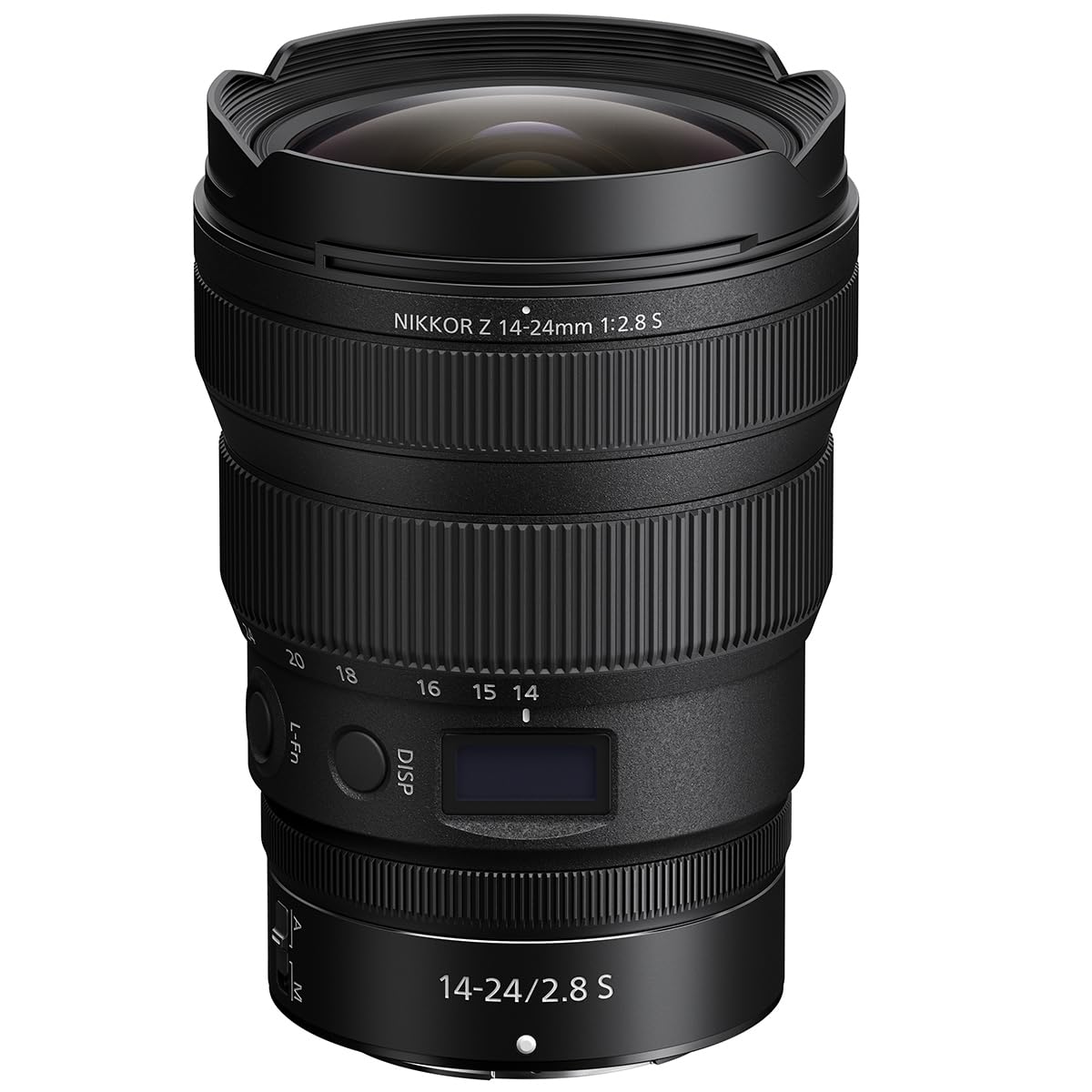
Fourteen millimeters, an f/2.8 constant aperture, and a weatherproof body for the new-build site.
Fourteen millimeters is the widest focal length Nikon’s Z mount reaches here, and the f/2.8 aperture stays constant across the 14-24mm range. On a tight foyer or a small bathroom, that 14mm setting pulls in more of the room than a 20mm ever will, and f/2.8 means you do not lose light when you zoom to 24mm for a room. Weatherproof construction is the spec that matters for construction sites and rainy exterior work, and it is compatible with all Nikon Z series mirrorless cameras.
What buyers praise most is the lens quality, and the numbers make the case: Nano Crystal Coating cuts ghosting and flare, the 14-24mm range covers interior and exterior work, and the resolution holds across the entire frame. It is also sharp in low light, which lets you shoot a dim hallway without a flash. At 650 grams it is manageable for a day of shooting, and the 1.7x optical zoom multiplier is part of its coverage.
The common gripes are value and size. This is a premium lens, and some buyers find it expensive for what it is, while a few find the size on the larger side. Weatherproofing and the f/2.8 constant aperture are what you are paying for, so if those are not priorities, the zoom is more lens than you need.
Why it carries the Nikon line: A 14-24mm f/2.8 with Nano Crystal Coating and weatherproof construction is the spec sheet for a working architectural kit. On a Z body it is the natural choice for interiors and exteriors on the same day.
What a few owners push back on: Value is the most-discussed point, and size comes up too. The lens is large enough that some shooters notice it on small Z bodies. Those are preferences, not flaws.
Suits: Nikon Z shooters who want one weatherproof wide zoom for interiors and exteriors and do not mind the size.
Weigh the cost if: you mostly shoot fair-weather interiors and a shorter zoom range is enough.
11. Canon TS-E 17mm f/4L Lens

The lens that straightens vertical lines in-camera, no software correction needed.
Tilt-shift is the feature that separates this lens from every other pick. It physically shifts the front of the lens by ±12mm and tilts it by ±6.5 degrees, so you can keep the camera level and still pull the top of a tall building or a wall of cabinets into frame with vertical lines that stay parallel. That is the dream for an architectural or exterior shot on a tight lot. The 17mm focal length gives you the ultra-wide view you need, and the UD (ultra-low-dispersion) and aspherical elements keep chromatic aberration (colored fringing) in check.
Buyers who use it for architectural work tend to sound like converts. The tilt-shift is the reason, especially in tight spots where you cannot step back. The floating internal focus mechanism keeps image quality consistent across the focus range, and the circular aperture keeps blurred highlights round. The ±12mm shift is generous enough to cover a full house exterior, and the 820-gram weight is the cost of the movement mechanism. It is manual focus — a tilt-shift of this kind cannot autofocus — so you will be focusing by hand, which is standard for the type.
The real limit here is use-case fit, not defect. It is manual focus and manual exposure, so it rewards a slow, deliberate shooter. And the movement mechanism makes it heavier and more expensive than a fixed wide prime. If you just need wide and fast, the primes at the top of this list get you there with autofocus.
Why architectural shooters pay for it: ±12mm shift and ±6.5 degrees of tilt let you correct verticals in-camera without cropping away the top of the building. That is a different job than a fixed-focal wide, and it is the reason this lens exists.
Who it is not for: Manual focus and a manual exposure setup mean it rewards patience. If you want speed and autofocus for a fast interior shoot, a wide prime is a better fit.
Choose it when: you shoot buildings and exterior verticals and want to correct perspective in-camera rather than in software.
Hold off if: you need autofocus and a lighter walkaround lens for fast interior days.
Know the Specs
Focal length: how wide the view gets
A focal length in millimeters tells you how much of a scene reaches the sensor. Lower numbers are wider. A 10mm or 16mm lens covers a huge slice of a room, so it suits tight bathrooms and small bedrooms. A 20mm to 24mm lens shows less but keeps proportions closer to what your eye expects. Many interior shooters keep one wide zoom for tight spaces and a normal-wide for larger rooms, and match the number to the tightest room they shoot most.
Aperture: how much light gets in
The f-number is the size of the opening inside the lens. A smaller number like f/1.8 is a wider opening, so more light reaches the sensor and you can shoot a dim room without a flash. A number like f/4 is a narrower opening, so it needs more light or a slower shutter. Faster apertures help most in dark hallways and at dusk. Keep in mind that a faster aperture also blurs the background more, which is not always wanted when everything in the room should read sharp — many shooters stop down to a smaller aperture and just use the fast lens for easier autofocus and a brighter viewfinder.
Mount: whether the lens fits your body
The mount is the physical bayonet connection between lens and camera. Sony E, Nikon Z, Nikon F, and Canon EF do not interchange without an adapter — a Sony E lens will not mount on a Canon EF body, and a Nikon F lens will not sit on a Nikon Z body without the specific adapter for it. Check your body’s mount before you shop, because the best glass in the world is useless if it will not attach. Full-frame and APS-C bodies (larger and smaller sensors) share a mount family but crop the view differently, so confirm which sensor size you shoot.
Distortion, coatings, and build quality
Distortion is the bowing at the frame edges that makes a straight wall look curved. Lens makers correct it with special glass — aspherical, UD, and FLD elements — or with in-camera software. Coatings like Nano AR, Fluorine, and Nano Crystal reduce flare and help shed fingerprints and dust off the front element. Moisture-resistant sealing and weatherproof bodies matter if you shoot on new-build sites or in drizzle. Fluorine and Nano Crystal coatings shed dust and fingerprints, and moisture-resistant sealing decides whether a lens survives a drizzle-soaked exterior shoot.
Common Questions
Will a Sony E-mount lens fit my Nikon Z camera?
What focal length is best for real estate interiors?
Is f/2.8 fast enough for dark interior rooms?
Do I need image stabilization for interior handheld shots?
How do tilt-shift lenses differ from a regular wide angle?
Will a full-frame lens work on my APS-C camera?
How long do wide-angle lenses last on the job?
Do I need autofocus for real estate photography?
Is a prime or a zoom better for shooting listings?
Can I shoot real estate video with a photo wide-angle lens?
The Bottom Line
For most shooters the strongest pick in this list is the Sony FE 20mm F1.8 G, because its f/1.8 aperture and sharp wide-open optics make dark interiors easy without a flash, and its 20mm view keeps a room looking natural. If your budget is tighter and you want a wider view, the VILTROX AF 16mm F1.8 gives you 105.6 degrees and f/1.8 for noticeably less. If your rooms vary in size and you want one lens for the day, the Tamron 16-30mm F/2.8 covers the range without swapping glass. And if you shoot architecture and want verticals straight in-camera, the Canon TS-E 17mm f/4L is the specialist that does the job no wide prime can. Confirm your mount, then pick the widest aperture your budget allows for the dim rooms you shoot most.
How we choose
We do not accept paid placement. Every pick is matched to a real buyer and a real use-case; we do not hands-on test units.
Sources
Specifications: manufacturer listings and product documentation. Review insights: verified customer reviews, as of November 2026. Pricing: not shown on this page (it changes often); check the current price via the retailer link.
As an Amazon Associate, Tactical Gear Guy earns from qualifying purchases. This does not affect which products we feature.