Specs are compiled from manufacturer listings and verified buyer reviews and can change over time — please confirm the key details on the product page before buying.
If your hands ache after ten minutes of pruning, the tool is the problem. A ratchet pruning clipper works like a car jack: each squeeze clicks the blade one notch deeper into the branch, so you cut a one-inch limb in several small bites instead of one brutal squeeze. That is the whole reason this category exists. Below are nine clippers that genuinely do it, ranked so you can pick the right one for your hand strength, your branch size, and how much you prune.
This guide is built by comparing the manufacturers’ published specifications and the patterns across verified customer reviews, so you get each pick’s real strengths and trade-offs instead of marketing spin.
Ratchet clippers are not the same as standard bypass pruners, and choosing badly means a tool that jams or dulls on the first hedge. This guide separates the ones that hold up from the ones that only look tough on paper, and it covers ratchet pruning clippers with the specifics that actually decide the cut.
Top Picks


How To Choose The Best Ratchet Pruning Clippers
Buy the clipper that matches your hand and your branches. That sounds obvious, but most people buy by looks or brand and end up with a tool that is too small for a fruit tree or too heavy for a flower bed. Here is what to weigh before you click buy.
Match the cut capacity to what you actually prune
Cut capacity is the thickest branch the jaws will close around, written in inches. A clipper rated to 3/4 inch handles most shrubs and rose canes. If you are clearing fruit tree suckers or dead limbs, you want a one-inch capacity or more. Buying less capacity than your branches means a ratchet that never finishes the cut.
Anvil versus bypass jaws
An anvil blade presses down onto a flat plate, which crushes through dead wood and dry stems. A bypass blade slices past a hook, which leaves a cleaner wound on living branches. Many ratchet clippers here are anvil type, so check the blade type if you mostly cut green growth. One model in this list uses a hybrid design so you get both.
Weight and handle size decide whether you finish the job
Weight is listed in ounces or grams, and it matters because you lift the tool hundreds of times an hour. A 4.8-ounce clipper and a 7-ounce clipper feel very different by mid-afternoon. Handle opening matters just as much: a handle that opens to 5.9 inches fits medium to large hands in gloves, while a smaller frame suits a compact grip. Pick the handle opening that fits your gloved hand, not the biggest one on the shelf.
Side-by-Side Comparison
| Model | Best For | Cut Capacity | Blade Type | Weight | Amazon |
|---|---|---|---|---|---|
| Ironwood Tool Company Ratchet Pruning Shears★ Best Overall | Weak hands and everyday shrubs | 1 inch | Bypass | 4.8 ounces | Amazon |
| DUROX Ratchet Pruning Shears Heavy DutySmartest Maintenance | Maintenance and blade swaps | 20 millimeters | Anvil | 240 g | Amazon |
| Premium Heavy Duty Ratchet Pruning ShearsLightest Squeeze | Lighter load in the hand | 3/4 inch | Ratchet | 7 ounces | Amazon |
| Clauss 20133 8-Inch Heavy-Duty Ratchet-Action Pruner | Hard vines and tough stems | 1 inch | Anvil | — | Amazon |
| GARDEN GURU 2 in 1 Ratchet Pruning Shears | Switching between modes | 1 inch | Anvil | 0.24 kg | Amazon |
| Kings County Tools Ratchet Anvil Pruning Shears | Compact carry and tight spaces | 0.75 inch | Parrot Beak | — | Amazon |
| The Gardener’s Friend Heavy Duty Ratchet Pruning Shears | All-day pruning and big jobs | 2.5 centimeters | Anvil | 220 g | Amazon |
| EZ Kut Heavy Duty Ratcheting Pruning Shears | Big branches and a full kit | 1.5 inches | Anvil | — | Amazon |
| P3 Ratcheting Hybrid Bypass Pruner | Large hands and mixed wood | 1 inch | Anvil and bypass | — | Amazon |
Detailed Reviews
1. Ironwood Tool Company Ratchet Pruning Shears H107
Our pick — 4.5+★ from 300+ verified ratings; the strongest balance of quality and price.
The scaled-down ratchet that keeps its full one-inch bite without weighing your arm down.
Your forearm decides how long you can prune, and this tool keeps it fresh: the Ironwood clipper weighs 4.8 ounces, the lightest tool in this guide. That weight sits in an aluminum handle you can lift over and over without your arm tightening up. The blade is high-strength carbon steel with a non-stick coating, so sap slides off instead of gluing the jaws shut. The edge is rated to cut 1 inch, so you can take a finger-thick branch in one squeeze.
What makes it the overall pick is the thoughtful detail around the blade. The hand guard stretches your reach and your mobility in the tight inside of a shrub, which is exactly where branches hide. There is no metal-to-metal contact, a small design choice that cuts friction and extends blade life. And the tool is built ambidextrous, so it works the same in your left hand as your right.
The crowd backs it up — 4.5+ stars across 300+ owners, and the quality of the build is what wins people over by a wide margin. Compare it to the Premium Heavy Duty clipper at 7 ounces: the Ironwood is the lighter of the two, which is the spec to remember if you prune with a weakened grip. The honest catch is the locking mechanism, a recurring gripe that some find finicky, so treat the latch gently rather than forcing it shut.
What earns its place
- 4.8-ounce body — the lightest clipper reviewed here, so long sessions cost your arm less.
- 1-inch cut capacity handles shrub limbs without a second pass.
- Non-stick carbon steel blade shrugs off sap and lets the edge live longer.
- Extended hand guard lets you reach into tight shrub interiors.
What to know first
- The lock takes a little finesse — ease it closed rather than snapping it.
- Smaller frame can feel slim in very large gloved hands.
Take this one if: your grip tires quickly and you want the lightest tool that still bites through a one-inch branch.
Try something else if: you need a lock you can snap shut one-handed in the middle of a job.
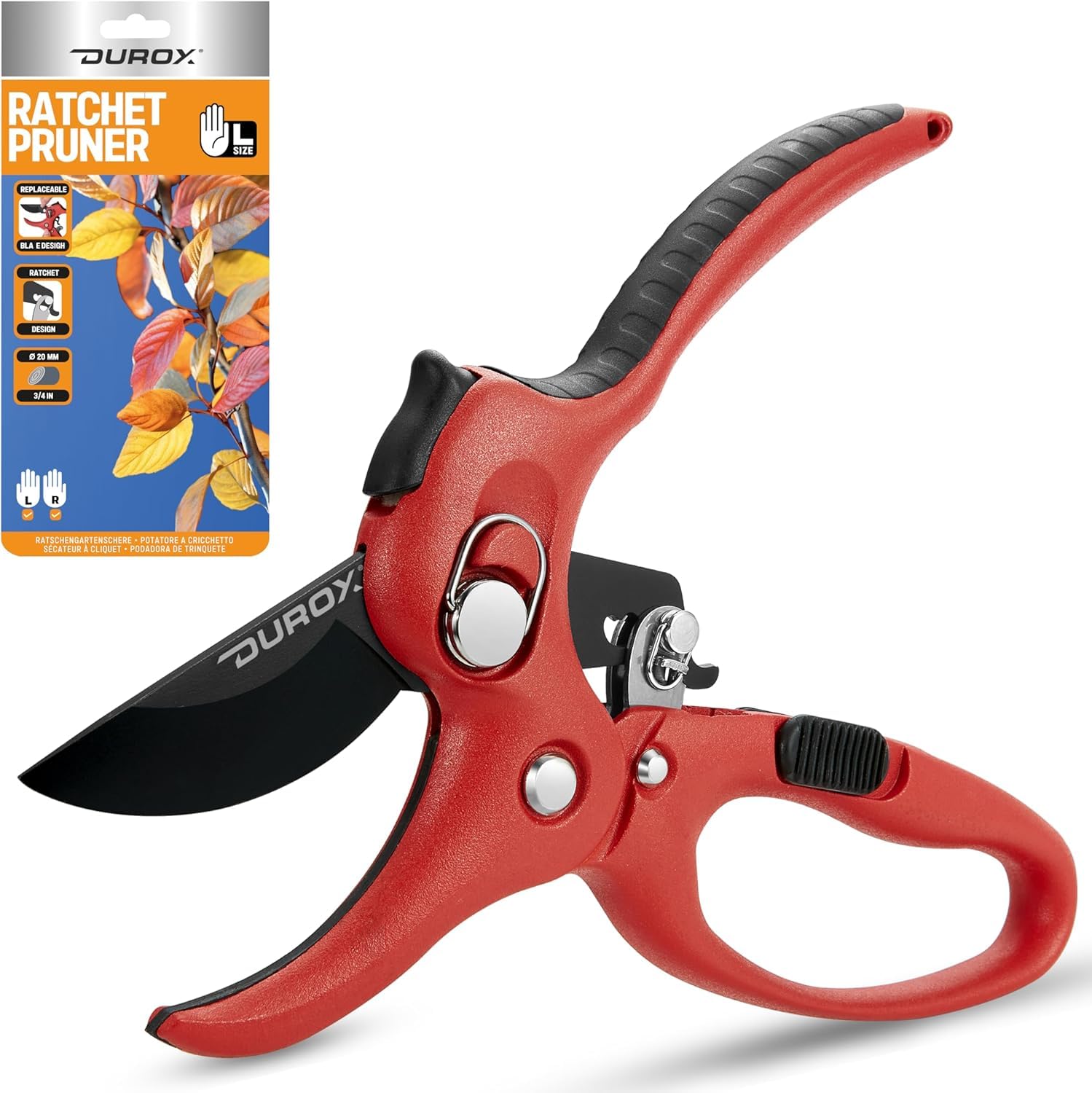
2. DUROX Ratchet Pruning Shears
A pruner that treats its own blade: swap the edge, wipe off the sap, get back to work.
Most pruners are disposable once the edge goes dull. The DUROX is the opposite. When the edge wears, you lift the two pull rings with a flat-head screwdriver, turn to loosen, and drop in a new blade instead of buying a whole new tool. That replacement blade (DGRB-01) is sold separately, which is the one catch in the plan.
The second clever piece sits on the handle: a pre-oiled sponge that wipes sap off the blade and leaves a thin film of oil to slow rust. It clips back on so it travels with you. The blade itself is high carbon steel in an anvil type, which crushes through dry stems cleanly, and the cutting width is listed at 20 millimeters.
Fit is where this one shines. It runs 8 inches long and 8.5 ounces, with handles that open to 5.9 inches — sized for medium to large hands in glove sizes M to L. It is ambidextrous and locks firmly for storage. Owners find the ratchet action handles branches up to half an inch in diameter without complaint, and the removable blade design is a draw on its own. Just expect the mixed reports on sharpness — a few owners want a keener factory edge from the start.
Why it earns a slot: a replaceable edge and a self-oiling sponge turn a wear item into a tool you keep for years. That is a real maintenance win, not a marketing line.
The trade-off: the blade is a separate purchase, and the factory edge draws mixed reactions — plan to touch it up or swap it early.
Reach for this if: you like a tool you can service and keep running rather than replace.
Look elsewhere if: you have very small hands — the 5.9-inch handle opening is sized for medium to large gloves.
3. Premium Heavy Duty Ratchet Pruning Shears 8 Inch
Seven ounces of cast aluminum built to multiply your squeeze, not test it.
The maker claims the ratchet shares force up to 3 times, and the way it works is simple: each squeeze clicks onto the next setting, builds pressure, and you release and squeeze again. You cut in stages instead of one hard crush. The ratchet only engages while you are actively cutting, so it does not fight you between branches. At 7 ounces with a cast aluminum body and cushioned non-slip grips, it stays easy on the wrist.
The blade is heat-treated SK-5 high carbon steel, held by a high-strength locking screw that adds support when the branch is thick. Cutting performance is what owners praise most here, and the range is wide: it handles everything from flower blossoms up to 3/4-inch branches, and it is a capable option on roses and crepe myrtle.
Now the honest part. The ratchet action gets mixed reviews, and the locking mechanism is the weakest spot — the latch is the most common complaint, and a few buyers report the blame dulling too easily. It also runs smaller than other ratchet pruners, so check the frame against your hand before you commit. The weight is genuinely low, though — 7 ounces against the Ironwood’s 4.8 ounces, and this one gives you a forged steel blade for the extra heft.
The case for it: a forged SK-5 steel blade and a 3-times force claim in a 7-ounce package aimed squarely at weaker hands.
What to watch: the latch and the compact size are the two things buyers flag — inspect both on arrival.
Worth it when: you want a forged blade and light weight, and a compact frame suits your grip.
Think twice when: a smooth, easy lock is your top priority — this one draws the most latch complaints of the group.
4. Clauss 20133 8-Inch Heavy-Duty Ratchet-Action Pruner
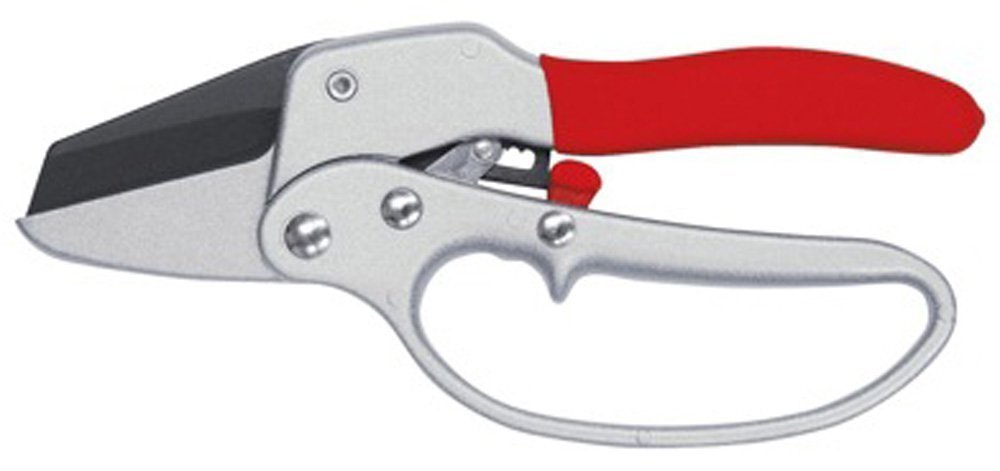
The 8-inch brute that owners say goes through hard vines and one-inch limbs without flinching.
Build quality is what wins people over on the Clauss, and it shows. This is an 8-inch, 8.25-inch-long anvil pruner with an alloy steel blade and a rubberized polyamide handle that gives you something solid to grip. It is ambidextrous and made in Taiwan. The whole package feels like a tool that was meant to take abuse in a hedge row.
The ratchet action is the star here for anyone with a weaker grip. Owners say it shines exactly where a plain pruner fails, letting them slice through hard vines and small branches that would otherwise stall a squeeze. One-inch diameter branches are within reach. Functionality ranks right behind build quality as the thing buyers talk about.
Comfort and ease of use are where it gets mixed — some find the handle less forgiving over a long session, and the tool is not featherlight. That is the honest trade for a build that feels this solid. If you want a pruner that survives a season of hard cutting more than you want a delicate one, this is the lane.
Where it wins
- Build quality is the top praise — a solid 8-inch anvil pruner with rubberized polyamide grip.
- Ratchet action gets through hard vines and 1-inch branches.
- Ambidextrous alloy steel blade with a durable feel.
Where it gives ground
- Comfort is a mixed bag over long sessions.
- Heavier feel than lighter-frame clippers in this list.
Pick it for: hard vines, tough stems, and a build you do not have to baby.
Pass if: your sessions run long and you want the softest, lightest grip available.
5. GARDEN GURU 2 in 1 Ratchet Pruning Shears

Flip a switch for the ratchet when the branch fights back, then go plain-cut when it does not.
This is the only clipper here with a real two-mode design. A dual-mode switch engages the powerful ratchet setting when you need it, and you can turn it off for a straight cut. The maker puts the boost at 4X cutting power, and the ratchet works the standard way — squeeze, click to the next setting, build pressure, release and repeat. It cuts stems and light branches and is rated to 1 inch.
The ergonomics are aimed at the hands that need help most. The ratchet setting eases wrist strain for arthritic hands, and the anvil blade is high carbon steel. Owners confirm the design lands: it trims sizable branches and the ergonomic grip is easy on sore hands.
The warranty is a genuine standout — a lifetime warranty plus a 90-day satisfaction guarantee, and the tool is certified carbon neutral. At 0.24 kg it sits in the middle of the weight range, so it is neither a featherweight nor a burden. The honest note is that this is a lighter-duty tool in this group; if your branches run past the one-inch rating, look at a 1.5-inch cutter instead.
The draw: a switchable ratchet you can turn off, a 1-inch anvil cut, and a lifetime warranty behind it.
The limit: one-inch capacity is the ceiling — thick limbs call for a bigger-jawed tool.
Reach for this if: you want the choice of ratchet or straight cut and the reassurance of a lifetime warranty.
Look elsewhere if: your pruning regularly involves branches thicker than an inch.
6. Kings County Tools Ratchet Anvil Pruning Shears 5”
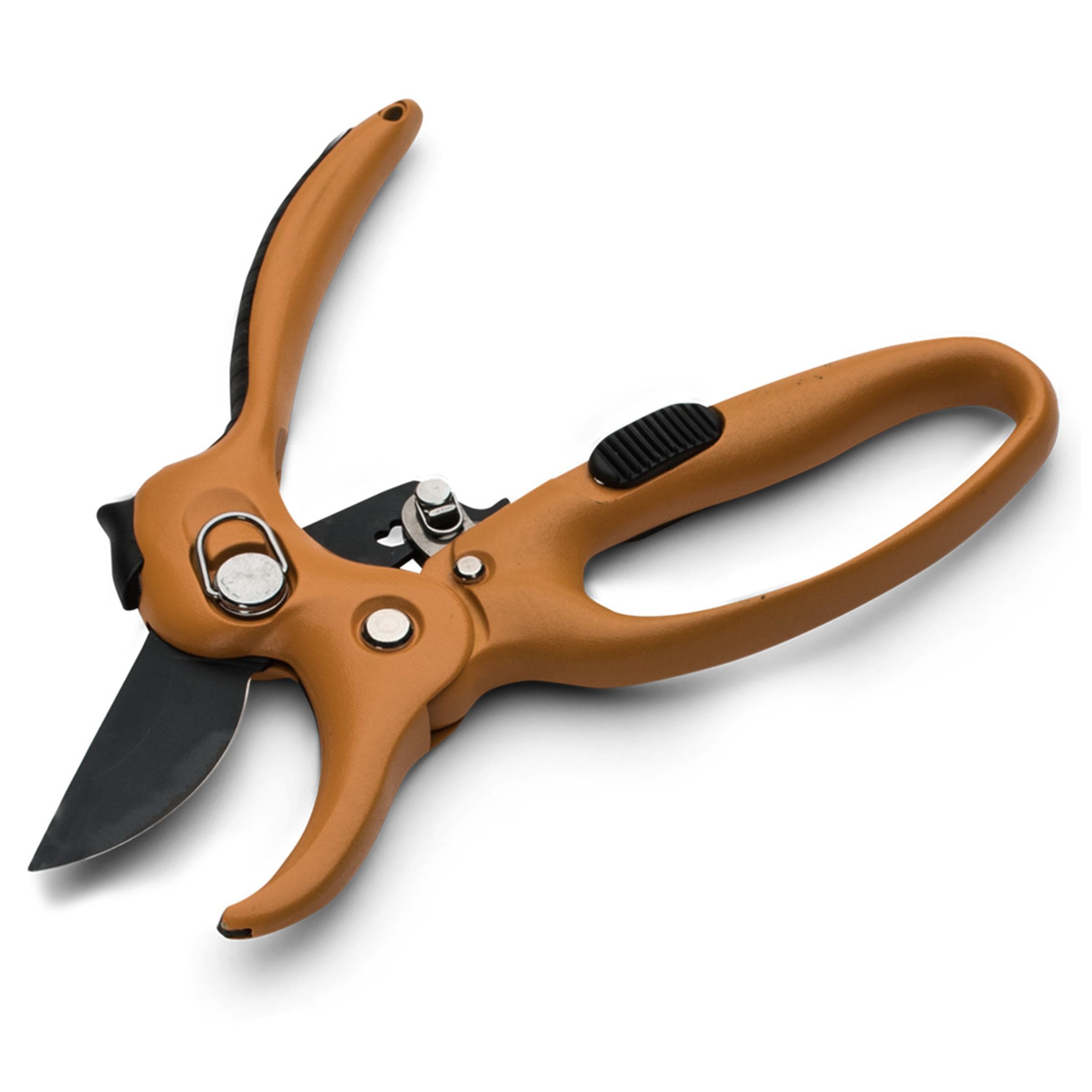
A stubby five-inch pruner made to ride in a holster and slip into tight garden spaces.
Short and handy is the point here. It measures 5 inches long by 4.5 inches wide, so it tucks into a pocket or holster where the 8-inch tools will not. The ratchet holds the jaws in place when you loosen your grip, which lets you rest your hand and then give an extra squeeze — the same staged cut as the big tools, in a smaller frame. Capacity is 0.75 inch.
Kings County put some smart features on it. A thumb-slide lock protects the blade and your fingers when it is not in use, and a detachable oil pad slides into the handle for on-the-go cleanup. The cast aluminum body and non-stick-coated carbon steel blade can be replaced via a bolt on the handle. Sharpness and a clean cut are what owners highlight, and it slices through branches with little resistance.
Durability is the mixed signal — a few report the blade chipping or the tool coming apart, so treat it as a compact helper rather than a heavy-clearing tool. Buy it for portability and reach into tight spots, not for thick dead wood.
Best use: a pocket-sized, ratcheting helper with a slide lock and built-in oil pad for on-the-go cleanup.
The catch: durability draws mixed reports and 0.75-inch capacity is modest — fine for stems, not for big limbs.
Choose it for: a compact pruner you can holster and carry into tight garden corners.
Choose bigger if: your branches regularly run past three-quarters of an inch.
7. The Gardener’s Friend Heavy Duty Ratchet Pruning Shears

The one the crowd has already tested: a three-stage anvil pruner aimed at sore hands.
Start with the number that separates it from the pack: 5,000+ owners, and 4.0+ stars. That volume means the design has been through real seasons. The cutting performance is the thing everyone raves about — it slices through 3/4-inch branches and works on both live and dead wood. A heavy-duty manganese steel blade sits in an aluminum body rated corrosion-resistant, with a 2-inch blade and 2.5-centimeter cutting width.
The new-and-improved version added a neoprene insert in the anvil that holds branches and stems in place while you cut, and an enhanced safety latch to reduce accidents. The 3-stage ratchet multiplies each squeeze so arthritic hands can finish thicker branches. At 220 grams it is one of the lighter full-size tools here, and the ambidextrous build works in either hand.
Two honest notes sit alongside all that praise. Ease of use and value for money both draw mixed reactions — some want smoother handling. And durability is the recurring complaint, so treat the latch and the blade edge with care rather than abusing them. With thousands of owners behind it, though, this is the safest bet for a first serious ratchet clipper.
Why the crowd loves it
- Proven by 5,000+ owners — the most-reviewed pruner here.
- 3-stage ratchet and neoprene anvil insert hold stems and cut cleanly.
- Manganese steel blade through 3/4-inch branches, live or dead wood.
- 220 grams keeps long sessions comfortable.
What to know before buying
- Durability is the recurring gripe — take care of the latch and edge.
- Handling draws mixed reactions for some owners.
Take this one if: you want the most-proven pruner on the list and a ratchet built for sore hands.
Try something else if: you expect to push a tool past its limits — durability is the weak spot.
8. EZ Kut Heavy Duty Ratcheting Pruning Shears
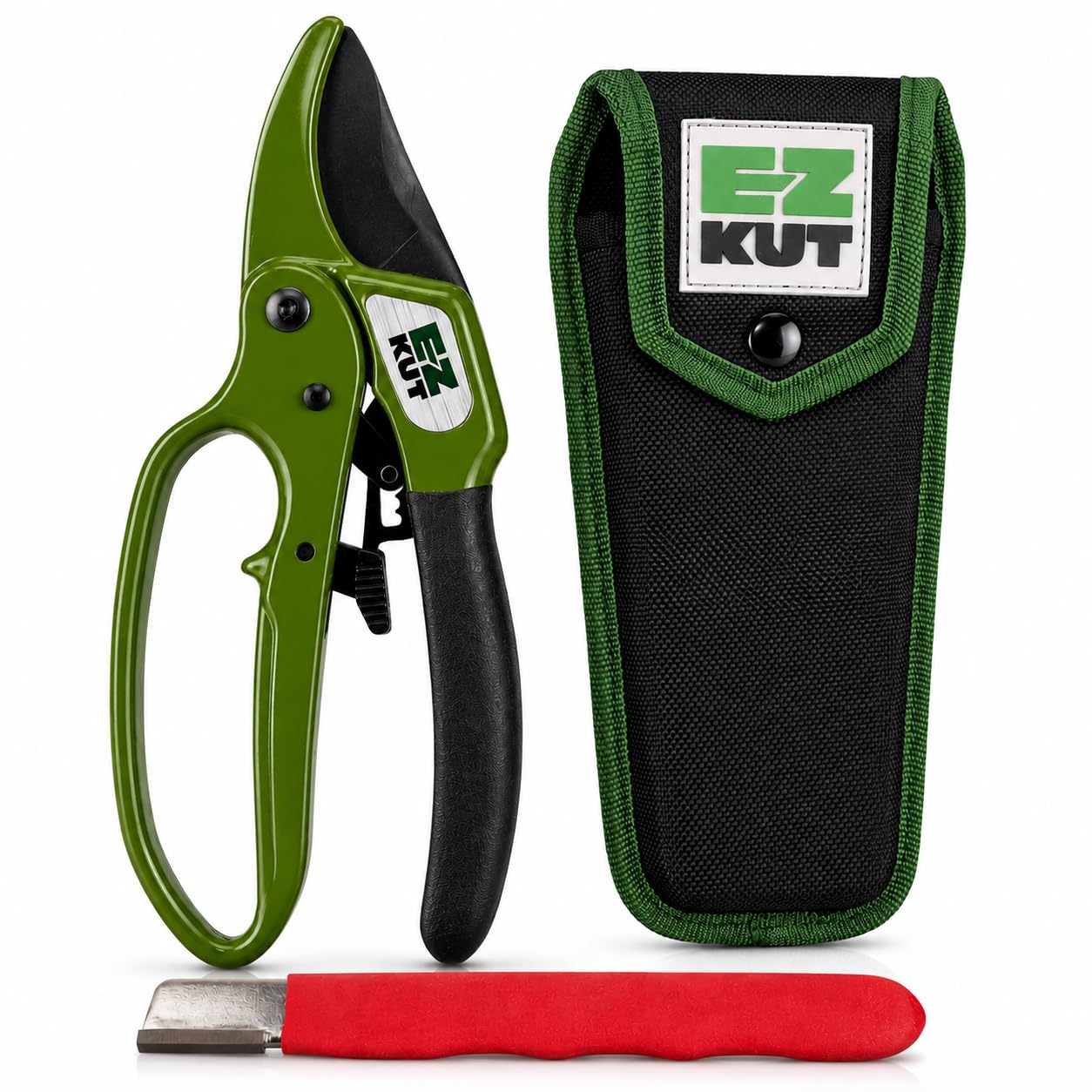
A 1.5-inch anvil cutter that comes as a kit: holster, sharpener, and all.
No other clipper in this guide bites as big. A ratcheting mechanism (a geared action that clicks through several steps per cut) multiplies your hand strength and cuts the effort each time. So a thick limb goes in stages instead of one impossible squeeze. The hardened SK5 carbon steel blade (a tough Japanese steel grade) carries a non-stick coating to reduce friction and sap buildup.
It arrives as a complete set: the pruner, a ballistic nylon holster, and a sharpener. The holster protects the tool between jobs, and the sharpener keeps the blade ready between prunings. The non-slip handle is built for comfort and control, aimed at arthritis and weak hands.
Cutting performance is what owners point to — the tool works well and cuts branches easily, and quality ranks as the top praise. If your yard means real limbs rather than thin stems, the 1.5-inch capacity is the reason to pick it.
The headline spec: a 1.5-inch cut capacity — the largest in this list — plus a holster and sharpener in the box.
The honest read: the review base is thinner than the giants here, so you are buying on specs and kit rather than a deep track record.
Pick it for: thick branches and a ready-to-go kit with a holster and sharpener included.
Pick a proven name if: you would rather buy on thousands of ratings than a large cut capacity.
9. P3 Ratcheting Hybrid Bypass Anvil Blade Hand Pruner

A hybrid bypass-anvil jaw that handles green and dead wood in the same pass.
Here is the design detail that sets the Tiger Jaw apart: a hybrid bypass-anvil ratcheting blade and jaw. Most clippers here are anvil-only, which crushes through dead wood but can bruise green growth. This one combines the two so it cuts green or dead wood up to 1 inch. The ratchet steps the cut deeper with each squeeze, which the maker says reduces trauma to the plant.
It is built for medium to large hands and comes with a knuckle guard to protect your grip. The metal body feels substantial, and it is ambidextrous. This is the P3 heavy-duty model in the company’s line — aimed at landscapers, ranches, farms, and homeowners clearing fruit trees, hedges, and large ornamentals.
The honest catch is the safety lock, which some find extremely hard to operate, and ease of use draws mixed reactions. Cutting performance is solid — it handles thicker stems and branches well. Buy it for the hybrid jaw and the large-hand fit, and be ready to work the lock with a firm hand.
Why it stands out: a hybrid bypass-anvil jaw cuts green or dead wood to 1 inch, with a knuckle guard for large hands.
The caveat: the safety lock is hard to operate for some — expect to work it with purpose.
Reach for this if: you have medium to large hands and cut green and dead wood with the same tool.
Pass if: an easy one-thumb safety lock matters more to you than a hybrid jaw.
Know the Specs
Ratchet mechanism
A ratchet is a stepped clicking action that holds the blade partway through a cut, so you can release your grip and squeeze again to push deeper. Instead of one hard crush, you cut in stages. That is what lets a weaker hand finish a branch it could never cut in a single squeeze. The best designs engage only while you are actively cutting, so the tool does not fight you between branches.
Cut capacity
Cut capacity is the thickest branch the jaws will close around, listed in inches or millimeters. A 3/4-inch or 20-millimeter rating covers most shrubs and rose canes. For fruit tree suckers and dead limbs, aim for one inch or more, and for genuinely thick wood look at a 1.5-inch tool. Matching capacity to your real branches is the single biggest decision you make.
Anvil versus bypass blades
An anvil blade presses the branch against a flat plate, which works well on dry, dead wood. A bypass blade slices past a hook, leaving a cleaner cut on living growth. A hybrid jaw combines both, which is handy if you cut green and dead wood on the same day. Check the blade type before you buy if the health of living stems matters to you.
Weight and grip
Weight is listed in ounces or grams, and it compounds over hundreds of lifts in a session. A tool around 220 grams or under 5 ounces feels light; a 7-ounce or heavier tool gives more heft for thick cuts. Handle opening matters too — a wider opening suits larger gloved hands, while a compact frame fits a smaller grip. Match both to your hand, not to the biggest spec.
Common Questions
How does a ratchet pruning clipper help weak hands?
What size branch can a ratchet pruner actually cut?
Is an anvil or bypass ratchet better for dead wood?
Will a ratchet pruner fit gloved hands?
How do I keep the blade from rusting or seizing up?
Can I replace a dull blade instead of buying new shears?
What is the difference between a 1-inch and a 1.5-inch cutting capacity?
Should I buy a ratchet pruner with a holster and sharpener?
Are ratchet pruners safe for living plants?
The Bottom Line
If your hands tire fast, the ratchet pruning clippers winner is the Ironwood Tool Company Ratchet Pruning Shears. At 4.8 ounces with a one-inch non-stick blade, it is the easiest tool here to lift all afternoon. If you prune a lot and want the one the crowd has already proven, grab The Gardener’s Friend, with 5,000+ owners behind it. And for genuinely thick limbs, reach for the EZ Kut and its 1.5-inch cut.
How we choose
We do not accept paid placement. Every pick is matched to a real buyer and a real use-case; we do not hands-on test units.
Sources
Specifications: manufacturer listings and product documentation. Review insights: verified customer reviews, as of November 2026. Pricing: not shown on this page (it changes often); check the current price via the retailer link.
As an Amazon Associate, Tactical Gear Guy earns from qualifying purchases. This does not affect which products we feature.