Specs are compiled from manufacturer listings and verified buyer reviews and can change over time — please confirm the key details on the product page before buying.
You want fresh ramen noodles at home, and the shopping question is simple: do you buy a hand-cranked roller or an automatic machine that kneads and extrudes the dough for you? That choice decides whether the machine earns counter space or shelf space. This guide covers both types and tells you exactly who each one suits.
This guide is built by comparing the manufacturers’ published specifications and the patterns across verified customer reviews, so you get each pick’s real strengths and trade-offs instead of marketing spin.
The picks below split into hand-cranked rollers and fully automatic extruders, and your pick depends on counter space and cleanup time. Read on for the full breakdown of every ramen noodle machine worth considering.
Top Picks


How To Choose The Best Ramen Noodle Machine
Start with the roller-versus-extruder decision, because everything else follows from it. A roller flattens dough into a sheet and then cuts it — that is how most ramen noodles get their springy bite. An extruder pushes dough through a disc, which gives you round spaghetti-style strands and penne but a softer chew. Both work; they just produce different textures.
Decide between hand-cranked and automatic
A hand-cranked roller gives you total control over the sheet and needs no motor to fail. The trade-off is arm work and a dough you have to knead yourself first. An automatic machine kneads and pushes the dough for you — the VEVOR, for example, handles 500g of flour and turns it into noodles for about four people in 14 minutes. That convenience comes with a motor and, on cheaper units, a shorter working life.
Check the thickness range in millimeters
Sheet thickness is the number that decides which noodles you can actually make. Thin ramen strands want a sheet rolled down to a low setting, while dumpling and wonton wrappers need a thicker sheet so they hold filling. Look for an adjustable range you can dial through — the Newhai spans 0.5-3mm, and the Luzrise covers 0.5-5mm — rather than a single fixed gap.
Count the discs and blades before you buy
Each disc or blade is one noodle width, and buying extras later is often impossible. A machine with 8 molds gives you spaghetti, fettuccine and wider strands without add-ons; one with a single cutter makes exactly one width. If you plan to feed a family with different preferences, the disc count matters more than the motor wattage on paper.
Side-by-Side Comparison
| Model | Best For | Type | Discs / Blades | Thickness Range | Amazon |
|---|---|---|---|---|---|
| MARCATO Atlas 150★ Best Overall | Hands-on noodle makers | Hand crank roller | 1 | — | Amazon |
| VEVOR 150W AutomaticEasiest Start | Beginners who want one button | Automatic extruder | 8 | — | Amazon |
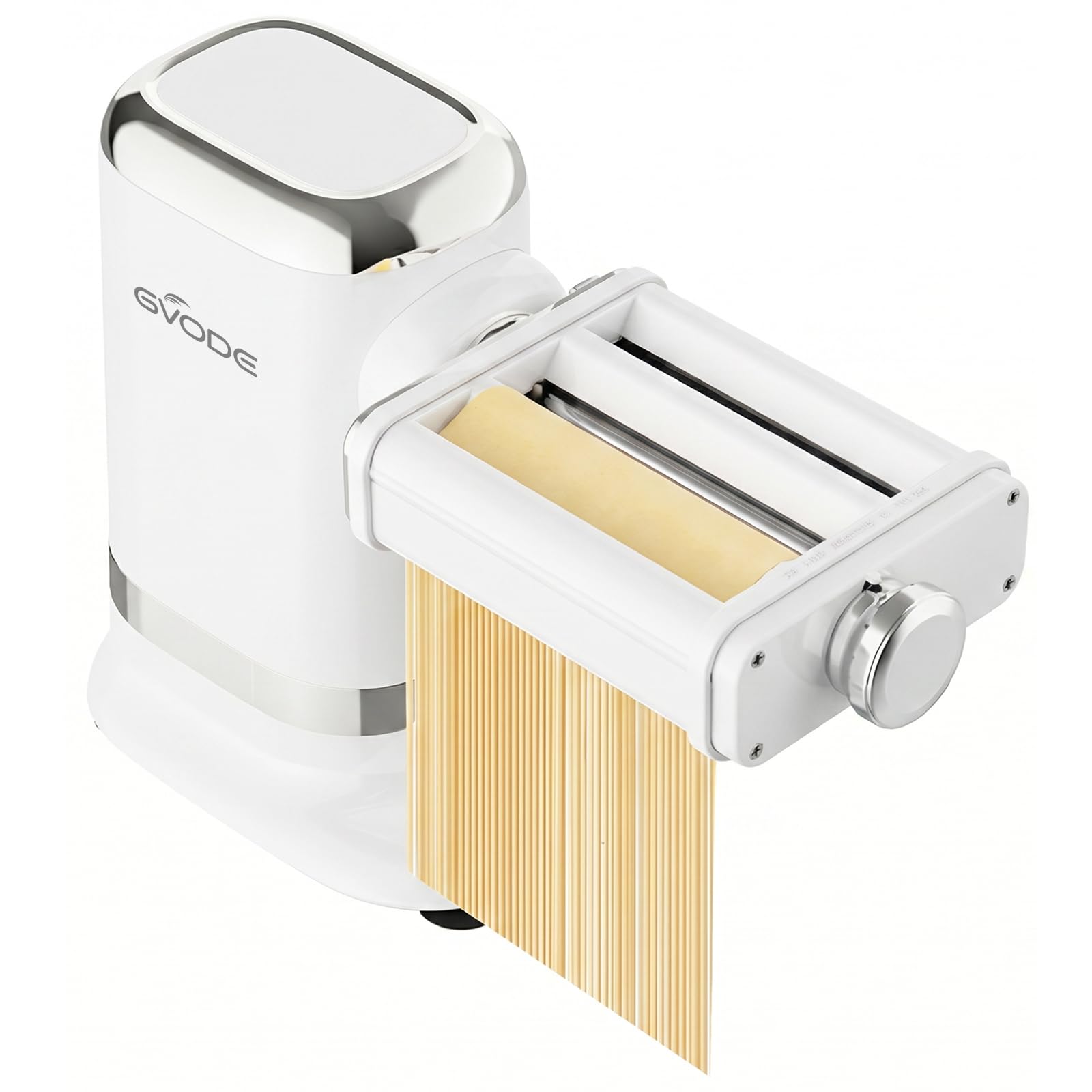
| GVODE 3-in-1Best for Small Kitchens | Small kitchens and storage | Electric roller and cutter | 3-in-1 set | 0.4-2mm | Amazon |
| Newhai 135W Stainless | Two noodle widths, heavy use | Electric roller and cutter | 2 | 0.5-3mm | Amazon |
| CGOLDENWALL CGO-Q6 | Maximum shape variety | Automatic extruder | 12 | — | Amazon |
| Luzrise Stainless Steel | Widest thickness range | Electric roller and cutter | 4 | 0.5-5mm | Amazon |
| Philips HR2370/05 | Fast everyday pasta | Automatic extruder | 3 | — | Amazon |
| LEONEBEBE Dual-Cutter | Big batches and small business | Electric roller and cutter | Dual cutter | 0.1-5mm | Amazon |
Detailed Reviews
1. MARCATO Atlas 150 Machine, Made in Italy, Red
Our pick — 4.5+★ from 2,000+ verified ratings; the strongest balance of quality and price.
A hand-crank roller with no motor to burn out.
The Atlas 150 is the pick for anyone who wants to feel the dough under their hands rather than press a button and hope. It rolls and cuts dough into sheets, with a hand crank you turn yourself so nothing can jam and nothing can burn out. The body is anodized aluminum with oxidation coloring — a coating that keeps the metal protected and simply wipes clean with a dry cloth.
What wins people over is the build quality; it is the aspect that dwarfs everything else in owner feedback. The machine also carries a 10-year manufacturer warranty, which is a real signal of how the company feels about its own craft. It is compact in a way a motorized unit is not — its dimensions come in at 8.11″L x 8.27″W x 5.9″H, so it tucks away on a shelf rather than owning a whole cupboard shelf. Compare that to the VEVOR’s 13.4″L x 7.1″W x 11″H footprint and the size difference is plain.
The catch is honesty about what you are buying: this is one unit, and the one disc means one cutter setup rather than a rack of shapes. A handful of owners also report the moving parts giving out early, while many others describe it as heavy-duty. Kneading the dough is your job before the crank takes over — the machine flattens and cuts; it does not mix. That is how a manual roller works, and it is why the noodles get the bite ramen wants.
What earns its keep
- Anodized aluminum body wipes clean with a dry cloth
- 10-year manufacturer warranty backs the craft
- 8.11″L x 8.27″W x 5.9″H stores on a shelf
- Zero motor parts, so nothing can overheat
Where it asks more of you
- You knead the dough yourself before rolling
- One disc means one cutter width from the start
- Cranking is manual arm work on every batch
Reach for this if: you want a roller that will outlive every motorized gadget on the counter and you enjoy working the dough by hand.
Think twice if: you want the machine to knead for you — this one only rolls and cuts.
2. VEVOR 150W Automatic Noodle Maker with 8 Pasta Shapes
One click, four modes, and noodles for four in 14 minutes.
If you have never made a noodle from scratch, this is the gentlest way in. The VEVOR runs four automatic modes — you add ingredients, press a button, and the two-way kneading rod and four-dimensional mixing do the work of hands. It turns 500g of flour into enough noodles for about four people in 14 minutes, which is the single number that sells it.
Eight molds come in the box, so you get a range of shapes from wide ribbons to round strands without buying anything extra. The parts go in the dishwasher and a cleaning brush and spatula are included, so the after-dinner chore is short. Owners are happiest with the results themselves — the performance is what gets praised most — and easy assembly gets a warm reception too.
Here is the honest part, and it matters more on this machine than on any other here: water ratio is everything. Add too much water and the dough will not pass through the extruder and sticks inside. Follow the flour-to-water table in the Quick Start guide, and a first batch goes smoothly; eyeball it, and you are in for a frustrating afternoon. A few owners have hit exactly that wall, with a small cluster reporting dough feed and durability trouble.
The ratio rule: measure the water by the included cup exactly — the machine rewards precision and punishes guesswork.
What the size means: at 11 pounds it stays put on the counter while the motor works, so you are not chasing it across the countertop.
Go here for: a first automatic machine that kneads and extrudes for you with eight shapes included.
Pass if: you refuse to weigh water — this machine needs the ratio respected.
3. GVODE 3-in-1 Electric Pasta Roller & Cutter Set
The lightest machine here, and the easiest to lift in and out of a cupboard.
At 5.2 pounds this is the lightest unit on the list — the Newhai, for comparison, is 16 pounds, so the GVODE is the one you can actually move with one hand. That matters in a small kitchen where a machine that lives in a cupboard has to be easy to grab. The 700W motor is the highest wattage of any machine here, and it rolls sheets from 0.4mm up to 2mm across 8 thickness settings.
Two speeds plus a reverse mode let you back dough out if it bunches, which is a small feature that saves a whole batch. The housing is plastic but the drive gears are metal, so the rollers hold alignment. Owners consistently call the performance the best thing about it, and speed is a frequent note — it beats the hand-crank process for effort if not for texture.
The trade-off runs to motor care. Run it in 15-minute batches with a 5-minute cool-down between, keep the vents clear, and it holds up; skip the rest step too often and a small number of units overheat or quit early. For clean cuts, run the sheet through 3-4 times on progressively thinner settings before cutting — the dough should feel like soft modeling clay, not sticky.
Why it fits a tight kitchen
- 5.2 lb lifts out one-handed
- 700W motor, highest here
- 8 settings span 0.4mm to 2mm
- Metal drive gears hold roller alignment
Treat it kindly
- Needs a 5-minute cool-down every 15 minutes
- A few units overheat when pushed hard
Built for: cramped counters where the machine has to go back in the cupboard after every batch.
Skip if: you plan to run it back-to-back for an hour — the motor wants rests.
4. Newhai Electric Pasta Maker, Stainless Steel 135W

Full stainless steel, low noise, and two noodle widths done properly.
This machine does two things and does them with steel. The body, roller and noodle blade are all 430 stainless steel, and the food-contact parts are food-grade so they meet dough directly. That build is why it weighs 16 pounds — it sits on the counter like a fixture. It makes two noodle widths, a 1.5mm thin round strand and a 4mm flat noodle, at 11lb/h of output.
The thickness knob runs 1 through 8, from 0.5mm up to 3mm, with the 8th gear thinnest. That is the widest adjustable range of any machine on this list other than the Luzrise, and it lets you press a sheet for ramen and roll a thicker one for dumpling wrappers on the same machine. The 135W motor runs quietly enough that owners consistently say it does not disturb the family.
The honest catch is weight and voice: 135W is modest next to the 700W GVODE, so this is a gentle machine, not a fast one. The 16-pound body also needs a permanent spot. What it does offer is one-key switching from pressing to cutting, rounded corners that will not scratch your fingers, and a near-silent working environment. It is a stainless workhorse built for steady use, not a countertop gadget.
Where it shines: two widths and an 8-gear, 0.5-3mm range mean ramen and dumpling wrappers from the same machine.
The honest limit: 16 pounds is heavy, and 135W is a slow motor — this is a fixture, not a portable gadget.
Consider it: a stainless machine that presses and cuts for you and stays whisper-quiet while it does.
Look elsewhere if: you need to move it after each use — this one wants a permanent home.
5. CGOLDENWALL Automatic Pasta Maker with 12 Shape Discs

Twelve discs, 650g of flour, and a smart touch panel that does the mixing.
Twelve shape discs is more than any other machine on this list — the VEVOR has 8 and the Philips has 3. It kneads, extrudes and cuts on its own with a smart touch panel and a clear flour-to-water ratio shown on the panel. A 650g flour capacity makes 3-5 servings at once, and 10 minutes is the time from ingredients to fresh noodles.
Other flavors are welcome: vegetable juice, eggs and gluten-free flour all go in, so you can color and fortify the dough to family taste. Detachable components are dishwasher-safe, and the main body just needs the dough dried off and brushed clean. Pasta quality is the thing owners praise most, with ease of use close behind.
The catch is real and worth saying plainly: dough extrusion is the recurring weak point, with a small number of owners finding the auger does not push dough out properly. That can mean a gummy batch when the ratio is off. If your dough is too wet or too dry the extruder is unforgiving. Follow the ratio on the panel and keep the batch size within the 650g capacity, and the machine behaves.
Where the variety lives
- 12 discs, most on this list
- 650g flour makes 3-5 servings
- Smart touch panel with ratio guidance
- 10 minutes batch to table
The honest caveat
- Auger can stall on off-ratio dough
- Main body is not dishwasher-safe
Pick it for: making 12 shapes from one machine without buying extras and color it with veggie juice.
Not for: anyone who refuses to keep the water ratio on the panel — the auger will let you know.
6. Luzrise Electric Pasta Maker, 4 Blades, Stainless Steel

A 0.5mm-to-5mm range that handles everything from ramen to dumpling dough.
Five millimeters at the top and half a millimeter at the bottom: that is the range on the Luzrise, the widest sheet thickness of any roller here. Thin sheets go for ramen-style strands, thick sheets go for dumplings and ravioli, and 9 settings let you land between them. Four blades cover 1.5mm, 2.5mm, 4mm and 9mm widths, so you get everything from thin round strands to wide flat ribbon.
The 135W motor is built in and positioned next to a heat dissipation system to keep heat in check, and the maker rates it for up to 1 hour of quiet, jam-free running. The body is 304 stainless steel with an ABS shield to protect the polish, and the whole thing measures 13.2*13*11.6″ — sizeable but not a counter hog. A two-year warranty backs it.
One habit to build: run the dough through the roller several times on progressive settings before cutting, which relaxes the dough so the blades slice instead of tear. That is the difference between clean ramen strands and a ragged sheet. The build quality is what owners praise most, and the operation is plain enough to learn on the first batch.
The standout: 9 settings across 0.5-5mm give you the widest sheet range on this list for one machine.
Worth knowing: it needs a few progressive passes through the roller before cutting — skip that and the blades tear the sheet.
Best fit for: cooks who want both paper-thin ramen sheets and thick dumpling dough from a single stainless machine.
Be ready to: feed the sheet through several passes before cutting — the roller rewards patience.
7. Philips HR2370/05 Compact Pasta and Noodle Maker

Kneads and extrudes 2-3 servings in 18 minutes with three classic discs.
The Viva HR2370 gets a batch from flour to fresh strands in 18 minutes, kneading and extruding 2-3 servings on its own. Three default discs — spaghetti, penne and fettuccine — use a double extrusion process that keeps the pasta smooth on both passes. The stirring bar is the piece that does the kneading, and it earns the speed.
Owners are happiest with the performance and the plain ease of it: compared to a bread machine, the ritual is simpler and the wait is short. You swap flours and add egg, herbs, spinach or carrot juice to change flavor and color without changing discs. A space-saving shape means it can stay out on the counter, and the discs store inside the machine. The 40-inch cord gives you some slack along the counter.
The honest trade-off is that cleaning is the most-discussed mixed point: some find everything machine-washable and easy, others find the dough residue a pain to reach. The 2-3 serving size is also a small batch — you will run it twice for a big family. Set against that, the whole cycle is 18 minutes, so a second run is not a long wait.
Why the cycle time wins: 18 minutes for 2-3 servings means fresh noodles on a weeknight, not just a weekend project.
The cleanup question: detachable parts are machine-washable, but the nooks around the stir bar take a brush.
Reach for it: simple weeknight pasta with three classic discs and a recipe book to learn from.
Think twice if: you cook for a crowd — 2-3 servings is a small batch.
8. LEONEBEBE Dual-Cutter Electric Noodle Maker, 550W
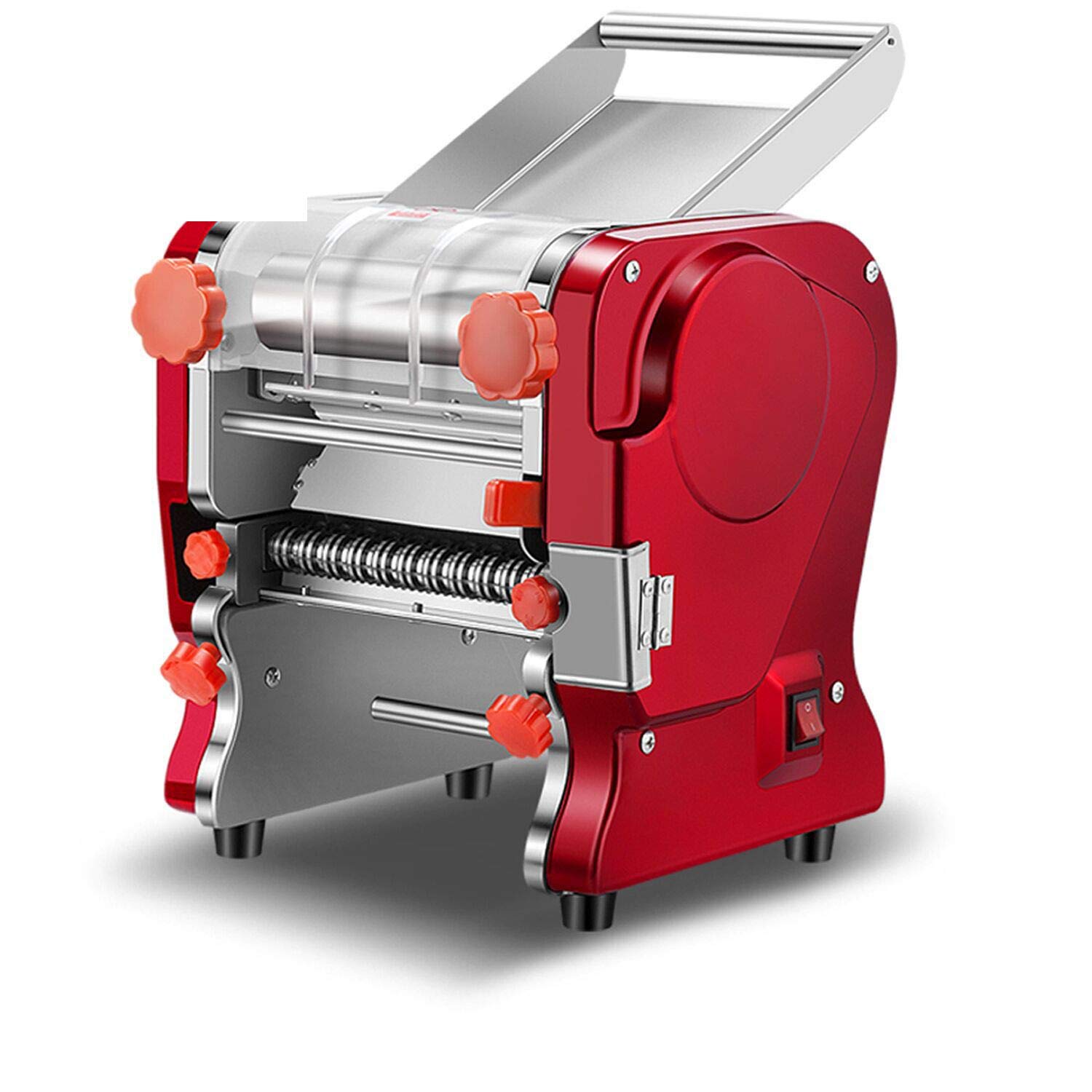
A 550W stainless machine built for a restaurant line as much as a home kitchen.
Most machines here are rated for home use; this one is built for both. The 550W motor and all-stainless body handle the whole family’s noodles in under ten minutes, and the same machine is rated to turn out 55lbs of noodles an hour for a small business. Its dual cutter makes 3mm and 9mm flat noodles at once, toggled by a mode switch between cutting noodles and pressing dough.
The sheet thickness runs from 0.1mm up to 5mm on the low end of the dough adjustment, so the same roller handles thin ramen and a thicker wrapper for dumplings and wonton skins. A 2-in-1 cutter lets you run two widths at once, and the machine kneads, presses and cuts as one operation. It measures 13″L x 10″W x 18″H and carries a one-year warranty.
The obvious catch is weight and footprint: at 44 pounds this is the heaviest machine on the list, and the 18-inch height makes it a countertop fixture you will not move between uses. That heavy stainless build is what earns the commercial rating, and owners single out the sturdy construction. A few owners find the accessory range limited for the shapes they want, so check the widths fit your plan.
Built to work: 550W, all-stainless, 55lbs/hr — this one is spec’d for a noodle shop that also feeds a family.
Space to budget: 44 pounds and 18 inches tall mean it wants a dedicated corner.
Choose it if: you want commercial-grade capacity with two noodle widths running at the same time.
Only if: you can give a 44-pound machine a permanent counter spot.
Know the Specs
Motor Wattage and Batch Cycle
Wattage tells you how much muscle the motor has, not how fast your noodles appear. The GVODE runs 700W, the LEONEBEBE 550W, the CGOLDENWALL 260W, and the VEVOR, Newhai and Luzrise each run 150W or 135W. Higher wattage generally means a machine that can run longer and push through tougher dough, while a lower figure often comes with a quieter, slower pace. Match the motor to your batch size — a low-watt machine paired with long batches will stall or overheat.
Sheet Thickness in Millimeters
Thickness in millimeters is the number that decides which noodles you get. Thin sheets in the 0.4-1mm range are what ramen-style strands and delicate pasta want, while a 3-5mm sheet makes dumpling and wonton wrappers that hold filling. Adjustable ranges beat a fixed gap because you can dial between. The Luzrise spans 0.5-5mm, the Newhai 0.5-3mm, the GVODE 0.4-2mm, and the LEONEBEBE 0.1-5mm.
Common Questions
Will an extruder machine make noodles like the chewy ramen I buy fresh?
How much flour does a typical automatic ramen noodle machine hold?
Do I have to knead the dough myself before using a hand-crank machine?
Why does my dough stick inside the machine instead of coming out?
How long can I run an electric pasta machine before it needs a rest?
Can these machines make dumpling wrappers as well as noodles?
Are the parts dishwasher-safe?
Is a heavier machine better for making noodles?
What is the difference between a roller machine and an extruder machine?
How many noodle shapes can I make without buying extra discs?
The Bottom Line
For most kitchens, the ramen noodle machine winner is the MARCATO Atlas 150 because its anodized aluminum body, dry-cloth cleanup and 10-year warranty make it the machine that keeps working when the motorized ones need a rest. If you want the machine to knead and extrude for you, grab the VEVOR 150W Automatic — 8 discs and noodles for four in 14 minutes with one button. And for a stainless workhorse that presses and cuts two widths quietly, the Newhai 135W is the one to reach for. Buy the one that matches the noodles you actually plan to make.
How we choose
We do not accept paid placement. Every pick is matched to a real buyer and a real use-case; we do not hands-on test units.
Sources
Specifications: manufacturer listings and product documentation. Review insights: verified customer reviews, as of November 2026. Pricing: not shown on this page (it changes often); check the current price via the retailer link.
As an Amazon Associate, Tactical Gear Guy earns from qualifying purchases. This does not affect which products we feature.