Specs are compiled from manufacturer listings and verified buyer reviews and can change over time — please confirm the key details on the product page before buying.
The pedal that decides your lap is the brake, and the only thing that makes it consistent is a load cell — a sensor that measures how hard you press instead of how far the pedal travels. That load cell is what separates a wheelstand toy from a rig you can actually learn on. This guide covers the eight sets worth your money, from an entry-level Logitech that punches far above its tier to a CNC-machined MOZA built for a full cockpit.
This guide is built by comparing the manufacturers’ published specifications and the patterns across verified customer reviews, so you get each pick’s real strengths and trade-offs instead of marketing spin.
You want a brake that returns the same pressure lap after lap, not a pedal that fights you. Below you get the brake force ratings, the adjustability each set actually offers, and the platform compatibility that decides whether your pedals plug into a console or a PC. Every pick here uses a load cell brake (a brake that measures how hard you press, not how far the pedal travels), so the real sorting depends on feel and fit. These eight load cell sets are the ones that turn sloppy braking into repeatable lap times.
Top Picks
How To Choose The Best Race Sim Pedals
The shortest version: buy for the brake first, then check what your wheel base and your platform will accept. Everything else — springs, spacers, rubber feet — is tuning you can adjust later. Start with the three decisions below and you will not end up with a set that fights your rig.
Start With Brake Force, Not Brand
The brake load cell is rated in kilograms of force — the ceiling of how hard you can press before the pedal bottoms out. More force means a firmer, more car-like pedal that rewards a firm foot. Less force means an easier pedal that suits a light rig and a softer touch. Check the number and picture your own foot on it before anything else.
Match the Mount Before the Feel
Pedals bolt to a wheelstand, a cockpit, or nothing at all. Some sets ship with a baseplate and some do not, so measure your mounting surface first. A three-pedal set with a clutch needs more floor space than a two-pedal set. If you race on a console, confirm the pedals connect to your wheel base, not just to a PC via USB.
Adjustability You Will Actually Use
Pedal spacing, height, and face angle change how your legs sit during a long stint. Elastomer stacks — the rubber pucks inside the brake that create the pedal’s firmness — change the feel. A set with several hardness options lets you tune brake firmness without buying anything extra. A set with one fixed stack is fine if it matches your foot.
Side-by-Side Comparison
| Model | Best For | Brake Load Cell | Pedals | Platform | Amazon |
|---|---|---|---|---|---|
| Logitech G RS Sim Racing Pedals★ Best Overall | Entry into load-cell braking | 75 kg | 2 standard (clutch module optional) | PC, PS4, PS5, Xbox Series S/X | Amazon |
| MOZA SRP2 Pedals SetBest Brake Tuning | PC racers who tune brake feel | 100 kg | 2 (throttle and brake) | PC | Amazon |
| Simjack UT PedalsTop Brake Force | Firm brake under a heavy foot | 200 kg | 3 (throttle, brake, clutch) | PC | Amazon |
| SIMSONN Plus X | Hydraulic feel on a budget rig | Hydraulic system | 3 (throttle, brake, clutch) | PC | Amazon |
| FANATEC CSL Elite Pedals V2 | Console and PC mixed setups | Up to 90 kg measured foot force | 3 (throttle, brake, clutch) | PC, PS5, PS4, Xbox | Amazon |
| SIMSONN PRO Plus | Full rigs with haptic add-ons | Hydraulic system | 3 (throttle, brake, clutch) | PC | Amazon |
| Logitech G PRO Racing Pedals | Modular setup under a premium wheel | 100 kg | 3 (throttle, brake, clutch) | PC, PS4, PS5, Xbox | Amazon |
| MOZA CRP2 Pedals | Cockpit builds with inverted mounting | 200 kg | 2 (throttle and brake) | PC, Xbox One, Xbox Series X | Amazon |
Detailed Reviews
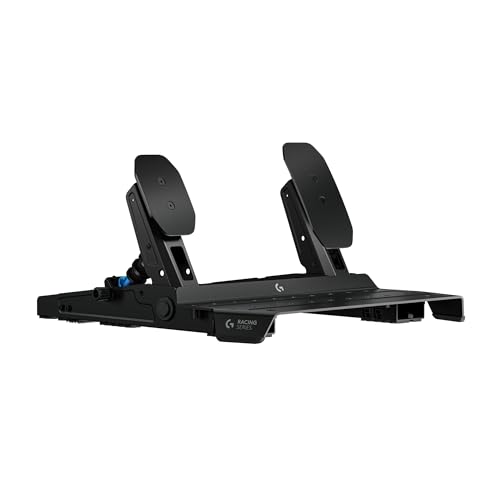
1. Logitech G RS Sim Racing Pedals (with 75 kg Load Cell Brake)
Our pick — 4.5+★ from 200+ verified ratings; the strongest balance of quality and price.
A steel-framed pedal set that puts real load-cell braking underfoot without a cockpit-sized commitment.
The brake here is rated at 75 kg of force — a load cell that registers exactly how hard you press rather than how far the pedal travels. In plain terms, that is the difference between a brake you squeeze by force like a real car’s and one you push by travel like a toy. Every trail-braking habit you build depends on the pedal returning that force consistently, and a load cell is what makes consistency repeatable instead of luck.
The RS earns its spot with a frame that stays put when you stamp on the middle pedal. You get an anti-tip steel chassis, large rubber feet for hard floors, carpet grippers for carpeted rooms, and an extendable wall brace — four different ways to stop the whole thing sliding. Pedal positions adjust on the frame too, so you can line the brake up under your foot instead of leaning your leg sideways. That stability and adjustability are why the RS works as a starter set.
The throttle and the optional clutch use Hall Effect sensors — contactless magnetic sensors that never physically rub against anything. That means no worn tracks and no scratchy dead spots over long use, which is the usual failure mode on cheap pedal potentiometers (the older sensor type that wears as it rubs). The catch is compatibility: the RS connects straight to a PRO or RS50 wheel base for console play, but a G-Series wheel needs the Racing Adapter sold separately, and older wheels can also run it over USB on PC.
Where It Delivers
- 75 kg load cell brake gives a genuinely firm, car-like pedal for reading out consistent brake pressure
- Anti-tip steel frame with rubber feet, carpet grippers, and a wall brace for four options against slide
- Hall Effect throttle and clutch remove the wear that kills cheap potentiometers
- Adjustable pedal positions and an optional clutch module for expanding later
What To Plan Around
- Console play needs a PRO or RS50 base; a G-Series wheel needs the separately sold Racing Adapter
- The clutch pedal is an optional module, not included in the standard set
My honest read: Logitech made a set that stops sliding and reads your braking force accurately, at a builder-friendly price — that is everything the first serious pedal upgrade needs to do.
The one snag: plan the clutch purchase and check your wheel base before you buy; this is a two-pedal set from the start.
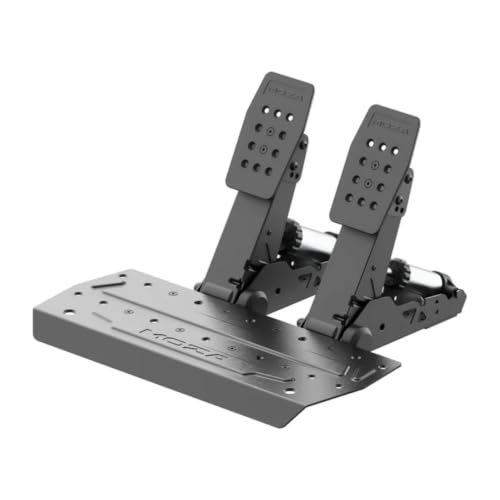
2. MOZA SRP2 Pedals Set
Twenty-five brake configurations from one box — the SRP2 is a tuning bench disguised as a pedal set.
The number that matters here is 25: the standard elastomer and multi-hardness spring setup delivers 25 brake feel configurations. That is the count of different firmness combinations you can build by swapping the rubber pucks and springs, which changes how the brake bites at the top of the travel. If you drive a stiff formula-style car one night and a softer road car the next, the pedal can follow you. The optional Performance Kit pushes that up to 1,000+ setups with F1/LMP1-style ultra-responsive feedback, but the 25 you get in the box already cover most driving styles.
Underneath sits a 100 kg load cell — the sensor that measures brake force in kilograms. That is below the 200 kg rating of the Simjack UT, and above the 75 kg brake on the Logitech RS. In practice, 100 kg is a firm pedal that still rewards a moderate foot, and it suits a lot of drivers who do not want to brace a whole rig against a wall. The advanced sensor fusion blends angle and force data, so the brake reads both how far and how hard you press.
Ergonomics get real attention too. You get a two-stage pedal face angle adjustment at 10° or 25°, adjustable pedal spacing of ±15 mm, and a height range of 36 mm. In plain terms, you can set the pedal face to 10° or 25°, shift spacing ±15 mm, and adjust height across 36 mm to fit your hips and ankle angles. It is a two-pedal set — throttle and brake — so it is a PC-first pick for racers who do not need a clutch. The catch: it is PC only, no console support.
What lands well: 25 brake configurations from the start give you real flexibility to dial in a firmness that matches your leg, and the CNC-machined aerospace-grade aluminum body keeps the pedal feeling tight rather than flexy.
What it asks of you: the platform list is PC only, and the Performance Kit that open up 1,000+ brake setups is an extra purchase.
The SRP2 strikes me as the right answer for: a PC racer who wants to tune brake firmness by vehicle and does not need a clutch pedal.
Look elsewhere if: you race on a console or you want a three-pedal set in the box.
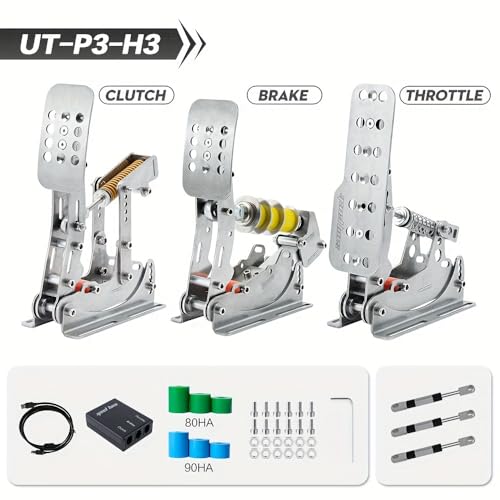
3. Simjack UT Sim Racing Pedals 200KG Load Cell Brake Pedal
The biggest brake-force ceiling here — 200 kg of load cell travel for a foot that likes to stand on it.
Set the Simjack UT’s 200 kg brake rating beside the Logitech RS’s 75 kg and the gap speaks for itself. You get a pedal you can lean into hard without running out of travel, which suits heavy-footed brakers who want feel to progress deeper into a corner rather than hitting a wall. The UT loads up a triple-pedal set — throttle, brake, and clutch — with the brake’s load-bearing part thickened to 6 mm in CNC-cut stainless steel.
The electronics are dressed for a lively rig. A 32-bit dual-core processor and a 16-bit independent ADC chip handle sampling across all three channels at once, held in an aluminum casing for interference resistance. That matters when other gear on the rig — a wheel base or a moving seat — throws signal noise at the pedals. In plain terms, the brake keeps its readings clean and consistent when a wheel base or moving seat throws signal noise at the pedals. Brake damping comes with imported rubber in 60, 80, and 90 hardness, so you can firm the pedal up or soften it.
The Simjack Control software lets you set linear pedal output curves, dead zones, and brake curves, then save them as profiles that follow you across sim software. One practical note: the mounting spec here is built around Steam ESR (Extreme Sim Racing) wheel stands and cockpits, and the pedal is PC-only — no PS4, PS5, Xbox, or Mac support. The 12-month manufacturer warranty covers defective units.
The Firm Pedal Case
- 200 kg load cell brake for a deep, firm travel that rewards a heavy foot
- 32-bit dual-core processor with a 16-bit ADC chip and three-channel sampling for clean signals
- 60/80/90 hardness rubber damping and a Simjack Control software suite for brake curves and dead zones
- 6 mm thick load-bearing steel and CNC stainless construction for a solid feel
The Fit Notes To Weigh
- PC-only — the spec sheet lists no PS4, PS5, Xbox, or Mac support
- Mounting is aligned to Steam ESR wheel stands and cockpits, so check your rig first
Short answer for the heavy-footed: if you want the most brake force in this group and you race on PC, the UT is the pedal to reach for.
The caution: that 200 kg firmness rewards a firm foot — if you drive with a light touch, a lower-force set will feel more natural.
4. SIMSONN Plus X Racing Simulator Hydraulic Pedals

A hydraulic brake that slows the pedal stroke in and out, for a brake that resists your foot like a real pedal box.
The Plus X uses hydraulic brake technology rather than a load cell alone. The hydraulics slow the speed of the pedal going in and out, which restores the progressive, non-linear feel of a real car brake — a pedal that pushes back harder the further you press. That matters most when you trail brake into a corner and want the pressure to build rather than snap. It also simulates the clutch’s dynamic response, so the third pedal behaves less like a switch and more like a mechanism. Rounding it out: 60HA, 70HA, and 80HA elastomers with 13 spacers for many brake feel combinations.
The hardware itself is built for a long life under heavy use. High-strength steel and a dual-bearing design with flange bearings and plane bearings keep the pedal movement smooth and precise, without the slop that shows up in cheaper pedals over time. The upgraded control box has three vibration module ports for SIMSONN’s VAM, VAM RPO, and VAM Neo motors. If you plan to add haptics to feel the road through your pedals, that is a real feature rather than an afterthought.
What wins people over is the quality of the build for the price. The ergonomics get more divided feedback — some find the pedal comfortable, others note a stiff feel — so it is worth planning your mounting position before you start. The SIMSONN Manager software handles pedal curves and dead zones and saves them to a config file. Note the 24-month warranty on the pedals; accessories get 3 months. PC only.
Why the hydraulics matter: a progressive brake stroke that builds resistance as you press is exactly what makes real braking feel informative. The Plus X puts that in a PC pedal set with a steel-and-dual-bearing build that should hold its tightness.
The fit question: the ergonomics split the room — comfortable for some, stiff for others — so be ready to adjust spacing and take a session to settle in.
Reach for this if: you want the feel of a hydraulic brake and plan to add haptic vibration motors to your pedals.
Think twice if: you prefer a lighter pedal from the start or you race on anything other than a PC.
5. FANATEC Sim Racing CSL Elite Pedals V2
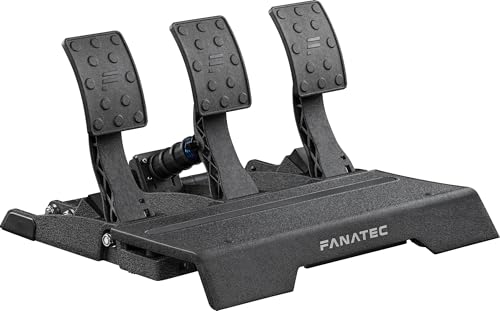
A three-pedal set with a 90 kg brake and swappable elastomers, tuned for rigs that mix console and PC.
The CSL Elite V2 measures up to 90 kg of foot force on the brake plate, with a load cell sensor rated above 200 kg underneath. In plain terms, you press a firm pedal plate that reports up to 90 kg of your actual foot force, while the load cell beneath is rated above 200 kg. It fits between the 75 kg Logitech RS and the 200 kg Simjack UT in brake feel — a step up in firmness without demanding a full-on heavy foot.
The build is what earns the praise: the clutch and throttle use contactless Hall sensors for precision without wear, so throttle response stays clean over time. The brake runs an elastomer stack combined with the load cell, and the box includes 65, 75, and 85 Shore hardness elastomers plus an alternative metal spring for stiffer preload. Shore hardness is simply the rubber’s firmness rating — softer pucks give a longer, cushionier stroke, harder ones snap back faster. Every change is tool-free.
You can also run the CSL Elite V2 as a two-pedal set by configuring it that way, slide the pedals sideways along the heel rest, and pull the rubber pedal covers off. Connection is the practical divider: it is PC-only as a standalone USB input device, but it hooks up to all compatible Fanatec bases via RJ12. PS5 and PS4 work with a PlayStation-licensed Fanatec base, and Xbox works the same way with an Xbox-licensed Fanatec wheel.
The Case For It
- 90 kg brake with a load cell rated above 200 kg gives firm, measurable force without an extreme press
- 65, 75, and 85 Shore hardness elastomers and an alternative metal spring for tool-free tuning
- Hall sensors on the throttle and clutch cut wear and keep response clean
- Configurable as two pedals, and adaptable to PlayStation or Xbox through licensed Fanatec gear
Details To Know
- As a standalone USB device it is PC-only; console play requires a console-licensed Fanatec base or wheel
- The alternative metal spring and elastomer swaps are a few minutes of setup time you will revisit
Bottom line: a three-pedal set with a genuinely firm 90 kg brake that stays honest to both console and PC racers who stay inside the Fanatec ecosystem.
Mind the requirement: console compatibility runs through a console-licensed Fanatec base, not the pedal’s own USB port.
6. SIMSONN PRO Plus Pedals for PC Racing Simulator

The Plus X’s hydraulic hardware with a stronger control box — and a haptic path that needs care at checkout.
The PRO Plus runs the same hydraulic brake technology as the Plus X, so the pedal stroke slows in and out for that progressive, non-linear brake feel. It brings the same 60HA/70HA/80HA elastomers with 13 spacers for a spread of brake feel combinations. Where it steps up is the control box: it has stronger anti-interference and three vibration ports for SIMSONN’s VAM and VAM RPO motors. That makes it the pick if you want a haptic pathway built into your pedals.
The hardware is high-strength steel with a dual-bearing design using flange and plane bearings, so pedal movement stays precise and smooth. The SIMSONN Manager software handles non-linear curves, dead zones, and brake curves, saved to a config file you reload in a few clicks. Quality is what this pedal gets praised for, closely followed by value.
Read the checkout note carefully before you buy. If you want the Haptic Reactor, add it to your order; if you do not, leave it off. If you plan to run a haptic reactor on PRO or PRO PLUS pedals, you need to buy an additional new PLUS X control box. The warranty runs 12 months on defective units with accessories at 3 months, and it ships PC only from China. One more sizing reality: the listed body dimensions are 18.11 x 13.39 x 6.69 inches — treat those as the space your mounting plate needs, not the pedal footprint alone.
Its appeal: a hydraulic brake with a steel dual-bearing build and a control box that has real haptic ambition, backed by consistent quality praise.
The care point: the haptic module is not simply plug-and-play with this pedal’s box — get your configuration sorted at checkout.
The right buyer: a PC builder planning a vibration-motor rig and happy to order the haptic parts alongside the pedals.
The part to research: the extra PLUS X control box if you plan a haptic reactor on PRO or PRO PLUS pedals.
7. Logitech G PRO Racing Pedals

The modular pedal board — slide the pedals where you want them or remove one entirely.
The PRO steps the Logitech line up from the RS’s 75 kg brake to a 100 kg load cell. In everyday terms, you get a firmer pedal that reads pressure more precisely and builds the muscle memory trail braking needs. Where the PRO shines is the body: each pedal slides horizontally for spacing, and you can pull a whole pedal module off to build a two-pedal layout. That flexibility is rare, and it means the pedals can match your footwear and hip width instead of forcing your legs into Logitech’s spacing.
You also get swappable gas and clutch springs and brake elastomers, so you can change throttle and clutch return feel along with brake firmness. The clutch and throttle run contactless Hall effect sensors, so they stay accurate over many sessions without the wear of a rubbing potentiometer. The whole set is designed to pair with the PRO Racing Wheel, PRO X Lightspeed Wireless Headset, and the Playseat Trophy Logitech G Edition if you are building a single-brand cockpit.
The honest trade-offs come in part fit. Precision drew mixed opinions — some find the pedal spot-on, others less so — and value for money had its dissenters too. The pedals are ergonomic and the adjustability is well regarded, so the answer is to give yourself a session or two to set spacing before you judge. It is compatible across PC, PS5, PS4, and Xbox, and the portable pedal weight of 922 g per pedal makes fitting and setup easy enough to do alone.
The Modular Advantage
- 100 kg load cell brake steps up from the 75 kg RS for firmer, more consistent braking
- Each pedal slides horizontally or removes entirely to build a two-pedal layout
- Swappable gas and clutch springs plus brake elastomers for tuning throttle and brake feel
- Hall effect sensors on the throttle and clutch for long-term accuracy
- Compatible with PC, PS5, PS4, and Xbox
The Trade-offs
- Some drivers find the precision less than perfect and the value less than they expected
- Its fully modular design tempts you into buying more pedals than you need — the three you get are already enough for most
The fit: a cockpit builder who wants to lay out three pedals exactly where their legs sit — or drop one — and stays inside the Logitech family.
Plan on: a setup session to find your spacing, since precision impressions vary and adjustment is the answer.
8. MOZA CRP2 Load Cell Pedals (Throttle+Brake)

CNC aluminum, a carbon fiber heel plate, and a 200 kg brake — the cockpit-first set.
The CRP2 matches the Simjack UT’s 200 kg load cell — the highest brake force in this group — and wraps it in CNC aerospace-grade aluminum with a carbon fiber heel plate underneath. In daily terms, a 200 kg brake rewards a firm, confident press and punishes a light one. If your leg is light, a lower rating like the Fanatec’s 90 kg or the Logitech RS’s 75 kg will feel more natural underfoot. The 15-bit high-precision angle sensor on the throttle reads pedal position finely, so throttle modulation stays smooth rather than steppy.
Tuning on the CRP2 goes wide. You get 125 combination brake pedal damper, tool-free adjustment, wide-range adjustability, and fully adjustable throttle and clutch. The damper combinations let you build a brake firmness that matches your car or driving style with fewer tools and less wrestling. If your rig is built for it, inverted mounting is supported, so you can hang the pedals for that formula-car footwell layout. A smooth and quiet design rounds out the hardware.
Quality is what this pedal gets praised for most, and the value question splits opinion: some drivers see it as an excellent option for their build, others less so. It is a two-pedal set — throttle and brake — so a clutch needs a different path. Because mounting is the headline feature, check that your cockpit can take an inverted setup before you count on it. PC, Xbox One, and Xbox Series X are supported.
Why it ranks high: 200 kg of brake force, a 15-bit angle sensor, carbon fiber under your heel, and 125 damper combinations add up to a pedal set built for serious cockpit time.
The honest caveat: it lands in the premium tier, and value drew some mixed opinion — so this is a set for a builder sure about their rig and their budget.
My pick for: a dedicated cockpit build that wants a 200 kg brake, inverted mounting, and CNC-and-carbon hardware.
Not for: a barefoot casual or anyone wanting a clutch in the box — this is a throttle-plus-brake set.
Know the Specs
Brake Load Cell (kg of force)
A load cell measures force, not travel. The kiloggram rating is the ceiling of pressure the pedal registers, so a 200 kg brake gives you far more pedal travel than a 75 kg one before it bottoms out. Higher rating means a firmer pedal that rewards a firm foot. Lower rating means a lighter, easier pedal that suits a softer rig and a lighter touch. Match the rating to how you actually brake, not to the biggest number on the box.
Hall Effect vs Load Cell Sensors
These are two different jobs. A load cell on the brake reports how hard you press. A Hall Effect sensor on the throttle or clutch reports position contactlessly, with no friction rubbing away a surface. That is why the throttle and clutch use Hall sensors and the brake uses a load cell. Both are cut above a plain potentiometer, which can wear and develop scratchy dead spots as it ages.
Elastomers and Shore Hardness
Elastomers are the rubber pucks inside the brake that create its firmness. Shore hardness rates how firm that rubber is — lower numbers give a softer, longer depression; higher numbers snap back faster. A set with 65, 75, and 85 hardness options lets you swap between firmness levels without buying new parts. A set with a fixed stack is fine if its factory settings already match your foot.
Adjustability and Mounting
Pedal spacing, height, and pedals’ face angle all change your leg position over a long stint. Adjustable spacing lets the pedals line up with your hips and ankles rather than forcing your body to fit. Mounting options are equally critical: confirm whether your set includes a baseplate, whether it supports inverted mounting, and whether it fits your wheelstand or cockpit specific brand. A great pedal set that fights your rig is worse than a decent one that fits.
Common Questions
What is a load cell brake, and why does it matter for sim racing?
Should I pick a higher or lower load cell brake rating?
Can I use these pedals on a console like a PS5 or Xbox?
Do I need a clutch pedal?
What are elastomers and Shore hardness, and do I need to change them?
Will these pedals fit my wheelstand or cockpit?
Is hydraulic better than a pure load cell brake?
Can I hook these pedals into other sim hardware?
How do haptic vibration modules work with these pedals?
How long is the warranty on these sim racing pedals?
The Bottom Line
For most people, the winner is the Logitech G RS Sim Racing Pedals — a 75 kg load cell brake, an anti-tip steel frame with carpet grippers and a wall brace, and Hall Effect throttle and clutch in one box. If you brake hard and race on PC, the Simjack UT gives you a 200 kg load cell and a 32-bit processing unit (the chip that reads your pedal input). And for a rig where experience and hydraulic feel are the priority, the SIMSONN Plus X is the one to reach for. That RS pedal quality gets mentioned most often in its reviews, and it is the reason it sits at the top.
How we choose
We do not accept paid placement. Every pick is matched to a real buyer and a real use-case; we do not hands-on test units.
Sources
Specifications: manufacturer listings and product documentation. Review insights: verified customer reviews, as of November 2026. Pricing: not shown on this page (it changes often); check the current price via the retailer link.
As an Amazon Associate, Tactical Gear Guy earns from qualifying purchases. This does not affect which products we feature.