Specs are compiled from manufacturer listings and verified buyer reviews and can change over time — please confirm the key details on the product page before buying.
You want cold drinks within arm’s reach — not a compressor that rattles through your Zoom calls or wakes you at 3 a.m. That is the whole job of a quiet small fridge. The picks below all run on a sealed compressor, so none of them is silent. What separates them is how low the noise rating goes, how much usable space you get for the floor area you give up, and whether the thing still holds temperature two summers from now.
This guide is built by comparing the manufacturers’ published specifications and the patterns across verified customer reviews, so you get each pick’s real strengths and trade-offs instead of marketing spin.
A mini fridge lives or dies on two numbers: the decibel rating while the compressor cycles and the cubic feet you actually get to fill. Both are published for every unit below, alongside the energy draw that hits your bill every month. That is why this breakdown of the quiet small fridge market sticks to the published figures and the recurring owner patterns rather than a spec sheet read aloud.
Top Picks
How To Choose The Best Quiet Small Fridge
Most people buy a mini fridge on capacity and then discover the noise problem on night one. Flip that order. Decide where the unit will sit, then work backward from the loudest thing you can tolerate in that spot.
Start with the decibel number, not the cubic feet
A decibel (dB) is a measure of sound pressure, and the scale is not linear in the way you would expect. A fridge rated at 37 dB is a meaningfully softer presence in a bedroom than one rated at 42 dB. Look for a published dB figure on the listing. If a manufacturer publishes no number at all, treat that as a blank, not a promise — several listings below simply do not state one.
Match the footprint to the gap you actually have
A fridge under a desk needs a low height. A fridge in a narrow corner needs a reversible door so the hinge can swap sides. Check the depth with the door open, not just the closed footprint, because that swing is what decides whether it clears a cabinet run. Two-door models with a separate freezer take more vertical room than a single-door box of similar capacity.
Decide if you need a real freezer compartment
Many compact fridges have an internal chiller box or a small freezer niche rather than a true separate zone. If you want ice cream to stay solid rather than merely cold, a dedicated freezer door matters. Those models tend to run larger and draw more power, so weigh the frozen-food habit against the extra energy use before you commit.
Read the energy figure as a yearly cost, not a daily one
Annual kilowatt hours (kWh/year) is the total electricity the unit uses across a year of normal running. A model at 200 kWh/year and one at 350 kWh/year behave very differently over the life of the appliance, because you leave a fridge plugged in constantly. That gap is the single most overlooked number on a mini fridge listing.
Side-by-Side Comparison
| Model | Best For | Noise Rating | Capacity | Energy Use | Amazon |
|---|---|---|---|---|---|
| Midea 1.6 Cu.ft Mini Fridge★ Best Overall | Bedroom and desk-side duty | Less than 42 dB | 1.6 cubic feet | 207 kWh/year | Amazon |
| Frestec 1.7 Cu.Ft Mini FridgeQuietest Runner | Quietest desk fridge | 37 dB | 1.7 cubic feet | 200 kWh/year | Amazon |
| DEMULLER 45L Double-Door FridgeBest Two-Zone Value | Separate freezer on a budget | 38 dB | 2.39 cubic feet | — | Amazon |
| DEMULLER 2.35ft³ Double Door | Dorm rooms and tiny spaces | 38 dB | 2.35 cubic feet | — | Amazon |
| COWSAR 2.6 Cu.Ft Fridge | Skincare and snacks split storage | 40 dB | 2.6 cubic feet | 219 kWh/year | Amazon |
| Midea 3.3 Cu.ft Mini Fridge | Pantry overflow without a freezer | Less than 42 dB | 3.3 cubic feet | 260 kWh/year | Amazon |
| Frestec 3.2 CU.FT Double Door | Small family or RV use | — | 3.2 cubic feet | 320 kWh/year | Amazon |
| Electactic 2.5 Cu.Ft Double Door | Build quality on a mid budget | Below 38 dB | 2.48 cubic feet | 350 kWh/year | Amazon |
| Antarctic Star 2.45 Cu.Ft | Dorm room rapid cooling | — | 2.45 cubic feet | 340 kWh/year | Amazon |
| Feelfunn 2.5 Cu.Ft Double Door | Bedroom use with LED light | ≤38 dB | 2.5 cubic feet | 350 kWh/year | Amazon |
| Danby DAR010A1BDB | Smallest footprint, quietest tech | Silencer Technology | 1 cubic foot | 241 kWh/year | Amazon |
Detailed Reviews
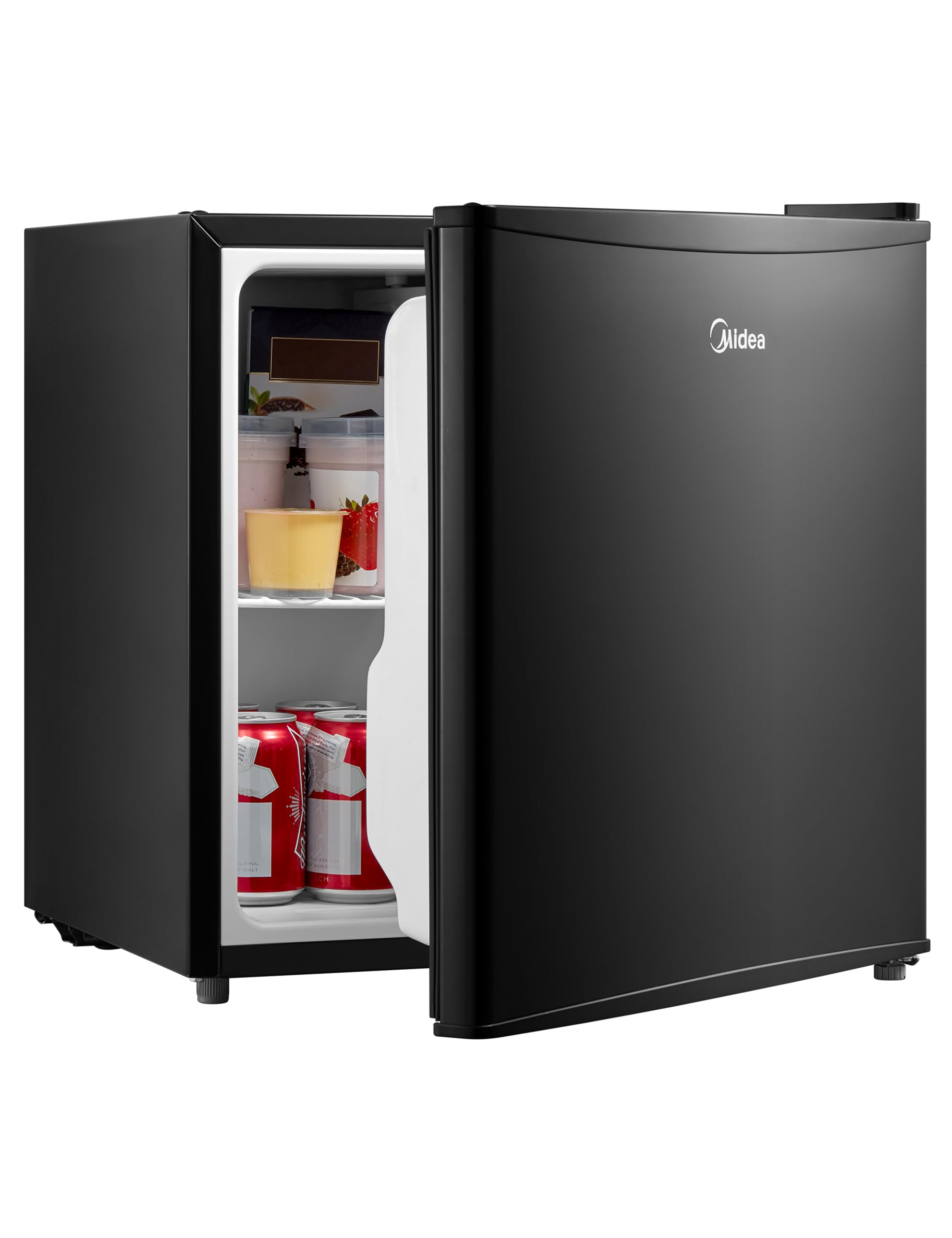
1. Midea 1.6 Cu.ft Mini Fridge
Our pick — 4.5+★ from 5,000+ verified ratings; the strongest balance of quality and price.
The 1.6-cubic-foot workhorse that fits under a desk and holds temperature better than it has any right to.
For a fridge small enough to slide under an office desk, the temperature range is what earns this pick the top spot. The mechanical thermostat holds a 28.4°F to 35.6°F window — cold enough that milk, creamer, and soda stay properly chilled rather than merely cool. That 1.6-cubic-foot capacity also covers more than you would guess, with room for several cans plus the coffee creamer and small milk carton that make an office setup actually usable.
Noise is where this one needs an honest framing. Midea rates it at less than 42 dB, which is a soft background presence rather than dead silence — fine for a den or a kitchen corner, more noticeable if you sleep two feet away. The comparison that matters is against the Frestec 1.7 Cu.Ft, which is rated at 37 dB. If the fridge sits beside your pillow, that gap is the whole decision.
Energy and build round it out. The R600A compressor draws 207 kWh/year with Energy Star certification, and the reversible door lets you flip the hinge for a tight corner. There is a single glass shelf, and it lifts out so a tall bottle or an irregular container can stand upright. Manual defrost means you schedule the thaw yourself, which is a small chore traded for one less thing to fail.
What performs night after night
- Holds a 28.4°F to 35.6°F range — drinks come out properly cold
- 207 kWh/year with Energy Star certification
- Reversible door and one removable glass shelf for tall items
- Fits under a standard office desk without crowding your feet
Where it asks for patience
- Rated at less than 42 dB — audible in a very quiet bedroom
- Manual defrost, so ice builds until you clear it
- The single shelf limits how you can split the interior
Reach for this one if: you need a desk-side or den fridge that actually keeps food at a safe cold and you can live with a soft compressor hum.
Think again if: the unit will sit within arm’s reach of your head at night — the Frestec below is the quieter build for that spot.
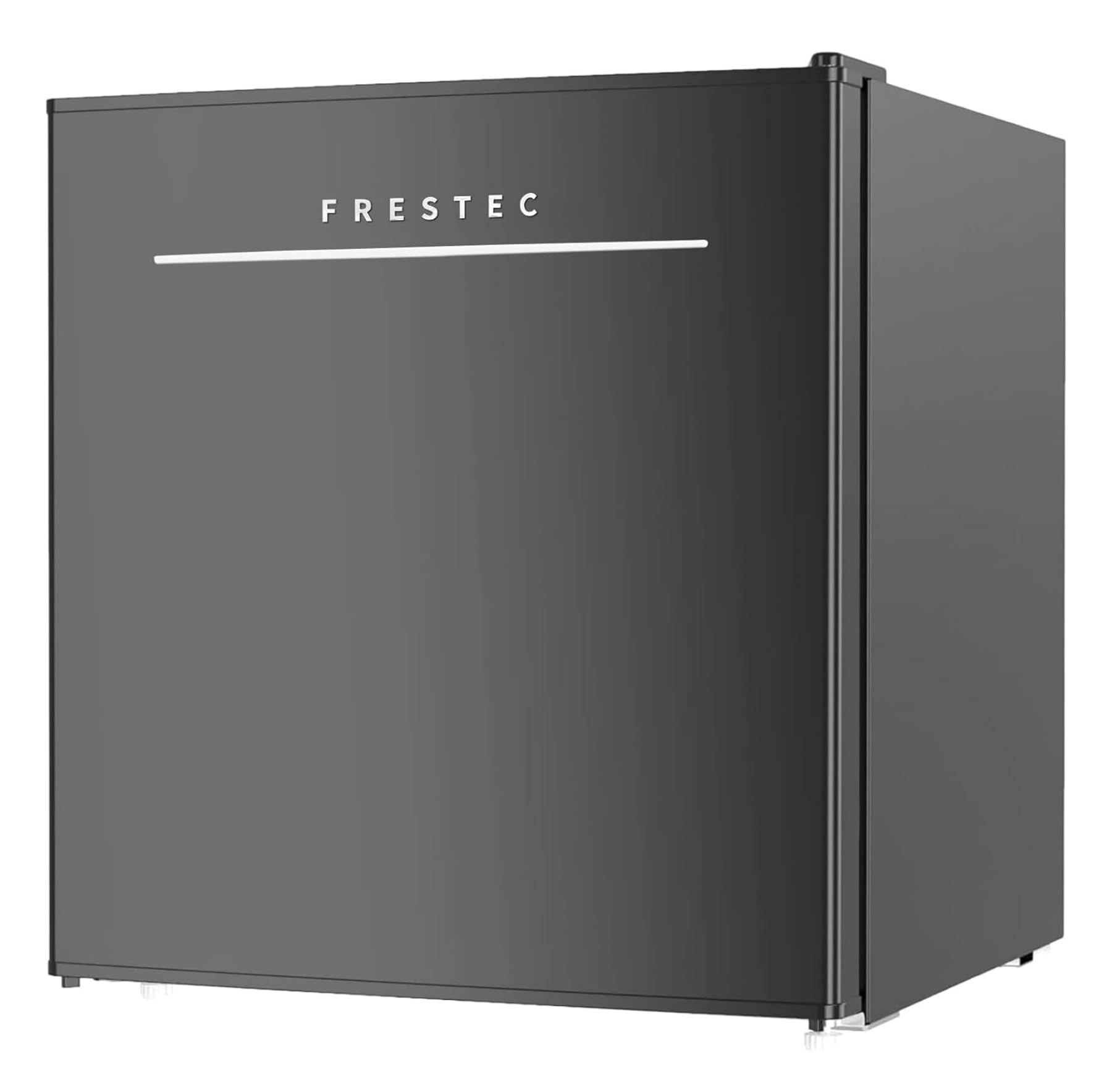
2. 1.7 Cu.Ft Mini Fridge
At 37 dB this is the quietest unit on the list — a fridge you can sleep beside without the compressor waking you.
Here is a direct number to weigh: this Frestec is rated at 37 dB, while the Midea Best Overall above is rated at less than 42 dB. That is the headline difference between the two, and it is why this one belongs in a bedroom or a shared study rather than a kitchen. The manufacturer pitches it as not disturbing the quiet of your home, and the figure backs that claim up better than most listings do.
Beyond the noise, the defrost design is the standout detail. Instead of hauling the whole unit out to thaw, you press the defrost button set into the middle of the temperature knob. The soft detachable door seal then comes off for cleaning. The thermostat runs from position 0 to 6 across a 28.4°F to 50°F span, so you can dial in a proper cold setting for drinks and drop toward the low end for the freezing niche.
The 1.7-cubic-foot capacity is split between a 1.5-cubic-foot fresh section and a small freezer niche, and the door flips to open either direction for tight layouts. Energy use runs 200 kWh/year — lower than the Midea’s 207 kWh/year — so the quieter unit also sips slightly less power. Adjustable feet handle an uneven floor so the door still seals square.
The sound argument: if noise is the reason you are shopping at all, the 37 dB rating is the strongest published number here, and it undercuts the larger Midea on energy too — 200 kWh/year against 207 kWh/year.
The thing to plan around: the fresh section is compact, so this is a drinks-and-snacks fridge, not a leftovers fridge. Buy it for the quiet, not for the volume.
The calm sleeper’s pick: bedroom, nursery-adjacent room, or home office where a hum gets on your nerves.
Where it stops: if you routinely store a week of groceries, the small fresh capacity will frustrate you fast.
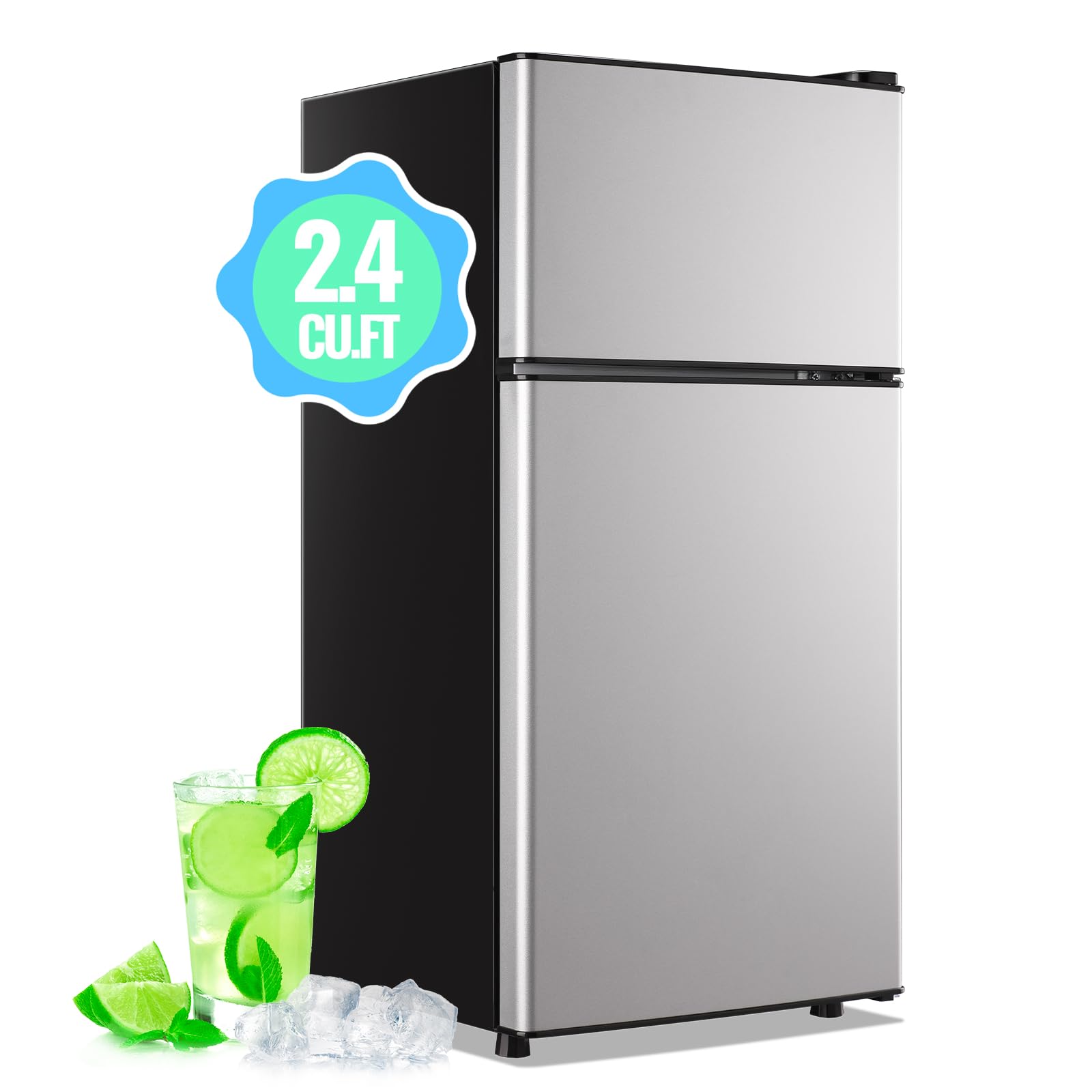
3. 45L Personal Double‑Door Mini Fridge With Freezer, Silver
A separate freezer door at a budget price — 0.8 cubic feet of frozen space beside the fresh section.
The number that changes everything here is 2.39 cubic feet, split into a 0.8-cubic-foot freezer and a 1.6-cubic-foot fresh zone. Compare that total to the Midea 1.6 Cu.ft at the top of this list: the DEMULLER holds roughly half again as much, which is the difference between a drinks box and a fridge that can store a frozen meal alongside your produce. Two independent doors mean the freezer air stays put when you open the fresh side.
The seven-level thermostat knob gives you a manual dial rather than presets. The freezer reaches down to -0.4°F for frozen goods, and the fresh compartment holds 32°F to 50°F for beverages, fruit, and snacks. Two removable shelves let you reconfigure the interior, and two adjustable leveling legs keep the door sitting square on a sloped floor. The unit runs at 38 dB, so it lands between the 37 dB Frestec and the less-than-42 dB Midea.
What owners consistently sign off on is the core performance — it meets expectations across the board, and the freezer compartment handles ice and frozen meals as advertised. The fair caution is on expectations: some buyers describe the box as smaller than the footprint suggests once the freezer takes its share. Measure the shelf gap you need before you commit to a double-door unit of this size.
Where the value sits: a true separate freezer with two doors and 38 dB operation for a budget-tier outlay — that combination is rare at this size.
The honest catch: the freezer eats interior room, so the fresh zone feels tighter than a 1.6-cubic-foot single door. Manual defrost also means periodic thawing.
Suits the frozen-food habit: dorm, rental, or spare room where ice cream and frozen meals are part of the plan.
Not for produce-heavy shopping: if the freezer will sit mostly empty, the space is better spent on a single-door box.
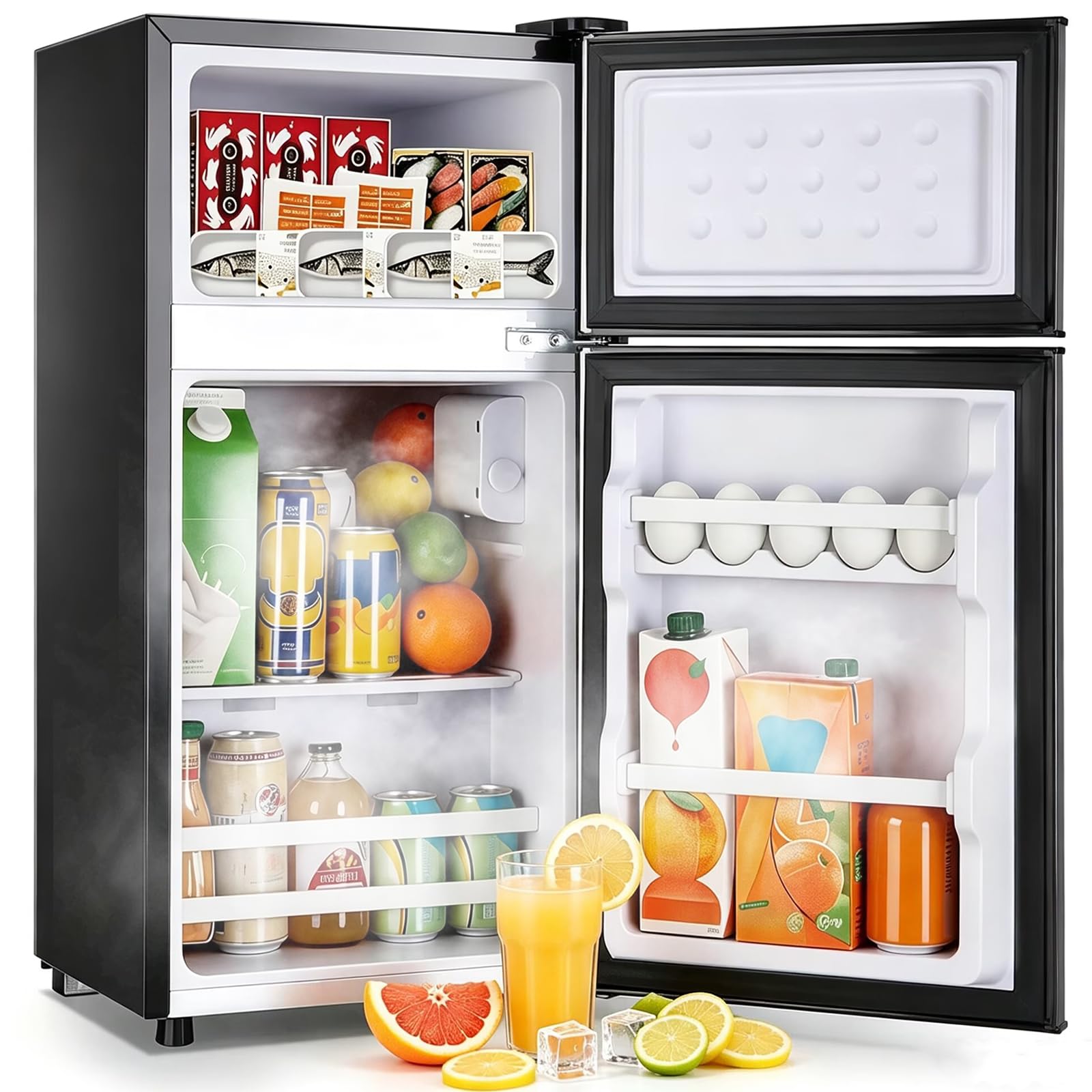
4. 2.35ft³ Mini Fridge with Double Doors
Narrow enough for a dorm corner, with a 0.8-cubic-foot freezer door that keeps ice cream actually solid.
The build splits 2.35 cubic feet into a 1.55-cubic-foot fresh area and a 0.8-cubic-foot freezer. That is essentially the same freezer volume as the DEMULLER 45L above, in a slightly smaller overall package. For a college dorm or a narrow apartment kitchen, that means frozen food storage without the fridge eating your whole walkway.
Quiet operation sits at an average of 38 dB in normal use, thanks to an R600a compressor. That figure is where this fridge is most at home: owners here point to quiet running as a standout strength, and it is a natural fit for a shared dorm where the unit sits near a desk or bed. The seven-position thermostat knob runs from position one up to seven as the coldest, across a -0.4°F to 50°F span.
Two points deserve attention before you buy. The listing itself advises standing the unit upright for 6 to 12 hours before plugging it in, so the compressor oil settles and quiet operation holds. Respect that window or you invite rattle. Second, the interior is genuinely compact — buyers describe it as a tiny fridge that meets basic needs rather than a roomy box. The motor housing also reduces usable interior volume compared to the outside dimensions.
The dorm-friendly read: 38 dB with a real separate freezer makes this a rare quiet-plus-frozen combination for a single-person space.
Before you plug in: the 6-to-12-hour upright wait is not optional if you want the quiet the listing promises — plan the delivery day around it.
Built for the dorm: a student who wants a quiet fridge and a working freezer without a large footprint.
Skip if volume is king: the interior is tight, and the compressor housing takes its share of the space.
5. COWSAR 2.6 Cu.Ft Mini Fridge with Freezer
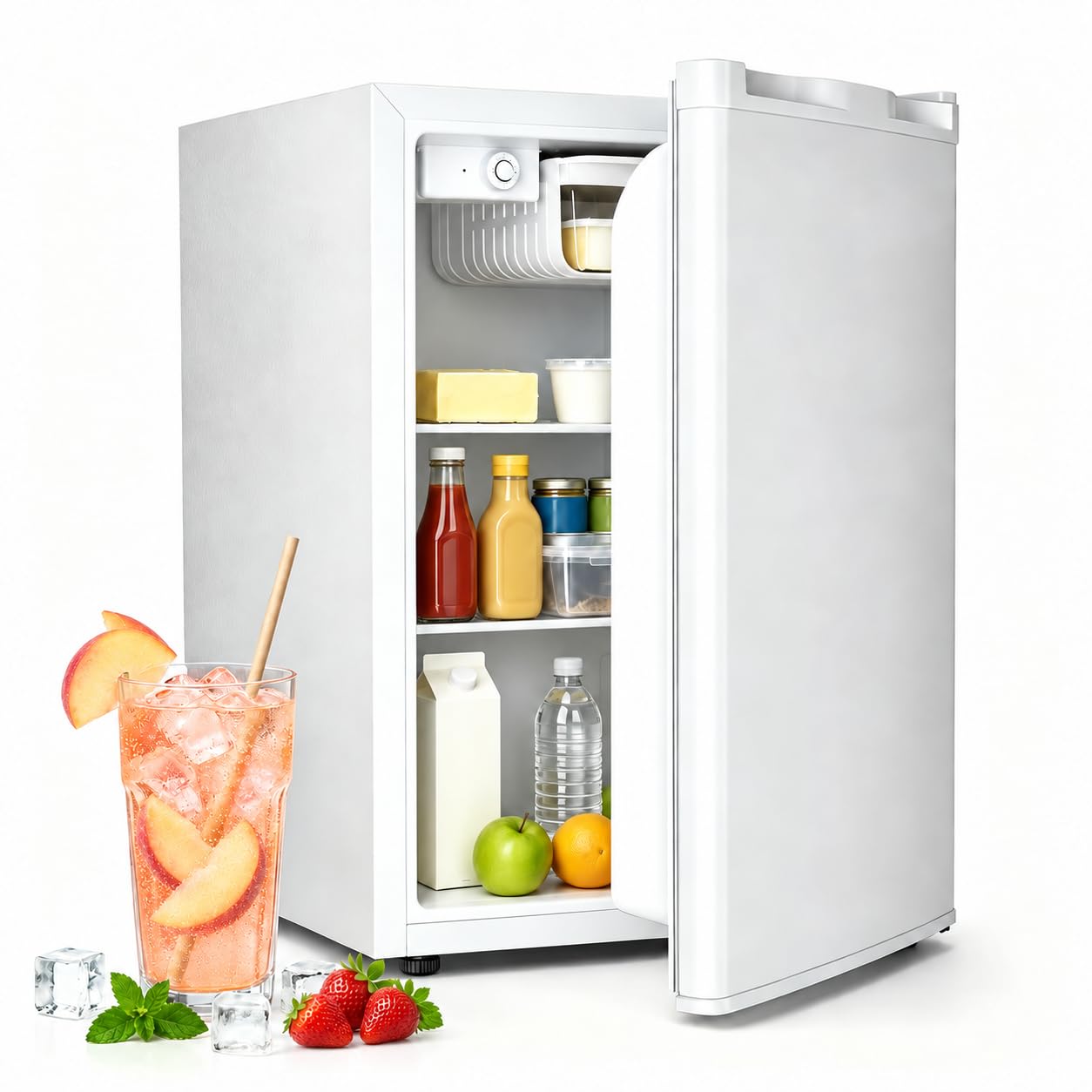
A 2.6-cubic-foot box that separates your snacks from your skincare with a dedicated cold-air niche.
Most mini fridges give you one undifferentiated cavity. This COWSAR splits the interior into a main area and a compact built-in niche that focuses cold airflow, so serums, butter, and dairy sit apart from the fruit and drinks. The whole cabinet works across a 32°F to 50°F range, and the seven-position mechanical dial adjusts it without any electronic board to fail during a power wobble.
The low-vibration compressor runs at 40 dB, which lands it between the 38 dB double-door units and the less-than-42 dB Midea. It carries ETL safety certification, and it draws 0.66 kWh per day across an annual 219 kWh/year. The reversible door swings either way for a tight corner, and two removable tempered-glass shelves reconfigure the interior when you need height.
This is a smaller review base than the veteran picks on this list, so treat the early feedback as a directional signal rather than a settled record. The freezer niche performs its job, and buyers describe it as a good little appliance for its size. If you want a long track record to lean on, the Midea and Frestec units above carry far more history. If the split-zone layout is what you need, this is the model built around it.
The layout advantage: a built-in cold-air niche plus reversible door and tempered-glass shelves gives you sorting options most boxes do not offer.
The honest limit: the review history is thin compared to the veteran picks here, so you are buying the design more than a proven decade-long record.
Made for the vanity corner: skincare serums, dairy, and snacks that need separate cold zones in one small unit.
Not the safe-history pick: if a long, thick review trail matters to you, choose a model further up this list.
6. Midea 3.3 Cu.ft Mini Fridge
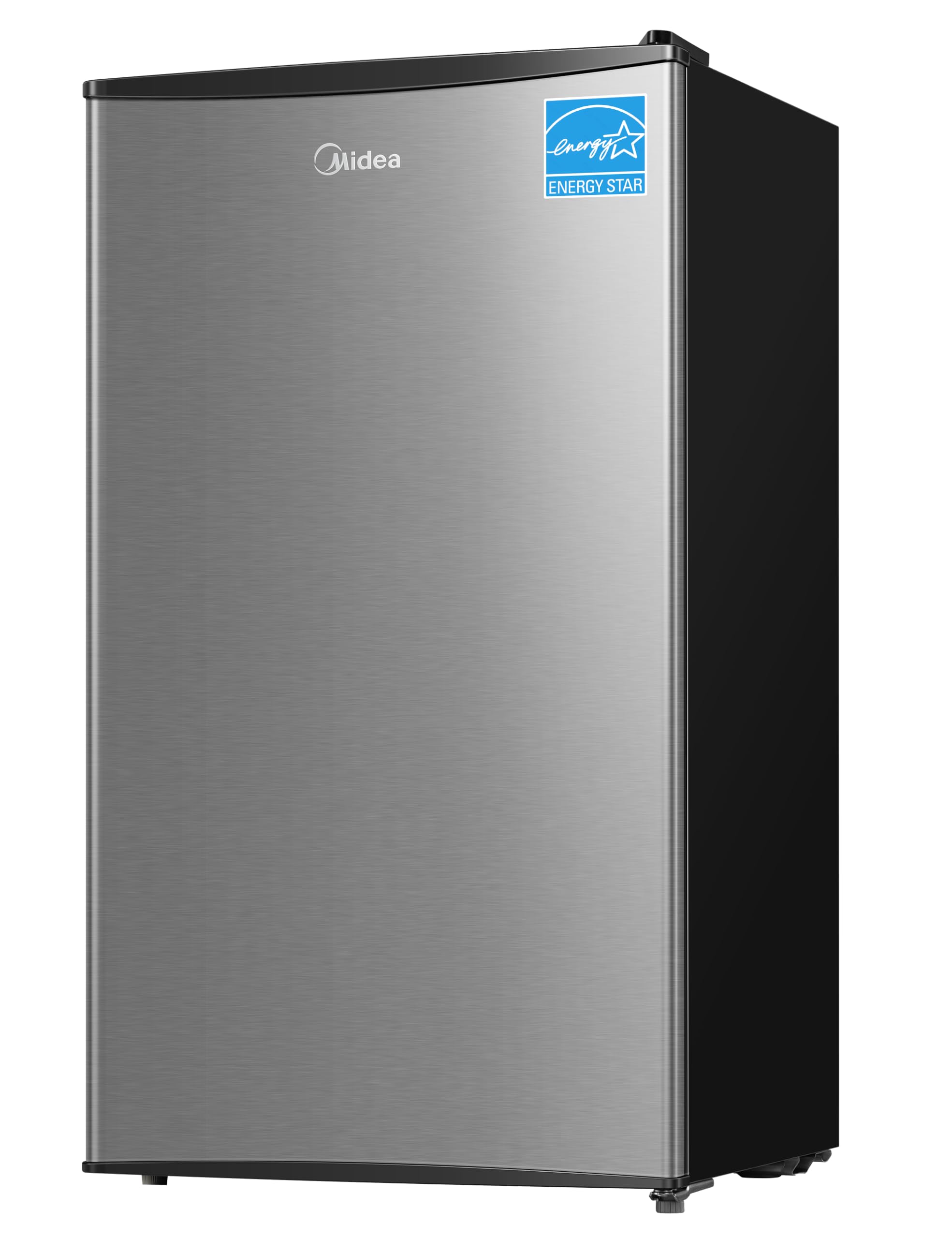
The overflow fridge you put beside the main one — 3.3 cubic feet of extra cold without a second freezer to manage.
This is a freezerless box, and that is the point. At 3.3 cubic feet it works as a pantry refrigerator beside a full-size unit, holding drinks, produce, and overflow without the defrost chore a freezer compartment adds. The mechanical thermostat runs 33.8°F to 50°F, a 2L bottle rack holds milk and juice upright, and a can rack makes grabbing a soda a one-hand job.
Where it shines is quiet. Owners consistently single out how quietly it runs, and Midea rates it at less than 42 dB. There is an LED interior light so you can find what you want in a dark corner, and the reversible door with three door shelves fits most kitchen layouts. A multi-air-flow system spreads cold air more evenly, which helps food last instead of freezing against the back wall.
The trade-offs are worth knowing up front. Temperature control draws mixed feedback — some find drinks properly cold, others find it slower to hold a steady set point. And a few units arrive dented, so inspect the box before you accept delivery.
Where it earns its place: 3.3 cubic feet, three door shelves, an interior LED, and quiet running make a strong second fridge for garage or pantry.
Set your expectations: 260 kWh/year is a real step up from the smaller Midea, and dented-on-arrival is a documented pattern worth checking at the door.
The overflow solution: a garage, pantry, or office fridge that takes pressure off the main appliance.
Not for frozen goods: with no real freezer compartment, ice cream and frozen meals belong elsewhere.
7. 3.2 CU.FT Mini Fridge with Freezer for Bedroom Office Black
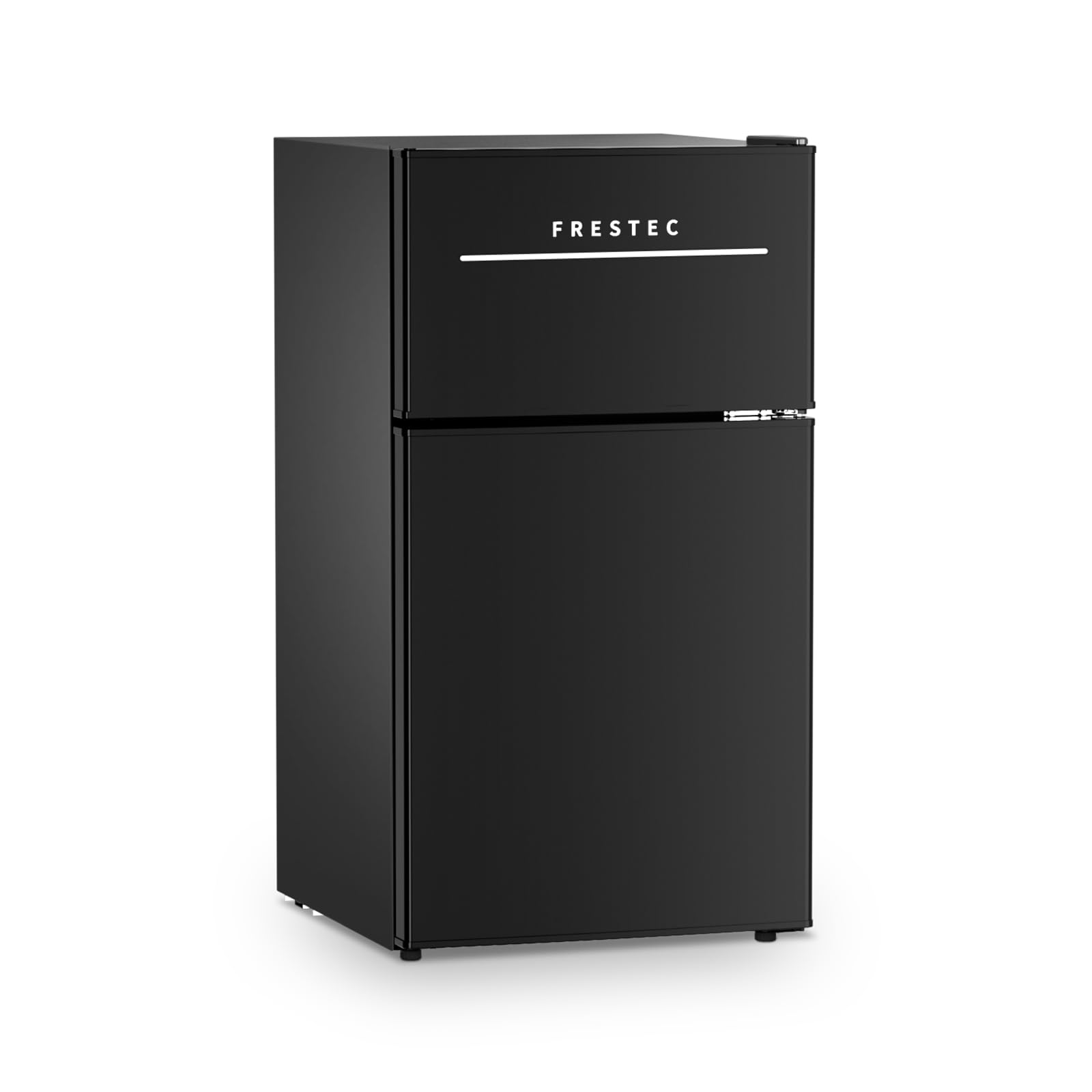
A 3.2-cubic-foot double-door with a real 1-cubic-foot freezer — enough for a small family or a camper.
Capacity is the story here. The 3.2 cubic feet split into a 2.2-cubic-foot fresh section and a 1-cubic-foot freezer puts it a full cubic foot above the DEMULLER boxes, and it fits in a compact footprint suited to an RV, garage, or dorm. The freezer is big enough for frozen meat and ice cream rather than just an ice cube tray.
Quiet is a genuine strength, with owners describing it as super quiet in use. Cooling is fast courtesy of an R600a compressor, and the unit carries an Energy Saving certificate at 0.69 kWh per day across 320 kWh/year. Inside you get an LED light, a crisper drawer dedicated to vegetables or fruit, adjustable glass shelves, an adjustable foot for uneven floors, and a reversible two-door layout.
The caution is on delivery condition. Dented and damaged units are a documented pattern in the feedback, so open the box and check the shell before you sign off. As with any compressor fridge, the listing asks for 6 to 12 hours upright before plugging in so the oil settles and quiet operation holds. Get those two steps right and the fridge delivers on its size and quiet promise.
The size argument: 3.2 cubic feet with a full 1-cubic-foot freezer and a crisper drawer — the most usable split on this list for a small family.
Check at the door: dented arrivals are a real pattern, so inspect before you accept. 320 kWh/year is also the higher end of the group.
Feeds more than one: couples, small families, or RV owners who need a real freezer and a crisper in a compact body.
Weigh the energy: at 320 kWh/year it costs more to run than the smaller quiet picks — fine if the volume earns it.
8. Electactic 2.5 Cu.Ft Double Door Mini Fridge
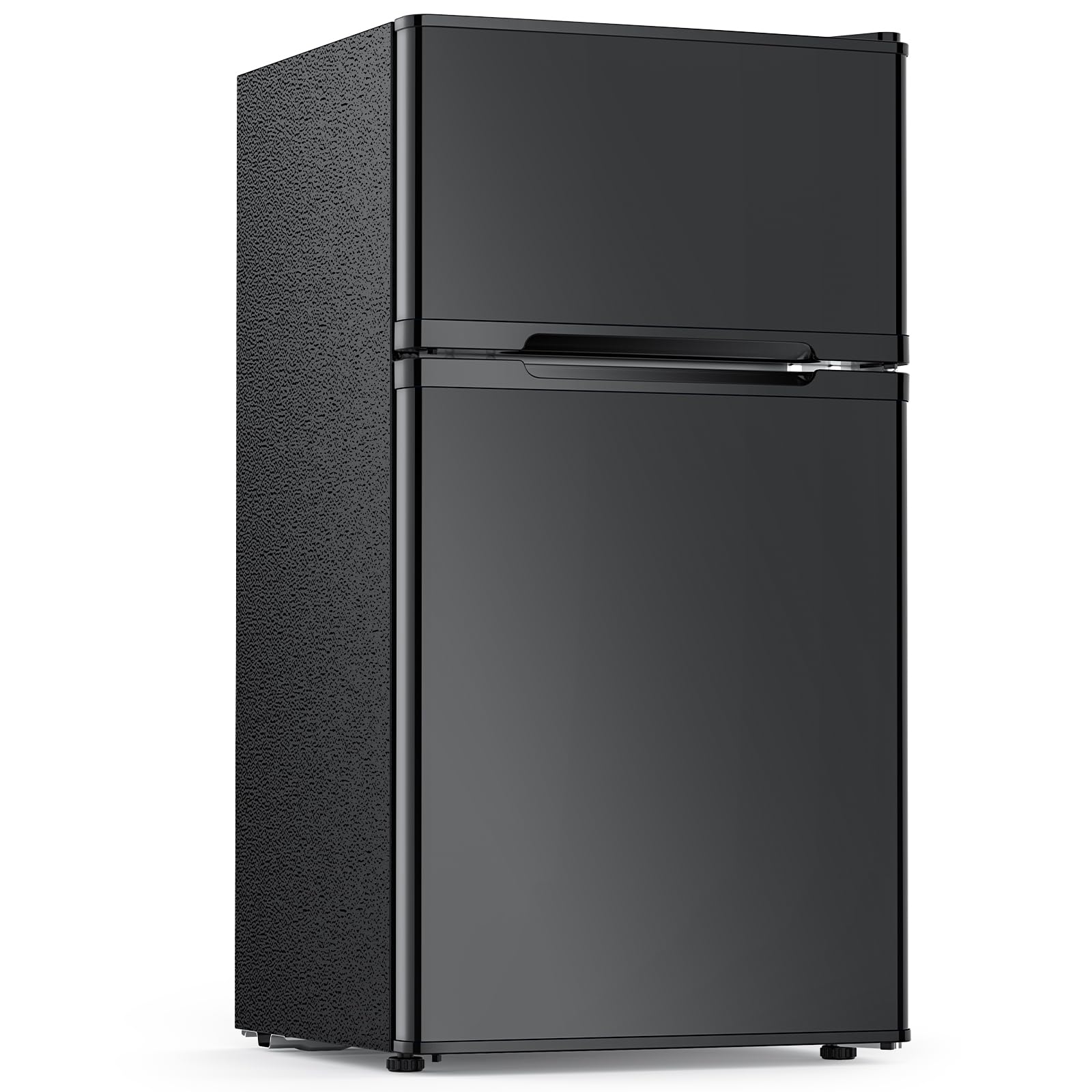
The one that feels more solid than its size suggests — the construction is the standout, not just the cooling.
Construction is the thing that keeps coming up with this Electactic, and it makes sense for a double-door build. The high-efficiency compressor runs consistently and below 38 dB, quiet enough not to disturb work or rest. The dedicated freezer runs from -4°F to 32°F while the fresh zone holds 32°F to 50°F, both set by one control knob, and the bright interior light makes a dark-corner grab easy.
The layout is genuinely usable. The 2.5 cubic feet splits into a 0.65-cubic-foot freezer and a 1.85-cubic-foot fresh section, with adjustable glass shelves that lift out for cleaning. An ice tray is included, and the reversible door lets you set the swing to your room. At 350 kWh/year it is on the higher side for energy, which is the honest cost of running two cooling zones this size.
The fair caveat is temperature consistency. Cooling performance draws mixed reports — some say the whole cabinet keeps items very cold, while others note the fresh section does not always reach the chill they expect. It is not a deal-breaker for drinks and snacks, but if you need precise produce storage, keep the knob a notch colder than you think you need. Build quality and quiet operation carry it for anyone who values a solid feel.
Solid where it counts: a below-38-dB compressor, a real 0.65-cubic-foot freezer, and construction that reads sturdier than the price tier suggests.
Dial it colder: mixed reports on fresh-section chill mean you should run the knob a notch beyond your first instinct.
For the build-conscious buyer: dorm, bedroom, or office where a solid-feeling double-door and a working freezer matter.
Watch the power draw: 350 kWh/year is heavy for the class — worth it if the freezer earns its keep.
9. Antarctic Star Mini Fridge with Freezer
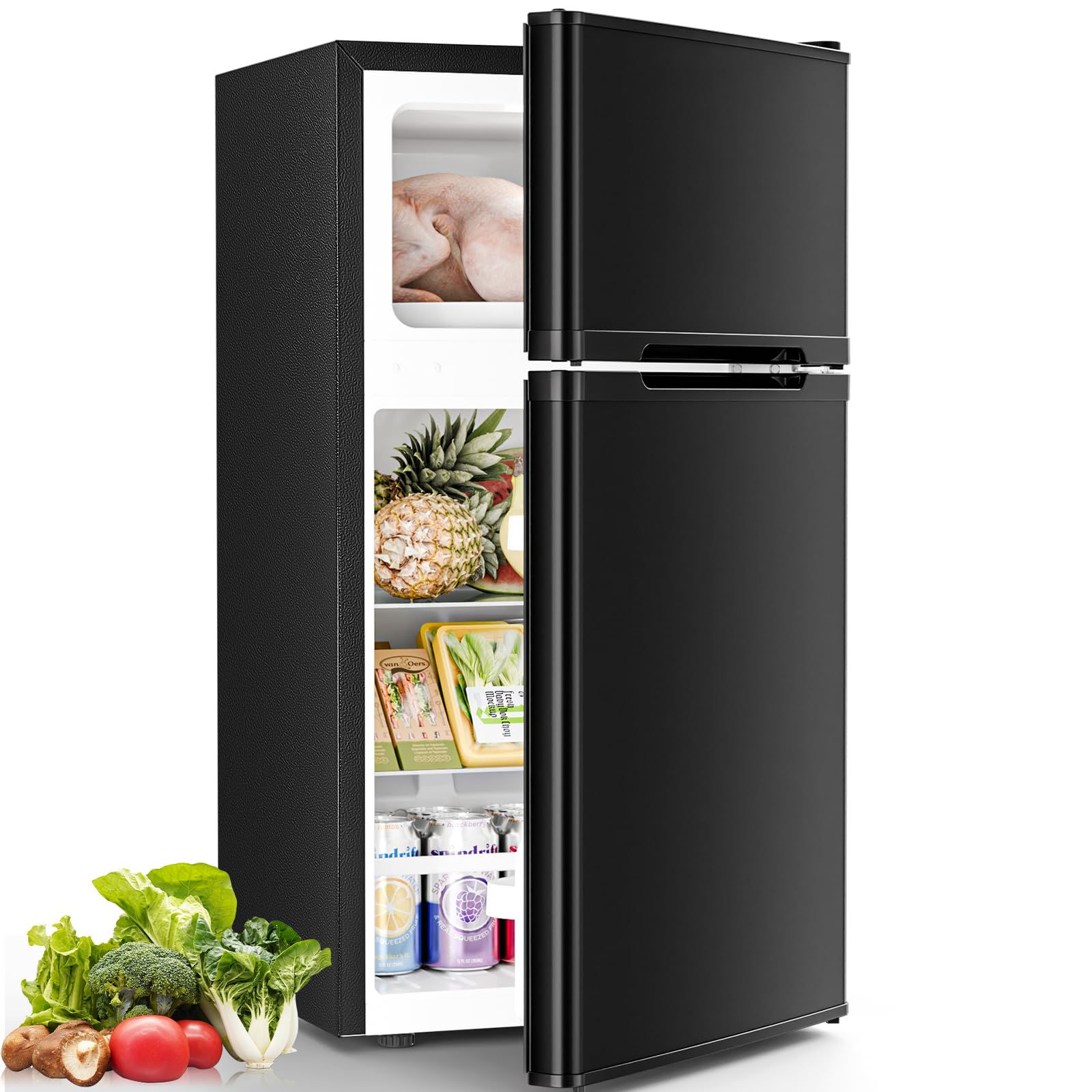
Fridge and freezer that both get cold fast — the cooler for someone who wants drinks chilled now, not tonight.
The 2.45 cubic feet split into a 0.64-cubic-foot freezer and a 1.81-cubic-foot fresh area, with two sturdy glass shelves, a door bin, and an ice cube tray in the box. The thermostat is a simple three-position dial: one for cold, two for normal everyday use, three for coldest and ice making. It is a refreshingly plain control scheme — no menu, no board to fail.
What owners praise most is the speed. Both compartments drop cold quickly and freeze items solid, which is a real difference if you load warm cans and want them drinkable the same evening. Quiet operation also holds a solid reputation, and the door bin handles cans, bottles, and condiments while the two front leveling legs square the unit on an uneven floor.
Two practical notes. The brand asks you to stand the unit upright for at least four hours after delivery so the refrigerant settles before plugging in. The door orientation is right-hand, not reversible, so plan the corner around a right-opening swing.
Cold where you need it: a three-setting dial, fast cooldown on both zones, and a real 0.64-cubic-foot freezer with an ice tray included.
Plan the corner: the door is right-hand only, so the hinge cannot swap sides — measure the swing before you buy.
For the impatient chill: a dorm or office where fast cooldown and a working freezer matter most.
Check the hinge first: a right-opening door is not reversible, so a left-side corner layout will fight it.
10. Feelfunn 2.5 Cu.Ft Mini Fridge with Freezer
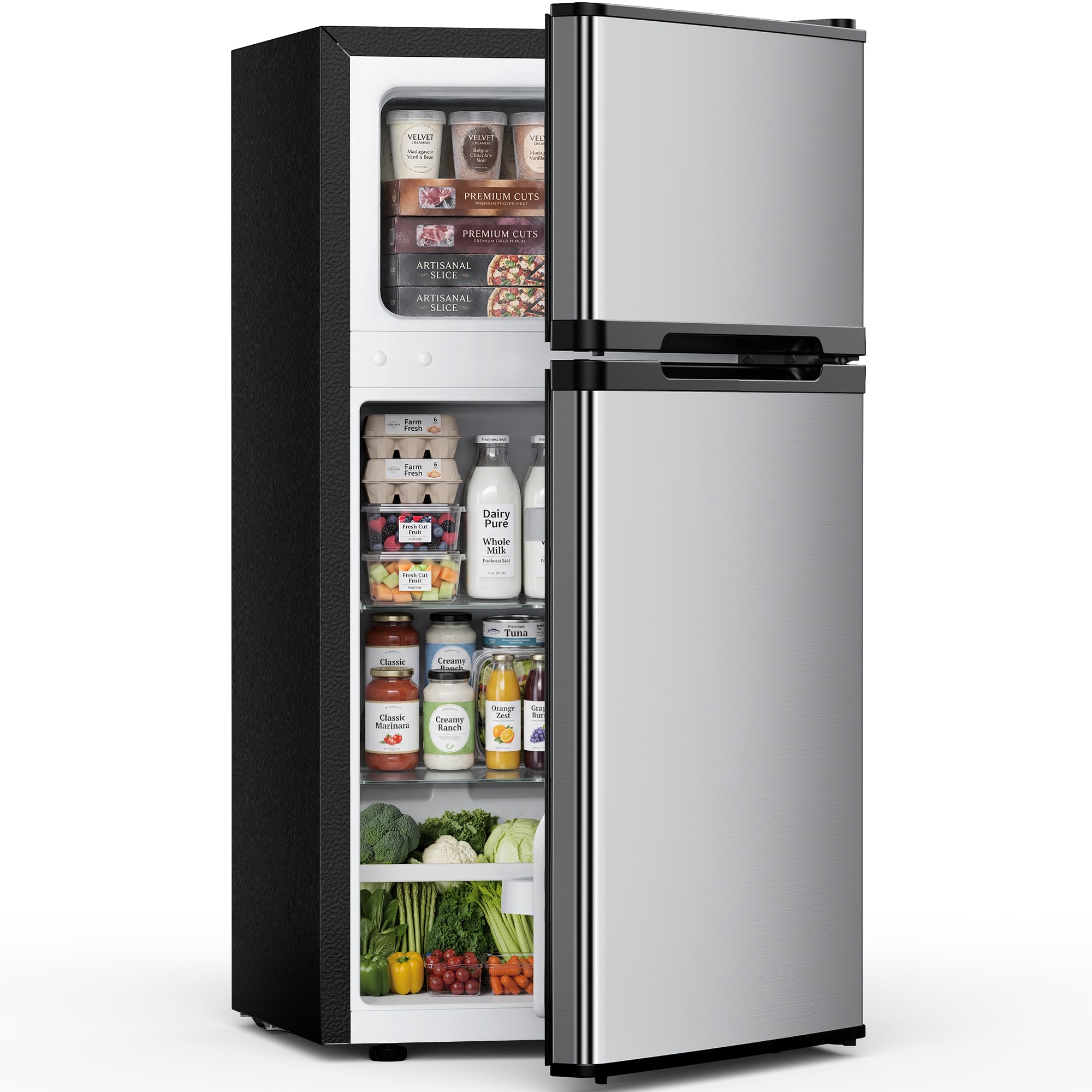
A ≤38 dB two-door that keeps frozen food frozen and switches on an LED so you can find it in the dark.
The numbers line up neatly: 2.5 cubic feet split into a 1.85-cubic-foot fresh section and a 0.65-cubic-foot freezer, running at ≤38 dB. That puts it in the same quiet band as the Electactic and the DEMULLER boxes, and it is the reason this fridge is pitched at bedrooms. The three-level thermostat holds 32°F to 41°F in the fresh zone and below -4°F in the freezer, a stable range that keeps produce and frozen goods from swinging.
The energy picture is honest but not the lowest here. The R600a compressor runs 0.96 kWh per day across 350 kWh/year, which is a real draw if you run it all year. What you get back is a reversible door for tight room layouts, a built-in LED light for clear visibility, and an ice tray plus ice shovel included. The removable glass shelves reconfigure for tall bottles.
The one thing to expect is a slow start on the fresh side. Some buyers find it takes time to settle around 35 to 37 degrees, and a few report it cycling warm before catching up. Give it the recommended 6-to-12-hour upright settle before first power, then run the knob a notch colder if your first reading seems off. The separate freezer zone itself gets strong marks for keeping frozen food properly frozen.
Quiet with a real freezer: ≤38 dB, a below -4°F freezer, LED light, and reversible door make it a natural bedroom unit.
Give it time: the fresh side can take a while to reach its set temperature, so do not judge the first hour.
Bedroom-first design: anyone who wants true quiet plus frozen storage in a room they sleep in.
Energy-minded buyers look up: 350 kWh/year is heavy for the size, so weigh that against the quiet band.
11. Danby DAR010A1BDB 1 Cu.Ft. Mini Fridge
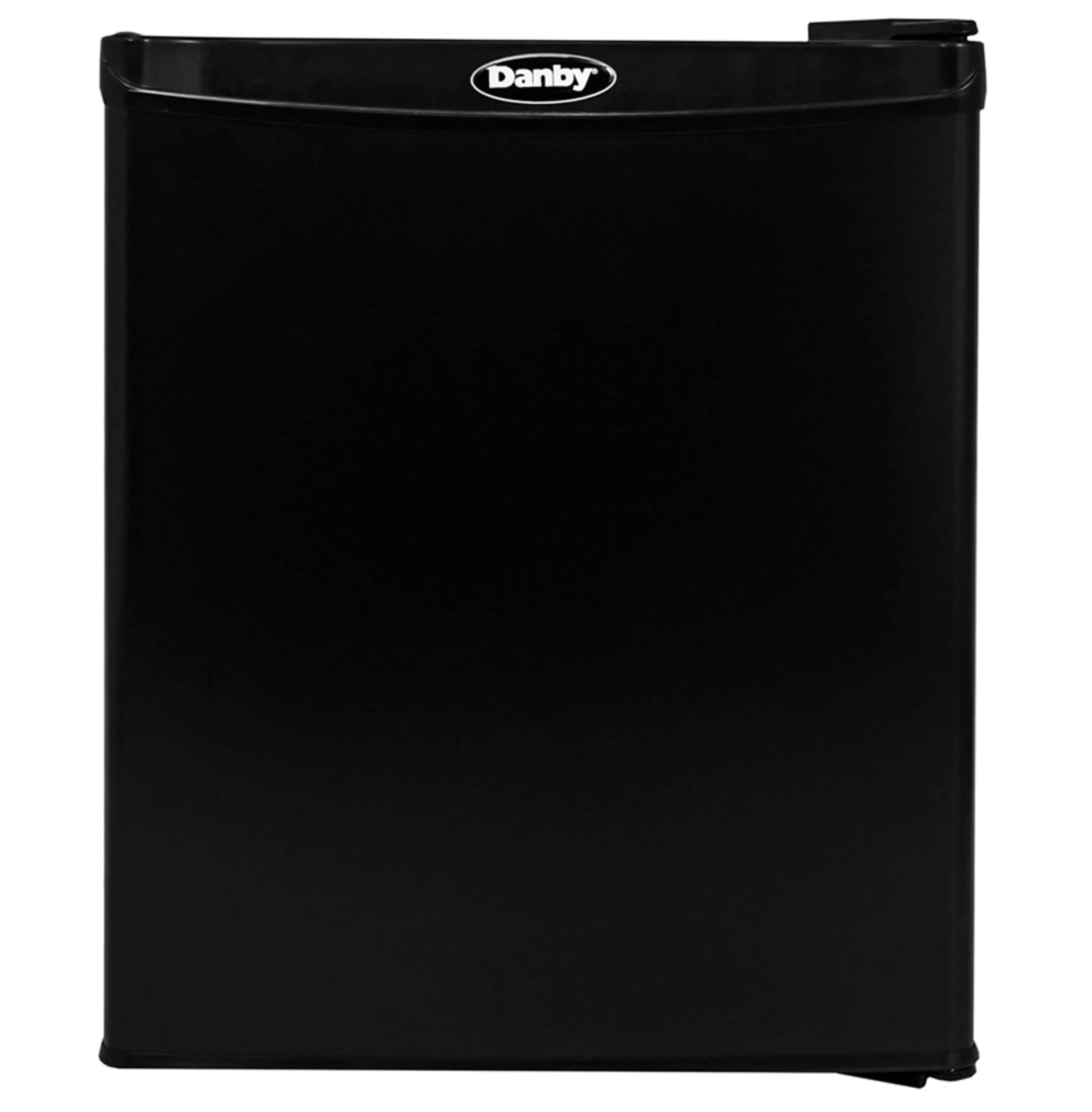
One cubic foot of cold that fits on a desk, a bathroom counter, or a nightstand — with silence as the selling point.
At 1 cubic foot (29 liters) this is the smallest unit on the list, and it makes up for lost volume with placement freedom. It fits beside a work-from-home desk, in a bathroom, or next to a bed without dominating the space. The headline feature is Danby’s Silencer Technology, which targets quiet operation as the design goal rather than a side effect.
The engineering list is longer than you would expect for this size. Automatic defrost means no manual thawing chore, a 1-1/2 width wire shelf gives you one adjustable level, and integrated door shelving includes tall bottle storage. A CanStor beverage dispenser and a mechanical thermostat round out the practical bits, and the smooth back design lets it sit flush against a wall.
The honest trade is capacity and energy. One cubic foot holds a modest number of cans and small items — enough for drinks and a few snacks, not a week of food. For a desk or bathroom where space and quiet are the whole point, that is a fair exchange.
Built for tight silence: Silencer Technology, automatic defrost, smooth back design, and a CanStor dispenser in a 1-cubic-foot body.
Capacity is the limit: 1 cubic foot is a drinks box, and 241 kWh/year is high for the volume — buy it for the footprint, not the efficiency.
The desk or bathroom box: work-from-home offices and small rooms where a full-size fridge would never fit.
Not a food fridge: 1 cubic foot will not hold a week of groceries — this is a cold-drinks and small-snacks unit.
Know the Specs
Decibel (dB) ratings
A decibel is a unit of sound pressure, and for a fridge it describes how loud the compressor runs while it works. A 37 dB unit is noticeably softer in a bedroom than a 42 dB one, even though the numbers look close. Published figures are the best guide you have, but treat any unit whose listing carries no dB figure as an unknown rather than a quiet one.
Cubic feet and fresh-to-freezer split
Cubic feet measures usable interior volume. What matters more is how it splits: a 2.5-cubic-foot unit with a 0.65-cubic-foot freezer gives the fresh side far less room than a single-door box of the same size. Always check whether the freezer is a separate door and how much of the total it consumes before you decide the capacity is enough.
Annual kilowatt hours (kWh/year)
This is the total electricity the fridge uses across a year of normal running — the number that shows up on your energy bill. A fridge you keep plugged in constantly is different from a toaster, so a gap between 200 and 350 kWh/year matters over the appliance’s life. Lower is better, but weight it against capacity and quiet, since bigger and quieter often pull more power.
Compressor settling and defrost type
Compressor fridges need to stand upright for hours before first power so the oil settles back to the bottom, or the unit may run loud and wear early. Automatic defrost saves you the thawing chore; manual defrost means you schedule it. Choose automatic if convenience matters, and accept manual if you would rather have fewer moving parts to fail.
Common Questions
Will a mini fridge keep me awake if it sits next to my bed?
What is the smallest quiet small fridge I can get?
Do I need a separate freezer compartment in a small fridge?
How long should I wait before plugging in a new mini fridge?
Is manual defrost or automatic defrost better on a small fridge?
Does a lower dB rating always mean a better fridge?
Can I put a mini fridge under a desk?
What does a reversible door actually do?
Will a quiet small fridge actually save money on electricity?
What is the difference between 2.5 and 3.3 cubic feet in daily use?
The Bottom Line
For most people, the quiet small fridge winner is the Midea 1.6 Cu.ft because it holds a proper 28.4°F to 35.6°F range, draws only 207 kWh/year with Energy Star certification, and slides under a desk — a combination backed by 4.5+ stars across 5,000+ ratings. If silence is the whole reason you are shopping, the Frestec 1.7 Cu.Ft drops to 37 dB and cuts energy to 200 kWh/year. And when you want a real separate freezer beside your fresh food, the DEMULLER 45L delivers 0.8 cubic feet of frozen space at 38 dB.
For a bedroom, the Frestec’s pairing of the lowest published noise rating here (37 dB) with the lightest draw (200 kWh/year) is the one to beat.
How we choose
We do not accept paid placement. Every pick is matched to a real buyer and a real use-case; we do not hands-on test units.
Sources
Specifications: manufacturer listings and product documentation. Review insights: verified customer reviews, as of November 2026. Pricing: not shown on this page (it changes often); check the current price via the retailer link.
As an Amazon Associate, Tactical Gear Guy earns from qualifying purchases. This does not affect which products we feature.