Specs are compiled from manufacturer listings and verified buyer reviews and can change over time — please confirm the key details on the product page before buying.
If your recordings sound thin, hissy, or muffled, the microphone is usually the first thing to fix — and the fix is simpler than you think. What separates a usable recording mic from a frustrating one is not brand prestige but three plain numbers: how quiet it runs on its own (self-noise), which direction it listens in (polar pattern), and how it plugs into your computer. This guide covers nine recording mics across every budget tier and breaks down exactly which one suits your room, your voice, and your setup.
This guide is built by comparing the manufacturers’ published specifications and the patterns across verified customer reviews, so you get each pick’s real strengths and trade-offs instead of marketing spin.
You will see dynamic mics built to shrug off an untreated bedroom and condensers that capture every breath. The trick is matching the mic to the job, and the right quality mics for recording choice starts with one honest look at where you actually record.
Top Picks


How To Choose The Best Quality Mics for Recording
Most first-time buyers assume a bigger price tag automatically means a better recording. In practice, a mid-tier mic matched to your room beats a premium one that picks up every fridge hum and passing truck. Get these four decisions right and you will not outgrow the mic for years.
Dynamic or condenser — start with your room, not the spec sheet
A dynamic mic uses a moving coil and tends to need more gain from your interface, but it shrugs off room echo and background noise. That makes it the safer pick for a bedroom or a shared apartment. A condenser mic uses a charged diaphragm and is far more sensitive — it captures detail and air, but it also captures your neighbor’s television. If your space is untreated, lean dynamic. If you have some acoustic treatment, a condenser rewards you with depth.
Self-noise in dBA — the number that decides quiet recordings
Self-noise is the faint hiss a microphone generates on its own with nobody talking, measured in dBA (A-weighted decibels, a scale tuned to how human ears perceive quiet sounds). Lower is better. A condenser sitting at 4 to 9 dBA stays silent between phrases, so whispered lines and soft acoustic guitar come through clean. A mic with high self-noise forces you to add gain, and gain lifts the hiss along with your voice.
Polar pattern and the cardioid promise
A polar pattern is the shape of the area a mic listens to. Every pick here is cardioid, meaning it hears what is in front of it and rejects sound arriving from the sides and rear. That rear rejection is what keeps a keyboard clatter or a room reflection out of your track. Point the front of the mic at your mouth, keep the back facing away from your monitor speakers, and the pattern does the rest.
XLR or USB — pick your workflow first
An XLR mic uses a three-pin cable and needs an audio interface or mixer to get into your computer. That extra box costs money and desk space, but it gives you control over gain and lets you upgrade the mic later without rebuying the whole chain. A USB mic plugs straight into your laptop with nothing else required. If you want one-cable simplicity for calls, streaming, or quick voiceovers, USB wins. If you plan to build a studio, go XLR now.
Side-by-Side Comparison
| Model | Best For | Type | Connection | Self-Noise | Amazon |
|---|---|---|---|---|---|
| Shure SM7B★ Best Overall | Untreated rooms and broadcast voice | Dynamic | XLR | 60 db | Amazon |
| RØDE PodMicBest Value | Podcast desks on a mid-range budget | Dynamic | XLR | 78 db | Amazon |
| Audio-Technica AT2020Studio Staple | Home studio vocals and instruments | Condenser | XLR | 20 db | Amazon |
| RØDE NT1 Signature | Silent-room detail capture | Condenser | XLR | 4 db | Amazon |
| AT2020USB-X | One-cable calls and voiceovers | Condenser | USB | 80 db | Amazon |
| Warm Audio WA-87jr | ‘87-style studio character | Condenser | XLR | 9 db | Amazon |
| LEWITT LCT440PURE | Vocals plus acoustic instruments | Condenser | XLR | 7 db | Amazon |
| Shure SM4 | Mix-ready home studio kits | Condenser | XLR | 140 db | Amazon |
| AKG C214 | Loud sources without distortion | Condenser | XLR | 81 db | Amazon |
Detailed Reviews
1. Shure SM7B Dynamic Vocal Microphone
Our pick — 4.5+★ from 12,000+ verified ratings; the strongest balance of quality and price.
The mic that makes an untreated bedroom sound like it was quietly treated.
If your “studio” is a spare room with a bare wall and a humming laptop, the SM7B is the safest money you will spend. It is a dynamic capsule, which means it needs more gain from your interface but refuses to amplify room echo the way a sensitive condenser will. Its cardioid pattern rejects sound from the sides and rear, and the air suspension shock isolation floats the capsule so desk bumps and stand knocks stay out of the take.
The frequency response runs to 20000 hertz, which matters less for its top end than for what the housing does around it. Built-in pop filtering and a detachable windscreen tame plosives (the hard “p” and “b” blasts of air) and breath noise without you buying extra accessories. Buyers consistently say the street, the fan, and the keyboard simply disappear once they switch to it. Feed it clean gain from a decent preamp and it stays quiet between phrases.
Here is the catch worth knowing before you buy: this mic is hungry. It wants a preamp with real clean gain, and plenty of owners add an inline booster to get there. The all-metal housing also sits at 150 ohm impedance, which pairs happily with most interfaces but is not the lightest thing to clamp onto a flimsy boom arm. What wins people over is the sound: 4.5+ stars across 12,000+ ratings, and the depth it gives a spoken voice is why podcasters keep coming back.
Where the SM7B earns its keep
- Cardioid pattern plus air suspension shock isolation keeps handling noise and room reflections out of the take.
- Pop filtering and a detachable windscreen handle plosives from the start — no add-on shopping.
- All-metal body with electromagnetic shielding guards against hum from nearby gear.
- XLR output hands you full control of gain, EQ, and tone shaping at the interface.
What to plan around
- It needs a preamp with plenty of clean gain, and many owners add a booster to get there.
- The heavy metal housing is not ideal on a lightweight boom arm.
Reach for this if: you record speech in a room you cannot acoustically treat, and you already own or plan to own an interface with strong clean gain.
Look elsewhere if: you want a one-cable USB setup — this is XLR only and needs a separate interface.
2. RØDE PodMic Cardioid Dynamic Broadcast Microphone, XLR
Broadcast-style speech rejection at the entry end of the XLR market.
Start with the number that tells you the most about this mic’s price class: its frequency response is specified at 20 hertz, the low end of its quoted 20Hz to 20kHz range. The SM7B above quotes 20000 hertz at the other end of the same 20Hz–20kHz span, and both mics are chasing the same goal — clear broadcast speech. What the PodMic adds for far less money is a built-in pop filter and internal shock mounting, so plosives and desk thumps get handled without you buying a windscreen first.
You get clean speech in a noisy room because the capsule is tuned for speech and its cardioid pattern (a pickup shape that listens mainly from the front) rejects room noise in untreated spaces. That is exactly why it belongs on a podcast desk rather than in a vocal booth. An all-metal body means it will sit on air for years, and the integrated swing mount connects straight to any XLR interface (a box that converts analog mic signal to digital), mixer, or RØDECaster. Expect it to need a fair amount of gain (input boost) — the recurring note from the review pages is that this mic is quiet and has “an untapped hunger for gain,” so pair it with an interface that can push clean level. Its weight comes up too, though owners describe it as heavy but still portable enough to tote.
What people talk about most is simply the sound: a frequency curve that leans toward condenser-like brightness in the highs while keeping body in the low end. Value gets mentioned constantly because it delivers studio-adjacent speech for a fraction of flagship money. It is not the mic for a whisper-quiet ASMR channel — the high gain requirement will expose any preamp hiss — but for a talking head at a desk, it earns its place fast.
The sound signature: bright top end and solid low body, tuned so spoken words cut through without harshness.
Budget note: the internal pop filter saves you a windscreen purchase, but you will still want an interface with generous clean gain.
Pick this one when: you want a broadcast-flavored dynamic mic and already have an interface that can drive a gain-hungry capsule.
Keep shopping if: your interface runs low on clean gain, or you need a USB-only plug-and-play path.
3. Audio-Technica AT2020 Condenser Microphone
The side-address condenser that has launched a thousand home studios.
For the money, this is the mic most people should learn on. Its custom low-mass diaphragm (a thin, light moving element) extends frequency response and gives a fast transient response, so strummed strings and consonants land with snap instead of smearing. Sensitivity is quoted at 37 db, which is far hotter than the RØDE NT1 Signature Series at 4 db — meaning this mic reaches healthy level with less gain from your interface. Self-noise sits at 20 db, quiet enough for vocals but not the near-silent floor of a premium condenser.
The cardioid pattern reduces pickup from the sides and rear, so pointing the front at your mouth keeps a nearby monitor out of the mix. It ships with a stand mount for 5/8″-27 threaded stands, a 5/8″-27 to 3/8″-16 adapter, and a soft pouch. Owners use it as a main mic for home demos and small-budget sessions, and it doubles as a fine instrument mic — acoustic guitar, banjo, violin, and mandolin all come through clean and crisp. What earns the most praise by a wide margin is build and overall quality, with sound quality close behind and value right after that.
Two honest notes. First, plenty of buyers report it stopped working within days of arrival, so buy from a seller with a straightforward return path and test it the day it lands. Second, it does not include an XLR cable, and it requires an audio interface if you are recording to a computer — a real added cost that catches people out. Neither changes the math for a first home studio, but budget for both.
What it does well
- 37 db sensitivity means healthy level without cranking gain.
- Low-mass diaphragm gives extended and fast frequency response.
- Cardioid pattern blocks sound from the sides and rear for cleaner isolation.
- Ships with a stand mount, thread adapter, and soft pouch.
Budget for these
- No XLR cable in the box, and a computer setup needs an audio interface.
- Some units arrive faulty — test yours the day it arrives.
Best fit: a first home studio where you want one mic for vocals and instruments and already expect to buy an interface.
Think twice if: you need a cable and interface bundled, or you demand near-silent self-noise for ultra-quiet sources.
4. RØDE NT1 Signature Series Condenser Microphone

Four dBA of self-noise changes what you can record after midnight.
The number to lead with is 4 — as in 4 dBA of self-noise, the lowest in this entire group and enough to make this the quietest studio condenser here. Compare it directly: the Audio-Technica AT2020USB-X is quoted at 80 db on the same audible-noise spec. The gap is huge, and you hear it as a total absence of hiss between words. Its HF6 1-inch true condenser capsule pairs that silence with high sensitivity and extremely high SPL handling, so a belted note or a close-miked snare does not clip.
The package is unusually complete. RØDE includes a studio-grade shock mount, a pop filter, and a premium XLR cable — the parts that push other mics over budget are already in the box. It is built from premium components in Sydney and backed by a 10-year warranty. Reviewers with deep voices say it catches every nuance.
Its honest limit is that this much sensitivity is a two-way street. A noisy room, a humming fridge, or a mechanical keyboard will all land in the file because the capsule misses nothing. This is a mic for a treated space or a very quiet one, not a shared kitchen. Availability is also thin at this listing compared with the more established picks, so it suits someone who wants maximum detail and knows their room can support it.
Detail capture: the 4 dBA noise floor and 1-inch capsule capture breath-level nuance that other mics bury under hiss.
The trade-off: extreme sensitivity means your room noise comes along for the ride — treat the space first.
Choose this when: you record vocals or instruments in a quiet, controlled room and want the lowest hiss floor in this lineup.
Pass it by if: your recording space has hard reflections or steady background noise it will faithfully capture.
5. Audio-Technica AT2020USB-X Cardioid Condenser USB Microphone

One cable, no interface, and a headphone jack for live monitoring.
If the word “interface” makes you close the tab, this is your mic. The AT2020USB-X is a USB condenser that plugs straight into a computer, and its high-resolution AD convertor captures at 24-Bit/96 kHz — that is the sampling rate and bit depth of the digital file, and it means natural, clear reproduction without a separate box. A built-in headphone jack lets you monitor directly from the mic, so you hear yourself as you record instead of guessing.
The body carries a soft-touch capacitive mute button that silences you silently with a tap, and a two-state LED ring glows blue when powered and red when muted so you always know where you stand. The cardioid pattern minimizes background pickup, and people describe it recording a whisper with no background hum. Setup is quick — it works with Mac and PC, and the box includes a custom desk stand plus a USB-C to USB-A cable with an adapter. What buyers mention most is sound quality, then how easy it is to get running.
The catch is that this is the least silent mic in the group on paper, quoted at 80 db of audible noise (the mic’s own background hiss), and the included cable has been reported dead on arrival in some boxes — test the cable before you rely on it. Software-level tweaks also replace the physical gain control an XLR chain gives you, which limits how far you can grow. For calls, streaming, and voiceovers from a desk, though, the trade is worth it.
Made for: streamers, teachers, and voiceover beginners who want studio-flavored sound from a single USB-C cable.
Not the one for: anyone planning to add outboard preamps or who needs the lowest possible noise floor in the lineup.
6. Warm Audio WA-87jr Condenser Mic
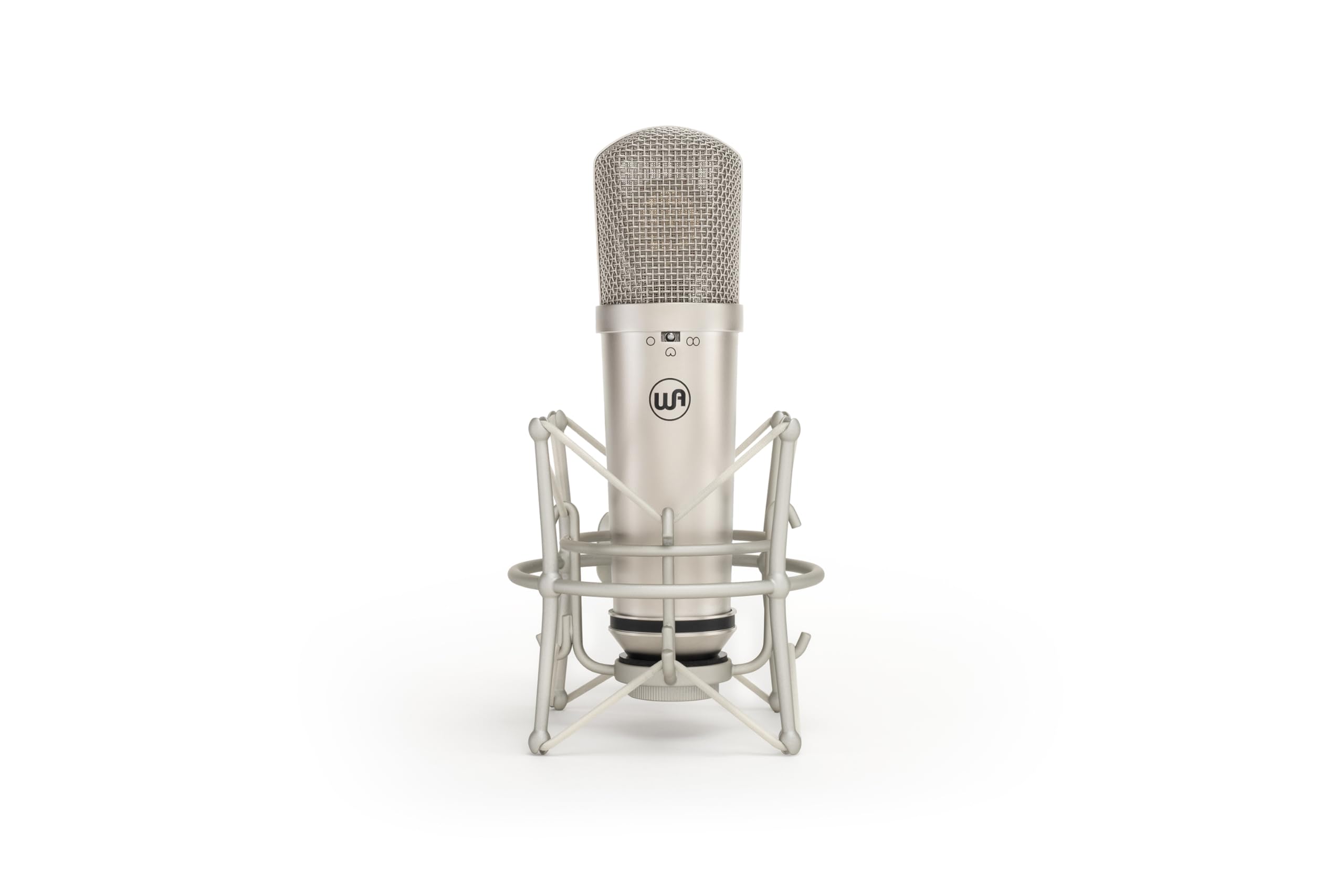
An ‘87-style voicing with the switches that make loud sources easy.
This mic takes its cue from the classic ‘87 studio workhorse — pristine highs, detailed mids, and a modern multipattern condenser design. Its professional capsule uses the same hole pattern and frequency response as the original it evokes, running through a discrete signal path with ultra-low self-noise specified at 9 db. That is quiet enough to track vocals and acoustic instruments without hearing the mic itself between phrases.
The feature that separates it from the plain condensers here is the built-in pad and high-pass filter. The pad lowers the incoming level so a loud source does not overload the capsule, and the high-pass filter cuts unwanted low-frequency rumble like foot traffic or HVAC thrum. A professional shockmount is included to keep vibrations out of the recording. Each unit is hand-tested and inspected in Austin, Texas.
Its weight — 1.62 kg — makes it a stay-on-the-stand mic rather than something you toss in a backpack, so plan your boom arm accordingly. It is also a character mic: the voicing flatters a voice, which is exactly what some singers want and not what someone chasing surgical accuracy needs. For vocals, podcasts, and instrument overdubs in a home studio, it delivers that recognizable studio flavor without asking for flagship money.
What you gain: pad and high-pass filter switches let one mic handle both a whisper and a loud amp, with 9 db self-noise keeping the floor low.
What to plan for: at 1.62 kg it wants a solid stand, and its colored voicing is a taste choice rather than a neutral capture.
Right for you if: you want classic ‘87-style character and switchable pad and filter control in a home-studio condenser.
Skip the shortlist if: you need a flyweight mic for travel, or you want an utterly flat, uncolored response.
7. LEWITT LCT440PURE Large Diaphragm Condenser Mic

A one-inch capsule tuned for depth, with the mount and filter already in the box.
Depth is the word that follows this mic around, and the spec behind it is a 1-inch true condenser capsule with a 7 db self-noise floor. That is nearly as quiet as the RØDE NT1 Signature above and quieter than the Audio-Technica AT2020 at 20 db — meaning soft acoustic picking and intimate vocals hold their detail instead of drowning in hiss. Its 44 db sensitivity means you reach healthy level without leaning on your interface’s gain.
The cardioid pattern delivers effective rear rejection, so it holds up on stage as well as in a home studio. It handles vocals, acoustic instruments, drums, cymbals, amplifiers, and piano, and the bundle includes a shock mount and a magnetic pop filter — the magnetic attachment is a small thing owners notice and like. Reviewers describe it matching mics that cost far more, and the build is often compared to a Sherman tank.
The honest limits are few but real. At 200 ohm impedance it pairs well with most interfaces, but it is a condenser, so a noisy room will still leak in. And its frequency response tops out at 20 KHz, which is standard for the class and not a limitation you will hear. What keeps it in this spot is the balance: sound quality is the most-praised trait by a clear margin, with value right behind, and few mics at this level arrive with the shock mount and pop filter included.
The tone: full, crisp, and forward on cleans, with a midrange that flatters a male tenor and enough bass extension to avoid mud.
The package: shock mount and magnetic pop filter in the box save you the usual accessory spend.
This is your mic if: you want one condenser for vocals and instruments that arrives ready to record, mount and filter included.
Consider another pick if: your room is noisy, or you specifically need the ultra-low noise floor of a 4 dBA capsule.
8. Shure SM4 XLR Studio Condenser Microphone Kit for Recording

A kit built to fight interference, not just capture sound.
Most condensers ignore the fact that your laptop, phone, and Wi-Fi router are sitting six inches away. The SM4 uses patent-pending interference shielding to block that radio-frequency noise (the clicks and buzz from nearby electronics), and its woven mesh Faraday cage (a metal mesh that blocks electrical interference) adds a second layer of protection. A brass 1-inch dual-diaphragm capsule handles the capture side, with clean low end and smooth highs. The uniform cardioid pattern rejects off-axis noise, and a large balance reduces the proximity effect — the bass boost that creeps in when you sing too close to the grille.
Loud sources are no problem: it captures up to 140dB without distortion, so a drum hit or a belted chorus stays intact. The integrated pop filter and detachable magnetic version both handle plosives, and the included shock mount keeps floor vibration out. It ships with a brass mic stand adapter and a zippered carrying case. The low-profile body stays out of the way on camera, which is why it suits live streaming as much as recording.
The trade to know: the specs quote an audible noise figure of 140 db on this listing, which is the same figure used for its max SPL (the loudest sound it can handle), so treat the noise spec with caution and lean on the audible results — buyers call it natural and clean. Its 2.5-pound weight wants a proper stand. For a home studio with imperfect acoustics, it is a smart first condenser.
Why it suits imperfect rooms
- Interference shielding blocks RF noise from laptops, phones, and routers.
- Large balance reduces the proximity effect for consistent close-miked vocals.
- Captures up to 140dB without distortion for loud instruments.
- Comes with shock mount, detachable magnetic pop filter, adapter, and carrying case.
Worth noting
- At 2.5 pounds it needs a sturdy stand.
- It is XLR, so an audio interface is required to record to a computer.
Go here for: a less-than-perfect home setup where a nearby laptop and router would otherwise inject noise into every take.
Look past it if: you want USB simplicity or already own a fully isolated, treated booth where shielding is moot.
9. AKG Pro Audio C214 Condenser Microphone

A single-capsule take on a studio legend, aimed at loud sources and close work.
It borrows the sonic character of the C414 XLII, the pricier AKG that producers reach for on lead vocals and solo instruments. The C214 strips that down to a single large diaphragm while still handling an outstanding 156 dB SPL — SPL is sound pressure level, meaning how loud a source it can take before distorting. That ceiling makes it a natural for close-miking a loud amp or a drum, and its switchable 20 dB attenuator and bass-cut filter dial in the right capture without distortion.
Self-noise is specified at 81 db, so it is not the quietest capsule in this lineup — a clean, healthy signal level matters here, and low gain will expose background noise. Get the level right and it sounds clear, clean, and crisp. Owners compare it to the 414 it echoes and praise it on acoustic guitar and vocals.
The integrated suspension reduces mechanical noise and stage vibration, which is why it travels well and holds up live. Its rugged aluminum body ships in a carrying case. At 0.8 kg it is portable without being fragile. What gets praised most is overall quality, then sound quality, and the value holds up because you are getting a slice of a much pricier mic’s character.
Where it shines: a 156 dB SPL ceiling and switchable 20 dB attenuator mean loud sources stay clean instead of clipping.
Where it asks more of you: 81 db of specified self-noise means you need a solid signal level to keep background out.
Best for: guitar amps, drums, and close-miked vocals where a big SPL ceiling and attenuator do the heavy lifting.
Not ideal if: you record very quiet sources and need the lowest possible self-noise in the group.
Know the Specs
Self-noise (dBA)
This is the faint hiss a mic makes on its own, measured in dBA (A-weighted decibels, which follow how your ears hear quiet sounds). Lower is better. A capsule in the single digits stays silent between phrases, so whispers and soft guitar come through clean. A higher figure pushes you to add gain, which lifts the hiss along with your voice.
Frequency response (hertz)
This is the range of pitches a mic can capture, quoted in hertz. A wide range from low bass to high treble means it reproduces a full voice or instrument fairly. A narrower or shifted range can color the sound, leaning bright or warm. Match the response to your source — a speech mic often favors clarity over extreme bass.
Polar pattern (cardioid)
The pattern is the shape of the area a mic listens to. Cardioid means it hears what is directly in front and rejects the sides and rear. That rejection is why a cardioid mic keeps desk clatter and room reflections out of your track. Point the front at the source and keep the back aimed away from speakers.
Connectivity (XLR vs USB)
XLR uses a three-pin cable and needs an audio interface or mixer to reach your computer, giving you gain and upgrade control at extra cost. USB plugs straight into a laptop with no extra box, so it suits quick setups. Choose XLR if you plan to build a studio, USB if you want one-cable simplicity.
Common Questions
Do I need an audio interface to use an XLR microphone?
Is a dynamic or condenser mic better for a bedroom recording setup?
What does self-noise in dBA actually mean for my recordings?
Why does my XLR mic sound too quiet on my interface?
What is the difference between a cardioid and multipattern microphone?
Can a condenser mic handle loud sources like drums and guitar amps without distortion?
Do I need a pop filter if my mic has one built in?
What does a switchable pad or high-pass filter do on a recording mic?
Will a USB microphone work with my Mac or PC without extra software?
Should I choose an XLR mic or a USB mic for streaming and voiceover?
The Bottom Line
The best of these quality mics for recording is the Shure SM7B, because its cardioid pattern and shock isolation make a bare room sound usable and its all-metal body will sit on your desk for years. If you want a home-studio condenser that arrives with the shock mount and pop filter already included, grab the LEWITT LCT440PURE. And for one-cable calls and voiceovers with no interface at all, the AT2020USB-X is the one to reach for. One honest nudge: the SM7B carries a stronger track record than most of this list, so if you already own a capable interface, it is the least risky buy here.
How we choose
We do not accept paid placement. Every pick is matched to a real buyer and a real use-case; we do not hands-on test units.
Sources
Specifications: manufacturer listings and product documentation. Review insights: verified customer reviews, as of November 2026. Pricing: not shown on this page (it changes often); check the current price via the retailer link.
As an Amazon Associate, Tactical Gear Guy earns from qualifying purchases. This does not affect which products we feature.