Specs are compiled from manufacturer listings and verified buyer reviews and can change over time — please confirm the key details on the product page before buying.
If you are tired of crooked cuts, cracked pipe ends, and a blade that quits halfway through a run, the answer sits in one number: how much force the tool asks from your hand. The picks below all cut plastic tubing, but they split into two camps — manual ratcheting cutters you squeeze by hand and one cordless shear that does the squeezing for you. Match the jaw capacity to the pipe you cut most, and the cut stays square.
This guide is built by comparing the manufacturers’ published specifications and the patterns across verified customer reviews, so you get each pick’s real strengths and trade-offs instead of marketing spin.
The list below sorts each cutter by real cutting capacity, blade steel, and handle comfort, so you can see which jaw capacity fits the pipe you cut most. Here is the honest shortlist for the best PVC tube cutter that will not fight you on a straight run.
Top Picks
How To Choose The Best PVC Tube Cutter
The right pick depends on the pipe’s outside diameter and wall thickness, not the brand on the handle. A homeowner fixing one broken line and an electrician running conduit all day need different tools. Start with capacity and blade, then check how the handle feels over fifty cuts.
Match the outside-diameter capacity to your pipe
Outside diameter (OD) is the measurement across the pipe’s outer wall — the number that decides whether a cutter will fit around it. A cutter rated to 2-1/2″ OD handles far more than a small hobby tool, while a 1-1/8″ or 1-5/8″ jaw is meant for tight work. Buy one rated above the pipe you cut most often, so you are not forcing it.
Understand manual ratchet versus cordless shear
A ratcheting cutter locks its jaw in steps, so you squeeze several small bites instead of one hard crush — that saves wrist strain on Schedule 40 and 80 PVC. A cordless shear runs a motorized blade and does the work for you, at the cost of a battery. For a plumber doing repetitive cuts overhead, that trade is worth it; for a one-off repair, it is overkill.
Check the blade and how to keep cuts straight
A sharp stainless steel blade with a pointed pierce point bites into PVC and leaves a burr-free, square cut. To keep a kerf straight, support the pipe on both sides and keep the blade perpendicular as it bites — pushing too fast is what warps the cut. A locking latch and comfortable grip let you focus on that alignment instead of fighting the handle.
Side-by-Side Comparison
| Model | Best For | Cutting Capacity | Weight | Blade / Material | Amazon |
|---|---|---|---|---|---|
| RIDGID 30088 RC-2375★ Best Overall | All-round plastic and multilayer work | 1/8″ to 2-3/8″ O.D. | 1.41 pounds | Aluminum body, ratchet action | Amazon |
| Klein Tools 50080Top Performer | Versatile PVC, CPVC, and PEX work | Up to 2-Inch ID, 2-3/8-Inch OD | 1.25 pounds | Die cast aluminum body, steel blade | Amazon |
| Milwaukee M12 2470-20Most Versatile | High-volume repetitive cutting | Up to 2″ Schedule 80 PVC | 4.71 pounds | Stainless steel blade, aluminum jaw | Amazon |
| WORKPRO Ratchet PVC Cutter | Quick single-hand cuts | Up to 2-1/2″ OD | 1.14 pounds | Aluminum alloy steel | Amazon |
| Mudder 9-Piece PTFE Tube Cutter | Small air lines and 1/4 inch tubing | Soft tubing (PU, PE, Nylon, PVC) | 8.5 ounces | 304 stainless steel blade | Amazon |
| DOMINOX PVC Pipe Cutter | One-hand ratchet cutting | 2-1/2″ OD | 1.21 pounds | Stainless steel blade, rubber handle | Amazon |
| Superior Tool 37116 | Budget single-hand work | 2 inches | 16 ounces | Aluminum body, cushion grip | Amazon |
| LENOX LXHT80822 | Compact one-hand cuts in tight spots | 1-5/8″ | 1 pound | Coated stainless steel, cast aluminum | Amazon |
| REED TC2QPVC | Large-diameter PVC tubing | 1/4 to 2-5/8″ O.D. | 544 g | Multi-material, tracking design | Amazon |
Detailed Reviews
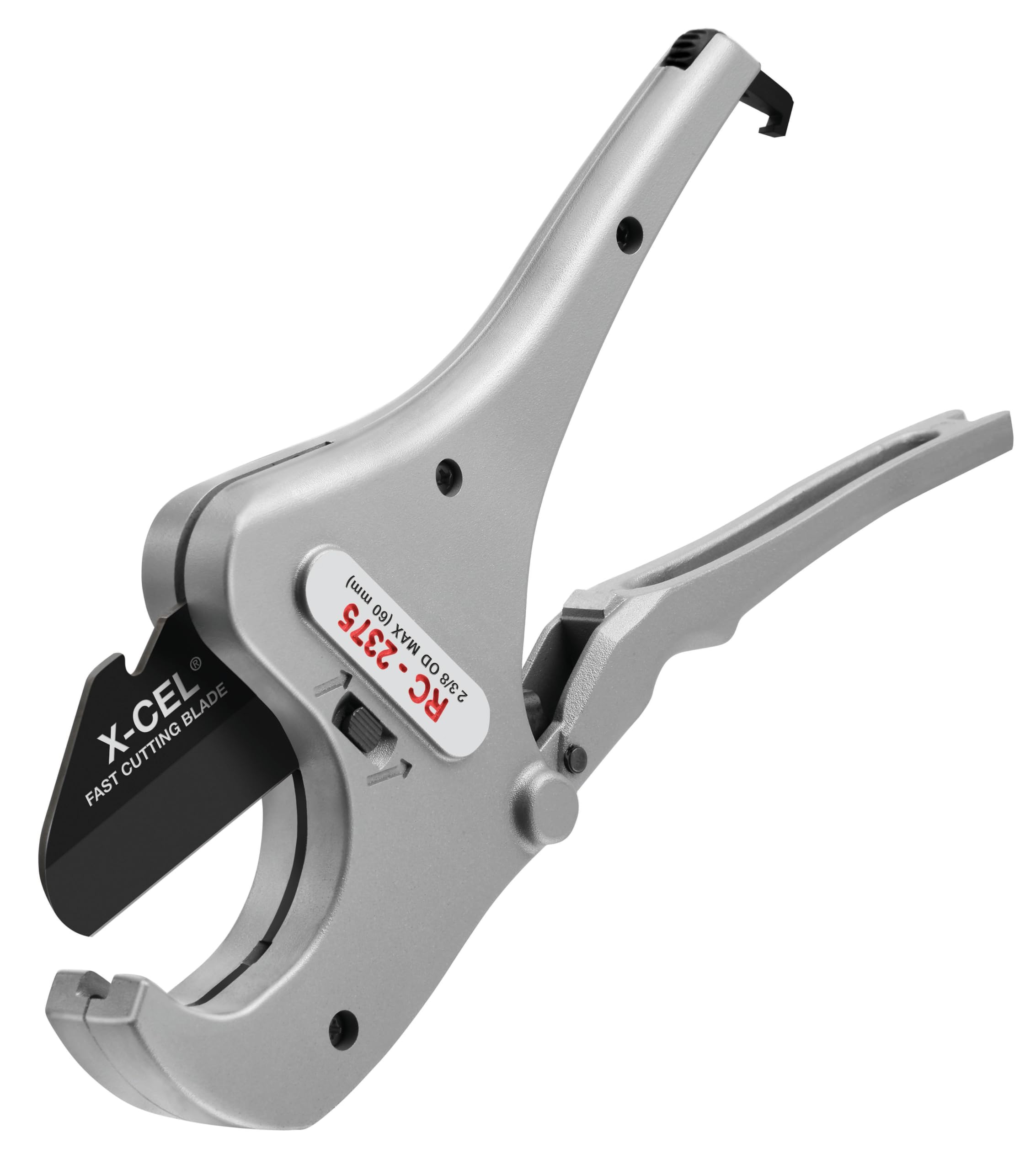
1. RIDGID 30088 RC-2375 Pipe and Tubing Cutter
Our pick — 4.5+★ from 950+ verified ratings; the strongest balance of quality and price.
A 1/8″ to 2-3/8″ jaw range that swallows nearly any plastic or multilayer line you meet.
This is the cutter that covers the widest spread of materials on the list. The 1/8″ to 2-3/8″ outside-diameter capacity handles PVC, CPVC, PP, PEX, PE, and rubber hose, so it is the one tool that can follow you from a water line to a drain run. The ratcheting mechanism and blade geometry work together to reduce the hand force you need, which matters when you are squeezing overhead on a ladder.
What wins people over is the build and the cut quality. The sturdy aluminum body takes jobsite knocks, and the “burr-less” operation leaves a clean square edge you can glue or fit right away. The grips on the bottom handle sit at 1/2″ increments and double as a quick measuring scale, so you can mark a length without hunting for a tape. The X-CEL blade system swaps a blade tool-free in seconds, and you will not lose clips or screws on the ground.
The catch is real and worth knowing before you buy: the tighter you get into the thick-wall material, the more this tool asks of your hands, and the ratchet action splits opinion — some find it smooth, others fight it. It also keeps the tool’s weight where you feel it — 1.41 pounds, heavier than the WORKPRO (1.14 pounds) and much heavier than the little Mudder (8.5 ounces). Replacement blades also cost more than you might expect, which is the trade-off for that clean-cut design.
Where it earns its keep
- Widest material range here — PVC, CPVC, PEX, PE, and rubber hose in one tool
- “Burr-less” square cut saves a cleanup step before glue-up
- Tool-free X-CEL blade change in seconds without losing clips or screws
- Bottom-handle grips at 1/2″ increments double as a measuring scale
Where it makes you work
- At 1.41 pounds it is the heavier of the two manual picks compared here
- Ratchet action feels smooth to some, stiff to others
- Replacement blades cost noticeably more than budget options
Right tool if: you cut several plastic types and want one cutter that handles all of them without swapping tools.
Think twice if: you want the lightest possible cutter for one narrow job — a smaller dedicated tool will feel easier in the hand.
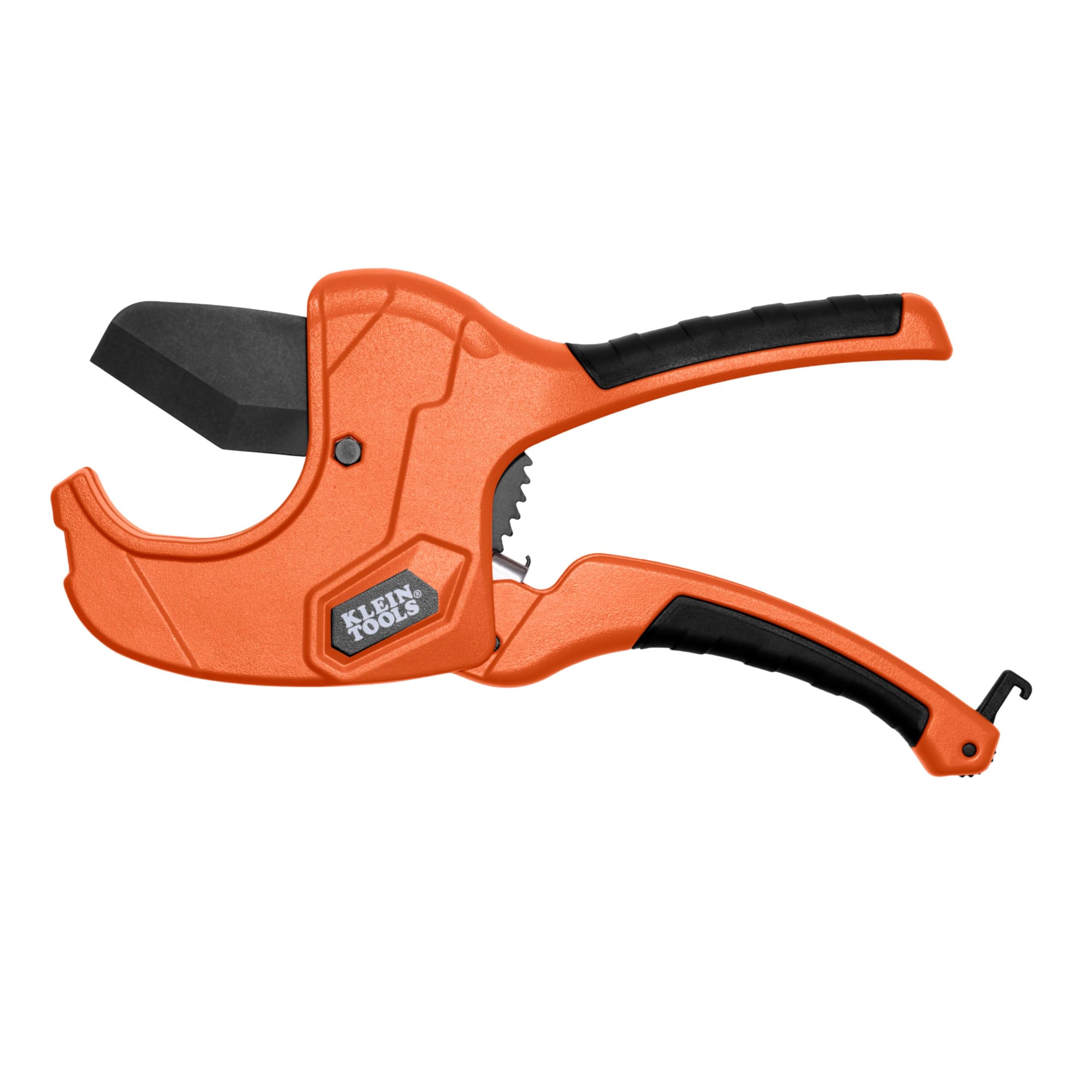
2. Klein Tools 50080 PVC Pipe Cutter
A versatile ratchet that handles the full plumbing mix — Schedule 40/80 PVC, CPVC, and PEX.
What separates this one is the breadth of pipe it accepts. The jaw takes up to 2-Inch ID and 2-3/8-Inch OD, and it is rated for Schedule 40/80 PVC, CPVC, and PEX, so it is equally at home on a drain line and a supply run. The tune jaw design holds different pipe sizes without slipping — an easy win for homeowners, handymen, plumbers, and electricians who cut a range of sizes on one job.
The soft-molded handles keep a secure grip over a long run, and the blade retracts easily by pulling the handles apart. That blade retraction is a small thing that adds up: it speeds up repeated cuts, so you are not resetting the jaw by hand between each one. The die-cast aluminum alloy body with a steel blade gives it a solid, long-term feel that buyers keep coming back to.
Two honest points. At 1.25 pounds it carries a little more heft than a compact cutter, and the blade durability is the one mixed signal — some report great life, others find it chips after a while. Plan for that as a wear item rather than expecting a single blade to last forever.
Versatility writes the check: the widest pipe-type coverage of the manual picks here — PVC, CPVC, and PEX from the same jaw.
The blade is the variable: durability splits between owners, so keep a spare on the truck if you cut daily.
Best fit for: the working plumber or electrician who needs one cutter to move between PVC, CPVC, and PEX without changing tools.
Look elsewhere if: you want the absolute lightest carry or only ever cut small tubing.
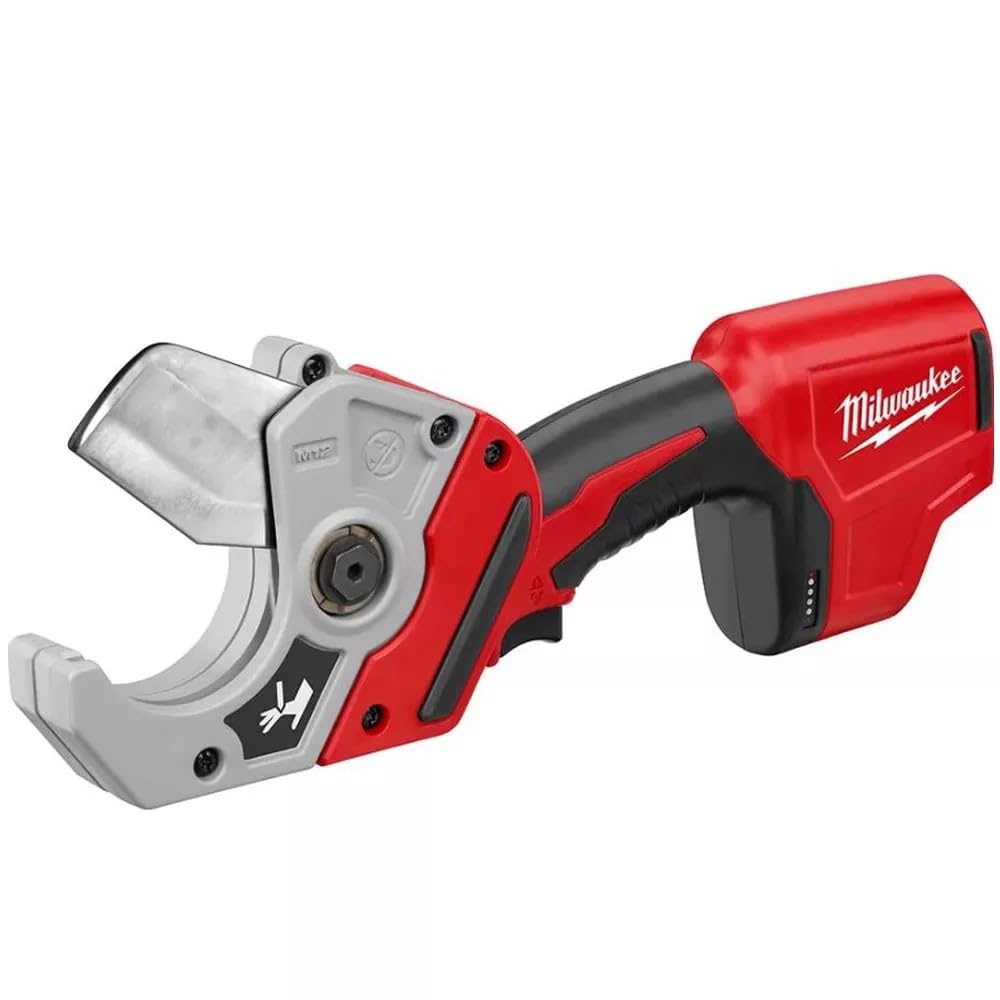
3. Milwaukee M12 12-Volt Cordless PVC Shear (2470-20)
Let the motor do the squeezing — a cordless shear that slices 2″ schedule 40 PVC in 3 seconds.
This is the one pick that replaces your wrist entirely. The patented shear mechanism cuts Schedule 80 PVC up to 2 inches, and the maker’s spec puts a 2″ schedule 40 cut at 3 seconds. The quick blade return speeds up repetitive work, so you can flow from cut to cut without resetting by hand. Swing it against the manual alternatives and the gap is the squeeze: no ratcheting, no hand force, just pull the trigger.
Plumbers who do volume cuts call this a time-saver, and it is the kind of tool that turns a two-handed job into a one-handed one — handy when you are up a ladder holding pipe in the other hand. The stainless steel blade and aluminum jaw resist impact, water, and rust. A variable-speed trigger lets you control the bite in cold or warm weather, and an on-board fuel gauge shows what is left so you are not caught mid-run.
The honest limit is the one written on the box: it is the power tool only, with battery, charger, and accessories sold separately. If you are not already on the M12 platform, budget for those before you commit, because the tool will not cut a single pipe without them. At 4.71 pounds it is also far heavier in hand than any manual cutter here — that weight is the price of not squeezing.
Pick this if: you cut pipe all day and want zero hand strain, especially overhead or in tight spots.
Not for you if: you do not own the battery and charger, or you only make a few cuts a year.
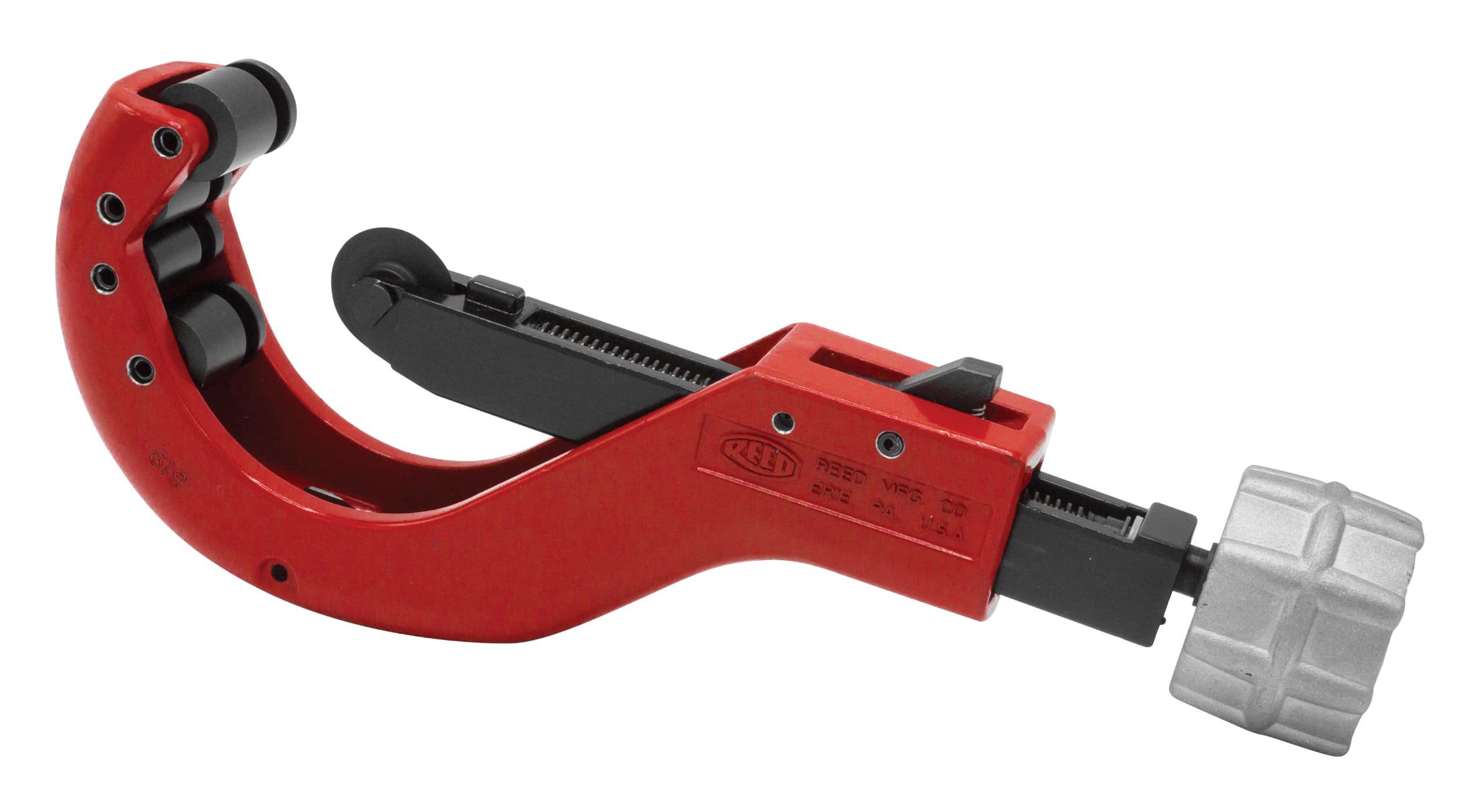
4. REED TC2QPVC Tubing Cutter for PVC (04124)
The widest outside-diameter reach here, from 1/4 to 2-5/8″ — made for the big runs.
When the pipe gets big, this is where the REED earns its spot. The 1/4 to 2-5/8″ outside-diameter capacity is the largest reach on this list, and the same range is listed as 6 to 63 mm for anyone working to metric specs. It is a dedicated PVC cutting tool, so it does one job and does it well — no guessing whether the jaw will handle a heavy-walled line.
What the tool is built around is tracking and cutting ease: the design keeps the blade running true so the cut comes out clean and square rather than ragged. Buyers doing larger-diameter work note cuts coming out straight and clean, and some mention going through 4″ PVC in under 2 minutes — the kind of speed that keeps a job moving. The unit is heavy-duty and sturdy in the hand, with a build that feels like it will take years of use.
Keep the wear points in mind. Durability is the one split signal — some expect it to last a lifetime, others report the blade coming loose or the cutting wheel pin working out over time. Give the blade a check before a big run so a loose pin does not cost you a cut mid-job.
The reach is the story: 1/4 to 2-5/8″ O.D. capacity is the biggest spread on the list — ideal when you regularly face heavyweight PVC tubing.
Watch the blade: the wheel pin and blade seating are the parts to inspect between jobs.
Reach for this if: your work leans toward larger-diameter PVC and you want a tool that tracks a straight line through it.
Look elsewhere if: you mostly cut under-1″ tubing where the extra capacity adds bulk without benefit.
5. WORKPRO Ratchet PVC Pipe Cutter Tool, Up to 2-1/2″

Single-hand ratchet cuts in 5 to 20 seconds — a low-cost entry into ratcheting PVC work.
The pitch here is speed and lightness. The ratchet drive lets you cut one-handed, and the tool’s own spec claims cuts land in 5 to 20 seconds, so quick jobs stay quick. It is built of hardness aluminum alloy steel, which resists rust, bending, and breaking, and it is rated for an outside diameter under 60.5mm across PVC, CPVC, PPR, PEX, PE, and rubber hose. At 1.14 pounds it is lighter than the RIDGID by a noticeable margin, so it carries easier in a bag.
Two smart touches make it friendlier day to day. A ratchet automatic-locking design protects you from the blade springing back, and a plastic buckle at the bottom lets the handles retract and lock for compact, safe storage. The spring-loaded ergonomic handle gives a secure grip that holds the bite as you cut.
The one honest caveat is straightness. It cuts PVC and CPVC cleanly and fast, but if you need a perfectly straight cut, you have to support the pipe from both sides — especially on short pieces, where a clean square edge is harder to land. At its price, that is a fair trade for a tool that still bites firmly.
The quick cuts add up
- Ratcheting one-handed design with cuts claimed at 5 to 20 seconds
- Light 1.14-pound carry for a tool at this capacity
- Automatic-locking ratchet protects against blade rebound
- Retracting, locking handles store compactly and safely
Where straightness gets fickle
- Straight cuts need two-sided pipe support, especially on short pieces
- Blade dulls and drifts over repeated cutting, so expect to replace it
- Handle lock is the weak point in long-term use
Grab it if: you want into the ratchet game cheaply for PVC and CPVC jobs that do not demand a perfect kerf.
Pass if: every cut must be dead square on short pieces — a stiffer, heavier cutter tracks straighter.
6. LENOX LXHT80822 PVC Pipe Cutter, Ratcheting, 1 ⅝”
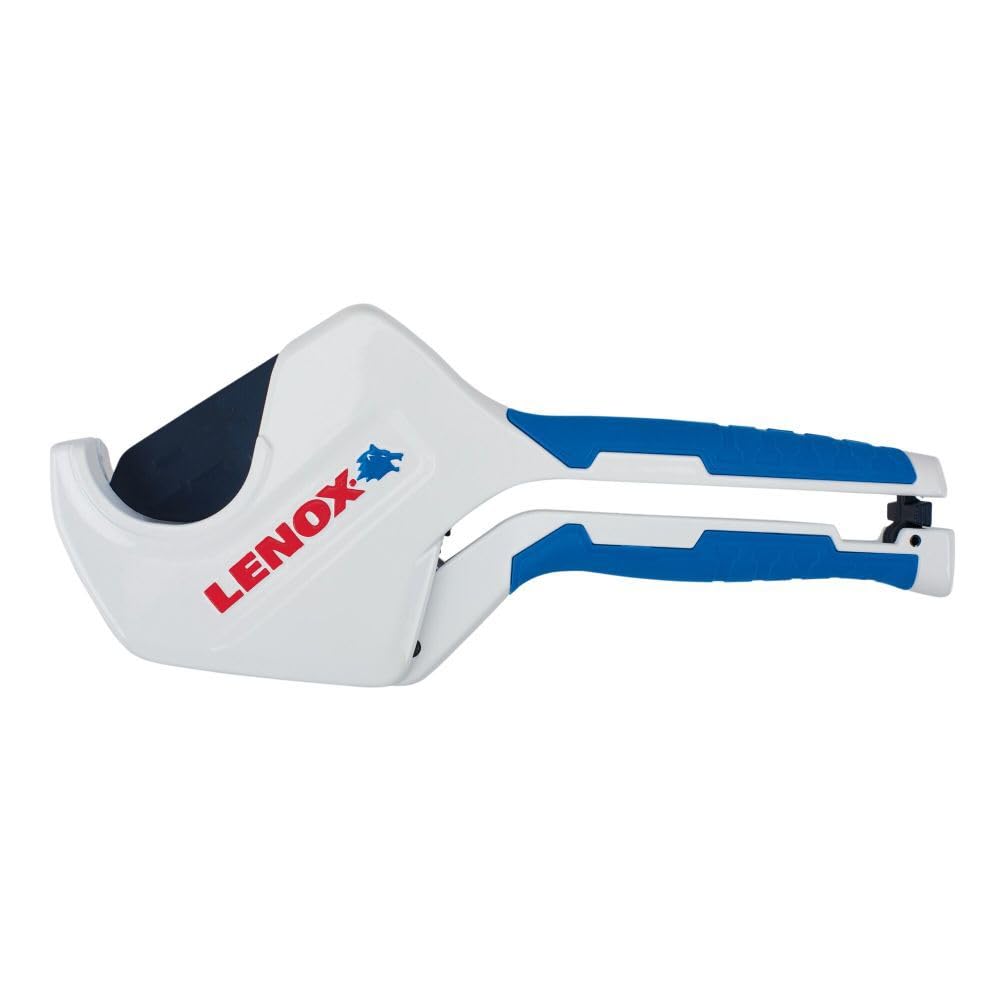
A compact cutter built for wet, dirty hands and one-handed locking in tight spots.
The 1-5/8″ capacity tells you exactly who this is for: small to mid-size rigid plastic tubing, not a 2″ drain run. Within that range it is a thoughtful little tool. A premium coated stainless steel blade and high-leverage design are built to cut with 25% less effort, so you do not have to crush the handles to get through a line. The cast aluminum body stands up to rugged, repeated use.
Two details make it nicer in the field. The rubber handles keep a confident grip even in wet, dirty conditions — a real thing when you are working under a sink or in mud. A conveniently placed locking latch gives true one-handed operation of the spring-loaded cutter, so you can open and close it without the second hand you do not have free. What buyers most notice is steady, reliable cutting.
The obvious limit is the jaw. At 1-5/8″ it will not take on the bigger PVC the RIDGID or REED will swallow, so if your jobs run to 2″ pipe, this is the wrong size. Consider it the tidy compact option for smaller tubing rather than a do-everything cutter.
Ideal for: tight-space cuts on smaller rigid tubing where wet hands and one-hand operation matter.
skip it if: your pipe routinely runs at or above 2″ — you will hit the capacity wall fast.
7. Mudder 9 Pieces PTFE Tube Cutter

Nine small cutters for soft tubing — the pick for 1/4 inch air and fluid lines.
This is a different tool for a different job. The Mudder is a self-supporting tubing cutter set of 9 pieces, sized for soft pipes — PU, PE, Nylon Tube, PVC — and it shines on small air lines and 1/4 inch tubing. You press the tail and it clicks and cuts, no ratchet, no big jaws. At 8.5 ounces the whole set is far lighter than the manual ratchet picks here, so it lives easily in a drawer or bag.
The build is fuselage polyacetal with a 304 stainless steel blade, and the blade is replaceable — fixed by a screw, so you can swap it to your own need. The pointed, self-supporting blade gives a clean, square cut and stays safely closed when not in use, which protects both the edge and your fingers. It also works in high-temperature and high-pressure environments, so it is meant to take long service. Clean cuts on small tubing are what buyers praise most.
The flip side is scale and toughness. This is a small soft-tubing tool, not a PVC pipe cutter for 2″ drain pipe — push it past that and it will not perform. Sharpness and durability split between buyers, so inspect the blade edge on arrival; if it feels dull, a fresh replacement restores it.
Built for the small stuff: 9 pieces, 8.5 ounces, and a self-supporting click-and-cut design sized for PU, PE, Nylon, and PVC tubing.
The size ceiling is real: it will not replace a ratchet cutter on thick or large-diameter pipe, and a blade can arrive dull.
Choose this if: you run small air or fluid lines and want a light, replaceable-blade set for clean square tubing cuts.
Move on if: you need a cutter for 2″ PVC pipe — this set is a different class of tool.
8. DOMINOX PVC Pipe Cutter
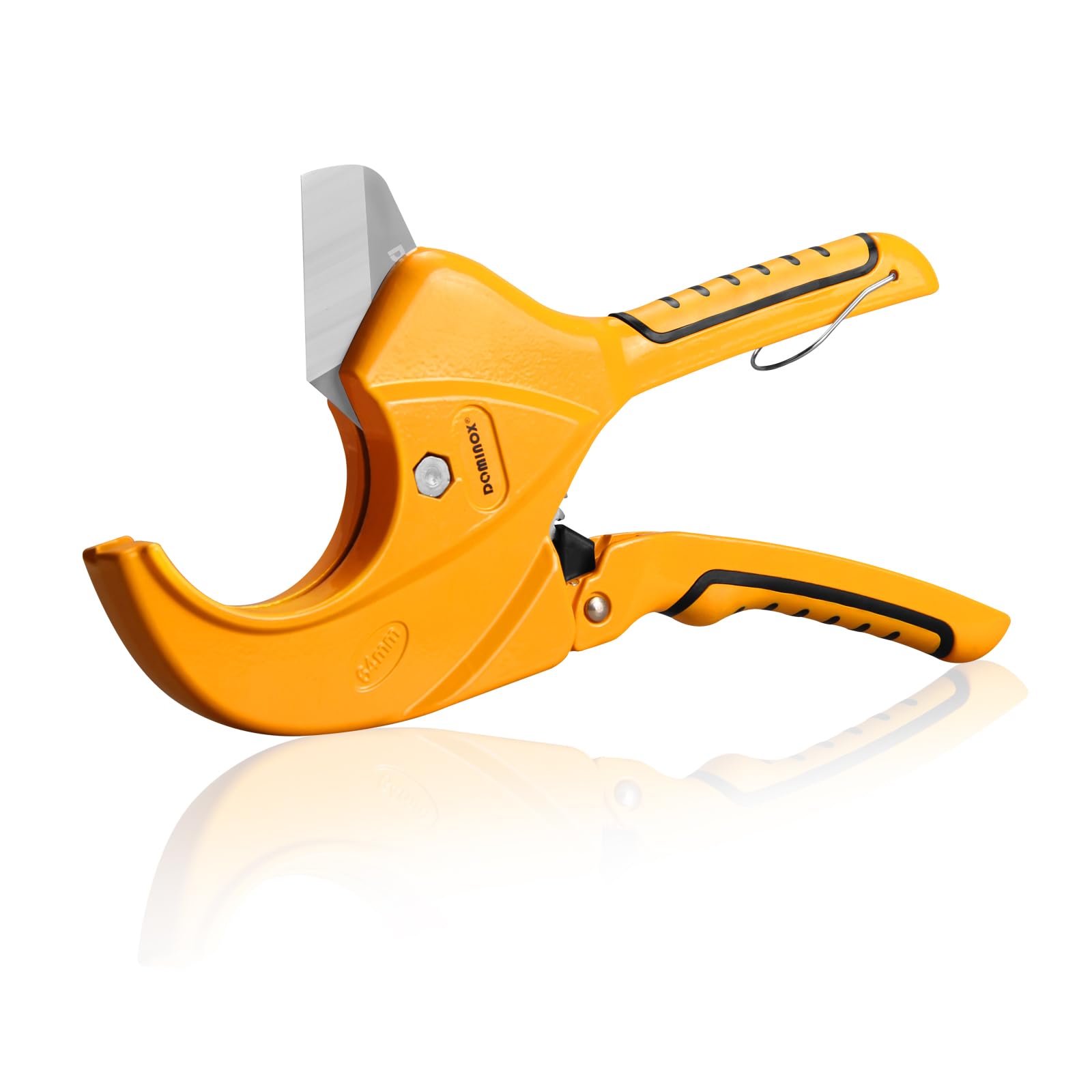
A ratcheting cutter rated to 2-1/2″ that makes PVC feel like hot butter.
The DOMINOX is the tool to look at if you want a smooth, hot-knife feel through standard plastic pipe. It uses a high-quality stainless steel blade that resists rust, bending, and breakage, paired with a rubber handle that cuts slip and improves comfort over a run. The ratchet mechanism applies consistent pressure so the cut stays clean and even, and it allows one-hand cutting with easy blade release.
Its reach covers PVC, PEX, PE, rubber, and plastic pipe up to a 2-1/2″ outside diameter, so it handles a wide mix of sizes on one job. The pointed blade angle is designed to hold the pipe in place as it bites, which helps avoid slipping. The tip the spec sheet gives is worth following: tighten the blade screws, keep the kerf at least 1.5 inch from the pipe mouth, and start with the pipe perpendicular to the blade, centered on the point.
The honest catch is squareness on shorter pieces — cutting performance splits between buyers, with some finding clean straight cuts and others struggling to keep the kerf square. Support the pipe, follow the alignment steps, and it behaves; rush it and the blade can wander. Blade stability is the part to watch, as the edge can drift as you near the end of a cut.
What it gets right
- Ratcheting one-hand action with consistent pressure for even cuts
- Covers PVC, PEX, PE, rubber, and plastic up to 2-1/2″ OD
- Rubber anti-slip handle stays comfortable over a run
- Stainless blade resists rust, bending, and breakage
Where the kerf can wander
- Square cuts on short pieces take care and pipe support
- Blade stability can drift toward the end of a cut
- Some owners find the blade breaks after short use
Great for: mixed-size plastic pipe where you want a smooth ratchet feel and one-hand cutting.
Think about it if: every cut must be square — this rewards a slow, supported hand, not a rushed one.
9. Superior Tool 37116 One-handed 2″ PVC Ratcheting Cutter
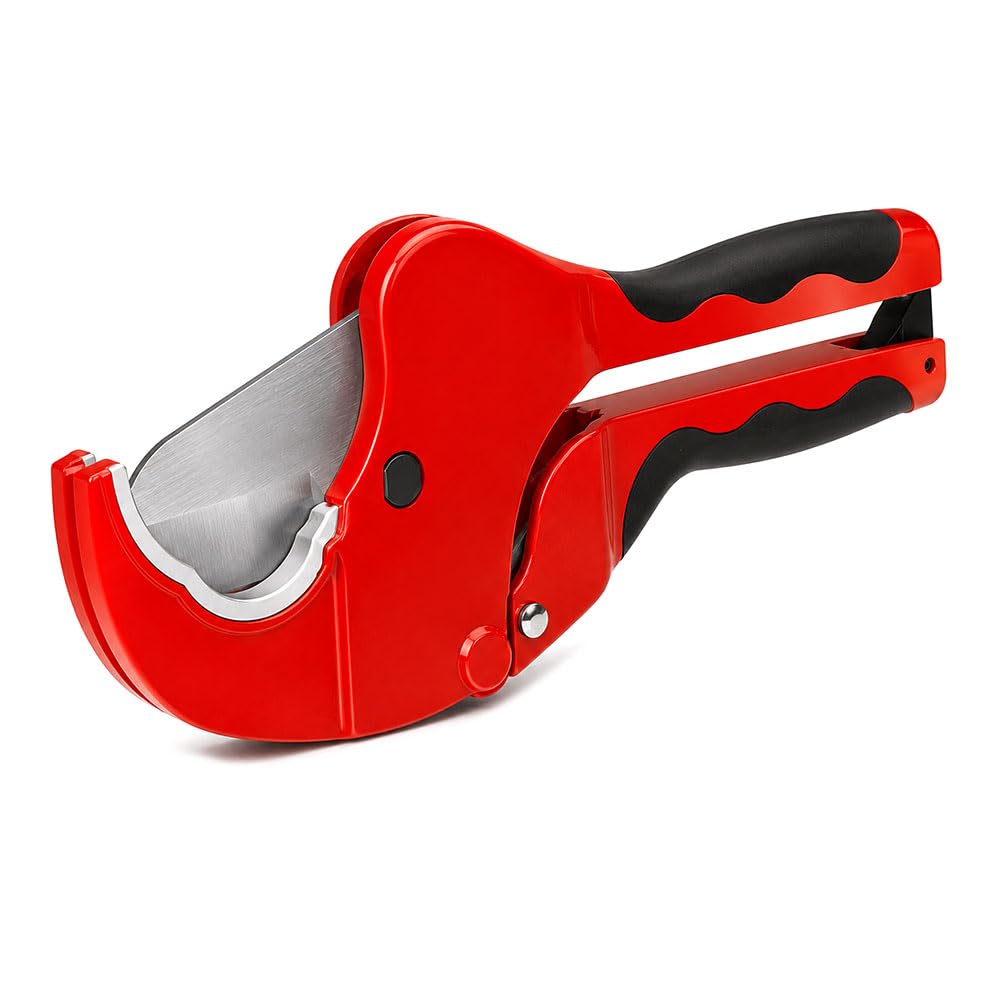
A low-cost one-handed ratchet for quick 2″ PVC cuts that will not break the budget.
If the job is simple and the budget is tight, the Superior Tool gets you a one-handed ratcheting cutter for 2″ PVC. It uses a cushion grip over an aluminum handle for comfort, and it cuts PVC pipes cleanly and reliably when the blade is fresh. Owners find it easy to use and a good value for a tool that holds up on straightforward cuts.
This is the lightest way onto the list in cost terms, and for quick, occasional cuts it does the job. Where you feel the money saved is in the wear parts: this cutter runs 16 ounces, and its lifespan depends on how hard you work the blade. Keep it for light-duty runs and it will serve you well.
Be realistic about the build, though. Blade durability is the loudest recurring note — the blade can break after about 10 cuts, the ratchet teeth can fail, and the cutting edge can bend under pressure and produce angled cuts. That is fine for one-off repairs, less so for a full repipe. Treat it as a spare or a light-duty tool, not a daily driver.
Best for: a spare in the truck or a homeowner doing a couple of light PVC cuts where cost matters most.
Steer clear if: you cut daily or lean hard on the tool — the blade and ratchet will not take that pace.
Know the Specs
Outside-diameter (OD) capacity
This is the widest pipe, measured across its outer wall, a cutter’s jaw can open around. A 2-1/2″ OD rating handles big pipe; a 1-5/8″ rating is a compact tool for smaller tubing. Buy at or above the pipe you cut most, so you are not forcing a jaw that is too small.
Ratcheting versus motorized shear
A ratchet locks in steps so you squeeze several small bites instead of one hard crush — easier on the wrist on thick-wall PVC. A cordless shear runs a motorized blade that cuts in seconds with no hand force, but it needs a compatible battery and charger, which are often sold separately.
Blade steel and pierce point
A stainless steel blade with a pointed pierce point bites into PVC and leaves a burr-free cut. The blade is a wear item — how long it lasts depends on the material you cut and how squarely you load it. Keep a spare if you cut daily.
Handle grip and locking latch
A cushion or rubber grip keeps control when your hands are wet or dirty, and a locking latch holds the jaw closed for safe storage. One-handed open and close matters when your other hand is busy holding pipe.
Common Questions
Will a PVC tube cutter cut PEX and CPVC too?
Is a ratcheting cutter better than a plain one?
How do I get a straight, square cut on PVC pipe?
Can the Milwaukee cordless shear cut without a battery?
What is the largest PVC pipe I can cut with these tools?
How long does a cutter blade last?
Do I need a special cutter for small 1/4 inch tubing?
What does 25% less effort mean on the LENOX cutter?
Why do some cutters struggle on short pipe pieces?
The Bottom Line
For most people facing a mix of plastic and multilayer lines, the RIDGID 30088 RC-2375 earns the top spot because its 1/8″ to 2-3/8″ range covers PVC, CPVC, PEX, and PE with a burr-free cut. If you want one cutter for PVC, CPVC, and PEX with a solid grip, the Klein Tools 50080 is the versatile second choice. And if you cut PVC all day and want zero hand strain, the Milwaukee M12 shear is the one to reach for — just add a battery and charger first.
How we choose
We do not accept paid placement. Every pick is matched to a real buyer and a real use-case; we do not hands-on test units.
Sources
Specifications: manufacturer listings and product documentation. Review insights: verified customer reviews, as of November 2026. Pricing: not shown on this page (it changes often); check the current price via the retailer link.
As an Amazon Associate, Tactical Gear Guy earns from qualifying purchases. This does not affect which products we feature.