Specs are compiled from manufacturer listings and verified buyer reviews and can change over time — please confirm the key details on the product page before buying.
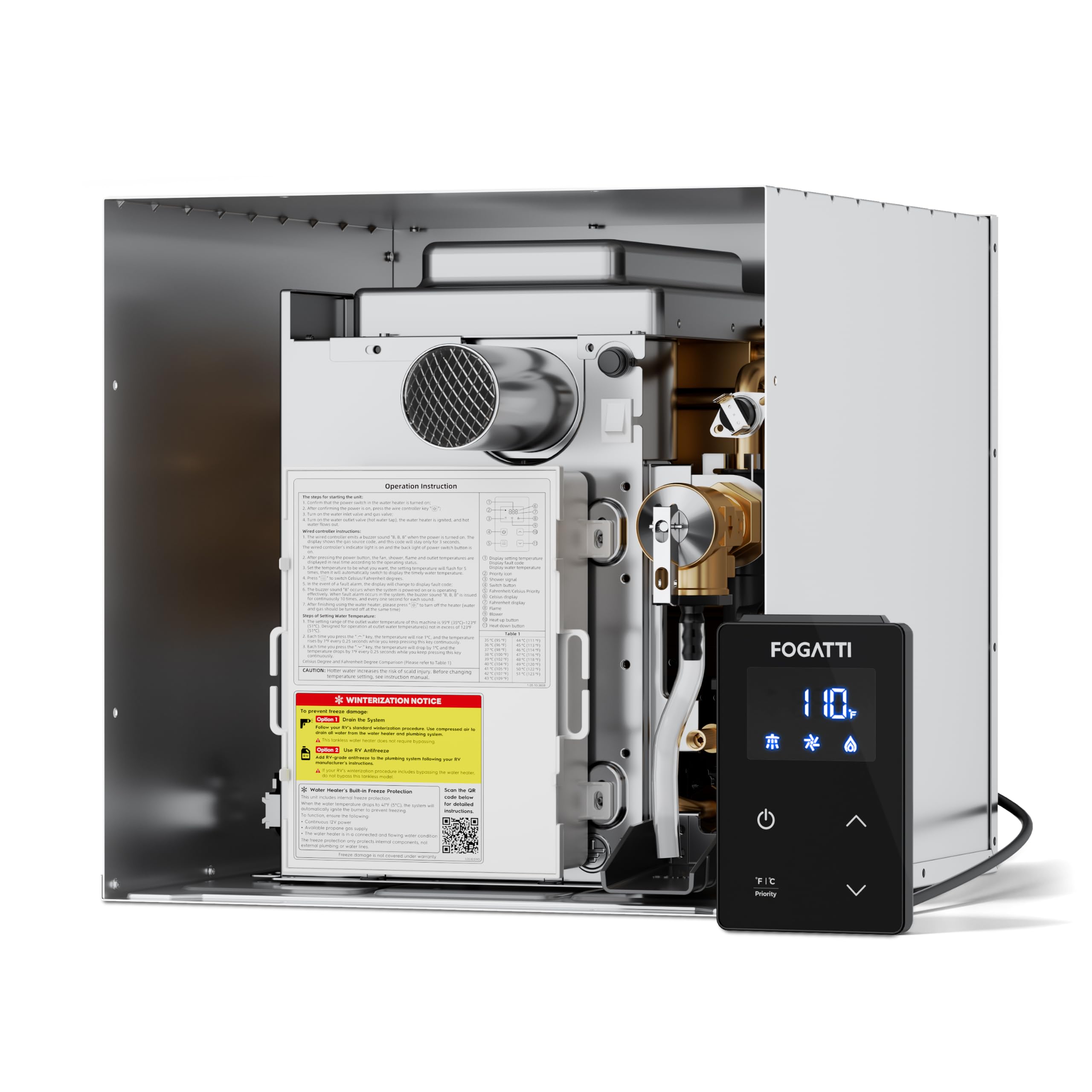
If you are tired of a lukewarm shower because someone ran the sink, the fix is a propane water heater that heats on demand instead of storing a tank of hot water. The picks below cover RV replacements, indoor whole-home units, and portable camping showers — each one runs on liquid propane, so it keeps working through a power outage. The crowd favorite is the FOGATTI InstaShower 7, sitting at 4.0+ stars across 400+ ratings, because its 15″×15″, 15″×18″, and 18″×18″ door sizes drop into an existing RV cutout without drilling.
This guide is built by comparing the manufacturers’ published specifications and the patterns across verified customer reviews, so you get each pick’s real strengths and trade-offs instead of marketing spin.
Flow rate in gallons per minute (GPM) decides how many taps you can run at once, and BTU output decides how fast the water heats. Weigh those two against where the unit mounts and you can narrow the field fast. This breakdown of the best propane water heater pairs real specs with the trade-offs owners actually live with.
Top Picks


How To Choose The Best Propane Water Heater
A propane water heater is a box that heats water the moment you open the tap, using a gas burner instead of a stored tank. That means no waiting for a tank to refill, and no heat lost sitting idle. The tricky part is matching the unit to your water demand, your mounting spot, and your fuel line — because the wrong pick either can’t keep up or won’t fit.
Start with flow rate, then check BTU
Flow rate, measured in gallons per minute (GPM), is how much hot water the unit pushes through at once. One shower typically draws around 1.5 to 2 GPM, so a 2.5 GPM unit handles a shower and a sink together, while a 5 GPM unit can run two showers. BTU (British thermal units) is the burner’s heating power — the higher the number, the faster it raises cold water to temperature. A 48,000 BTU unit and a 120,000 BTU unit both make hot water, but the bigger burner recovers faster when the inlet water is cold.
Match the install location to the unit
Indoor models need a vent pipe routed outside, so they suit a utility closet or garage with a wall to vent through. Outdoor models skip venting entirely because the exhaust escapes into open air. RV models run on 12V DC power from your camper’s electrical system and are sized to drop into a standard exterior cutout. Getting this wrong is the most common reason a return happens.
Check the plumbing and gas connections before you buy
Standard residential units use 3/4″ NPT water connections and a 1/2″ NPT gas inlet, and most need a 120V plug for the controls. RV tankless models usually want a 12.8″ × 12.8″ cutout and a separate exterior door kit. Measure your existing setup first; a unit that is a half-inch off will not seal.
Side-by-Side Comparison
| Model | Best For | Flow Rate | Heat Output | Install Type | Amazon |
|---|---|---|---|---|---|
| FOGATTI InstaShower 7★ Best Overall | RV drop-in replacement | 2.5 GPM | 48,000 BTU | RV, 12V DC | Amazon |
| APUS 120,000 BTUMulti-Point Pick | Multi-point home use | 5.43 GPM | 120,000 BTU | Indoor, vented | Amazon |
| CAMPLUX F10 UltraCamp Favorite | Portable family camping | 2.64 GPM | 68,000 BTU | Portable, outdoor | Amazon |
| Ranein RA65EH | Full-time RV living | 3.9 GPM | 65,000 BTU | RV, 12V DC | Amazon |
| ThermoMate CZ422LP | Two-shower homes | 5 GPM | 102,000 BTU | Indoor, vented | Amazon |
| CAMPLUX Nano 3 Ultra | Off-grid showers | — | 20,000 BTU | Portable, outdoor | Amazon |
| A. O. Smith ATO-140H | Outdoor whole-home | 6.6 GPM | 120,000 BTU | Outdoor, condensing | Amazon |
| Rinnai RE140iP | Whole-house indoor | 5.3 GPM | 140,000 BTU | Indoor, vented | Amazon |
| Rheem RTG Series | Large-family outdoor | 7 GPM | 160,000 BTU | Outdoor | Amazon |
| Westinghouse 8.1 GPM | Biggest output available | 8.1 GPM | 180,000 BTU | Outdoor | Amazon |
Detailed Reviews
1. FOGATTI InstaShower 7 RV Tankless Water Heater
Our pick — 4.0+★ from 400+ verified ratings; the strongest balance of quality and price.
The one that slides straight into your old RV heater hole with no drilling.
Other RV water heater upgrades often involve a weekend of cutting and resealing. The InstaShower 7 is built to skip that — it drops into your existing tank or tankless cutout and reuses the current propane and water lines. FOGATTI lists it for three door sizes (15″×15″, 15″×18″, and 18″×18″), so check which one your rig matches before ordering. Owners consistently say the fit is the best part, and the install instructions are clear enough to finish in an afternoon without a plumber.
Output sits at 48,000 BTU and 2.5 GPM. That is modest next to the APUS at 120,000 BTU and 5.43 GPM, so treat this as a camper-sized unit, not a whole-home replacement. Where it earns its keep is in summer heat: adaptive staged combustion keeps the temperature steady when the incoming water is already warm, and the burners kick on at just 0.5 GPM for low-flow RV fixtures. Cold-weather campers get an auto-heat cycle that triggers below 41°F to protect against freeze damage, plus normal operation up to 9,800 ft for high-altitude camping.
You set the water temperature from 95–123°F on a 6.6 ft wired remote without leaving your seat. The unit is CSA certified and carries 9 safety layers, including flame-failure and freeze protection. Max pressure is 150 psi. When owners do hit a snag, it tends to be the exhaust hole lining up rather than the heater itself — a small fit detail, not a performance problem.
What earns it first place
- Drop-in retrofit across 15″×15″, 15″×18″ and 18″×18″ door sizes
- Auto-freeze heat below 41°F and operation up to 9,800 ft
- 6.6 ft wired remote sets 95–123°F from inside
- CSA certified with 9 safety layers
Where it stops short
- 2.5 GPM and 48,000 BTU suit an RV, not a whole house
- Exhaust hole alignment can be fussy on some rigs
- Confirm your cutout size first or the fit will not work
Go with this if: you want to replace an RV tank heater without cutting into the rig, and you camp in the southwest or at elevation.
Change course if: you need to feed two showers and a sink at home — the 2.5 GPM ceiling is the hard limit here.
2. APUS Propane Tankless Water Heater 120,000 BTU
A 120,000 BTU burner that keeps two showers and a sink running at once.
For a household where people shower back to back, the APUS gives you the biggest margin on this list under the premium tier. It pushes 5.43 GPM at 120,000 BTU, which APUS rates for 3–4 water points. Compare that to the CAMPLUX CX264 at 2.64 GPM and you can see the difference in how many taps run together. The heat output is roughly 2.5 times the FOGATTI RV unit’s 48,000 BTU, so multi-person morning routines are the whole point here.
The temperature holds within ±1°F from 95–149°F, and high-precision sensors and a smart CPU adjust when another faucet opens mid-shower. An LED touchscreen shows your setting at a glance. The oxygen-free copper exchanger and segmented combustion carry a stated up-to-98% thermal efficiency and a UEF (Uniform Energy Factor, the government’s efficiency score) of 0.81. APUS claims up to 30% savings over conventional tanks at a 0.81 UEF — treat that as the maker’s number, not a tested result.
Freeze protection kicks in near 41°F, and APUS advises draining the unit below that or during long idle stretches. The multi-layer protection cuts the fuel when something reads abnormal, and you get 2-year coverage. Quality and simple installation are what buyers talk about most, and the unit runs quietly. Heat output and water flow are the split points — plenty report fast, plentiful hot water, and a smaller set find it runs lukewarm. That usually traces back to a small burner fighting a large demand, so size the unit to your home.
Why it climbs the list
- 5.43 GPM at 120,000 BTU for 3–4 water points
- ±1°F control across 95–149°F with LED touchscreen
- UEF 0.81 with oxygen-free copper heat transfer
Honest caveats
- Heat output and flow get split verdicts from owners
- Freeze protection needs a full drain in deep cold
- 2-year warranty is shorter than the premium names
The right call for: a family that wants two showers and a sink without a wait.
Think again if: you live where the temperature drops well below 41°F and can’t drain the unit each season.
3. CAMPLUX F10 Ultra Portable Propane Water Heater
A thermostatic camping heater that fills a five-gallon bucket in about two minutes.
Most portable propane showers swing hot and cold. CAMPLUX calls the F10 Ultra the first thermostatic propane water heater, holding within ±1°F (about half a degree Celsius) so back-to-back showers stay even. Output is 68,000 BTU (a measure of heating power) across 2.64 GPM (gallons per minute), and buyers report it delivers “a strong, steady flow to fill about a 5-gallon bucket in roughly 2 minutes.” That is enough for a family’s worth of showers, several pet washes, or a portable hot tub fill.
Setup needs no tools. The gas regulator is pre-installed so you connect a standard 20 lb propane tank, attach a water source, drop in 2 D-type batteries, and set the temperature with the +/- buttons. It weighs 14.5 pounds, which is 4.7 pounds lighter than the APUS at 19.2 pounds — an easy lift from the truck to the campsite.
Where this one asks for care is reliability. Functionality and temperature are the split points — plenty of owners find it heats fast and works well, but a few report units that quit early or drift off the set temperature. Durability and ignition show up as the recurring negatives. The honest read: treat it as a camping appliance that needs a clean fuel line and dry storage, not a year-round fixture. The 5-layer safety system (flame-failure shutoff, overheat, overpressure, low-flow shutoff, dry-combustion prevention) gives it a solid safety floor.
Camp-trip strength: ±1°F thermostatic control is rare in a portable, and the 2-minute bucket fill proves the 2.64 GPM flow is real.
What to expect: a few units stop working early — keep it dry, feed it clean propane, and store it indoors between trips.
Built for: family camping, RV aux showers, and pet washes where steady temperature matters.
Not for: a permanent whole-home install — this is a portable appliance with a 1-year warranty.
4. Ranein RV Tankless Water Heater, 65,000 BTU, 3.9 GPM, CSA
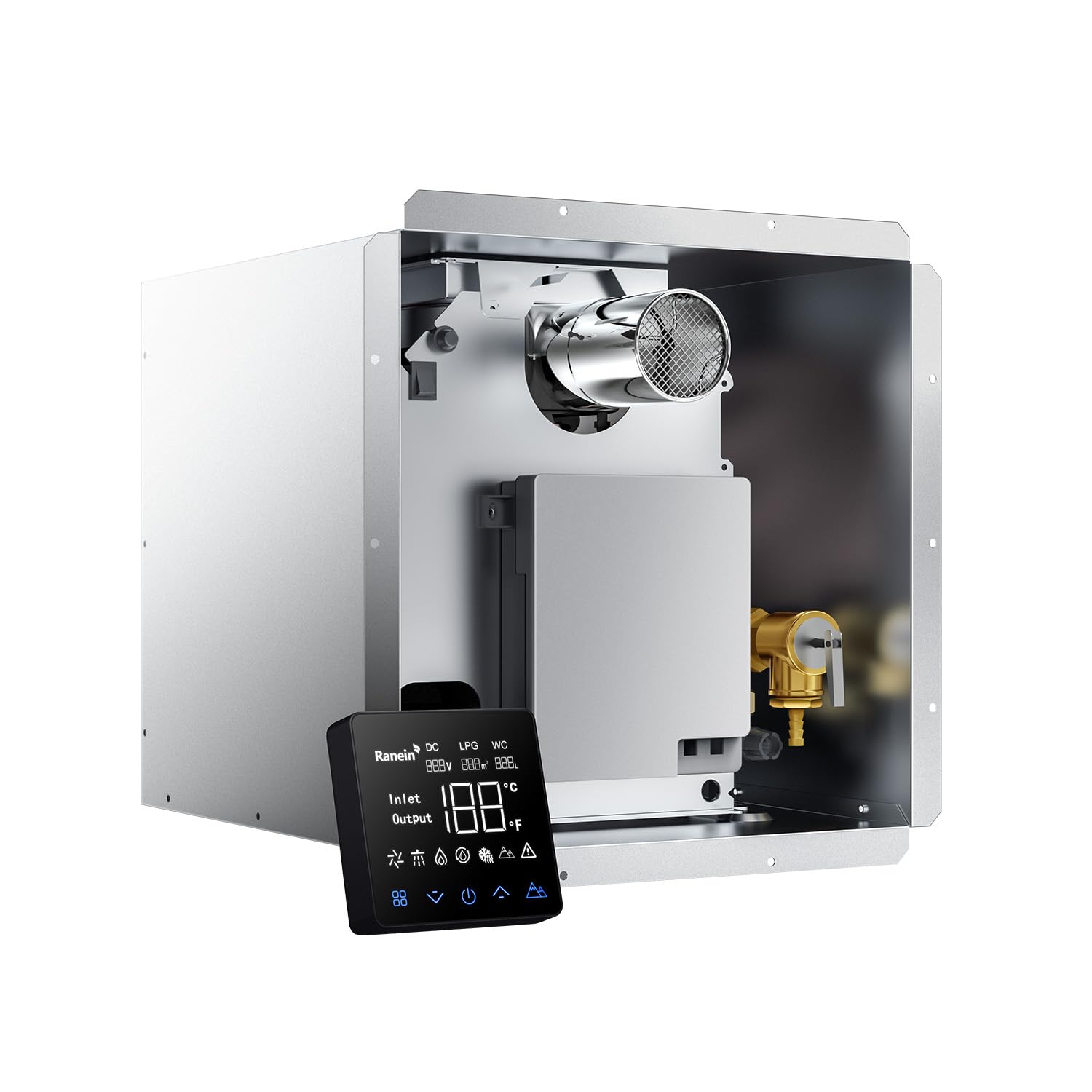
More flow than the FOGATTI RV unit, with a remote that shows your gas use.
If you live in your rig full time, the Ranein’s 3.9 GPM at 65,000 BTU beats the FOGATTI’s 2.5 GPM and 48,000 BTU — a meaningful jump when a shower and the kitchen sink run together. It heats on demand, so no waiting for a tank to refill between showers. Families and extended-trip campers get back-to-back hot water without the cooldown.
The temperature is adjustable from 95°F to 124°F, and staged combustion trims burner output to match demand so it doesn’t overheat in summer. The oxygen-free copper exchanger handles the heat transfer and resists corrosion. The digital remote is the standout — it displays gas consumption, system voltage, water flow in GPM, and when anti-freeze is active. That is real information most RV heaters hide from you.
It is engineered to run up to 9,800 feet and sold CSA certified, with a top-mounted forced exhaust fan, flame-failure gas shutoff, and anti-freeze below 42.8°F. It uses 12V DC power and a 12.8″ × 12.8″ cutout, with optional 15″×15″, 15″×18″, and 18″×18″ door kits sold separately. The exterior door is not included — that is the one thing to budget for. Considered a great step up from tank heaters, it heats within 30 seconds and the fit lands clean for most buyers.
Best matched to: full-time RVers and families who need more flow than a basic camper heater and want live diagnostics.
Factor in: the exterior door kit is separate, so add that to your install plan before you order.
5. ThermoMate CZ422LP Propane Tankless Water Heater Indoor
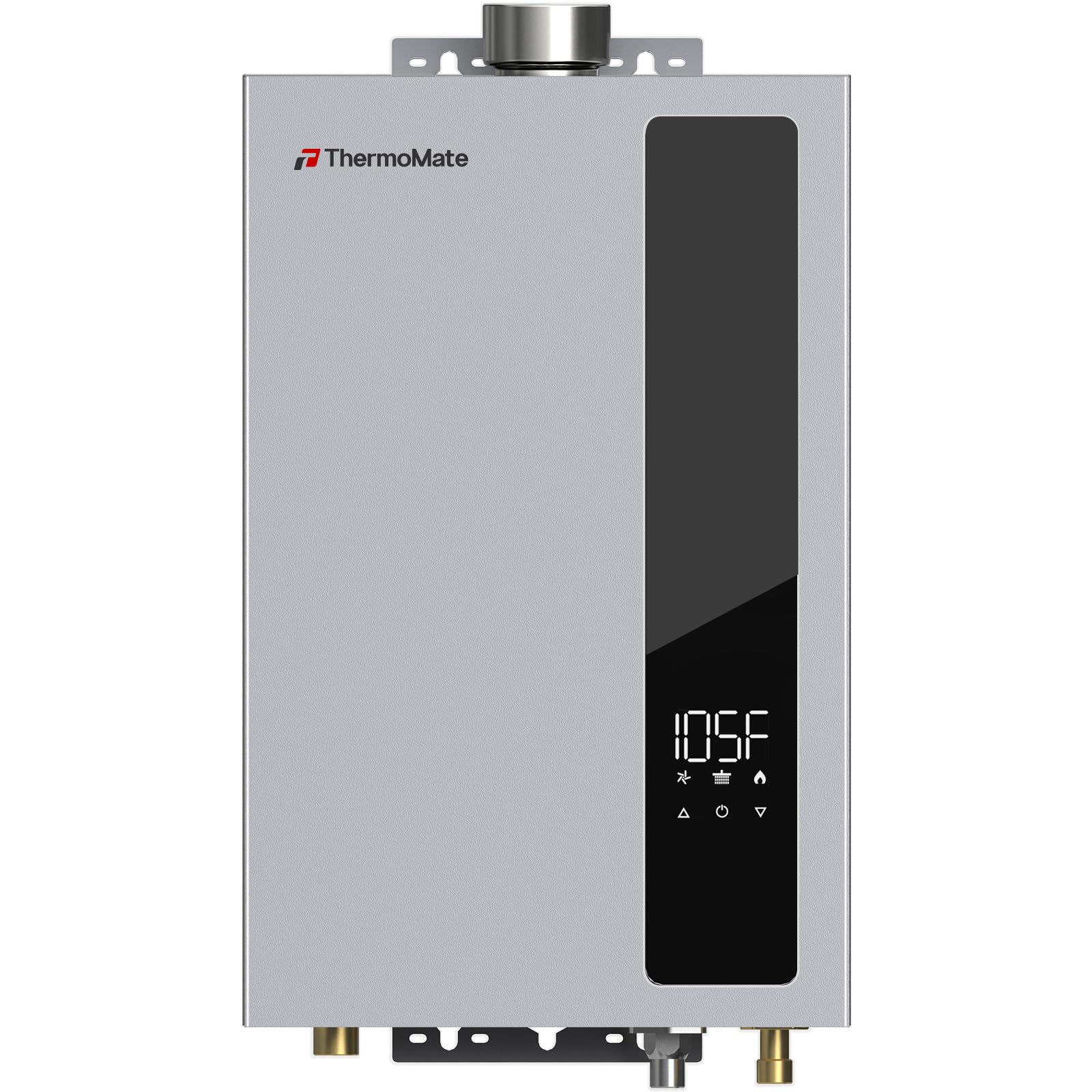
Two showers at once — 5 GPM and 102,000 BTU built for busy mornings.
ThermoMate sizes this one for the two-shower household: up to 5 GPM and 102,000 BTU holding a stable 105°F at a 65°F inlet. A smart flow sensor and control chip adjust the burner 20,000 times per second to hold outlet temperature within ±1°F. That puts it between the APUS’s 5.43 GPM and the CAMPLUX CX264’s 2.64 GPM — more headroom than a small indoor unit, without the top-tier output of the Westinghouse.
It is CSA certified with 8 protections: boil-dry, freeze, flame-out, overheating, over-temperature, pipe blockage, high-temperature lock, and excessive air pressure. Four ceramic cores auto-start frost protection at 41°F. The footprint is 21″ × 13″ × 7″, taking less than one-third of the space of a traditional tank model — easy to fit into a laundry nook or closet.
Connections are standard: 3/4″ NPT water in and out, a 1/2″ NPT gas inlet, a 3″ OD vent, and a UL-approved 120V plug. The 3.5-inch LED display tracks flow, fan, and flame, and error codes speed up troubleshooting. Performance and easy install are what owners mention most, with several installs done in a couple of hours. Temperature stays the split point — some hold hot water through several showers, others say it drifts. A 3-year warranty backs it.
Space-and-flow balance: 5 GPM and 102,000 BTU in a 7-inch-deep cabinet that frees up the old tank’s corner.
The catch to know: consistent temperature is the recurring split verdict — if you like a locked-in shower temp, run it at a steady draw.
Good fit for: a busy household replacing an old indoor tank with a compact 5 GPM unit.
Weigh carefully if: you demand dead-steady temperature across long showers — that is the one split point here.
6. CAMPLUX Nano 3 Ultra Portable Propane Water Heater
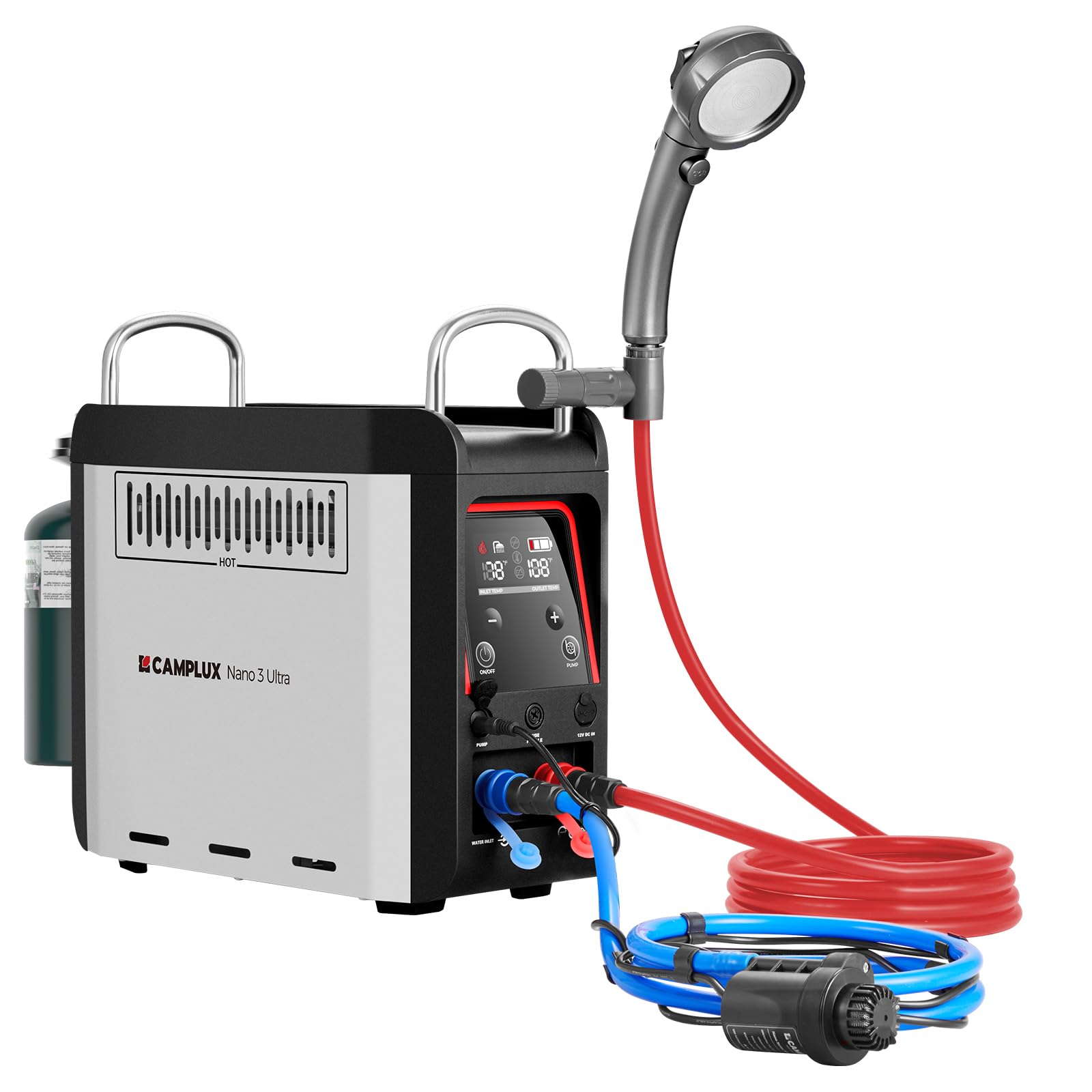
The self-powered shower that runs off a battery and a propane bottle.
For off-grid camping, hunting trips, or fishing weekends, the Nano 3 Ultra brings its own pump and battery. Output is 20,000 BTU — the lowest here, sized for one shower at a time, not a household. The built-in 4,000mAh rechargeable battery runs 100 minutes per charge, gets to 80% in 1.5 hours, and fully charges in 3 hours. It can even charge while you use it.
Temperature holds within ±1°F with the +/- buttons, and you can switch to a cold-water mode to cut fuel use — short-press PUMP for hot, long-press for cold. The whole kit comes ready: the heater, a submersible pump, a 3-mode shower head, a shower bracket, a gas regulator, and a DC 12V-24V cigarette lighter cable. It weighs 17.6 pounds and mounts nowhere — it is purely portable.
Safety is CSA-tested with 122°F overheat protection, dry-run pump protection, a low-voltage alert, a 45° tip-over shutoff, and a 2-minute auto shutoff. The trade-off is longevity: a few units stop working within months, and the 20,000 BTU ceiling means cold inlet water can feel underwhelming. Portability is what owners value most here. Keep it out of the elements and it suits the trip it was built for.
Pack it for: solo or small-group off-grid showers where there is no power hook-up.
Skip the upgrade if: you want a fixed indoor water heater — 20,000 BTU won’t run a home.
7. A. O. Smith ATO-140H Propane Outdoor Tankless Water Heater

An outdoor condensing heater with a heat exchanger built to outlast the house.
The A. O. Smith steps into premium territory with a 15-year limited warranty on the heat exchanger for residential use. Flow runs up to 6.6 GPM at 120,000 BTU — enough for a 1–2 bath home. It is a condensing unit rated ultra-low NOx (a measure of nitrogen-oxide emissions), and it mounts outdoors, so there is no venting to run inside the house.
Two exchangers do the work: a commercial-grade copper primary that A. O. Smith states transfers heat 25x better than stainless steel, and a 316L stainless steel secondary for corrosion resistance. The wall-mount design frees floor space. Venting goes through 3″ PVC up to 70 feet or 4″ PVC up to 100 feet — a long run for a fairly flexible install.
Safety features include exhaust and water temperature controls, an overheat cut-off fuse, and an air-fuel ratio sensor. This is a newer listing with a small review base, so there is less owner history to lean on than the Rinnai or Rheem. Lean on the warranty and the spec sheet here. If long-term heat-exchanger coverage matters most, this is the pick.
The 15-year play: a copper primary plus 316L stainless secondary and a 15-year heat-exchanger warranty front-load the durability story.
What is thin: a small owner base means less real-world feedback — buy it on the spec sheet and warranty rather than reviews.
Right for: a homeowner who wants outdoor installation and maximum heat-exchanger coverage.
Consider waiting if: you want a long track record of owner experience before you commit.
8. Rinnai RE140iP Non-Condensing Propane Tankless Water Heater

Suitcase-sized, 140,000 BTU, and built to run five fixtures at once.
Rinnai packs 140,000 BTU and 5.3 GPM into a unit the size of a small suitcase, rated for five fixtures at once. That is more heat than the ThermoMate’s 102,000 BTU and more than double the CAMPLUX CX264’s 65,000 BTU — a serious step up for a larger household. It only fires when there is demand, so it conserves energy between draws.
The redesigned internal layout is meant to speed installation and make servicing easier, and the LED screen shows service reminders plus error codes so you are not guessing when something trips. The maximum temperature is 140°F. It weighs 48.5 pounds — the heaviest indoor pick here — so plan on a two-person wall mount.
Rinnai recommends professional installation and even publishes a Find a Rinnai PRO tool to locate a technician. The residential warranty is limited 15-year on the heat exchanger, 5-year on parts, and 5-year on labor, but labor drops to 1 year if the product is not registered within 90 days of installation. Customers note it works well and are happy with performance; the split point is temperature control, with a few saying it runs cold. Register it on time and treat this as a pro-install appliance.
Output leader for indoor: 140,000 BTU and 5.3 GPM cover five fixtures, more heat than the ThermoMate and roughly double the CX264.
Install reality: 48.5 pounds and a pro-install recommendation mean you should hire the technician and register within 90 days.
Choose it for: a larger home with several fixtures where professional installation is already in the plan.
One caution: register the unit within 90 days or the 5-year labor warranty drops to 1 year.
9. Rheem RTG Series 7.0 GPM Liquid Propane Tankless Water Heater
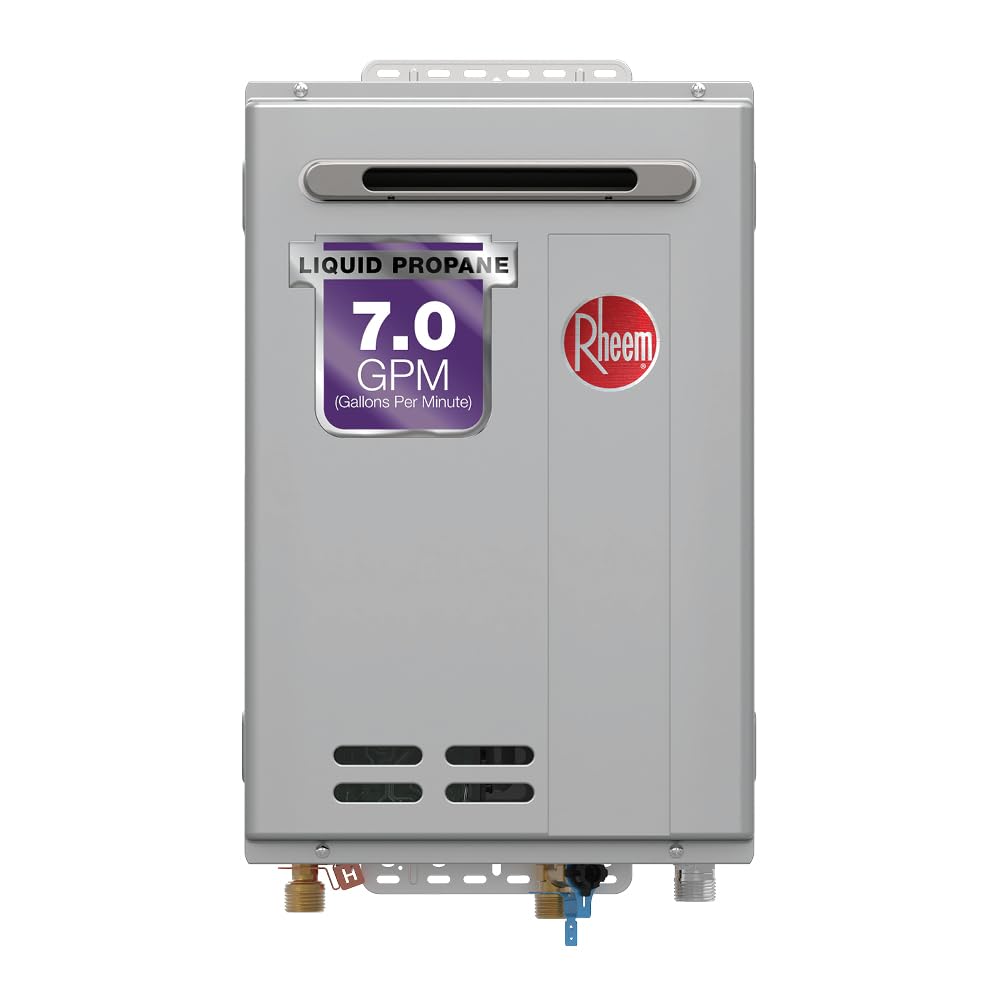
160,000 BTU and 7 GPM — a whole-house outdoor heater for a big family.
This is the outdoor pick for a large family or a multi-bathroom home. Rheem rates 7.0 GPM at a 35°F temperature rise, delivering 160,000 BTU/hr for 2–3 simultaneous showers. Put that next to the ThermoMate’s 102,000 BTU or the Ranein’s 65,000 BTU and you can see the difference in multi-shower capacity. Outdoor installation also eliminates venting, so the install stays simple.
Efficiency comes from a 0.82 Uniform Energy Factor, which Rheem says saves up to 34% on energy costs versus a 50-gallon electric tank heater — a maker’s comparison, not a tested result. The cabinet is a durable metal build with a stainless steel material type, and it mounts to the wall by a qualified installer. Non-condensing design keeps the exhaust simple.
Reviewers point out it performs better than expected and the install is straightforward. Value is the split point — some find it worth the money, others less convinced. The warranty covers 15 years on the heat exchanger (the part that transfers heat to the water), 5 years on parts, and 1 year on labor. If you want big output outdoors and prefer a name with a long service network, this earns its spot.
Matched to: a large family home with several bathrooms and an exterior wall to mount on.
Reconsider if: your install has to be indoors — the outdoors-only design rules that out.
10. Westinghouse Tankless Water Heater Propane Outdoor 8.1 GPM
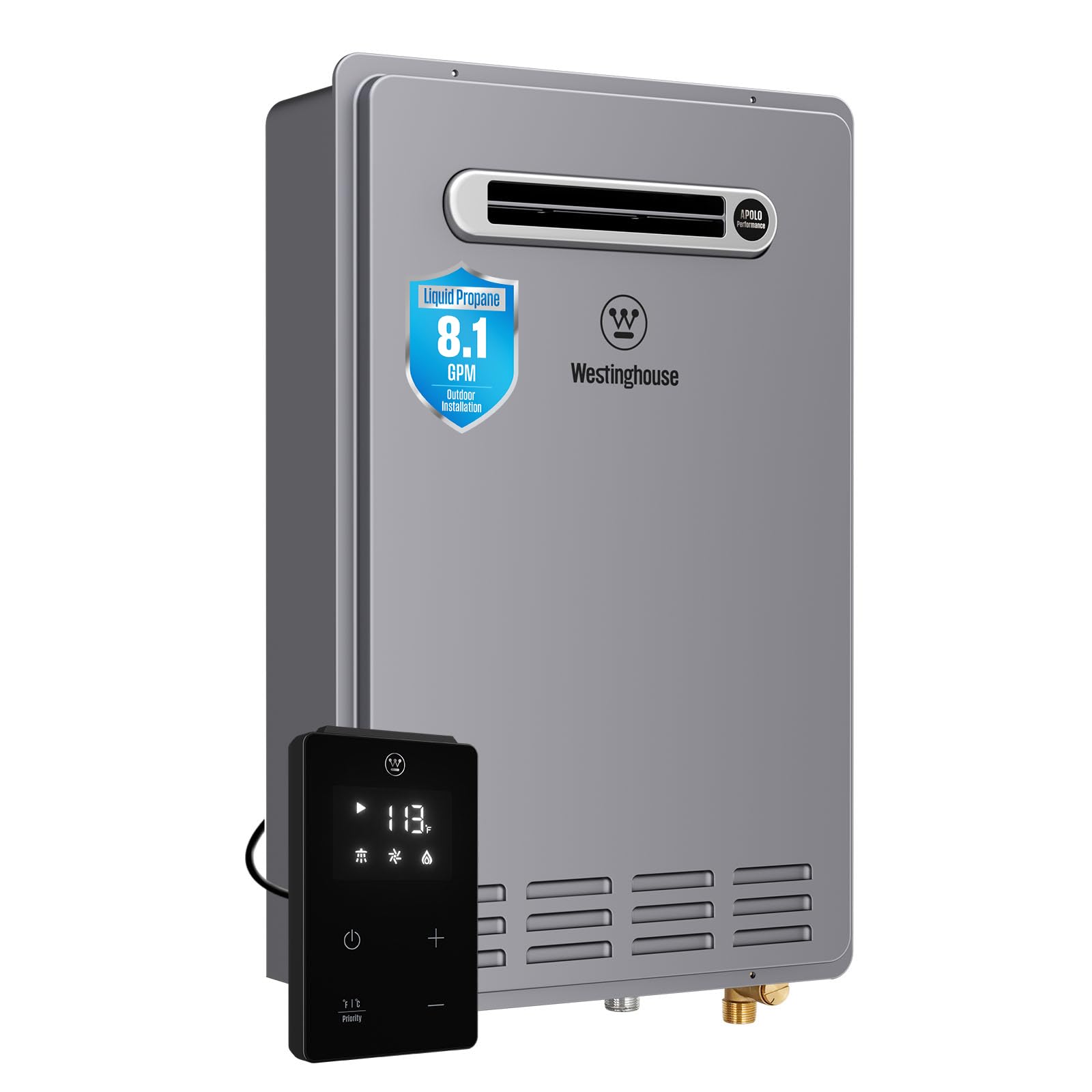
The heaviest hitter here — 8.1 GPM and 180,000 BTU for 3–5 fixtures.
When nothing on the list can keep up with your house, the Westinghouse tops it out at 8.1 GPM and 180,000 BTU, supporting 3–5 fixtures at once — showers, sinks, dishwasher, and laundry together. That beats the Rheem’s 7 GPM and 160,000 BTU and dwarfs the FOGATTI RV unit’s 2.5 GPM. It is built for outdoor installation, so venting is not in the picture.
Self-modulating water-gas linkage matches gas input to water flow in real time, holding within ±1°F across a 95°F–158°F range. A wired digital controller lets you adjust the temperature from multiple points in the house. Freeze protection and a variable-speed combustion fan keep it running through changing weather, and it connects to standard 3/4″ NPT plumbing.
The unit is CSA certified and backed by a 2-year limited warranty on the whole unit plus a 5-year heat-exchanger warranty. It needs 120V AC power and standard 3/4″ NPT plumbing. Owners find it easy to install and say it performs well — temperature accuracy is the split point, with several noting inconsistent water temperature. At 180,000 BTU it moves a lot of heat, so dial in a steady flow and the results stay consistent. You get the most output of any pick here, with the caveat that precise temperature is where opinions divide.
Who it wins for: a large home that runs several fixtures at once and needs the highest flow on this list.
The honest split: temperature accuracy is where feedback divides — the raw 180,000 BTU is not in doubt, but shower temp can drift.
Pick it if: you run 3–5 fixtures at once and outdoor mounting is an option.
Look elsewhere when: steady single-shower temperature matters more than maximum flow.
Know the Specs
Flow rate (GPM)
Gallons per minute is how much hot water the unit pushes through at once. One shower draws roughly 1.5 to 2 GPM, so a 2.64 GPM unit covers a single water point, while a 5.43 GPM unit handles two showers and a sink. Match the GPM to how many taps you run together, not to the size of your house.
Heat output (BTU)
British thermal units measure the burner’s power. A 48,000 BTU unit is camper-sized, while 180,000 BTU is whole-home with room to spare. Higher BTU means the unit recovers faster when the incoming water is cold, so it holds temperature through a second shower instead of cooling off.
Venting and install type
Indoor units need a vent pipe routed outside, so plan for a wall to run it through. Outdoor units skip venting because the exhaust leaves into open air. RV models run on 12V DC and drop into a fixed exterior cutout. Confirm your connection sizes — most homes use 3/4″ NPT water and a 1/2″ NPT gas inlet.
Efficiency (UEF)
Uniform Energy Factor is the efficiency score for water heaters. A 0.81 or 0.82 UEF means the unit captures most of the heat it makes. Condensing models squeeze more heat from the exhaust, which is why manufacturers claim savings over older tanks — treat those percentage claims as maker figures.
Common Questions
Do I need a plumber to install a propane tankless water heater?
How many showers can a 5 GPM propane water heater run at once?
Will a propane tankless water heater work during a power outage?
What is the difference between indoor and outdoor propane water heaters?
How much propane does a tankless water heater use compared to a tank?
Can I use a portable propane water heater for a whole house?
Does a tankless propane water heater protect against freezing in winter?
Can a tankless propane heater run at high altitude?
How long does a propane tankless water heater take to deliver hot water?
What size tankless propane heater do I need for two bathrooms?
Do RV tankless water heaters replace a standard 6-gallon tank?
Is a condensing propane water heater better than non-condensing?
The Bottom Line
For most people upgrading a camper, the propane water heater winner is the FOGATTI InstaShower 7 because it drops into your existing RV cutout and brings freeze protection and high-altitude operation without cutting into the rig. If you want more flow for a full-time RV, grab the Ranein RA65EH and its 3.9 GPM and live-diagnostics remote. And for a busy house with two showers running at once, the APUS 120,000 BTU is the one to reach for. If you want the most raw output on the list, the Westinghouse 8.1 GPM is the ceiling here — match the unit to your real demand and you will be glad you measured first.
How we choose
We do not accept paid placement. Every pick is matched to a real buyer and a real use-case; we do not hands-on test units.
Sources
Specifications: manufacturer listings and product documentation. Review insights: verified customer reviews, as of November 2026. Pricing: not shown on this page (it changes often); check the current price via the retailer link.
As an Amazon Associate, Tactical Gear Guy earns from qualifying purchases. This does not affect which products we feature.