Specs are compiled from manufacturer listings and verified buyer reviews and can change over time — please confirm the key details on the product page before buying.
You want a cold garage to feel like a workspace in minutes, not an all-afternoon wait in gloves. Three things decide that: how many BTUs (a measure of heat output) your space actually swallows, if you need moving air or still air, and how much noise your ears will tolerate all afternoon. Get those three right and the shop warms up fast. Get them wrong and you’re either sweating in a corner or still wearing gloves at noon.
This guide is built by comparing the manufacturers’ published specifications and the patterns across verified customer reviews, so you get each pick’s real strengths and trade-offs instead of marketing spin.
The picks below are split between forced-air torpedo units that push hot air across a wide bay and convection cabinets that warm air quietly by circulating it. A 200,000 BTU unit and a 60,000 BTU unit are not rivals — they solve different rooms. Below you’ll see exactly which one belongs in yours, from a single-bay garage to a five-thousand-square-foot workshop floor, and which spec tells you so.
Top Picks
How To Choose The Best Propane Shop Heater
The single most common mistake is buying BTUs you’ll never use, or buying too few for the cubic feet you’re standing in. A heater rated for a huge open warehouse will blast a small insulated garage into an oven and burn through propane doing it. Start with your floor area and ceiling height, then work outward to airflow, tank size, and ignition type.
Match BTU output to square footage, not to bragging rights
BTU (British thermal units) is the raw heat number. Square-foot coverage is that number translated into a room. A 60,000 BTU forced-air heater typically names a coverage around 1,500 to 2,000 square feet, while a 200,000 BTU unit can claim 5,000 square feet. Pick the coverage that matches your space with a little headroom, then stop — a bigger heater costs more fuel to run per hour than a smaller one doing the same job.
Forced air blows heat at you; convection warms the air and lets it rise
A forced-air torpedo heater has a fan that pushes hot air out in a directed stream, so you feel warmth within minutes even in an unheated barn. A convection heater relies on hot air rising and circulating naturally, which is quieter and gentler but slower to spread across a big floor. If you work with your hands in one spot, forced air wins. If you want steady background warmth without a fan roaring, convection is the fit.
Check the minimum propane tank before you buy
This is the spec buyers overlook most. Some heaters run on a standard 20 lb propane tank; others require a 40 lb cylinder or a 100 lb tank at minimum. The Mr. Heater 200,000 BTU model specifically calls for a 100 lb tank minimum, which means a small barbecue cylinder won’t feed it. Match the tank you already own or plan to buy, or you’ll be making a second trip.
Ventilation and shut-offs are not optional in a shop
Propane heaters burn fuel and produce exhaust, so every model here is meant for a well-ventilated space — an open garage door, a barn, a construction site. Look for flameout shut-off (cuts gas if the flame dies), overheat protection, and a tip-over or low-oxygen sensor on cabinet-style units. Those are what keep a propane heater from becoming a problem in a closed room.
Side-by-Side Comparison
| Model | Best For | Heat Output | Coverage | Heating Method | Amazon |
|---|---|---|---|---|---|
| Remington 60,000 BTU LP Forced Air★ Best Overall | Single-bay garages and small workshops | 60,000 BTU | 1,500 sq ft | Forced Air | Amazon |
| SPECRAFT 60,000 BTU Forced AirBest Value | Aiming heat at one work zone | 60,000 BTU | 2,000 sq ft | Forced Air | Amazon |
| CAMMOO 85,000 BTU Forced AirFastest Warm-Up | Big work areas that need heat fast | 85,000 BTU | 2,200 sq ft | Forced Air | Amazon |
| Dura Heat LPC80 Convection | Quiet warmth with no electricity | 50,000–80,000 BTU | 2,000 sq ft | Convection | Amazon |
| Mr. Heater 200,000 BTU Convection | Warehouse-scale open spaces | 75,000–200,000 BTU | 5,000 sq ft | Convection | Amazon |
| BILT HARD 125,000 BTU Torpedo | Jobsite and barn heating | 75,000–125,000 BTU | 3,125 sq ft | Forced Air | Amazon |
| Ruasveltan 18,000 BTU Cabinet | Patio and garage ambient heat | 6,000–18,000 BTU | 450 sq ft | Radiant | Amazon |
| DEWALT 65,000 BTU Forced Air | Noise-sensitive shops | 65,000 BTU | 1,625 sq ft | Forced Air | Amazon |
| InoKraft MAXHEAT MH85 | Hands-off temperature control | 85,000 BTU | 2,000 sq ft | Forced Air | Amazon |
| Mr. Heater 85,000 BTU Quiet Burner | Long unattended runs in a shop | 85,000 BTU | 2,125 sq ft | Forced Air | Amazon |
Detailed Reviews
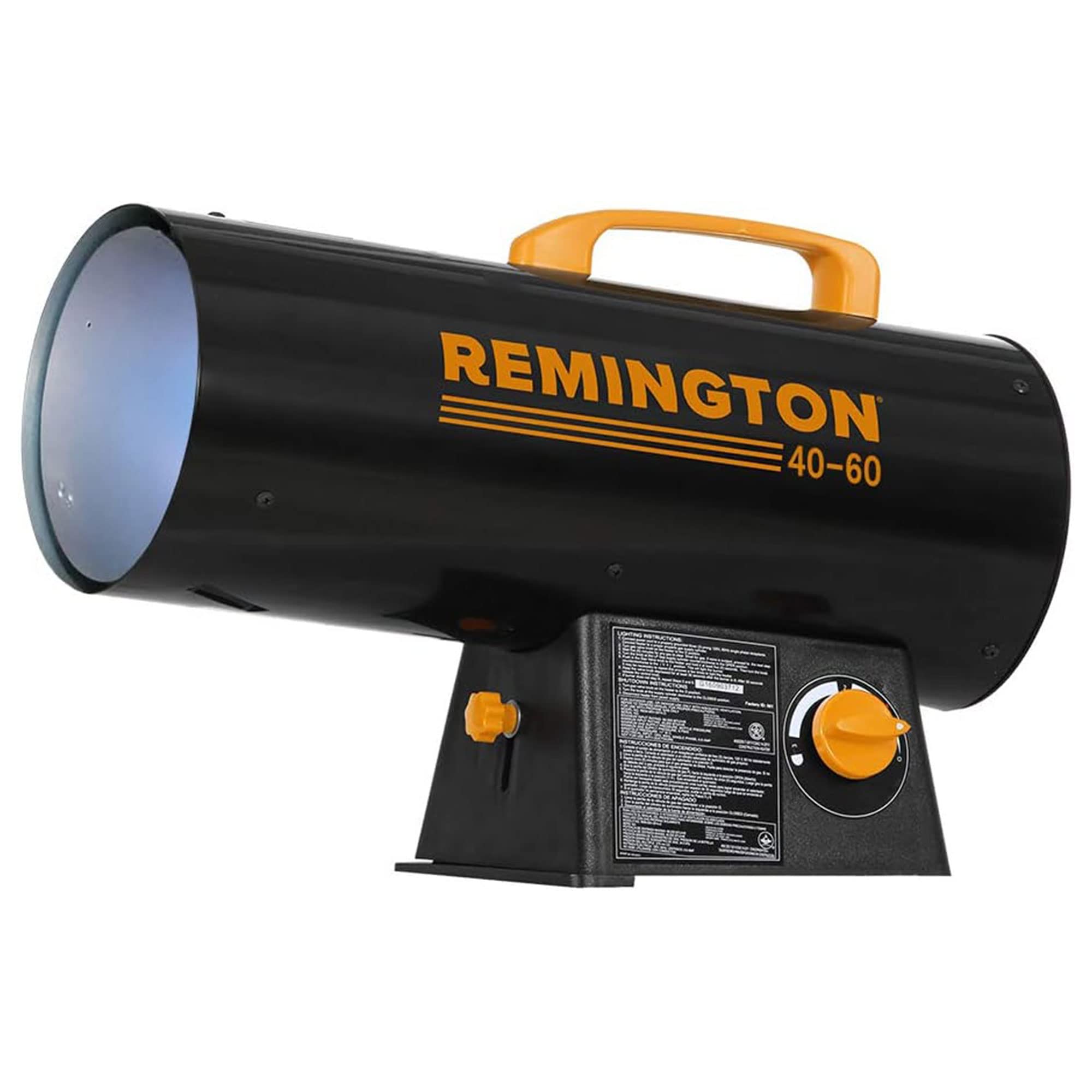
1. Remington 60,000 BTU Propane Heater
Our pick — 4.5+★ from 700+ verified ratings; the strongest balance of quality and price.
A 60,000 BTU forced-air heater that warms a 1,500 square foot garage fast enough to work in.
Start with the number that decides the room: the Remington pushes 60,000 BTU of forced-air heat into a space the maker rates up to 1,500 square feet. That’s a typical one- or two-car garage, a small barn, or a single work bay. Because it moves air with a fan instead of just radiating warmth, the heat reaches your hands and your tools rather than hovering near the ceiling.
What wins people over is that it simply heats the space, reliably, in the cold. You’re paying for the features that get it there: electronic ignition you don’t have to coax, variable heat settings so you’re not stuck at full blast, and a trio of safety shut-offs. Those shut-offs are a high-temperature limit, a flame-out fuel cut, and a thermocouple (a sensor that kills the gas if the pilot flame dies). It ships with a 10-foot propane hose and regulator, so you’re not hunting parts on day one.
The honest catch is noise. Forced-air heaters move a lot of air, and this one is loud enough that you’ll want ear protection if you’re running machinery beside it. The power cord is also on the short side, so plan your outlet before you drag the tank into place. Neither issue bothers anyone who’s using it to knock the chill off a bay and then shutting it down — and at 19 by 7.5 by 13 inches, it stores in a corner when the season ends.
What earns it the top slot
- 60,000 BTU forced air covers a 1,500 sq ft garage or bay
- Electronic ignition and variable heat settings mean no fiddling
- Three safety layers — high-temp limit, flame-out cut, thermocouple
- 10-foot hose and regulator included, ready to connect
- Compact 19″ x 7.5″ x 13″ footprint stores easily off-season
Where it asks you to compromise
- Noise level runs high — ear protection is wise near other tools
- Power cord is short; you’ll want an outlet close by
Reach for this if: you’ve got a single garage, barn, or work bay and want heat that shows up fast and reliably.
Keep looking if: you need warm air spread across a warehouse floor or want something you can run without hearing protection.
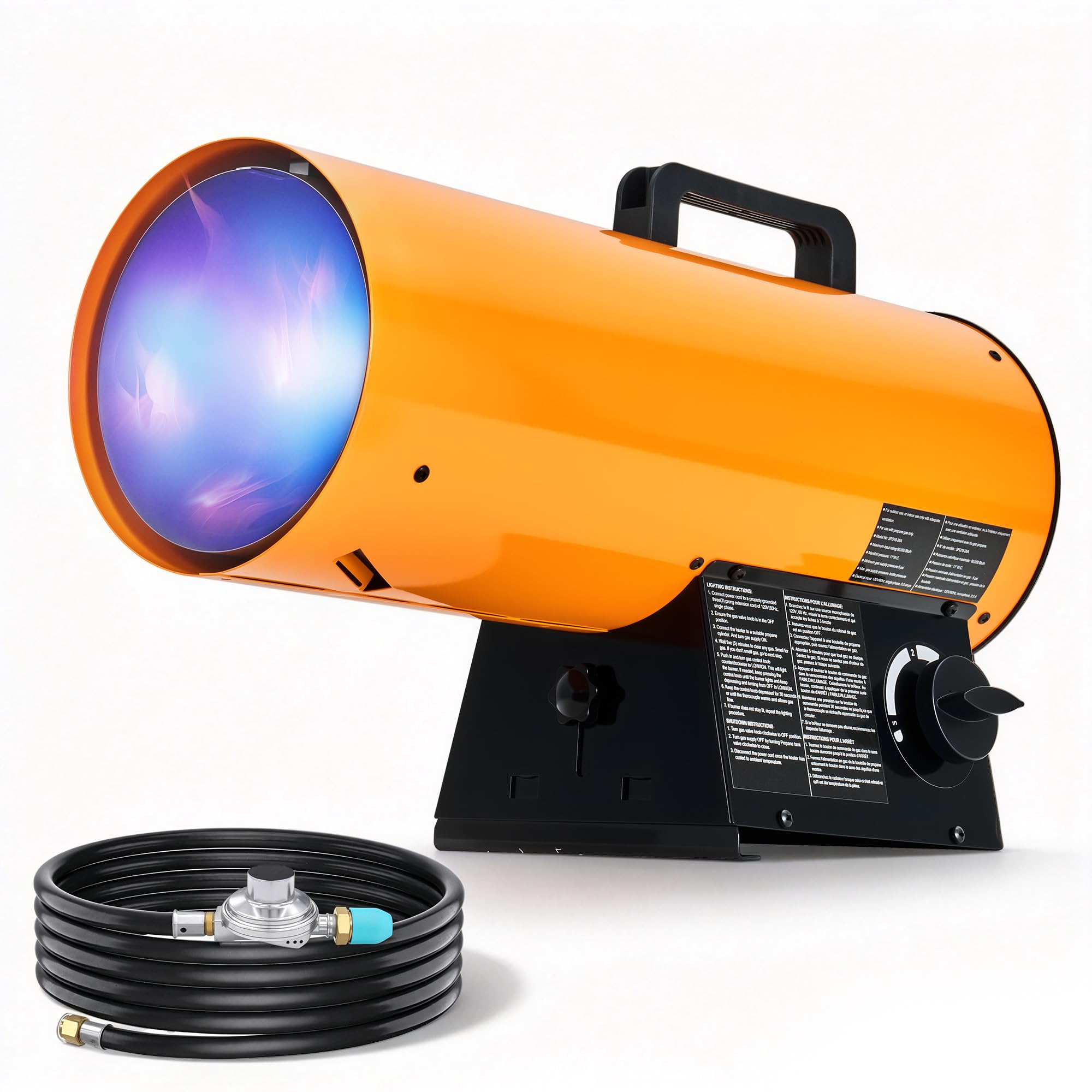
2. SPECRAFT 60,000 BTU Propane Heater
Same 60,000 BTU punch as the pick above, but its head tilts to aim the heat right where you’re standing.
This SPECRAFT fires 60,000 BTU of forced air and rates coverage up to 2,000 square feet — a bit more floor than the Remington claims. The adjustable tilt lets you swing the warm stream down toward a low bench or across an open pad, so you’re not heating the rafters to stay warm.
Its manual heat control works through the gas valve: turn it to dial fuel flow and output up or down for the job at hand. Continuous spark ignition handles startup, and the build carries ETL certification plus an 80°C overheat auto-shutoff. A 10-foot hose and regulator come in the box; the propane tank does not. Form factor is a torpedo, at 18.1 by 7.1 by 12 inches, so it tucks under a shelf between uses.
One operating quirk to know before you buy: turning the valve to off stops gas flow but leaves the fan and igniter running while the unit is plugged in, so you follow the manual’s cooldown steps before unplugging. It’s a cooling routine, not a fault — but it’s the kind of detail that surprises a first-timer.
The aiming advantage: an adjustable tilt plus 2,000 sq ft coverage turns a fixed heater into a directed one, which suits anyone working at a bench rather than roaming a floor.
Set your expectations: the cooldown-then-unplug routine takes a minute longer than a simple on/off switch.
The right call for: workshop owners who want a heater pointed at one work zone and a little more rated coverage to work with.
Less suited to: anyone who wants to kill the gas and walk away in one motion.
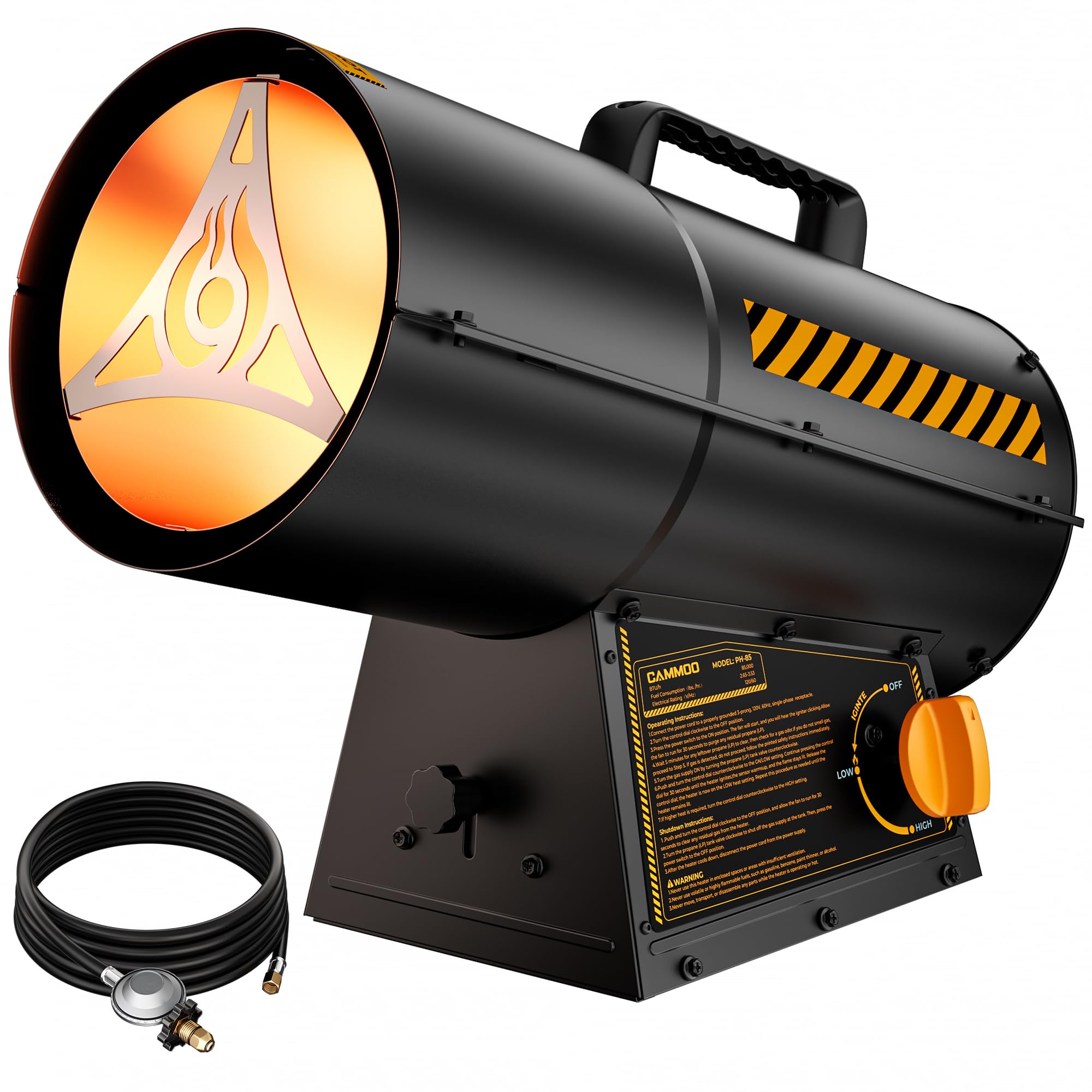
3. CAMMOO 85,000 BTU Portable Forced Air Propane Heater
More raw heat than both 60,000 BTU picks, aimed by a knob that swings the airflow where you need it.
If your shop is on the larger side, the CAMMOO’s 85,000 BTU of forced-air output is the difference between waiting and working. It rates coverage up to 2,200 square feet — more reach than the 60,000 BTU Remington’s 1,500 square feet. That extra output is exactly what you want when the door opens and the cold rushes back in during a long afternoon.
Stepless heat control lets you slide output from low to high rather than living with discrete settings, and the height knob swings warm airflow from 20° to 35°. The propane connection is built for convenience: a wide-grip POL connector tightens by hand with no wrench, though you still leak-test with soapy water before firing. Five layers of protection back it up — flameout gas shutoff, 176°F overheat protection, excess-flow protection, a front grille, and a silicone-covered power switch. It’s CSA certified.
Weight is the trade-off to weigh. At 17.6 pounds it’s heavier than the Mr. Heater 200,000 BTU convection unit’s 14.5 pounds, so lugging it between buildings is a two-hand job. The 3.3-foot cord is also short, which limits where you can park it. If it stays in one shop, neither matters.
Built to move air, not just sit: 85,000 BTU across 2,200 sq ft with a tilting head is a quick-warm-up combination for a big bay.
Where it costs you: 17.6 lb and a 3.3 ft cord mean it wants a permanent spot near an outlet.
Pick it when: your workspace is bigger than a two-car garage and you want it warm before the coffee’s done.
Think twice if: you move a heater between buildings or outlets are scarce.
4. Dura Heat LPC80 50-80,000 BTU Propane Convection Heater

The heater that needs no outlet at all — just propane, a match-style igniter, and patience.
Here’s the one that works when the power is out. The Dura Heat draws no electricity, running off propane alone with a piezo igniter (a push-button spark) rather than a fan. Its variable output ranges from 50,000 to 80,000 BTU, and it circulates warmth 360 degrees around a tower-shaped body rated for a 2,000 square foot space. On a 40 lb cylinder it keeps going up to 17 hours — enough for a long workday or an overnight cold snap.
What buyers enjoy most is that steady background warmth without a roaring fan. The collapsible design folds down for transport, an 11-foot hose and regulator are included, and an auto safety shut-off guards the flame. If your shop is a converted barn with no wiring, this is a natural fit.
Be honest about the trade-off: functionality draws mixed reports, and a share of owners hit ignition trouble that keeps the burner from lighting.
Why owners keep it
- No electricity required — propane only, piezo igniter
- Up to 17 hours on a 40 lb cylinder
- Variable 50,000–80,000 BTU output, 360-degree convection
- Collapsible design packs down; 11 ft hose included
What to watch for
- Ignition reliability splits opinion — some units fight to light
- Slower to spread heat than a forced-air torpedo
Best for: unpowered shops, barns, and anyone who wants warmth during an outage.
Not for: buyers who want instant push-button heat and no pilot-lighting ritual.
5. Mr. Heater 200,000 BTU Convection Heater Portable Propane
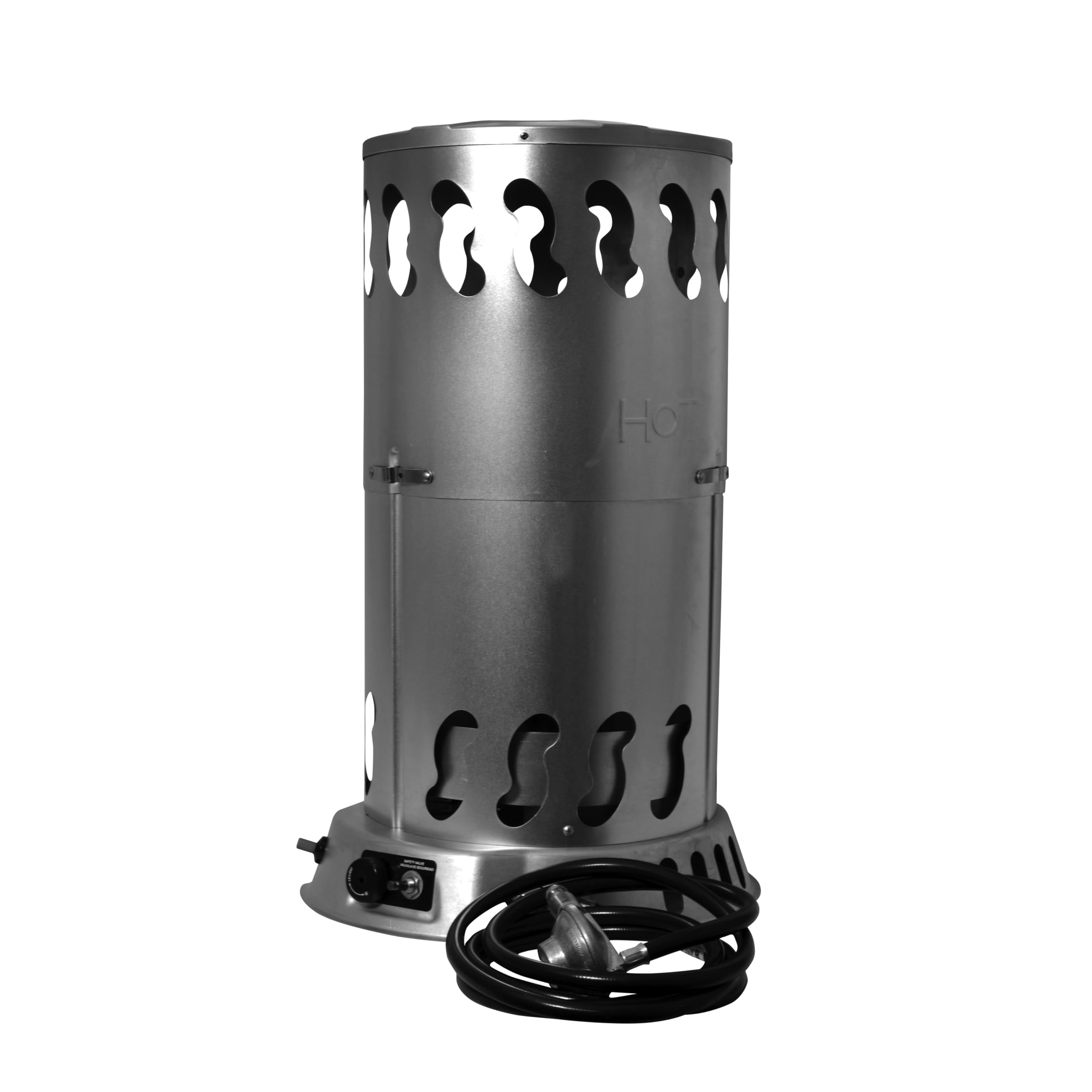
When the building is a warehouse, this is the heater that answers the phone.
Nothing else here comes close on raw heat. The Mr. Heater runs from 75,000 up to 200,000 BTU and claims coverage of 5,000 square feet — five times the floor of the Remington’s 1,500 square feet. If you’re heating a wide open barn, a warehouse floor, or a construction shell, that headroom is the whole point: it doesn’t fight the cold, it overpowers it.
Owners describe exactly that — garages going from 40 to 80 degrees in 20-25 minutes — and the consensus is that it heats big spaces and turns in real performance. The electro-thermoelectric safety valve cuts gas the instant the flame goes out, and it ships with a 20-foot hose and regulator assembly. It’s built for well-ventilated construction sites, barns, warehouses, and workshops.
The catches are real but predictable for a heater this size. It requires a 100 lb propane tank minimum, so a small cylinder won’t feed it. The noise is jet-engine loud, and reliability reports on staying lit are mixed — some units need coaxing. Size the tank and the ear protection first, and this heater will outrun anything on the list.
The raw-heat leader: 200,000 BTU and 5,000 sq ft of coverage is a scale no other pick here touches — the 80,000 BTU Dura Heat’s 80,000 british thermal units sits well below it.
Its honest price of admission: a 100 lb tank minimum, jet-engine noise, and some reports of the flame not staying lit.
Choose this if: you’re heating a warehouse or open shell where only brute BTU output will do.
Walk past if: you have a small garage or a 20 lb tank — neither suits this scale.
6. BILT HARD 125,000 BTU Propane Torpedo Heater
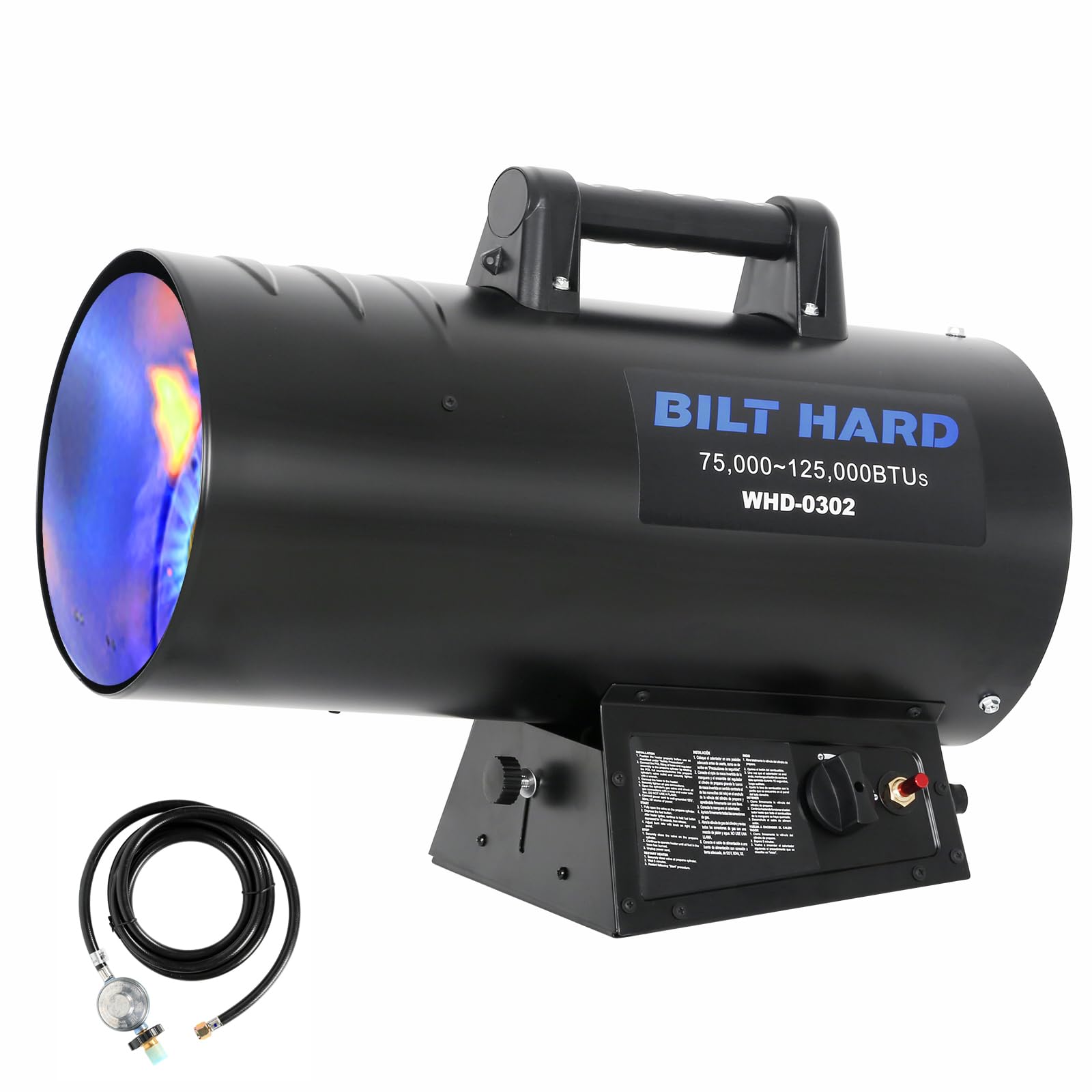
The mid-sized torpedo that covers a three-bay shop without demanding a 100 lb tank.
There’s a gap between the 60,000 BTU garage heaters and the 200,000 BTU warehouse monster, and the BILT HARD sits right in it. Its adjustable output ranges from 75,000 to 125,000 BTU, rated for up to 3,125 square feet — more than double the Remington’s floor. It’s the fit for a barn, a factory floor, or a large outbuilding where the smaller units run all day and never catch up.
Fuel economy is a strong selling point at this size. On a 20 lb propane tank it runs about 5.5 hours on low and 3.5 hours on high, so a standard cylinder is enough. Overheat auto-shutoff and gas auto-cutoff guard against leakage, and continuous electronic ignition means simple startup. It’s CSA certified and carries a one-year warranty with manufacturer-backed exchange.
Buyers report it heating a one-bay garage in under five minutes, and reviewers consistently praise its fuel economy. Noise is the split vote — some find it quieter than expected, others call it loud. It’s also a taller 21.3 by 10.8 by 14.2 inches and 17 pounds, so it’s a floor-standing tool rather than a carry-along.
Right-sized for a serious shop: 125,000 BTU over 3,125 sq ft bridges the gap between a garage heater and a warehouse unit.
The one variable: noise opinions vary widely, so position it away from your quiet work.
Matched to: barn and jobsite owners with a three-bay-scale space and a standard 20 lb tank.
Not the one for: anyone who works within arm’s reach of the heater and wants near-silent operation.
7. Ruasveltan 18,000 BTU Portable Cabinet Propane Heater
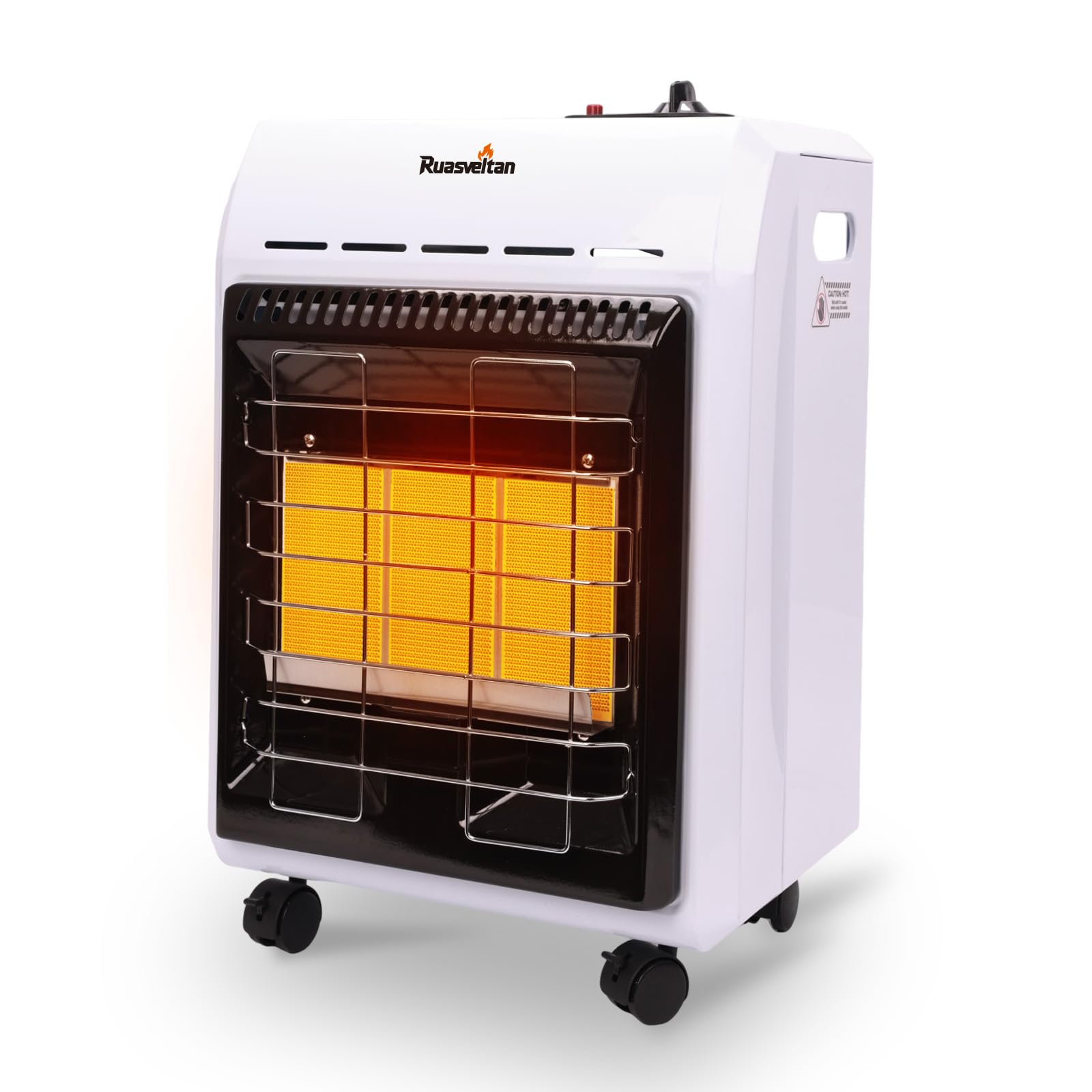
A cabinet heater for the corner of the shop, not the whole floor — warmth without the roar.
This is the different animal on the list, and worth understanding before you dismiss the BTU number. Where the torpedoes blast warm air, this cabinet heater radiates it from a ceramic panel across up to 450 square feet. Output ranges from 6,000 to 18,000 BTU across three heat modes, and on a 20 lb tank it can run up to 69 hours. For a small workshop or a patio, that’s a different job done well.
The safety story is the standout. It shuts the gas off automatically if oxygen runs low (an ODS, or oxygen depletion sensor) or if the unit tips over, which makes it far more forgiving in a small space. It also runs with no electricity at all — no cord to trip over, no power outage to worry about. Owners praise the reliability and the heat output, with five locking casters for wheeling it around and a foldable body that stores flat.
The real limit is reach. At 450 square feet it will not warm a big bay, and it’s rated for outdoor use. Ease of use draws a split verdict — setup is simple, but dialing in the right mode takes some practice. Used as a corner warmer for a small area, it’s a genuinely pleasant heater. Expecting it to replace a 60,000 BTU torpedo is the wrong expectation.
Its quiet-strength case
- ODS and tip-over shutoff cut the gas automatically
- No electricity — runs on a 20 lb propane cylinder
- Up to 69 hours of heat across three modes
- Locking casters and a foldable body make it easy to store
Where it stops short
- 450 sq ft coverage won’t touch a full shop floor
- Dialing in the mode takes a little trial and error
Suits you if: you want quiet, cordless warmth for a small workshop corner or patio and value the low-oxygen and tip-over shutoffs.
Wrong fit if: you need to heat a whole bay — this one is built for smaller rooms.
8. DEWALT 65,000 BTU Forced Air Propane Heater

A forced-air heater that treats noise as a design problem and tool-damage as a second one.
Most torpedo heaters make you shout over them. The DEWALT takes a swing at that with patented Quiet Burner Technology, which the maker says reduces combustion and operation noise by up to 50 percent. For a shop where you’re on the phone or listening for a machine to falter, that alone can justify it. And it doesn’t skimp on heat: 65,000 BTU of forced air rated for 1,625 square feet.
The build is genuinely jobsite-minded in ways the cheaper units aren’t. Recessed controls sit back from the frame so a dropped wrench doesn’t snap them. The two-piece split barrel comes apart for cleaning and maintenance, which matters when the burner collects dust season after season. It covers well-ventilated construction sites, barns, warehouses, and workshops.
Output lands a step above the 60,000 BTU Remington at 65,000 BTU, but noise opinions still split — some buyers find it low, others still call it noisy. At 17.1 pounds it’s no featherweight. The honest read: it’s the quietest torpedo here by design, not a silent device.
Built for a working shop: recessed controls and a split barrel for cleaning make it a tool rather than a box.
Set the expectation: quieter by design, but reports still split on how quiet.
Worth it for: noise-sensitive shops that still want forced-air reach and durable controls.
Look elsewhere for: a silent heater — forced air means some fan noise regardless.
9. InoKraft MAXHEAT MH85 Propane Heater
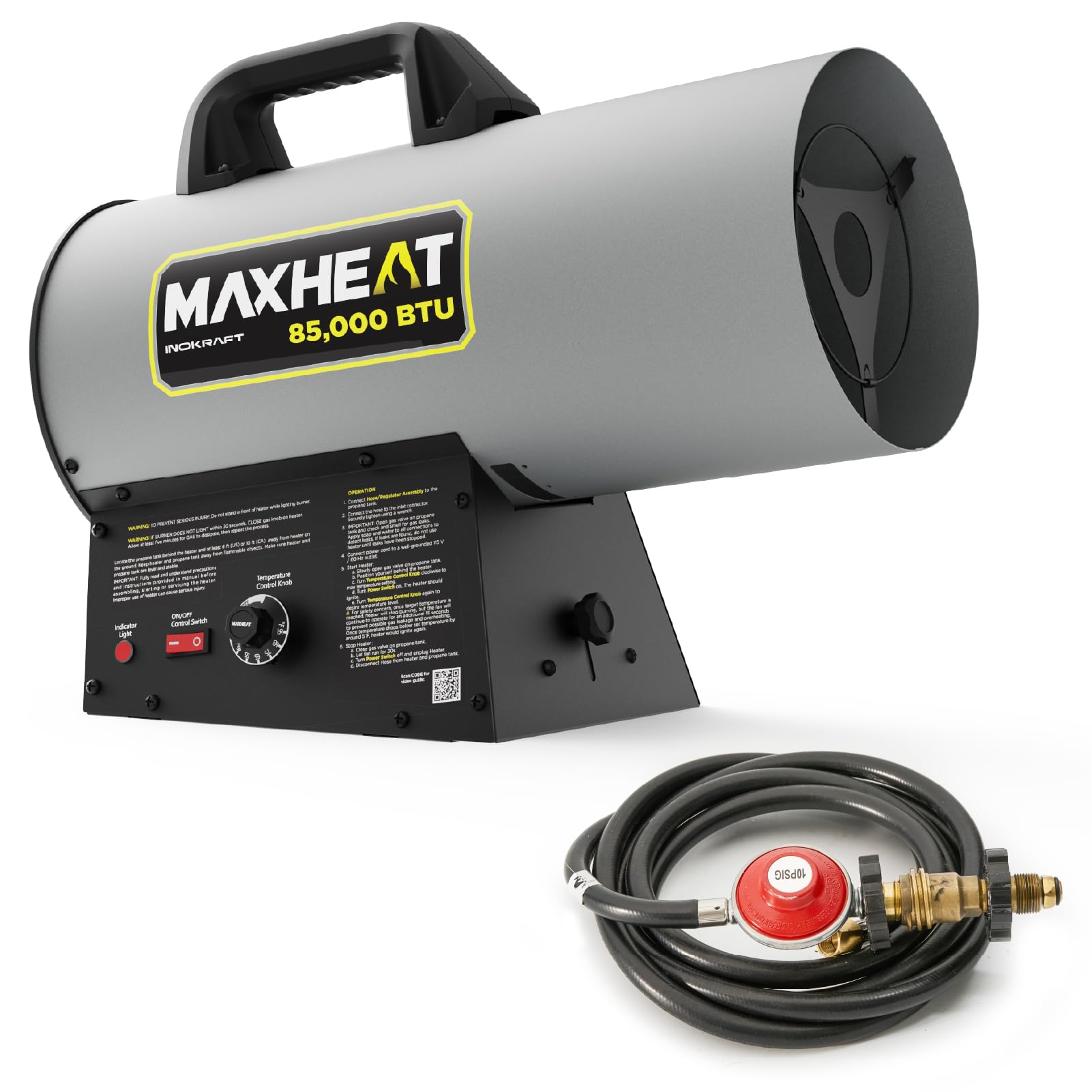
The only heater here with a real thermostat — set a temperature and it holds it while you work.
This is the pick for anyone tired of babysitting a heater. The InoKraft carries a 25–95°F thermostat that shuts the burner off at your set temperature and restarts it automatically when the air cools below that point. That means fewer trips to tweak the dial and less wasted propane between adjustments. Underneath the control feature sits a serious 85,000 BTU forced-air burner rated for 2,000 square feet.
Heat comes up fast: the heavy-duty fan pushes warm air across the space, and the maker states it can raise temperatures in as little as 8 minutes. The adjustable heat angle aims the stream where you’re working. Multi-layer protection includes overheat auto-shutoff and gas shutoff, and the unit is CSA certified. A 10-foot hose and regulator come with it, and the power cord runs 4.9 feet so you needn’t reach for an extension.
The honest trade-off is that the thermostat auto-cycle is the reason to pay the mid-range price — if you only ever run a heater full-blast for ten minutes, you’re paying for a feature you won’t use. Setup needs a 20 lb propane tank or larger and a 115V outlet, so it’s not a cordless option.
The hands-off case
- 25–95°F thermostat auto-cuts and restarts at your set temp
- 85,000 BTU forced air, rated to 2,000 sq ft
- Maker states fast warm-up in as little as 8 minutes
- 4.9 ft cord and CSA-certified overheat/gas shutoff
What you’re buying into
- Needs a 115V outlet and a 20 lb tank or larger
- The thermostat value only shows up on longer runs
Built for: all-day workshop sessions where you’d rather set a temperature and forget it.
Overkill if: you fire a heater for short bursts and never leave it running.
10. Mr. Heater 85,000 BTU Propane
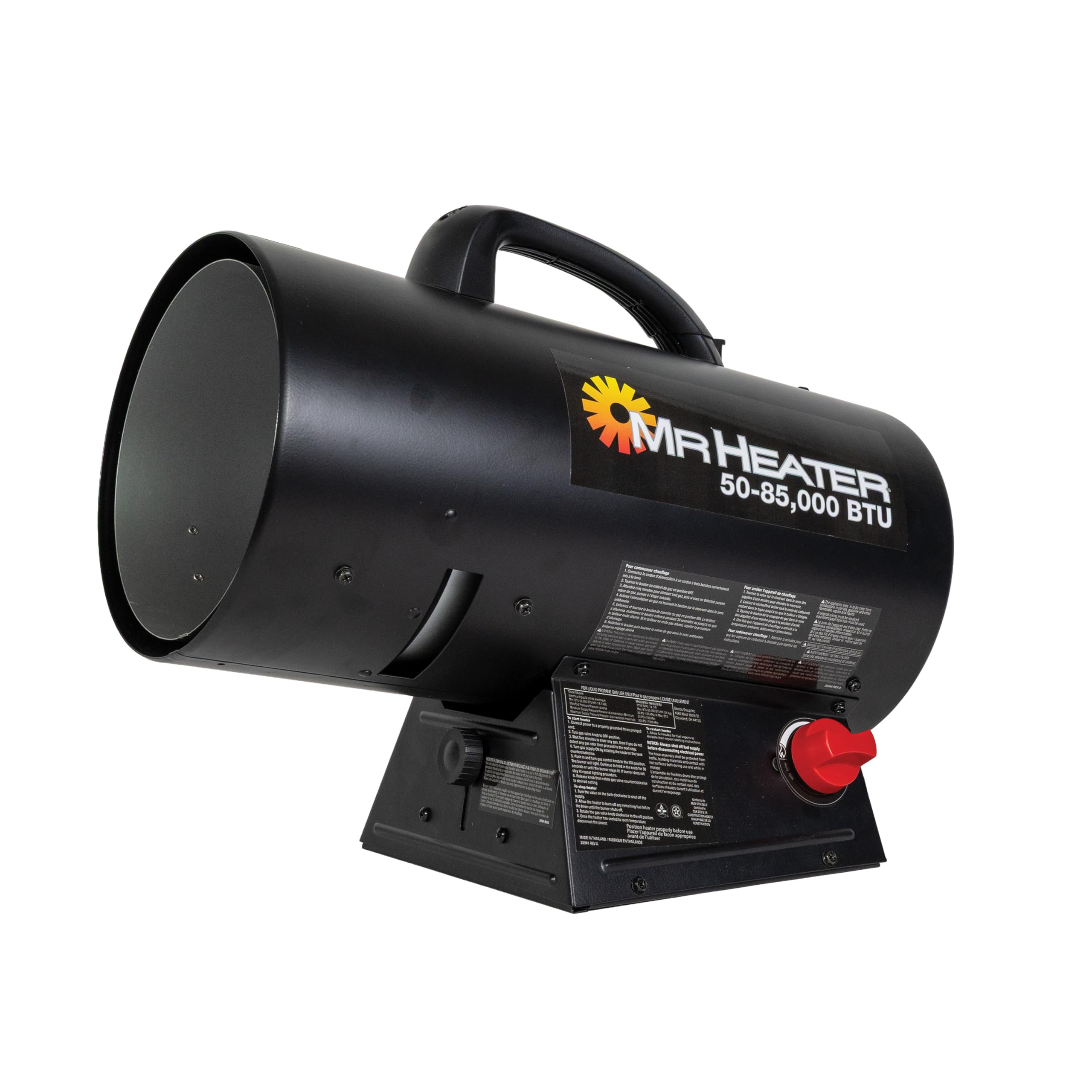
Eight and a half hours on one tank, so a shift’s worth of heat doesn’t need a refill.
Run time is the spec that saves you the most hassle, and this Mr. Heater leads with it. On a standard 20 lb propane tank it delivers up to 8.5 hours of continuous operation, warming 2,125 square feet with variable heat output. For a shop where you’re there all day, that one figure tells you whether you’ll be swapping tanks mid-afternoon — and here, you won’t.
It’s compact and quick to bring online, with no assembly required. Quiet Burner Technology trims the noise, and the build is rugged, industrial-grade, and designed to keep running in cold temperatures. Owners confirm it heats fast — a shop to 50 degrees in 15 minutes, 40 degrees in 10 — and praise its small size and no-assembly setup. An L.P. gas hose and regulator are included, and the height is adjustable.
The honest note is the same one every forced-air heater earns: the noise is a matter of taste, with opinions split between “low” and “a bit loud.” It also runs on a 20 lb tank minimum, so keep a spare fed. Everything else about it — the run time, the fast heat, the compact form — is why it tops the premium end of this list.
The endurance leader: up to 8.5 hours on a 20 lb tank means one fill carries you through a full shift.
The single caveat: noise splits opinion, so don’t expect silence — just less of it.
The pick for: full-day shop sessions where you want heat without a mid-shift tank swap.
Skip if: you work right beside the heater and every decibel counts.
Know the Specs
BTU output vs. square-foot coverage
BTU is the heat number; square-foot coverage is that number translated into a room. A 60,000 BTU heater tends to name a mid-sized space — think 1,500 to 2,000 square feet — while a 200,000 BTU unit can claim 5,000. Buy the coverage that matches your floor with a little headroom, then stop. A bigger burner costs more fuel per hour to do the same job.
Forced air vs. convection vs. radiant
A forced-air heater uses a fan to push hot air in a directed stream — fast and targeted. A convection heater lets warm air rise and circulate naturally — slower and quieter. A radiant cabinet heater warms objects and people directly, which feels nice up close but covers a smaller floor. Your work style tells you which one you want more than the label does.
Tank size and run time
This is where a heater lives or dies in daily use. Some run on a standard 20 lb cylinder and stretch to 5.5 or 8.5 hours; others require a 40 lb cylinder or a 100 lb tank minimum and run far longer. Check the minimum tank before you buy — a small barbecue cylinder physically won’t feed a unit built for a 100 lb tank.
Ignition and safety shut-offs
Electronic ignition and continuous spark ignition start the burner with a button. A piezo igniter uses a push-spark with no electricity at all. On the safety side, look for flame-out shutoff, overheat protection, tip-over shutoff, low-oxygen (ODS) sensors on cabinet units, and certifications like CSA or ETL. Those are what a well-ventilated shop relies on.
Common Questions
What size propane tank does a shop heater need?
Can I use a propane shop heater in an enclosed garage?
Will a forced-air heater on a 20 lb tank run all day?
Does a propane shop heater need electricity to run?
Is forced air or convection better for a workshop?
What safety shutoffs should a shop heater have?
How many BTUs do I need to heat a two-car garage?
Can a propane heater sit on a wood floor in a shop?
Is a bigger BTU heater always better?
The Bottom Line
For most people with a garage or a small shop, the Remington 60,000 BTU forced air heater is the one to bring home. It’s the crowd favorite at 4.5+ stars across 700+ ratings, it heats a 1,500 square foot bay fast, and its electronic ignition and triple safety shutoffs mean it lights on the first try on a cold morning. If you need the heat aimed at a bench, the SPECRAFT 60,000 BTU tilts its airflow and rates a bit more coverage. And when the space is a warehouse or an open shell, the Mr. Heater 200,000 BTU outruns everything here at 5,000 square feet of reach.
Here’s the one fact worth acting on: the run-time spec quietly separates the everyday heaters from the all-day ones. The Mr. Heater 85,000 BTU’s up to 8.5 hours on a 20 lb tank is what turns a shop heater from a chore into background comfort — and that’s the pick that earns its place for a full working day.
How we choose
We do not accept paid placement. Every pick is matched to a real buyer and a real use-case; we do not hands-on test units.
Sources
Specifications: manufacturer listings and product documentation. Review insights: verified customer reviews, as of November 2026. Pricing: not shown on this page (it changes often); check the current price via the retailer link.
As an Amazon Associate, Tactical Gear Guy earns from qualifying purchases. This does not affect which products we feature.