Specs are compiled from manufacturer listings and verified buyer reviews and can change over time — please confirm the key details on the product page before buying.
If you do close-up work all day — soldering, jewelry, facials, embroidery — the magnifying lamp you want is the one with a real glass lens, a light that does not flicker, and an arm that stays exactly where you put it. Everything else is a compromise that shows up as eye strain by mid-afternoon. Below you get nine lamps sorted by what they actually do best, with the honest catch on each one spelled out in plain terms.
This guide is built by comparing the manufacturers’ published specifications and the patterns across verified customer reviews, so you get each pick’s real strengths and trade-offs instead of marketing spin.
Some lamps here clamp to a bench, some stand on the floor, and one gives you two lenses you can swap. Match the clamp or floor base to your bench and the diopter to your working distance, not the biggest lens. Here is how each of these earns its place as a professional magnifying lamp.
Top Picks

How To Choose The Best Professional Magnifying Lamp
The first decision is not the lens at all — it is where the lamp has to live. A bench with a thick edge takes a clamp. A chair or sofa corner needs a floor stand. Get the mount wrong and you will fight the lamp every session instead of using it.
Start with the mount, then the lens
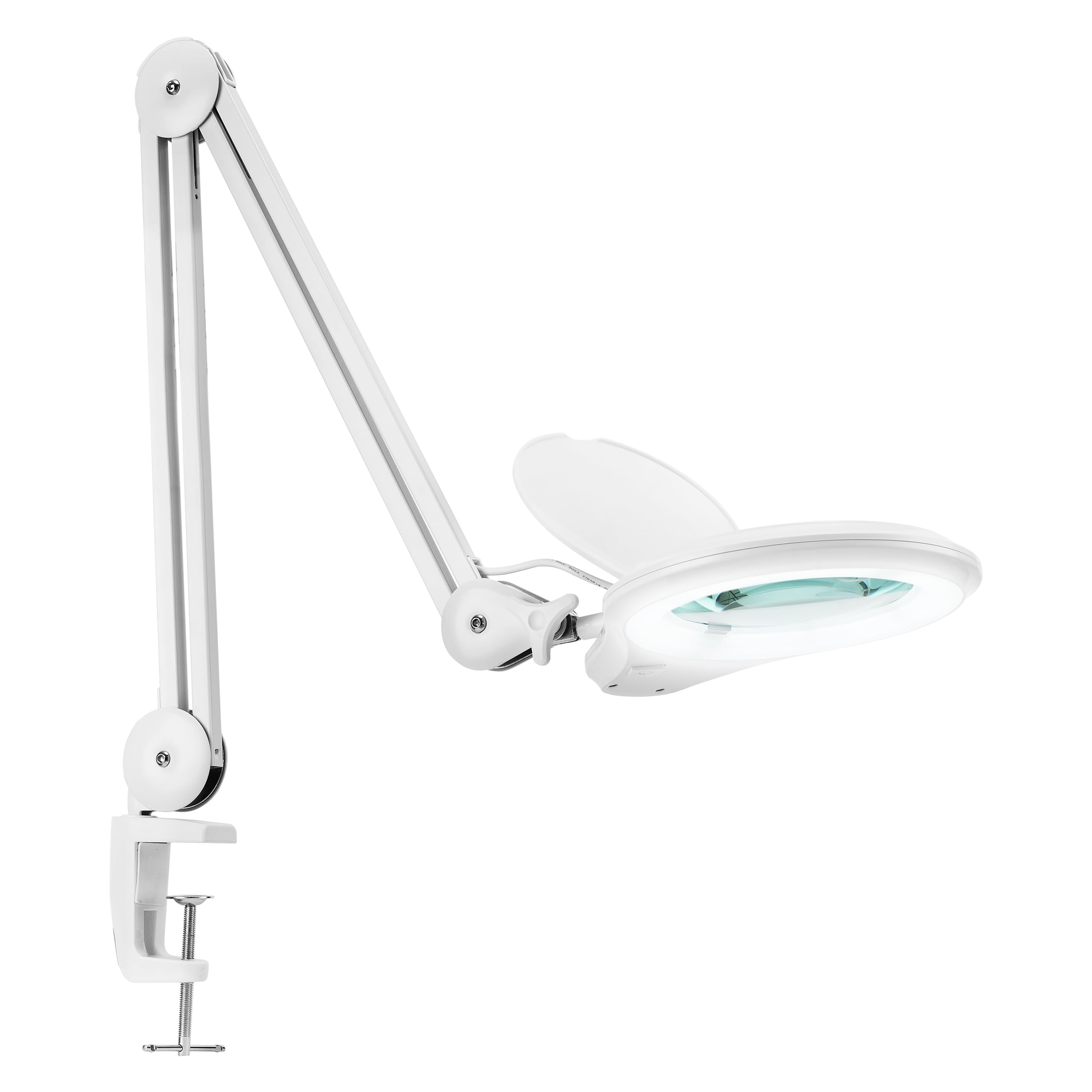
A clamp lamp grips the edge of a desk, workbench, or table and holds the head out over your work. Check the clamp’s maximum thickness against your bench before anything else — the BoliOptics clamp, for example, is rated for surfaces less than 2 ⅜ inch thick, and a thicker bench means it simply will not bite. Clamp lamps free up floor space and put the lens right over the job.
A floor or freestanding lamp stands on its own base and reaches over a chair, a sewing table, or a recliner. The trade-off is footprint: you need a clear patch of floor and a stable base. The OttLite EasyView floor lamp uses a base measuring 8.1875 x 11 inches and adjusts from 48 to 64 inches tall, so it clears most seating but still wants a flat, firm spot to stand.
Read the diopter, not just the “X”
The number stamped on a lens is usually the diopter, and diopter is the honest measure of how much the lens bends light to enlarge what you see. A 3 diopter lens is 1.75x magnification, a 5 diopter lens is 2.25x, and a 20 diopter lens jumps all the way to 6x. Higher diopter means a shorter working distance — you must bring your work closer to the lens to stay in focus — so a 20 diopter spot viewer is for tiny inspection, not for a whole page.
That is why bifocal lamps exist. A bifocal gives you a big general lens plus a small high-power inset for the tiny stuff. The Neatfi bifocal pairs a 2.25x (5D) lens with a 6x (20D) lens, so you can sweep a whole project and then lean in for one stubborn detail without swapping anything.
Glass versus acrylic lens
Glass lenses resist yellowing, clouding, scratches, and warping over time, and they do not warp from the heat of the light sitting right behind them. Acrylic can be clear and light, but it is softer and ages faster under heat and cleaning. For daily professional use, buy glass; acrylic suits occasional hobby work if you clean it gently.
Light quality: lumens, CRI, and flicker
Lumens tell you raw brightness. A 1,200-lumen lamp like the Neatfi bifocal is bright enough to light a full workbench, while a 600-lumen lamp like the Daylight Magnificent Pro is tuned for closer, more controlled tasks. Color Rendering Index (CRI) tells you how faithfully the light shows true color on a 1-100 scale; the OttLite ClearSun LEDs are rated 95+ CRI, which matters when you are matching thread colors or judging skin tone.
Flicker rarely appears on the spec sheet, but a light that pulses faster than your eye tracks can leave you with a headache after an hour. If you already deal with eye fatigue, look for a flicker-free LED lamp.
Side-by-Side Comparison
All three spec columns below use the same measure across every row, so you can scan magnification, light output, and reach side by side.
| Model | Best For | Magnification | Light Output | Magnifier / Lens Size | Amazon |
|---|---|---|---|---|---|
| Neatfi LED Bifocal Magnifying Lamp (White)★ Best Overall | Detail work with a second high-power lens | 2.25x (5D) + 6x (20D) | 1,200 lumens, 60 SMD LEDs | 5 in base, 36 in arm | Amazon |
| Prevention by OttLite LED Desk LampBest for Reading | Reading and handwork at a table | 1.7x + 3.4x spot viewer | 4 brightness settings, 95+ CRI | 7 in base, 10–21 in height | Amazon |
| Brightech LightView Pro XLWidest Field of View | Wide field of view for crafts | 2.25x | 3 dimming levels | 6 x 4.5 in rectangular lens | Amazon |
| BoliOptics MG16303121 | Professional bench work, aging eyes | 1.75x (3 Diopter) | 1,200 lumens, 60 SMD LEDs | 5 in glass lens, 34 in arm | Amazon |
| OttLite EasyView Floor Lamp | Reading and sewing from a chair | 1.75x + 3x spot viewer | 3 brightness levels, 95+ CRI | 11 in base, 48–64 in height | Amazon |
| Brightech LightView Pro 3-in-1 | Moving between clinic, salon, or bench | Genuine diopter glass (13 in focus range) | 800 lumens, 9W LEDs | 20,000-hour LEDs | Amazon |
| Neatfi 1600 Lumens 7-Inch | Big-lens viewing over a workbench | 2.25x (5D) + 6x (20D) | 1,600 lumens, 84 SMD LEDs | 7 in acrylic lens, 36 in arm | Amazon |
| Daylight Magnificent Pro | Floor, table, or task lamp in one | 1.75x | 600 lumens, 6,000K, 95+ CRI | 5 in semi-rimless lens | Amazon |
| Omega 5 by Daylight | Health and beauty professionals | 1.75x and 2.25x (interchangeable) | 4 brightness levels, 6,000K | Glass lens, 18 cm | Amazon |
Detailed Reviews
1. Neatfi LED Bifocal Magnifying Lamp
Our pick — 4.5+★ from 800+ verified ratings; the strongest balance of quality and price.
Two lenses in one head — a wide 2.25x view and a 6x precision inset — for people who do both.
The reason this one sits at the top is simple: you get 2.25x (5 diopter) magnification for general detail work and a 6x (20 diopter) inset for the tiny stuff, all in a single head. That means you can sweep a whole watch movement or ring setting and then lean in on one stubborn screw without swapping anything. For anyone who alternates between “see the whole thing” and “see the grain,” the bifocal removes a step from every session.
The light behind it is 60 SMD LEDs pushing 1,200 lumens, and the head runs cool enough to sit inches from your face for hours. Dimming is handled in four steps, so you can drop from ultra-bright for tiny projects down to a gentler level for reading. The 36-inch flexible arm rotates a full 360° and holds position, and the clamp grips desks up to 2.7 inches thick. Owners of small engines and carburetors love the vision boost; handcrafted-silver-ring makers call the magnification and build quality the whole point. What earns the most praise across the review pages is outright quality, with functionality and brightness right behind it.
The honest catch is stability. The recurring gripe is that the clamp wants a solid, immovable surface — put it on a thin folding table and the whole assembly can wander as you position the arm. Give it a real bench and it settles down. Note too that the 6x inset demands a very short working distance, so it is an inspection lens, not a page-reading lens. The crowd verdict is strong at 4.5+ stars across 800+ ratings, and for the mix of dual lenses, 1,200 lumens, and a 30,000-hour LED rating, that is a fair read on a genuinely versatile bench tool.
Where it earns its keep
- Bifocal 2.25x and 6x lens covers both general and precision work in one head
- 1,200 lumens from 60 SMD LEDs is bright enough to light a whole bench
- 36-inch arm rotates 360° and clamps to desks up to 2.7 inches thick
- LEDs rated up to 30,000 hours, so the light source outlasts the hobby
What to plan around
- Clamp needs a solid, rigid surface or the arm drifts as you position it
- The 6x inset has a short working distance, so it is inspection-only
Reach for this if: you work both wide and fine on one bench and want a single lamp to cover both.
Think twice if: your only mounting surface is a lightweight folding table that flexes under load.
2. Prevention by OttLite LED Desk Lamp
True-to-life light for knitters, stitchers, and anyone who reads fine print under a chair-side lamp.
Start with the color of the light, because that is what makes this lamp different. OttLite’s ClearSun LEDs are rated 95+ CRI on a 1-100 scale, so a dark navy sock yarn or a black cross-stitch background reads as the color it actually is instead of a muddy smear. That single spec is why stitchers and readers keep coming back to it — you are not just brightening the page, you are seeing the true tone.
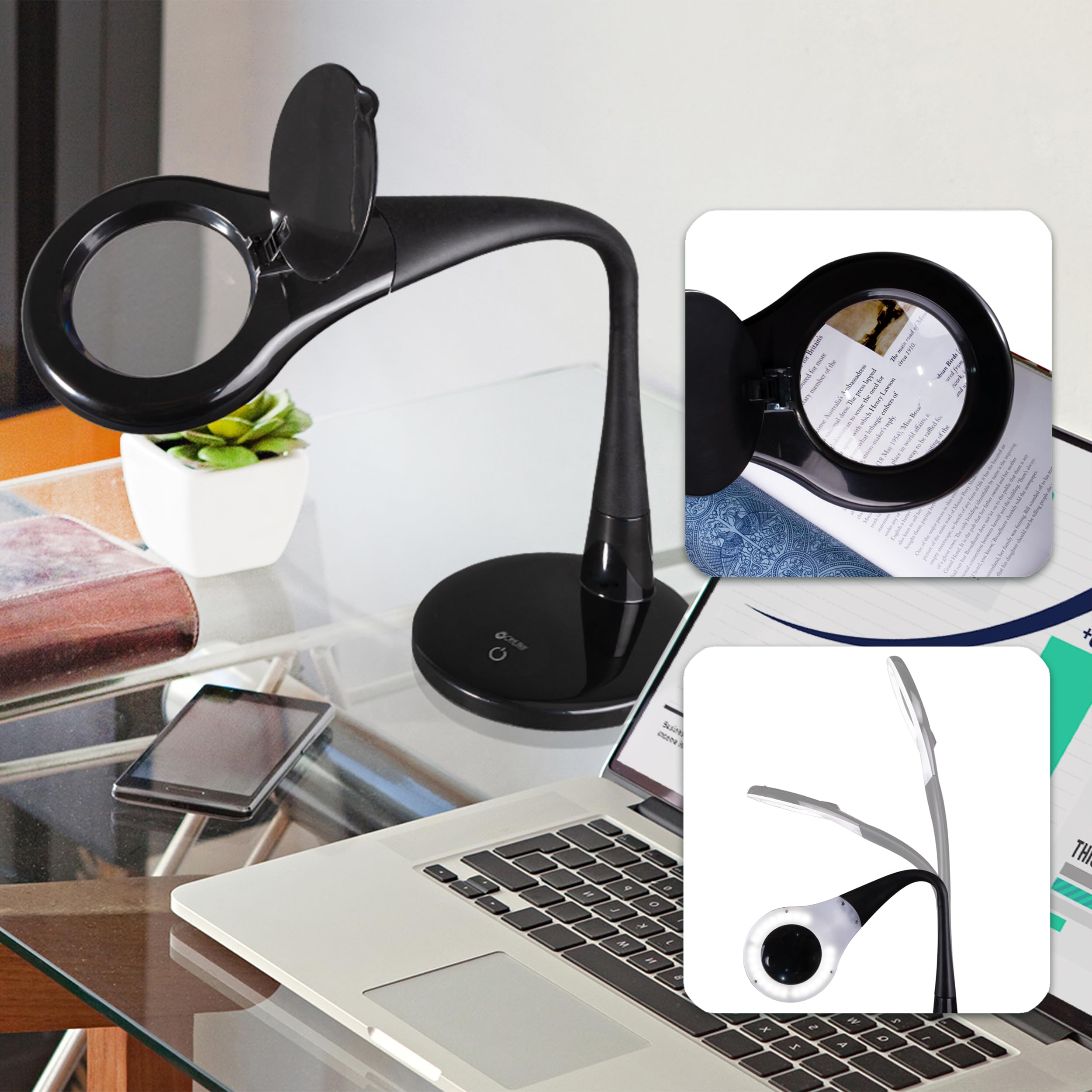
The optics are a 1.7x magnifier with a 3.4x spot viewer tucked inside, and the spot viewer carries an easy-close lid to keep the lens clean when you are not using it. The flexible neck adjusts from 10 to 21 inches, so you can bring the head right down over a lap project or lift it up for reading music or medicine labels. Four brightness settings run from a soft ambient glow up to full reading brightness.
It is the most modest magnification of the group — 3.4x on the spot viewer, where the Neatfi bifocal goes to 6x — so it is built for reading and handwork, not for inspecting micro-solder joints. If you need extreme close detail, look up the list. What wins people over here is the quality of the light itself: chainmaille and beadwork makers say it makes the work easier to see without eye strain over long stretches. The rare miss is a buyer expecting the main head to magnify everything as they look through it — the lid and spot viewer arrangement takes a beat to get used to.
Built around the light: 95+ CRI ClearSun LEDs, four brightness steps, and a height range of 10 to 21 inches make this a natural chair-side reading and crafting lamp.
The trade-off: 1.7x main magnification tops out well below the precision lamps on this list, so it rewards readers and handworkers rather than bench-level detail inspectors.
Suits you if: your project lives on your lap and true color matters more than extreme zoom.
Keep looking if: you need to zoom past 3.4x for micro work.
3. Brightech LightView Pro XL Magnifying Desk Lamp with Clamp
A rectangular lens big enough to read a whole page without sliding the head around.
The headline here is the lens shape. Instead of a round lens that only shows you a circle of your work, the LightView Pro XL uses a 6-inch-wide by 4.5-inch-long rectangular lens at 2.25x magnification. That means you can move through a whole book page or sweep a wide patch of a mosaic without repositioning the arm every few inches. For readers and crafters who hate nudging the lamp, that switch from round to rectangular is the whole argument.
The glass itself is genuine diopter glass and scratch-resistant, and because the light comes from LEDs rather than a hot bulb, the lens will not yellow or warp from heat over time. Three dimming levels let you tune the cool white light to the job — dim for reading, high contrast for spotting the finest line in a repair. The steel arm pivots smoothly and stays put.
The build gets the most nods from owners — stitching, mosaics, and jewelry repair all come up — and the rectangular lens is the specific thing people single out as easier to look through. The caveat is the clamp mounting hardware: a few buyers have modified the shaft to stiffen it up, so if you plan to swing this head around a lot, expect to set the clamp up carefully once and leave it. The consensus is strong at 4.5+ stars, with the large lens and bright adjustable output doing the heavy lifting.
The case for it: buy the XL if you read full pages or work across a wide craft surface and are tired of chasing the lens around.
The fine print: the clamp shaft is the part to set up with care — some owners reinforce it, so mount it once on a sturdy bench and leave it.
4. BoliOptics LED Magnifying Lamp

Built to shrug off years of fluorescent-era eye strain with flicker-free glass-lens light.
The number that matters here is 100,000 hours — the rated life of the LED array, which is more than three times the 30,000 hours the Neatfi bifocal is rated for. That is not a marketing flourish; it is the difference between a lamp you replace and a lamp that outlasts several of your other tools. Combine it with a genuine glass lens that resists yellowing, clouding, scratches, and warping, and you have a bench fixture meant to stay put for a long time.
The light itself is 60 SMD LEDs producing 1,200 lumens at 5600K-6000K daylight white, and the key word is flicker-free. Fluorescent tubes pulse in a way your eye cannot consciously see but your brain registers as fatigue over an hour of close work, and this lamp’s constant output is aimed squarely at that problem. Four adjustable levels run 25%, 50%, 75%, and 100%, and it has a handy habit of remembering your last brightness setting between sessions.
Magnification is a 3 diopter, 1.75x glass lens with a 5-½ inch working space — a comfortable distance for soldering, repairs, fly tying, facials, and tattoo work. The clamp fits surfaces less than 2 ⅜ inch thick, the arm fully extends to 34 inches, and 360° swivel plus a locking pin keep the head where you leave it. The recurring note is that the light color is not adjustable — you get four brightness levels, not a warm/cool tuning dial. Ratings sit at 4.5+ stars, and the working distance and flicker-free output are what professional users keep returning to.
Why bench pros lean here: flicker-free 1,200-lumen light and a glass lens rated at 100,000 hours make this a set-and-forget fixture for a fixed workstation.
The limit worth knowing: you can change brightness but not color temperature — it holds one daylight tone, so warm-light lovers will notice the difference.
Pick this one if: your lamp lives bolted to the same bench every day and eye fatigue is your main enemy.
Skip the glass here if: you need warm-to-cool color tuning for photo or color-matching work.
5. OttLite EasyView LED Floor Lamp

A floor-standing light that reaches over your sewing chair instead of clamping to a desk.
If your work happens from a chair rather than a bench, this is the one. The flexible arm runs from 48 to 64 inches tall and sits on a base measuring 8.1875 by 11 inches, so it stands on the floor and reaches over a sewing table, a crafting spot, or a reading chair. No clamp, no bench edge needed — just a firm patch of floor.
The magnifier is a rimless 1.75x optical-grade lens, and rimless is the quiet benefit: with no frame cutting across your view, you get uninterrupted sight of the whole magnified area. A 3x spot viewer handles the finer detail like threading a needle or lining up an embroidery stitch. Light is OttLite’s ClearSun LED at 95+ CRI with three touch-controlled brightness levels, so colors stay true whether you are sorting thread or matching fabric.
Crafters and stitchers keep coming back for the easy assembly and the bendy arm that lets them aim the light exactly where their hands are. The recurring gripe is height against low seating — the arm can barely clear a bulky recliner’s armrest, so measure your chair before you commit. Otherwise, 4.5+ stars and an easy-to-move, easy-to-assemble design make this a natural fit for anyone whose projects live on a chair or table rather than a workbench.
What makes it work
- 48 to 64-inch height range covers sewing tables and reading chairs
- Rimless lens gives uninterrupted viewing with no frame in the way
- 95+ CRI ClearSun light with three touch brightness levels
- Stands free — no clamp and no bench edge required
Where it can fall short
- The arm can barely clear the armrest of a bulky recliner or low chair
- Floor footprint means you need clear ground and a stable spot
Good match for: stitchers and crafters who sit in a normal chair and want light brought to them.
Measure first if: you do your work from a large recliner — the arm’s reach to a high armrest is the limit here.
6. Brightech LightView Pro 3-in-1 LED Glass Magnifier, Black
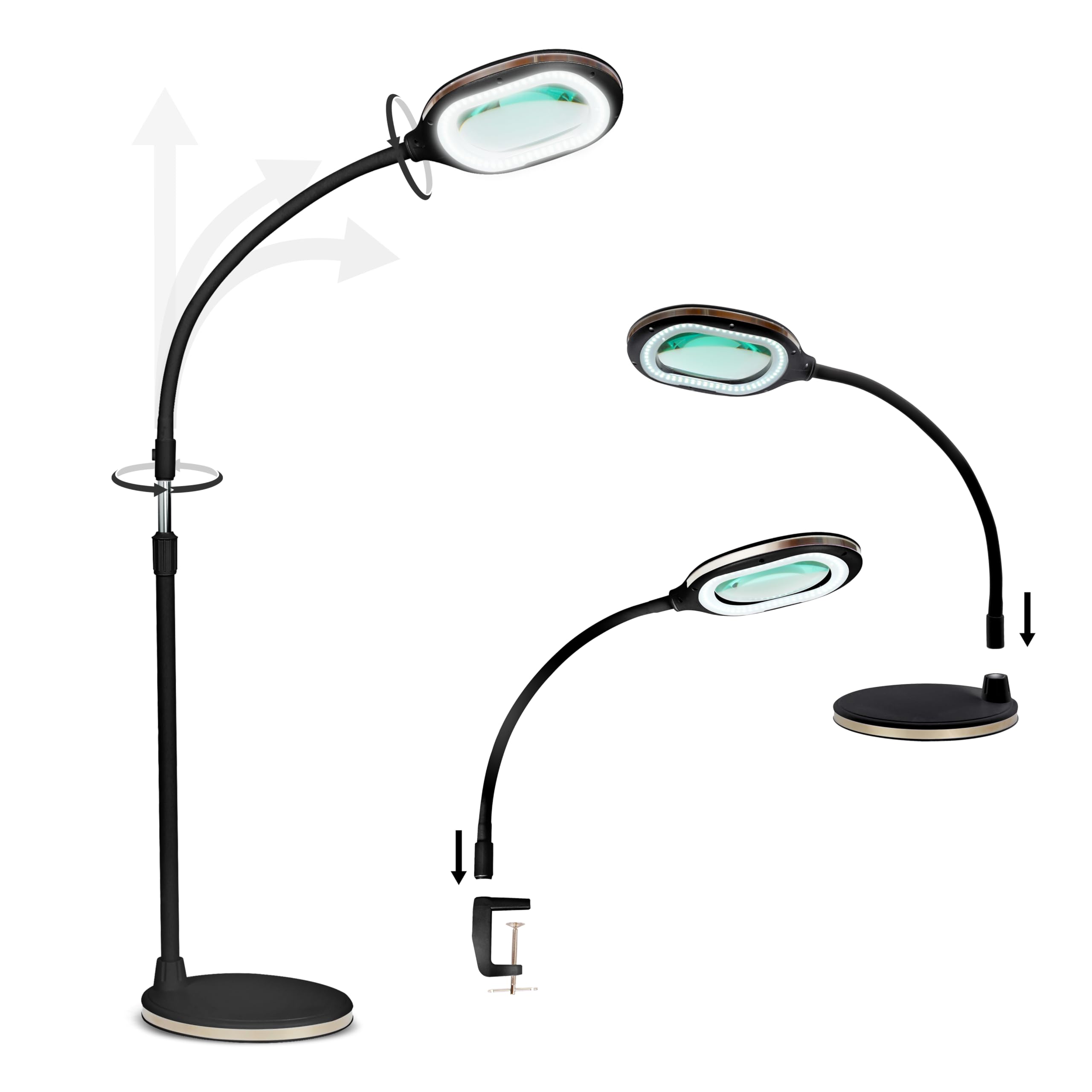
One lamp that screws to a clamp, drops into a base, or stands tall — three mounts in a single box.
The defining trick is flexibility of mounting. Screw the head into the clamp for a workbench, set it into the base for a desktop, or insert it into the stand to make a free-standing tall magnifier. If you move between a table, a clinic chair, and a salon station, one lamp covers all three setups. That mobility is the whole reason this earns a slot — you are not buying a fixture for one spot, you are buying a lamp that travels.
The optics are genuine diopter glass that resists heat, time, and scratches, and the 800 lumens from 9W LEDs are plenty bright for close work. Focus range stretches to 13 inches, so your hands do not cramp from holding the work in one stiff position. The 20,000-hour LED rating is roughly 20 years at three hours a day, according to the maker’s own math. Clarity and brightness are what people notice first; cross-stitchers and jewelers both make use of it.
Here is the honest part: this lamp is top-heavy, and the base is the weak link. Owners have had to weight the base or point it in line with the arm to keep it from tipping. On a bench with the clamp, that is a non-issue — it is the freestanding stand mode where you notice the balance. At 4.0+ stars, it suits someone who wants three mounting options and does not mind committing to the clamp for daily use.
Worth it for: mobile pros hopping between bench, chair, and stand setups who want one lamp for all of them.
Trade-off to accept: the freestanding stand is top-heavy, so lean on the clamp for everyday use and keep the stand for occasional setup.
7. Neatfi LED Magnifying Lamp 1600 Lumens
The 7-inch lens and 1,600 lumens make this the widest, brightest bench view in the lineup.
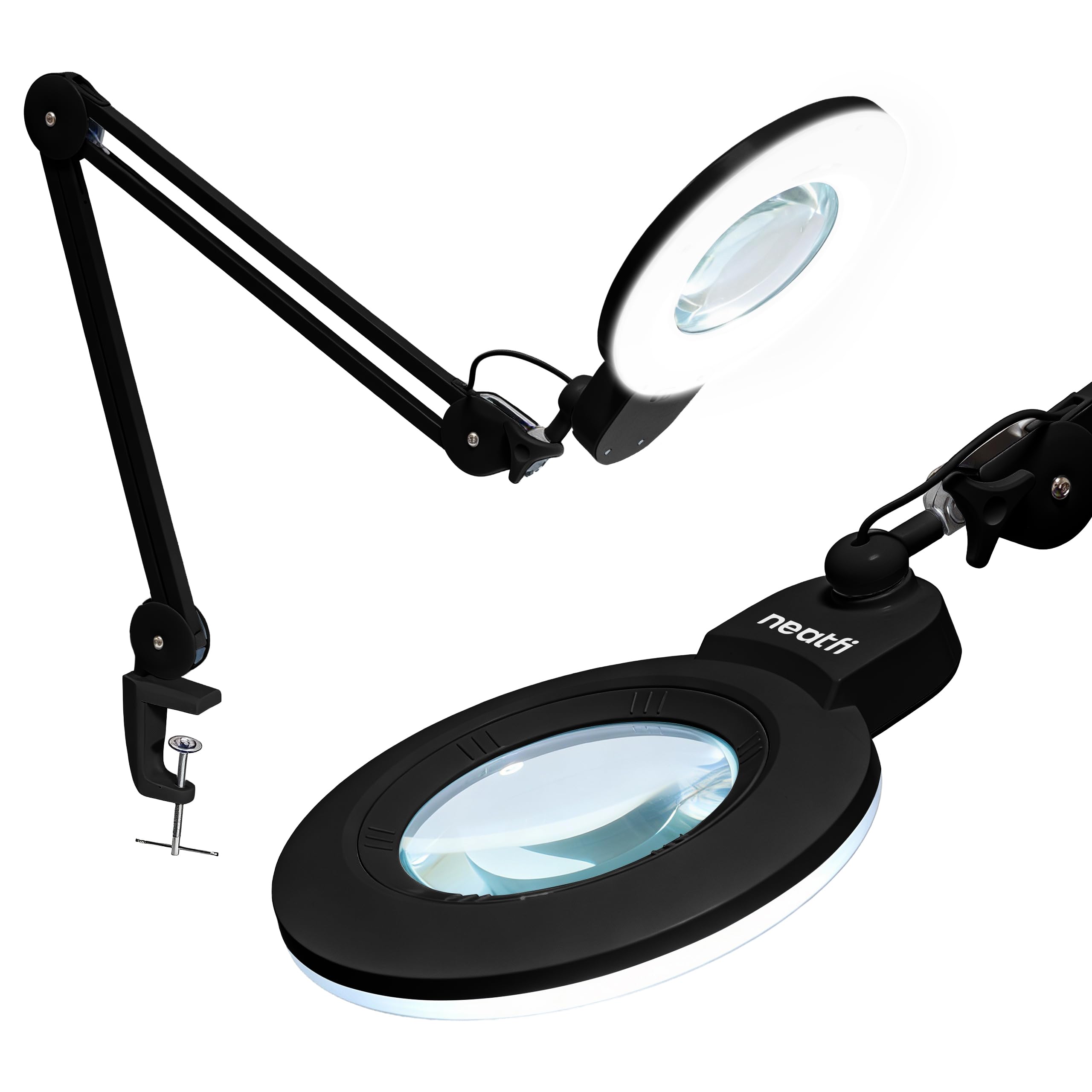
Compare the numbers and the case builds itself: 1,600 lumens from 84 integrated SMD LEDs, and a 7-inch lens that gives you 2.25x (5 diopter) general viewing plus a 6x (20 diopter) inset for precision. The arm runs 36 inches and rotates a full 360°, locking in place on a clamp that holds a desk or bench steady. If your project is large — a whole sewing panel, a PC board, a big piece of jewelry — that lens width lets you see it in one look instead of panning across it.
Four dimming levels (25%, 50%, 75%, 100%) let you dial brightness down from the 1,600-lumen maximum, and the glare-free output keeps your eyes comfortable during long sessions. Magnification and lens size are what people notice — the big, clear lens and even illumination get called out again and again. The 30,000-hour LED rating matches the smaller Neatfi bifocal.
The trade-offs are worth naming before you buy. This lamp uses an acrylic lens rather than glass, so it is softer than the glass options here and demands gentle cleaning. The arm adjustment also has its fussy moments — owners describe the positioning as needing a bit of patience to dial in just right. Neither is a dealbreaker on a 4.5+ star lamp with this much viewing area, but if glass is a hard requirement, the BoliOptics or Omega 5 is the buy.
The view you are paying for: a 7-inch lens at 2.25x with a 6x inset and 1,600 lumens gives the widest, brightest single view on this list.
The honest caveat: acrylic, not glass — clean it with a soft cloth and it serves well, but glass lasts longer under daily use.
Choose it when: your work is large and you want to see all of it at once with serious light behind it.
Choose glass instead if: you scrub your lens every day and want the longest-lived surface.
8. Daylight Company Magnificent Pro Magnifying Lamp

Flips from floor lamp to table lamp to clean task lamp with a magnetically detachable lens cover.
This is the shape-shifter of the group. It stands as a floor lamp for detail work, drops to a table lamp for seated tasks, and the magnetically detachable lens cover turns it into a plain task lamp in one motion. Add the 6,000K daylight LEDs at 95+ CRI and you have lighting that mimics natural daylight for color-accurate work, with three brightness levels at 5,500 lux, 3,500 lux, and 1,500 lux.
The magnifier is a 5-inch, 1.75x lens in a semi-rimless design, which widens your viewing area by removing the frame from the parts you actually look through. The Easy Twist head lets you aim the light precisely, and needlework and counted cross-stitch are where owners say it shines — a black-background cross-stitch project suddenly becomes visible instead of a battle. Assembly is quick and the base is heavy enough that it does not wobble.
Now the part you need to weigh honestly: durability is the recurring weak spot. Some units have quit after a few months of use, and the lens surface scratches more easily than glass. It is not a reason to rule the whole lamp out — the light quality and conversion versatility are real — but if you are buying for a hard, all-day professional bench, a unit that can fail early is a risk worth knowing about. Consider the glass-lens options if longevity is your priority.
Suits you if: you want one light to serve standing work, seated tasks, and plain illumination without magnification.
Weigh the risk if: you need a lamp to survive years of daily professional use — the lens scratches and some units fail early.
9. Omega 5 Premium LED Magnifying Lamp

Two glass lenses in the box — 1.75x and 2.25x — so you can switch strength to match the task.
What makes the Omega 5 different is that it ships with two glass lenses, a 3 diopter for 1.75x and a 5 diopter for 2.25x, and you swap between them depending on the job. That is the opposite approach to the bifocal Neatfi, which gives you a fixed general-and-inset pair in one head. Here you get a clean, single-strength view at whichever magnification you choose — no inset circle dividing your field, no compromise on working distance. For health and beauty work like facials and podiatry, where you want one clear, uniform view, that matters.
The light is a 6,000K LED tuned to daylight, with four brightness levels running from 5,500 lux down to 1,700 lux, so you can go bright for detail inspection or softer for overall observation. The long-reach arm uses an internal spring mechanism for smooth positioning, and a head joint with a wing nut locks the lens at the exact angle you set. Owners single out the optics as excellent — the higher-grade construction and the brightness levels are what they keep noting, and the light holds position without roaming.
The one honest note is cost. This is the premium pick on the list, and it earns that by build and by the second lens — but if you only ever need one magnification strength, you are paying for flexibility you may not use. Consider it a professional investment rather than a casual purchase, and it holds a 2-year manufacturer warranty to back the commitment.
Built for professionals: two interchangeable glass lenses, a spring-loaded long-reach arm, and a wing-nut head lock make this a precise, stationary fixture for clinics and studios.
Where it sits on value: the premium tier of this list — justified by glass and a second lens, less so if you only ever need one magnification.
Built for: estheticians, podiatrists, model makers, and low-vision users who want a uniform glass-lens view at a chosen strength.
Reconsider if: you work with one magnification only — the second lens is wasted and a fixed lens costs less.
Know the Specs
These are the four numbers and terms that decide whether a magnifying lamp works for your bench, explained in plain words.
Diopter and Magnification
Diopter measures how strongly a lens bends light to enlarge what you see — it is the honest number behind the “X” printed on the head. A 3 diopter lens equals 1.75x, a 5 diopter lens equals 2.25x, and a 20 diopter lens reaches 6x. Higher diopter means stronger enlargement but a shorter working distance, so you must bring the work closer to stay in focus. That is why high-power lenses are best for inspecting small spots rather than reading whole pages.
Lens Material: Glass vs Acrylic
Glass resists yellowing, clouding, scratches, and warping, and it does not bend out of shape from the heat of the lamp sitting right behind it. Acrylic lenses can be clear and light, but they are softer and age faster under cleaning and heat. For daily professional use, glass is the longer-lived choice; for occasional hobby work, acrylic is acceptable if you treat it gently.
Lumens and CRI
Lumens measure raw brightness — a 1,600-lumen lamp lights a big bench, while a 600-lumen lamp is tuned for close, controlled tasks. Color Rendering Index (CRI) tells you how faithfully the light shows true color on a 1-100 scale, so a 95+ CRI lamp keeps thread colors and skin tones accurate where a lower-CRI lamp can muddle them. Brightness plus high CRI is what lets you judge fine detail without squinting.
Mounting and Reach
Clamp lamps grip a bench edge and free up floor space, but the clamp has a maximum thickness — the BoliOptics clamp fits surfaces less than 2 ⅜ inch thick, for instance. Floor lamps stand on their own base and reach over a chair, but need clear floor and a stable spot. Arm length sets how far the head reaches your work; the Neatfi bifocal arm runs 36 inches, while the BoliOptics reaches 34 inches fully extended.
Common Questions
What does the diopter number on a magnifying lamp actually mean?
Is a glass lens worth it over acrylic?
Will a clamp lamp fit my workbench?
What is the difference between a bifocal and an interchangeable-lens lamp?
Why does flicker matter in a magnifying lamp?
How many lumens do I need for close-up work?
Can a magnifying lamp help if I have low vision?
What is CRI and why does it matter for color work?
Do these lamps work from a recliner or a low chair?
How long do the LEDs in these lamps last?
The Bottom Line
For most people doing serious close-up work, the professional magnifying lamp to beat is the Neatfi LED Bifocal Magnifying Lamp, because it pairs a 2.25x general lens with a 6x precision inset and floods the bench with 1,200 lumens — a combination that covers both wide and fine work without swapping anything. Its 36-inch arm and clamp that grips desks up to 2.7 inches thick keep both your hands free, and the 30,000-hour LED rating means the light source will outlast most of your projects.
If your work stays bolted to one bench all day and eye fatigue is the enemy, reach for the BoliOptics MG16303121 — flicker-free 1,200-lumen light behind a glass lens rated at 100,000 hours is a hard fixture to argue with. And if you need the widest possible single view, the Neatfi 7-inch model gives you that bigger lens and 1,600 lumens, with acrylic as the honest trade-off.
Choose by the mount and the diopter, and whichever pick lands on your bench will give you years of comfortable close work. The neighborhood of 4.5+ stars across hundreds of owners on the top bifocal is a strong signal it does what it promises — so start there, then size the lens and mount to the job in front of you.
How we choose
We do not accept paid placement. Every pick is matched to a real buyer and a real use-case; we do not hands-on test units.
Sources
Specifications: manufacturer listings and product documentation. Review insights: verified customer reviews, as of November 2026. Pricing: not shown on this page (it changes often); check the current price via the retailer link.
As an Amazon Associate, Tactical Gear Guy earns from qualifying purchases. This does not affect which products we feature.