Specs are compiled from manufacturer listings and verified buyer reviews and can change over time — please confirm the key details on the product page before buying.
You want to know whether the air in your room is actually clean, and whether the number on the screen can be trusted. That is the whole job of a professional indoor air quality monitor. The instruments below all read more than one pollutant — particulate matter, carbon dioxide, chemical vapors — because a single-number gadget tells you almost nothing about a room. What separates them is sensor type, how long they hold calibration, and whether you can get the readings back out for a report.
This guide is built by comparing the manufacturers’ published specifications and the patterns across verified customer reviews, so you get each pick’s real strengths and trade-offs instead of marketing spin.
Some use lab-grade optical sensors and some cut corners, and that gap decides whether your readings mean anything. Below I break down how each unit handles sensor quality, calibration, and data export so you can pick the right professional indoor air quality monitor.
Top Picks

How To Choose The Best Professional Indoor Air Quality Monitor
The mistake beginners make is buying a monitor that reads one thing. A gadget that only shows PM2.5 tells you about smoke and dust but says nothing about a stuffy, poorly ventilated room. For real indoor air work you want a unit that reads both particulate matter (the tiny airborne particles you can’t see) and carbon dioxide (the gas your own breath builds up in a closed room).
Sensor type decides whether the number matters
For carbon dioxide, you want an NDIR sensor (a non-dispersive infrared sensor that measures the gas by how it absorbs infrared light). It is the standard used in lab and HVAC work, and it holds its reading far better than cheaper alternatives. For particles, a laser particle counter is the dependable choice. It scatters a laser off passing dust and counts what it sees.
Formaldehyde and VOCs are the harder measurements. An electrochemical HCHO sensor (one that reacts chemically to formaldehyde) is more serious than a basic semiconductor sensor, and the data will say which one you are getting. Check that detail before you trust a chemical reading.
Calibration and data export separate tools from toys
A monitor is only as good as its last calibration. Look for factory pre-calibration plus a built-in recalibration routine, because a sensor left uncalibrated for months will quietly drift. And if you need to prove something — to a landlord, a contractor after a renovation, or a facilities report — data logging with USB or app export is what turns a reading into evidence.
Side-by-Side Comparison
| Model | Best For | Key Sensors | Power | Data Export | Amazon |
|---|---|---|---|---|---|
| Temtop M2000 (2nd Gen)★ Best Overall | Full 8-in-1 lab-style checks | NDIR CO2, Dart HCHO, laser particle | Rechargeable battery | USB, 3+ months logging | Amazon |
| Airthings 322 Wave EnhanceBest for Bedrooms | Bedrooms and home offices | CO2, VOC, humidity, temp, pressure, noise, light | 2 AA batteries | App-based | Amazon |
| Temtop LKC-1000S+Best for Reporting | Trend tracking and reporting | Laser particle, Dart HCHO, TVOC | Battery + USB-C | USB, 3 months, Excel | Amazon |
| CF-60PP SMART | Business and facility reports | PM1.0/2.5/10, CO2, TVOC, HCHO, pollen | 9V battery (included) | USB, up to 1 year | Amazon |
| AK16C 16-in-1 | Wall-mount or tabletop all-in-one | CO2, PM1.0/2.5/10, HCHO, TVOC | USB-C + battery (4–5 hrs) | On-screen only | Amazon |
| Qingping Air Monitor 2 | Smart-home app monitoring | PM2.5, PM10, CO2, eTVOC, noise | USB (3 hrs on battery) | App, 30 days | Amazon |
| AprilAire ZAWTHCPV | Whole-home Healthy Air system | PM2.5, VOC, TVOC, CO2, humidity, temp | Corded electric | App-based | Amazon |
| Smart 128s (BLATN) | Long-term particle logging | NDIR CO2, electrochemical HCHO, TVOC, 6-channel particles | 2200 mAh rechargeable | TF card, up to 400 days | Amazon |
| IQAir AirVisual Pro | Professional real-time monitoring | PM2.5, CO2, AQI, temp, humidity | Rechargeable, USB or outlet | App historical data | Amazon |
Detailed Reviews
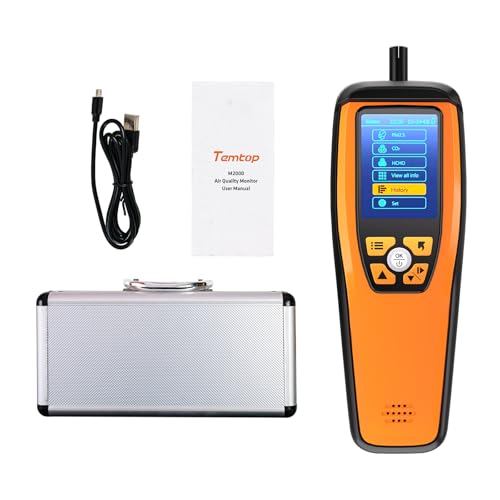
1. Temtop M2000 Professional Air Quality Analyzer & CO2 Monitor
Our pick — 4.0+★ from 200+ verified ratings; the strongest balance of quality and price.
Eight readings in one hand-held case, with the CO2 sensor done properly.
The M2000 is the pick that reads like a real instrument. It combines a SenseAir NDIR carbon dioxide sensor (a light-absorption sensor that is the standard for CO2 work), a Dart HCHO sensor for formaldehyde, and a Temtop particle sensor for fine dust. Eight measurements land on one screen: CO2, PM2.5, PM10, formaldehyde, particle count, temperature, and humidity. Few units in this category cover that much ground in a single device.
Where it earns its keep is data. Everything exports over USB, including CO2, PM2.5, PM10, and HCHO, and the built-in memory holds more than 3 months of continuous logging. There is a built-in calibration program for both the CO2 and formaldehyde sensors, so you can bring readings back to true instead of guessing. The response time is listed at 2 seconds, which means the number reacts almost as fast as you breathe into a room. The color TFT screen and audio alarm let you set a threshold and know when a room crosses it without staring at the panel.
The honest catch is mass. At 2 pounds this is roughly twice the weight of the CF-60PP SMART, so it is a bench or carry-case instrument rather than something you forget in a pocket. It also ships in a larger footprint — 11.18 x 5.35 x 7.64 inches — so plan shelf space for it. Buyers here value exactly what this unit is built for: measuring air quality anywhere you need it, with logging across formaldehyde, particulates, and CO2 all in one export.
What it gets right
- NDIR CO2 plus Dart HCHO plus laser particle sensing in one body
- USB export of full data with 3+ months of logging
- Built-in calibration for both CO2 and formaldehyde
- 2-second response time and adjustable audio alarm
What to weigh first
- 2 pounds — a cased instrument, not a pocket gadget
- Larger footprint needs a real spot on a shelf
- Chemical readings still benefit from steady calibration habits
Built for: anyone who needs lab-style CO2, particle, and formaldehyde readings plus exportable logs from a single carry-case unit.
Look elsewhere if: you want a featherweight wall sensor you hang and forget — this one wants a bench.
2. Airthings 322 Wave Enhance Indoor Air Quality Monitor
The one you screw to a bedroom wall and never think about again.
At 3.36 ounces, the Wave Enhance is the lightest unit here — roughly a quarter of the 14.4-ounce Temtop LKC-1000S+, which you will notice the moment you mount it. It runs on 2 AA batteries, so there is no cable to route across a wall. Five sensors stay always-on: carbon dioxide, VOCs (the airborne gases given off by fumes and cleaning products), humidity, temperature, and air pressure. It also tracks noise and light, which matters for a bedroom where both affect how well you sleep.
What people tend to love is simply that it works quietly and consistently wherever it sits. The touch sensor gives you a color-coded reading at a glance, and the full detail lives in the free Airthings app on your phone. That app handles notifications, trend history, and even a local pollen forecast. For a home office, watching CO2 climb while the door stays shut is the moment this monitor earns its place — high CO2 is the signature of a room that isn’t getting fresh air.
The trade-off is connectivity. There is no Wi-Fi on board — it is Bluetooth-only — so you have to be within range with your phone to pull readings. Anyone expecting remote monitoring from another city will find that inconvenient. But for a bedroom or a home office in the same house, Bluetooth does the job fine, and the battery power means no outlet required.
Why it fits a nightstand: CO2, VOC, humidity, temperature, and pressure in a 3.36-ounce battery-powered puck that tracks noise and light too.
What to know: No Wi-Fi, so remote checks from outside the house are off the table — you read it in the app over Bluetooth.
Great match for: a bedroom or quiet home office where you want a cable-free sensor that quietly strengthens its case through daily CO2 trends.
Pass on this one if: you need to monitor the room from outside your home — the Bluetooth link stops at range.
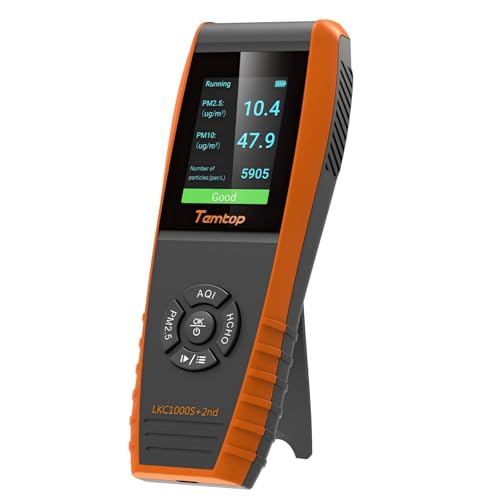
3. Temtop LKC-1000S+ Air Quality Monitor
Built to spot where the pollution is coming from, not just how bad it is.
Most monitors give you a single number and leave you guessing. The LKC-1000S+ tracks PM2.5, PM10, HCHO, VOCs, humidity, and temperature — and it presents a 12-hour trend histogram so you can see exactly when the readings spike. That turns a reading into a source you can trace. If PM2.5 climbs every time the kitchen fan stays off, you’ve found the source. Its laser particle sensor is rated for a 3-year designed lifespan, and the HCHO sensor is an electrochemical Dart cell rather than a cheap semiconductor. Temtop claims R² up to 0.999 for the particle readings.
For documentation, this is the tool. It logs all seven parameters continuously and exports to Excel spreadsheets over USB, with 3 months of storage and no subscription or app needed. Renovation monitoring, long-term tracking, or sharing a report with a contractor all fall within its range. Calibration is handled at the factory, so startup is quick, and it is designed to run plugged into the included Type-C cable for continuous 24/7 use.
Two practical notes. The built-in battery gets you 6–8 hours of room-to-room spot checks when you unplug it, which is useful but not all-day. And to keep readings stable, you want to keep alcohol, perfume, disinfectant spray, and strong cleaners away from it during testing, plus allow 10 minutes of warm-up after moving between hot and cold rooms. The only measurement it can’t handle is gas or CO leaks — that needs a dedicated alarm, which is worth knowing before you rely on it for combustion safety.
Where it pulls ahead
- 12-hour trend histogram pinpoints when pollution peaks
- Excel export of all 7 parameters, 3 months of logging, no subscription
- Electrochemical Dart HCHO sensor and laser particle counter with a 3-year designed lifespan
- Factory pre-calibrated for a quick start
Where it asks for care
- Battery gives 6–8 hours off the cable, so 24/7 work needs the Type-C plugged in
- Does not detect gas or CO leaks — a dedicated alarm covers that
- Wants a 10-minute warm-up when moved between hot and cold rooms
Ideal for: renovation checks, classrooms, and any job where you need a dated Excel log of seven parameters to show someone.
Think twice if: you also want the unit to double as a carbon monoxide alarm — it can’t do that.
4. CF-60PP SMART Professional Air Quality Monitor
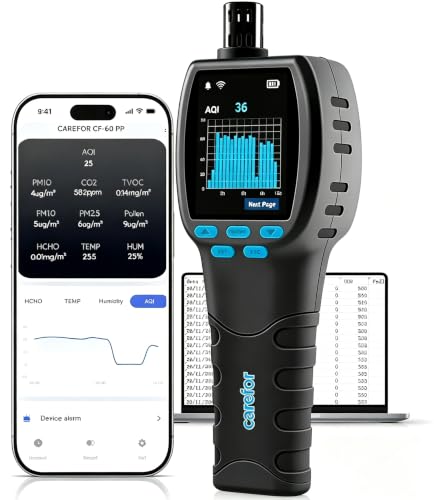
A facility manager’s monitor: on-screen history, push alerts, and a full year of records.
Bulk matters here. At 1 pound the CF-60PP is half the weight of the 2-pound Temtop M2000, which makes it easier to move between rooms in a building. It reads PM1.0, PM2.5, PM10, CO2, TVOC, HCHO, AQI, temperature, and humidity on one color display — and crucially, it shows 4-minute, 6-minute, 2-hour, and 12-hour historical curves right on the screen. That means you see the spike that happened while you were in a meeting, not just whatever is happening right now.
What gives it a business edge is the combination of local alarms and a documented paper trail. You can set custom thresholds for CO2, PM2.5, and VOCs, and the device both sounds a local alarm and fires a phone push. It stores up to 1 year of history with USB export, which is what lets a facilities team build an indoor air quality report and tune HVAC energy use against actual data. It also adds a dedicated pollen metric (0–500 µg/m³), useful for flagging high-pollen days in rooms used by allergy-sensitive occupants.
The one habit to plan around is power. It runs on an included 9V battery, which suits placement flexibility but is a consumable you will eventually replace. Beyond that, this is the pick for anyone who needs the numbers to be actionable from a room away.
The facility angle: A 12-hour on-screen history, custom threshold alarms with phone push, and 1-year USB export cover everything a documented building check needs.
The detail worth noting: The pollen reading (0–500 µg/m³) is uncommon at this level and helps identify high-allergen days before they catch you out.
Reach for this if: you manage classrooms, offices, or commercial rooms and need defensive, dated records plus alerts you can act on remotely.
Look elsewhere if: you want rechargeable internal power — this one is a 9V cell you swap.
5. AK16C 16-in-1 Indoor Air Quality Monitor
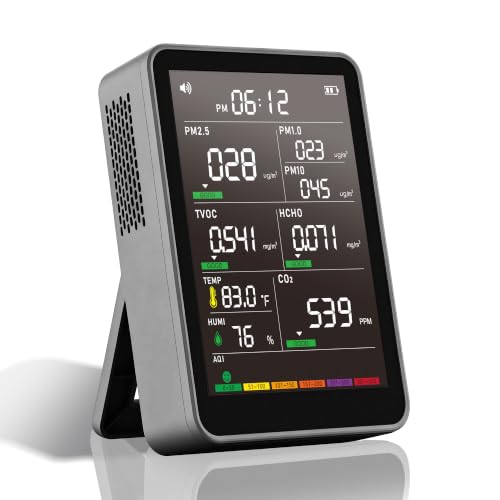
Sixteen readings, a bright color screen, and a back that mounts to the wall.
This one covers a lot of ground for one device. It tracks CO2, PM1.0, PM2.5, PM10, HCHO, and TVOC, and puts AQI, temperature, humidity, and a live clock on the same HD color screen. It arrives factory pre-calibrated against industrial-grade equipment, which helps keep sensor drift (the slow wander in readings over time) to a minimum. The screen shows a 6-level color-coded AQI bar, so a green-to-red glance tells you more than reading six separate numbers.
Sampling is quick: a 1.5-second cycle with readings updating every 1–2 seconds. On power-up it auto-recalibrates through a 120-second sensor warm-up, and a manual reset recalibration is available if you want to start fresh. Power is USB-C with a battery good for 4–5 hours of portable spot checks, or continuous 24-hour monitoring when plugged into the included adapter. Back-mount holes let it sit on a table or hang on a wall — useful in a basement or classroom where the best measuring spot is eye level, not a shelf.
You can read this screen in a bright or dim room, because brightness adjusts across three levels. A °C/°F switch (Celsius or Fahrenheit) and a 12/24-hour clock setting round out the extras. This is an all-in-one room monitor, not a data-logging instrument (a device that saves readings you can export). If you need exportable records, look at the logging picks above instead.
Pick it for: a wall-mounted or tabletop multi-sensor that gives you color-coded AQI at a glance across a whole room.
Rule it out if: you need to export charts or logs — this one keeps its data on-screen.
6. Qingping Air Monitor Gen 2

The best-looking screen in the group, and the one that lives on your Wi-Fi.
The 4-inch IPS touchscreen is the star here: 254 pixels per inch (a measure of sharpness) makes it crisp enough to read from across a room, and its brightness adjusts automatically. You tap and slide to move between readings, and each metric carries a color indicator below the number. It tracks seven metrics — temperature, humidity, CO2, PM2.5, PM10, eTVOC, and noise level — plus the date, time, and a multi-alarm clock that can act as a bedside alarm.
Being a connected device means you can watch those seven metrics remotely in the Qingping+ app when it is linked to 2.4GHz or 5GHz Wi-Fi. The app also handles 30 days of historical data, which you can check or export, and the firmware updates over Wi-Fi. A replaceable PM sensor sits behind a magnetically held back cover, so long-term maintenance is a matter of swapping a part rather than replacing the unit.
There are two caveats worth knowing before you plug it in. It does not measure formaldehyde, so a room being tested after fresh-furniture installation needs a different tool for that. And while it can run 3 hours on a charge, it wants USB power for daily use — and the power adapter is not included, so you supply a 5V⎓1A supply yourself. Some units have also proven less durable over time, so treat it as a connected convenience build rather than a long-haul instrument.
Why you’d want it on a desk: Seven metrics on a 254-PPI touchscreen, remote access over 2.4GHz or 5GHz Wi-Fi, and 30 days of exportable history in the Qingping+ app.
The fine print: No formaldehyde detection, no power adapter in the box, and only 3 hours off the cable.
Suits you if: a sharp touchscreen and Wi-Fi app control are the features that make you actually check your air every day.
Skip the idea if: you need formaldehyde readings or a set-and-forget battery sensor.
7. AprilAire ZAWTHCPV Air Quality Monitor
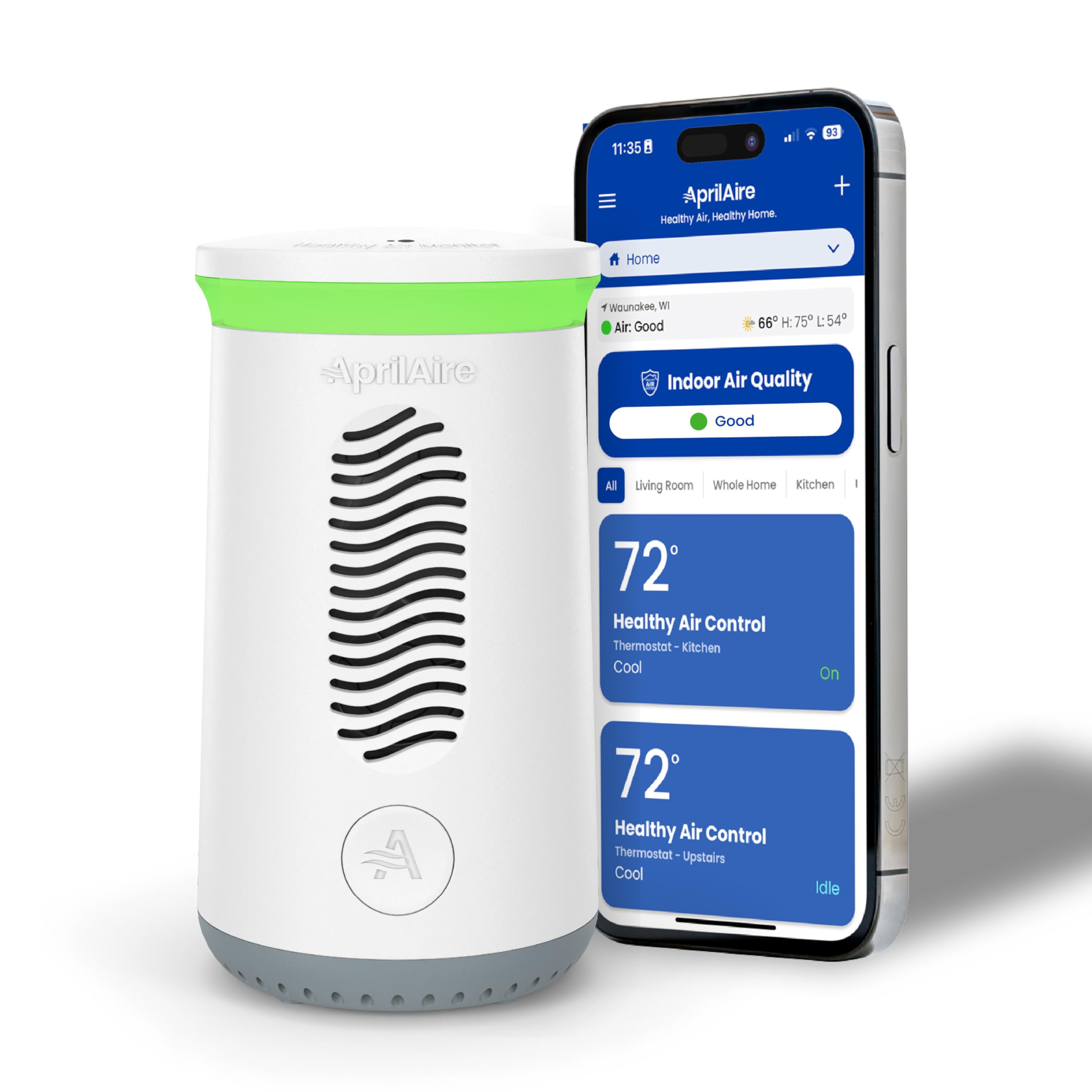
A sensor that plugs into a whole-home filtration system, not just a phone.
This monitor measures PM2.5 particulate matter, VOCs, TVOC, CO2, humidity, and temperature — and it is meant to be part of a larger air strategy. The Healthy Air App is required to run it, and the app is where you get actual values, trends, and plain explanations of each reading. Its patented Healthy Air Intelligence layer offers tips and education to help you act on what you see, and a simple color scheme flashes status at a glance. The unit runs on corded electric power, so it stays where you place it.
Where it stands out from the crowd is its ability to tie into real hardware. If you own an AprilAire Wi-Fi thermostat (models S86WMUPR or 8920W, sold separately), the monitor can trigger a Healthy Air Mode that drives your AprilAire filtration or ventilation to correct a problem. That closes the loop between measuring and fixing, which the standalone monitors here can’t do. It also ships with smart alerts for CO2, VOCs, temperature, and humidity that cut through to what matters.
The honest limitation is lock-in. Because it requires the app and reaches full potential only with the AprilAire ecosystem, it is the wrong choice if you want a standalone sensor or a brand you don’t otherwise own. The corded power also means no battery portability. Bought into the right home, though, it is a smart piece of a complete system.
Made for: households already running AprilAire filtration or ventilation who want a sensor that can trigger the fix.
Not the one if: you want a standalone, portable monitor with no app dependency or ecosystem requirement.
8. Smart 128s (BLATN) Air Quality Monitor

The particle counter that goes smallest, with logging that goes longest.
If you care specifically about dust, this is the most granular instrument here. Its laser sensor does 6-channel particle-number detection — counting particles per liter from PM0.3 and PM0.5 through PM1.0, PM2.5, PM5.0, and PM10 — alongside 3-channel particulate matter quality in µg/m³. It also carries an NDIR carbon dioxide sensor with self-calibration and an electrochemical HCHO sensor with a double platinum catalytic electrode and automatic calibration. A semiconductor TVOC meter rounds out the chemical side.
The logging is the headline. It stores and exports all 12 testing items with date and time at a frequency of once every 1 minute, and the memory can expand to 8G for up to 400 days of records. That is 400 days of minute-by-minute records in a 7.68-ounce handheld. A 2200 mAh rechargeable battery, stereo air convection sampling with a silent fan, and an anti-fall PE soft shell make it practical to carry and use in the field.
Where to be careful: the measurement story here draws the most pushback, and some units have been less reliable than the spec suggests. Some buyers also note the internal battery does not last long and can’t be recharged or replaced. Approach it as a serious logging device with variable quality control, and it fills a niche — deep particle detail and very long records — the others don’t.
What stands out
- 6-channel particle counting from PM0.3 up, plus 3-channel PM in µg/m³
- Logs all 12 items once a minute, expandable to 8G / 400 days
- NDIR CO2 and electrochemical HCHO sensors
- 2200 mAh rechargeable battery and 7.68-ounce portable shell
What to budget for
- Accuracy comes with mixed reports — treat readings as a guide, not gospel
- Internal battery life is short and not user-replaceable
- Some units have stopped working over time
Worth it for: particle obsessives who want PM0.3-to-PM10 counts and months of minute-by-minute records in one handheld.
Weigh carefully if: you need rock-solid reliability and a swappable battery for years of continuous duty.
9. IQAir AirVisual Pro Air Quality Monitor

The established name in professional-grade sensing, now with indoor and outdoor air in one view.
The AirVisual Pro leans on IQAir’s high-precision laser sensor technology to read PM2.5, carbon dioxide, smoke, dust, and other fine particles, plus temperature and humidity. It shows real-time readings alongside historical indoor AQI, temperature, and humidity trends, plus health advice keyed to current readings. The device sets up quickly through IQAir’s smartphone, tablet, or desktop app, and it recharges over an outlet or USB port.
Where it earns the premium label is the complete picture. It can pair with an AirVisual Outdoor monitor or follow your nearest public air quality station, so you compare indoor air against the air outside your window. That context is what an indoor-only sensor misses — knowing whether a spike is coming from your kitchen or drifting in from a smoky afternoon outside changes what you do about it. The fit and finish is clean Swiss design, and it weighs 381 g, light enough to place anywhere on a desk or shelf.
One caution shows up in the pattern: carbon dioxide readings have come in for mixed feedback, with some reporting erroneous CO2 values, so verify against a known baseline when you first set it up. Otherwise it is a well-regarded tool for both home and professional use, with an easy-to-read display that simplifies daily checks.
The premium case: PM2.5, CO2, AQI, temperature, and humidity with historical trends, plus optional pairing to outdoor air quality data for full context.
The check to make: CO2 accuracy has drawn mixed reports, so cross-check it early against a trusted reference.
Fits best with: buyers who want a polished, well-known instrument that compares indoor readings against local outdoor air.
Take pause if: your priority is formaldehyde or VOC detail — this one focuses on PM2.5 and CO2.
Know the Specs
Sensor type: NDIR vs semiconductor
The sensor is the whole ballgame. An NDIR carbon dioxide sensor measures the gas by how it absorbs infrared light, which is the method used in lab and HVAC work — the Temtop M2000 and the BLATN Smart 128s both use it. A cheaper semiconductor sensor reacts to a broad range of gases and is far more prone to drifting with temperature and humidity. For formaldehyde, an electrochemical sensor (one that reacts chemically to the gas) is more serious than a semiconductor, which is what separates the Temtop LKC-1000S+ from basic monitors. If a listing doesn’t name the sensor type, treat it as a flag.
Calibration and data logging
Every sensor drifts over time, so calibration routines matter as much as the sensor itself. Look for factory pre-calibration plus a built-in recalibration program you can run when readings start to look off. Data logging is the second half: exporting readings over USB or through an app is what turns a number on a screen into a document you can act on. The Temtop M2000 and LKC-1000S+ both offer USB export with months of storage, the CF-60PP keeps up to a year, and the BLATN Smart 128s pushes to 400 days with a memory card. If you need records, prioritise the loggers.
Common Questions
What does PM2.5 actually measure?
Why do I need a CO2 sensor if I already track PM2.5?
Does an air quality monitor need calibration over time?
Can a monitor detect carbon monoxide and gas leaks?
Which monitors can export data for reporting?
Is Wi-Fi monitoring worth having?
What is formaldehyde and why does it matter for renovation?
Are these monitors portable or do they need to be plugged in?
How loud is the alarm on the Temtop M2000?
Will an indoor air quality monitor improve my air on its own?
The Bottom Line
For most buyers, the strongest overall pick is the Temtop M2000 because it packs NDIR CO2, electrochemical formaldehyde, and laser particle sensing into one unit with USB export and 3+ months of logging. If your priority is a cable-free bedroom or home-office sensor, the Airthings Wave Enhance does that at 3.36 ounces on AA batteries. And if you need documented facility-grade records, the CF-60PP SMART is the one to reach for with its 1-year history and phone alerts. The Temtop M2000 backs that up with 4.0+ stars across 200+ ratings, the strongest review record of the logging picks here.
How we choose
We do not accept paid placement. Every pick is matched to a real buyer and a real use-case; we do not hands-on test units.
Sources
Specifications: manufacturer listings and product documentation. Review insights: verified customer reviews, as of November 2026. Pricing: not shown on this page (it changes often); check the current price via the retailer link.
As an Amazon Associate, Tactical Gear Guy earns from qualifying purchases. This does not affect which products we feature.