Specs are compiled from manufacturer listings and verified buyer reviews and can change over time — please confirm the key details on the product page before buying.
Here is the short answer most buyers never hear before they spend big: on a pressure washer, water flow (measured in GPM, gallons per minute) rinses away dirt just as hard as raw pressure (PSI, pounds per square inch). A machine with strong flow and modest pressure can clean a driveway faster than a high-PSI unit that dribbles water. The picks below are sorted by what actually holds up under real use — engine quality, pump type, hose reach, and how much hassle the machine is to start and move.
This guide is built by comparing the manufacturers’ published specifications and the patterns across verified customer reviews, so you get each pick’s real strengths and trade-offs instead of marketing spin.
You will see gas and electric models side by side, because the right choice depends on whether you have an outdoor outlet and how far you need to drag a hose. Every spec below is pulled from the maker’s own listing, and the buyer patterns come from thousands of owner experiences. This breakdown of the press washer machine market separates the engines and pumps that last from the ones that merely look tough on the box.
Top Picks
How To Choose The Best Press Washer Machine
Buying a pressure washer is really two decisions stacked on top of each other: what powers it, and what pumps the water. Get those two right and almost everything else — nozzles, soap tanks, wheels — is a bonus.
Gas or electric first
A gas unit runs a small engine you fill with fuel, so it goes anywhere with no cord. That freedom suits big yards, fences far from the house, and job sites. An electric unit plugs into a wall outlet, so it stays near the building but runs without fuel and tends to be far quieter. If your cleaning is a car, a patio, and a short driveway within reach of an outlet, electric can be the calmer choice.
Read the flow number, not just the pressure
Pressure (PSI) is the force of the spray, and flow (GPM) is how much water comes out each minute. Flow is what floats the loosened dirt off the surface. A machine rated at a high flow rate rinses a wide swath and saves you passes over the same concrete. Match a strong flow figure with a sensible pressure and you clean faster than chasing the biggest PSI alone.
The pump is the part that dies first
Two pump styles show up in this range. An axial cam pump is a simpler design often found on lighter machines. A triplex plunger pump uses three pistons and is the heavier-duty build chosen for long, repeated jobs. If you plan to clean for hours at a time, the pump type tells you more about lifespan than the engine badge.
Reach, wheels, and setup
Hose length sets how far you can work before dragging the whole machine. A longer hose with a rolling frame and large pneumatic wheels (air-filled tires that roll over gravel and grass) saves your arms on a fence line. Also weigh the starting routine: a well-tuned engine fires on the first or second pull, while a fussy one turns a quick rinse into a chore.
Side-by-Side Comparison
| Model | Best For | Max Pressure | Max Flow | Hose Length | Amazon |
|---|---|---|---|---|---|
| Westinghouse WPX3400★ Best Overall | All-round home cleaning | 3400 psi | 2.6 gpm | 25 feet | Amazon |
| IvyBess 4200PSI (B0HP1CBJG1)Top Pressure | Raw cleaning force | 4200 psi | 4 gpm | 25 feet | Amazon |
| Steupoek 4200PSI (B0HP1358XB)Long Reach | Long-reach jobs | 4200 psi | 4 gpm | 32 feet | Amazon |
| IvyBess 4200PSI Green | Compact storage | 4200 psi | 4 gpm | 33 feet | Amazon |
| IvyBess 4200PSI GBlack | Big soap jobs | 4200 psi | 4 gpm | 33 feet | Amazon |
| Steupoek 4000PSI | Budget-friendly gas | 4000 psi | 4 gpm | 25 feet | Amazon |
| Tecoloy Electric 2200PSI | Quiet neighborhood cleaning | 2200 psi | 3.2 gpm | 47 feet | Amazon |
| Yoking Electric 2200PSI | Corded, low-maintenance motor | 2200 psi | 3.2 gpm | 40 feet | Amazon |
| Simpson PowerShot 3500 | Contractor reliability | 3500 psi | 2.5 gpm | 25 feet | Amazon |
| Simpson Aluminum 3600 | Lightweight pro frame | 3400 psi | 2.5 gpm | 35 feet | Amazon |
Detailed Reviews
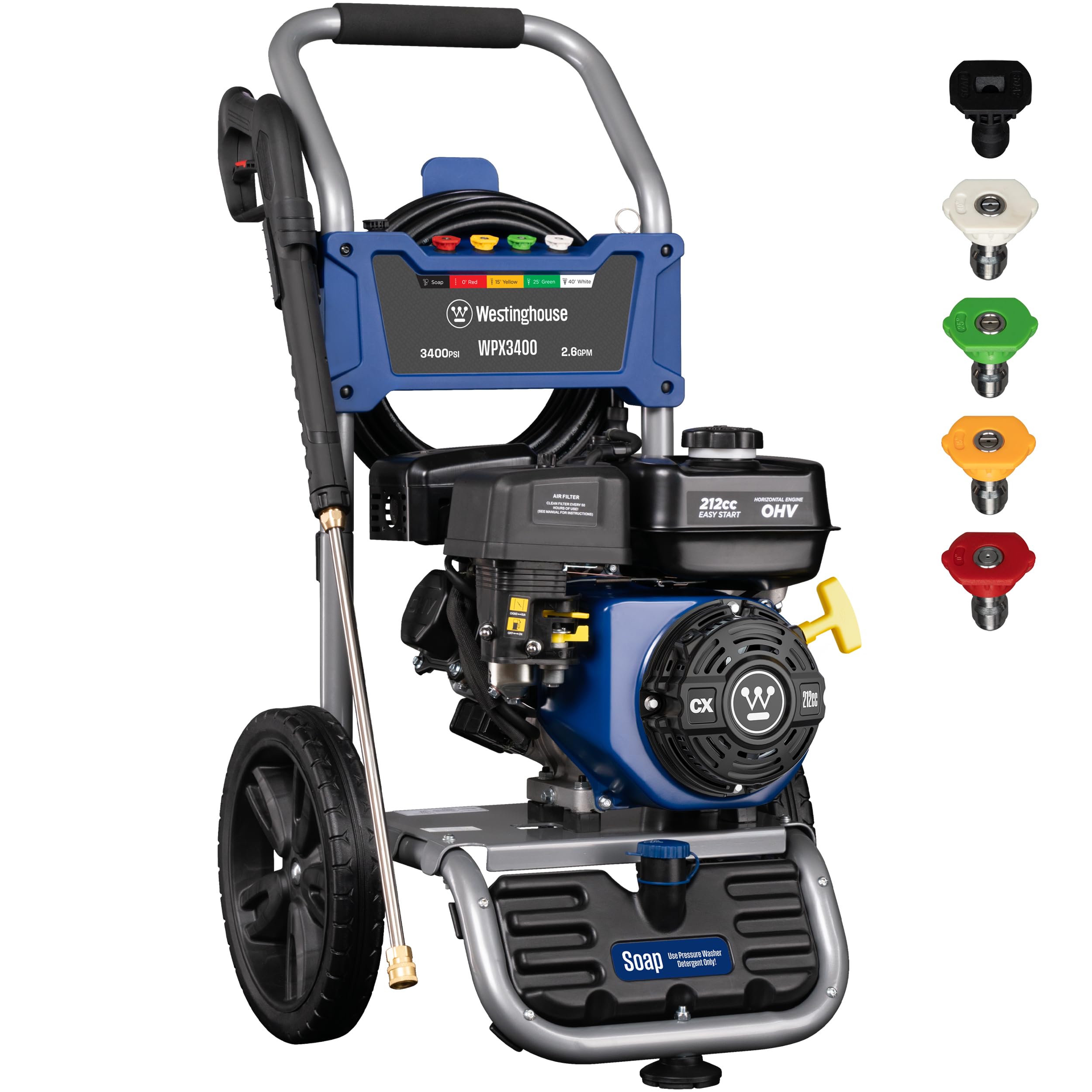
1. Westinghouse WPX3400 Gas Pressure Washer
Our pick — 4.5+★ from 4,500+ verified ratings; the strongest balance of quality and price.
The proven all-rounder that fires up fast and cleans everything in the yard.
If you want one machine to handle the deck, the driveway, the siding, the fence, and the patio furniture without a fight at startup, this is the safest bet on the list. It pushes a maximum 3400 PSI at a 2.6 GPM flow rate, which is enough pressure to strip grime and enough water to float it away. The engine is a 212cc 4-stroke Westinghouse OHV (overhead valve) unit with a pull-start cord, mated to an axial cam pump the listing describes as maintenance-free.
What wins the crowd is the build quality — the steel frame, the 12-inch never-flat wheels, and the general sense that nothing feels cheap. The machine assembles quickly, and the engine tends to catch on the first or second pull once you get the choke routine down. A half-gallon soap tank sits onboard for detergent, and the kit ships with engine oil, tools, and a quick-start guide so you can be washing the same afternoon.
The 25-foot super-flex hose is abrasion-resistant, and the five quick-connect nozzles (0°, 15°, 25°, 40°, and soap) cover everything from a hard concrete etch to a gentle car rinse. The listing also confirms M22 fittings, so a surface cleaner, undercarriage cleaner, or foam cannon drops straight on. The honest catch: at 2.6 GPM this delivers less water flow than the 4 GPM gas machines further down — a real difference on a big driveway, where the bigger-flow units rinse a wider swath per pass. Weigh that against the fact that this is one of the best-supported gas washers on Amazon, sitting at 4.5+ stars across 4,000+ ratings.
Where it earns its keep
- Cleans siding, decks, and concrete without drama, thanks to 3400 PSI at 2.6 GPM.
- 12-inch never-flat wheels and a steel frame roll smoothly and won’t get a flat.
- Starts on the first or second pull with the standard choke procedure.
- 3-year limited manufacturer service, labor, and parts coverage backs the whole machine.
The fair caveats
- 2.6 GPM flow is well under the 4 GPM commercial units, so big flat areas take longer.
- Factory testing can leave a faint oil or fuel smell when it arrives.
- Recoil-start engine means no key, so the choke ritual takes a little practice.
Reach for this if: you want one dependable gas washer for a normal-size home, and you value proven support over the biggest spec number.
Look elsewhere if: you clean huge commercial slabs and need maximum water flow to move quickly.
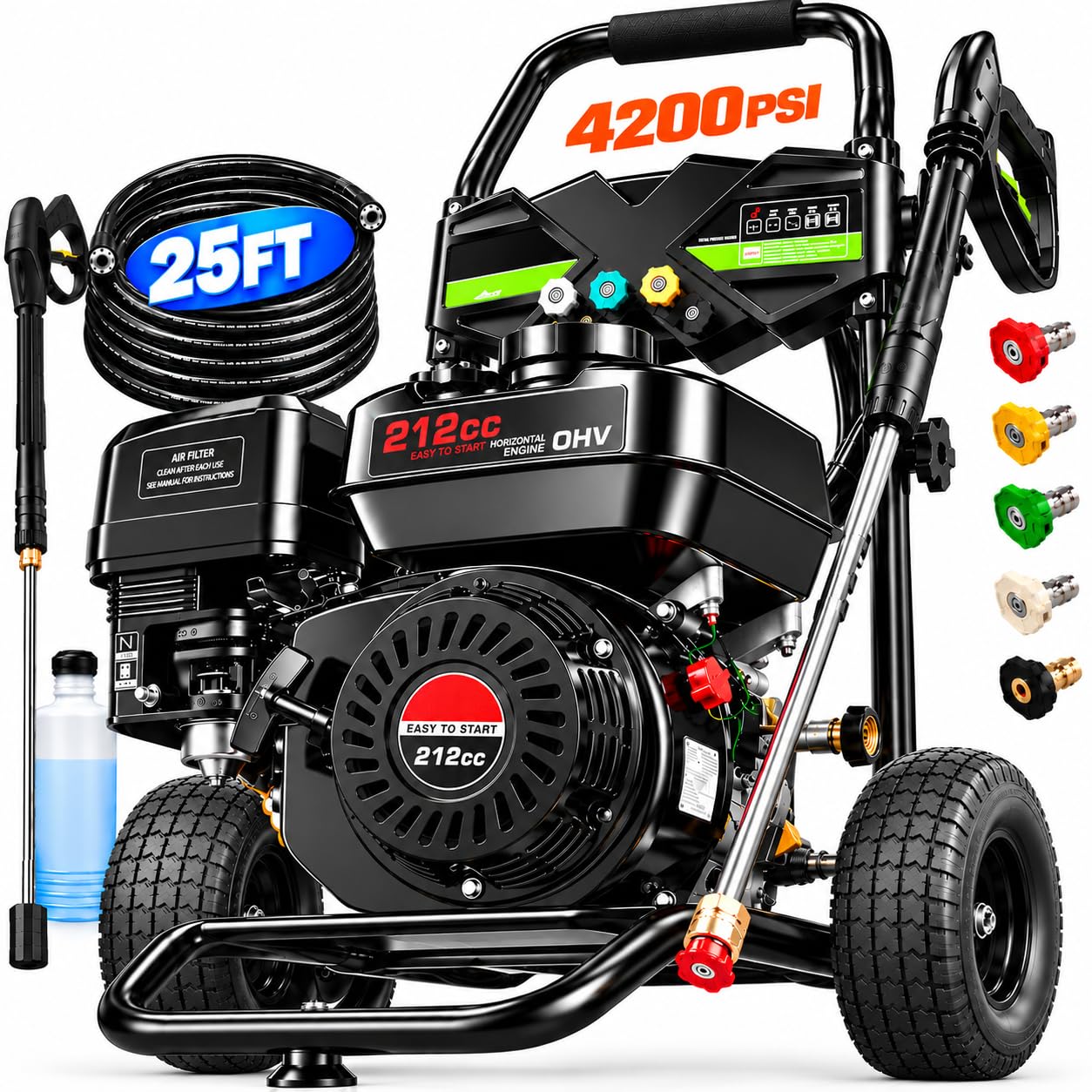
2. IvyBess 4200PSI Gas Pressure Washer, 4.0GPM, 212CC
A commercial-grade cannon that strips a driveway in minutes and still fits the yard.
This is the machine for the buyer who has looked at a muddy driveway and thought, “bring the biggest gun available.” It pushes a maximum 4200 PSI at a 4.0 GPM flow rate from a 7HP 4-stroke 212cc gasoline engine. Stack that against the Westinghouse above and the numbers speak: 4200 psi vs 3400 psi, and 4 gpm vs 2.6 gpm. The bigger flow is what lets it rinse a wide swath of concrete per pass instead of chasing the same spot.
A 25-foot high-pressure hose widens the work radius so you aren’t constantly dragging the frame. The kit adds five quick-connect nozzles (0°, 15°, 25°, 40°, and a soap nozzle), a 3L dual soap tank with an adjustable switch that mixes detergent automatically, and 10-inch pneumatic wheels so the whole rig rolls over lawn and mud. It also carries EPA, CARB, and ETL certification for emissions and safety, and storage hooks keep the wand and hose tidy.
The machine is a hefty 77 pounds and its frame measures 23 “L x 17″W x 22″H, so plan a spot where it can sit rather than carrying it around. The owner consensus lands on raw power: it clears thick moss, oil stains, and peeling paint without repeated passes. The trade-off to know is the break-in ritual — use SAE 10W-30 oil, keep the level between 500 and 550 ml, burn 87+ octane gas, and expect a faint fuel smell from factory pre-testing. Get the oil level and fuel right at first fill and the engine runs steady.
Where it shines: the 0° nozzle plus 4200 PSI turns hard concrete stains into a fast job, and the 4.0 GPM flow rinses the mess away instead of leaving a muddy film.
The one catch: at 77 pounds it’s a push-around machine, not a carry-up-the-stairs one — park it and work from the hose.
The verdict: the top pick for sheer cleaning firepower on big outdoor surfaces and the go-to for exterior renovation or post-storm cleanup.
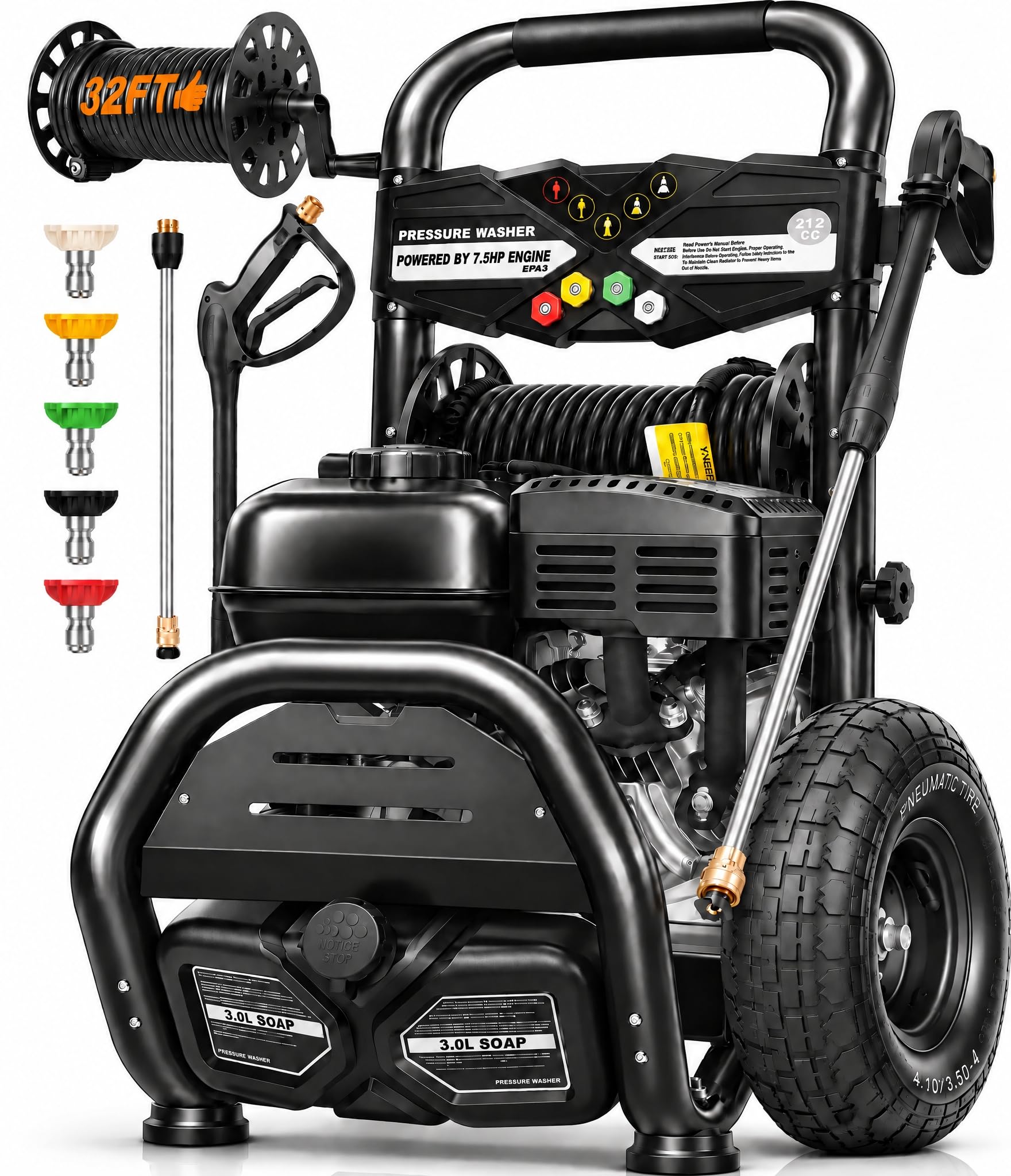
3. Steupoek 4200PSI Gas Pressure Washer, 32ft Hose
Extra hose means fewer trips back to the machine on a long fence line.
Bill this one as the reach specialist. Its headline is the 4200 PSI at 4.0 GPM output from a 7HP 4-stroke 212cc engine — the same muscle class as the IvyBess above. The difference sits in the plumbing: a 32-foot high-pressure steel-braided hose that is non-marring, kink-resistant, and abrasion-resistant. That extra length buys you perimeter coverage, so on a long fence or a big patio you reposition the machine far less and work more.
The 3.6L gas bottle feeds a 3L dual soap tank with an adjustable switch, letting detergent auto-mix into the spray for a foam pass before the rinse. Five quick-connect nozzles (0°, 15°, 25°, 40°, and soap) cover light to heavy work, and 10-inch pneumatic tires roll it over rough ground. The wand’s 1/4″ quick-connect end accepts a surface cleaner, extension wand, or undercarriage cleaner, and the machine is EPA, CARB, and ETL certified.
Weight runs high, though — 77 pounds on a 23 “L x 17″W x 22″H frame — so this is a wheel-it, not a lift-it, tool. The starting ritual matches its siblings: 10W-30 oil, 500 to 550 ml of it, 87+ octane fuel, choke set mid-position, speed lever to the rabbit setting. Owners tend to praise the power delivery on siding, driveways, and decks without complaint. The caveat is the same as any gas unit: skip the oil-and-fuel steps and it will act up.
Reach beats everything: the 32-foot hose is the real story — it keeps you from hauling the frame to every corner of the yard.
Pick this one if: your cleaning zone is spread out and reach matters more than portability, or you’re chasing stubborn moss on a big deck.
Think twice if: you want something light enough to move one-handed — at 77 pounds, this rolls, it doesn’t lift.
4. IvyBess Professional 4200PSI Gas Washer, Green
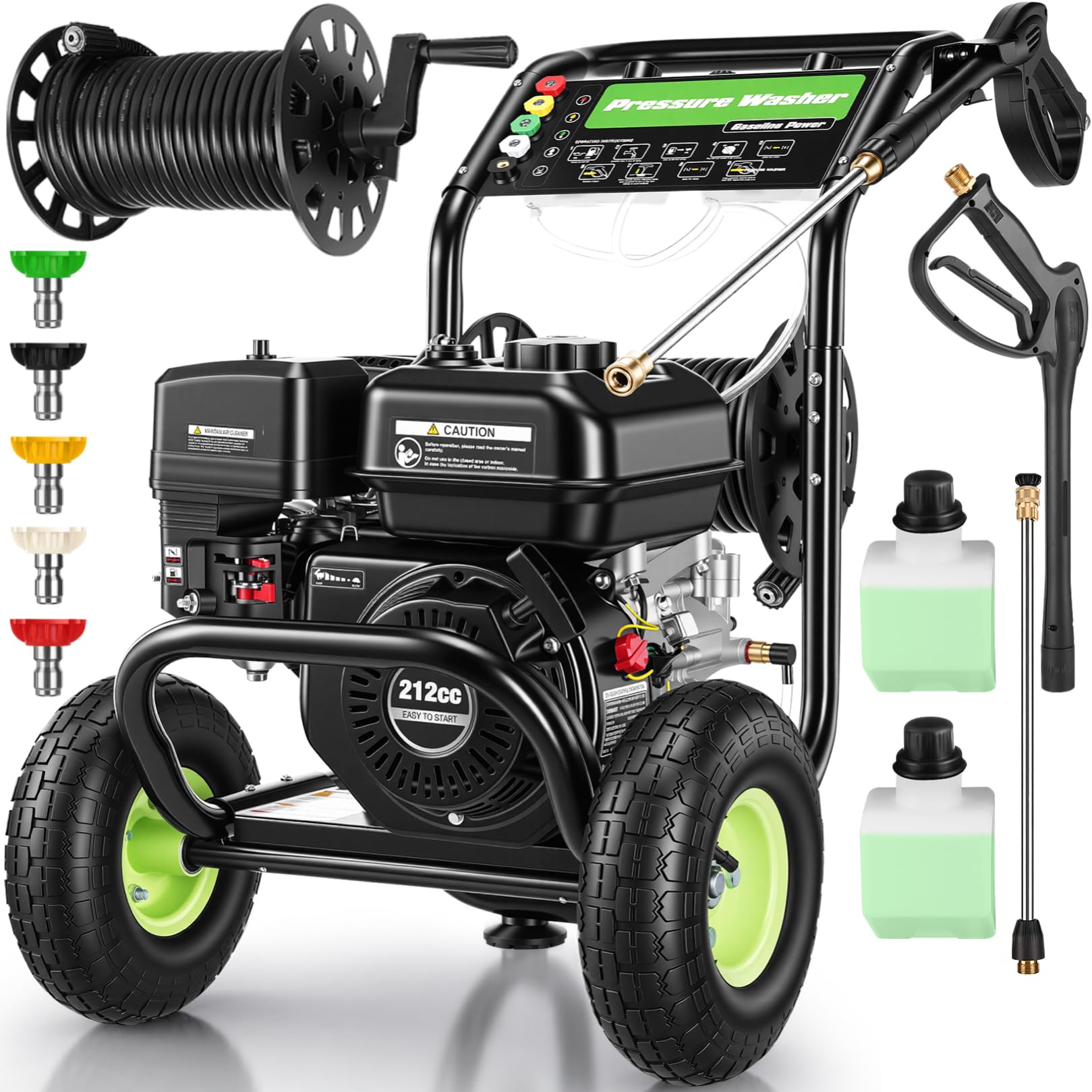
Full-size 4 GPM muscle packed into a frame that tucks into a garage corner.
What makes this one stand out is how much reach and storage it packs into a compact body. It delivers the same 4200 PSI at 4.0 GPM from a 7.0HP 212cc engine running at 3600RPM, and adds a 33-foot high-pressure hose — enough to circle around a vehicle without moving the machine. The listing frames the 4200 PSI spec honestly: it’s reached with a fully warmed engine, a garden hose on normal pressure, and the 0° nozzle fitted.
Five quick-connect nozzles (0°, 15°, 25°, 40°, and soap) let you match the spray to the surface, and a 1600ml foam bottle handles the soap pass. 10-inch wheels roll it around, and a safety lock on the trigger lowers to prevent accidental fire when it’s parked. The machine carries EPA, CARB, and ETL compliance and rates 4.5+ stars — its buyers key on compact size and portability, noting how easy it is to store.
At 68.3 pounds on a 17″L x 22″W x 22″H frame, it’s lighter than the 77-pound machines beside it, which makes the storage-and-shove routine easier. Getting the most out of it asks the same discipline as the rest: fill the engine to the proper oil level before first start, pull the connector fully before swapping nozzles to reduce wear, and drain the hose after use before storing. Two-year warranty and a support team round out the package.
Why buyers gravitate to it
- Compact frame stores in a tight garage or shed without eating floor space.
- 33-foot hose covers a full vehicle or a long deck edge in one position.
- 4.0 GPM flow rinses wide and fast on driveways and patios.
What to keep in mind
- 4200 PSI is only achieved with the 0° nozzle on a full-pressure hose — other nozzles drop the force.
- Gas setup (oil level, fuel, choke) is required before every first run.
Best fit: a homeowner with limited storage who still wants commercial-level 4 GPM flow.
5. IvyBess Professional 4200PSI Gas Washer, GBlack
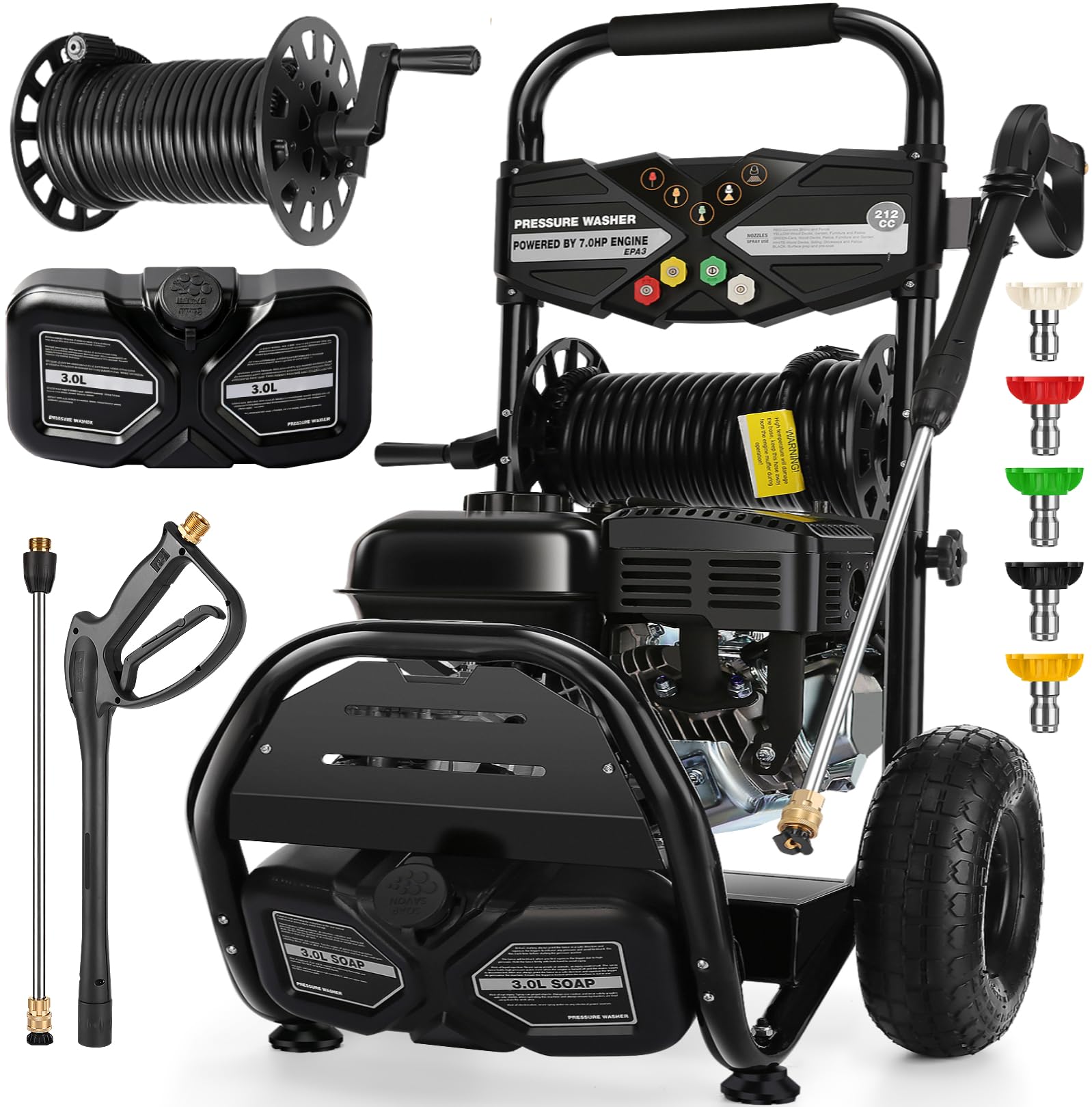
A foam-first rig with a big soap bottle for jobs that need detergent to break down.
For buyers whose dirt needs soap before the rinse — greasy garage floors, moldy siding, a muddy truck — the 3000ml foam bottle on this one is the draw. It carries the same 4200 PSI at 4.0 GPM ceiling as its IvyBess sibling, delivered by the same class of 7.0HP engine. The bigger detergent reserve means fewer refills during a long soap pass across a fence or a fleet of vehicles.
A 33-foot hose gives generous reach, and 10-inch wheels keep it moving over uneven ground. The nozzle set (0°, 15°, 25°, 40°, and soap) lets you dial from a hard concrete blast to a soft final rinse, and the listing again notes the 4200 PSI figure assumes a full-pressure hose with the 0° tip. EPA, CARB, and ETL compliance covers the environmental and safety side, and the trigger has a safety lock for when it’s parked.
This is the heaviest configuration of the family at 77 pounds on a 26″L x 18″W x 23″H frame, so it’s a stationary machine you wheel to position rather than carry. Its 4.0+ stars across 20+ ratings reflect early-stage feedback rather than deep long-term pattern, so treat it as a capable setup with a smaller track record. The no-nonsense tips are the usual: bring it up to proper oil level before the first pull, drain the hose after each job, and pull the connector fully before swapping tips.
The standout: that 3000ml foam bottle is far bigger than the 1600ml on the Green model above, which means a long soap-down pass without stopping to refill.
Honest note: it wants break-in care and a level spot to sit, so plan for both.
Why choose it: you clean heavy, soap-dependent messes and want the biggest detergent tank to match.
Not for you if: storage is tight — this is the largest footprint of the group.
6. Steupoek Commercial 4000PSI Gas Pressure Washer
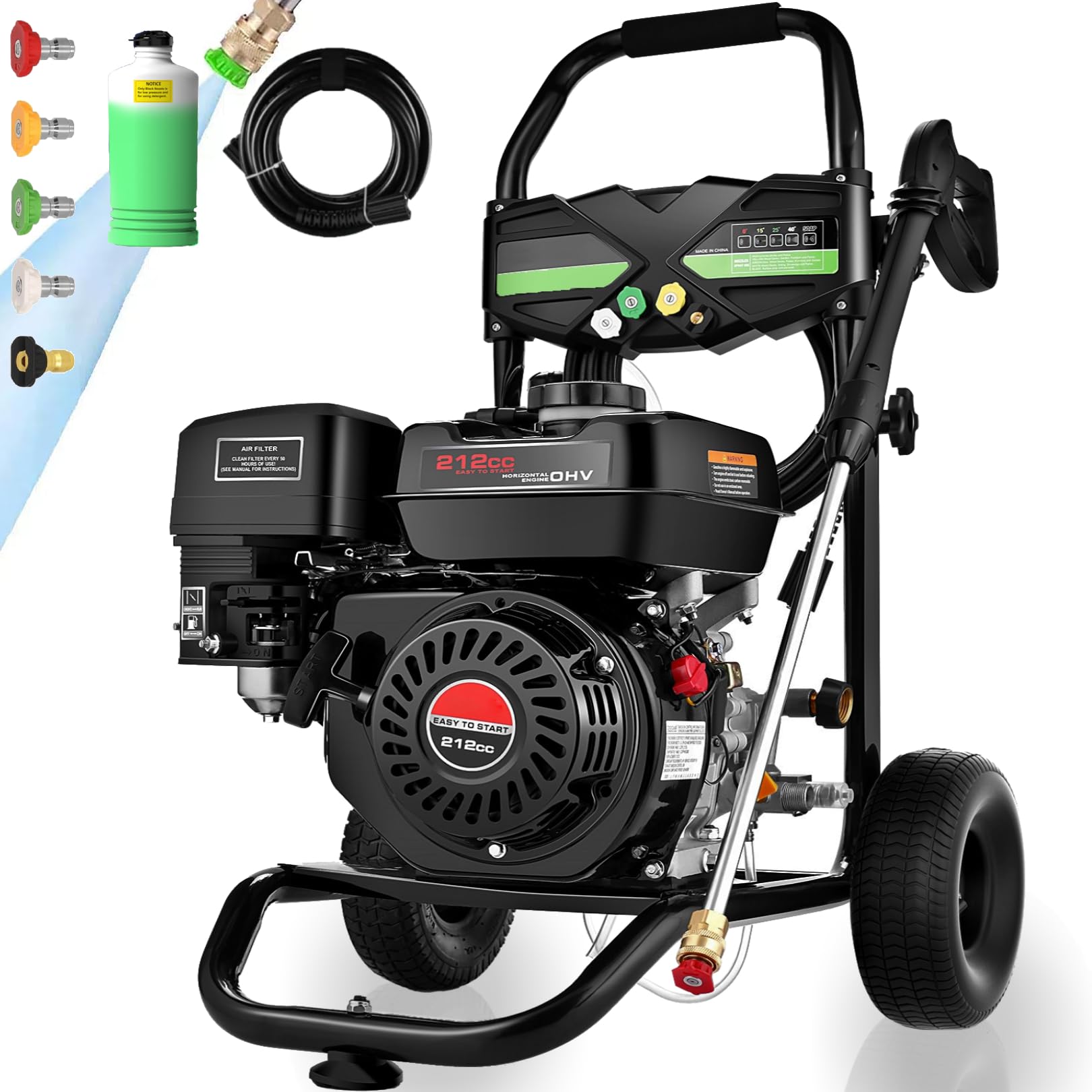
An entry-friendly gas washer with strong flow and a sturdier-than-expected steel frame.
Here’s a machine built to hit a sensible middle: just under the big-pressure units but still pushing a maximum 4000 PSI at a high 4.0 GPM flow. That flow is the point — 4 GPM floats loosened dirt off wide surfaces, which is why it suits driveways, fences, and carpets without endless passes. The 7.0 HP 4-stroke 212cc engine at 3600RPM drives the pump, and it runs on gas with no cord to trip over.
The reach setup is a 25-foot hose paired with 9-inch wheels, so you can move the frame across a property and work a 25-foot radius from it. Five nozzles (0°, 15°, 25°, 40°, and soap) adjust from focused power to wide rinse, and the metal frame with a two-handed handle carries the weight properly. EPA and CARB certification cover emissions, and a support team responds within 3 working days.
The fair warning: buyers split on the actual water force. Some find 4000 PSI plenty strong and clean their home or garden fine, while others feel it lands softer than the number promises. The honest read is that this is a good flow machine for everyday jobs rather than a paint-stripping brute. It runs 66 pounds on a 23″L x 17″W x 22″H frame, which keeps it manageable to roll and store.
Best if: you want strong 4 GPM flow at the entry end of the gas range and don’t need to strip paint.
Look at the 4200 PSI units above if: maximum force on stubborn stains is the whole point of your purchase.
7. Tecoloy 2200PSI Electric Pressure Washer, 65dB

The plug-in that cleans early on a Sunday without waking the neighbors or your family.
This is the pick for anyone who lives close to neighbors or cleans at odd hours. It runs at just 65dB — a decibel is a measure of sound, and 65dB sits roughly at the level of a normal conversation — so an early-morning deck wash or a late-night car rinse stays polite. Under the hood is a permanent-magnet (PM) brushless motor paired with a horizontal triplex pump with ceramic plungers, an industrial-style build meant to hold pressure across long sessions.
The output is 2200 PSI at 3.2 GPM, and it brings serious hose reach: a 47-foot pressure hose plus a 40-foot power cord, so you almost never reposition the unit. Seven nozzles are included (0°, 15°, 25°, 40°, soap, and a turbo tip), and a 1L transparent detergent tank handles the soap pass. The design is wall-mountable with a built-in storage case and an LED panel showing real-time current — handy in a garage or workshop.
A self-priming system lets it draw from a bucket with a max suction height of 1.5m, which is a real help where no tap is handy. The triplex pump is rated for 500+ service hours. The catch most owners point to is cost — this sits at the higher end of the electric tier, and the value-per-dollar lands lower than the gas units for pure power. Quality and quiet operation are what buyers come away impressed by, and a 1-year warranty on motor and pump backs it.
Why it earns a spot
- 65dB operation lets you clean without disturbing neighbors or family.
- 47-foot hose plus 40-foot cord removes most repositioning.
- Self-priming draws from a bucket where no tap exists.
- Triplex pump rated for 500+ service hours.
What to weigh
- Sits at the top of the electric price tier, so the power-per-dollar trails the gas machines.
- Narrower spray-to-reach advantage than the big-flow gas models on wide flat concrete.
Choose it for: quiet, corded cleaning near the house — patios, decks, cars, and RVs — where noise matters.
8. Yoking Electric Pressure Washer, 2200 PSI
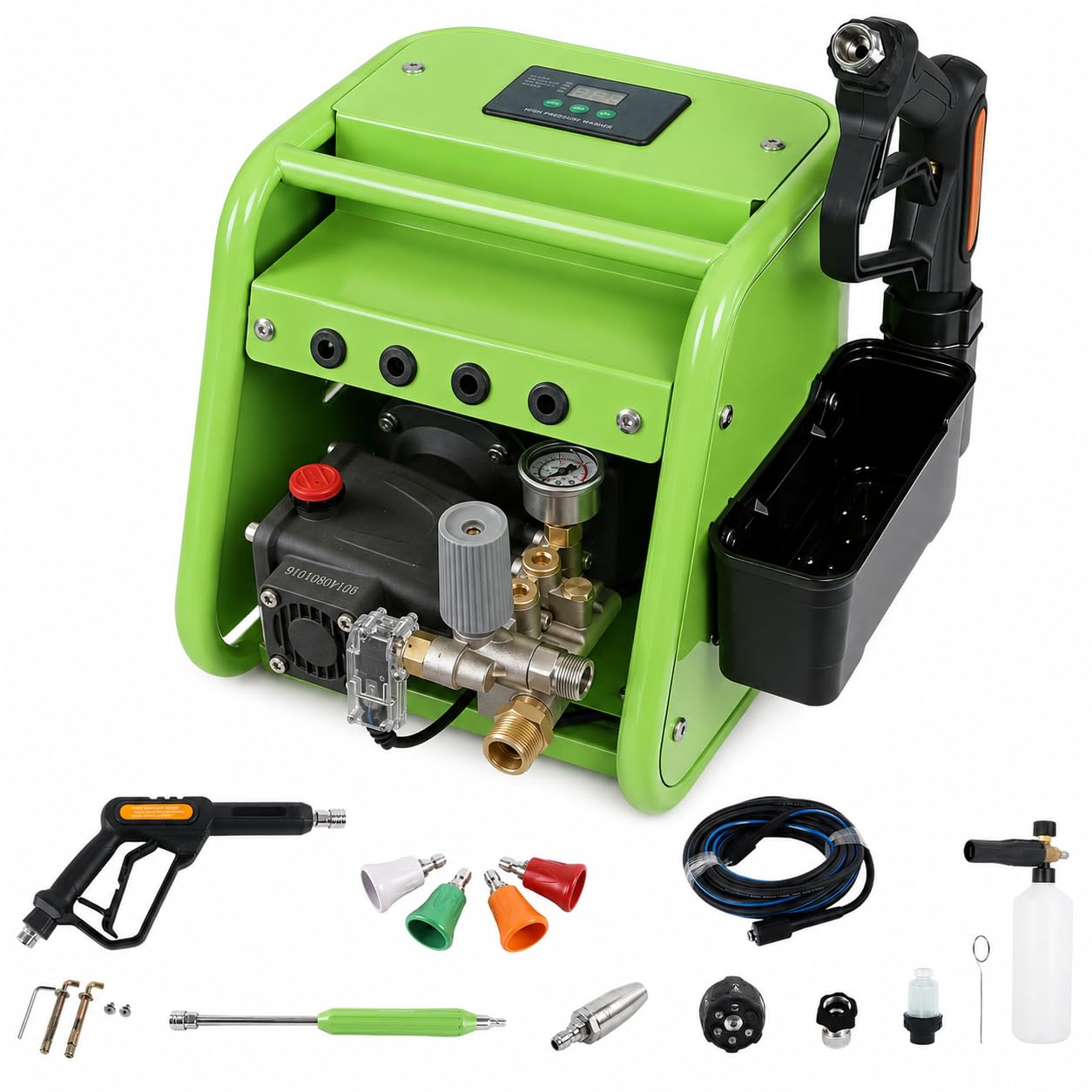
A brushless motor you never have to fiddle with, plus a wall-mount kit to keep it tucked away.
The appeal here is less upkeep. A permanent-magnet brushless motor has no carbon brushes to replace, so it runs cooler and asks for less routine motor maintenance than a brushed design — a genuine plus for frequent cleaning. It’s rated up to 2200 PSI at 3.2 GPM, with a horizontal triplex crankshaft pump and anti-cavitation design for steady pressure over longer jobs.
Reach and storage are well thought out: a 40-foot high-pressure hose, a 33-foot power cord, a carry handle, and a built-in wall-mount kit. It can connect to a faucet or draw from a bucket or tank for those spots where a tap isn’t near. A TSS (total stop system) shuts the pump down when you release the trigger, and soft start smooths the power draw. The kit includes four spray tips, turbo and multi-pattern nozzles, a 34 oz foam cannon, wand, filter, and gun.
ETL certification covers the electrical safety side, and a 1-year warranty backs it. At 37 pounds it’s still a wheel-and-lift proposition rather than a pocket machine, but it’s far lighter than the gas frames beside it. This is the electric for someone who wants to hang it, plug it, and not worry about fuel or a motor that needs servicing.
What you gain: a brushless motor with nothing to replace, a 40-foot hose, and a wall-mount kit that keeps the garage floor clear.
Good match for: a garage or workshop where you want a mounted, low-maintenance electric washer.
Skip the idea if: you need gas-level flow for large acreage — stick with the 4 GPM machines.
9. Simpson PowerShot 3500 PSI Gas Pressure Washer, Honda GX200
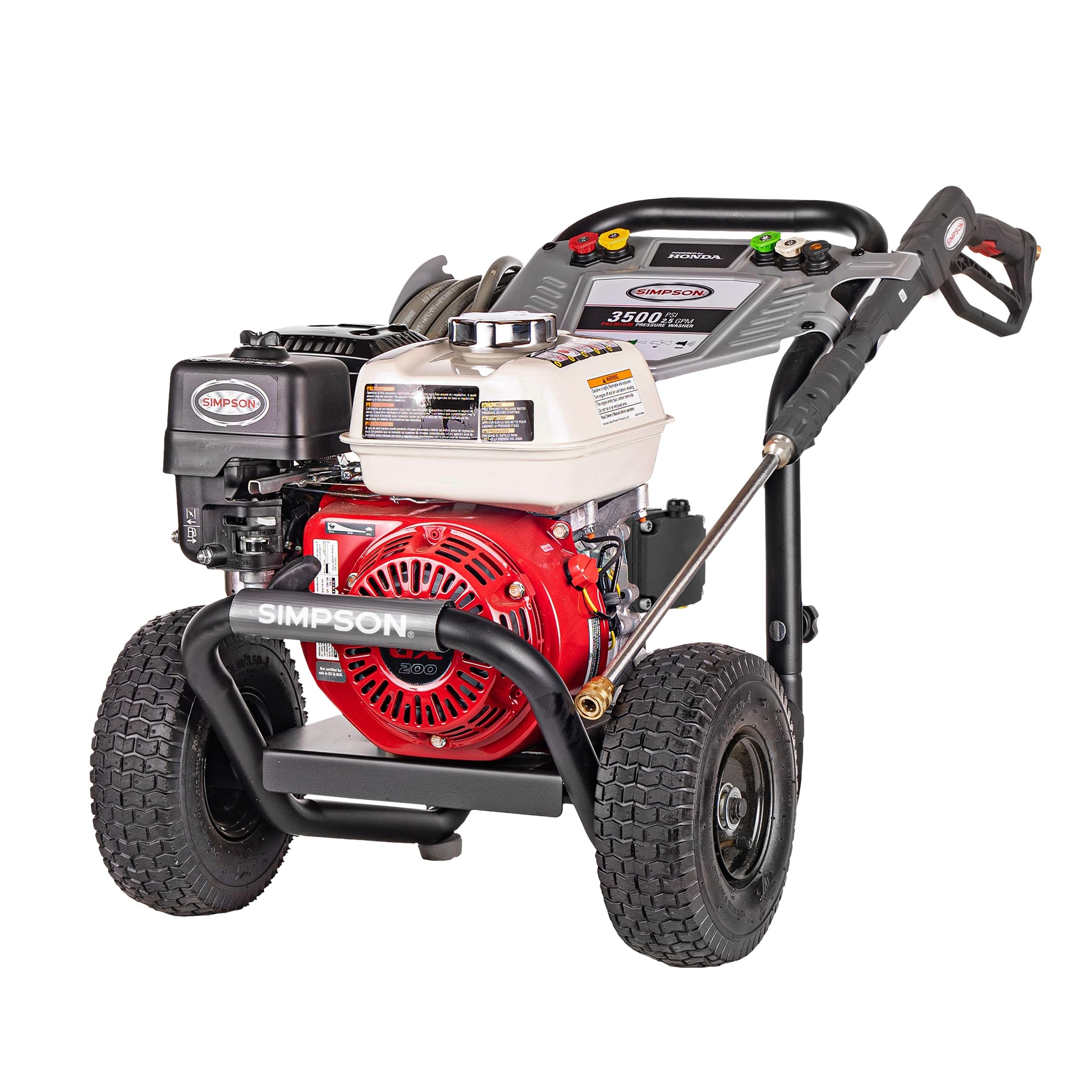
The Honda-powered workhorse contractors trust to start on the first pull every time.
When reliability is the spec you care about most, the Honda engine is the headline. This PowerShot runs a Honda GX200 with low-oil shutdown — a feature that cuts the engine when oil gets low to protect it — driving a 3300 PSI 2.5 GPM AAA triplex pump with an integrated unloader and thermal relief to prevent overheating. It cleans decks, driveways, siding, fencing, and even graffiti, and it’s 49-state compliant (not for sale in California).
The 25-foot Morflex hose resists kinks and abrasion, and its non-marring polyurethane jacket helps protect finished surfaces — a real advantage near painted siding or a car. 10-inch premium pneumatic tires roll over gravel, grass, and curbs, and the welded steel frame is powder-coated to resist corrosion. Five quick-connect tips (0°, 15°, 25°, 40°, and soap) plus a 16-inch spray wand cover everything from paint stripping to a gentle car rinse.
At 72.8 pounds on a 21″L x 24″W x 34″H frame, it’s a serious rig that assembles with reasonable ease. The one split in owner experience is long-term durability: the engine and performance draw strong reviews, but some report pump bolts or parts failing down the road, so buying with an eye to servicing the pump is smart. For a professional or a homeowner chasing contractor-grade starting, it’s a solid anchor.
The strong suit
- Honda GX200 with low-oil shutdown starts reliably and protects itself.
- AAA triplex pump with thermal relief handles repeated heavy work.
- Non-marring 25-foot hose protects finished surfaces near cars and siding.
What to plan for
- Long-term pump durability is the split point — budget for possible pump service.
- Not for sale in California.
The call: ideal for contractors and serious homeowners who value a Honda engine and first-pull reliability over the highest PSI.
10. Simpson Aluminum Series 3600 PSI Gas Pressure Washer
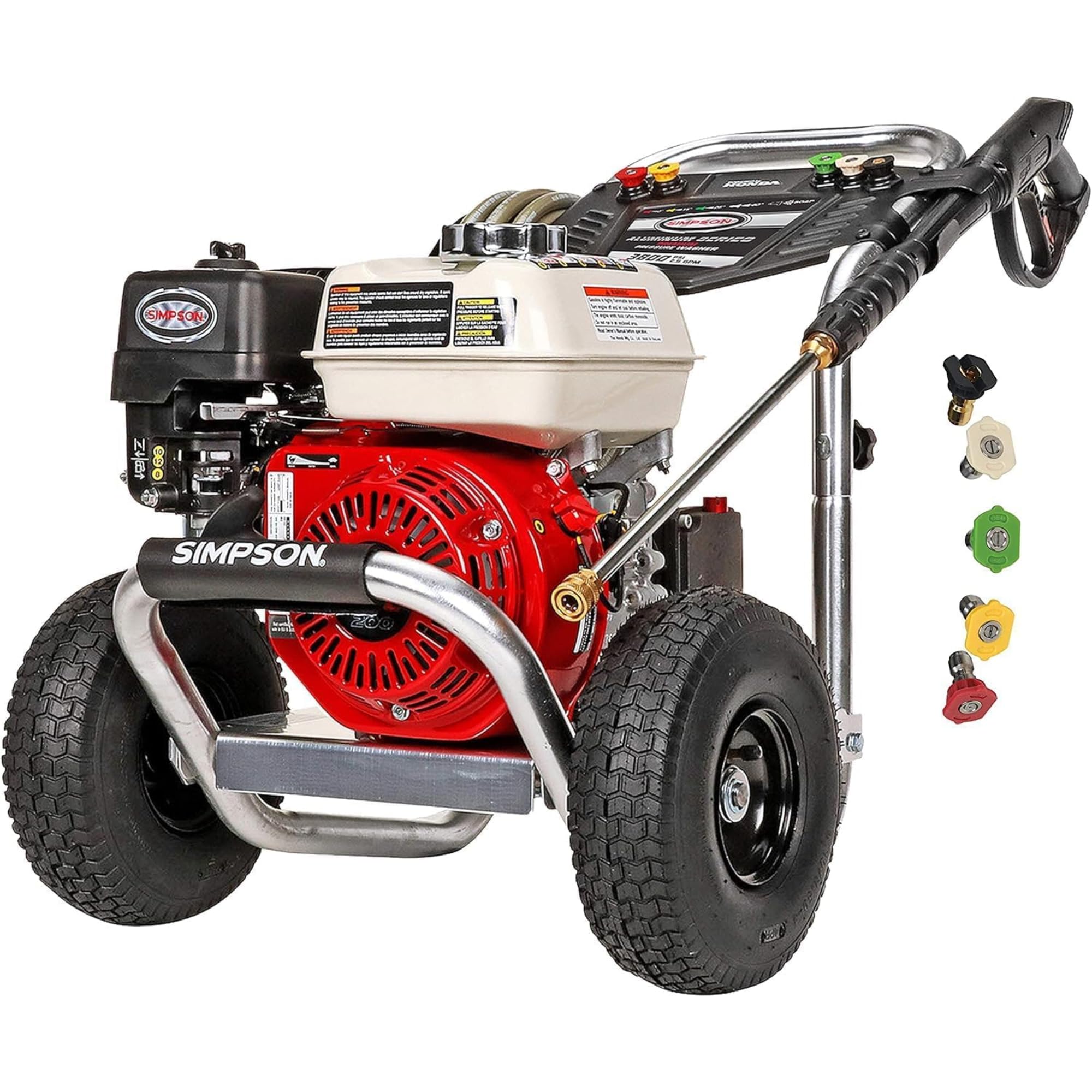
An aluminum-frame pro machine that trades steel for lighter, rust-resistant hauling.
The draw here is the airframe-style aluminum frame with a powder-coated finish — lighter to move and built to resist corrosion over years of cold-water cleaning. It pairs a Honda GX200 engine (with low-oil shutdown) to a 3600 PSI 2.5 GPM AAA triplex plunger pump. PowerBoost Technology is listed to deliver higher pressure at the nozzle, and thermal relief protects against overheating. Also 49-state compliant and not for sale in California.
Reach is a step up from the PowerShot above: a 35-foot Morflex hose — longer than that model’s 25 feet — gives more working radius on a fence or a deck. 10-inch pneumatic tires and the balanced layout roll it over gravel and curbs, and a professional QC spray gun with safety lock-out plus a 16-inch wand are included. The five-tip nozzle set (0°, 15°, 25°, 40°, and soap) runs the full range from paint stripping to a car rinse.
It’s 78 pounds on a 30″L x 24″W x 21″H frame, backed by a 3-year engine, 5-year pump, and 10-year frame warranty. The honest trade-off is long-term reliability: the engine earns steady praise and the machine ranks as a top-notch cleaner, but a share of buyers report durability trouble — units that fall apart within a month, or pumps that fail after a few years. In other words, it’s a capable performer whose warranty length is worth reading closely.
Why it’s on the list: a 35-foot hose, an aluminum frame, and a long engine-and-pump warranty make it a strong mid-tier pro option.
The real caveat: durability is the split point with this model — budget for pump care and lean on that warranty.
Best fit for: a pro or serious homeowner who wants a lighter frame and longer reach than the PowerShot 3500.
Know the Specs
PSI vs GPM
PSI (pounds per square inch) is the force of the spray; GPM (gallons per minute) is how much water leaves the nozzle each minute. Pressure breaks dirt loose, and flow carries it away. A machine with strong GPM cleans a wide, flat surface faster than a higher-PSI unit that moves less water. So when you compare, read both numbers together rather than chasing the biggest PSI alone.
Pump Types
A triplex plunger pump uses three pistons to push water and is the heavier-duty build chosen for long, repeated jobs. An axial cam pump is simpler and common on lighter machines. If you clean for hours, the pump style tells you more about how long the machine lasts than the engine badge.
Engine Brands
A Honda engine carries an expectation of reliable starting, and the Honda-powered models here add low-oil shutdown — a sensor that cuts the engine when oil runs low to protect the pump. A generic 212cc engine can also be strong, but it asks you to follow the oil and fuel steps carefully. A fussy engine turns a quick rinse into a chore on a cold morning.
Hose and Reach
Hose length is a working metric: 25 feet keeps you near the frame, while 33, 35, and 50 feet let you cover a fence or a job site without moving the machine. Longer hoses add convenience but add kink risk too, so abrasion- and kink-resistant builds matter. Pair a long hose with large pneumatic wheels for easy movementacross gravel and grass.
Common Questions
Is a higher PSI always better on a pressure washer?
Do I need a gas or an electric pressure washer?
What does GPM actually mean and why does it matter?
What is the difference between a triplex pump and an axial cam pump?
How long a hose do I need to clean a fence or a large driveway?
Can a pressure washer draw water from a bucket instead of a tap?
What maintenance does a gas pressure washer need before each use?
What do the different nozzle colors and angles do?
Is a pressure washer safe to use on a car or painted siding?
Does a pressure washer need a special circuit or fuel type to run?
The Bottom Line
For most people, the press washer machine winner is the Westinghouse WPX3400 because it balances 3400 PSI and 2.6 GPM with a steel frame, never-flat wheels, and a 3-year service plan — and it holds 4.5+ stars across 4,000+ ratings, the deepest track record on the list. If you want maximum cleaning force on big outdoor surfaces, grab the IvyBess 4200PSI at 4200 psi and 4 gpm. And for quiet, corded cleaning near the house without waking anyone, the Tecoloy electric at 65dB is the one to reach for.
One honest nudge: the Westinghouse is the crowd favorite by rating count, so if you are unsure where to start, begin there and match your cleaning zone to its hose and flow.
How we choose
We do not accept paid placement. Every pick is matched to a real buyer and a real use-case; we do not hands-on test units.
Sources
Specifications: manufacturer listings and product documentation. Review insights: verified customer reviews, as of November 2026. Pricing: not shown on this page (it changes often); check the current price via the retailer link.
As an Amazon Associate, Tactical Gear Guy earns from qualifying purchases. This does not affect which products we feature.