Specs are compiled from manufacturer listings and verified buyer reviews and can change over time — please confirm the key details on the product page before buying.
Most bike motor kits disappoint for one boring reason: the motor is fine, but the voltage, dropout width or chainring doesn’t match the bike you already own. This guide fixes that. Every pick here is a real electric motor built to drive a bicycle — a hub motor that replaces your rear wheel, or a mid-drive that sits at the pedals — and each listing tells you plainly what it fits, what it turns, and who it suits. One note before you read on: not every pick is the exact model you typed into the search bar. Motor kits vary by wheel size, wattage and mount, so the nearest same-type option that serves the same job is included here. You will never be nudged toward a part that can’t physically bolt to your frame.
This guide is built by comparing the manufacturers’ published specifications and the patterns across verified customer reviews, so you get each pick’s real strengths and trade-offs instead of marketing spin.
The strongest performer of the whole group is bold enough to publish 85 N·m of torque and a 55 km/h top speed, and it ships as a complete rear wheel. Here is how each of these nine units earns its place in a powerful electric motor for bicycle build.
Top Picks
How To Choose The Best Powerful Electric Motor for Bicycle
The first thing to settle is not wattage. It is fitment. A motor that cannot bolt to your frame delivers no power at all. Measure your bike first, then read the numbers — that order saves you a return shipping label and three weekends of waiting.
Hub wheel or mid-drive — pick your mount first
A hub motor replaces your existing rear wheel entirely, so you get the motor and the rim in one piece. That is the easier path if your bike runs a common wheel size. A mid-drive motor mounts at the bottom bracket (the bearing housing where your pedal cranks spin) and drives the chain instead, which suits riders who want the motor to use their gears. Mid-drives need a bottom bracket in the 68mm to 73mm range on most kits, so measure that shell before anything else.
Match the voltage to your battery and controller
Voltage is the pressure your battery pushes. A 48V motor wants a 48V battery and a controller rated for the same. Mixing a 48V motor with a 36V pack will not deliver the rated performance, and it can stress the controller. If you are buying a kit that includes a controller, check that the controller’s amp rating covers the motor’s draw — a 45A controller and a 42A-rated motor is a matched pair.
Read torque and rpm, not just the wattage badge
Wattage tells you the motor’s input ceiling. Torque, measured in N·m, tells you how hard it pulls — the number that decides whether a hill feels easy. A 48V 1000W unit rated at 85 N·m will climb far more assertively than a 1000W unit rated at 5.1 N·m. Speed in rpm then translates to how fast the motor spins, which your wheel size and gearing turn into road speed. Both numbers matter more than the headline watt.
Side-by-Side Comparison
| Model | Best For | Motor Type | Rated Power | Torque / Speed | Amazon |
|---|---|---|---|---|---|
| 20 x 4.0” Fat Tire Rear Wheel, 48V 1000W★ Best Overall | Fat-tire builds needing maximum pull | Rear hub wheel | 48V 1000W | 85 N·m / 55 km/h | Amazon |
| Mahugde 26″ 48V 1000W Hub Motor KitBest for 26-Inch Bikes | Converting a standard 26-inch bike | Rear hub wheel | 48V 1000W | 45 N·m / 53 km/h | Amazon |
| LTIGOAW 26 Inch 48V 1000W Rear Wheel KitBudget Conversion | Budget-minded DIY conversions | Rear hub wheel | 48V 1000W | 45 N.M / 440rpm | Amazon |
| Chokayaky 48V 1000W Brushless DC Motor Kit | Full kit with controller and throttle | Brushless DC + controller | 48V 1000W | 5.1 N·m / 3500RPM | Amazon |
| Kunray Electric Scooter Motor Kit 48V 2000W | Heavy-duty scooter and kart builds | Brushless DC + 45A controller | 48V 2000W | 6.9 N.m / 5600 rpm | Amazon |
| Varstrom TSDZ2B Mid Drive Kit | Riders who want the motor to use their gears | Mid-drive, torque sensor | 48V 250W–1000W | Up to 160 N·m / 55 km/h | Amazon |
| BAFANG BBS02B BBS-HD Mid Drive Kit | MTB and commuter mid-drive upgrades | Mid-drive, CAN protocol | 36V / 48V / 52V, 500W–1000W | 100 N·m–160 N·m / up to 37mph | Amazon |
Detailed Reviews
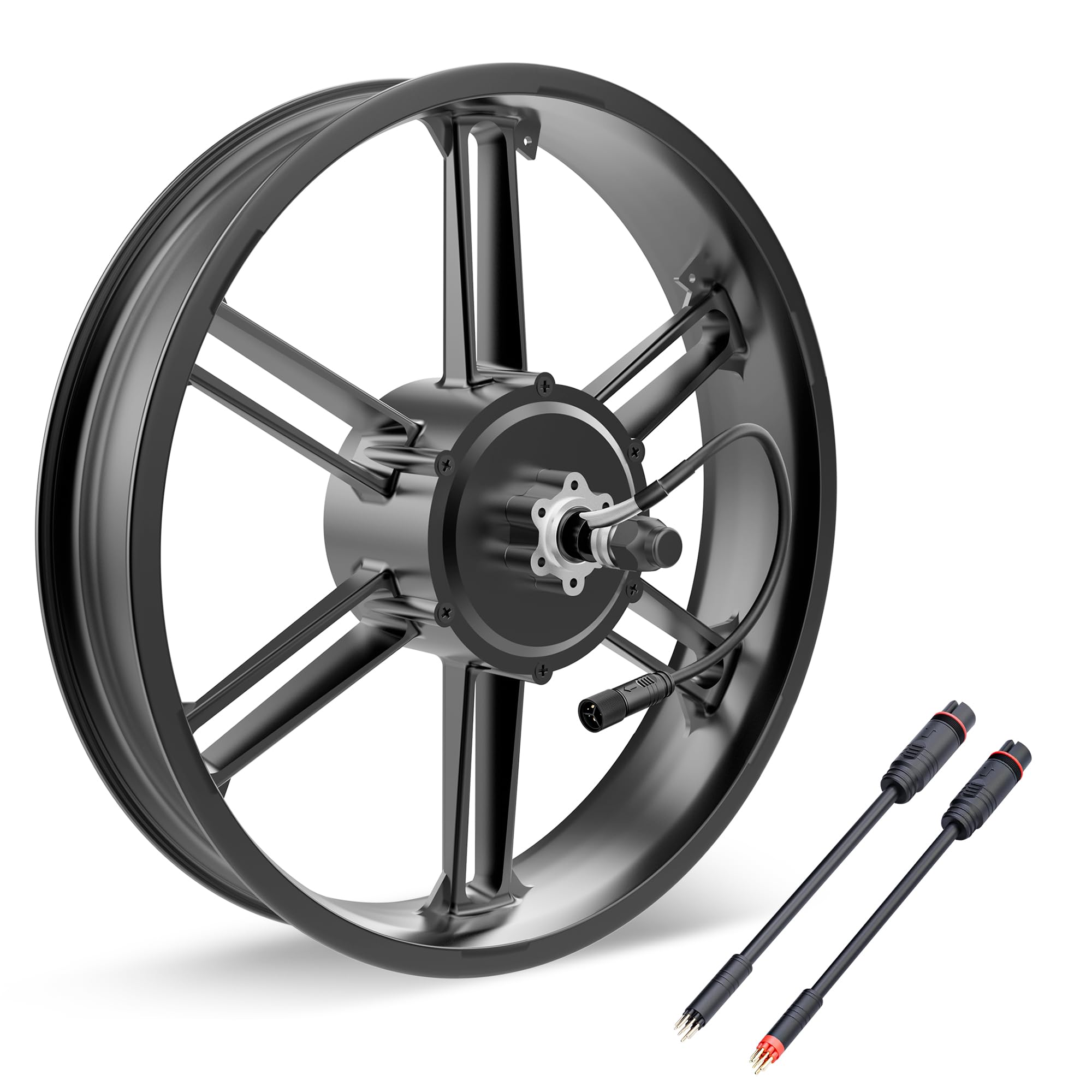
1. 20 x 4.0” Fat Tire E-bike Rear Wheel, 48V 1000W Motor
Eighty-five newton-metres of pull in a fat-tire wheel you bolt on and forget.
Two numbers decide this one, and neither is the wattage. The motor produces up to 85 N·m of torque — the twisting force that actually pushes you up a ramp — and it tops out at 55 km/h (34 mph). Both figures are the highest torque and the highest top speed in this entire group. If you ride a 20-inch fat-tire bike and want the rear wheel to do the work, this is the strongest single unit here.
It is also the only pick that arrives as a finished one-piece aluminum wheel. That means no spoke tightening and no wheel truing — the integrally forged rim has no joints to work loose, so it holds steady under heavy loads. Compare that with the BAFANG mid-drive at 6.5 kg or the Mahugde hub wheel at 22.9 pounds, and this 10.5-pound wheel is the lighter of the two rear-wheel kits by a wide margin. The trade-off is honest: fat-tire geometry only. It needs frame dropouts between 170 mm and 175 mm and a 20×4-inch tire, plus an L915 9-pin threaded connector.
The other hub kit here reaches 53 km/h against this one’s 55 km/h, so the gap is narrow on road speed. Where this wheel separates itself is the wheel itself — nothing to adjust, nothing to true, and a clean finish that upgrades the look of the bike. If your frame is a genuine fat-tire build, this is the pick that makes the rest of the list feel like a compromise.
What earns the top spot
- 85 N·m of torque — the highest pull of any pick here
- 55 km/h top speed, the fastest in the group
- One-piece forged alloy wheel, so no truing or spoke work
- 10.5 pounds, meaning it is easy to fit one-handed
- Works with disc brakes and most standard e-bike frames
What to measure first
- Only fits 20×4-inch tires with 170 mm–175 mm dropouts
- Requires the L915 9-pin threaded controller connector
- Ships as a wheel only — controller and battery are not included
Go for it if: your fat-tire frame measures 170–175 mm at the dropouts and you want the most torque on this page.
Hold off if: you ride a standard 26-inch or mid-drive bike, since the fit simply won’t happen.
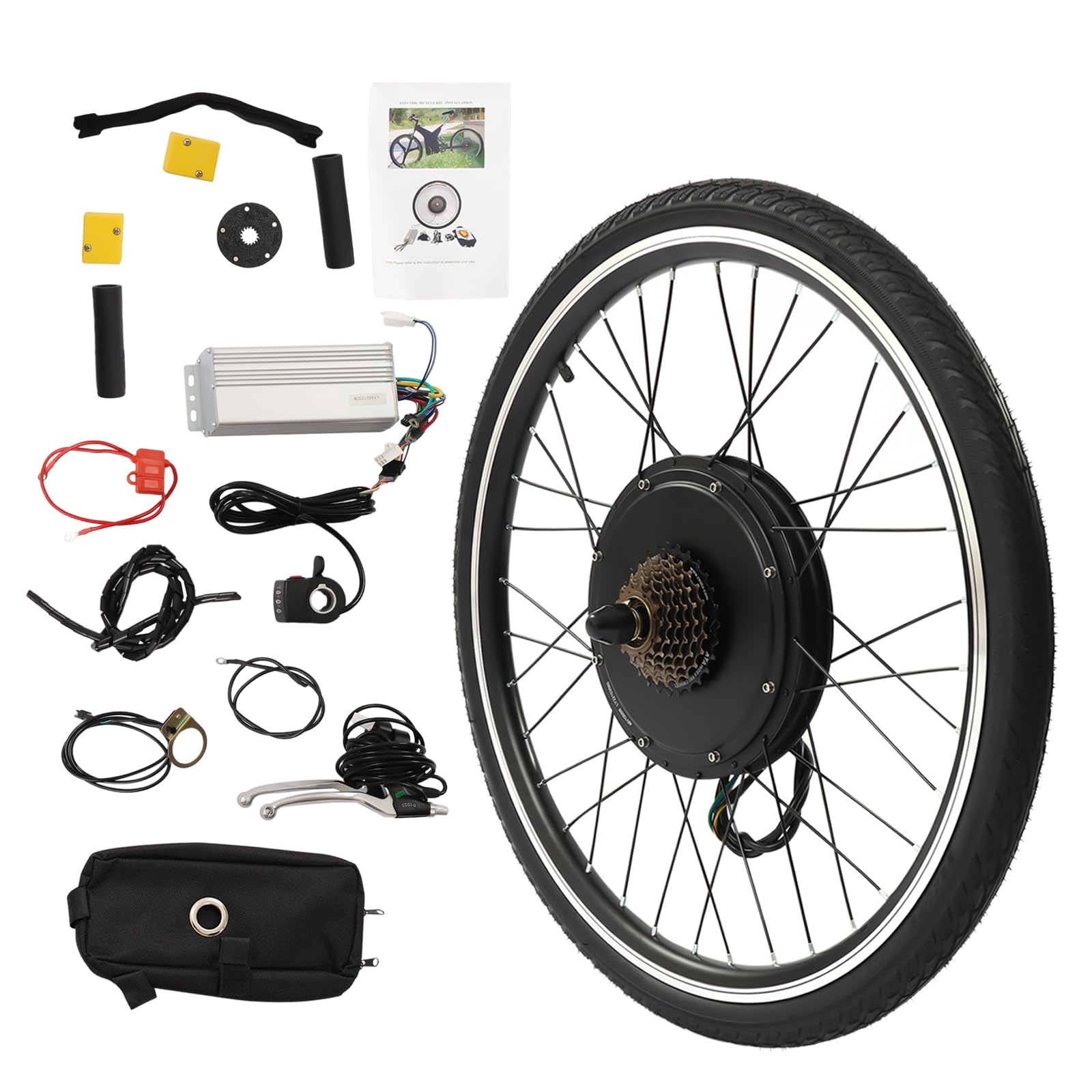
2. Mahugde 48V 1000W 26″ E-Bike Hub Motor Wheel Kit
The straightforward answer for anyone with an ordinary 26-inch bike sitting in the garage.
Start with the load rating, because it tells you how the wheel is built. Thirty-six spokes, laced in a staggered weave so the stress spreads evenly, carry about 120 kg (264.55 lbs) — enough for most adult riders plus a loaded rack. The motor spins at 440 rpm with 45 N·m of torque and reaches 53 km/h, which is the same speed band as the wheel above and only a couple of km/h shy of it.
Two details make it safer for a first conversion. A power-off brake handle cuts motor power the instant you brake hard, so the bike stops on your brakes rather than fighting them. And the thumb throttle lets you dial speed up or down without lifting a hand off the bar. It comes ready with both throttle assist and pedal assist, so you can ride without pedaling or let the motor support your stroke.
The honest caveat is weight. At 22.9 pounds this wheel is 2.2 times the weight of the fat-tire wheel in the top spot, and you will feel that when you lift the bike onto a rack. That weight is the price of 36 spokes and a load rating that carries a rider plus cargo, and for a commuter that trade is usually the right one.
Built to carry: the 36-spoke staggered lacing spreads load evenly across the wheel, so a rider plus gear is not pushing one weak spot.
Safety detail worth noting: the power-off brake handle is a small part that makes a big difference when a car pulls out in front of you.
Reach for this if: you own a 26-inch bike, want throttle and pedal assist together, and need the wheel to carry real weight.
Look elsewhere if: you want a featherweight wheel or ride a fat-tire frame.
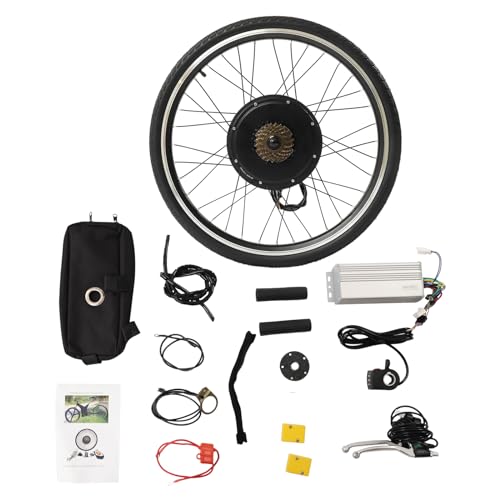
3. LTIGOAW 26 Inch Electric Bicycle Conversion Kit
A rear-wheel kit that turns a plain 26-inch bike electric and hands you a two-year warranty.
Reliability is the single strongest theme in this kit’s owner feedback — it keeps working. The motor is rated for more than 80% efficiency, the controller is included, and it reaches 53 km/h with 45 N.M of torque at 440 rpm and a 120 kg (264.55 lbs) load rating. It also carries three LED lights for visibility after dark.
Then there is the maintenance story. Brushless motors have no brushes to replace, so the long-term care is close to nothing. Inside the motor you get aluminum, iron, copper, magnetic steel, aluminum alloy and rubber butyl — materials chosen so the kit resists rust and avoids frequent replacement. A two-year warranty backs the whole thing.
Set expectations on power delivery, though. It delivers about 45 N.M — the same figure as the Mahugde above — so it will not pull like the 85 N·m fat-tire wheel or the mid-drives further down the list. It is the sensible entry to a rear-wheel conversion, not the muscle option.
The quiet strength: owners rate reliability above everything else here, and a brushless motor with no brushes to wear is exactly why that reputation builds.
Where it sits: 45 N.M of torque is honest commuter power — enough for hills, not enough to feel violent.
Best fit for: a first DIY conversion where durability and a two-year warranty matter more than maximum torque.
Not the one if: you want the strongest hub pull on the page — this sits a full tier below the top pick.
4. Kunray Electric DC Motor 48V 2000W Max Speed 5700rpm
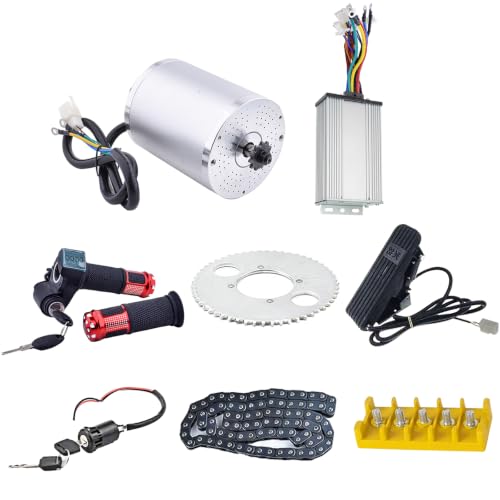
Seven parts in one box, from the motor to the key — the closest thing to a complete build.
The kit count is the point here. You get the 48V 1000W motor, a 30A brushless controller, a digital voltage twist throttle, a pedal throttle, an ignition lock with key, a T8F 54-tooth sprocket and a T8F chain — seven items. The motor runs at 3500RPM with 5.1 N·m of torque and a 150KG load capacity, and the controller is a 1500W 12-MOSFET unit that works at 48V connected and 36V disconnected.
Weatherproofing matters if you commute year-round. The motor carries an IP57 rating — a dust and water rating where dust can’t get in and water sprayed at it won’t cause harm — so rainy rides and muddy lanes are covered. A 3-in-1 twist throttle shows live voltage, so you can see remaining charge before you get stranded. The full-copper coil and aluminum housing are built to shed heat in continuous use.
Be realistic about reliability. Reliability feedback on this kit is mixed — some units run well and some fail early — so it suits someone comfortable troubleshooting wiring and returning a component if needed. At 5.1 N·m it is also the softest pull on this page; the 85 N·m wheel makes 85 where this makes 5.1.
The complete-box case: a controller tuned 1:1 to the motor, plus throttle, sprocket and chain, means you are not hunting for matching parts one by one.
Weather confidence: an IP57 rating is a real spec, not a marketing line, and it means the motor handles wet roads.
Choose it when: you want a whole kit in one order and are happy to troubleshoot if a unit misbehaves.
Think twice if: you need maximum torque or want zero risk on reliability — this one is a mixed bag on that front.
5. Kunray Electric Scooter Motor Kit 48V 2000W
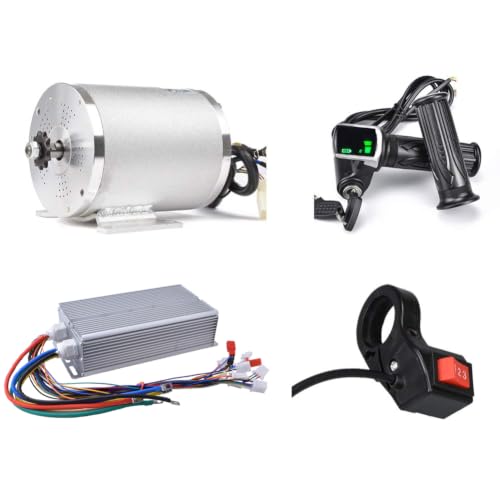
A 24-MOSFET controller and 2000W motor pairing for scooters, karts and heavier DIY builds.
The controller is the standout. It’s a 45A unit with 24 MOSFETs — the switching components that handle current — rated 2000W and set for a 120° phase angle. It supports low-level brake, three-speed selection, reverse, headlight, charge port and an E-lock. The motor side runs 48V, 2000W, 42A rated current, 4300 rpm rated speed, a 5600 rpm no-load maximum and 6.9 N.m of torque.
Owners rate build quality as this kit’s best feature, backed by its aluminum body, full copper coil, heat-resistant construction and natural air cooling. The LCD handlebar twist throttle combines a power display, ignition lock and throttle in one grip with a rubber grip for comfort. The three-speed switch lets you pick your power level on the fly.
Where it gets complicated is real-world speed and durability. Feedback on speed and durability is mixed — the three settings report roughly 16 mph, 23 mph and 32 mph, and more than one unit has had issues. This is the pick for someone who wants a strong kit with a serious controller and will keep an eye on it, not for a plug-and-play commuter.
Controller headroom: 24 MOSFETs and 45A give this kit more current handling than the Chokayaky’s 30A controller, so there is room to push harder.
Honest read on reliability: quality is the strongest theme in its feedback, but speed and durability both land mixed — treat it as a project kit.
Made for: a scooter or go-kart builder who wants a hefty 45A controller and 2000W motor in one package.
Not ideal for: someone who wants guaranteed top speed on the first ride or zero maintenance.
6. Varstrom TSDZ2B Mid Drive Kit for Ebike
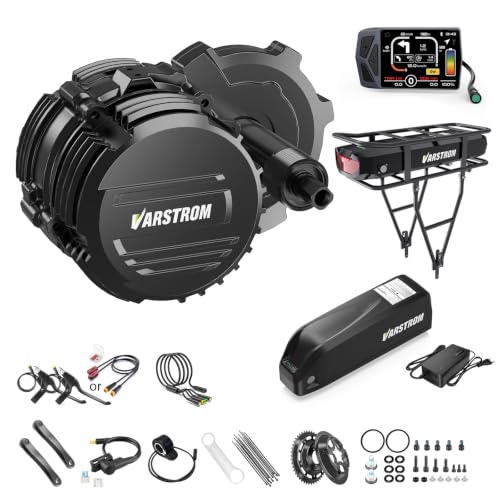
A torque-sensing mid-drive that lets a normal mountain bike climb like it has gears to spare.
Performance is what this motor gets known for, and the spec backs it. The 1000W version of the kit delivers 160N·m and up to 55km/h, the 750W offers 140N·m and 50km/h, the 500W delivers 80N·m and 45km/h, and the 250W reaches 80N·m and 30km/h. That range means you pick the version to match your local limits and your leg strength. Owners describe this mid-drive climbing hills with real authority and rate it a better performer than the BBSHD model.
The design upgrades are worth understanding. A bidirectional free-wheeling clutch removes the drag that one-way clutches create when the motor is off — so you can pedal it like a normal bike with no resistance. The nylon internals now take higher torque via an external clutch, and a 1T4 main wiring setup boosts contact strength by 15% for fewer after-sales problems. It fits 68–73mm bottom brackets, and the chainrings differ by model: 42T for the TSDZ-2B, 44T for the Z8, and 46T for the TSDZ16.
The one thing to plan for is installation depth. It requires a bottom bracket in the 68–73mm range, and the kit comes with a torque sensor — the part that reads how hard you pedal and adds matching power. That means a real install rather than a wheel swap, so budget an afternoon or a shop visit.
Gear-sharing power: because it drives the chain, the motor works through your gears — 160N·m delivered to the drivetrain climbs differently than a hub wheel pushing a fixed tire.
Pedal like normal: the bidirectional clutch means no motor drag when the assist is off, so the bike still feels like a bike.
Right call for: riders with a 68–73mm bottom bracket who want hill-climbing torque and the option to pedal with no drag.
Wrong call for: a bolt-on wheel swap — this needs real bottom-bracket work.
7. BAFANG BBS02B BBS-HD Mid Drive Conversion Kit
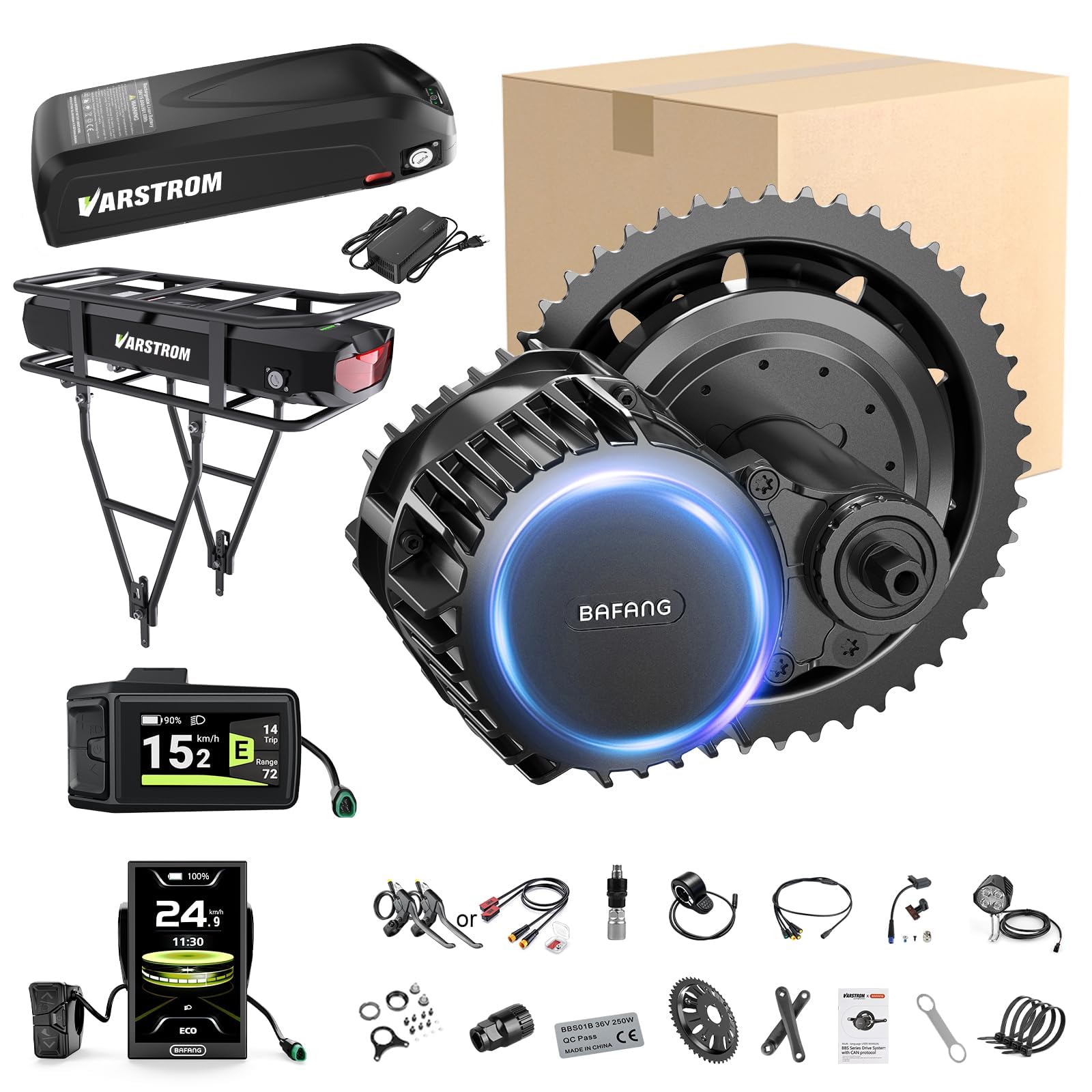
The mid-drive built for riders who want their bike’s electronics to keep getting updates.
Pick your power first. The BAFANG BBS mid-drive comes in 500W, 750W or 1000W, delivering 100N.m at 500W, 120N.m at 750W and 160N.m at 1000W. Speed tracks the power: up to 28mph at 500W, 34mph at 750W and 37mph at 1000W. The 1000W figure lands at the same 160 N·m ceiling as the Varstrom TSDZ16, so both top out at the same torque number.
What separates this kit is the controller language. It has moved from UART to CAN bus, which gives better electronic stability and anti-interference, supports more accessory interfaces, and allows OTA firmware upgrades over the air. Direct programming means you can change parameters without a USB cable by choosing a DPC010, DPC080, EKD01, VD04 or VD18MT touchscreen display. It fits 68mm, 100mm and 120mm bottom brackets — wider than the Varstrom’s 68–73mm range — and works with disc brakes, V-brakes and chain drives.
Note that the battery is sold separately, and you have real choices there: 48V 13Ah or 16Ah downtube for daily rides, up to 52V 25Ah downtube for extended range. The bike rides on a 6.5 kg motor unit. Budget for the pack, and confirm your bottom bracket is one of the three supported sizes.
Why it earns the premium slot
- CAN bus control with over-the-air firmware updates
- Parameter programming through the display, no cable needed
- Fits 68mm, 100mm and 120mm bottom brackets — the widest range here
- Up to 160N.m and 37mph on the 1000W version
What to budget around
- Battery is sold separately, so the full build costs more
- Needs a compatible display for full programming access
- A mid-drive install, not a simple rear-wheel swap
Designed for: a rider who wants a mid-drive that keeps learning new tricks and fits a wider set of bottom brackets.
Not the pick if: you want everything in one box — the battery here is an extra step.
Know the Specs
Torque in N·m — the real pull number
Torque is how hard the motor twists its output. A higher figure means stronger acceleration and easier climbing. On this page the range runs from about 5.1 N·m on the Chokayaky kit to 85 N·m on the fat-tire wheel, and the mid-drives reach up to 160N·m. A big wattage badge with low torque is a fast spinner, not a hill climber. Read torque before you read watts.
Rated speed in rpm — the spin rate
Rpm is how many times the motor’s shaft turns per minute. The Kunray DC motor rates 4300 rpm, the BAFANG’s electric equivalents spin to match road speeds like 34mph at 750W. Hub wheels pair motor rpm with wheel size to produce road speed, while mid-drives put that spin through your gears. Two motors at the same wattage can reach very different road speeds because of rpm and gearing.
Voltage — the pressure, not the power
Voltage must match your battery and controller. This group spans 48V, 72V and the BAFANG’s 36V/48V/52V options. A 72V motor needs a 72V pack; a 48V system needs a 48V pack. Getting this wrong undercuts every other spec. Check the controller’s amp rating too — a 45A controller with a 42A-rated motor is a coherent pairing.
Bottom bracket and dropout width — the fit gate
Mid-drives mount at the bottom bracket, and most kits here fit a 68–73mm shell. The BAFANG stretches to 68mm, 100mm and 120mm. Hub wheels instead need matching frame dropouts — the fat-tire wheel requires 170 mm to 175 mm. Measure before you order. A motor that does not physically fit delivers no wattage at all.
Common Questions
Will a hub motor wheel fit my bike if I have disc brakes?
Can I put a 48V motor on a 36V battery?
Is a mid-drive better than a hub motor for hills?
What bottom bracket size do I need to measure for a mid-drive kit?
Do these motors come with a battery?
How fast will a 48V 1000W kit actually go?
Can I install these kits myself?
What is the difference between a brushless and a brushed motor here?
Are these hub and mid-drive motors waterproof?
Can I adjust the power on these kits?
The Bottom Line
For most riders building up a fat-tire bike, the KPATH 20×4.0 Rear Wheel is the winner because 85 N·m of torque and a 55 km/h top speed sit above every other pick here, and the one-piece wheel skips the truing work. If you ride a standard 26-inch frame, grab the Mahugde 48V 1000W Hub Motor Kit — its 36-spoke wheel carries about 120 kg and includes a power-off brake handle. And for anyone who wants the motor to work through the gears, the Varstrom TSDZ2B delivers up to 160N·m with a free-wheeling clutch that lets you pedal with no drag.
Whichever way you go, measure first. Check your dropout width for a hub wheel or your bottom bracket for a mid-drive, match the voltage to your battery, and confirm the controller’s amp rating. The KPATH fat-tire wheel holds the highest rating in this group at 4.5+, and its 85 N·m torque figure is the single strongest reason to start there.
How we choose
We do not accept paid placement. Every pick is matched to a real buyer and a real use-case; we do not hands-on test units.
Sources
Specifications: manufacturer listings and product documentation. Review insights: verified customer reviews, as of November 2026. Pricing: not shown on this page (it changes often); check the current price via the retailer link.
As an Amazon Associate, Tactical Gear Guy earns from qualifying purchases. This does not affect which products we feature.