Specs are compiled from manufacturer listings and verified buyer reviews and can change over time — please confirm the key details on the product page before buying.
You want a speaker that still sounds full and rich when it is sitting on a picnic table with wind and traffic noise all around it. That is the whole job here: loud enough to carry, tough enough to survive a splash or a dropped bag, and with a battery that outlasts your outing. Below you get nine powered outdoor Bluetooth speakers, each matched to the kind of buyer it actually suits, so you can pick the one that fits your yard, your boat, or your tailgate instead of guessing.
This guide is built by comparing the manufacturers’ published specifications and the patterns across verified customer reviews, so you get each pick’s real strengths and trade-offs instead of marketing spin.
Some speakers here prioritize raw decibels, others rugged shells or app-tuned bass, and a few stretch playtime across multiple days. Weigh those against how you actually listen, and the right choice for the best powered outdoor Bluetooth speakers becomes a lot clearer.
Top Picks


How To Choose The Best Powered Outdoor Bluetooth Speakers
Shopping outdoors-first is a different game from buying a desk speaker. Your sound has nowhere to bounce off, so you need more push, and your gear has to survive weather it never sees indoors. Lock these few things down and the rest gets easy.
Start with the water and dust rating
An IP rating is a two-digit score for how sealed the shell is — the first digit covers dust, the second covers water. IPX7 means it can be dunked briefly; IP67 adds full dust protection; IP54 is splash-resistant only. If your speaker lives by the pool or on a boat, chase the 67s. If it just rides in a bag to a picnic, splash resistance covers you.
Match wattage to your space
Wattage is a rough measure of how hard the amp can push, and outdoors you want more of it than you would indoors. A small backyard needs far less than a field full of people or a noisy worksite. Remember the flip side: the louder you run it, the faster the battery empties.
Think about playtime versus volume
Every quoted playtime assumes moderate listening. Crank it near full and that number drops hard. If your outings run long, favor a bigger battery figure, and check whether the speaker doubles as a power bank so your phone gets a top-up too.
Decide if you need pairing and inputs
Stereo pairing lets two or more same-brand speakers play together for wider sound. Mic and AUX inputs matter if you want karaoke, a PA, or a wired source. Skip the extras you will never touch and put that toward sound and build quality instead.
Side-by-Side Comparison
| Model | Best For | Battery Playtime | Water/Dust Rating | Power Output | Amazon |
|---|---|---|---|---|---|
| JBL Charge 5★ Best Overall | Everyday outdoor all-rounder | 20 hours | IPX7 | — | Amazon |
| Soundcore Boom 2Best Bass Value | Bass on a budget | 24 hours | IPX7 | 80W | Amazon |
| ION Block RockerParty & Karaoke Pick | Parties and karaoke | 35 hours | IPX5 | 120W | Amazon |
| Tribit StormBox Blast 2 | Big party sound | 30 hours | IP67 | 200W | Amazon |
| ECOXGEAR Defender | Loud PA outdoors | 25 hours | IP67 | 100W | Amazon |
| Bose SoundLink Max | Premium portable sound | 20 hours | IP67 | — | Amazon |
| Marshall Kilburn III | Style and long playtime | 50+ hours | IP54 | — | Amazon |
| Sony ULT Field 7 | Party lighting and bass | 30 hours | IP67 | — | Amazon |
| Turtlebox Original Gen 3 | Off-grid extreme durability | Up to 3 days | IP67 | — | Amazon |
Detailed Reviews
1. JBL Charge 5 – Portable Waterproof Speaker – Black
Our pick — 4.5+★ from 36,000+ verified ratings; the strongest balance of quality and price.
A compact IPX7 cylinder with a 20-hour battery and a built-in power bank for backyard duty.
You get 20 hours of stated playtime from a 7500 milliamp-hour battery (a measure of stored charge) — enough to run a full day and well into the evening. It is sealed to IPX7 (a rating that survives a dunk in the pool or a sudden downpour), so a splash will not kill it. The built-in power bank also lets you top up a dying phone while the music keeps playing.
Where it pulls ahead of the JBL-adjacent pack is connection freedom: this one officially lists 10 meters of Bluetooth range — roughly across a yard or down a dock. Set against the Soundcore Boom 2’s 100 meters, the reach is far shorter, so keep your phone relatively close. The driver is a 5.2 centimeter unit, a compact speaker meant to throw sound cleanly rather than fill a stadium.
The honest note is battery life. Play it loud outdoors, in open air, and the runtime shrinks — several owners describe high-volume sessions draining it far sooner than the headline number suggests. Run it at a sane level and it holds up nicely. Given it is the highest-scoring speaker here at 4.5+ stars across 36,000+ owners, the consensus is clearly happy.
What earns it the top spot
- The most-praised strength by a wide margin is sound quality — it is the thing buyers rave about.
- IPX7 sealing means pool splashes and rain are a non-issue.
- Doubles as a power bank, so your phone rides on the speaker’s charge.
- Pairs with a second device and supports multi-speaker PartyBoost.
Where to slow down
- Loud outdoor listening eats the battery faster than the 20-hour figure implies.
- Bluetooth reach of 10 meters trails the 100-meter Soundcore below.
- It is a little heavy in the hand for a pocket-sized speaker.
Go for it if: you want the safest all-round outdoor speaker with the strongest owner track record.
Bear in mind: keep the volume moderate if you need the full day of playtime.
2. Soundcore Boom 2
It pairs 80 watts of output with a floatable IPX7 body at a budget price.
Here is a case where the spec sheet genuinely surprises. It pushes 80W and runs a 10 centimeter driver — a full order of magnitude bigger than the JBL’s 5.2 centimeter unit — and that extra cone area is why the bass lands so hard. Anker pairs it with a dedicated subwoofer and BassUp 2.0, which is their bass-boost processing, so the low end thumps even in open space.
Reach is the standout. It lists up to 100 meters of Bluetooth range versus the JBL’s 10 meters, so you can wander to the far end of a field or the other side of a jobsite and the connection holds. You also get up to 24 hours of playtime, a built-in power bank, and a floatable IPX7 body, meaning a dropped speaker in the lake bobs back up.
The trade-offs are real but manageable. A few owners describe audio breaking up after long stretches at high volume, and the 180 millisecond audio latency (the delay between picture and sound) is worth knowing if you plan to pair it to a TV. Charging is a slower 5.5 hours, longer than the JBL’s 4. What wins people over is straightforward: punchy, price-friendly bass.
The bass argument: a 10 centimeter driver and a dedicated subwoofer are why low end you can feel comes out of a speaker this size — the range and wattage punch well above what the tier suggests.
The catch to plan around: 5.5 hours to recharge is the longest wait in this group, so charge it overnight rather than expecting a quick turnaround.
Made for: buyers who want deep, floor-shaking bass and long wireless reach without stepping up to a premium tier.
Pass if: you need a fast recharge or a low-latency link for video.
3. ION Block Rocker
Wheels, handles, a microphone, and 35 hours — this is the tailgate workhorse.
This is the pick for a crowd: four speakers — an 8 inch woofer, a 2 inch tweeter and two 4 inch drivers — spread 120W of sound to the front, left and right. The battery is rated at 35 hours versus the JBL’s 20, so it outlasts that pick by 15 hours. Wheels and handles mean you roll it rather than dead-lift it, and the included microphone with a 7.5 foot cable turns any gathering into a karaoke night.
You get plenty of ways to connect for a party box: Bluetooth 5.3 reaching up to 100 feet, a 1/8 inch AUX in, a USB port for a thumb drive, onboard FM radio, and the ION Sound Control app for EQ and firmware updates. Back-lit buttons and a BOOM button that instantly cranks bass and volume round out the controls.
The one spec that matters for placement is IPX5 — that is splash-resistant, not submersible. Rain showers are fine; a dunk in the lake is not. It is also the heavier, bulkier option here, which is the price of wheels and four drivers. For backyard parties and public speaking, though, it does the job and then some.
Why party hosts rate it: the built-in mic, 35-hour battery and rolling design make setup a one-person job, and buyers report it can blast at volume 14-16 for about ten hours, with owners calling it “worth the price.”
Know before you buy: IPX5 is splash-proof only, so keep it out of standing water.
Built for: karaoke nights, tailgates, and anyone hauling a speaker with a crowd attached.
Not for: beach dunkings or buyers who want a one-hand carry.
4. Tribit StormBox Blast 2
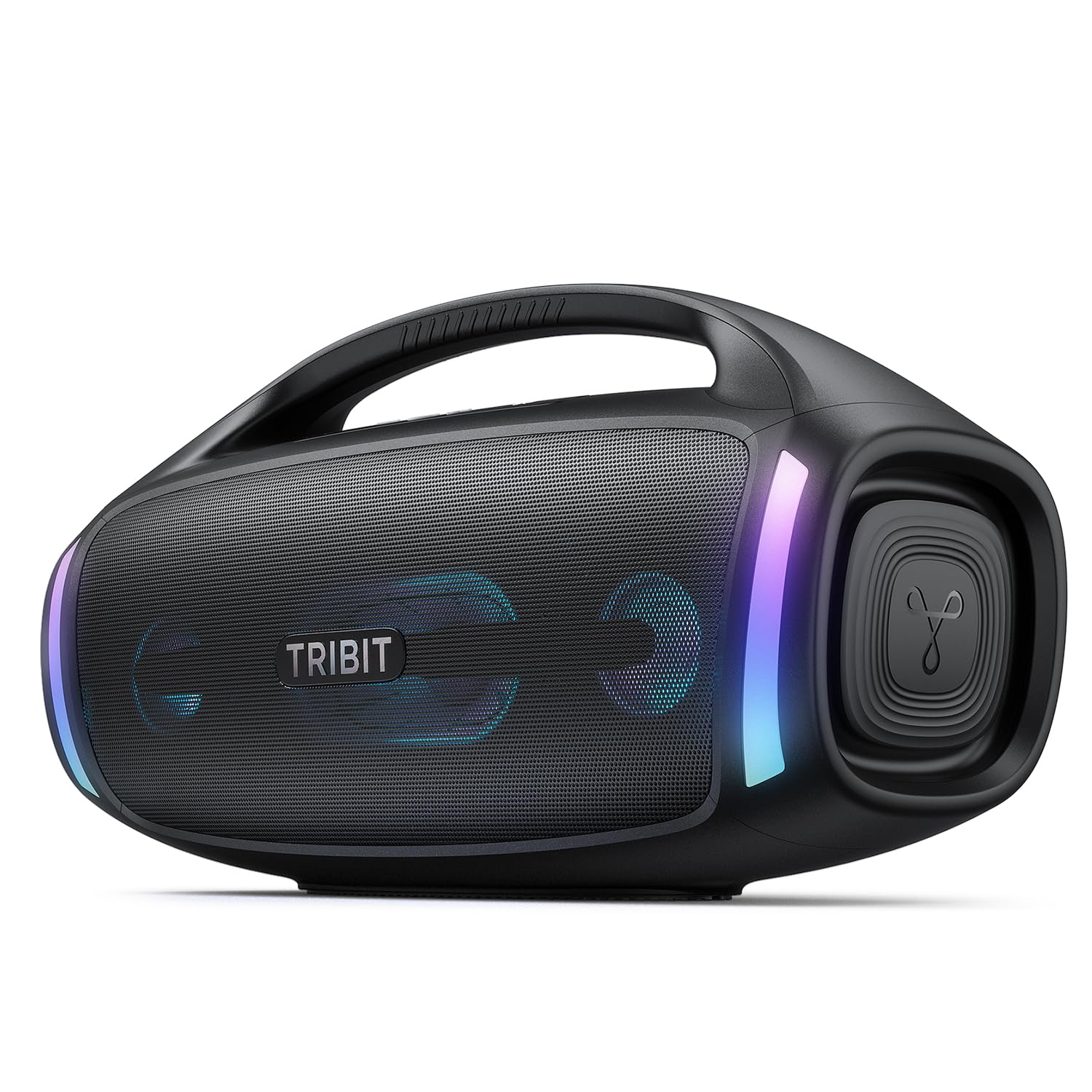
A 200-watt boombox with a 2.1 channel layout, 30 hours of playtime, and app-tuned lighting.
Where the JBL is a yard speaker and the ION is a party box, this one splits the difference at serious volume. It delivers a 200W output (with a 320W peak figure) through a 2.1 channel layout: an 80W subwoofer, two 45W mid-range drivers, and two 15W tweeters. The bass is furthered by dual passive radiators, which are unpowered cones that move with the air to add low-end weight.
You get Bluetooth 5.4 plus TWS pairing — true wireless stereo, meaning two of these can play left and right together. The 30-hour playtime keeps a long evening fed, and the IP67 body shrugs off rain and dust. Two 6.35mm mic inputs add karaoke with adjustable reverb, and the app lets you tune lighting and EQ.
It is on the heavy side — closer to a boombox than a grab-and-go puck, and owners say so plainly. Size is part of the deal here; bigger cones and radiators take up room. If you want sound that fills a driveway and a battery that carries a full day, that weight buys something real.
The case for the Blast 2
- 200W output with a dedicated subwoofer gives it the most raw push below the premium picks.
- 30-hour playtime runs longer than the JBL’s 20 hours.
- IP67 means dust and rain are covered.
- Dual mic inputs and app EQ make it a karaoke-capable rig.
Where it asks for a trade
- It is bulky and heavy — you will not toss it in a daypack.
- The app EQ is fiddly to learn at first.
Choose this if: party volume matters more than pocketability and you want a boombox feel.
Think twice if: you will be carrying it on foot for long stretches.
5. ECOXGEAR Defender

A 121-decibel, IP67 speaker that floats and survives a drop — built for crowd-level volume.
Decibels measure loudness, and 121 dB is genuinely enough to cut through wind, crowd noise, and open air. It comes from a 100-watt Texas Instruments amplifier driving a 6 by 9 inch main driver and a 1.7 inch tweeter. The IP67 shell is built to be dropped, and the speaker floats in the pool or lake rather than sinking, which is a tough trick to find.
The EcoCast system links up to 100 compatible speakers for a sprawling stereo or party-mode setup. A built-in 24-bit DSP — that is digital signal processing, the chip that shapes the tone — gives you three equalizer presets, and there is a dedicated mic DSP for voice work. Battery runs 25+ hours at average listening levels, or about 6 hours cranked to full volume.
The honest limit lives in that volume curve. At full blast the runtime halves to roughly a quarter of the headline, and using the LED light show drains it further still. Match it to a group of twenty or a baseball team and it earns its keep; match it to a quiet patio and you are buying headroom you will not use.
Built for abuse: floating, IP67, and a shock-proof body make it the pick when the speaker lives outdoors rather than visits.
The battery reality: 25+ hours is at average volume; at full tilt expect roughly 6, so bring a charge for all-day loud use.
Right for: sports teams, contractors, and anyone amplifying a crowd or a job site.
Overkill for: a quiet deck where moderate volume is all you need.
6. Bose SoundLink Max
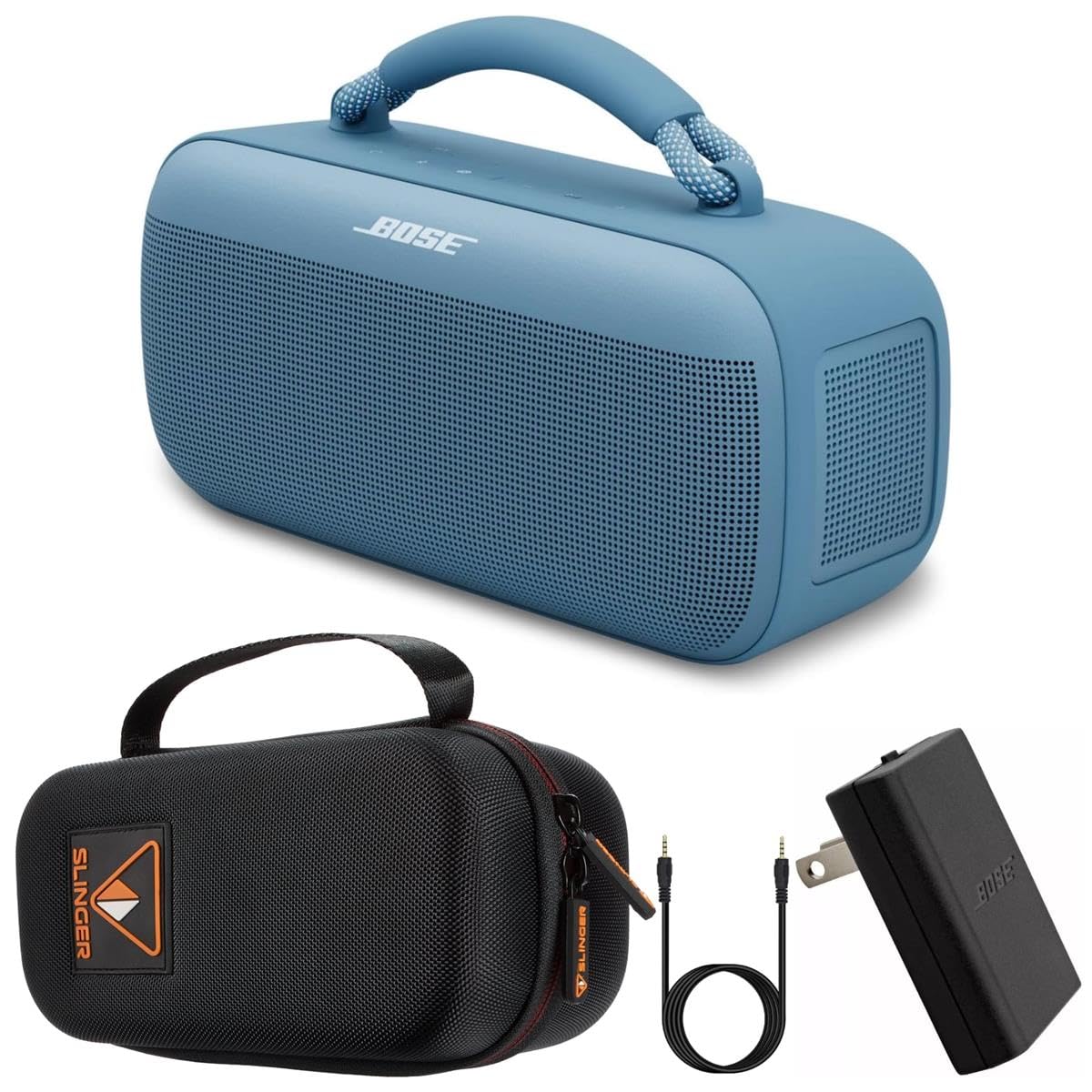
A premium IP67 speaker with a hard travel case, AUX cable, and 20 hours of playtime included.
This is the top-tier build pick. It ships with a hard shell travel case and an AUX cable, wraps everything in an IP67 shell that handles dust and water, and gives you Bluetooth 5.3 plus USB-C and a 3.5mm wired input. Playtime is up to 20 hours — the same figure the JBL lists — and the Bose app handles EQ and settings.
Bluetooth reach is the one spec that asks attention: it is listed at 30 feet, noticeably shorter than the Soundcore’s 100 meters or the Sony’s 30 meters below. Keep your phone nearby. The upside is a compact body with an integrated handle that owners describe as dense and well-made, not flimsy.
Value is the open question. This sits in the premium band, and opinions on worth are split — some call it money well spent, others say wait for a markdown. Everything else about it is polished. If you want the most refined small speaker and can justify the tier, the build quality is what carries it.
What reviewers appreciate most: build quality leads by a clear margin, followed by sound — the case and construction read premium in the hand.
The honest tension: 30 feet of Bluetooth range is short for a premium speaker, so plan to keep the source close.
Suits: buyers who want a compact, tough, great-sounding speaker and a hard case already included.
Skip if: you need long wireless reach or an entry-level outlay.
7. Marshall Kilburn III

50+ hours of playtime in a metal, brass-accented body with 360-degree sound.
Fifty-plus hours is the headline, and that is more than double the JBL’s 20-hour claim — the longest playtime here aside from the Turtlebox’s days-long figure. It also gives true 360-degree sound that carries wherever you stand, a frequency response reaching down to 45 hertz for real low end, and a charging bank so your phone rides along on its power.
The look is the sell: a metal enclosure, tactile click controls in the brand’s signature style, and brass accents that make it a piece you leave out rather than hide. Bluetooth reach is 33 feet, close in spirit to the JBL’s 10 meters, so treat it as a nearby-phone speaker rather than a roam-the-field one.
The one spec to weigh is IP54 — that is dust and splash resistant, not submersible. A rain shower is fine; a splash is fine; a dunk is not. It is the trade for that handsome metal body. If your outdoors is a porch or a patio rather than a lake, that is a fair bargain.
Why it wins on endurance and looks
- 50+ hours of playtime outlasts the 20-hour JBL by more than double.
- 360-degree sound and 45 hertz low end fill a space evenly.
- Charges your phone from its own battery.
- Tactile knob controls for volume, bass, and treble.
What to plan for
- IP54 is splash-only — not built for a dunking.
- It sits in the premium tier, so value depends on how much you prize the styling.
Made for: porch and patio listeners who value long battery and a speaker that looks like furniture.
Look elsewhere if: your speaker regularly meets deep water.
8. Sony ULT Field 7

Beat-synced party lighting, IP67 sealing, and a 10-minute charge that buys back 3 hours.
The party lighting sets this one apart — dynamic lights that pulse with the music — plus an IP67 shell that keeps dust and water out entirely. You get up to 30 hours of battery, and a quick 10-minute charge buys back up to 3 hours of play, a rescue no other speaker here spells out. Bluetooth Fast Pair and multipoint let two devices stay linked, so swapping between your phone and a tablet is painless.
A 46 millimeter driver and a unique X-Balanced unit give it deep, clear bass, and there is a mic and guitar input for live fun. Bluetooth reach lands at 30 meters — thirty times the JBL’s 10 meters — so you can set it down and roam. It is built with handles on both ends for carrying, though it is a large, weighty unit.
The trade is size. It is big and it is heavy, and owners note it could use a shoulder strap for longer hauls. Given the loudness and the battery, the bulk is the cost of the output. For someone who leaves the speaker on a deck or in a yard and wants party energy, the size is easy to live with.
What buyers prize: the sound leads the feedback, with owners calling it a clear winner for mids and vocals against the JBL. The quick-charge feature pivots it from a busted night to a working one.
The catch: it is a large, heavy speaker with no shoulder strap in the box — plan to leave it in one place rather than tote it.
Fits: deck-side and yard parties where the light show and loud, clear vocals are the draw.
skip it if: you need something you can carry comfortably for a long walk.
9. Turtlebox Original Gen 3
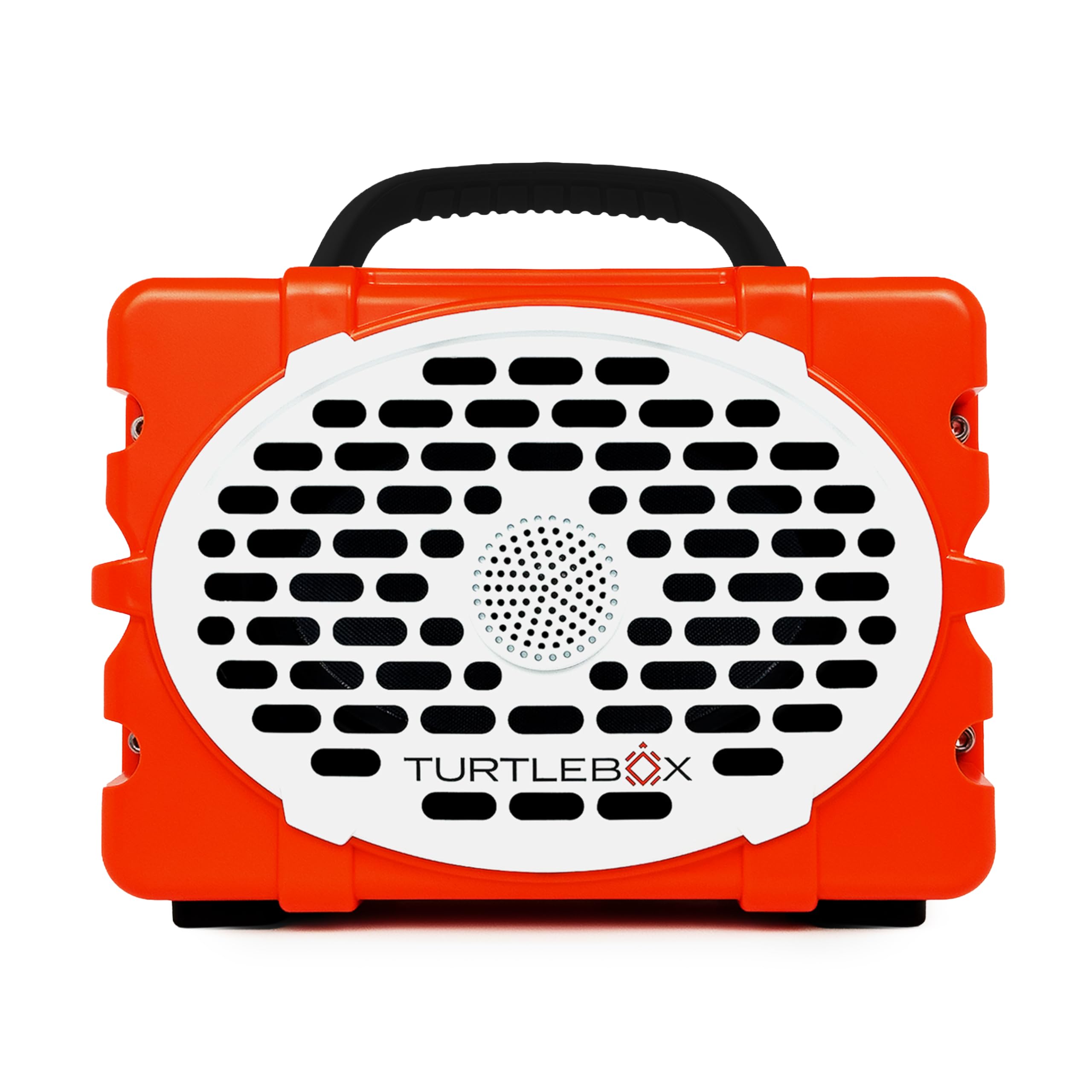
A drop-proof, crush-proof IP67 shell with 120 decibels and up to three days of playtime.
This is the one you take off-grid. The shell is 100% drop, crush, and dust-proof and sealed to IP67, so it survives rain, mud, and saltwater without flinching. It puts out 120 decibels through a 1 inch titanium tweeter and a 6 by 9 inch woofer, driven by a Class D digital amplifier and fed by an 85 watt-hour lithium-ion battery. That battery is rated for up to three days of playtime on a single charge.
The build materials explain the price band: fiberglass, stainless steel, and titanium in the enclosure. Party mode lets you sync an unlimited number of these Gen 3 units, though it will not pair with older generations. It works across boats, UTVs, ATVs, and trucks as well as on foot, which is why it earns top marks on quality and durability.
Two honest constraints. First, the charger is proprietary — the only one that works with a Turtlebox — so do not lose it. Second, value is the most-debated point, with opinion split on whether the premium is justified. What owners agree on is how it holds up: the recurring note is that this thing is built to take a beating.
The ruggedness argument: fiberglass, stainless steel, and titanium over an IP67 shell make it the most abuse-tolerant speaker here, and it keeps its composure at near-full volume.
The two caveats: a proprietary charger you cannot replace cheaply, and no pairing with Gen 1 or Gen 2 models.
Built for: boat owners, off-grid adventurers, and anyone whose speaker lives in the back of a truck.
Think hard if: you want one charger for everything you own — this speaker needs its own.
Know the Specs
IP Ratings Decoded
An IP number scores how sealed a speaker is against dust and water. IP67 means full dust protection and the ability to survive a brief dunking — the level to chase for boats and pools. IPX7 keeps the water figure but drops the dust digit, so splash and brief submersion are covered. IP54 is dust-protected and splash-resistant only, which suits a porch rather than a lake. Match the rating to where the speaker will sit, not how it looks on a shelf.
Playtime at What Volume
Every playtime figure, whether it is 20, 30, or 50 hours, assumes a moderate level. Push the volume up outdoors and the drain accelerates — several speakers here drop dramatically when cranked. If long outings are your norm, favor a larger battery and a charge-bank feature. If you play loud for short bursts, raw volume headroom matters more than the headline hours.
Wattage and Driver Size
Wattage is the amp’s push and driver size is the cone area that moves air. A large driver — 10 centimeters or a 6 by 9 inch woofer — moves more air and reaches lower than a compact 5.2 centimeter unit. More power and more cone area usually mean more bass and volume, though a bigger box tends to follow. Outdoors, that extra push is what lets sound survive the open air.
Bluetooth Range and Latency
Bluetooth range is the distance before the signal drops, and it varies widely here — from 10 meters up to 100 meters. Longer reach lets you leave the speaker and keep the phone on you. Latency is the delay between audio and video; a low number keeps movies in sync, a higher one drifts. Also decide whether stereo pairing or mic inputs are features you will actually use.
Common Questions
Will a waterproof outdoor speaker actually survive being dropped in the pool?
How much louder is a 120-watt speaker than an 80-watt one?
Why does my speaker’s battery die faster outdoors than the box claims?
Can I pair two of these speakers together for stereo sound?
What does the second digit in an IP67 rating actually mean?
Do I need a speaker with a microphone input?
What Bluetooth range do I really need for an outdoor speaker?
Is an IP54 speaker tough enough for outdoor use?
What is audio latency and does it matter for a party speaker?
The Bottom Line
For most people, the powered outdoor bluetooth speakers winner is the JBL Charge 5 because it pairs the strongest owner track record with IPX7 sealing, a 20-hour battery, and a power bank that keeps your phone alive. If you want deep bass and long reach for less, grab the Soundcore Boom 2 with its 80W output and 100-meter range. And for a party box that rolls, sings, and runs 35 hours, the ION Block Rocker is the one to reach for.
How we choose
We do not accept paid placement. Every pick is matched to a real buyer and a real use-case; we do not hands-on test units.
Sources
Specifications: manufacturer listings and product documentation. Review insights: verified customer reviews, as of November 2026. Pricing: not shown on this page (it changes often); check the current price via the retailer link.
As an Amazon Associate, Tactical Gear Guy earns from qualifying purchases. This does not affect which products we feature.