Specs are compiled from manufacturer listings and verified buyer reviews and can change over time — please confirm the key details on the product page before buying.
You want clean, square cuts and no burned edges, but the tool shelf is crowded with motors that claim the same specs. A palm router that suits edge work will fight you on a cabinet build, and a benchtop saw that walks across your bench will wreck a good rip cut. Start with what you actually build. Then match the motor, the base, and the footprint to that job, and read every number on the label before you commit.
This guide is built by comparing the manufacturers’ published specifications and the patterns across verified customer reviews, so you get each pick’s real strengths and trade-offs instead of marketing spin.
Some of these tools want a cord and a dedicated bench, while others run on a battery pack you already own. That single choice shapes nearly every other decision you will make in the shop. The picks below cover the full spread of power tools for woodworking, from palm-sized trim routers to full table saws, so you can match one to the work on your bench.
Top Picks


How To Choose The Best Power Tools for Woodworking
The biggest mistake new woodworkers make is buying for the whole shop at once. You end up with a garage full of tools and none of them suited to the one cut you actually repeat every weekend. Buy for the cut you make most, then add the next tool when a real project demands it.
Match the tool to the cut, not the catalog
A table saw breaks down sheet goods and rips long boards to width. A router shapes edges, cuts grooves, and rounds over a corner. A miter saw crosscuts trim and framing stock to length. If you build cabinets, the saw earns its space first. If you build small boxes and signs, a router does the most work per dollar.
Read the motor numbers in plain terms
Amperage is the motor’s appetite for current, and it tells you roughly how much load the tool can carry before it slows. A 15 amp motor on a table saw pushes a 10 inch blade through hardwood; a 5.6 amp motor on a palm router is built for lighter edge passes. Speed range matters too, because a router spinning too fast burns some materials while one spinning too slow tears them out. Look for a variable speed dial if you plan to work in more than one material.
Measure your bench before you buy
A jobsite table saw needs room to feed a board in and out, roughly twice the length of your longest board. A benchtop saw needs a stable surface that will not tip under the motor’s weight. Palm routers live in a drawer, so they cost you almost no space. Cordless tools only pay off if you already own the battery platform, since a bare tool without a battery is a paperweight.
Think about depth adjustment and repeatability
A router that changes depth easily is a router you will actually use for joinery. A micro-adjust dial lets you sneak up on a cut in small steps, which is how you fit a groove to a panel without guesswork. On a table saw, a smooth fence that locks square is worth more than a bigger motor, because a wandering fence turns every rip into scrap.
Side-by-Side Comparison
| Model | Best For | Motor | Speed / Capacity | Weight | Amazon |
|---|---|---|---|---|---|
| DEWALT DWE7485 Table Saw★ Best Overall | Breaking down plywood and long rips | 15 A | 24.5 in. rip capacity | 54 lb | Amazon |
| RYOBI PCL424B RouterCompact Pick | Cordless edge work in tight spots | 18V cordless | 20,000–30,000 RPM | 3.2 lb | Amazon |
| TEENO Wood RouterTool Kit Pick | Router kit with bits included | 6.5 A / 1.25 HP | 13,000–33,000 RPM | — | Amazon |
| SKIL PL201201 Planer | Smoothing doors and rough boards | 6.5 A | 3.25 in. cutting width | 6 lb | Amazon |
| CRAFTSMAN CMCW400B Router | V20 owners wanting cordless routing | 2 A cordless | 16,000–30,000 RPM | 4.1 lb | Amazon |
| BOSCH PR20EVS Colt Router | Precise small-project routing | 5.6 A / 1.0 HP | 16,000–35,000 RPM | 3.3 lb | Amazon |
| Metabo HPT C10FCG2 Miter Saw | Crosscutting trim and lumber | 15 A | 5,000 RPM no-load | 24.2 lb | Amazon |
| 15Amp Portable Table Saw | Small-shop ripping on a bench | 15 A | 4,600 RPM | 28.3 lb | Amazon |
| Mini Lathe Machine | Pens, beads, and tiny turnings | 96 W | 7-speed regulation | 5.65 lb | Amazon |
Detailed Reviews
1. DEWALT DWE7485 Table Saw
Our pick — 4.5+★ from 5,500+ verified ratings; the strongest balance of quality and price.
A jobsite saw that turns a full plywood sheet into clean, repeatable rips without a second pair of hands.
The number to fix in your head is 24.5 inches. That is the rip capacity of this saw’s fence, measured from the blade, and it is what lets you break down a 4×8 sheet of plywood or OSB with the factory edge against the fence. Most compact saws stop well short of that mark, which forces you to rough-cut first and trim second. Here you can set the fence once and take the finished width in a single pass.
The rack and pinion fence is the part owners keep coming back to. That is a geared fence that slides on toothed rails instead of a friction clamp, so it moves smoothly and locks square without you wrestling it. Add the Site-Pro Modular Guarding System, which lets you adjust the blade guard with no tools, and the saw stops wasting your setup time. Weighing 54 pounds, it is not a carry-in-one-hand machine, but the metal roll cage base protects it in the truck and it stands up to being loaded and unloaded. That is a clear gap against the RYOBI router here at 3.2 pounds — this one is built to be moved by two hands and a plan, not tucked in a drawer.
You get clean, accurate cuts: owners describe it slicing through stock with no vibration or rattling, and accuracy is the theme across the listing. The trade-off is the fence learning curve: it takes a few minutes to figure out the setup the first time, and the included miter gauge is a plain accessory that benefits from a lighter hand. Neither ruins the saw. Fit a good blade and a featherboard (a hold-down that keeps stock tight to the fence) and it will hold square for years of home and small-shop work. At 4.5+ stars from 5,000+ ratings, it is the crowd favorite, and it earns position one on merit.
What Makes It The Pick
- 24.5 in. rip capacity handles full 4×8 plywood sheets without a rough-cut step
- Rack and pinion fence slides smoothly and locks square, so repeat rips stay true
- Tool-free guarding adjustments keep setup fast between blade changes
- Power-loss reset stops an accidental restart after an outage, so the blade stays off until you reset it
- Metal roll cage base survives truck beds and jobsite knocks
Where It Asks More Of You
- 54 pounds is a two-handed move, not a one-hand carry
- The fence takes a session to learn before it feels natural
- The stock miter gauge is basic compared with the saw itself
Built for: Anyone who rips sheet goods at home and needs one saw that stays square under load.
Rent the trailer if: You need to carry the saw up a flight of stairs every single job.
2. RYOBI ONE+ PCL424B Router
A router that weighs almost nothing and goes anywhere your battery goes.
At 3.2 pounds without a battery, this is the tool you grab for a quick edge round on a finished cabinet, the one spot where dragging a cord around a corner would scuff the work. It runs on any Ryobi 18V ONE+ pack, so if you already own the platform, this is the cheapest way into cordless routing. Just be sure to read the listing: it is the bare tool only, and the battery does not come in the box.
Its variable speed dial spans 20,000 to 30,000 RPM, and there is a micro dial plus a quick-release lever for depth. Those two features do the real work in daily use. The quick-release lets you swap bits without losing the height you set, and the micro dial lets you creep up on a groove in small turns. A dust port and an LED light round it out, so the cut stays visible and the chips go somewhere other than your shoes.
You get into tight spots a full-size router cannot reach, because owners point to the smaller body as a plus. A fixed router table is a common plan for it, since it can sit under a plate as the permanent motor. The honest note is durability: a few routers have reportedly broken after a couple of months of use, so if you plan to push it hard across every project, budget for that risk. A buyer who uses it for the occasional edge and trim pass will be well served.
The real draw: It slides into a router table as a fixed motor, and it comes on fast for quick trim work in tight corners. That compact size is why owners choose it over a full-size body.
Reach for this if: You already run Ryobi 18V batteries and want routing without a cord trailing behind you.
Look at a corded tool if: You plan to run it hard on every project — the durability reports on this one are mixed.
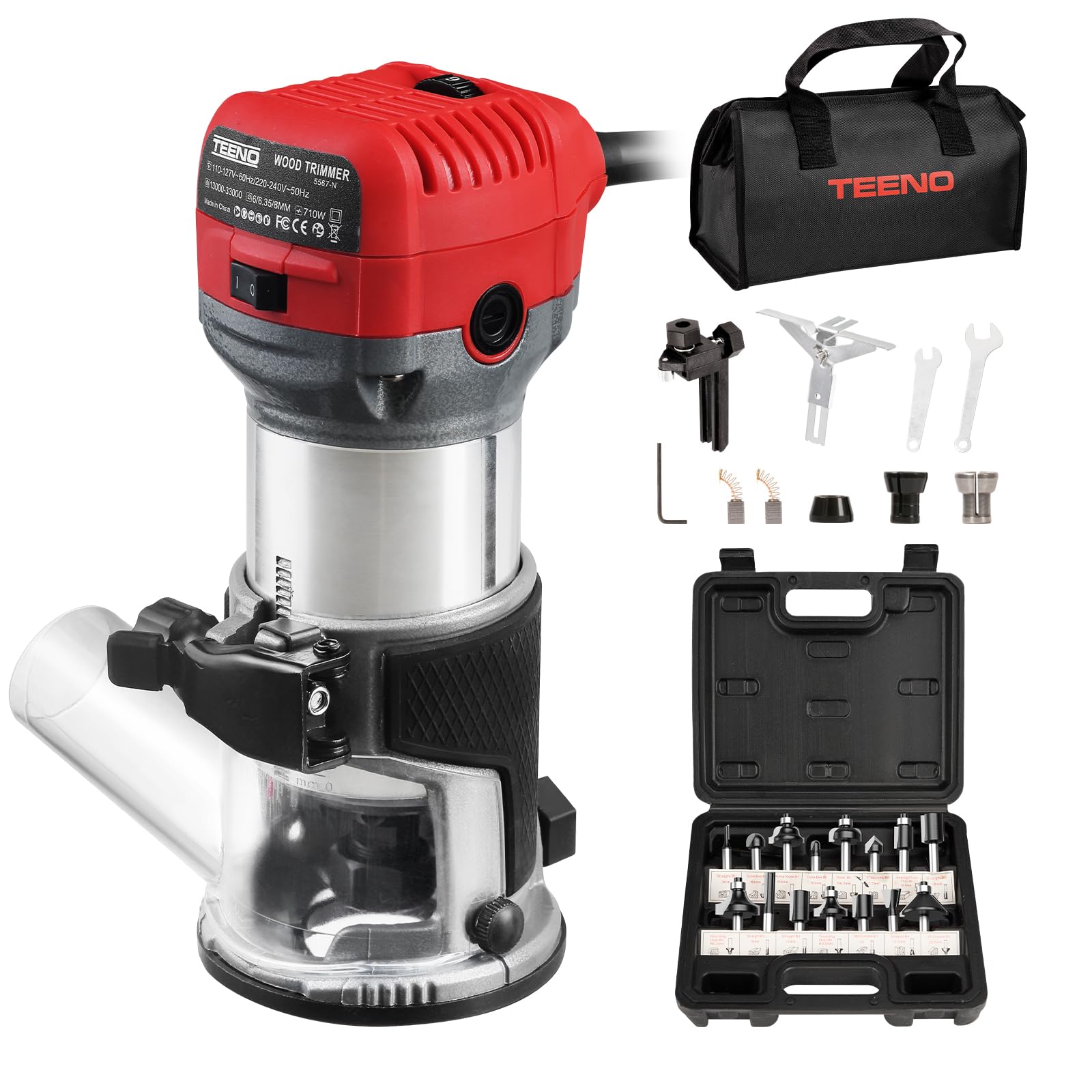
3. TEENO Wood Router, 6.5 Amp 1.25 HP Compact Router
A starter router that arrives with fifteen bits, two guides, and an aluminum body.
If you are buying your first router, the bit set matters as much as the motor. This one ships with 15 quarter-inch carbide cutters covering straight, V-groove, dovetail, and round profiles, plus a straight guide, a curved edge guide, two wrenches, and two spare carbon brushes. That is a working kit from the start, not a bare tool you have to finish shopping for. At 6.5 amps and 1.25 horsepower, the all-copper motor has enough muscle for grooves and edge profiles in hardwood.
Speed is adjustable across six steps from 13,000 to 33,000 RPM. That range matters because a low speed keeps a large bit from burning the wood, while the top end suits small trim passes. The soft start function ramps the motor up instead of kicking, which saves you from a jump on the first cut. The aluminum base is the sturdy part you want on a bench, and a canvas bag keeps the whole set together.
Here is the part the reviews make plain: this router performs, but it does not hold your hand. There are no useful instructions in the box, and the mixed marks on ease of use reflect that. A first-time user who watched a few videos got a clean threshold cut, so the tool can do the work — you just have to know what a router should do before you pick it up. Compared with the BOSCH below, it spins a little slower at the top end (33,000 RPM vs 35,000 RPM), but it comes with the bit set the Bosch does not.
First-run reality: A buyer doing a bedroom threshold cut reported it was easy to control and finished the job. The power is there; the guidance is not.
Suits you if: You want a complete routing kit in one order and you are comfortable learning a tool by trial.
The catch: No useful instructions and mixed reports on beginner friendliness mean you should plan on a tutorial before your first pass.
4. SKIL 6.5 AMP Electric 3-1/4 Inch Corded Planer – PL201201
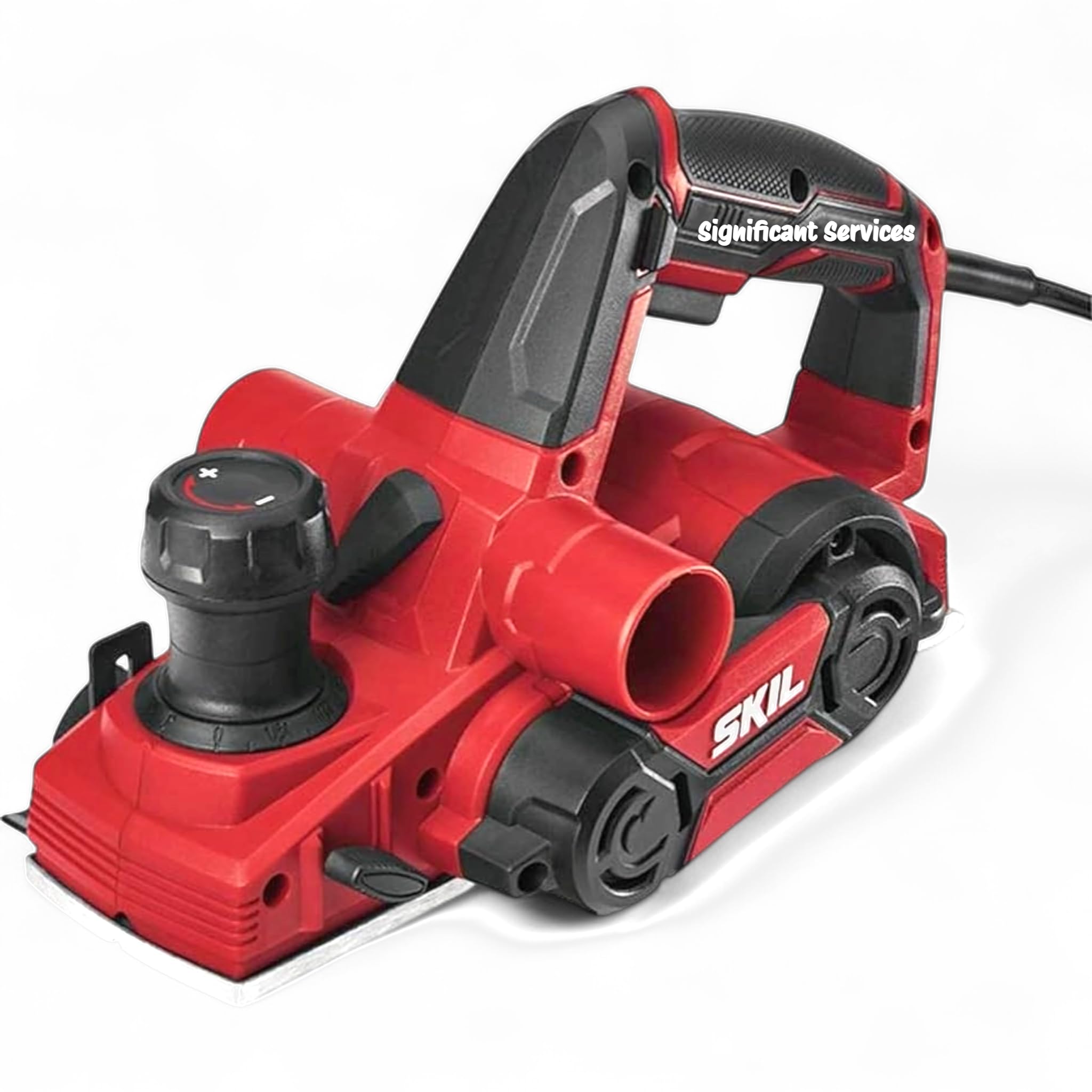
The tool that fixes a sticking door in ten minutes and flattens a rough board without a hand plane.
You can take a thin, even shaving off a face, which a saw cannot do. This one cuts a 3.25 inch wide swath at up to 2 millimeters of depth, so you can ease a swollen door edge down to fit, or smooth a cupped board that would have needed a hand plane and a lot of patience. That 6.5 amp motor carries it through the cut instead of stalling halfway. At 6 pounds it is light enough to run one-handed along a door edge.
The dual chip exhaust is the everyday win. Sawdust shoots out of two ports into a bag instead of piling up under the blade, and a clear line of sight is what keeps your cut straight. There is a smooth kickstand so the blade never scratches a finished surface when you set the tool down, and a lock-off switch so it will not start if the trigger gets bumped. A parallel guide and rebate fence come in the box for keeping the cut on track.
Surfaces come out smooth — the review pages compare the finish to a frozen lake, and the sharpness gets consistent praise. Two honest caveats sit in the details. The depth adjuster rides at the front of the tool, where a wandering hand can twist it mid-pass, so set it and check it. And the springy plastic blade guard is the part that draws the most grumbles for feeling flimsy. Neither stops the tool from doing its job; both reward a bit of care.
Why It Earns Its Bench Spot
- 3.25 inch cutting width covers a door edge in a couple of passes
- Dual chip exhaust keeps the surface visible while you work
- Lock-off switch stops an accidental start
- Kickstand protects finished faces when the tool is set down
Small Annoyances To Expect
- Front-mounted depth adjuster can get knocked during a pass
- The plastic blade guard feels less substantial than the rest of the tool
A strong fit for: Homeowners fixing doors and DIY builders who need to flatten a board without a hand plane.
Set it gently if: You tend to rush — the front depth dial needs a check before every pass.
5. CRAFTSMAN V20 CMCW400B Router

A cordless fixed-base router built for the CRAFTSMAN V20 owner who is tired of the cord snagging.
If you already have V20 batteries on the shelf, this router slots straight into the platform. The brushless motor is the reason it can run all day on a pack — a brushless design has no carbon brushes to wear, so it wastes less power as heat and stretches the runtime. A speed dial runs from 16,000 to 30,000 RPM, and the depth adjustment knob moves your bit height fast, with the precision owners praise most.
An LED light throws light on the cut line, and the included edge guide and dust port make it usable from the start. At 4.1 pounds it is heavier than the RYOBI above by a fair margin, but the extra mass and power show up in the cut. A 5/8 inch straight bit through 3/4 inch oak held its speed without bogging, the load test where most trim routers stall.
The catch is the battery. It is a bare tool, so the honest cost depends on what is already in your shop. Owners run it on a 4Ah pack or larger, and a pack that size is what keeps the runtime honest. What wins people over is the height adjustment — precise enough to sneak up on a fit and easy enough to repeat. For an occasional trim job, it beats dragging a cord.
What stands out: The depth knob gets called out for precision again and again, and the brushless motor keeps a hard cut moving. If you own V20 batteries, this is a strong add.
Pick this one if: You are already on the CRAFTSMAN V20 battery platform and want a cord-free trim router.
Look elsewhere if: You do not own a battery — this is a bare tool, and buying a pack changes the budget entirely.
6. BOSCH PR20EVS Colt 1.0 HP Variable-Speed Palm Router
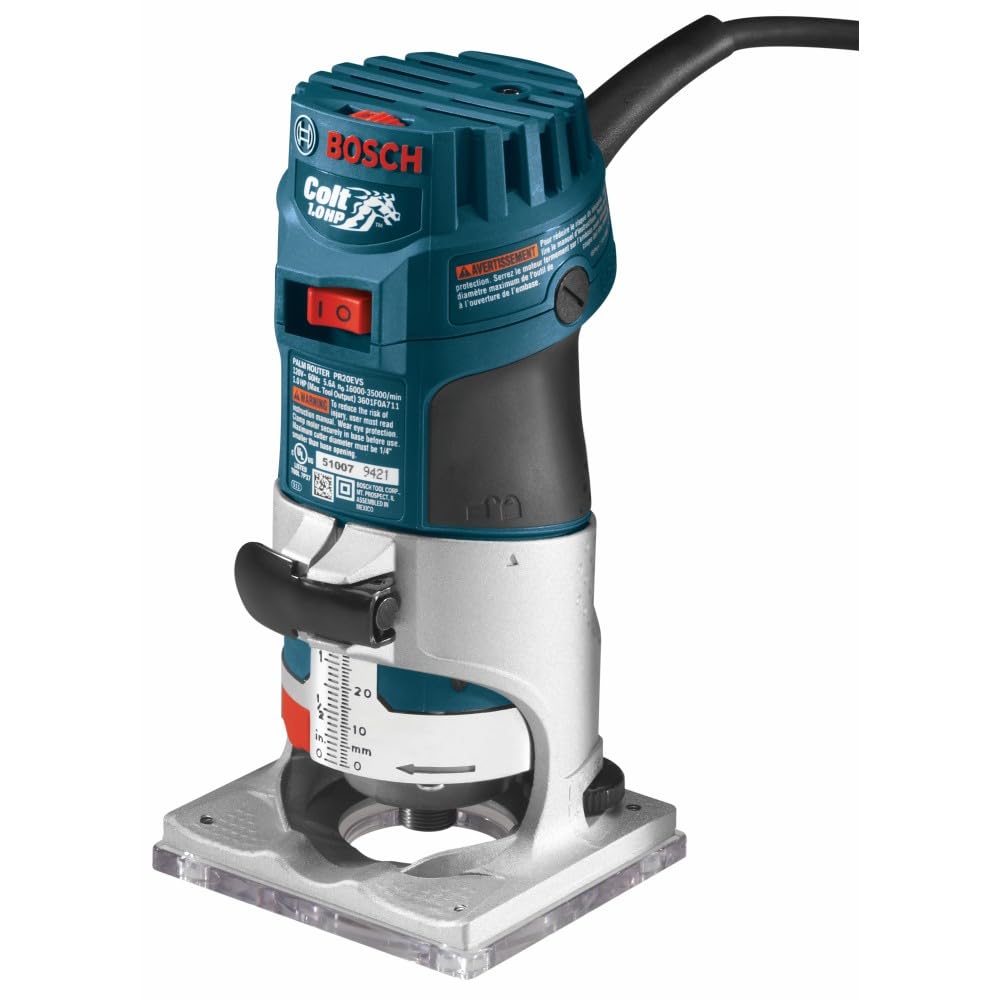
The palm router that most shops reach for first when an edge needs rounding.
Bosch got the palm router right, and the numbers show it. A 5.6 amp, 1.0 horsepower motor spins from 16,000 to 35,000 RPM, and that top end is higher than the TEENO above (35,000 vs 33,000 RPM). The quick-clamp system lets you pop the motor out of the base for a bit change and clamp it back without losing your setup. Angled finger support pockets give you a place to press when you are trimming an edge and want the base flat against it.
Weighing 3.3 pounds, it is light in the hand, and the fixed aluminum base stays solid and precise. The included straight edge guide runs the router along a board edge or up to 3-5/8 inches in, so you can cut a groove that stays parallel. The depth system offers both macro and micro adjustment — a big turn for roughing in, a fine turn for dialing the fit. Owners consistently call it smooth, quiet, and easy to handle, and setting it up with a plunge kit is a common path.
Two realistic gripes come through. The collet sits close to the body, so reaching the bit for a change takes a moment. Durability remarks skew negative on 32 counts, with a few reports of the motor giving out after some months. For the money, the vast majority still find it a workhorse. Give it breathing room on long sessions and it will repay you.
The verdict: It has the deepest spec sheet of any palm router on this list — fastest top speed, a two-stage depth adjust, and a quick-clamp base worth learning. Start here if you want a router for years of edge work.
Best matched to: Small-shop and DIY buyers who route edges and grooves often and want a tool that stays precise.
Worth a moment’s thought: A few reports of early motor failure mean you should not push long, hot cuts back-to-back.
7. Metabo HPT C10FCG2 Miter Saw
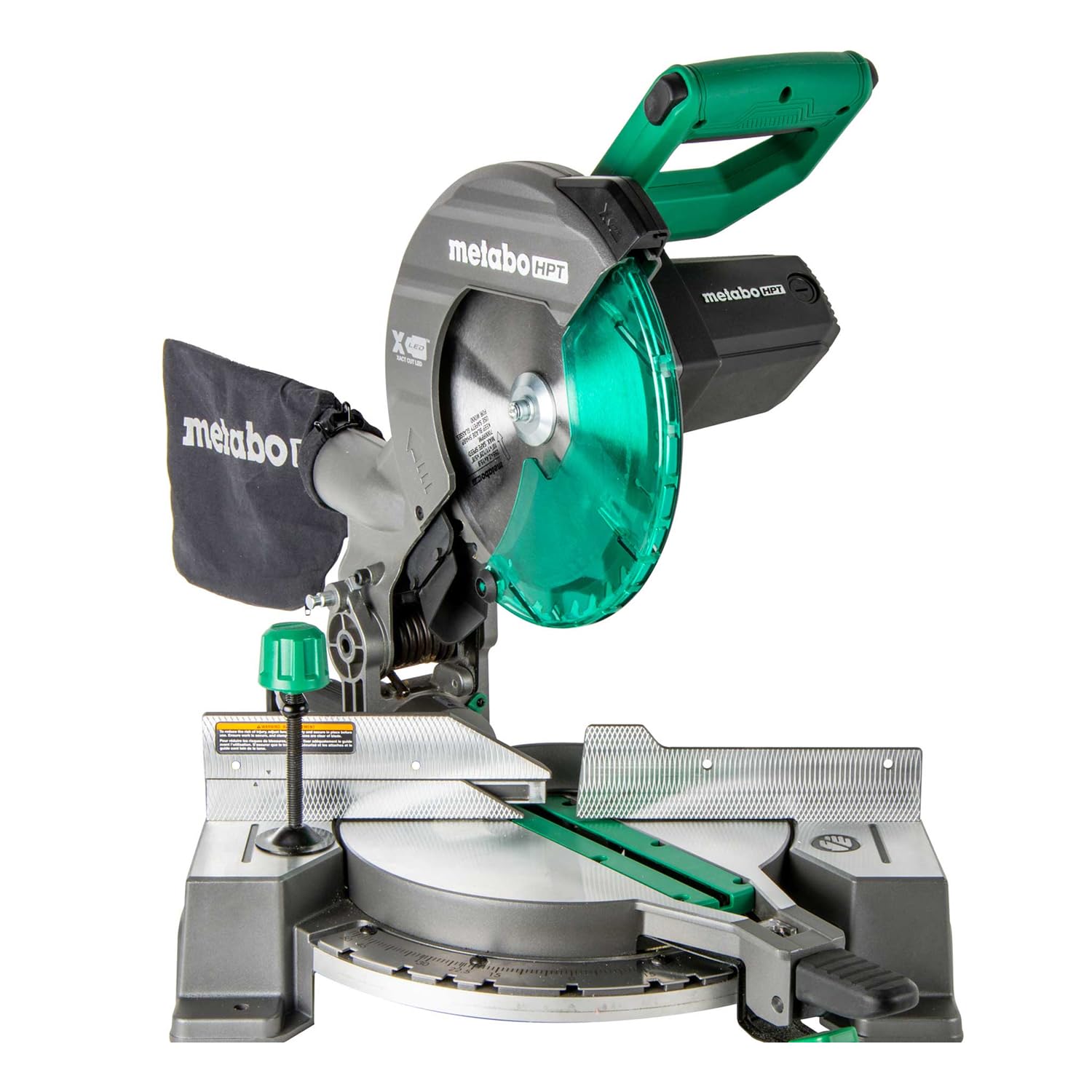
A 24-pound miter saw that swings through trim and lumber without a second pair of hands.
The headline is the motor. A 15 amp motor drives a 10 inch blade at up to 5,000 RPM no-load, which is enough to slice a 2×6 without bogging. The miter table swings 0 to 52 degrees left and right, and the bevel reaches 45 degrees left, so cutting a corner for baseboard is a matter of dialing the angle and pulling the handle. Adjustable bevel stops mean you can trust the common angles to land where they should. At 24.2 pounds, this is the kind of saw you can carry to a friend’s garage under one arm.
The large table is the quiet hero. It supports a longer piece so it does not tip while you cut, and the vice clamping system holds the workpiece in place so your left hand stays clear of the blade. A green body is your visual reminder that this is a jobsite tool, not a showroom piece, and the improved miter scale keeps the setup clear.
Owners talk about the cut quality first — across the listing, cuts through 2 inch lumber and 1-1/4 inch composite boards come out clean, and the saw arrives with a usable 24-tooth carbide blade. The honest gaps show up on the largest work: it is not made for production runs, and the fence is a touch short for a wide piece unless you clamp a jig to the table. For trim carpentry and occasional framing, that is a minor thing, and a 5-year warranty covers the rest.
Where This Saw Delivers
- 15 amp motor cuts 2 inch lumber and 1-1/4 inch composite cleanly
- 0–52° miter left and right plus 45° bevel covers trim corners
- 24.2 pounds carries under one arm to a job
- Large table and vice clamp keep the piece steady
Set Your Expectations Here
- The fence is short on a wide stock, so add a support jig
- It is not a production saw for cutting for hours straight
A confident buy for: Trim carpenters and DIYers cutting baseboard, crown, and framing on a bench or portable workmate.
Not the tool for: High-volume production cutting — bring a bigger saw for that.
8. 15Amp Portable Table Saw 10 inch
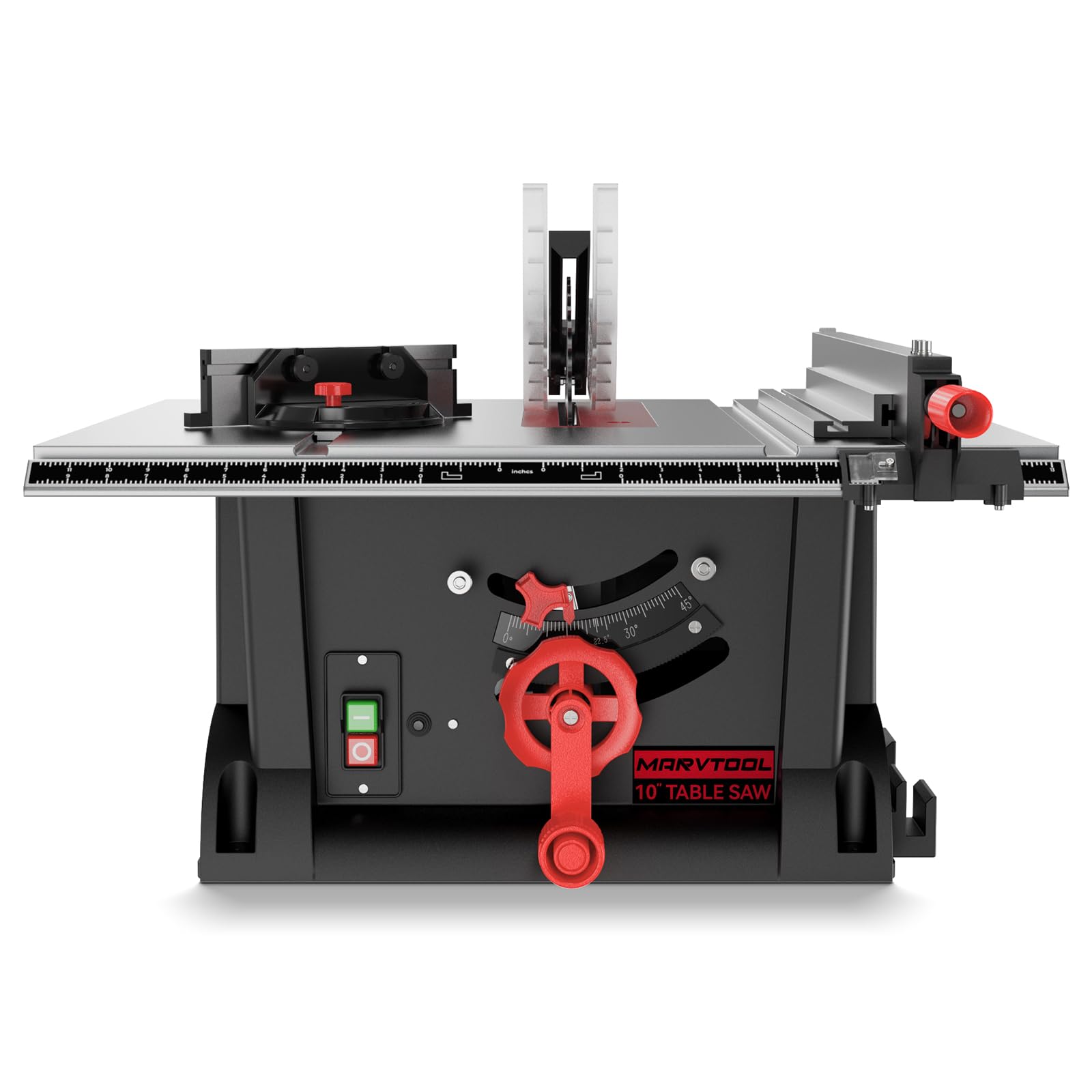
A 28-pound bench saw that rips hardwood cleanly right out of the carton.
You can fit this saw in a small shop or a crowded bench. At 28.3 pounds, it is lighter than the DEWALT at 54 pounds, so one person can lift it onto a bench. A 15 amp motor turns a 36-tooth 10 inch blade at around 4,600 RPM (revolutions per minute, how fast the blade spins). The blade cuts through stock up to 3.4 inches thick at 90 degrees and up to 2.1 inches thick at 45 degrees, and the height and angle both adjust so you can bevel a piece as well as rip it.
A transparent blade guard lets you watch the blade meet the wood while keeping fingers back, and a dust port takes a shop vac so the bench does not disappear under sawdust. Owners cutting Brazilian cherry hardwood report clean results with the included 36-tooth blade, and an upgraded blade makes it better, as it would on any saw. The sound level gets noted as quieter than many of the older saws in this class, and assembly is straightforward.
The trade-off to plan around is blade changes. There is no brake on the motor, so the blade coasts to a stop, and the blade-change process takes some patience. Neither is a fault of the cut, but know it before you buy. For a compact benchtop saw, it earns its place.
What owners get: Good, clean rips in hardwood right from the start, and a bench footprint that fits a small garage. The price-to-performance ratio is why owners keep recommending it.
Fits the bill for: Small-shop woodworkers who need a bench saw for rips and bevels and want it to fit in a tight space.
Good to know: No motor brake means the blade coasts, and swapping a blade takes patience — set aside time for the first change.
9. Mini Lathe Machine

A tiny lathe for pens, beads, and dollhouse parts, sized for a curious beginner.
This is a bench-top miniature lathe, not a full-size turning machine. A 96-watt motor with a 7-speed control turns small stock down for pens, rings, beads, and tiny furniture, and the multi-purpose chuck makes it easy to fix a piece in place. It weighs 5.65 pounds, so it lives on a shelf between projects, and it handles turning, cutting, grinding, and polishing with the included tools.
The full accessory kit is the point. You get carbide-tipped cutters hardened for long wear, a selection of sanding and grinding tools, and video tutorials to get started. The instruction sheet alone is thin, so the video guidance counts. It is sized for small work, and the listing describes it as a good fit for beginners and families starting out in woodworking.
Be clear about size before you order. One buyer found the machine’s 11 inch claim closer to 11 centimeters, and the size notes on the listing point the same way — this is a miniature lathe for miniature pieces. It will not turn a table leg. If your project is a pen blank or a dollhouse chair, it does the job; if you want to spin a bowl, this is the wrong class of tool.
What It Brings
- 96W motor with 7 speeds for small turning, grinding, and polishing
- Ships with cutters, sanding tools, and video guidance
- Compact 5.65 pound body fits a shelf
Know Before You Order
- It is a miniature lathe — 11 inch numbers read closer to 11 cm in practice
- Reports of stripped threads and a finicky power cable mean check it on arrival
Right for: A beginner or kid making pens, rings, and tiny models who wants a cheap way to try turning.
Wrong for: Anyone planning full-size bowls or legs — the miniature scale is the whole point, and the limit.
Know the Specs
Amperage and Horsepower
Amps tell you how much current a corded motor pulls, and horsepower tells you the shaft power it delivers. A 6.5 amp router is built for edge work and grooves. A 15 amp table saw pushes a 10 inch blade through sheet goods. Buy the smallest motor that does your hardest cut, because a bigger motor adds weight without helping a light task.
RPM and Variable Speed
RPM is how fast the spindle turns. A router spinning at 13,000 to 33,000 RPM can be dialed down for a large bit that would burn at full speed, and wound up for a small trim pass. A fixed-speed tool locks you into one rate, so you cannot adapt to material. Look for a variable speed dial if you plan to work in more than one material.
Blade Size and Cutting Width
Blade size sets the depth a saw can reach. A 10 inch table saw blade takes a thicker board than an 8-1/4 inch blade, but a bigger blade needs more room and a bigger bench. Cutting width matters just as much on a planer: a 3.25 inch width covers a door edge in a couple of passes.
Rip Capacity and Fence
Rip capacity is the widest board you can cut with the fence on the tool, measured from the blade. A 24.5 inch capacity means you can break down a full 4×8 sheet. A saw with less forces you to rough-cut first. A geared fence that locks square is worth as much as the capacity, because a wandering fence wastes every board.
Common Questions
Do I actually need both a router and a table saw?
Is a cordless router strong enough for hardwood?
What rip capacity do I need to cut plywood sheets?
Can a 10 inch miter saw cut a 2×6 board?
How often do I need to change router bits?
Do router bits from one brand fit another brand’s router?
Is a planer worth it for a home shop?
What is the difference between a fixed base and a plunge base router?
Can I use these tools in a small garage without a dedicated shop?
Do I need to buy a battery separately for cordless tools?
The Bottom Line
For most woodworkers, the power tools for woodworking winner is the DEWALT DWE7485 Table Saw because 24.5 inches of rip capacity lets you break down full plywood sheets and its rack and pinion fence stays square under load. If your work lives on edges and profiles, grab the BOSCH PR20EVS Colt Router — it tops the palm-router specs at 35,000 RPM and gives you two-stage depth control. And for trim and framing cuts on the bench, the Metabo HPT C10FCG2 Miter Saw is the one to reach for.
One honest note as you buy: the table saw carries the higher score at 4.5+ stars, but the planer has more ratings in play — both hold strong averages with owners. Buy for the cut you make most, budget a battery if the tool is bare, and trust the spec sheet over the badge on the motor.
How we choose
We do not accept paid placement. Every pick is matched to a real buyer and a real use-case; we do not hands-on test units.
Sources
Specifications: manufacturer listings and product documentation. Review insights: verified customer reviews, as of November 2026. Pricing: not shown on this page (it changes often); check the current price via the retailer link.
As an Amazon Associate, Tactical Gear Guy earns from qualifying purchases. This does not affect which products we feature.